R E S E A R C H
Open Access
Developing CRS iterative methods for
periodic Sylvester matrix equation
Linjie Chen
1and Changfeng Ma
1**Correspondence:
1College of Mathematics and
Informatics, Fujian Normal University, Fuzhou, P.R. China
Abstract
In this paper, by applying Kronecker product and vectorization operator, we extend two mathematical equivalent forms of the conjugate residual squared (CRS) method to solve the periodic Sylvester matrix equation
AjXjBj+CjXj+1Dj=Ej forj= 1, 2,. . .,
λ
.We give some numerical examples to compare the accuracy and efficiency of the matrix CRS iterative methods with other methods in the literature. Numerical results validate that the proposed methods are superior to some existing methods and that equivalent mathematical methods can show different numerical performance.
Keywords: Conjugate residual squared; Iterative method; Periodic Sylvester matrix equation; Kronecker product; Vectorization operator
1 Introduction
We consider the iterative solution of the periodic Sylvester matrix equation
AjXjBj+CjXj+1Dj=Ej forj= 1, 2, . . . , (1.1)
where the coefficient matricesAj,Bj,Cj,Dj,Ej∈Rm×m and the solutionsXj∈Rm×m are
periodic with periodλ, that is,Aj+λ=Aj,Bj+λ=Bj,Cj+λ=Cj,Dj+λ=Dj,Ej+λ=Ej, andXj+λ=
Xj. The periodic Sylvester matrix equation (1.1) attracts considerable attention because it
comes from a variety of fields of control theory and applied mathematics [1–12]. In recent years, many efficient iterative methods have been proposed to solve the pe-riodic Sylvester matrix equation (1.1). For example, Hajarian [13,14] developed the con-jugate gradient squared (CGS), biconcon-jugate gradient stabilized (BiCGSTAB) and bicon-jugate residual methods for solving the periodic Sylvester matrix equation (1.1). Lv and Zhang [15] proposed a new kind of iterative algorithm for constructing the least square solution for the periodic Sylvester matrix equation. Hajarian [16] studied the biconjugate
A-orthogonal residual and conjugateA-orthogonal residual squared (CORS) methods for solving coupled periodic Sylvester matrix equation, and so forth; see [17–28] and the ref-erences therein.
As we know, by applying Kronecker product and vectorization operator, some iterative algorithms for solving linear systemAx=bcan be extended to solve linear matrix
tions. Recently, Sogabe et al. [29] proposed a conjugate residual squared (CRS) method for solving linear systemsAx=bwith nonsymmetric coefficient matrix. Independently, Zhang et al. [30] presented another form of CRS method. It can be proved that these CRS methods are mathematically equivalent. Chen and Ma [31] used the matrix CRS iterative method to solve a class of coupled Sylvester-transpose matrix equations. In this work, we obtain a matrix form of the CRS methods for solving the periodic Sylvester matrix equa-tion (1.1).
The rest of this paper is organized as follows. In Sect.2, we extend the CRS methods to solve the periodic Sylvester matrix equation (1.1). We give some numerical examples and comparison results in Sect.3. In Sect.4, we draw a brief conclusion.
Throughout this paper, we use the following notations. The set of all realm-vectors and the set of allm×nreal matrices are denoted by Rmand Rm×n, respectively. The usual inner
product in Rmis denoted by (u,v) foru,v∈Rm. For a matrixA∈Rm×n, we denote its trace
and transpose bytr(A) andAT, respectively. The inner product ofA∈Rm×nandB∈Rm×n is defined byA,B=tr(BTA). Then the norm of a matrix generated by this inner product
is the matrix Frobenius norm · . For a matrix A∈Rm×n, the vectorization operator
is defined asvec(A) = (aT1 aT2 · · · aTn)T, whereaiis theith column ofA. The Kronecker
product of matricesA= [aij]∈Rm×nandB∈Rp×qis defined asA⊗B= [aijB]∈Rmp×nq.
For matricesA,B, andXof appropriate dimensions, we have the following well-known property related to the Kronecker product and vectorization operator:
vec(AXB) =BT⊗Avec(X).
2 Matrix forms of the CRS iterative methods
In this section, we first briefly recall the CRS iterative methods for solving a large sparse nonsymmetric linear systemAx=b, whereA∈RN×N andx,b∈RN. As described in the introduction, the CRS iterative methods are presented in [29] and [30], which are summa-rized as the following Algorithms2.1and2.2, respectively. For more detail about the CRS methods, see [32–34].
Algorithm 2.1(The first form of CRS method (CRS1) [29])
1. x0is an initial guess;r0=b–Ax0; chooser∗0(for example,r0∗=r0).
2. Sete0=r0,d0=Ae0,β–1= 0. Lett=ATr∗0.
3. Forn= 0, 1, . . ., until convergenceDo:
sn=dn+βn–1(fn–1+βn–1sn–1);
αn= (t,rn)/(t,sn);
hn=en–αnsn;
fn=dn–αnAsn;
xn+1=xn+αn(en+hn);
rn+1=rn–αn(dn+fn);
βn= (t,rn+1)/(t,rn);
dn+1=Arn+1+βnfn;
4. EndDo.
Algorithm 2.2(The second form of CRS method (CRS2) [30])
1. Computer0=b–Ax0; chooser∗0such that(Ar0,r0∗)= 0(for example,r0∗=r0).
Then we can verify that CRS1 and CRS2 are mathematically equivalent. The CRS methods were proposed mainly to avoid using the transpose ofAin the BiCR algorithm and gain a faster convergence for roughly the same computational costs [30]. Indeed, in many cases, the CRS methods converge twice as fast as the BiCR method [33,35]. On the other hand, the BiCR method can be derived from the preconditioned conjugate residual (CR) method [36]. Furthermore, the CR and conjugate gradient (CG) methods exhibit typically similar convergence [37]. In exact arithmetic, they terminate after a finite number of iterations. In conclusion, we can expect that the CRS methods also terminate after a finite number of iterations in exact arithmetic.
In the following, we want to use the CRS algorithms to solve the periodic Sylvester ma-trix equations (1.1). For this purpose, we can easily show that the periodic Sylvester matrix equation (1.1) is equivalent to the following generalized Sylvester matrix equation [13]:
C=diag[C1,C2, . . . ,Cλ], D=diag[D1,D2, . . . ,Dλ],
E=diag[E1,E2, . . . ,Eλ], X=diag[X2,X3, . . . ,Xλ,X1].
Then we need to transform the generalized Sylvester matrix equations (2.1) into a linear systemAx=b. We should mention that the following derivation borrows much of that used in [13].
By applying the Kronecker product and vectorization operator we can change the gen-eralized Sylvester matrix equations (2.1) into the following linear system of equations:
BT⊗A+ DT⊗Cvec(X) =vec(E). (2.2)
Denote
A:= BT⊗A+ DT⊗C, x:=vec(X), b:=vec(E).
Then (2.2) can be written as
Ax=b,
whereA∈Rλ2m2×λ2m2andx,b∈Rλ2m2. Then we are in position to present the matrix forms
of Algorithms2.1and2.2for solving the generalized Sylvester matrix equation (2.1), and we just discuss Algorithm2.1in detail since the discussion of Algorithm2.2is similar.
From Algorithm2.1and the linear system of equation (2.2) we have
r0=b–Ax0→r0=vec(E) –BT⊗A+ DT⊗Cx0, (2.3)
d0=Ae0→d0=BT⊗A+ DT⊗Ce0, (2.4)
t=ATr∗0→t=B⊗AT+ D⊗CTr∗0, (2.5)
Asn→
BT⊗A+ DT⊗Csn, (2.6)
Arn+1→
BT⊗A+ DT⊗Crn+1. (2.7)
According to (2.3)–(2.7), we define
xn=vec
X(n), rn=vec
R(n), sn=vec
S(n), (2.8)
hn=vec
H(n), fn=vec
F(n), en=vec
E(n), (2.9)
dn=vec
D(n), r0∗=vecR∗(0), t=vec(T), (2.10)
where X(n), R(n), S(n), H(n), F(n), E(n), D(n), R∗(0), T∈Rλm×λm forn= 0, 1, 2, . . . . Substi-tuting (2.8)–(2.10) into (2.3)–(2.7), we get
vecR(0)=vec(E) –BT⊗A+ DT⊗CvecX(0),
vecD(0)=BT⊗A+ DT⊗CvecE(0),
Asn=
In addition, for the parametersαnandβn, we have
αn=
From this discussion it follows that the matrix form of CRS1 method for solving the gen-eralized Sylvester matrix equation (2.1) can be constructed as the following Algorithm2.3. Analogously, the matrix form of CRS1 method for solving the generalized Sylvester matrix equation (2.1) is summarized as Algorithm2.4.
Algorithm 2.3(Matrix CRS1 method for solving (2.1))
1. ComputeR(0) = E – AX(0)B – CX(0)Dfor an initial guessX(0)∈Rλm×λm. Set
Algorithm 2.4(Matrix CRS2 method for solving (2.1))
1. ComputeR(0) = E – AX(0)B – CX(0)Dfor an initial guessX(0)∈Rλm×λm. Set
R∗(0) = P(0) = U(0) = R(0).
2. SetT= ATR∗(0)BT+ CTR∗(0)DT.
3. Forn= 0, 1, . . ., until convergenceDo:
αn=
From Algorithms2.3and2.4by using the equivalent relationships of periodic Sylvester matrix equation (1.1) and generalized Sylvester matrix equation (2.1) we can derive the CRS methods for solving periodic Sylvester matrix equation (1.1) as Algorithms2.5and
2.6, respectively.
Algorithm 2.5(Matrix CRS1 method for solving (1.1))
Algorithm 2.6(Matrix CRS2 method for solving (1.1))
Based on the earlier discussion, we know that Algorithms2.5and2.6are just the ma-trix forms of the original CRS method. Hence, generally speaking, Algorithms2.5and
2.6have the same properties as Algorithms2.1and2.2. For instance, in exact arithmetic, Algorithms2.5and2.6will also terminate after a finite number of iterations.
3 Numerical experiments
In this section, we present two numerical examples to show the accuracy and efficiency of the proposed methods. We compare the performances of CRS methods to those of the CGS, BiCGSTAB [13], and CORS [16] methods.
In our experiments, all runs are started from the zero initial guess and implemented in MATLAB(R2014b) with a machine precision 10–16on a personal computer with Intel(R)
Core(TM) i7-6500U CPU 2.50 GHz 2.60 GHz, 16.0 GB memory.
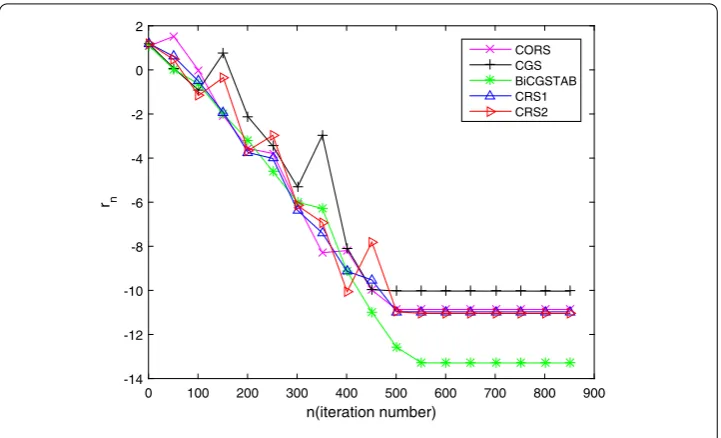
Example3.1 ([13]) Consider the periodic Sylvester matrix equation
Figure 1The residual for Example3.1
with parameters
C1=trilrand(m,m), 1+diag2 +diagrand(m),
D1=triurand(m,m), 1+diag1.75 +diagrand(m),
C2=triurand(m,m), 1+diag1.75 +diagrand(m),
D2=trilrand(m,m), 1+diag2 +diagrand(m),
E1=E2=rand(m,m).
In this example, we setm= 20. The numerical results are shown in Fig.1, where
rn=log10
E1–X1(n) –C1X2(n)D12+E2–X2(n) –C2X1(n)D22.
From Fig.1we find that the CRS1 and CRS2 methods are superior to the CGS and CORS methods, and the BiCGSTAB method is the best among them for Example3.1. In addition, the residual history of the CRS1 method seems smoother than that of the CRS2 method.
Example3.2 ([16]) Consider the periodic Sylvester matrix equations
Xj+CjXj+1Dj=Ej, forj= 1, 2
with parameters
C1= –triurand(m,m), 1+diag1.75 +diagrand(m),
D1=tril
rand(m,m), 1+diag1.25 +diagrand(m),
Figure 2The residual for Example3.2
D2=trilrand(m,m), 1+diag2 +diagrand(m),
E1=E2=rand(m,m).
In this example, letm= 40. The numerical results are shown in Fig.2, where
rn=log10
E1–X1(n) –C1X2(n)D12+E2–X2(n) –C2X1(n)D22.
From Fig.2, for Example3.2, we see that the CRS2 method is the best one among the five methods mentioned. The BiCGSTAB method can achieve higher accuracy than the CGS, CORS, and CRS1 methods.
4 Conclusions
In this paper, we present two matrix forms of the CRS iterative method for solving the pe-riodic Sylvester matrix equation (1.1). Numerical examples and comparison with the CGS, BiCGSTAB, and CORS methods have illustrated that the CRS methods can work quite well in some situations. In addition, numerical results show that the CRS1 and CRS2 methods show different numerical performance, though they are mathematically equivalent.
Acknowledgements
The authors deeply thank the anonymous referees for helping to improve the original manuscript by valuable suggestions.
Funding
This work is supported by National Key Research and Development Program of China (No. 2018YFC0603500) and National Science Foundation of China (Nos. 41725017, 41590864).
Competing interests
The authors declare that they have no competing interests.
Authors’ contributions
Publisher’s Note
Springer Nature remains neutral with regard to jurisdictional claims in published maps and institutional affiliations.
Received: 9 April 2018 Accepted: 21 February 2019
References
1. Varga, A.: Periodic Lyapunov equations: some applications and new algorithms. Int. J. Control67, 69–88 (1997) 2. Chu, E.K.W., Fan, H.-Y., Lin, W.-W.: Projected generalized discrete-time periodic Lyapunov equations and balanced
realization of periodic descriptor systems. SIAM J. Matrix Anal. Appl.29, 982–1006 (2017)
3. Liu, C., Peng, Y.J.: Stability of periodic steady-state solutions to a non-isentropic Euler–Maxwell system. Z. Angew. Math. Phys.68, 105 (2017)
4. Zheng, X.X., Shang, Y.D., Peng, X.M.: Orbital stability of periodic traveling wave solutions to the generalized Zakharov equations. Acta Math. Sci.37B, 1–21 (2017)
5. Zheng, X.X., Shang, Y.D., Di, H.F.: The time-periodic solutions to the modified Zakharov equations with a quantum correction. Mediterr. J. Math.14, 152 (2017)
6. Tian, H.H., Han, M.A.: Bifurcation of periodic orbits by perturbing high-dimensional piecewise smooth integrable systems. J. Differ. Equ.263(11), 7448–7474 (2017)
7. Liu, B.M., Liu, L.S., Wu, Y.H.: Existence of nontrivial periodic solutions for a nonlinear second order periodic boundary value problem. Nonlinear Anal.72(7–8), 3337–3345 (2010)
8. Hao, X.N., Liu, L.S., Wu, Y.H.: Existence and multiplicity results for nonlinear periodic boundary value problems. Nonlinear Anal.72(9–10), 3635–3642 (2010)
9. Liu, A.J., Chen, G.L.: On the Hermitian positive definite solutions of nonlinear matrix equationXs+m
i=1A∗iX–tiAi=Q. Appl. Math. Comput.243, 950–959 (2014)
10. Liu, A.J., Chen, G.L., Zhang, X.Y.: A new method for the bisymmetric minimum norm solution of the consistent matrix equationsA1XB1=C1,A2XB2=C2. J. Appl. Math.2013, Article ID 125687 (2013)
11. Stykel, T.: Low-rank iterative methods for projected generalized Lyapunov equations. Electron. Trans. Numer. Anal.30, 187–202 (2008)
12. Bittanti, S., Colaneri, P.: Periodic Systems: Filtering and Control. Springer, London (2009)
13. Hajarian, M.: Matrix iterative methods for solving the Sylvester-transpose and periodic Sylvester matrix equations. J. Franklin Inst.350, 3328–3341 (2013)
14. Hajarian, M.: Matrix form of biconjugate residual algorithm to solve the discrete-time periodic Sylvester matrix equations. Asian J. Control20, 49–56 (2018)
15. Lv, L.-L., Zhang, Z., Zhang, L., Wang, W.-S.: An iterative algorithm for periodic Sylvester matrix equations. J. Ind. Manag. Optim.14, 413–425 (2018)
16. Hajarian, M.: Developing BiCOR and CORS methods for coupled Sylvester-transpose and periodic Sylvester matrix equations. Appl. Math. Model.39, 6073–6084 (2015)
17. Kressner, D.: Large periodic Lyapunov equations: algorithms and applications. In: Proc. ECC03, Cambridge, UK, pp. 951–956 (2003)
18. Hajarian, M.: Solving the general Sylvester discrete-time periodic matrix equations via the gradient based iterative method. Appl. Math. Lett.52, 87–95 (2016)
19. Hajarian, M.: Gradient based iterative algorithm to solve general coupled discrete-time periodic matrix equations over generalized reflexive matrices. Math. Model. Anal.21, 533–549 (2016)
20. Hajarian, M.: A finite iterative method for solving the general coupled discrete-time periodic matrix equations. Circuits Syst. Signal Process.34, 105–125 (2015)
21. Hajarian, M.: Developing CGNE algorithm for the periodic discrete-time generalized coupled Sylvester matrix equations. Comput. Appl. Math.34, 755–771 (2015)
22. Hajarian, M.: Convergence analysis of the MCGNR algorithm for the least squares solution group of discrete-time periodic coupled matrix equations. Trans. Inst. Meas. Control39, 29–42 (2017)
23. Cai, G.-B., Hu, C.-H.: Solving periodic Lyapunov matrix equations via finite steps iteration. IET Control Theory Appl.6, 2111–2119 (2012)
24. Lv, L., Zhang, Z., Zhang, L.: A periodic observers synthesis approach for LDP systems based on iteration. IEEE Access6, 8539–8546 (2018)
25. Lv, L., Zhang, Z.: Finite iterative solutions to periodic Sylvester matrix equations. J. Franklin Inst.354(5), 2358–2370 (2017)
26. Lv, L., Zhang, Z., Zhang, L.: A parametric poles assignment algorithm for second-order linear periodic systems. J. Franklin Inst.354, 8057–8071 (2017)
27. Lv, L., Zhang, L.: Robust stabilization based on periodic observers for LDP systems. J. Comput. Anal. Appl.20, 487–498 (2016)
28. Lv, L., Zhang, L.: On the periodic Sylvester equations and their applications in periodic Luenberger observers design. J. Franklin Inst.353, 1005–1018 (2016)
29. Sogabe, T., Fujino, S., Zhang, S.-L.: A product-type Krylov subspace method based on conjugate residual method for nonsymmetric coefficient matrices. Trans. IPSJ48, 11–21 (2007)
30. Zhang, L.-T., Zuo, X.-Y., Gu, T.-X., Huang, T.-Z., Yue, J.-H.: Conjugate residual squared method and its improvement for non-symmetric linear systems. Int. J. Comput. Math.87, 1578–1590 (2010)
31. Chen, C.-R., Ma, C.-F.: A matrix CRS iterative method for solving a class of coupled Sylvester-transpose matrix equations. Comput. Math. Appl.74, 1223–1231 (2017)
32. Zhang, L.-T., Huang, T.-Z., Gu, T.-X., Zuo, X.-Y.: An improved conjugate residual squared algorithm suitable for distributed parallel computing. Microelectron. Comput.25, 12–14 (2008) (in Chinese)
33. Zhao, J., Zhang, J.-H.: A smoothed conjugate residual squared algorithm for solving nonsymmetric linear systems. In: 2009 Second International Conference on Information and Computing Science, ICIC, vol. 3, pp. 364–367 (2009) 34. Zuo, X.-Y., Zhang, L.-T., Gu, T.-X.: An improved generalized conjugate residual squared algorithm suitable for
35. Sogabe, T., Zhang, S.-L.: Extended conjugate residual methods for solving nonsymmetric linear systems. Numerical Linear Algebra and Optimization 88–99 (2003)
36. Sogabe, T., Sugihara, M., Zhang, S.-L.: An extension of the conjugate residual method to nonsymmetric linear systems. J. Comput. Appl. Math.226, 103–113 (2009)