Parameter Estimation of a Plucked String Synthesis
Model Using a Genetic Algorithm with Perceptual
Fitness Calculation
Janne Riionheimo
Laboratory of Acoustics and Audio Signal Processing, Helsinki University of Technology, P.O. Box 3000, FIN-02015 HUT, Espoo, Finland
Email:[email protected]
Vesa V ¨alim ¨aki
Laboratory of Acoustics and Audio Signal Processing, Helsinki University of Technology, P.O. Box 3000, FIN-02015 HUT, Espoo, Finland
Pori School of Technology and Economics, Tampere University of Technology, P.O. Box 300, FIN-28101, Pori, Finland
Email:[email protected]
Received 30 June 2002 and in revised form 2 December 2002
We describe a technique for estimating control parameters for a plucked string synthesis model using a genetic algorithm. The model has been intensively used for sound synthesis of various string instruments but the fine tuning of the parameters has been carried out with a semiautomatic method that requires some hand adjustment with human listening. An automated method for extracting the parameters from recorded tones is described in this paper. The calculation of the fitness function utilizes knowledge of the properties of human hearing.
Keywords and phrases:sound synthesis, physical modeling synthesis, plucked string synthesis, parameter estimation, genetic algorithm.
1. INTRODUCTION
Model-based sound synthesis is a powerful tool for creating natural sounding tones by simulating the sound production mechanisms and physical behavior of real musical instru-ments. These mechanisms are often too complex to simulate in every detail, so simplified models are used for synthesis. The aim is to generate a perceptually indistinguishable model for real instruments.
One workable method for physical modelling synthesis is based on digital waveguide theory proposed by Smith [1]. In the case of the plucked string instruments, the method can be extended to model also the plucking style and instrument body [2,3]. A synthesis model of this kind can be applied to synthesize various plucked string instruments by changing the control parameters and using different body and pluck-ing models [4,5]. A characteristic feature in string instru-ment tones is the double decay and beating effect [6], which can be implemented by using two slightly mistuned string models in parallel to simulate the two polarizations of the transversal vibratory motion of a real string [7].
Parameter estimation is an important and difficult chal-lenge in sound synthesis. Usually, the natural parameter set-tings are in great demand at the initial state of the synthesis. When using these parameters with a model, we are able to produce real-sounding instrument tones. Various methods for adjusting the parameters to produce the desired sounds have been proposed in the literature [4, 8, 9,10,11,12]. An automated parameter calibration method for a plucked string synthesis model has been proposed in [4,8], and then improved in [9]. It gives the estimates for the fundamental frequency, the decay parameters, and the excitation signal which is used in commuted synthesis.
viewpoint of auditory perception would be to carry out lis-tening tests with trained participants and rank the candidate solutions according to the data obtained from the tests [13]. This method is extremely time consuming and, therefore, we are forced to use analytical methods to calculate the quality of the solutions. Various techniques to simulate human hearing and calculate perceptual quality exist. Perceptual linear pre-dictive (PLP) technique is widely used with speech signals [14], and frequency-warped digital signal processing is used to implement perceptually relevant audio applications [15].
In this work, we use an error function that simulates the human hearing and calculates the perceptual error be-tween the tones. Frequency masking behavior, frequency de-pendence, and other limitations of human hearing are taken into account. From the optimization point of view, the task is to find the global minimum of the error function. The variables of the function, that is, the parameters of the syn-thesis model, span the parameter space where each point corresponds to a set of parameters and thus to a synthe-sized sound. When dealing with discrete parameter values, the number of parameter sets is finite and given by the prod-uct of the number of possible values of each parameter. Us-ing nine control parameters with 100 possible values, a total of 1018combinations exist in the space and, therefore, an
ex-haustive search is obviously impossible.
Evolutionary algorithms have shown a good performance in optimizing problems relating to the parameter estimation of synthesis models. Vuori and V¨alim¨aki [16] tried a simu-lated evolution algorithm for the flute model, and Horner et al. [17] proposed an automated system for parameter estima-tion of FM synthesizer using a genetic algorithm (GA). GAs have been used for automatically designing sound synthesis algorithms in [18,19]. In this study, a GA is used to optimize the perceptual error function.
This paper is sectioned as follows. The plucked string synthesis model and the control parameters to be estimated are described in Section 2. Parameter estimation problem and methods for solving it are discussed in Section 3.
Section 4concentrates on the calculation of the perceptual error. In Section 5, we discretize the parameter space in a perceptually reasonable manner. Implementation of the GA and different schemes for selection, mutation, and crossover used in our work are surveyed inSection 6. Experiments and results are analyzed inSection 7and conclusions are finally drawn inSection 8.
2. PLUCKED STRING SYNTHESIS MODEL
The model proposed by Karjalainen et al. [7] is used for plucked string synthesis in this study. The block diagram of the model is presented inFigure 1. It is based on digital waveguide synthesis theory [1] that is extended in accordance with commuted waveguide synthesis approach [2,3] to in-clude also the body modes of the instrument in the string synthesis model.
Different plucking styles and body responses are stored as wavetables in the memory and used to excite the two string
Excitation
Figure1: The plucked string synthesis model.
x(n)
F(z) H(z) z−LI
y(n)
Figure2: The basic string model.
models Sh(z) and Sv(z) that simulate the effect of the two polarizations of the transversal vibratory motion. A single string modelS(z) inFigure 2consists of a lowpass filterH(z) that controls the decay rate of the harmonics, a delay line
z−LI, and a fractional delay filterF(z). The delay time around
the loop for a given fundamental frequency f0is
Ld= fs
f0, (1)
where fsis the sampling rate (in Hz). The loop delayLd is implemented by the delay line z−LI and the fractional
de-lay filter F(z). The delay line is used to control the integer partLIof the string length while the coefficients of the filter F(z) are adjusted to produce the fractional partLf [20]. The fractional delay filterF(z) is implemented as a first-order all-pass filter. Two string models are typically slightly mistuned to produce a natural sounding beating effect.
A one-pole filter with transfer function
H(z)=g 1 +a
1 +az−1 (2)
is used as a loop filter in the model. Parameter 0< g <1 in (2) determines the overall decay rate of the sound while pa-rameter−1< a <0 controls the frequency-dependent decay. The excitation signal is scaled by the mixing coefficientsmp and (1−mp) before sending it to two string models. Co-efficientgc enables coupling between the two polarizations. Mixing coefficientmodefines the proportion of the two po-larizations in the output sound. All parametersmp,gc, and moare chosen to have values between 0 and 1. The transfer function of the entire model is written as
Table1: Control parameters of the synthesis model.
Parameter Control
f0,h Fundamental frequency of the horizontal string model
f0,v Fundamental frequency of the vertical string model
gh Loop gain of the horizontal string model
ah Frequency-dependent gain of the horizontal string model
gv Loop gain of the vertical string model
av Frequency-dependent gain of the vertical string model
mp Input mixing coefficient
mo Output mixing coefficient
gc Coupling gain of the two polarizations
where the string modelsSh(z) andSv(z) for the two polariza-tions can be written as an individual string model
S(z)= 1
1−z−LIF(z)H(z). (4)
Synthesis model of this kind has been intensively used for sound synthesis of various plucked string instruments [5,21,
22]. Different methods for estimating the parameters have been used, but in consequence of interaction between the parameters, systematic methods are at least troublesome but probably impossible. The nine parameters that are used to control the synthesis model are listed inTable 1.
3. ESTIMATION OF THE MODEL PARAMETERS
Determination of the proper parameter values for sound syn-thesis systems is an important problem and also depends on the purpose of the synthesis. When the goal is to imitate the sounds of real instruments, the aim of the estimation is un-ambiguous: we wish to find a parameter set which gives the sound output that is sufficiently similar to the natural one in terms of human perception. These parameters are also feasi-ble for virtual instruments at the initial stage after which the limits of real instruments can be exceeded by adjusting the parameters in more creative ways.
Parameters of a synthesis model correspond normally to the physical characteristics of an instrument [7]. The estimation procedure can then be seen as sound analysis where the parameters are extracted from the sound or from the measurements of physical behavior of an instrument [23]. Usually, the model parameters have to be fine-tuned by laborious trial and error experiments, in collaboration with accomplished players [23]. Parameters for the synthe-sis model in Figure 1have earlier been estimated this way and recently in a semiautomatic fashion, where some pa-rameter values can be obtained with an estimation algo-rithm while others must be guessed. Another approach is to consider the parameter estimation problem as a non-linear optimization process and take advantage of the gen-eral searching methods. All possible parameter sets can then be ranked according to their similarity with the desired sound.
3.1. Calibrator
A brief overview of the calibration scheme, used earlier with the model, is given here. The fundamental frequency ˆf0 is first estimated using the autocorrelation method. The fre-quency estimate in samples from (1) is used to adjust the de-lay line lengthLIand the coefficients of the fractional delay filterF(z). The amplitude, frequency, and phase trajectories for partials are analyzed using the short-time Fourier trans-form (STFT), as in [4]. The estimates for loop filter parame-tersgandaare then analyzed from the envelopes of individ-ual partials. The excitation signal for the model is extracted from the recorded tone by a method described in [24]. The amplitude, frequency, and phase trajectories are first used to synthesize the deterministic part of the original signal and the residual is obtained by a time-domain subtraction. This produces a signal which lacks the energy to excite the har-monics when used with the synthesis model. This is avoided by inverse filtering the deterministic signal and the residual separately. The output signal of the model is finally fed to the optimization routine which automatically fine-tunes the model parameters by analyzing the time-domain envelope of the signal.
The difference in the length of the delay lines can be es-timated based on the beating of a recorded tone. In [25], the beating frequency is extracted from the first harmonic of a recorded string instrument tone by fitting a sine wave using the least squares method. Another procedure for ex-tracting beating and two-stage decay from the string tones is described by Bank in [26]. In practice, the automatical cal-ibrator algorithm is first used to find decent values for the control parameters of one string model. These values are also used for another string model. The mistuning between the two string models has then been found by ear [5] and the differences in the decay parameters are set by trial and error. Our method automatically extracts the nine control param-eter values from recorded tones.
3.2. Optimization
quality value which denotes how good is the candidate so-lution. This performance metric is usually called a fitness function, or inversely, an error function. A parameter set is fed into the fitness function which calculates the error be-tween the corresponding synthesized tone and the desired sound. The smaller the error, the better the parameter set and the higher the fitness value. These functions give a numeri-cal grade to each solution, by means of which we are able to classify all possible parameter sets.
4. FITNESS CALCULATION
Human hearing analyzes sound both in the frequency and time domain. Since spectra of all musical sounds vary with time, it is appropriate to calculate the spectral similarity in short time segments. A common method is to measure the least squared error of the short-time spectra of the two sounds [17,18]. The STFT of signal y(n) is a sequence of discrete Fourier transforms (DFT)
Y(m, k)= andHis the hop size or time advance (in samples) per frame. Integersmandkrefer to the frame index and frequency bin, respectively. WhenNis a power of two, for example, 1024, each DFT can be computed efficiently with the FFT algo-rithm. Ifo(n) is the output sound of the synthesis model and
t(n) is the target sound, then the error (inverse of the fitness) of the candidate solution is calculated as follows:
E= 1
The analytical error calculated from (7) is a raw simplifica-tion from the viewpoint of auditory percepsimplifica-tion. Therefore, an auditory model is required. One possibility would be to include the frequency masking properties of human hearing by applying a narrow band masking curve [27] for each par-tial. This method has been used to speed up additive syn-thesis [28] and perceptual wavetable matching for synthesis of musical instrument tones [29]. One disadvantage of the method is that it requires peak tracking of partials, which is a time-consuming procedure. We use here a technique which determines the threshold of masking from the STFT sequences. The frequency components below that threshold are inaudible, therefore, they are unnecessary when calculat-ing the perceptual similarity. This technique proposed in [30]
has been successfully applied in audio coding and perceptual error calculation [18].
4.2. Calculating the threshold of masking
The threshold of masking is calculated in several steps:
(1) windowing the signal and calculating STFT, (2) calculating the power spectrum for each DFT,
(3) mapping the frequency scale into the Bark domain and calculating the energy per critical band,
(4) applying the spreading function to the critical band energy spectrum,
(5) calculating the spread masking threshold,
(6) calculating the tonality-dependent masking threshold, (7) normalizing the raw masking threshold and
calculat-ing the absolute threshold of maskcalculat-ing.
The frequency power spectrum is translated into the Bark scale by using the approximation [27]
ν=13 arctan
where f is the frequency in Hertz andνis the mapped fre-quency in Bark units. The energy in each critical band is cal-culated by summing the frequency components in the critical band. The number of critical bands depends on the sampling rate and is 25 for the sample rate of 44.1 kHz. The discrete representation of fixed critical bands is a close approxima-tion and, in reality, each band builds up around a narrow band excitation. A power spectrumP(k) and energy per crit-ical band Z(ν) for a 12 milliseconds excerpt from a guitar tone are shown inFigure 3a.
The effect of masking of each narrow band excitation spreads across all critical bands. This is described by a spread-ing function given in [31]
10 log10B(ν)=15.91 + 7.5(ν+ 0.474)
−17.5
1 + (ν+ 0.474)2dB. (9)
The spreading function is presented in Figure 3b. The spreading effect is applied by convolving the critical band en-ergy function Z(ν) with the spreading functionB(ν) [30]. The spread energy per critical band SP(ν) is shown in
Figure 3c.
The masking threshold depends on the characteristics of the masker and masked tone. Two different thresholds are detailed and used in [30]. For the tone masking noise, the threshold is estimated as 14.5 +νdB below theSP. For noise masking, the tone it is estimated as 5.5 dB below theSP. A spectral flatness measure is used to determine the noiselike or tonelike characteristics of the masker. The spectral flatness measure V is defined in [30] as the ratio of the geometric to the arithmetic mean of the power spectrum. The tonality factorαis defined as follows:
20 63 250 1k 4k 16k Frequency (Hz)
−100
−80
−60
−40
−20
0
M
ag
nitude
(dB)
P(k) Z(ν)
(a) Power spectrum (solid line) and energy per critical band (dashed line).
−6 −4 −2 0 2 4 6
Bark −100
−80 −60 −40 −20 0
M
ag
nitude
(dB)
(b) Spreading function.
20 63 250 1k 4k 16k
Frequency (Hz)
−100
−80
−60
−40
−20
0
M
ag
nitude
(dB)
P(k) S(ν)
(c) Power spectrum (solid line) and spread energy per critical band (dashed line).
20 63 250 1k 4k 16k
Frequency (Hz)
−100
−80
−60
−40
−20
0
M
ag
nitude
(dB)
P(k) W(ν)
(d) Power spectrum (solid line) and final masking threshold (dashed line).
Figure3: Determining the threshold of masking for a 12 milliseconds excerpt from a recorded guitar tone. Fundamental frequency of the tone is 331 Hz.
whereVmax = −60 dB. That is to say that if the masker sig-nal is entirely tonelike, thenα=1, and if the signal is pure noise, thenα = 0. The tonality factor is used to geometri-cally weight the two thresholds mentioned above to form the masking energy offsetU(ν) for a critical band
U(ν)=α(14.5 +ν) + 5.5(1−α). (11)
The offset is then subtracted from the spread spectrum to estimate the raw masking threshold
R(ν)=10log10(SP(ν))−U(ν)/10. (12)
Convolution of the spreading function and the critical band
energy function increases the energy level in each band. The normalization procedure used in [30] takes this into account and divides each component ofR(ν) by the number of points in the corresponding band
Q(ν)=R(ν) Np ,
(13)
energyQ(ν) in any critical band is lower than the energy in a 4 kHz sinusoidal tone with one bit of dynamic range, it is changed to the absolute threshold of hearing. This is a sim-plified method to set the absolute levels since in reality the absolute threshold of hearing varies with the frequency.
An example of the final threshold of masking is shown in Figure 3d. It is seen that many of the high partials and the background noise at the high frequencies are below the threshold and thus inaudible.
4.3. Calculating the perceptual error
Perceptual error is calculated in [18] by weighting the error from (7) with two matrices
wheremandkrefer to the frame index and frequency bin, as defined previously. Matrices are defined such that the full error is calculated for spectral components which are audible in a recorded tonet(n) (that is above the threshold of mask-ing). The matrixG(m, k) is used to account for these compo-nents. For the components which are inaudible in a recorded tone but audible in the sound output of the modelo(n), the error between the sound output and the threshold of mask-ing is calculated. The matrixH(m, k) is used to weight these components.
Perceptual errorEpis a sum of these two cases. No error is calculated for the components which are below the thresh-old of masking in both sounds. Finally, the perceptual error function is evaluated as
Ep= 1
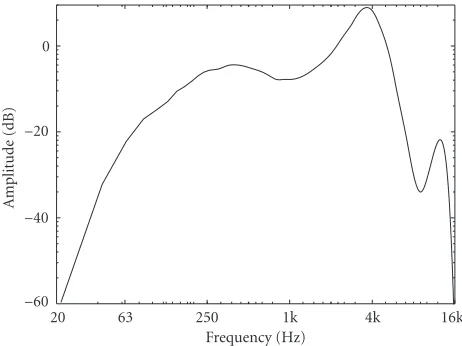
where Ws(k) is an inverted equal loudness curve at sound pressure level of 60 dB shown in Figure 4 that is used to weight the error and imitate the frequency-dependent sen-sitivity of human hearing.
5. DISCRETIZING THE PARAMETER SPACE
The number of data points in the parameter space can be reduced by discretizing the individual parameters in a per-ceptually reasonable manner. The range of parameters can be
20 63 250 1k 4k 16k
Figure4: The frequency-dependent weighting function, which is the inverse of the equal loudness curve at the SPL of 60 dB.
reduced to cover only all the possible musical tones and devi-ation steps can be kept just below the discrimindevi-ation thresh-old.
5.1. Decay parameters
The audibility of variations in decay of the single string model inFigure 2have been studied in [32]. Time constant
τ of the overall decay was used to describe the loop gain parameterg while the frequency-dependent decay was con-trolled directly by parametera. Values ofτandawere varied and relatively large deviations in parameters were claimed to be inaudible. J¨arvel¨ainen and Tolonen [32] proposed that a variation of the time constant between 75% and 140% of the reference value can be allowed in most cases. An inaudible variation for the parameterawas between 83% and 116% of the reference value.
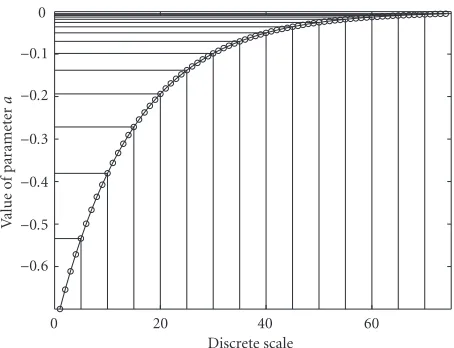
The discrimination thresholds were determined with two different tone durations 0.6 second and 2.0 seconds. In our study, the judgement of similarity between two tones is done by comparing the entire signals and, therefore, the results from [32] cannot be directly used for the parametrization of a andg. The tolerances are slightly smaller because the judgement is made based on not only the decay but also the duration of a tone. Based on our informal listening test and including a margin of certainty, we have defined the variation to be 10% for theτand 7% for the parametera. The parame-ters are bounded so that all the playable musical sounds from tightly damped picks to very slowly decaying notes are pos-sible to produce with the model. This results in 62 discrete nonuniformly distributed values forgand 75 values fora, as shown in Figures5aand5b. The corresponding amplitude envelopes of tones with differentg parameter are shown in
Figure 5c. Loop filter magnitude responses for varying pa-rameterawithg=1 are shown inFigure 5d.
5.2. Fundamental frequency and beating parameters
0 20 40 60 Discrete scale
0.75 0.8 0.85 0.9 0.95 1
V
alue
o
f
p
ar
amet
er
g
(a) Discrete values for the parametergwhenf0=331 and the
variation for the time constantτis 10%.
0 20 40 60
Discrete scale −0.6
−0.5 −0.4 −0.3 −0.2 −0.1 0
V
alue
o
f
p
ar
amet
er
a
(b) Discrete values for the parameterawhen the variation is 7%.
0 2 4 6 8 10
Time (s) −60
−50 −40 −30 −20 −10 0
A
m
plitude
(dB)
(c) Amplitude envelopes of tones with different discrete values ofg.
0 5000 10000 15000 20000
Frequency (Hz) −15
−12 −9 −6 −3 0
A
m
plitude
(dB)
(d) Loop filter magnitude responses for different discrete values ofawheng=1.
Figure5: Discretizing the parametersganda.
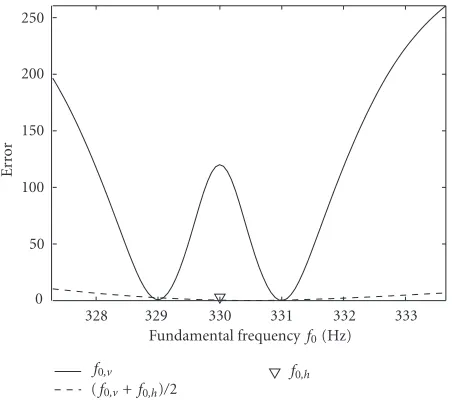
fundamental frequencies of two polarizations differ, the fre-quency estimate settles in the middle of the frequencies, as shown inFigure 6. Frequency discrimination thresholds as a function of frequency have been proposed in [33]. Also the audibility of beating and amplitude modulation has been studied in [27]. These results do not give us directly the dis-crimination thresholds for the difference in the fundamental frequencies of the two-polarization string model, because the fluctuation strength in an output sound depends on the fun-damental frequencies and the decay parametersganda.
The sensitivity of parameters can be examined when a synthesized tone with known parameter values is used as a target tone with which another synthesized tone is compared. Varying one parameter after another and freezing the oth-ers, we obtain the error as a function of the parameters. In
Figure 7, the target values of f0,vand f0,hare 331 and 330 Hz. The solid line shows the error whenf0,vis linearly swept from 327 to 344 Hz. The global minimum is obviously found when
f0,v=331 Hz. Interestingly, another nonzero local minimum is found when f0,v=329 Hz, that is, when the beating is sim-ilar. The dashed line shows the error when both f0,vand f0,h are varied but the difference in the fundamental frequencies is kept constant. It can be seen that the difference is more dominant than the absolute frequency value and have to be therefore discretized with higher resolution. Instead of op-erating the fundamental frequency parameters directly, we optimize the differencedf = |f0,v− f0,h|and the mean fre-quency f0= |f0,v+ f0,h|/2 individually. Combining previous results from [27,33] with our informal listening test, we have discretizeddf with 100 discrete values and f0with 20. The
range of variation is set as follows:
rp= ± f0ˆ
10 1/3
, (16)
0 0.01 0.02 0.03 0.04 Time (s)
−1 −0.5 0 0.5 1
N
o
rm
aliz
ed
mag
nitude
80 Hz 84 Hz
80 + 84 Hz Maximum (a) Entire autocorrelation function.
0.01 0.011 0.012 0.013 0.014
Time (s) −1
−0.5 0 0.5 1
N
o
rm
aliz
ed
mag
nitude
80 Hz 84 Hz
80 + 84 Hz Maximum (b) Zoomed around the maximum.
Figure6: Three autocorrelation functions. Dashed and solid lines show functions for two single-polarization guitar tones with funda-mental frequencies of 80 and 84 Hz. Dash-dotted line corresponds to a dual-polarization guitar tone with fundamental frequencies of 80 and 84 Hz.
5.3. Other parameters
The tolerances for the mixing coefficientsmp,mo, andgchave not been studied and the parameters have been earlier ad-justed by trial and error [5]. Therefore, no initial guesses are made for these parameters. The sensitivities of the mixing co-efficients are examined in an example case inFigure 9, where
mp =0.5,mp =0.5, andmp =0.1. It can be seen that the parametersmp andmo are most sensitive near the bound-aries and the parametergcis most sensitive near zero. Ranges formp andmo are discretized with 40 values according to
328 329 330 331 332 333
Fundamental frequencyf0(Hz)
0 50 100 150 200 250
Er
ro
r
f0,v (f0,v+f0,h)/2
f0,h
Figure7: Error as a function of the fundamental frequencies. The
target values off0,vandf0,hare 331 and 330 Hz. The solid line shows
the error when f0,h = 330 and f0,v is linearly swept from 327 to
334 Hz. The dashed line shows the error when both frequencies are
varied simultaneously while the difference remains similar.
125 250 500 1k
Frequency estimate ˆf0(Hz)
4 5 6 7 8 9 10
rp
+
−
rp−
(Hz)
Figure 8: The range of variation in fundamental frequency as a
function of frequency estimate from 80 to 1000 Hz.
Figure 10. This method is applied to the parameter gc, the range of which is limited to 0–0.5.
Discretizing the nine parameters this way results in 2.77× 10¹⁵ combinations in total for a single tone. For an
acous-tic guitar, about 120 tones with different dynamic levels and playing styles have to be analyzed. It is obvious that an ex-haustive search is out of question.
6. GENETIC ALGORITHM
0 0.2 0.4 0.6 0.8 1
Figure10: Discrete values for the parametersmpandmo.
characteristics of the individuals from generation to gener-ation. Each individual, called a chromosome, is made up of an array of genes that contain, in our case, the actual param-eters to be estimated.
In the original algorithm design, the chromosomes were represented with binary numbers [35]. Michalewicz [36] showed that representing the chromosomes with floating-point numbers results in faster, more consistent, higher pre-cision, and more intuitive solution of the algorithm. We use a GA with the floating-point representation, although the parameter space is discrete, as discussed in Section 5. We have also experimented with the binary-number repre-sentation, but the execution time of the iteration becomes slow. Nonuniformly graduated parameter space is trans-formed into the uniform scales where the GA operates on. The floating-point numbers are rounded to the nearest
dis-crete parameter value. The original floating-point operators are discussed in [36], where the characteristics of the oper-ators are also described. Few modifications to the original mutation operators in step 5 have been made to improve the operation of the algorithm with the discrete grid.
The algorithm we use is implemented as follows.
(1) Analyze the recorded tone to be resynthesized using the analysis methods discussed inSection 3. The range of the parameter f0 is chosen and the excitation
sig-nal is produced according to these results. Calculate the threshold of masking (Section 4) and the discrete scales for the parameters (Section 5).
(2) Initialization: create a population of Sp individuals (chromosomes). Each chromosome is represented as a vector arrayx, with nine components (genes), which contains the actual parameters. The initial parameter values are randomly assigned.
(3) Fitness calculation: calculate the perceptual fitness of each individual in the current population according to (15).
(4) Selection of individuals: select individuals from the current population to produce the next generation based upon the individual’s fitness. We use the nor-malized geometric selection scheme [37], where the individuals are first ranked according to their fitness values. The probability of selecting theith individual to the next generation is then calculated by
Pi=q(1−q)r−1, (17)
where
q= q
1−(1−q)Sp, (18)
q is the user-defined parameter which denotes the probability of selecting the best individual, andris the rank of the individual, where 1 is the best andSpis the worst. Decreasing the value ofqslows the convergence. (5) Crossover: randomly pick a specified number of par-ents from selected individuals. An offspring is pro-duced by crossing the parents with a simple, arithmeti-cal, and heuristic crossover scheme. Simple crossover creates two new individuals by splitting the parents in a random point and swapping the parts. Arithmeti-cal crossover produces two linear combinations of the parents with a random weighting. Heuristic crossover produces a single offspringxowhich is a linear extrap-olation of the two parentsxp,1andxp,2as follows:
(6) Mutation: randomly pick a specified number of in-dividuals for mutation. Uniform, nonuniform, multi-nonuniform, and boundary mutation schemes are used. Mutation works with a single individual at a time. Uniform mutation sets a randomly selected pa-rameter (gene) to a uniform random number between the boundaries. Nonuniform mutation operates uni-formly at early stage and more locally as the current generation approaches the maximum generation. We have defined the scheme to operate in such a way that the change is always at least one discrete step. The de-gree of nonuniformity is controlled with the param-eter b. Nonuniformity is important for fine-tuning. Multi-nonuniform mutation changes all of the pa-rameters in the current individual. Boundary muta-tion sets a parameter to one of its boundaries and is useful if the optimal solution is supposed to lie near the boundaries of the parameter space. The bound-ary mutation is used in special cases, such as staccato tones.
(7) Replace the current population with the new one. (8) Repeat steps 3, 4, 5, 6, and 7 until termination.
Our algorithm is terminated when a specified number of generations is produced. The number of generations defines the maximum duration of the algorithm. In our case, the time spent with the GA operations is negligible compared to the synthesis and fitness calculation. Synthesis of a tone with candidate parameter values takes approximately 0.5 second, while the duration of the error calculation is 1.2 second. This makes 1.7 second in total for a single parameter set.
7. EXPERIMENTATION AND RESULTS
To study the efficiency of the proposed method, we first tried to estimate the parameters for the sound produced by the synthesis model itself. First, the same excitation signal ex-tracted from a recorded tone by the method described in [24] was used for target and output sounds. A more realis-tic case is simulated when the excitation for resynthesis is ex-tracted from the target sound. The system was implemented with Matlab software and all runs were performed on an In-tel Pentium III computer. We used the following parameters for all experiments: population sizeSp=60, number of gen-erations = 400, probability of selecting the best individual
q = 0.08, degree of nonuniformityb = 3, retriesw = 3, number of crossovers=18, and number of mutations=18.
Thepitch synchronous Fourier transform scheme, where the window lengthLwis synchronized with the period length of the signal such thatLw =4fs/ f0, is utilized in this work. The overlap of the used hanning windows is 50%, implying that hop sizeH =Lw/2. The sampling rate is fs=44100 Hz and the length of FFT isN=2048.
The original and the estimated parameters for three ex-periments are shown in Table 2. In experiment 1 the origi-nal excitation is used for the resynthesis. The exact param-eters are estimated for the difference df and for the decay
parameters gh, gv, and av. The adjacent point in the dis-crete grid is estimated for the decay parameter ah. As can be seen in Figure 7, the sensitivity of the mean frequency is negligible compared to the differencedf, which might be the cause of deviations in mean frequency. Differences in the mixing parameters mo,mp, and the coupling coefficientgc can be noticed. When running the algorithm multiple times, no explicit optima for mixing and coupling parameters were found. However, synthesized tones produced by correspond-ing parameter values are indistcorrespond-inguishable. That is to say that the parametersmp,mo, andgcare not orthogonal, which is clearly a problem with the model and also impairs the effi -ciency of our parameter estimation algorithm.
To overcome the nonorthogonality problem, we have run the algorithm with constant values ofmp =mo=0.5 in ex-periment 2. If the target parameters are set according to dis-crete grid, the exact parameters with zero error are estimated. The convergence of the parameters and the error of such case is shown inFigure 11. Apart from the fact that the parameter values are estimated precisely, the convergence of the algo-rithm is very fast. Zero error is already found in generation 87.
A similar behavior is noticed in experiment 3 where an extracted excitation is used for resynthesis. The difference and the decay parametersghandgvare again estimated pre-cisely. Parametersmp,mo, andgcdrift as in previous exper-iment. Interestingly,mp =1, which means that the straight path to vertical polarization is totally closed. The model is, in a manner of speaking, rearranged in such a way that the indi-vidual string models are in series as opposed to the original construction where the polarization are arranged in paral-lel.
Unlike in experiments 1 and 2, the exact parameter val-ues are not so relevant since different excitation signals are used for the target and estimated tones. Rather than look-ing into the parameter values, it is better to analyze the tones produced with the parameters. InFigure 12, the overall tem-poral envelopes and the envelopes of the first eight partials for the target and for the estimated tone are presented. As can be seen, the overall temporal envelopes are almost iden-tical and the partial envelopes match well. Only the beating amplitude differs slightly but it is inaudible. This indicates that the parametrization of the model itself is not the best possible since similar tones can be synthesized with various parameter sets.
Our estimation method is designed to be used with real recorded tones. Time and frequency analysis for such case is shown in Figure 13. As can be seen, the overall tempo-ral envelopes and the partial envelopes for a recorded tone are very similar to those that are analyzed from a tone that uses estimated parameter values. Appraisal of the perceptual quality of synthesized tones is left as a future project, but our informal listening indicates that the quality is compa-rable with or better than our previous methods and it does not require any hand tuning after the estimation procedure. Sound clips demonstrating these experiments are available at
0 50 100 150 Generation
329 329.5 330 330.5 331 331.5 332 332.5
F
u
ndamental
fr
eq
uency
(Hz)
f0 Target value off0 (a) Convergence of the parameterf0.
0 50 100 150
Generation 0
0.5 1 1.5 2 2.5 3
F
u
ndamental
fr
eq
uency
(Hz)
df Target value ofdf
(b) Convergence of the parameterdf.
0 100 200 300 400
Generation 0.95
0.96 0.97 0.98 0.99 1
Va
lu
e
o
f
g
gh
gv Target value ofTarget value ofghgv (c) Convergence of the parametersghandgv.
0 50 100 150
Generation −0.6
−0.5 −0.4 −0.3 −0.2 −0.1 0
Va
lu
e
o
f
a
ah av
Target value ofah Target value ofav (d) Convergence of the parametersahandav.
0 50 100 150
Generation 0
0.2 0.4 0.6 0.8 1
Gain
gc Target values
(e) Convergence of the parametergc.
0 100 200 300 400
Generation 0
5 10 15 20 25
Er
ro
r
(f) Convergence of the error.
Table2: Original and estimated parameters when a synthesized tone with known parameter values are used as a target tone. The original excitation is used for resynthesis in experiments 1 and 2 and the extracted excitation is used for the resynthesis in experiment 3. In experiment
2 the mixing coefficients are frozen asmp=mo=0.5.
Parameter Target parameter Experiment 1 Experiment 2 Experiment 3
f0 330.5409 331.000850 330.5409 330.00085
df 0.8987 0.8987 0.8987 0.8987 gh 0.9873 0.9873 0.9873 0.9873
ah −0.2905 −0.3108 −0.2905 −0.2071 gv 0.9907 0.9907 0.9907 0.9907
av −0.1936 −0.1936 −0.1936 −0.1290
mp 0.5 0.2603 (0.5) 1.000
mo 0.5 0.6971 (0.5) 0.8715
gc 0.1013 0.2628 0.1013 0.2450
Error — 0.0464 0 0.4131
0 0.5 1 1.5 2
Time (s) −1
−0.5 0 0.5 1
N
o
rm
aliz
ed
amplitude
(a) Overall temporal envelope for a target tone.
2
1
0
Time (s) 2
4 6
8 Partial
−60 −40 −20 0
A
m
plitude
(dB)
(b) First eight partials for a target tone.
0 0.5 1 1.5 2
Time (s) −1
−0.5 0 0.5 1
N
o
rm
aliz
ed
amplitude
(c) Overall temporal envelope for an estimated tone.
2
1
0
Time (s) 2
4 6
8 Partial
−60 −40 −20 0
A
m
plitude
(dB)
(d) First eight partials for an estimated tone.
0 1 2 3 4 Time (s)
−1 −0.5 0 0.5 1
N
o
rm
aliz
ed
amplitude
(a) Waveform for a recorded tone.
2
1
0
Time (s) 2
4 6
8 Partial
−60 −40 −20 0
A
m
plitude
(dB)
(b) First eight partials for a recorded tone.
0 1 2 3 4
Time (s) −1
−0.5 0 0.5 1
N
o
rm
aliz
ed
amplitude
(c) Waveform for an estimated tone.
2
1
0
Time (s) 2
4 6
8 Partial
−60 −40 −20 0
A
m
plitude
(dB)
(d) First eight partials for an estimated tone.
Figure13: Time and frequency analysis for a recorded tone and for a synthesized tone that uses estimated parameter values. Extracted
excitation is used for the resynthesis. Estimated parameter values are f0=331.1044,df =1.1558,gh=0.9762,ah= −0.4991,gv=0.9925,
av=0.0751,mp=0.1865,mo=0.7397, andgc=0.1250.
8. CONCLUSIONS AND FUTURE WORK
A parameter estimation scheme based on a GA with a percep-tual fitness function was designed and tested for a plucked string synthesis algorithm. The synthesis algorithm is used for natural-sounding synthesis of various string instruments. For this purpose, automatic parameter estimation is needed. Previously, the parameter values have been extracted from recordings using more traditional signal processing tech-niques, such as short-term Fourier transform, linear regres-sion, and linear digital filter design. Some of the parameters could not have been reliably estimated from the recorded sound signal, but they have had to be fine-tuned manually by an expert user.
In this work, we presented a fully automatic parameter extraction method for string synthesis. The fitness function we use employs knowledge of properties of the human au-ditory system, such as frequency-dependent sensitivity and frequency masking. In addition, a discrete parameter space
has been designed for the synthesizer parameters. The range, the nonuniformity of the sampling grid, and the number of allowed values for each parameter were chosen based on for-mer research results, experiments on parameter sensitivity, and informal listening.
expected to hear good results using the GA-based method, which was also the case.
Appraisal of synthetic tones that use parameter values from the proposed GA-based method is left as a future project. Listening tests similar to those used for evaluating high-quality audio coding algorithms may be useful for this task.
REFERENCES
[1] J. O. Smith, “Physical modeling using digital waveguides,”
Computer Music Journal, vol. 16, no. 4, pp. 74–91, 1992.
[2] J. O. Smith, “Efficient synthesis of stringed musical
instru-ments,” in Proc. International Computer Music Conference
(ICMC ’93), pp. 64–71, Tokyo, Japan, September 1993. [3] M. Karjalainen, V. V¨alim¨aki, and Z. J´anosy, “Towards
high-quality sound synthesis of the guitar and string instruments,” inProc. International Computer Music Conference (ICMC ’93), pp. 56–63, Tokyo, Japan, September 1993.
[4] V. V¨alim¨aki, J. Huopaniemi, M. Karjalainen, and Z. J´anosy, “Physical modeling of plucked string instruments with
appli-cation to real-time sound synthesis,”Journal of the Audio
En-gineering Society, vol. 44, no. 5, pp. 331–353, 1996.
[5] M. Laurson, C. Erkut, V. V¨alim¨aki, and M. Kuuskankare, “Methods for modeling realistic playing in acoustic guitar
synthesis,”Computer Music Journal, vol. 25, no. 3, pp. 38–49,
2001.
[6] G. Weinreich, “Coupled piano strings,” Journal of the
Acous-tical Society of America, vol. 62, no. 6, pp. 1474–1484, 1977. [7] M. Karjalainen, V. V¨alim¨aki, and T. Tolonen, “Plucked-string
models: from the Karplus-Strong algorithm to digital
waveg-uides and beyond,”Computer Music Journal, vol. 22, no. 3, pp.
17–32, 1998.
[8] T. Tolonen and V. V¨alim¨aki, “Automated parameter
extrac-tion for plucked string synthesis,” inProc. International
Sym-posium on Musical Acoustics (ISMA ’97), pp. 245–250, Edin-burgh, Scotland, August 1997.
[9] C. Erkut, V. V¨alim¨aki, M. Karjalainen, and M. Laurson, “Ex-traction of physical and expressive parameters for
model-based sound synthesis of the classical guitar,” in the
Au-dio Engineering Society 108th International Convention, Paris,
France, February 2000, preprint 5114,http://lib.hut.fi/Diss/
2002/isbn9512261901.
[10] A. Nackaerts, B. De Moor, and R. Lauwereins, “Parameter estimation for dual-polarization plucked string models,” in
Proc. International Computer Music Conference (ICMC ’01), pp. 203–206, Havana, Cuba, September 2001.
[11] S.-F. Liang and A. W. Y. Su, “Recurrent neural-network-based physical model for the chin and other plucked-string
instru-ments,” Journal of the Audio Engineering Society, vol. 48, no.
11, pp. 1045–1059, 2000.
[12] C. Drioli and D. Rocchesso, “Learning pseudo-physical
mod-els for sound synthesis and transformation,” inProc. IEEE
In-ternational Conference on Systems, Man, and Cybernetics, pp. 1085–1090, San Diego, Calif, USA, October 1998.
[13] V.-V. Mattila and N. Zacharov, “Generalized listener selection
(GLS) procedure,” inthe Audio Engineering Society 110th
In-ternational Convention, Amsterdam, The Netherlands, 2001, preprint 5405.
[14] H. Hermansky, “Perceptual linear predictive (PLP) analysis of
speech,” Journal of the Acoustical Society of America, vol. 87,
no. 4, pp. 1738–1752, 1990.
[15] A. H¨arm¨a, M. Karjalainen, L. Savioja, V. V¨alim¨aki, U. Laine, and J. Huopaniemi, “Frequency-warped signal processing for
audio applications,” Journal of the Audio Engineering Society,
vol. 48, no. 11, pp. 1011–1031, 2000.
[16] J. Vuori and V. V¨alim¨aki, “Parameter estimation of non-linear physical models by simulated evolution—application to the
flute model,” inProc. International Computer Music
Confer-ence (ICMC ’93), pp. 402–404, Tokyo, Japan, September 1993. [17] A. Horner, J. Beauchamp, and L. Haken, “Machine tongues XVI: Genetic algorithms and their application to FM
match-ing synthesis,”Computer Music Journal, vol. 17, no. 4, pp. 17–
29, 1993.
[18] R. Garcia, “Automatic generation of sound synthesis tech-niques,” M.S. thesis, Massachusetts Institute of Technology, Cambridge, Mass, USA, 2001.
[19] C. Johnson, “Exploring the sound-space of synthesis
algo-rithms using interactive genetic algoalgo-rithms,” inProc. AISB
Workshop on Artificial Intelligence and Musical Creativity, pp. 20–27, Edinburgh, Scotland, April 1999.
[20] D. Jaffe and J. O. Smith, “Extensions of the Karplus-Strong
plucked-string algorithm,” Computer Music Journal, vol. 7,
no. 2, pp. 56–69, 1983.
[21] C. Erkut, M. Laurson, M. Kuuskankare, and V. V¨alim¨aki, “Model-based synthesis of the ud and the renaissance lute,” inProc. International Computer Music Conference (ICMC ’01), pp. 119–122, Havana, Cuba, September 2001.
[22] C. Erkut and V. V¨alim¨aki, “Model-based sound
synthe-sis of tanbur, a Turkish long-necked lute,” inProc. IEEE
Int. Conf. Acoustics, Speech, Signal Processing, pp. 769–772, Is-tanbul, Turkey, June 2000.
[23] C. Roads, The Computer Music Tutorial, MIT Press,
Cam-bridge, Mass, USA, 1996.
[24] V. V¨alim¨aki and T. Tolonen, “Development and calibration of
a guitar synthesizer,”Journal of the Audio Engineering Society,
vol. 46, no. 9, pp. 766–778, 1998.
[25] C. Erkut, M. Karjalainen, P. Huang, and V. V¨alim¨aki, “Acous-tical analysis and model-based sound synthesis of the kantele,”
Journal of the Acoustical Society of America, vol. 112, no. 4, pp. 1681–1691, 2002.
[26] B. Bank, “Physics-based sound synthesis of the piano,” Tech. Rep. 54, Helsinki University of Technology, Laboratory of Acoustics and Audio Signal Processing, Espoo, Finland, May
2000,http://www.acoustics.hut.fi/publications/2000.html.
[27] E. Zwicker and H. Fastl, Psychoacoustics: Facts and Models,
Springer-Verlag, Berlin, Germany, 1990.
[28] M. Lagrange and S. Marchand, “Real-time additive synthesis
of sound by taking advantage of psychoacoustics,” inProc.
COST-G6 Conference on Digital Audio Effects (DAFx ’01), pp. 5–9, Limerick, Ireland, December 2001.
[29] C. W. Wun and A. Horner, “Perceptual wavetable matching
for synthesis of musical instrument tones,” Journal of the
Au-dio Engineering Society, vol. 49, no. 4, pp. 250–262, 2001. [30] J. D. Johnston, “Transform coding of audio signals using
per-ceptual noise criteria,”IEEE Journal on Selected Areas in
Com-munications, vol. 6, no. 2, pp. 314–323, 1988.
[31] M. R. Schroeder, B. S. Atal, and J. L. Hall, “Optimizing digital speech coders by exploiting masking properties of the human
ear,”Journal of the Acoustical Society of America, vol. 66, no. 6,
pp. 1647–1652, 1979.
[32] H. J¨arvel¨ainen and T. Tolonen, “Perceptual tolerances for
de-cay parameters in plucked string synthesis,”Journal of the
Au-dio Engineering Society, vol. 49, no. 11, pp. 1049–1059, 2001. [33] C. C. Wier, W. Jesteadt, and D. M. Green, “Frequency
dis-crimination as a function of frequency and sensation level,”
Journal of the Acoustical Society of America, vol. 61, no. 1, pp. 178–184, 1977.
[34] M. Mitchell, An Introduction to Genetic Algorithms, MIT
[35] J. H. Holland, Adaptation in Natural and Artificial Systems, University of Michigan Press, Ann Arbor, Mich, USA, 1975.
[36] Z. Michalewicz, Genetic Algorithms + Data Structures =
Evo-lution Programs, AI Series. Springer-Verlag, New York, NY, USA, 1992.
[37] J. Joines and C. Houck, “On the use of non-stationary penalty functions to solve nonlinear constrained optimization
prob-lems with GA’s,” inIEEE International Symposium on
Evolu-tionary Computation, pp. 579–584, Orlando, Fla, USA, June 1994.
Janne Riionheimo was born in Toronto, Canada, in 1974. He studies acoustics and digital signal processing at Helsinki Univer-sity of Technology, Espoo, Finland, and mu-sic technology, as a secondary subject, at the Centre for Music and Technology, Sibelius Academy, Helsinki, Finland. He is currently finishing his M.S. thesis, which deals with parameter estimation of a physical synthesis model. He has worked as a Research
Assis-tant at the HUT Laboratory of Acoustics and Audio Signal Process-ing from 2001 until 2002. His research interests include physical modeling of musical instruments and musical acoustics. He is also working as a Recording Engineer.
Vesa V¨alim¨akiwas born in Kuorevesi, Fin-land, in 1968. He received his Master of Sci-ence in Technology, Licentiate of SciSci-ence in Technology, and Doctor of Science in Tech-nology degrees, all in electrical engineer-ing from Helsinki University of Technology (HUT), Espoo, Finland, in 1992, 1994, and 1995, respectively. Dr. V¨alim¨aki worked at the HUT Laboratory of Acoustics and Au-dio Signal Processing from 1990 until 2001.