Secure Personalize Web Search
Sandesh Dagdu1 , Chiranjivi Jawale2 , Akshay Aher3 , Anurag Bokade4, Dr. Abhijit Banubakode5 Student, Dept. of Information Technology, Rajarshi Shahu College of Engineering, Savitribai Phule Pune University,
Pune, Maharashtra, India1, 2, 3, 4
Professor, Dept. of Information Technology, Rajarshi Shahu College of Engineering, Savitribai Phule Pune University, Pune, Maharashtra, India5
ABSTRACT: As the scope of the Internet keeps developing the clients of solicitation suppliers consistently request list
things that are exact to their essentials. Revamped Search is one of the choices open to clients fit as a fiddle question things came back to them in context of their own information accommodated the solicitation supplier. This raises anxieties of security issues however as clients are customarily uncomfortable uncovering singular data to a reliably faceless association supplier on the Internet. This paper hopes to manage the protection issues encompassing changed search for and examines ways that security can be upgraded so clients can wind up being more OK with the arrival of their own information recalling the completed target to get more correct inquiry things. Adjusted web look (PWS) has demonstrated its adequacy in redesigning the method for different solicitation associations on the Internet. Regardless, shows display that clients' antipathy for unveil their private data amidst solicitation has changed into a basic breaking point for the wide augmentation of PWS. We consider security insurance in PWS applications that model client inclines as various leveled client profiles. We propose a PWS structure called UPS that can adaptively entire up profiles by request while concerning client chose security necessities.
KEYWORDS: Privacy protection, personalized web search, utility, risk, profile
I. INTRODUCTION
Click-log-based methods
1. The click-log based methods are straightforward they simply impose bias to clicked pages in the user’s query history.
2. It can only work on repeated queries from the same user, which is a strong limitation confining its applicability.
3. Profile-based methods
Profile-based methods can be potentially effective for almost all sorts of queries, but are reported to be unstable under some circumstances.
Improve the search experience with complicated user-interest models generated from user profiling techniques. PWS has demonstrated more effectiveness in improving the quality of web search recently, with increasing usage of personal and behavior information to profile its users, which is usually gathered implicitly from query history, browsing history, click-through data bookmarks, user documents and so forth.
II. RELATED WORK
The current profile-based Personalized Web Search does not bolster runtime profiling [1]. A client profile is normally summed up for just once logged off, and used to customize all questions from a same client indiscriminatingly [3]. Such "one profile fits all" methodology surely has downsides given the assortment of questions. One confirmation reported in is that profile-based personalization may not enhance the quest quality for some specially appointed inquiries, however presenting client profile to a server has put the client's security at danger.
The current techniques don't consider the customization of security prerequisites. This most likely makes some client security to be overprotected while others deficiently ensured. For instance, in, all the delicate themes are distinguished utilizing a flat out metric called surprise in view of the data hypothesis, expecting that the hobbies with less client record backing are more sensitive[1]. Nonetheless, this suspicion can be questioned with a straightforward counterexample: If a client has countless about "sex," the surprise of this point might prompt a conclusion that "sex" is exceptionally broad and not touchy, in spite of reality which is inverse. Lamentably, minimal earlier work can successfully address singular protection needs amid the speculation.
Here we concentrate on the writing of profile-based personalization and security assurance in Personalized The past chips away at Profile-based Personalized Web Search fundamentally spotlights on enhancing the inquiry utility. [5]Generally the Profile-based Personalized Web Search gives the query items by alluding to the client profile that uncovers an individual data need. Here we survey the past answers for PWS on two perspectives, specifically the representation of profiles, and the measure of the viability of personalization. To encourage distinctive personalization techniques numerous profile representations are accessible in the writing. However in latest the client profiles are implicit various leveled structures because of their more grounded enlightening capacity, better adaptability, and higher access effectiveness. For the most part the progressive representations are built with existing weighted subject chain of command/diagram, for example, ODP, Wikipedia et cetera. Another strategy is to construct the various leveled profile naturally through term-recurrence examination on the client information. In our proposed UPS system, we don't concentrate on the usage of the client profiles. Really, our system can possibly embrace any various leveled representation taking into account scientific classification of information. [5]
For the execution measures of PWS in the writing, Normalized Discounted Cumulative Gain (nDCG) is a typical measure of the viability of a data recovery framework. However, there is a great deal of human association in execution measuring and to diminish this specialists likewise propose different measurements of customized web look that depend on clicking choices, including Average Precision (AP), Rank Scoring, and Average Rank. In our structure we utilize the Average Precision metric, proposed by Dou et al., to quantify the Effectiveness of the personalization in UPS. Our work additionally proposes two prescient measurements, to be specific personalization utility and security hazard, on a profile case without asking for client input. [8]
personality, no character, and no individual data. [6]The Solution for the primary level is demonstrated excessively delicate. The third and fourth levels are unrealistic because of high cost in correspondence and cryptography. Along these lines, the current endeavors concentrate on the second level. The arrangements in class two don't require outsider help or coordinated efforts between interpersonal organization sections. In these arrangements, clients just trust themselves and don't permit the presentation of their complete profiles to a secrecy server. Krause and Horvitz and Xu et al. proposed a security assurance answer for PWS however sadly, this work does not address the inquiry utility, which is critical for the administration nature of PWS. Yet, our methodology considers both the protection necessity and the question utility. We likewise give customized protection.
III. OBJECTIVES
1. Input Design is the process of converting a user-oriented description of the input into a computer based system. This design is important to avoid errors in the data input process and show the correct direction to the management for getting correct information from the computerized system.
2. It is achieved by creating user-friendly screens for the data entry to handle large volume of data. The goal of designing input is to make data entry easier and to be free from errors. The data entry screen is designed in such a way that all the data manipulates can be performed. It also provides record viewing facilities.
3. When the data is entered it will check for its validity. Data can be entered with the help of screens. Appropriate messages are provided as when needed so that the user will not be in maize of instant. Thus the objective of input design is to create an input layout that is easy to follow.
IV. PROPOSEDSYSTEM
To propose UPS (User adaptable Privacy-saving Search) structure, which is a protection saving customized web seek system, which can sum up profiles for every inquiry as indicated by client determined security necessities? To create two straightforward yet viable speculation calculations, GreedyDP and GreedyIL, to bolster runtime profiling. GreedyDP tries to boost the segregating power (DP), GreedyIL endeavors to minimize the data misfortune (IL). The system expects that the inquiries don't contain any delicate data, and goes for ensuring the security in individual client profiles while holding their convenience for PWS. UPS comprises of a non-trusty web search tool server and various customers. Every customer (client) getting to the pursuit administration believes nobody however himself herself. The key part for security assurance is an online profiler actualized as a hunt intermediary running on the customer machine itself. The intermediary keeps up both the complete client profile, in a progressive system of hubs with semantics, and the client determined (altered) security prerequisites spoke to as an arrangement of touchy hubs. Amid the disconnected from the net stage, a progressive client profile is developed and tweaked with the client indicated security prerequisites. The online stage handles questions as When a client issues an inquiry qi on the customer, the intermediary creates a client profile in runtime in the light of question terms. The yield of this stride is a summed up client profile Gi fulfilling the security necessities. The speculation procedure is guided by considering two clashing measurements, in particular the personalization utility and the protection hazard, both characterized for client profiles. The question and the summed up client profile are sent together to the PWS server for customized look. The list items are customized with the profile and conveyed back to the inquiry intermediary. At last, the intermediary either exhibits the crude results to the client, or reranks them with the complete client profile.
V. PRIVACYPROTECTIONMECHANISMINPWSSYSTEM
individual. These works assume the existence of a trustworthy third-party Anonymized, which is not readily available over the Internet at large.
Viejo and Castell-a-Roca use legacy social networks instead of the third party to provide a distorted user profile to the web search engine. In the scheme, every user acts as a search agency of his or her neighbors. They can decide to submit the query on behalf of who issued it, or forward it to other neighbors. The shortcomings of current solutions in class one is the high cost introduced due to the collaboration and communication. The solutions in class two do not require third-party assistance or collaborations between social network entries.
In these solutions, users only trust themselves and cannot tolerate the exposure of their complete profiles an anonymity server. Krause and Horvitz employ statistical techniques to learn a probabilistic model, and then use this model to generate the near-optimal partial profile. Limitation in this work is that it builds the user profile as a finite set of attributes, and the probabilistic model is trained through predefined frequent queries. These assumptions are impractical in the context of PWS.
VI. FLOWOFPROJECT
It consists of two main modules which are further divided into sub modules as follows: I] Creation of user profile considering user’s positive and negative preferences: 1) Dealing with Clickthrough data from user (Concept Extraction).
2) Creation of Concept-Relationship Graph. 3) Creation of user Profile
II] Applying Clustering algorithm on created profile:
1) Apply Agglomerative clustering algorithm on created profile. 2) Use of precision and recall to measure the performance.
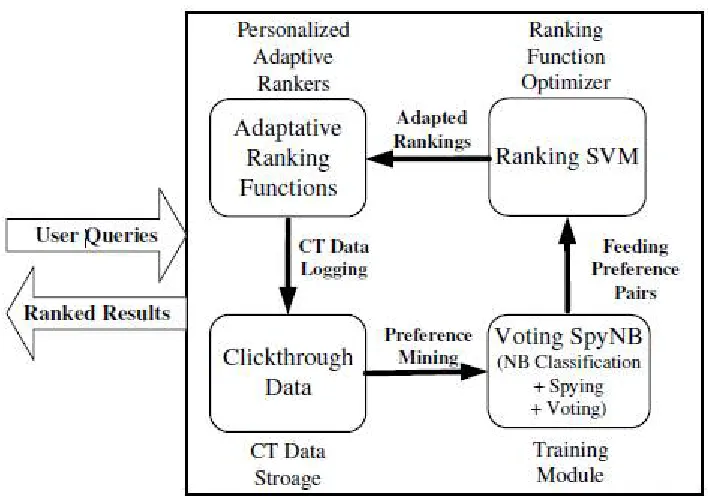
VII. SYSTEMARCHITECTURES
VIII. EXPERIMENTALRESULTANDGRAPH
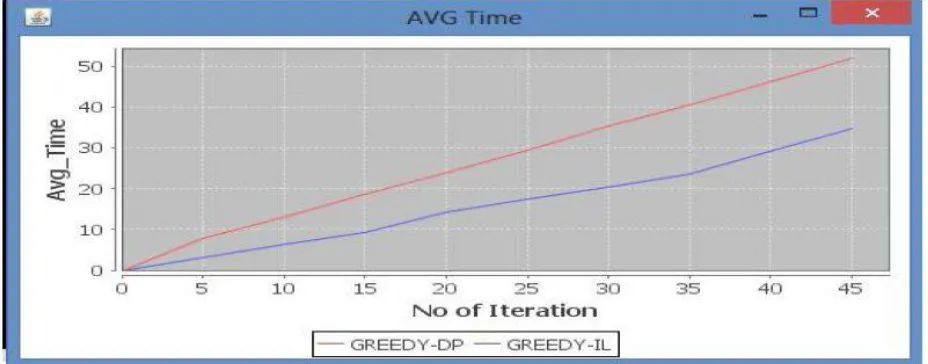
A protection saving customized net inquiry system client adaptable security saving pursuit, which might sum up profiles for each inquiry in venture with client indicated security needs. GreedyDP and greedyIL square measure utilized for sum up profiles. Separating force is utilized in greedyDP and learning misfortune is utilized in greedyIL. At the point when the segregating force will expand information misfortune can diminishes. GreedyDP have high segregating power than greedyIL. GreedyIL have less hazard contrast with greedyDP. The normal time for greedyIL is a littler sum than greedyDP. So greedyIL is more advantageous than greedyDP.
Fig No 02Graph for risk
In the figure 4.3 shows the graph comparison the common time for greedyDP and greedyIL. The x axis denoted range of iteration and y axis denoted average time. The greedyDP have high average time whereas comparison with greedyIL. The greedyIL is best than greedyDP.
IX. CONCLUSION
Here we complete up a client side security protection structure called UPS for redid web look. UPS could be grasped by any PWS that gets customer profiles in a different leveled experimental characterization. The structure allowed customers to show adjusted security necessities by method for the different leveled profiles. Similarly, UPS moreover performed online theory on customer profiles to secure the individual insurance without dealing the request quality. We proposed two voracious counts, specifically Greedy DP and Greedy IL, for the online theory. Our trial results revealed that UPS could perform quality question things while ensuring customers adjusted security necessities. The results moreover certified the reasonability and viability of our answer.
REFERENCES
[1] Z. Dou, R. Song, and J.-R.Wen, “A Large-Scale Evaluation and Analysis of Personalized Search Strategies,” Proc. Int’l Conf. World Wide Web (WWW), pp. 581-590, 2007.
[2] J. Teevan, S.T. Dumais, and E. Horvitz, “Personalizing Search via Automated Analysis of Interests and Activities,” Proc. 28th Ann. Int’l ACM SIGIR Conf. Research and Development in Information Retrieval (SIGIR), pp. 449-456, 2005.
[3] M. Spertta and S. Gach, “Personalizing Search Based on User Search Histories,” Proc. IEEE/WIC/ACM Int’l Conf. Web Intelligence (WI), 2005. [4] B. Tan, X. Shen, and C. Zhai, “Mining Long-Term Search History to Improve Search Accuracy,” Proc. ACM SIGKDD Int’l Conf. Knowledge Discovery and Data Mining (KDD), 2006.
[5] K. Sugiyama, K. Hatano, and M. Yoshikawa, “Adaptive Web Search Based on User Profile Constructed without any Effort from Users,” Proc. 13th Int’l Conf. World Wide Web (WWW), 2004.
[6] Garcia, G. and Zhang, J., Application of ultrasonic phased arrays for rail flaw inspection, U.S.Department of Transportation Report, Federal Railroad Administration, July2006
[7] NWCG (2005). National Fire Danger Rating System Weather Station Standards
[8] Shurmer, H. V. and J. W. Gardner (1992). "Odour Discrimination with an Electronic Nose." Sensors and Actuators B: 1-11.
[9] Yu, L., N. Wang, et al. (2005). Real-time forest fire detection with wireless sensor networks.Wireless Communications, Networking and Mobile Computing.
[10] Zervas, E., O. Sekkas, et al. (2007). Fire Detection in the Urban Rural Interface through Fusion Techniques.Mobile Adhoc and Sensor Systems (MASS 2007).