The Effect of Answer Patterns for
Supervised Named Entity Recognition in Thai
∗
Nutcha Tirasaroj and Wirote Aroonmanakun
Department of Linguistics, Chulalongkorn University, Bangkok, Thailand
[email protected], [email protected]
Abstract. In this paper, we present Thai named entity recognition (NER) systems using supervised Conditional Random Fields (CRFs) with various answer patterns to find out whether different answer patterns would affect the performance of the systems. Every system used the same set of features except the answers in the training corpus. There are 5 patterns of answer used in this study. The results show that the answer tags having more information can help improve the system performance than those having less information.
Keywords: Named entity recognition, Conditional Random Fields, Supervised machine learning, Thai language processing
∗ The work reported in this paper was supported by The Thailand Research Fund (TRF) under grant no MSG53Z0008, and partially supported by Chulalongkorn University Centenary Academic Development Project. Moreover, we would like to thank NECTEC for their BEST 2009 corpus and reviewers for their suggestions and comments.
Introduction
Named entity recognition (NER) was first introduced in MUC-6 in 1990’s. According to MUC, NER is divided into 3 main groups. The first one is entity names including person, organization, and location names. The second one is temporal expressions and the last one is numerical expressions which are monetary values and percentages. Among these 3 groups, the first one is the most difficult to be recognized because the structures of the names are complicated and the contexts they occur are varying. As a result, a number of research on NER as well as this study have focused on the first group.
research did not distinguish metonymic names, which are location names referring to organizations and organization names referring to locations.
Thus, apart from presenting the NER systems, this study is conducted to find out if the more informative answers can improve the system performance of Thai NER like in Chinese or not. In addition, we will find out the differences of results when metonymic names are marked. Our NER systems are based on CRF models. Recently, there was a comparative study on Thai word segmentation approaches (Haruechaiyasak et al., 2008). The results showed that CRFs yielded the best performance when compared with other machine learning methods, Naïve Bayes, decision tree, and Support Vector Machine. CRFs were also applied to Thai NER (Tepdang et al.; Tirasaroj and Aroonmanakun, 2009) and yielded about 80% of recognition rate or F-measure. In this study, we used CRF++0.53 implemented by Taku Kudo.
Related Work
There are a number of research focusing on Thai named entity recognition. Charoenpornsawat
et al. (1998) used feature-based approach such as context words, collocations, and heuristic
rules to extract the candidates and then used Winnow algorithm to recognize the entity names. The accuracy was 92.17%. Chanlekha et al. (2002) applied statistical and heuristic rule-based model to POS tagged data. The results showed that the model did have much problem when extract the names from magazines but when the model was applied to the newspapers, the accuracy was quite low. It was due to the written style of magazines that the names were usually in regular patterns.
Tirasaroj and Aroonmanakun (2009) compared the performance of the systems between word-based and syllable-based system by applying CRF. The results showed no significant difference. Although in their work, they mentioned about the NE tags that differentiated between common named entities – person, organization, and location names - and metonymic names, the organization names referring to the locations and vice versa. Their answers did not divided into five categories like their tags but just three categories as other previous research.
In Thai NER, the researchers have never mentioned about their answer patterns used in their systems but in Chinese, there are some research proving that the number of tag types does have an effect on supervised learning systems. The amount of tags used in 2008 is more than those used in 2006. In 2006, Feng et al. (2006) used BIO tags; B for the beginning of names, I for the inside of names, and O for others. In 2008, Mao et al. (2008) used BIOE and Yu et al. (2008) used BIOES instead of BIO. They added E and S; E for the end of names and S for single character names. From their research, giving more tags could help improve the system performance. In our study, we will apply NE type tags like in Tirasaroj and Aroonmanakun’s work and for NE boundaries, we will adapt from BIOE. We will explain in more detail in the section about patterns of answer.
Conditional Random Filed Models
Conditional Random Fields (CRFs) (Lafferty et al., 2001), which are developed from MEMMs, is a discriminative undirected graphical model. They are usually used for segmenting and labeling sequence data. CRF models the conditional distribution P(Y|X), where Y is the hidden label sequence or output and X is the observation or input. A linear chain CRF defines the conditional probability of sequence Y when given the observation sequence X as follows:
(1)
(2)
where is an arbitrary feature function, is a learned weight for each feature function.
Corpus
The corpus used in this study is taken from BEST 2009 corpus. BEST 2009 is the corpus created for training and testing word segmentation systems in “BEST 2009: THAI WORD SEGMENTATION SOFTWARE CONTEST.” Many genres of data were collected in BEST but only news genre was used in our study because in the news there are all three kinds of named entities- person, organization, and location names- and the number of entities are much more various than those found in other genres like fictions and encyclopedia. Thai word segmentation program (Aroonmanakun, 2002) was used to segment all data in our corpus. The number of tokens is about 367,600 tokens.
As we applied supervised learning system, we tagged all answers in the corpus. The data from BEST 2009 had been tagged the NE boundaries but not NE types. We then had to add NE types manually. As one of the main purposes of this study was to compare the answer patterns of the systems, we tried to give as much information of answers as possible. We followed Tirasaroj and Aroonmakun (2009) so that there were five NE types in our corpus. Apart from common NE types, person, organization, and location names, there were two more tags for metonymic names, organization names referring to locations and vice versa. The followings were NE tags in our corpus:
1. <persName>…</persName> is for person names including first names, last names, nicknames, alias, etc. The titles and honorifics right before the names are also included such as
<persName>ลุงสมหมาย</persName> Uncle Sommai
2. <orgName>…</orgName> is for organization names. In case that the full names are followed by their abbreviated names, they are tagged separately like
<orgName>กระทรวงสาธารณสุข</orgName><orgName><abb>สธ.</abb></orgName> Ministry of Public Health MOPH
3. <placeName>…</placeName> is for location names such as
ที่<placeName>นครปฐม</placeName> at Nakornpathom
4. <orgName ref=“loc”>…</orgName> is for organization names used to refer to locations. Generally, if the locations do not have their specific names, their names would undoubtedly be the same as the organization situated in that place. For example,
เขามารักษาโรคที่<orgName ref=“loc”>โรงพยาบาลสัตว</orgName> had exam at Veterinary hospital
5. <placeName ref=“org”>…</placeName> is for location names used as organization names. Mostly, this kind of names is used to refer to an organization, especially official offices and the government such as
Table 1: Answer patterns
No Pattern
1 P, O, L, X
2 B, I, X – PER, ORG, LOC
3 B, I, X – P, O, L, LO, OL
4 B, I, E, X – PER, ORG, LOC
5 B, I, E, X – P, O, L, LO, OL
Pattern 1 has the least information and Pattern 5 has the most information. Pattern 1 has no information of named entities’ boundaries but only basic entity types. The entity boundaries are BIEX, B for the beginning of a name, I for a token inside a name, E for the end of a name, and X for others. The answer pattern 1, 2, and 4 have basic entity types. The metonymic names are included in their referred types. The pattern 3 and 5 have all 5 entity types.
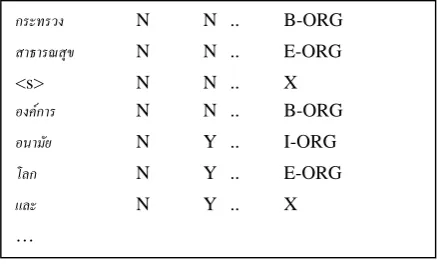
An example of training data, including features and answer, is shown in figure 1.
Figure 1: Example of training data with the 4th answer pattern
The first column is the token. From the second column to the one before the last column, they are features which are all binary features. The last column is the answer given to CRF. Every answer pattern uses the same set of features.
Experimental Results
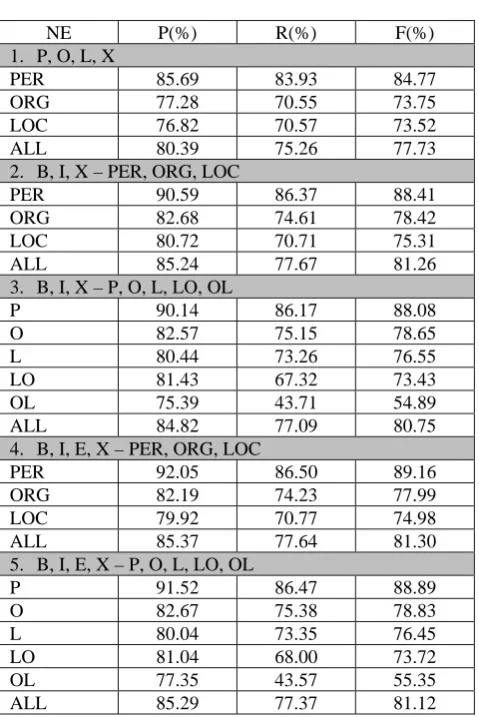
In this experiment, we used 10-fold cross validation and evaluated our systems with precision (P), recall (R), and F-measure (F). Only exactly matched answer is counted as correct answer. Table 2 shows the experimental results of all systems.
The performances of the systems with answer pattern 2 to 5 are almost indifferent, the difference of the values of f-measure is less than 1%. However, when compared with pattern 1, their performances are about 3% better. From all of the answer patterns, f-measure of pattern 4 is the highest while pattern 1 is the lowest. The results show that the patterns containing more information tend to improve the systems’ performances than those having less information.
Although pattern 5 has most information, it is not the one getting the best performance. The main reason may be that the training corpus is not large enough. Since the named entities are divided into 5 categories, the system, therefore, needs a large number of examples of names in each category for training. However, from all of the entity types, the organization names referring to the locations have the lowest number of examples (147 instances), while the highest number of entity names is 5,672 instances which are person names. As a result, the f-measures of this kind of names, both in pattern 3 and 5, are low when compared with other named entity types.
กระทรวง N N .. B-ORG
สาธารณสุข N N .. E-ORG
<s> N N .. X
องคการ N N .. B-ORG
อนามัย N Y .. I-ORG
Feng, Y., L. Sun and Y. Lv. 2006. Chinese Word Segmentation and Named Entity Recognition Based on Conditional Random Fields Models. Proceeding of the Fifth SIGHAN Workshop
on Chinese Language Processing, pp. 181-184. Sydney.
Haruechaiyasak, C., S. Kongyoung and M. N. Dailey. 2008. A Comparative Study on Thai Word Segmentation Approach. Proceedings of ECTI-CON. Krabi.
Lafferty, J., A. McCallum, and F. Pereira. 2001. Conditional Random Fields: Probabilistic Models for Sequence Data. Proceeding of 18thICML. San Francisco.
Mao, X., S. He, S. Bao, Y. Dong and H. Wang. 2008. Chinese Word Segmentation and Named Entity Recognition Based on Conditional Random Fields.Proceeding of the Sixth SIGHAN
Workshop on Chinese Language Processing, pp. 90-93. Hyderabad.
Sansing, Y., and A. Prayot. 2010. Thai Named Entity Recognition using Hidden Markov Model.
Proceedings of the Second Conference on Knowledge and Smart Technologies. Chonburi.
[in Thai]
Suwanno, N., Y. Suzuki and H. Yamazaki. 2007. Selecting the optimal feature sets for Thai named entity extraction. Proceedings of ICEE-2007 & PEC-5. Phuket.
Tepdang, S., C. Haruechaiyasak, and R. Kongkachandra. (n.d.) Thai Named Entity Recognition
by using Conditional Random Fields. (n.p.)
Tirasaroj, N. and W. Aroonmanakun. 2009. Thai Named Entity Recognition Based on Conditional Random Fields. Proceedings of the Eighth International Symposium on Natural
Language Processing. Bangkok.
Yu, X., W. Lam, S. Chan, Y. Wu and B. Chen. 2008. Chinese NER Using CRFs and Logic for the Fourth SIGHAN Bakeoff. Proceeding of the Sixth SIGHAN Workshop on Chinese