ATTWOOD, BRIAN CHRISTOPHER. Monte Carlo Simulations of Solid-Fluid Phase
Equilib-ria in Binary and Ternary Mixtures. (Under the direction of Carol K. Hall)
The objective of this research is to study the solid-fluid phase equilibria of binary and
ternary mixtures using molecular simulation. Solid-fluid phase equilibria plays an important
role in many chemical processes, especially crystallization. This research provides insight into
the underlying phenomena that govern these processes.
We first calculate complete phase diagrams, that is showing the solid, liquid, and vapor
phases, for 29 binary mixtures of Lennard-Jones molecules characterized by different sets of
interaction parameters using the Gibbs Duhem integration technique. The impact of including
the possibility of a solid phase on the global phase behavior of such mixtures is investigated by
comparing the complete phase behavior calculated by simulation to the global phase diagram
calculated from a fluid-phase-only equation of state. Complete phase diagrams from each region
of the global phase diagram are presented and compared with the fluid-phase-only phase
be-havior for the same mixture. It is found that for mixtures in which the components have greatly
dissimilar critical temperatures, the presence of the solid phase significantly alters the fluid phase
equilibria. In those cases, the phase behavior classification based on experimental observations
should differ from that predicted by an equation of state approach.
The Gibbs Duhem integration technique is then extended to calculate ternary phase
dia-grams at constant temperature and pressure. We calculate solid-fluid phase equilibria for ternary
mixtures of Lennard-Jones molecules. The simulation parameters were selected to roughly
melting point and a slightly smaller diameter. The cross-species well-depth and diameter
be-tween the two diastereomers are varied to determine their impact on the phase equilibria. We
find that increasing the interspecies diameter up to the diameter of the larger diastereomer results
in a slight increase of the solubility of the solid phase. We also find that when the interspecies
well-depth is lowered to less than that of either of the diastereomers, the solid phase separates into
two solid solutions and consequently there is a region of three-phase coexistence in the ternary
phase diagram. Finally we calculate ternary phase diagrams at a series of temperatures for one
set of molecular parameters. As the temperature increases, we find that the three-phase region
decreases in size until it eventually disappears. For an equimolar mixture of diastereomers, there
is a range of temperature and solvent concentration at which only one of the diastereomers will
precipitate, thus effecting a separation of the diastereomers. As the temperature is decreased the
and Ternary Mixtures
by
BRIAN CHRISTOPHER ATTWOOD
A dissertation submitted to the Graduate Faculty of North Carolina State University
in partial fulfillment of the requirements for the Degree of
Doctor of Philosophy
Chemical Engineering
Raleigh, NC 27695
2003
APPROVED BY:
Carol K. Hall Keith E. Gubbins Chair of Advisory Committee
Biography
The author was born in Troy, New York on April 27, 1975. He is the eldest son of Richard
and Dorothea Attwood and has two brothers, Jason and Kristopher. He received a B.S. degree in
chemical engineering from the State University of New York at Buffalo in May, 1997. In August,
1997, he was admitted to North Carolina State University to pursue graduate studies in Chemical
Engineering. On June 21, 1998, he married Karen Elizabeth Zawoysky of Clifton Park, New
York. He received an M.S. degree in chemical engineering from North Carolina State University
Acknowledgments
Through their support and encouragement, many people have contributed to the preparation
of this thesis. It gives me great pleasure to acknowledge them here.
First, I would like to thank my advisor, Professor Carol Hall. This thesis could not have
been completed without the insights I gained from discussions we had on both technical and
personal matters. Professor Hall is obviously very concerned about the welfare and success of
her students and I am grateful to be one of her students. I would also like to thank her for
obtaining the funding necessary to support me and my research for the past several years.
I thank the Office of Energy Research, Basic Sciences, Chemical Science Division of the
U.S. Department of Energy and the donors of the Petroleum Research Fund administered by the
American Chemical Society for their financial support for the research included in this thesis.
I am grateful to Julie McCormick, Andrew Schultz, Alex Marchut, Aysa Akad, and Arthi
Jayaraman for their parts in our joint effort to keep our computers running smoothly. I would also
like to thank the other members of our research group, past and present, for their friendship and
encouragement. To my other colleagues in the department with whom I have interacted, I thank
you for the support you have shown my work and the enjoyment you have given me socializing
outside of the office.
To my family and friends, I am especially grateful for the love and encouragement that you
have given me while in graduate school. Although I do not get to see you as much as I would
like, I think of you often. To my parents, thank you for always expressing your confidence in my
ability to succeed and pride in what I have accomplished. To Jason and Kris, at least I got out of
Table of Contents
Page
List of Tables viii
List of Figures x
Chapter 1 Introduction 1
1.1 Overview . . . 3
1.2 References . . . 7
Chapter 2 Effect of the Solid Phase on the Global Phase Behavior of Binary Lennard-Jones Mixtures 8 2.1 Introduction . . . 8
2.2 Method . . . 13
2.2.1 Gibbs Duhem integration technique . . . 13
2.2.2 Simulations . . . 18
2.3 Results and Discussion . . . 19
2.4 Conclusions . . . 27
2.5 Summary . . . 27
2.6 References . . . 29
Chapter 3 Solid-Liquid Phase Behavior of Ternary Mixtures 47
3.1 Introduction . . . 47
3.2 Method . . . 50
3.3 Results . . . 55
3.4 Summary . . . 60
3.5 References . . . 62
3.6 Figures . . . 64
Chapter 4 Future Work 77 4.1 References . . . 80
Appendices 81 Appendix A Global phase diagram for monomer/dimer mixtures 82 A.1 Introduction . . . 82
A.2 GFD equation of state for mixtures of square well chains and monomers . . . . 88
A.2.1 Review of Generalized Flory-Dimer theory for hard chain fluids . . . . 90
A.2.2 Review of Generalized Flory-Dimer theory for square-well chain fluids 92 A.2.3 Generalized Flory-Dimer theory for square-well chain/monomer mixtures 93 A.2.4 Comparison of GFD theory to molecular dynamic simulation . . . 100
A.3 Calculation of Global Phase Diagram . . . 102
A.4 Global Phase Diagram for Monomer/Dimer Mixtures . . . 108
A.5 Summary . . . 110
A.7 Figures . . . 116
List of Tables
Page
Chapter 1 Introduction 1
Chapter 2 Effect of the Solid Phase on the Global Phase Behavior of Binary
Lennard-Jones Mixtures 8
2.1 Three phase coexistence data from the figures discussed in Section 2.3. For each
three phase line the temperature, the identity of each of the phases, and their
respective mole fractions of component 2 are given. . . 31
Chapter 3 Solid-Liquid Phase Behavior of Ternary Mixtures 47
3.1 Lennard-Jones parameters used in Figures 1-2 . . . 63
Chapter 4 Future Work 77
Appendix A Global phase diagram for monomer/dimer mixtures 82
A.1 Values of the density-independent coefficients of Equations A.27, determined
using Boublik’s equation of state for mixtures . . . 114
A.2 The shape parameter ratios, and
, and their derivatives,
and
with respect
A.3 Species shape parameters for monomers and dimers determined from the segment radius,
/2.. . . 115
A.4 Coordination number model parameters, where
. . . 115
List of Figures
Page
Chapter 1 Introduction 1
Chapter 2 Effect of the Solid Phase on the Global Phase Behavior of Binary
Lennard-Jones Mixtures 8
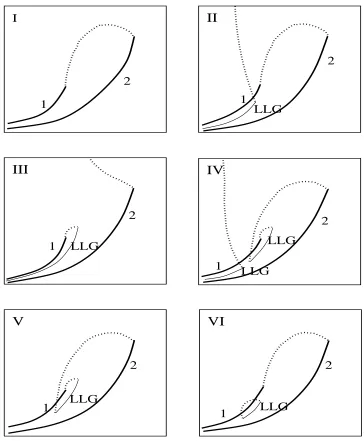
2.1 Six classifications of fluid phase behavior . . . 34
2.2 Method for finding liquid-liquid immiscibility with an UCST . . . 35
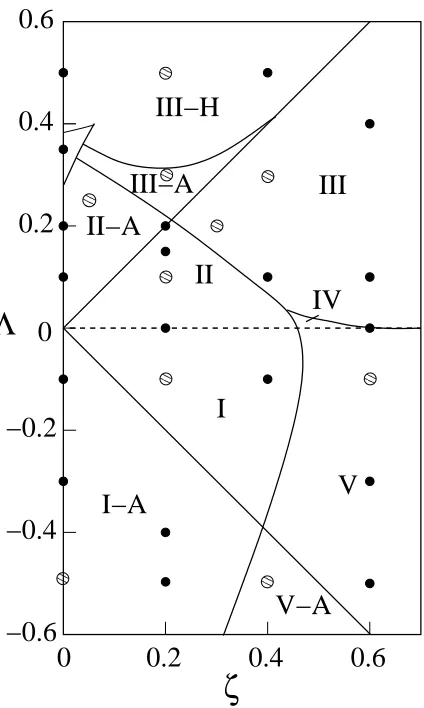
2.3 Parameters for which complete phase diagrams were calculated . . . 36
2.4 A series of temperature-composition diagrams at varying pressures with
and "!#%$ . . . 37
2.5 A temperature-composition diagram at a pressure,&(')*+, with* and
-"!./ . . . 38
2.6 A temperature-composition diagram at a pressure,& ' *+, with and
-%$ . . . 39
2.7 A series of temperature-composition diagrams at varying pressures with
*,/ and0+/ . . . 40
2.8 A series of temperature-composition diagrams at varying pressures with21
2.9 A temperature-composition diagram at a pressure, &('45%$ with(63 and
- . . . 42
2.10 A temperature-composition diagram at a pressure, & ' 5%$ with(6 and -3 . . . 43
2.11 A temperature-composition diagram at a pressure, & ' 5*,/ with(6 and -/ . . . 44
2.12 A series of temperature-composition diagrams at varying pressures with78 and "!#%$ . . . 45
2.13 A temperature-composition diagram at a pressure, & ' *+,/ with21 and -"!./ . . . 46
Chapter 3 Solid-Liquid Phase Behavior of Ternary Mixtures 47 3.1 Schematic of ternary Gibbs Duhem integration . . . 65
3.2 Binary phase diagram of component 1 and the solvent at&('.*91, . . . 66
3.3 Binary phase diagram of component 2 and the solvent at&('.*91, . . . 67
3.4 Binary phase diagram of component 1 and component 2 at&:'.*91, . . . 68
3.5 Ternary phase diagram calculated at ; ' $9*+<=& ' *91, and >?A@B C*,+/C<=D ?A@ "$9%$E8+3 . . . 69
3.6 Ternary phase diagram calculated at ; ' $9*+<=& ' *91, and > ?A@ C*,+/C<=D ?A@ "$9%$GF9/ . . . 70
3.8 Ternary phase diagram calculated at ;'H KF9/C<=&'I *91, and > ?A@
$9J++C<=DL?A@M"$9%$E8+3 . . . 72
3.9 Ternary phase diagram calculated at ; ' $9*+<=& ' *91, and > ?A@
$9J++C<=D ?A@ "$9%$E8+3 . . . 73
3.10 Ternary phase diagram calculated at ; ' $9+/C<=& ' *91, and > ?A@
$9J++C<=D ?A@ "$9%$E8+3 . . . 74
3.11 Ternary phase diagram calculated at ;'H $93+/C<=&'I *91, and > ?A@
$9J++C<=DL?A@M"$9%$E8+3 . . . 75
3.12 Ternary phase diagram calculated at ; ' $93+JC<=& ' *91, and >?A@B
$9J++C<=D ?A@
"$9%$E8+3 . . . 76
Chapter 4 Future Work 77
Appendix A Global phase diagram for monomer/dimer mixtures 82
A.1 Comparison of GFD equation of state to molecular dynamics simulation results
for mixtures of monomers and dimers at > @N@EO > ?N? P/C<E$9* and $9/ , equal
segment diameters and equal volume fractionsQ ?NRC? SQ @TR+@ of the two species. 117
A.2 Comparison of GFD equation of state to molecular dynamics simulation results
for mixtures of monomers and dimers at>U@N@ O >U?N?VW$9/ andQX@YZ%$+$+$9<=3+3+3C<
and8+8,F and equal segment diameters. . . 118
A.3 Comparison of GFD equation of state to molecular dynamics simulation results
for mixtures of monomers and 8-mers at > @N@GO > ?N? [/C<E$9*< and $9/ , equal
A.4 Six classifications of phase behavior . . . 120
A.5 Schematic of a parametrized plot of\]? vs. \L@ . . . 121
A.6 The global phase diagram predicted by the Generalized Flory Dimer theory for
a mixture of square-well monomer and dimers. . . 122
A.7 A schematic of the global phase diagram predicted by the van der Waals equation
of state for a mixture of equal-sized molecules as calculated by van Konynenburg
and Scott . . . 123
C
HAPTER
1
I
NTRODUCTION
Knowledge of the equilibria between solids and fluids is of vital importance in designing
in-dustrial processes based on crystallization, including separations, purification, concentration,
solidification, and analysis. Crystallization is widely used in the pharmaceutical industry for
product recovery because it yields high purity products with a relatively low energy expenditure
compared to distillation or other common methods of separation. Crystallization has economic
benefits over distillation for components with melting points near ambient conditions because
of its lower energy requirements. The lower operating temperatures typically used in
crystal-lization processes are also important when separating components that would decompose at the
temperatures necessary for distillation?
. Crystallization is also used in the desalination and
de-contamination of wastewater streams@
.
One area of crystallization that is of particular interest to us is chiral drug separation. For
chiral drugs, crystallization is the only feasible means of separation. Chiral drugs are normally
produced as a mixture of two racemates. In general, one of the racemates is the active ingredient;
the other is either inactive or has some unwanted activity. While it desirable to separate the
race-mates, this can not be done through standard techniques because the racemates have identical
crystallization techniques, which are also known as classical resolution^ . The two racemates are
first reacted with a chiral resolving agent, forming a pair of diastereomers that are chemically
identical but have different physical properties. The diastereomers are then separated using
frac-tional crystallization, taking advantage of the now differing solubilities of the two components.
As of yet the design of a diastereomeric separation process is more an art than a science and we
hope that this research will provide useful insights into the underlying phenomena.
A prerequisite to efficient use of crystallization is knowledge of the solid-liquid phase
equi-libria of the components to be separated. The solid-liquid phase diagram for a mixture has many
uses in the design of a fractional crystallization process. It can be used to identify feasible
opera-tion paths given a known feed stream, choose optimal operating condiopera-tions, and solve the related
mass balances in a separation operation_ . Although the solid-liquid phase diagram for a
partic-ular substance or mixture can be obtained by experiment, limited time and resources generally
allow for only a sampling of possible operating conditions for any given system. Theory and
molecular-level simulation make it possible to gain insight into the phase equilibria of whole
classes of mixtures, rather than just one in particular.
One might think that solid-fluid phase equilibria could be obtained from simulation directly
by simply putting a solid and fluid in contact with each other in the simulation box and allowing
them to come to equilibrium. Unfortunately this is not the case because, for reasonably-sized
systems, the breadth of the interface between the two phases makes it impossible to obtain
ac-curate bulk properties` . Even if the simulation box is large enough to overcome this problem,
system equilibration usually takes a long time due to slow mass transfer across the interfacea .
the Gibbs ensemble the two phases are simulated in separate boxes, each representing one of the
phases in equilibrium. Mechanical and thermal equilibrium between the boxes is maintained by
conducting the simulations at constant pressure and temperature. Chemical equilibrium is
main-tained by randomly attempting to insert particles from one phase into the other. This technique
does not work well for solid-fluid phase equilibria due to the difficulty of inserting a particle
from the liquid phase into the high-density solid phase. Without a sufficient number of these
swap moves, chemical equilibria is not maintained and the method fails.
An alternative for calculating solid-fluid equilibria in single or multicomponent systems is
the Gibbs-Duhem integration technique of Kofkec de . Instead of using a particle swap move to
maintain chemical equilibrium between the phases, an appropriate form of the Clapeyron
equa-tion is integrated to calculate the phase coexistence line. The Gibbs-Duhem integraequa-tion technique
procedure allows one to calculate an entire phase coexistence envelope in one calculation, rather
than in the many individual steps required when using Gibbs ensemble simulations. By
eliminat-ing the particle exchange move, the Gibbs-Duhem technique also makes it possible to calculate
single and multicomponent solid-fluid phase equilibria.
1.1
Overview
This thesis describes research into the fundamentals of solid-fluid phase equilibria by using
molecular simulation to analyze the phase change behavior of one of the simplest of all possible
mixtures, the Lennard-Jones binary mixture. In this section, we provide a short summary of
the remaining chapters of this thesis. All of the chapters are self-contained units complete with
Chapter 2 explores how the solid phase affects the global phase diagram of mixtures
com-posed of molecules of equal diameter. This was done by calculating “complete” phase diagrams,
that is including solid, liquid, and vapor phases, at 29 sets of Lennard-Jones parameters using
the Gibbs Duhem integration technique. For the systems studied, the well-depth ratio,> @N@GO > ?N? ,
ranged from 1.0 to 4.0 and the ratio of the interspecies well-depth to the Lorentz-Berthelot
mix-ing rule well-depth, f2> ?A@EOg> ?N? > @N@EhAikj ?lm@=n
, ranged from 0.5 to 1.875. By using the same parameter
definitions as Mazur et al. we are able to compare our results to their predictions for the global
phase diagram of Lennard-Jones mixtures. Phase diagrams were calculated for each region of
the global phase diagram, except for the type IV phase behavior region. We found that for
mix-tures in which the two pure components have similar critical temperamix-tures, the solid phase did
not significantly alter the vapor-liquid phase equilibria except at low pressure. For mixtures in
which the two components had greatly dissimilar critical temperatures, the solid phase interfered
with the fluid phase behavior over a greater range of pressures. In those cases, we found that it
was possible for the presence of the solid phase to change the classification of the fluid-phase
phase behavior.
Chapter 3 explores the role of molecular parameters, such as the Lennard-Jones well-depth
and diameter, in the crystallization of ternary mixtures. We investigate a model diastereomeric
mixture composed of Lennard-Jones particles. The two model diastereomer particles have
sim-ilar well-depths (> ?N? oC*+ vs. > @N@ oC*,/ ) and diameters (D ?N? p$9%$E/ vs. D @N@ q$9%$GF9/ ),
while the solvent has a much lower melting point and slightly smaller diameter ((>srtruv$9*+ and
D
rr
w$9*+ ). The cross-species parameters (>G?A@ and DL?A@ ) between the two diastereomers were
diameter up to the diameter of the large diastereomer resulted in a slight increase of the solubility
of the solid phase. We found that decreasing the interspecies well-depth to less than that of either
of the diastereomers resulted in an immiscibility in the solid phase and consequently a region of
three-phase equilibria (two solid phases and one liquid phase) in the ternary phase diagram. The
effect of temperature was then explored by calculating phase diagrams over a range of
tempera-tures for a given set of cross-species well-depths and molecular diameters. It was found that as
the temperature increases, the size of the three-phase region decreases until it disappears.
For completeness, an earlier study on the global phase diagram of monomer/dimer
mix-tures has been included in Appendix A. This work was defended as part of my Master of Science
research in September, 2001. In that research, we first extended the Generalized Flory Dimer
theory for hard sphere monomer/x -mer mixtures to square-well monomer/x -mer mixtures.
The-oretical predictions for the compressibility factor as a function of volume fraction are compared
to discontinuous molecular dynamic simulation results on monomer/dimer mixtures at well depth
ratios 0.5 - 1.5 and dimer mole fractions 0.111 - 0.667 and on monomers/8-mer mixtures at well
depth ratios 0.5 - 1.5. Agreement between theory and simulation is very good; this is
consis-tent with the performance of the GFD theory for other square-well systems. Next we calculate
the GFD-predicted global phase diagram for square-well monomer/dimer mixtures using a brute
force method. The locus of critical points in the&"!y; plane is calculated for a grid of points
in the 7!S plane, where is a measure of the difference between the monomer and dimer
well depths and is a measure of the strength of the attraction between monomers and dimers.
Initially, the locus of critical points was calculated for 360 points in a square grid between the
resolution in areas where more detail was needed. The most significant features of the resulting
global phase diagram is the absence of type IV and type VI behaviors. We also found that the
phase diagram is shifted towards the negative and directions when compared to the van der
Waals global phase diagram for equal diameter spherical molecules.
Chapter 2 and 3 and Appendix A have been adapted from the following publications:
Chapter 2 B. C. Attwood and C. K. Hall., “Effect of the Solid Phase on the Global Phase
Behavior of Binary Lennard-Jones Mixtures,” AIChE Journal, (submitted, 2003).
Chapter 3 B. C. Attwood and C. K. Hall., “Monte Carlo Simulations of Ternary Solid-liquid
Phase Equilibria,” AIChE Journal, (in preparation)
Appendix A B. C. Attwood and C. K. Hall., “Global Phase Diagram for Monomer/Dimer
1.2
References
[1] Cottin, X. , Paras, P. A. , Vega, C. , and Monson, P. A. , Fluid Phase Equil., 117, 114–125
(1996).
[2] Ericsson, B. and Hallmans, B. , Desalination, 105, 115–123 (1996).
[3] Stinson, S. C. , Chem Eng News, 9, 44 (1995).
[4] Takano, K. , Gani, R. , Ishikawa, T. , and Kolar, P. , Fluid Phase Equil., 194-197, 783–803
(2002).
[5] Panagiotopoulos, A. Z. , J Phys-Condens Mat, 12, R25–R52 (2000).
[6] Yan, Q. L. , Liu, H. L. , and Hu, Y. , Macromolecules, 29, 4066–4071 (1996).
[7] Panagiotopolous, A. Z. , Mol. Phys., 61, 813–826 (1987).
[8] Kofke, D. A. , Mol. Phys., 78, 1331–1336 (1993).
C
HAPTER
2
E
FFECT OF THE
S
OLID
P
HASE ON THE
G
LOBAL
P
HASE
B
EHAVIOR OF
B
INARY
L
ENNARD
-J
ONES
M
IXTURES
2.1
Introduction
Knowledge of the equilibria between solids and fluids is of vital importance in industrial
processes based on crystallization, including separations, purification, concentration,
solidifi-cation, and analysis. Crystallization is widely used in the pharmaceutical industry for product
recovery because it yields high purity products with a relatively low energy expenditure
com-pared to distillation or other common methods of separation. Crystallization is also used in the
desalination and decontamination of wastewater streams ?
, the resolution of racemic mixtures@
,
and the separation and purification of numerous organic and inorganic mixtures^ . A
prereq-uisite to efficient use of crystallization is knowledge of the solid-liquid phase equilibria of the
components to be separated.
The techniques for calculating phase equilibria of a system based on knowledge of its
of the molecular interaction parameters in order to predict the phase equilibrium for a particular
fluid or mixture. A different approach was taken in the late sixties by van Konynenburg and
Scott_
–
a who chose to examine the phase behavior predicted for a binary mixture obeying the
van der Waals equation of state over the entire range of interaction parameters. Their approach
involved calculating the locus of critical points as a function of composition, pressure, and
tem-perature. The type of phase behavior could then be classified into different types based on the
projection of the locus of critical points onto the& -; plane, as seen in Fig. 2.1.
For their analysis of mixtures of equal-sized components, Scott and van Konynenburg_Uda
considered two dimensionless interaction parameters, and , which were a function of the
attractive interaction parameters z ?N?
<=z @N@
< and z
?A@ between molecules of components 1 and 2,
where { gz @N@ !z ?N? hNOg z @N@Y| z ?N? h and } gz ?N?#| z @N@ !79z ?A@GhNOgz @N@Y| z ?N? h. For equal
sized molecules, is related to the differences in critical temperatures or pressures of the pure
components and is related to the molar heat of mixing at;66 . By determining the locus of
critical points for a range of these parameters, they were able to construct a global phase diagram
which divides the (!- parameter space into regions of similar phase behavior. Their global
phase diagram for the van der Waals equation of state accounts for five of the six types of fluid
phase behavior known to exist in nature. The only type of phase behavior not found by Scott and
van Konynenburg was type VI, which is distinguished from the other types by a region of closed
loop immiscibility. This was an important result because it showed that even though the van der
Waals equation of state is simplistic and quantitatively inaccurate for most fluids, it is able to
predict much of the phase behavior found in nature.
phase behavior for other equations of state. Furman et al. calculated the global phase behavior for
a regular solution model of a three-component mixture that is nearly equivalent mathematically
to a van der Waals model for binary mixtures with the parameter~ independent of concentration
(implying that the molecules are of equal size) and the parameter z a quadratic function of
compositionb . They found significant agreement between the phase diagram they calculated and
the one calculated by van Konynenburg and Scott for equal diameter molecules. Later Furman
and Griffithsc revisited the global phase diagram for the van der Waals model and discovered a
heretofore unidentified “shield region”, a small region containing several new classes of phase
behavior that had not been pointed out previously by van Konynenburg and Scott.
Mazur and Boshkove
–?N?
investigated the global phase behavior of binary Lennard-Jones
fluid mixtures using a polynomial form for the equation of state that was proposed earlier and
regressed to simulation data by Ree?A@
. This was the first analysis of the phase behavior of
a relatively modern equation of state that included a systematic look at the entire interaction
parameter space. Mazur and Boshkov’s papers revealed that the global phase behavior predicted
for Lennard-Jones fluids is qualitatively similar to that of the van der Waals equation of state,
except that Type VI phase behavior is also predicted. Dieters and Pegg calculated the global
phase diagram for the Redlich-Kwong equation of state?
^ in 1989 and found that for equal-sized
molecules, the global phase diagram predicted by the Redlich-Kwong equation of state is similar
to that found for the van der Waals fluid or the Lennard-Jones fluid. In this case however, no
instances of Type VI behavior were found. As the difference in molecular size was increased,
the topology of the global phase diagram changed considerably, with new sub-classes of phase
behavior being predicted. Kraska and Dieters?
equation of state a few years later in 1992. For equal-sized molecules the results were again
similar to those for the van der Waals equation of state. For molecules of different size, some
unusual new phase behavior was found involving four-phase states and high density instabilities.
In recent years, a number of investigators?
`
–?
e have calculated closed-loops of immiscibility
for equations of state based on isotropic potentials, a result that continues to be debated in the
literature. Yelash and Kraska?
` found that even a simple equation of state composed of the
Carnahan-Starling repulsion and the van der Waals attraction exhibited several types of
closed-loop phase behavior. One disadvantage of the global phase diagrams found in the literature is
that they are based on equations of state that are only applicable for fluid phases.
In this chapter, we consider how including the possibility of a solid phase influences the
global phase behavior of a binary mixture of equal-diameter Lennard-Jones molecules. We
cal-culate “complete” phase diagrams, that is including solid, vapor, and liquid phases, for 29 sets of
interaction parameters using the Gibbs Duhem integration technique developed by Kofke@N
d
@ ?
.
Since we have used the same interaction parameters as Mazur et al., we are able to compare our
results to their predictions for the global phase diagram of Lennard-Jones mixtures. It is
impor-tant to point out that our goal is not to remap the global phase diagram, since that is not our focus
and is extremely expensive computationally, but instead to sample the behavior in different
re-gions of the global phase diagram. By calculating temperature-composition phase diagrams at a
number of pressures for each set of interaction parameters we are able to see how the solid phase
influences the type of phase behavior exhibited by the fluid phases. That is, we seek to determine
those sets of parameters for which the classification of the fluid phase behavior with the solid
fluid phase equation of state.
For certain sets of parameters we consider our results in light of the classification scheme
for complete phase diagrams developed by Valyashko@N@
. Valyashko proposed a scheme of twelve
types based on analysis of experimental data and the method of continuous topological
transfor-mation. Valyashko proposed two main groups of complete phase behavior. In group 1 systems, a
continuous three-phase (SLV) curve in P-T-x space connects the triple points of the two
compo-nents. In group 2 systems, the three-phase (SLV) curve is interrupted by the locus of L-V critical
points, resulting in a discontinuity in both of the curves. Further subclasses are determined by
considering the presence and location of the liquid-liquid immiscibility region and the locus of
the three-phase (SLV) coexistence curve.
Highlights of our results are as follows. We find that for mixtures in which the components
have similar critical temperatures, inclusion of the solid phase does not significantly alter the
types of fluid phase equilibria observed. This is because for these mixtures the melting point
of both components is below the boiling point of either component. As such, the solid phase
can only impact the observed vapor-phase behavior at low pressures close to the triple point
of one or both of the components. Since the phase behavior classification scheme is based
mainly on the locus of the vapor-liquid critical points this low pressure interaction does not
alter the classification of these mixtures. However, as the difference in critical temperatures
increases, the solid phase of the component with the higher critical temperature can coexist with
the vapor phase of the component with the lower critical temperature. This results in some
interesting new behavior, such as the formation of a vapor-solid eutectic point. This interference
fluid-phase equilibria that are necessary in the classification of the type of phase behavior, such
as the presence of liquid-liquid immiscibility at low temperatures. It is seen that in those cases
the solid phase effectively alters the classification of the fluid phase behavior that would be seen
in experiment from what would have been predicted based on a fluid-phase-only equation of
state.
The remainder of this chapter is organized as follows. In Section 2 we briefly review the
Gibbs-Duhem technique for binary mixtures. In Section 3 we present our results and discuss
their significance. Section 4 concludes the chapter with a brief summary.
2.2
Method
2.2.1 Gibbs Duhem integration technique
The Gibbs Duhem integration technique is based upon integrating an appropriate form of
the Clapeyron equation which describes how the field variables vary as a function of each other
at equilibrium. One can calculate the properties of two coexisting phases as a function of almost
any variable of interest. For a mixture of components, the Gibbs-Duhem equation @N
can be
expressed as
#%6
% ?
% 7
|0
.%
!
% ? Q
(2.1)
where
is the pressure, is the compressibility factor,
QL and
are the mole fraction and
fugacity of species, is the residual molar enthalpy,
Boltzmann’s constant, and
is the fugacity fraction, defined as
L ? (2.2)
For binary mixtures equation 2.1 reduces to the following
.% g ?|
@Eh 7
|0 .%
!
Q @ !
@ @,g $#! @Eh @ (2.3)
sinceQ ? Z$)!Q @ and
? Z$)!
@ .
The Gibbs-Duhem equation can be applied to two phases, and , in equilibrium, by
writing Eq. 2.3 for each of the phases. Since the fugacity, and hence the fugacity fraction, of
each of the components is identical in phases and , we can set the right-hand sides of those
two equations equal to get
|0 #% ! Q @ ! @ @,g $.! @Eh @.7 |0 .% ! Q @ ! @ @9g $#! @Eh @ (2.4)
At this point one has a choice as to which variable to hold constant and which variable to
inte-grate with respect to. In the calculation of temperature-composition diagrams we hold pressure
constant and integrate Eq. 2.4 with respect to the fugacity fraction of component 2. Solving for
,
O
,
@ we get
@ Q @ !¡Q @ g !¢ h @,g $.! @h (2.5)
By starting with values of
and
@ at a known equilibrium point, we can calculate
as a
function of
an initial value for the integrand is needed. In general, we start the integration at one of the
pure components, i.e.
@4v or $ . Because the right-hand side of Eq. 2.5 is undefined at either
of these conditions, we obtain its value by calculating its limit as
@¤£ ¦¥+§)$ . Assuming the
mixtures to be ideal as
@#£ , the following approximations are made
@)Q@¨(@ (2.6) ? ª© ? (2.7) where ©
? is the fugacity of pure component 1; these approximations are based on Henry’s law
and the Lewis Randall rule, respectively. Thus we can write
@¬« « «® °¯²±E³ ´ µ ®9¶ ! ¯¬±E³ ´ µ ®s¶ !y (2.8)
The quantity ª·
?
O ¨:@ can be evaluated during an NPT simulation (at the boiling temperature
of pure component 1 for the desired pressure) on pure component 1 by performing trial identity
switches of randomly chosen atoms. The value of
·
?
O ¨ @ can then be calculated from
· ? ¨ @ Z¸º¹U»¼ gk½u¾²¿ÁÀXàÁÄ
O9 ; hNÅmÆÇXÈ (2.9)
where¸ Å denotes the ensemble average and¾]¿ÁÀXÃÂ ÁÄ
is the potential energy change upon switching
particle identities. The values of g ·
?
O ¨ @Gh and
g
·
?
O ¨ @Gh
can be calculated by conducting a
simulation at the density of the and phases respectively. If we are starting the integration
for -É
the initial value of the integrand. In either case, the values of the compositions and enthalpies in
Eq. 2.5 will either be known from a prior Gibbs-Duhem integration or can be calculated by an
NPT
@ simulation at the desired temperature, pressure, and fugacity fraction.
Once the initial condition is calculated, the integration is carried out using a standard
predictor-corrector algorithm. A step,½
@ , in the fugacity fraction value is taken and the
predic-tor formula is used to find the new value for the inverse temperature, i.e.
?
|0Ê ®
ÌË ® ®
@
,
@ (2.10)
A separate semigrand ensemble (constant NPT
@ ) Monte Carlo simulation is then performed
for each of the coexisting phases to evaluate the enthalpy and composition at the new fugacity
fraction and temperature. After the simulations have equilibrated, the integrand is recalculated,
the corrector formula is applied to find the “corrected” inverse temperature, and more simulations
are performed at the new value for the temperature. This corrector step is repeated until the
inverse temperature converges to its final value. A production run of simulations is then carried
out to calculate the final values for the enthalpies and compositions of the coexisting phases.
These values are then used in the predictor formula to calculate the inverse temperature at the
next value of the fugacity fraction. Continuing this process we can calculate the entire phase
coexistence envelope, starting at phase equilibrium for either of the pure components.
For certain sets of parameters, there is a range of pressures for which two two-phase
co-existence envelopes, e.g. vapor-liquid and liquid-solid, overlap over a range of temperatures
resulting in three-phase equilibria, e.g. vapor-liquid-solid coexistence, at the point of
for which the envelopes overlap. The solid-vapor coexistence envelope is calculated by
conduct-ing a Gibbs Duhem integration startconduct-ing at the values of temperature and
@ at the point of overlap
of the vapor-liquid and liquid-solid coexistence envelopes. The solid and vapor phases at that
temperature are used as the initial coexisting phases to start the integration. This procedure is
explained in greater detail in a paper by Lamm and Hall@ ^ .
A different approach is needed to calculate low-temperature liquid-liquid immiscibility with
an UCST, as would be found in type II phase behavior at higher pressures, because those curves
do not originate at either of the pure components. One way to calculate an initial point for
starting the integration would be to use Gibb’s ensemble simulation to calculate the properties of
the coexisting liquids at one temperature. We have developed an alternative approach that makes
use of the Gibb Duhem integration technique, as illustrated in Fig. 2.2 for the systemÍB
and ÎÏ%$GF9/ . Our approach starts by calculating a temperature-composition diagram at a
pressure (&'ÐÎ*91 ) lower than the desired pressure, where there is three-phase coexistence
(Fig. 2.2(a)). We then choose a temperature (; ' oÑ+Ñ ) below the three-phase coexistence
temperature at which two liquids are in equilibrium (solid circles on Fig. 2.2(a)). After that a
Gibbs Duhem pressure integration can be conducted at constant temperature (; ' vÑ+Ñ ) up to
the pressure (& ' I*,/ ) of interest (open circles Fig. 2.2(b)) using the following form of the
Clapeyron equation
& '
@
Q
@
!¡Q
@
gÁ
!
h
@+g $.!
@Eh
(2.11)
The resulting two coexisting liquid state points can then be used as initial conditions (open circles
2.2.2 Simulations
As mentioned previously, semigrand ensemble Monte Carlo (NPT
@ ) simulations are used
to evaluate the properties of the coexisting phases during the integration of the Gibbs-Duhem
equation. In this section, we briefly describe how these simulations are conducted.
There are three types of moves in the semigrand ensemble: particle displacement, volume
change, and identity exchange. The particle displacement and volume change moves are carried
out in the same manner as in isothermal-isobaric (NPT) simulations. The identity exchange move
involves choosing a random molecule in the system and switching its identity. The change in the
configurational energy of the system caused by the identity change is then evaluated. The overall
acceptance probability,Ò , for these moves is
ÒvÓ:Ô
fÃ$9<N¹U»C¼ g !
g¾¦Õ×ÖºØ*ÙmÚ ! ¾¦ÛNÚ2Ü,h !
& gÁÝVÕ×ÖºØ*ÙmÚ ! ÝYÛNÚ2Ü,hª| % Ý
Õ×ÖºØ*ÙmÚ
Þ
ÛNÚ2Ü
|
%
 àßâá
·
áã
hAi (2.12)
where ¾
Õ×ÖºØ*ÙmÚ and
¾
ÛNÚ2Ü are the configurational energies,
Ý
Õ×ÖºØ*ÙmÚ and
Ý
ÛNÚ2Ü are the volumes of the
trial and existing states respectively, is the total number of molecules, and
Â
àßâá and
·
áKã refer
to the fugacity fractions of the trial and existing identities of the molecule during the identity
exchange moves. At each step, the type of move is randomly chosen with a weighting such
that for every volume change move there are 20 particle displacements and 20 identity exchange
moves. After an appropriate number of equilibrium moves, running averages of the composition
and enthalpy (as calculated by v ¾)O | & ÝäO ) are calculated for use in evaluating the
integrand in the Gibbs Duhem technique.
Other details of the simulation are as follows. Prior theoretical calculations@
simulations@
` have shown that by choosing diameter ratiosJ+/(åæD ?N? O D @N@ å6$9* we can assume
that the most stable configuration for the solid phase will be that of a substitutionally disordered
fcc lattice. By using an fcc lattice as an initial configuration for the solid phase, an fcc lattice will
be maintained in the solid phase throughout the simulation without any additional constraints on
the simulation. The simulations are performed on a system of 500 molecules in a cubic box with
periodic boundary conditions. The molecules interact via the Lennard-Jones potential
ç
*è gºéth
S1t>N*è
¯
D*è
é
¶
?A@
!
¯
Dê*è
é
¶
a
(2.13)
where ç
*è is the potential energy of the interaction between atoms and ë , é is the distance
between atoms and ë , >T2è is the Lennard-Jones well-depth, and DÌ*è is the Lennard-Jones
di-ameter. The potential interactions are truncated at half the box length and standard long-range
corrections@
a are applied to the potential energy and pressure calculations.
2.3
Results and Discussion
We have calculated complete phase diagrams at conditions indicated by the circles on the
Mazur et al. global phase diagram shown in Fig. 2.3. The small dots indicate sets of parameters
at which complete phase diagrams have been calculated for at least one pressure and the larger
dots indicate sets of parameters at which complete phase diagrams have been calculated at more
than one pressure. We have not calculated the phase behavior in region IV because that region
is very small. In addition, it is difficult to be sure that a chosen set of parameters will lie within
equation of state. In each of the phase diagrams presented here, the upper row of diagrams show
the phase behavior calculated using the Gibbs Duhem technique for the fluid and solid phases,
the middle row is a schematic of the upper row of diagrams presented when necessary, and the
bottom row shows the phase behavior calculated when considering only the fluid phases. The
fluid-phase-only diagrams were calculated by simply omitting the calculation of the solid-fluid
phase coexistence. In this way we are able to calculate metastable fluid phase equilibria below
the freezing point of the mixtures. In the fluid-phase-only diagrams, the dotted lines indicate
portions of the diagram whose presence is inferred rather than calculated. In these cases the
fluid phase was sufficiently unstable compared to the solid phase that it spontaneously solidified
during the simulation. Table 2.1 lists the temperature and compositions of the coexisting phases
for each of the three-phase coexistence lines found in Figs. 2.4-2.13. In both the figures and the
table,&')ì&YDª^ ?N?
O > ?N? and;M')ì ; O > ?N? .
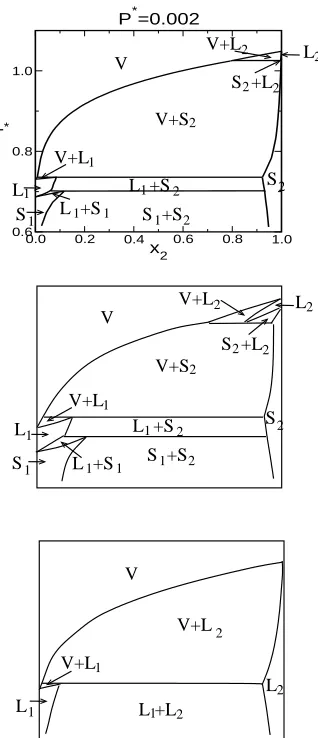
Fig. 2.4 shows a series of temperature-composition phase diagrams at decreasing pressures
for 0Ï and Îí!.%$ , which is in the type I region on the Mazur et al. global phase
diagram. In terms of the fluid-phase-only phase behavior classification, Type I phase behavior
is characterized by a single vapor-liquid phase coexistence envelope terminated at either end by
the pure component boiling points at the pressure of interest. We find that at high pressures (e.g.
&':I*,/ , Fig. 2.4(a)), the solid does not affect the fluid phase equilibria because the
vapor-liquid phase coexistence envelope occurs at a significantly higher temperature than the
solid-liquid phase coexistence envelope. At intermediate pressures (e.g.&:'.*+,/ Fig. 2.4(b) ) , the
solid-liquid phase coexistence envelope intersects with the descending vapor-liquid phase
re-gions of vapor-liquid, liquid-solid, and vapor-solid phase coexistence. Between these two
three-phase lines lies a range of temperatures at which there is coexistence between a solid three-phase and
a vapor phase. As the pressure decreases further, the range of temperatures at which vapor-solid
equilibria occurs broadens until the triple point pressure of pure component 2 (&
'
*+$E8+/ ) is
reached. Below this there is no longer solid-liquid and vapor-liquid equilibria for pure component
2, but only solid-vapor equilibria. At low pressures (e.g. &:'îH*+$U1t+/ , Fig. 2.4(c) ), which
is below the triple point pressure of component 2, the phase coexistence is predominantly
solid-vapor. Without including the possibility of a solid phase, we would be unable to see any of the
three phase (SLV) coexistence curves in region I. The complete phase behavior can be classified
as type 1a according to Valyashko’s scheme based on examining the temperature-composition
phase diagrams shown in Fig. 2.4. An experimental system which has similar complete phase
behavior is silver nitrate + water@ b .
Fig. 2.5 shows a temperature-composition phase diagram at &('îB*+, forï* and
6ð!./ , which is in the type I-A region on the Mazur et al. global phase diagram. Because
the mixture is symmetric (zX?N?¤wz@N@ ) the diagram is symmetric about QL@ñw/ . In terms of
fluid-phase-only phase behavior classification, Type I-A differs from Type I in that Type I-A
exhibits an azeotrope in the vapor-liquid phase coexistence envelope. When including the solid
phase, we find that there is an azeotrope in the solid-liquid phase coexistence envelope as well.
Because of the presence of the azeotrope there are two regions of vapor-solid phase coexistence,
in contrast with the single region of vapor-solid phase coexistence seen in Figs. 2.4(a)and 2.4(b).
Fig. 2.6 shows a temperature-composition phase diagram at &
'
fluid-phase-only phase behavior classification, the fluid phase equilibria is similar to that of type
I except that type II has low temperature liquid-liquid immiscibility. The pressure& ' Z*+,
is just above the triple point of component 2. Two three-phase coexistence lines (VL@ S@ and
VL? S@ ) separate regions of liquid and liquid-solid coexistence from a region of
vapor-solid coexistence, while one three-phase coexistence line (L? S? S@ ) separates regions of
liquid-solid coexistence from the region of liquid-solid-liquid-solid coexistence. It can be seen that for this set of
pa-rameters and at this particular pressure and temperature, liquid-liquid immiscibility is metastable
compared to the liquid-solid and solid-solid phase equilibria since liquid-liquid immiscibility is
present in the fluid-phase-only diagram, but not in the complete phase diagram.
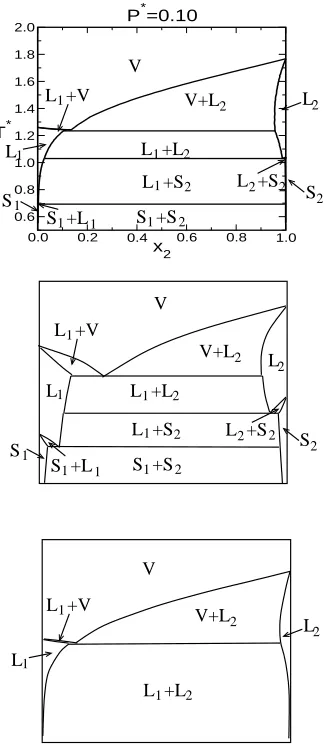
Fig. 2.7 shows a series of temperature-composition phase diagrams at decreasing pressures
forò*,/ and0+/ , which is in the type II-A region on the Mazur et al. global phase
di-agram. In terms of the fluid-phase-only phase behavior classification, Type II-A phase behavior
is the same as type II with the addition of an azeotrope in the vapor-liquid coexistence curves.
At the highest pressure (& ' H*,J , Fig. 2.7(a)) we can see that below; ' óKF9/+/ the
liquid-liquid immiscibility becomes less stable than liquid-liquid-solid phase coexistence. The interference
between the solid phase and liquid phases results in the formation of two three-phase
coexis-tence lines (L? L@ S@ ) and (S? L? S@ ) separating liquid-liquid, liquid-solid, and solid-solid phase
coexistence. We are unable to calculate the liquid-liquid immiscibility curve all the way up to
the UCST because as the critical point is approached, density fluctuations cause the simulation to
become unstable. The dashed line indicates where we expect the curve would be, approximately.
The liquid-liquid coexistence curves in this case were calculated by the method described in
envelope interferes with the liquid-liquid coexistence curves and a third three-phase line (L? VL@ )
is produced. As the pressure decreases further the L? VL@ line decreases in temperature and the
L? L@ S@ increases in temperature until they eventually coincide to form a four phase (L? VL@ S@ )
line at one value of the pressure (the quadruple point). We have not located the quadruple point
directly because this involves guessing the exact temperature at which it occurs. (An alternative
approach would be to conduct two Gibbs Duhem integrations along the two three-phase lines
(L? VL@ and L? L@ S@ ) to find the pressure at which they merge. This is beyond the scope of this
paper.) At the lowest pressure shown (& ' ð*+$+$E8 , Fig. 2.7(c)) , which is below the triple
point of component 2, there are two three-phase lines (S? L? V) and (S? VS@ ). The liquid-liquid
immiscibility has been completely obscured by the presence of the solid phase. In addition, a
solid-vapor eutectic point, a vapor in equilibrium with two solid phases, has been formed. The
interesting phenomena here are the changes in the three-phase lines as the pressure decreases and
the formation of a vapor-solid eutectic point, neither of which would be seen without including
the possibility of the solid phase. The complete phase behavior can most closely be classified
as type 1b
according to Valyashko’s scheme based on examining the temperature-composition
phase diagrams shown in Fig. 2.7. Based on the series of phase diagrams shown in Fig. 2.7, the
experimental system ethane + x -tetrasocane exhibits the most similar phase behavior although
there is no azeotrope in the vapor-liquid phase equilibria @ c .
Fig 2.8 shows a series of temperature-composition phase diagrams at decreasing pressures
for 0Ï21 and }Ï3 , which is in the type III region on the Mazur et al. global phase
diagram. In terms of the fluid-phase-only phase behavior classification, Type III phase behavior
component critical point to the other. At the highest pressure (&:':ô%$E/ , Fig. 2.8(a)), which
is above the critical pressure of pure component one, we see that the interference of the solid
phase with the vapor-liquid equilibria results in two three-phase coexistence lines (VL@ S@ and
VS? S@ ) separating regions of vapor-liquid, vapor-solid, and solid-solid phase coexistence. At
the two lower pressures (& ' 5*,/ , Fig. 2.8(b) and& ' v*+,/ , Fig. 2.7(c)), which are below
the critical pressure of component 2, a third three-phase coexistence line (VL? S@ ) is formed and
liquid-solid phase coexistence appears. One feature of type III phase behavior that we do not see
in this series of graphs is liquid-liquid immiscibility. Because the melting point of component
two is above the boiling point of component one, we find liquid-solid and solid-solid phase
coexistence occurring in the region where we would have expected liquid-liquid immiscibility.
We did find a small set of parameter sets in the type III region where liquid-liquid immiscibility
was not completely hidden by the liquid-solid and solid-solid phase equilibria. Figure 2.9 is
one such set of parameters, withB3 and vB . It can be seen that for a narrow range
of temperature there are two liquids in equilibrium with each other. We could not find a set of
parameters in the type III region in which the UCST of the liquid-liquid immiscibility was stable
with respect to the solid-liquid and solid-solid phase equilibria. The complete phase behavior
can most closely be classified as type 2a according to Valyashko’s scheme based on examining
the temperature-composition phase diagrams shown in Fig. 2.8. An experimental system which
has similar complete phase behavior is sodium sulfate and water@ b .
Fig. 2.10 shows a temperature-composition phase diagram at &:'õB%$ forï and
5H3 , which is in the type III-A region on the Mazur et al. global phase diagram. In terms
from type III by the presence of an azeotrope in the vapor-liquid phase diagram at high
pres-sures. It can be seen in Fig. 2.10, that the interference of the solid phase with the vapor-liquid
equilibrium results in the formation of two additional three-phase coexistence lines (L? L@ S@ and
S? L? S@ ) separating regions of liquid-liquid, liquid-solid, and solid-solid phase equilibria.
Al-though we investigated the phase behavior at a number of different pressures, we never located a
UCST for the liquid-liquid immiscibility, which indicates that this set of parameters may actually
be in the Type III-H region.
Fig. 2.11 shows a temperature-composition phase diagram at & ' B*,/ forï and
5H/ , which is in the type III-H region on the Mazur et al. global phase diagram. In terms
of the fluid-phase-only phase behavior classification, Type III-H phase behavior is distinguished
from type III by the presence of a heteroazeotrope in the vapor-liquid phase diagram, that is a
vapor-liquid eutectic. It differs from Type III-A in the following way. While Type III-A also
has a heteroazeotrope at low pressure, as the pressure is increased the vapor-liquid equilibria
separates from the liquid-liquid equilibria and the heteroazeotrope is replaced by an azeotrope.
In Type III-H phase equilibria, the heteroazeotrope is not replaced by an azeotrope at any
pres-sure. In this figure we can see that the increased value of compared to that in Fig. 2.10, (i.e.
decreased attractions between the two components) has caused the two components to become
more immiscible.
Fig 2.12 shows a series of temperature-composition phase diagrams at decreasing pressures
for ö8 and ô[!.%$ , which is in the type V region on the Mazur et al. global phase
diagram. In terms of the fluid-phase-only phase behavior classification, the unique feature of
vapor-liquid coexistence envelope, as depicted by the dashed lines in the bottom ;"!{Q diagram at
& ' ÷%$E/ (Fig. 2.12(a)). However, we found that interference by the solid obscured the region
in which this liquid-liquid immiscibility is supposed to occur. The consequence of this is that
although the equation of state might predict that this system should exhibit type V phase behavior,
experimentally it would appear to behave more like a type I mixture. As indicated in the
fluid-phase-only diagrams by the dashed line, we were unable to calculate the complete fluid phase
coexistence envelopes at the two lowest pressures. This occurred because the coexisting vapor
and liquid phases became so unstable as the vapor-solid coexistence region was entered during
our simulations, that the liquid phase spontaneously crystallized resulting in coexisting vapor and
solid phases. This prevented us from confirming the existence of the liquid-liquid immiscibility
expected for type V phase behavior. Similar attempts to find the LCST atò8 and0"!#3
or Iq!./ were also unsuccessful. The complete phase behavior can be classified as type
2a according to Valyashko’s scheme based on examining the temperature-composition phase
diagrams shown in Fig. 2.12. An experimental example of a system which exhibits similar phase
behavior is carbon dioxide +x -tetrasocane
@
e .
Fig. 2.13 shows a temperature-composition phase diagram at & ' "*+,/ for¤v21 and
0"!./ , which is in the type V-A region on the Mazur et al. global phase diagram. In terms of
the fluid-phase-only phase behavior classification, Type V-A phase behavior is similar to Type V
phase behavior with the additional feature of an azeotrope in the vapor-liquid phase coexistence
envelope. In Fig. 2.13, it can be seen that there is an azeotrope in both the vapor-liquid and
solid-liquid phase coexistence envelopes. Furthermore, we see that the interference of the solid phase
separating regions of vapor-liquid, vapor-solid, and liquid-solid phase coexistence.
2.4
Conclusions
Our general conclusions are that for mixtures in which the components have similar critical
temperatures, i.e. yÉó3 , inclusion of the solid phase does not alter how the phase behavior
of the mixture would be classified based solely on the fluid phase behavior. This is because the
classification scheme is based primarily on the locus of gas phase critical points. For values of
close to zero, the influence of the solid phase is only felt at temperatures and pressures well below
the critical point of either species, which means that it does not alter the topology of the locus
of critical points. This is seen to be especially true in regions I and II. For mixtures in which the
components have greatly dissimilar critical temperatures, i.e. ñøS21 , the fluid phase behavior
type may be different from what is expected because the solid phase for the component with the
higher critical point can exist in equilibrium with supercritical phases of the other component.
When this happens, the coexistence between a vapor rich in one species and a solid rich in the
other species can alter the topology of the locus of vapor-liquid critical points. This was seen in
the figures presented for region V.
2.5
Summary
The Gibbs Duhem integration technique was used to calculate composition-temperature
phase diagrams at 29 different points on the global phase diagram for binary mixtures of
Lennard-Jones molecules. We presented phase diagrams calculated in each region of the global
diagram calculated by Mazur et al. using a polynomial equation of state for binary mixtures
of Lennard-Jones molecules. We found that for mixtures of components with similar critical
temperatures, i.e. ùÉï3 , the phase behavior was essentially the same as in the
fluid-phase-only case. For mixtures in which the components had greatly dissimilar critical temperatures,
¡ø"21 , interaction between the vapor and solid phases could significantly alter the fluid-only
phase behavior. This was manifested in interesting types of solid-fluid phase behavior, such as a
vapor-solid eutectic point, that is - a vapor in equilibrium with two immiscible solids. We found
that a mixture that would be expected to have type V phase behavior according to a fluid-phase
equation of state might experimentally exhibit type I phase behavior. This is because the phase
behavior features unique to type V phase behavior occur below the freezing point of the
mix-tures. We also found that while the Gibbs Duhem integration technique does make it possible
to calculate metastable phase behavior below the freezing point of the mixtures, the calculations
2.6
References
[1] Ericsson, B. and Hallmans, B. , Desalination, 105, 115–123 (1996).
[2] Schroer, J. W. , Wibowo, C. , and Ng, K. M. , AICHE J, 47, 369–387 (2001).
[3] Kramer, H. J. M. and Jansens, P. J. , Chem. Eng. Tech., 26, 247–255 (2030).
[4] van Konynenburg, P. H. . Critical Lines and Phase Equilibria in Binary Mixtures. PhD
thesis, University of California, Los Angeles, (1968).
[5] van Konynenburg, P. H. and Scott, R. L. , Discuss Faraday Soc., 49, 87 (1970).
[6] van Konynenburg, P. H. and Scott, R. L. , Philos. Trans. R. Soc. London, Ser. A, 298, 495–
540 (1980).
[7] Furman, D. , Dattagupta, S. , and Griffiths, R. B. , Phys. Rev. B, 15, 441–464 (1977).
[8] Furman, D. and Griffiths, R. B. , Phys. Rev. A, 17, 1139–1148 (1978).
[9] Mazur, V. A. , Boshkov, L. Z. , and Fedorov, V. B. , Dokl. Akad. Nauk SSSR, 282, 137–140
(1985).
[10] Boshkov, L. Z. and Mazur, V. A. , Russ. J. Phys., 60, 16–20 (1986).
[11] Boshkov, L. Z. , Dokl. Akad. Nauk SSSR, 294, 901–905 (1987).
[12] Ree, F. H. , J. Chem. Phys., 73, 5401–5403 (1980).
[13] Deiters, U. K. and Pegg, I. L. , J. Chem. Phys., 90, 6632–6641 (1989).
[15] Yelash, L. V. and Kraska, T. , Ber. Bunsenges. Phys. Chem., 102, 213–223 (1998).
[16] Yelash, L. V. and Kraska, T. , Phys. Che. Chem. Phys., 1, 307–311 (1999).
[17] Yelash, L. V. , Kraska, T. , and Deiters, U. K. , J. Chem. Phys., 110, 3079–3084 (1999).
[18] Scott, R. L. , Phys. Che. Chem. Phys., 1, 4225–4231 (1999).
[19] Wang, J.-L. , Wu, G.-W. , and Sadus, R. J. , Mol. Phys., 98, 715–723 (2000).
[20] Kofke, D. A. , Mol. Phys., 78, 1331–1336 (1993).
[21] Kofke, D. A. , J. Chem. Phys., 98, 4149–4162 (1993).
[22] Valyashko, V. M. , Z. Phys. Chemie, 267, 481–493 (1986).
[23] Lamm, M. H. and Hall, C. , AICHE J, 47, 1664–1675 (2001).
[24] Cottin, X. . A Theoretical Study of the Thermodynamics of Solid Solutions and Solid-Liquid
Phase Equilibria. PhD thesis, University of Massachuesetts, (1996).
[25] Kranendonk, W. G. T. and Frenkel, D. , Mol. Phys., 72, 679–697 (1991).
[26] Allen, M. P. and Tildesley, D. J. , Computer Simulation of Liquids. Oxford Science
Publi-cations, (1997).
[27] Findlay, A. , The Phase Rule. Dover Publications, Inc., 9th edition, (1951).
[28] Peters, C. J. , Lichtenthaler, R. N. , and de Swaan Arons, J. , Fluid Phase Equil., 29, 495–
504 (1986).
>=@N@ >U?A@ P' T' Phases QX@ Figure
1.500 1.375 0.005 0.873 V-L@ -S 0.014, 0.364, 0.462 Fig. 2.4(b)
0.919 V-L? -S 0.045, 0.524, 0.595
0.001425 0.715 V-L-S 0.000, 0.037, 0.087 Fig. 2.4(c) 1.000 1.500 0.002 0.740 V-L-S 0.000, 0.062, 0.108 Fig. 2.5
0.852 V-L-S 0.052, 0.356, 0.375
1.500 1.125 0.002 0.701 L? -S? -S@ 0.060, 0.117, 0.932 Fig. 2.6
0.736 V-L? -S@ 0.008, 0.088, 0.924
1.025 V-L@ -S@ 0.803, 0.997, 0.999
1.105 0.789 0.08 0.690 S? -L? -S@ 0.005, 0.012, 0.995 Fig. 2.7(a)
0.760 L? -L@ -S@ 0.024, 0.982, 0.994
0.01 0.685 S? -L? -S@ 0.005, 0.011, 0.996 Fig. 2.7(b)
0.755 L? -L@ -S@ 0.024, 0.982, 0.994
0.841 L? -V-L@ 0.049, 0.329, 0.963
0.0016 0.673 S? -V-S@ 0.007, 0.246, 0.997 Fig. 2.7(c)
0.686 S? -L? -V 0.001, 0.002, 0.058
2.333 1.167 0.15 0.700 V-S? -S@ 0.002, 0.004, 0.999 Fig. 2.8(a)
1.607 V-L@ -S@ 0.033, 0.990, 0.998
0.05 0.689 L? -S? -S@ 0.002, 0.004, 1.000 Fig. 2.8(b)
1.122 V-L? -S@ 0.003, 0.008, 1.000
1.603 V-L@ -S@ 0.062, 0.996, 0.999
0.005 0.687 L? -S? -S@ 0.002, 0.004, 1.000 Fig. 2.8(c)
0.838 V-L? -S@ 0.002, 0.007, 1.000
1.594 V-L@ -S@ 0.479, 0.998, 1.000
1.857 1.143 0.10 0.688 V-S? -S@ S 0.002, 0.004, 1.000 Fig. 2.9
1.257 L? -Lú -S@ 0.093, 0.942, 0.988
1.283 V-L? -L@ 0.043, 0.097, 0.932
1.500 0.875 0.10 0.692 S? -L-S 0.002, 0.003, 1.000 Fig. 2.10
1.030 L? -L@ -S@ 0.027, 0.986, 0.997
1.243 L? -V-L@ 0.116, 0.135, 0.956
1.500 0.625 0.05 0.691 S? -L? -S@ 0.000, 0.001, 1.000 Fig. 2.11
1.033 L? -L@ -S@ 0.005, 0.999, 1.000
1.104 L? -V-L@ 0.006, 0.066, 0.998
4.000 2.750 0.15 2.614 V-L@ -S 0.036, 0.879, 0.956 Fig. 2.12(a)
0.05 1.149 V-L? -S 0.000, 0.002, 0.469 Fig. 2.12(b)
2.697 V-L@ -S 0.088, 0.952, 0.984
0.005 0.808 V-L? -S 0.000, 0.003, 0.214 Fig. 2.12(c)
2.746 V-L@ -S 0.802, 0.999, 1.000
2.333 2.500 0.005 0.806 V-L? -S 0.000, 0.021, 0.126 Fig. 2.13
1.572 V-L@ -S 0.170, 0.684, 0.717
2.7
Figures
Page
2.1 Six classifications of fluid phase behavior . . . 34
2.2 Method for finding liquid-liquid immiscibility with an UCST . . . 35
2.3 Parameters for which complete phase diagrams were calculated . . . 36
2.4 A series of temperature-composition diagrams at varying pressures with
and "!#%$ . . . 37
2.5 A temperature-composition diagram at a pressure,&(')*+, with* and
-"!./ . . . 38
2.6 A temperature-composition diagram at a pressure,& ' *+, with and
-%$ . . . 39
2.7 A series of temperature-composition diagrams at varying pressures with
*,/ and0+/ . . . 40
2.8 A series of temperature-composition diagrams at varying pressures with21
and 3 . . . 41
2.9 A temperature-composition diagram at a pressure, & ' 5%$ with(63 and
- . . . 42
2.10 A temperature-composition diagram at a pressure, &
'
5%$ with(6 and -3 . . . 43
2.11 A temperature-composition diagram at a pressure, &('45*,/ with(6 and
2.12 A series of temperature-composition diagrams at varying pressures with78
and "!#%$ . . . 45
2.13 A temperature-composition diagram at a pressure, & ' *+,/ with21 and
II
III
IV
V
VI
1
2 2
2
1
1
2 2
1 2
1 I
1
LLG LLG
LLG LLG
LLG
LLG
L1
L1
L2 L2
0.0 0.2 0.4 0.6 0.8 1.0
x2
1.0 1.2 1.4 1.6
T*
P*=0.04
0.0 0.2 0.4 0.6 0.8 1.0
x2
0.02 0.03 0.04 0.05 0.06 0.07
P*
T*=0.99
0.0 0.2 0.4 0.6 0.8 1.0
x2
1.0 1.2 1.4 1.6
T*
P*=0.05
V+L
L +L L +L
L +L
L L
V+L V+L
V V
1 2
L
1 1 2 2
2 1
1 2
(a) (b) (c)
ûû ûûü
ü
ýý ýý þþ þþ ÿÿ
ÿÿ