ISSN(Online): 2319-8753 ISSN (Print): 2347-6710
International Journal of Innovative Research in Science,
Engineering and Technology
(An ISO 3297: 2007 Certified Organization)
Website: www.ijirset.com
Vol. 6, Issue 3, March 2017
Automatic Drip Irrigation System using
Raspberry Pi and Wireless Sensor Networks
D.Veera Vanitha1, S.Nivitha2, R.Pritha2, J.Saranya2, T.Shobika2
Assistant Professor, Department of ECE, Avinashilingam University, Coimbatore, India1
Department of ECE, Avinashilingam University, Coimbatore, India2
ABSTRACT:- This paper focus on determining the humidity and temperature of the soil using Raspberry Pi controller. The field of the image is recorded by using web camera and it is viewed in the remote server. If any movement is found in the field the web camera will automatically on and capture the images and it is recognised by Pyroelectric Infrared sensor (PIR). The temperature sensor and humidity sensor will measure both the moisture and temperature in the soil. If the water level is found less, it will be corrected automatically using the relay through Raspberry Pi controller. If any disturbance is found in the field the notification will be sent as message through Global System for Mobile communication (GSM) and the recorded video is sent through mail. And to remove the disturbance manual inspection should be carried out.
KEYWORDS: Humidity sensor, Temperature sensor, PIR sensor, Raspberry Pi controller, GSM.
I.INTRODUCTION
In order to minimize the complexities like wastage of water and reducing the man power by using Raspberry Pi controller. The different types of sensors like temperature, humidity and PIR sensor are monitored in the field. Then the sensed information like motor status, soil temperature is send as notification to registered user through GSM technology. Web camera is used to monitor the irrigation field. If any disturbance is found in the field it sends information to the user through mail.
To avoid problems in manual irrigation like wastage of water and human interference the automatic irrigation is used. This system refers to operating systems with no or minimum manual intervention. The introduction of automatic irrigation system has increased application efficiency and drastically reduced labour requirement. In automatic irrigation ‘Raspberry Pi controller’ is used to control sensors and for communication purposes. In this proposed system Raspberry Pi controller helps to know the conditions of the soil for the irrigation. If the value of sensed data does not match with the threshold values which are coded in the Raspberry pi controller required for the proper crop production and through the controller the relay which act as switch, motor is turned on then the irrigation will start automatically.
Web camera is used to capture the movements in the field. There is a PIR sensor which detects the motion in the field. When motion is detected the camera automatically initiate recording then Raspberry Pi controller device alerts the registered user. The hardware has two main components interacting with each other. One is the web application that executes on the mobile device browser and server-side scripts that run in a cloud which will be operated by the Raspberry Pi controller. GSM technology is to control and monitor the function of agriculture irrigation pump set and remote location using mobile phone. A notification of the captured images in the field is sent to the user through GSM.
ISSN(Online): 2319-8753 ISSN (Print): 2347-6710
International Journal of Innovative Research in Science,
Engineering and Technology
(An ISO 3297: 2007 Certified Organization)
Website: www.ijirset.com
Vol. 6, Issue 3, March 2017
crop by attaching the arrangement to his computer and spontaneously screen the irrigation system for the crop with regulatory moisture and temperature [3]. Pandurang H.Tarangeet.al, discussed an embedded Linux board which allows collecting the sensor information from sensor node continuously, store it in a database and providing the web interface to the user [4]. Yunseop (james) kim et.al, the usage of an automated closed-loop irrigation system requires three major components: machine conversion, navigation, and mission planning to support the solid communication protocol. It provided extensive details for the wireless communication interface of sensors from in-field sensor stations and for a programmable logic controller from a control station to the computer at a base station [5]. Joaquín Gutiérrez et.al, used Wireless sensor units (WSUs) and a wireless information unit (WIU), linked by radio transceivers that allowed the transfer of soil moisture and temperature data, implementing a WSN that uses Zigbee technology. The WIU has also has a GPRS module to transmit the data to a web server via the public mobile network [6]. Jyotsna Raut and V. B. Shere, Used wireless sensor networks in automation for irrigation, this system provides a low-cost wireless solution for an in-field WSN and remote control of precision irrigation. Data mining algorithms used enhances automatic intelligence for WSN based drip irrigation system [7]. ZhaoLiqiang et.al, has said that application monitors the whole farm from remote location using IOT (Internet of Things). Energy saving algorithm is used in node to save energy. Tree based protocol is used for data collection from node to base station. System having two nodes sensor node which collect all environmental and soil parameters value soil moisture, temperature, air, humidity, light, etc. and second node consist of cam to capture images and monitor crops [8]. Robert W. Coateset et.al, using a Wireless sensor network with valve control unit is developed with actuator hardware and software. Irrigation is control by actuator. Web application is used for manual control and schedule irrigation timing. Water meter indicate the requirement of water. Node unit contain soil moisture sensor and actuator. Two way communications take place from actuator to node and base station [9]. Renua Chuimurkar and Vijay Bagadi, the usage of mobile technology provide essential security to our homes and for other control applications. This system uses webcam but IR filter was removed in order to have night vision. It can also find the number of persons located with the help of the Infrared sensor [10]. Rashid Hussain and J Sahgal, explained about different techniques to measure soil fertility in order to check the productivity of crop Information about the fertility of soil and secondly moisture contenet of soil [11]. S.Muhammad Umair and R. Usman, introduced Artificial Neural Network (ANN) based intelligent control system for effective irrigation scheduling. The proposed ANN based controller is prototyped using MATLAB. The input parameters like air temperature, soil moisture, radiations and humidity are modelled. The amount of water needed for irrigation is estimated and then associated results are simulated [12]. Francisco G. Montoya et.al, developed an android application which was implemented using the latest technologies in order to facilitate simple and easy management and monitoring of an agricultural system, greenhouse or golf course, among other functions. The system can simultaneously operate with several installations, which allows the manager or farmer to control the plantations through a better decision-making process [13]. Xiaoxue yang, Urban irrigation system is designed towards the intelligences and precision of irrigation, which is based on zigbee wireless technology combining with the socket internet programming mathematically modelling and digital control of terminal methods [14].
From the above reference, wireless communication interference sensor and artificial neural based controller and zigbee technology were used
III.PROPOSED SYSTEM
ISSN(Online): 2319-8753 ISSN (Print): 2347-6710
International Journal of Innovative Research in Science,
Engineering and Technology
(An ISO 3297: 2007 Certified Organization)
Website: www.ijirset.com
Vol. 6, Issue 3, March 2017
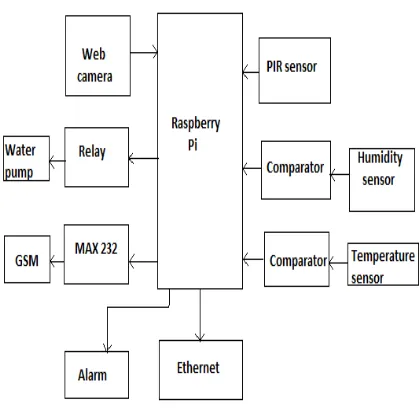
Fig 1.1 Block diagram
The humidity sensors senses, measures and reports the relative humidity in the air. It therefore measures both moisture and air temperature. Humidity is the ratio. The PIR Sensor is a pyroelectric device that detects motion by measuring changes in the infrared levels emitted by surrounding objects. This motion can be detected by checking for a high signal on a single I/O pin. This can vary with environmental conditions. The sensor is designed to adjust to slowly changing conditions that would happen normally as the day progresses and the environmental conditions change, but responds by toggling its output when sudden changes occur, such as when there is motion.
Humidity sensor is placed in the soil to measure the soil wet status. If the soil is wet the value is given to the comparator circuit. In comparator circuit, we set the predefined value using the trim pot, and read the humidity value and compare the two values, if the soil is wet the comparator will give high signal otherwise low signal to the Raspberry pi controller. Depending on the signal the controller will give signal to the relay driver circuit to switch ON and OFF the water pump. The controller will send the status of the motor (motor on & motor off). The controller will activate the alarm to intimate that the humidity value is low.
And the temperature sensor is used to sense the weather condition. The temperature sensor value is given to the comparator circuit. In comparator circuit we set the predefined value using the trim pot and read the temperature value and compare the two values, if the temperature value is high the comparator will give high signal otherwise low signal to the Raspberry pi controller. When the controller reads high signal, it sends the message to the predefined number using GSM modem. The controller will activate the alarm to intimate that the temperature value is high. And the PIR sensor is used to sense motion of the person or any animal. If any motion is sensed, the PIR sensor gives high signal to the controller. The controller activates the web camera to capture the object, and sends to the predefined mail ID, and also sends the message to the predefined number. MAX 232 is used to communicate between GSM and Raspberry Pi controller.
ISSN(Online): 2319-8753 ISSN (Print): 2347-6710
International Journal of Innovative Research in Science,
Engineering and Technology
(An ISO 3297: 2007 Certified Organization)
Website: www.ijirset.com
Vol. 6, Issue 3, March 2017
IV. RESULT AND DISCUSSION
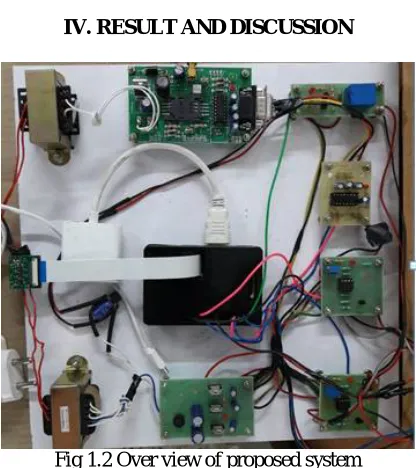
Fig 1.2 Over view of proposed system
The final prototype of an automatic drip irrigation using Raspberry Pi and Wireless Sensor Networks
Fig 1.3 Image of the message received from the field
ISSN(Online): 2319-8753 ISSN (Print): 2347-6710
International Journal of Innovative Research in Science,
Engineering and Technology
(An ISO 3297: 2007 Certified Organization)
Website: www.ijirset.com
Vol. 6, Issue 3, March 2017
Fig1.4 Image of the mail received from the field.
Acknowledgement of the mail received from the field.
V.CONCLUSION
An automatic irrigation system using Raspberry Pi controller was developed and tested. By using this method of irrigation the water is used to the maximum extent and wastage of water is reduced. This system can be adjusted to a variety of specific crop requires minimum maintenance. It also saves energy as the web cam is turned on only whenever it is necessary and mail will be send to the registered user.
REFERENCES
1) A. R. AI-Ali, MuradQasaimeh, Mamoun AI-Mardiniaand I.A.Zualkernanin, “ZigBee-Based Irrigation System for Home Gardens”, IEEE 2015. 2) Chandankumarsahu and PramiteeBehera, “A low cost smart irrigation control system”, International Conference 2015.
3) Pravina B. Chikankar, Deepak Mehetre and SoumitraDas “An Automatic Irrigation System using ZigBee in Wireless Sensor Network”, International Conference 2015.
4) Pandurang H.Tarange, Rajan G.Mevekari and Prashant A. Shinde, “Web based automatic irrigation system using wireless sensor network and embedded Linux board”, Interntional conference 2015.
5) Yunseop (james) kim, Robert G. Evansand William M. Iverson, “Remote sensing and control of an irrigation system using an distributed WSN”.IEEE Transactions on instrumentation and measurement. Vol. 57, No. 7,pp 1379-1387,2008.
6) Joaquín Gutiérrez, Juan Francisco Villa-Medina, Alejandra Nieto-Garibay and Miguel Angel Porta-Gandara “Automated Irrigation System Using a Wireless Sensor Network and GPRS Module”
7) Ms.JyotsnaRaut and V. B. Shere, “Automatic Drip Irrigation System using Wireless Sensor Network and Data Mining Algorithm”. International journal Volume 5, Issue (4) July, 2014, ISSN 2249–071X.
8) Zhao Liqiang, Yin Shouyi, Liu Leibo, Zhang Zhen and Wei Shaojun “A Crop Monitoring System Based on Wireless Sensor Network”, on Procedia Environment Sciences, Vol-11,pp.585-565,2014.
9) Robert W.Coates, Michael J.Delwiche, Alan Broad and Mark Holler, “Wireless sensor network with irrigation valve control”,Vol 96,pp. 13-22, 2013.
10) Renua Chuimurkar and Vijay Bagadi, “Smart surveillance security and monitoring system using Raspberry pi and PIR sensor” International journal-Vol2,2016.
11) Rashid Hussain and JlSahgal, “Control of Irrigation Automatically by Using Wireless Sensor Network”.