Division V
NON-LINEAR TIME DOMAIN SITE RESPONSE AND SOIL STRUCTURE
ANALYSES FOR NUCLEAR FACILITIES USING MASTODON
Omar Baltaji1, Ozgun A. Numanoglu1, Swetha Veeraraghavan2, Youssef M.A. Hashash3, Justin L.
Coleman4,Chandrakanth Bolisetti2
1 Graduate Student, Department of Civil and Environmental Engineering, University of Illinois at
Urbana-Champaign, USA
2 Research Scientist, Seismic Research Group,Idaho National Laboratory, USA
3 Professor, Department of Civil and Environmental Engineering, University of Illinois at
Urbana-Champaign, USA
4 Seismic Group Lead, Idaho National Laboratory, USA
ABSTRACT
Seismic performance of nuclear power plants (NPPs) has been typically evaluated using frequency domain linear or equivalent linear site response analyses and/or utilizing iterative linear elastic seismic soil-structure interaction (SSI) simulations. These approaches are convenient and provide reasonable results to approximate the actual nonlinear response of soil to the earthquake loadings at small to moderate strain levels. However, nonlinear analyses can better simulate the actual nonlinear, cyclic behaviour of soils under wide range of shear strains. In this study, the open source Multiphysics Object-Oriented Simulation Environment (MOOSE) framework developed at Idaho National Laboratory is extended, in an application called Multi-hazard Analysis for STOchastic time-DOmaiN phenomena (MASTODON), to conduct nonlinear seismic site response and 3-D soil-structure interaction analyses. First, simple linear visco-elastic shear beam site response analyses are performed to verify the time domain solution scheme implemented in the framework. Second, a nonlinear hysteretic soil material model is implemented and utilized in a 3-D nonlinear seismic site response analysis for benchmarking purposes. The simulations demonstrate the close agreement between the results calculated using MASTODON and those obtained from widely-used site response analysis software. Lastly, the performance of MASTODON is evaluated for an idealized 3-D SSI problem.
INTRODUCTION
Evaluation of the performance of nuclear power plant structures during earthquake loading is an important step to ensure their safety and serviceability. Numerical modelling of soil-structure interaction (SSI) analysis using direct analysis method is one of the tools to evaluate such performance. Finite element method (FEM) is an efficient numerical tool by means of which significant aspects of an idealized interaction analysis for embedded structures may be considered with a high degree of fidelity on theoretical grounds (Bolton Seed and Lysmer 1978). Many laboratory tests and case studies show that FEM can provide good estimates for site response (Bolton Seed and Lysmer (1978); Boulanger et al. (1999); Nakamura et al. (2010); Clouteau et al. (2012); Olson et al. (2015); Hashash et al. (2015); Numanoglu et al. (2017)). A typical SSI model includes the soil layers which are usually non-uniform with depth and a structural component which may or may not be embedded into the ground. A constitutive model capable of capturing small strain nonlinearity and hysteretic behaviour can be used to characterize the soil behaviour under small to large cyclic shear strains in a seismic SSI analysis.
24th Conference on Structural Mechanics in Reactor Technology
BEXCO, Busan, Korea - August 20-25, 2017 Division V
National Laboratory since 2008. Originally created to speed the development of nuclear energy related engineering applications, it has since been applied to many areas of science and engineering including: material microstructure evolution, chemistry, geo-mechanics, and superconductivity, each with its own application. In this study, the MOOSE FEA framework was extended, in an application called Multi-hazard Analysis for STOchastic time-DOmaiN phenomena (MASTODON) – (Coleman et al. 2017), to solve practical problems including nonlinear seismic site response and soil-structure interaction. To do this: (1) features such as acceleration and displacement boundary conditions as well as solution schemes were tested; (2) a nonlinear hysteretic soil material model was implemented; (3) nonlinear seismic site response and idealized SSI analyses were conducted. This paper presents the main milestones of the extension process and benchmarking studies listed above.
MOOSE TENSOR MECHANICS MODULE EVALUATION
1-D site response analyses can be used to estimate permanent displacements of slopes, retaining structures and other constructed facilities. One of the earliest approaches to the dynamic analysis of geotechnical systems was the shear beam analysis applied to earth dams by Mononobe et al. (1936). The approach has since been verified and extended to cover a variety of conditions. Three-dimensional dynamic problems are treated in much the same way as the two-dimensional problems (Kramer 1996). In the finite element context, shear-beam simplification can be used to simulate 1-D wave propagation.
Solving nonlinear seismic site response and SSI related problems by extending the tensor mechanics module (Coleman et al. 2017) in MOOSE requires an initial evaluation phase in which the functionality of the module’s components relevant to the problem is verified. In this section, such verification was done via comparing the results of linear visco-elastic 1-D wave propagation analyses using MASTODON and DEEPSOIL (Hashash et al. 2016), a one-dimensional wave propagation analysis program that can perform 1-D equivalent linear time domain and frequency domain site response analyses, as well as 1-D nonlinear time domain site response analyses with and without excess pore water pressure generation and dissipation. The next section presents the evaluation exercise that utilizes a shear beam analysis with a non-uniform soil profile using linear elastic material model and viscous damping.
Linear Visco-Elastic Shear Beam Model Development
A shear beam model composed of 20 brick elements stacked vertically (in z-direction) is developed in MOOSE. The dimensions of the model are 1m x 1m x 20m. Linear elastic materials are assigned to the model elements with a uniform Poisson’s ratio (ν) of 0.3, and modulus of elasticity (E) linearly increasing with depth from 50,000 to 325,000 kPa, which corresponds to shear wave velocity (Vs)
increasing from 100 m/s at the top to 250 m/s at the bottom. A density of 2 ton/m3 is assigned to all
elements.
Figure 1: Schematic of the “non-uniform shear beam” model with shear wave velocity and maximum frequency profiles.
Linear Visco-Elastic Shear Beam Model Results
Nodal acceleration response spectra and Fourier amplitude spectra resulting from MASTODON and DEEPSOIL analyses for locations at top of the shear beam are shown in Figure 2. MASTODON results are identical to those of DEEPSOIL in terms of peak ground and spectral accelerations. Some slight differences between DEEPSOIL and MASTODON results can be observed when examining the Fourier spectra, yet those differences are limited to a narrow range of frequencies (below 0.1 Hz and higher than 50 Hz) and are considered minor for the purpose of the analysis. Especially, the high frequency content difference is beyond the cut-off frequency and can be attributed to numerical artifacts. Thus, tensor mechanics module in MOOSE is capable of computing accelerations for a shear beam model and thus of simulating a 1-D seismic site response analysis of a non-uniform profile using a linear elastic material model with viscous damping.
24th Conference on Structural Mechanics in Reactor Technology
BEXCO, Busan, Korea - August 20-25, 2017 Division V
NONLINEAR 3-D SOIL CONSTITUTIVE MODEL AND SINGLE ELEMENT TEST
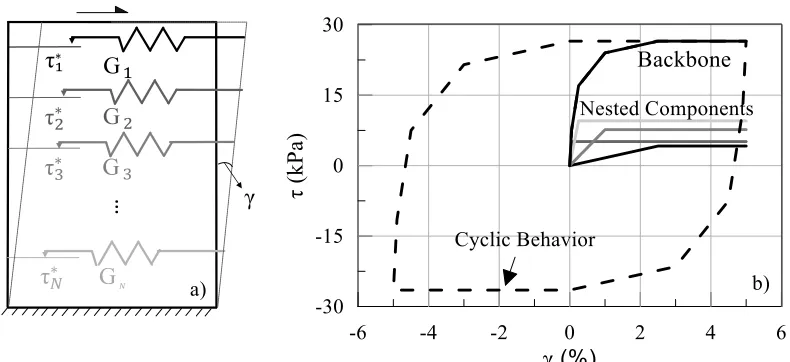
I-soil (Numanoglu 2017), a piecewise-linearized nonlinear, 3-D soil constitutive model developed based on a framework analogous to that developed by Iwan (1967) and Chiang and Beck (1994) is implemented in MASTODON. The model consists of multiple nested yield surfaces superimposed to capture the nonlinear behavior of the soil in a piecewise linear fashion. Upon un/reloading, the stiffness and strength of each nested component are regained. Thus, the Masing type un/reloading rules are inherently incorporated. The one-dimensional representation of the model with inherent Masing type un/reloading rules and the corresponding monotonic and cyclic response are presented in Figure 3. Three-dimensional implementation is achieved by utilizing von Mises (independent of effective mean stress) and/or Drucker-Prager (effective mean stress dependent) shear yield surfaces in 3-D stress space. The model can be used in shear beam type and 3-D nonlinear site response analyses as well as 3-D soil structure interaction analyses using multidirectional input motions. The implementation of the model in MASTODON includes automatic generation of Darendeli (2001) shear strain – shear strength (backbone) curves as well as implied shear strength control procedure adopted from Groholski et al. (2016). Reduction factor method, presented in (Phillips and Hashash 2009), is extended to 3-D by Numanoglu et al. (2017) and incorporated in I-soil to modify the Masing rules to better represent the hysteretic damping for a wide range of shear strains. In addition, the model includes non-associative flow rule to establish Rowe (1962) type relation between shear and volumetric response to capture shear induced volumetric strains. The current version of the I-soil model implemented within MASTODON uses Masing type loading-un/reloading rules and the volumetric behavior is linear elastic.
Figure 3: I-soil model details: (a) 1-D representation by springs and sliders; (b) example monotonic and cyclic behavior of four nested component model.
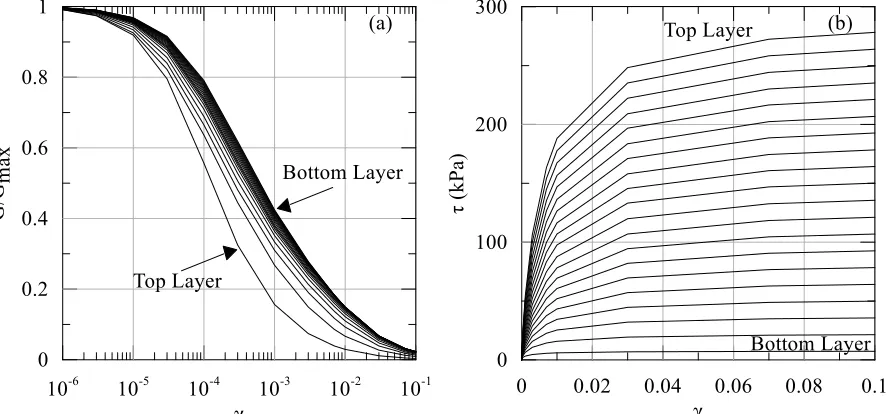
First, an element level test is conducted using a single unit brick element. The backbone curve used for the I-soil constitutive model is defined using (Darendeli 2001) normalized modulus reduction curves with a unit weight (γ), over-consolidation ration (OCR), lateral earth pressure coefficient at rest (K0), and plasticity index (Ip) of 20 KN/m3, 1, 0.4 and 0, respectively. A shear wave velocity (Vs) of 100
m/sec is used to determine small strain shear modulus. The normalized modulus reduction curve and corresponding backbone curve are shown in Figure 4.
γ τ
Figure 4: Material dynamic properties: (a) modulus reduction curve, (b) backbone curve
For the element level simulation, 9.81 m/s2 (1g) of gravitational acceleration was activated, and
the reference pressure was equated to the effective mean stress (σii/3), which is calculated to be ~6 kPa.
The model is set to be pressure independent. The material was assigned a density of 2 ton/m3. The stresses
were initialized to K0-conditions. The bottom boundaries of the element are fixed in all 3 directions, x, y
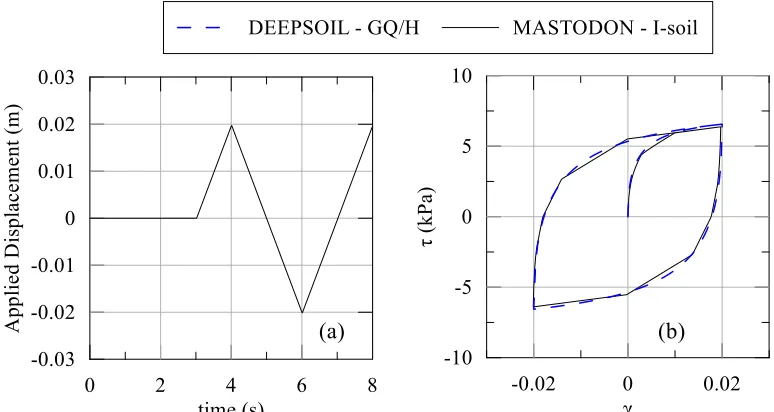
and z. Periodic boundary conditions were applied on nodes of the same elevation in x, y and z directions. Cyclic displacement was applied at the top nodes. Newmark-beta integration parameters, α and β, are set to 0.25 and 0.5.
Figure 5 compares the nonlinear hysteretic behavior obtained from the GQ/H model in DEEPSOIL and the I-soil model in MASTODON. The cyclic responses of the models are very close. The slight differences are due to the discrete (piecewise linear) nature of the backbone curve used in MASTODON.
24th Conference on Structural Mechanics in Reactor Technology
BEXCO, Busan, Korea - August 20-25, 2017 Division V
NONLINEAR SEISMIC SITE REPONSE AND SSI ANALYSES
I-soil model can be used to analyse wave propagation in more complex geometries and soil conditions. This study utilizes (1) a nonlinear 3-D free-field seismic site response analysis, (2) SSI analysis and the results are compared to those obtained from DEEPSOIL (former) and LS-DYNA (latter) simulations.
Nonlinear 3-D Free-field Seismic Site Response Model Development
The model developed in MASTODON is composed of 20 layers stacked vertically (in z-direction). The dimensions of the model are 36m x 36m x 20m (Figure 8). Figure 6 shows the normalized modulus reduction curves and the backbone curves used for defining the dynamic soil properties of the 20 layers. A density of 2 ton/m3 is assigned to all layers. In MASTODON, gravity is activated and stresses are initialized to K0-conditions. Periodic boundary conditions are applied on external nodes, along
external edges of the model, of the same elevation in x, y and z directions. The developed model is shown in Figure 8 (the structure is not present in this model).
Figure 6: Model dynamic soil properties: (a) normalized modulus reduction curves, (b) backbone curves.
Newmark-beta integration parameters, α and β, are set to 0.25 and 0.5. Rayleigh damping is applied to the system. For this model, the mass and stiffness damping parameters, zeta (ζ) and eta (η), are calculated to be 0.000781 and 0.64026 respectively. The same soil profile was utilized in DEEPSOIL to conduct a nonlinear 1-D seismic site response using the GQ/H model.
Finally, the baseline-corrected Chi-Chi-1999 motion, record P1116 (Ancheta et al. 2014), is applied as a rigid base motion in x-direction as a prescribed acceleration.
Nonlinear 3-D Free-field Seismic Site Response Model Results
frequency considered, 100 Hz, as suggested in (Chopra 2007) and (Phillips et al. 2012). Similar recommendations were suggested in (Coleman et al. 2016). For the first analysis, peak ground accelerations and spectral accelerations throughout the profile match very well for practical purposes except the high frequency content in MASTODON results near 0.02-0.03 sec periods at 10 and 1 m depths which also reveals itself in Fourier amplitude spectra. In the second analysis, it is observed that the high frequency content at 10 m depth vanished. This resulted in a good agreement between MASTODON and DEEPSOIL.
Figure 7: Non-uniform free-field models results: acceleration response spectra and Fourier amplitude spectra at top, middle and bottom of the model
Nonlinear 3-D SSI Model Development
This numerical model was developed in MASTODON to simulate an idealized 3-D SSI problem, where a structure is embedded into a soil, to analyze the response of the soil-structure system to earthquake shaking. A similar model was developed and simulated in LS-DYNA. Both MASTODON and LS-DYNA analyses use I-soil to characterize the soil behavior.
24th Conference on Structural Mechanics in Reactor Technology
BEXCO, Busan, Korea - August 20-25, 2017 Division V
used to define the backbone curve in both MASTODON and LS-DYNA. A structure of dimensions 4m x 4m x 4m is embedded two meters into the top two layers of the soil profile. A density of 8 ton/m3 is assigned to the structure.
The Coyote 1979 motion, record
P0154 (Ancheta et al. 2014),
is applied at the base of the model in the x-direction as a prescribed acceleration. Newmark-beta integration parameters, α and β, are set to 0.25 and 0.5. Rayleigh damping is applied to the system. For this model, the mass and stiffness damping parameters, zeta (ζ) and eta (η), are calculated to be 0.000781 and 0.64026 respectively, for a constant damping of 3% applied to all layers.Figure 8: Geometry of the non-uniform free-field model and the SSI model
Nonlinear 3-D SSI Model Results
Figure 9 demonstrates the reasonable agreement between MASTODON and LS-DYNA results in terms of peak ground acceleration and acceleration response spectrum for wide range of periods.
For periods below 0.1s, slight differences in the response can be observed particularly for results corresponding to 1.5 m below the bottom of the structure. Fourier amplitude spectra also demonstrates reasonable agreement and shows slight differences at high frequencies. For all practical purposes, MASTODON yields a similar response to LS-DYNA for an idealized soil-structure interaction problem. This demonstrates the capability of MASTODON to be utilized in a 3-D SSI analysis using the direct solution method.
CONCLUSIONS
The MOOSE finite element analysis framework was extended to MASTODON application and benchmarked to solve nonlinear seismic site response and idealized soil-structure interaction related problems. The process included following steps: (1) a linear visco-elastic wave propagation analysis to verify solution scheme, (2) nonlinear soil material model implementation and element scale tests to verify the implementation, (3) nonlinear hysteretic soil material model utilization in free-field finite element analysis of wave propagation and benchmarking against widely used – verified 1-D wave propagation analysis software, (4) simulation of idealized SSI problem and benchmarking against widely used-verified dynamic finite element analysis software.
NOMENCLATURE
ν: Poisson’s ratio E: modulus of elasticity Vs: shear wave velocity
α and β: Newmark-beta integration parameters ζ: Rayleigh mass damping parameter
η: Rayleigh stiffness damping parameter
REFERENCES
Ancheta, T. D., Darragh, R. B., Stewart, J. P., Seyhan, E., Silva, W. J., Chiou, B. S.-J., Wooddell, K. E., Graves, R. W., Kottke, A. R., Boore, D. M., Kishida, T. and Donahue, J. L. (2014). "NGA-West2 Database." Earthquake Spectra 30(3): 989-1005.
Bolton Seed, H. and Lysmer, J. (1978). "Soil-structure interaction analyses by finite elements — State of the art." Nuclear Engineering and Design 46(2): 349-365.
Boulanger, R. W., Curras, C. J., Kutter, B. L., Wilson, D. W. and Abghari, A. (1999). "Seismic soil-pile-structure interaction experiments and analyses." Journal of Geotechnical and Geoenvironmental Engineering 125(9): 750-759.
Chiang, D. Y. and Beck, J. L. (1994). "A new class of distributed-element models for cyclic plasticity—I. Theory and application." International Journal of Solids and Structures 31(4): 469-484.
Chopra, A. K. (2007). Dynamics of structures: theory and applications to earthquake engineering. 2007, Prentice-Hall.
Clouteau, D., Broc, D., Devésa, G., Guyonvarh, V. and Massin, P. (2012). "Calculation methods of Structure–Soil–Structure Interaction (3SI) for embedded buildings: Application to NUPEC tests." Soil Dynamics and Earthquake Engineering 32(1): 129-142.
24th Conference on Structural Mechanics in Reactor Technology
BEXCO, Busan, Korea - August 20-25, 2017 Division V
Coleman, J. L., Bolisetti, C. and Whittaker, A. S. (2016). "Time-domain soil-structure interaction analysis of nuclear facilities." Nuclear Engineering and Design 298: 264-270.
Darendeli, M. B. (2001). Development of a new family of normalized modulus reduction and material damping curves Ph. D., University of Texas at Austin.
Gaston, D., Newman, C., Hansen, G. and Lebrun-Grandie, D. (2009). "MOOSE: A parallel computational framework for coupled systems of nonlinear equations." Nuclear Engineering and Design
239(10): 1768-1778.
Groholski, D., Hashash, Y. M. A., Kim, B., Musgrove, M., Harmon, J. and Stewart, J. (2016). "Simplified Model for Small-Strain Nonlinearity and Strength in 1D Seismic Site Response Analysis." Journal of Geotechnical and Geoenvironmental Engineering 142(9): 04016042.
Hashash, Y. M. A., Dashti, S., Romero, M. I., Ghayoomi, M. and Musgrove, M. (2015). "Evaluation of 1-D seismic site response modeling of sand using centrifuge experiments." Soil 1-Dynamics and Earthquake Engineering 78: 19-31.
Hashash, Y. M. A., Musgrove, M. I., Harmon, J. A., Groholski, D., Phillips, C. A. and Park, D. (2016). DEEPSOIL V6.1, User Manual. Urbana, IL, Board of Trustees of University of Illinois at Urbana-Champaign.
Iwan, W. D. (1967). "On a class of models for the yielding behavior of continuous and composite systems." Jour. Apl. Mech., Trans. ASME 34(E3): 612-617.
Kramer, S. L. (1996). Geotechnical earthquake engineering. Upper Saddle River, N.J., Prentice Hall. Kwok, A. O. L., Stewart, J. P., Hashash, Y. M. A., Matasovic, N., Pyke, R., Wang, Z. and Yang, Z.
(2007). "Use of exact solutions of wave propagation problems to guide implementation of nonlinear seismic ground response analysis procedures." Journal of Geotechnical and Geoenvironmental Engineering 133(11): 1385-1398.
Nakamura, N., Akita, S., Suzuki, T., Koba, M., Nakamura, S. and Nakano, T. (2010). "Study of ultimate seismic response and fragility evaluation of nuclear power building using nonlinear three-dimensional finite element model." Nuclear Engineering and Design 240(1): 166-180. Newmark, N. M. (1959). "A Method of Computation for Structural Dynamics." Journal of the
Engineering Mechanics Division 85: 67-94.
Numanoglu, O. A. (2017). "Ph.D Thesis in progress." University of Illinois at Urbana Champaign. Numanoglu, O. A., Hashash, Y. M. A., Cerna-Diaz, A., Olson, S. M., Bhaumik, L., Rutherford, C. J. and
Weaver, T. (2017a). "Nonlinear 3-D Modeling of Dense Sand and Simulation of Soil-Structure System under Multi-directional Loading." Proceedings of Geotechnical Frontiers Conference 2017.
Numanoglu, O. A., Musgrove, M., Harmon, J. A. and Hashash, Y. M. A. (2017b). "Generalized non-masing hysteresis model for cyclic loading." Manuscript submitted for publication.
Olson, S. M., Hashash, Y. M. A., Rutherford, C., Cerna-Diaz, A., Numanoglu, O. A., Bhaumik, L. and Weaver, T. (2015). "Experimental and Numerical Investigation of Cyclic Response of Dense Sand under Multidirectional Shaking."
Phillips, C. and Hashash, Y. M. A. (2009). "Damping formulation for non-linear 1D site response analyses." Soil Dynamics and Earthquake Engineering 29(7): Pages 1143-1158.