EEG based Brain-Computer Interface for
Controlling Home Appliances
Sneha Pushpa S 1, Chandrashekar N S 2
P.G. Student, Department of E & C Engineering, Don Bosco IT, Bengaluru, Karnataka, India1
Associate Professor, Department of E & C Engineering, Don Bosco IT, Bengaluru, Karnataka, India2
ABSTRACT: Main aim of this paper is to help paralysed and physically disabled people to control the home appliances using Electroencephalogram (EEG) signals, so they become independent in their daily life. The BCI (Brain-Computer Interface) is considered as a recent and a unique transmission medium between the human brain and a computer. This approach offers an alternative communication path and the control system. It is referred as an artificial system that circumvents the human body’s normal adequate pathways, which are the neuromuscular output channels. Here, non-invasive Brain-Computer Interface approach is implemented. The NeuroSky brainwave sensor is used to sense the attention values of the brain signals and the eye blinks. The ARM7 processor is used as main interfacing device. According to the eye blink and the brain attention values the devices will be selected and through relays the switching on and off of the home appliances is done accordingly.
KEYWORDS: Brain-Computer Interface (BCI), Electroencephalogram (EEG), NeuroSky Brainwave sensor,
Non-invasive BCI technique, ARM7 processor.
I. INTRODUCTION
Smart Homes, also known as automated homes, intelligent buildings, integrated home systems or domestics, are a recent design development. Smart homes incorporate common devices that control features of the home. Originally, smart home technology was used to control environmental systems. A concept on smart home application and development includes various implementation techniques and is ever growing. Smart home systems are created based on analysis on client needs and budget to cater for the system. With technologies available today, efficient integration of this system could be achieved. Home automation is a new concept that encompasses the ability to control electrical and electronic devices at home remotely thus providing ease of access to the users. This concept may be applied in various manners to fit the requirement of a smart home.
The Brain-Computer Interface technique is treated as a communication system that serves the person to operate the devices by using his or her own thoughts. The data flows from brain to the outside machinery or from outside machinery to the brain. Different research groups have examined and used different methods to achieve this. All these method uses electroencephalography (EEG) signals which are taken from the scalp. The different brain states are the outcome of the various arrangements of neural interaction. These pattern leads to the waves that are characterized by various amplitude and frequency values.
The brain-computer interface (BCI) in its scientific interpretation is a combination of several hardware and software components trying to enable its user to communicate with a computer by intentionally altering his or her brain waves. There are three types of Brain-Computer Interface approaches. They are: Invasive BCI, Partially invasive BCI, Non-invasive BCI.
In invasive BCI approach, the brainwave sensor chip is implanted directly onto the grey matter of the human brain during neurosurgery. Invasive devices produce the highest quality signals of BCI devices but this method is prone to scar-tissue. In the partially invasive BCI approach, the brainwave sensor chip is placed inside the skull but rests outside the grey matter of the human brain. This method produces a better resolution signals. In the non-invasive BCI approach, the brainwave sensor chip will be placed outside the skull i.e., on the scalp. Here, dry electrode will be used to sense the brain signals and a reference electrode ear clip is used for the reference point. The non-invasive technique is used for a much variety of the applications, since the brainwave sensors for the non-invasive BCI method are easy to wear and do not require any surgery as it is in the invasive and partially invasive methods.
Paper is organized as follows. Section II describes the smart home automation techniques done using various technologies. The block diagram and the flow diagram that describes the proposed system is given in Section III. Section IV presents the results of the proposed system. Finally, Section V presents conclusion.
II. RELATED WORK
The brain signals are used for different applications. A Human-Machine Interfaces (HMIs) based on EMG signal and EEG signal was proposed in [13]. In [4], the brain waves are used to detect the driver drowsiness. When the driver starts driving the car, the brainwave sensor unit calculates the eye blinking level and also compares the driver’s present attention value with the recorded minimum attention value. When the eye blinking value crosses the set point, the driver gets an alert.
The measurement of brain activity using mind wave is proposed in [3]. Here, the system helps the person to better understand how human brain works in terms of learning, attention, memory, thinking, etc., The data values measured from the mind wave headset are compared with the stored database in the PC. These values are assigned for the particular task to be done like controlling the cursor and, pick and place application in robotics.
In [1], the brain signals are used to control the wheelchair. This paper describes EEG signals and eye blinking signals through a BCI interface. In [5], the implementation of the mind controlled robot is done using Lab VIEW to analyse the brain signals.
In this paper brain signals with their attention values and the eye blinking values are used to control the home appliances such as lights and fans. There are various techniques implemented and used for the home automations. Face movements are used to control an electric powered wheelchair for people with the disabilities [9]. In [14], the home automation is done using the GSM (Global system for Mobile communication) and controlling the physical devices using voice commands. The speech recognition program is written to control the devices by means of human voice. In [6], the proposed home automation system is based on the GSM and designed using App Invertor for Android mobile phones.
The smart home automation system is done using Internet of Things in [2]. Here Intel Galileo development board with inbuilt Wi-Fi card port that acts as a web server is used with the integration of cloud networking, wireless communication to provide the user with remote control of lights, fans within the home and storing the data in the cloud. The same technique with smart phone or PC used as a remote controller via internet is used [7, 11].
The design of the home automation system using wireless remote control is presented in [10]. Main control system implements wireless bluetooth technology to provide remote access from PC or laptop or smart phone.
III.PROPOSED SYSTEM
In the proposed system, a NeuroSky brainwave sensor is used to analyse the EEG signals. The BCI is a direct communication pathway between the human brain and an external device. According to the human thoughts i.e., the brain attention values the physical devices are operated. The BCI section is as shown in the Fig. 1.
Fig. 1 Brain-Computer Interface section
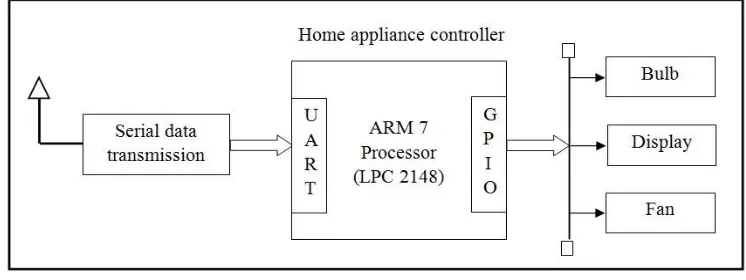
The level analyser unit (LAU) will receive the brain wave raw data and it will process the signal using MATLAB platform which is shown in data processing unit in the Fig. 2. In the data processing unit, for processing the data we use DSP processing i.e., MATLAB. The Visual Basic software is used along with the MATLAB because, 179 bytes of huge data will be receiving from the brain sensor and sending these data to the MATLAB and meanwhile these data i.e., the attention and the eye blink values should be sent to the hardware part. So the data transmission rate in visual basic is comparatively greater than that of the MATLAB. The form is created in the visual basic with two captions FAN and BULB.
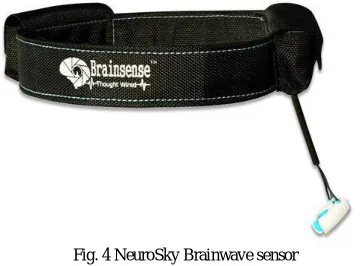
The patterns and frequencies of the brain electrical signals can be measured by placing a sensor on the scalp. The Mind Tools line of headset products contain NeuroSky ThinkGear technology [15], which measures the analog electrical signals, commonly referred to as brainwaves, and processes them into digital signals. The brain wave sensor is as shown in Fig. 4.
Fig. 4 NeuroSky Brainwave sensor
We can measure our focus i.e., attention and meditation level. The Mindset transmits ThinkGear Data Values, encoded within ThinkGear Packets, as a serial stream of bytes over Bluetooth via a standard Bluetooth Serial Port Profile (SPP). Also provides to analyse the stress. The technical specifications are:
1. Uses the TGAM1 module with TGAT ASIC, dry electrode and ear clip electrode. The TGAM1 module i.e., on
board.
2. Automatic wireless paring.
3. Bluetooth v2.1 Class 2 (10 meters range).
4. 512 Hz sampling rate
5. 3-100Hz frequency range
6. Baud rate: 57600
Think Gear is the technology inside every NeuroSky product or partner product that enables a device to interface with the wearers’ brainwaves. Both the raw brainwaves and the eSense Meters (Attention and Meditation) and eye blink are calculated on the ThinkGear chip [15].
To detect the EEG signals the non-invasive Brain-Computer Interface technique is used in which medical scanning devices or sensors are mounted on the scalp to read brain signals. Here to extract the EEG signals, Mind wave sensor is used. The read brain signals from the brain could help identify a wider range of brain activity. The measure of the brain signals and their transmission is implemented with the help of the brain wave sensor mounted in the mind wave EEG signal data transmission device.
The read brain signals are transmitted to the controller unit which includes laptop or desktop wirelessly via bluetooth. In the PC, the EEG signals are simulated using MATLAB coding software and the results are calibrated and sent to the processor unit using visual basic in the background to send the values for the hardware part that consists of ARM7 processor, relays. According to the brain signals, the physical devices such as switching on and off fan and tube light are controlled. Also the temperature sensor is used to monitor the room temperature.
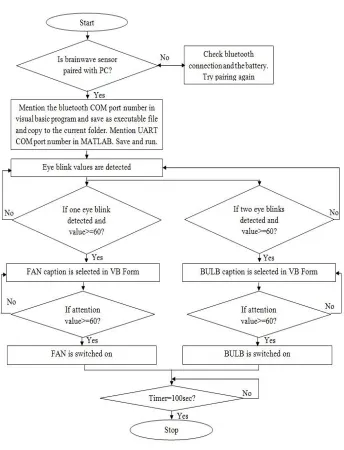
The workflow of the proposed system is as shown in the Fig. 5 to switch on the physical devices.
Fig. 5 Workflow of the system for switching on the devices
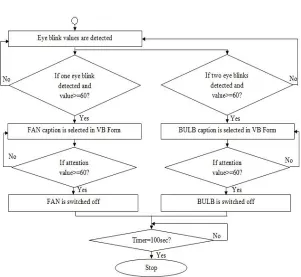
Fig. 6 5 Workflow of the system for switching off the devices
IV.EXPERIMENTAL RESULTS
The proposed system is implemented and the desired results are obtained in controlling the physical devices using brain signals. The experimental set up of the proposed system is shown in Fig.7 and the EEG signals that are sensed by the brainwave sensor are checked using the Brainwave Visualizer application.
Fig. 7 Project set up and EEG signals displaying in Brainwave Visualizer application
the eye blink value detected is 60. According to the number of eye blinks i.e., either one eye blink or two eye blinks the particular device is selected. Depending on the attention value device is switched on and switched off.
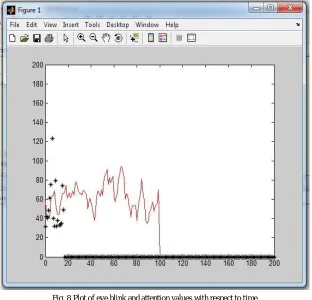
The plot of eye blink values (represented in black colour star mark) and the attention values (represented in the red colour curve) are obtained with respect to the time in the MATLAB. The plot is as shown in the Fig. 8.
Fig. 8 Plot of eye blink and attention values with respect to time
Also the approximate values of attention level of the brain and the values of eye blinking are obtained in the command window of the MATLAB for the purpose of better understanding.
V. CONCLUSION
The non-invasive BCI is an emerging technique which is still under research. This paper presents the design and implementation of non-invasive type of Brain-Computer Interface technique to control the home appliances using EEG based brain signals. It includes NeuroSky Brainwave Sensor with a dry electrode and a reference ear clip so that usage of gel is not necessary as it is used in wet electrode for connecting the sensor electrode to the scalp. This paper works on the brain signals for controlling the physical devices, so the paralysed and the physically disabled people can independently do their work like switching on and off the lights and fans by their own .Whereas, in existing techniques remotes are used for controlling purpose. In the future, this technique can be used to replace the whole manual control system in industries and in risk environments with the human mind control.
[3] Apeksha Rani H.M, Prathibha Kiran, “A Novel Method for Analysis of EEG Signals Using Brain Wave Data Analyzer”, International Journal of Soft Computing and Engineering (IJSCE), ISSN: 2231-2307, Vol. No. 5, Issue No. 2, pp: 98-100, May 2015.
[4] Krishnaveni Yendrapalli, S.S. Naga Pavan Kumar Tammana, “The Brain Signal Detection for Controlling the Robot”, International Journal of Scientific Engineering and Technology, ISSN: 2277-1581, Vol. No. 3, Issue No. 10, pp: 1280-1283, October 2014.
[5] Siliveru Ramesh, M.Gopi Krishna, Madhu Nakirekanti, “Brain Computer Interface System for Mind Controlled Robot using Bluetooth”, International Journal of Computer Applications (0975-8887), Vol. 104-No. 15, pp: 20-23, October 2014.
[6] Mahesh N. Jivani, “GSM Based Home Automation System Using App-Inventor for Android Mobile Phone”, International Journal of Advanced Research in Electrical, Electronics and Instrumentation Engineering (AN ISO 3297: 2007 Certified Organization), Vol. 3, Issue 9, pp: 12121-12128, September 2014.
[7] Ming Wang, Guiqing Zhang, Chenghui Zhang, Jianbin Zhang, Chengdong Li,“An IoT-based Appliances Control System for Smart Homes”, Fourth International Conference on Intelligent Control and Information Processing (ICICIP), doi: 978-1-4673-6249-8, pp: 744-747, June 2013. [8] S. Anwaarullah and S.V. Altaf, “RTOS based Home Automation System Using Cell phone”, International Journal of Advanced Trends in
Computer Science and Engineering, Vol. 2, pp: 480-484, January 2013.
[9] K. Kiguchi and Y. Hayashi, “Motion Estimation based on EMG and EEG Signals to Control Wearable Robots”, IEEE International Conference on Systems, Man and Cybernetics, pp: 4213-4218, 2013.
[10] R.A.Ramlee, M.H.Leong, R.S.S.Singh, M.M.Ismail, M.A.Othman, H.A.Sulaiman, M.H.Misran, M.A.Meor Said, “Bluetooth Remote Home Automation System Using Android Application”, International Journal of Engineering and Science (IJES), Vol. 2, Issue 1, pp: 149-153, 2013. [11] Liu Zhi-Gang, Haung Wei, “The Design of Smart Home System Based on Wi-Fi”, ICCP2012 Proceedings, doi: 978-1-4673-1691-2, pp:
454-456, 2012.
[12] Faizan Farid, Muhammad Rehan, Faiza Faizan, M Tahir Qadri, “Home Automation and Security System via PSTN”, 2nd International Conference on Education Technology and Computer (ICETC), doi: 978-1-4244-6370-1, pp: VI-52 – VI-55, 2010.
[13] Andre Ferreira, Wanderley C Celeste, Fernando A Cheein, Teodiano F Bastos Filho, Marai Sarcinelli Filho and Ricardo Carelli, “Human-Machine interfaces based on EMG and EEG applied to robotic systems”, Journal of Neuro Engineering and rehabilitation 2008, 5:10 doi: 10.1186/1743-0003-5-10.
[14] Baris Yuksekkaya, A. Alper Kayalar, M. Bilgehan Tosun, M. Kaan Ozcan, and Ali Ziya Alkar, Member, IEEE, “A GSM, Internet and Speech Controlled Wireless Interactive Home Automation System”, IEEE Transactions on Consumer Electronics, Vol. 52, No. 3, pp: 837-843, August 2006.
[15] NeuroSky, “Mind-set instruction manual”, [online] Available: http://developer.neurosky.com/docs/doku.php?id=mindset_instruction_manual.
BIOGRAPHY
Ms. Sneha Pushpa S, is a final year student, pursuing her Master of Technology Degree in Digital
Electronics at Don Bosco Institute of Technology, Bengaluru which is affiliated to Visvesvaraya Technological University, Belagavi.
Mr. Chandrashekar N S, is currently working as Associate Professor in Department of