Cryptanalysis of a class of cryptographic hash functions
Praveen Gauravaram1 and John Kelsey2
1 Technical University of Denmark, Denmark
Information Security Institute, Australia
2 National Institute of Standards and Technology, USA [email protected]
Abstract. We apply new cryptanalytical techniques to perform the generic multi-block multicollision, second preimage and herding attacks on the Damg˚ard-Merkle hash functions with linear-XOR/additive checksums. The computational work required to perform these attacks on the Damg˚ard-Merkle hash functions with linear-XOR/additive checksum of message blocks (GOST), intermediate states (3C, MAELSTROM-0, F-Hash) or both is only a little more than what is required on the Damg˚ard-Merkle hash functions. Our generic attacks on GOST answers the open question of Hoch and Shamir at FSE 2006 on the security of the iterated hash functions with the linear mixing of message blocks.
Keywords: XOR-linear/additive checksums, 3C, GOST, block collision, multicollision, multi-block multicollision, 2ndpreimage and herding attacks.
1 Introduction
The Damg˚ard-Merkle construction [7, 29] provides a blueprint for building a cryptographic hash function, given a fixed-length input compression function; this blueprint is followed for nearly all widely-used hash functions. However, the past few years have seen two kinds of surprising results on hash functions, which have led to a flurry of research:
1. Generic attacks apply to the Damg˚ard-Merkle construction directly, and make few or no as-sumptions about the compression function. These attacks involve attacking at-bit hash function with more than 2t/2 work, in order to violate some property other than collision resistance. Ex-amples of generic attacks are Joux multicollisions [15], long-message 2ndpreimage attacks [8,18], and herding attacks [17].
2. Cryptanalytic attacks apply to the compression function of the hash function. However, turning an attack on the compression function into an attack on the whole hash function involves properties of the Damg˚ard-Merkle construction. Examples of cryptanalytic attacks that involve the construction as well as the compression function include multi-block collisions on MD5 and SHA-1 [45, 46].
These results have stimulated interest in new constructions for hash functions, that prevent the generic attacks, provide some additional protection against cryptanalytic attacks or both. The recent call for submissions for a new hash function standard by NIST [33] has further stimulated interest in alternatives to Damg˚ard-Merkle. Examples of recently-proposed alternative construc-tions include the3Cconstruction [11–13], Haifa framework [4], Rivest’s proposal to use squarefree sequences to prevent the long-message second preimage attack [40] and the RadioGatun hash pro-posal [6].
In a Damg˚ard-Merkle hash with a linear-XOR checksum, each bit of the checksum is a XOR func-tion of the bits of the message, intermediate states or both; the checksum is processed as a final block after the padding and length encoding of the original message have been processed. The
3C construction [11–13] and the structure of the MAELSTROM-0 hash function [10] follow this pattern. F-Hash [23,24] uses a XOR checksum of the outputs of the compression function alongside a normal Damg˚ard-Merkle construction. Similarly, in a Damg˚ard-Merkle hash with linear-additive checksums, an additive checksum computed using message blocks, intermediate states or both is processed as a final block. The 256-bit GOST hash function specified in the Russian standard GOST R 34.11 [35] uses an additive checksum mod 2256 computed using 256-bit message blocks. GOST, as a one-way and collision resistant hash function, is always used in conjunction with the Russian standard digital signature algorithms GOST R 34.10-94 and GOST R 34.10-2001 that are used to sign certificates and CRLs [26]. In addition, GOST has been specified for use in the cryp-tographic message syntax in [25] and with the HMAC algorithm [1, 2] for the purposes of message authentication and pseudorandom generation in [36].
The known cryptanalytical techniques of performing the generic attacks on the Damg˚ard-Merkle hash functions are unsuccessful on these designs due to their much larger intermediate state in addi-tion to the algebraic properties of the linear-XOR/additive operaaddi-tions used to compute checksums. Similarly, these designs make many cryptanalytic attacks on the compression function difficult or impossible to extend to attacks on the full hash function. For example, the inapplicability of the known long message second preimage attacks [8,18] and herding attack [17] on the3Cconstruction was shown in [11–13] and in [11] respectively. This applies to F-Hash, MAELSTROM-0, GOST and any hash function with these checksums. The designers of 3C[11] and MAELSTROM-0 [10] claim that it takes 2t computations of the hash function to find a (second) preimage on their designs with a t-bit hash value. GOST has been used as a one-way and collision resistant hash function in practice [25, 26, 36].
Unfortunately, all is not true. We first provide a general algorithm for attacking linear-XOR checksums of various kinds. Next, we provide another novel algorithm to defeat additive checksums in hash functions. Our attacks show that adding XOR/additive checksums to the Damg˚ard-Merkle construction turns out to add almost no security against generic attacks. The linear-XOR/additive checksum may sometimes make it more difficult to use a cryptanalytic attack on the compression function to attack the full hash function, but this depends on the fine details of the linear checksum and cryptanalytic attack.
To summarize our results:
1. All known generic attacks on the Damg˚ard-Merkle hash functions can be applied to linear-XOR/additive checksum variants of Damg˚ard-Merkle at very little additional cost using our attacks that defeat these checksums. Thus, Joux multicollisions over multiple blocks, long-message second preimage attack, and herding attack all work just as well against the linear-XOR/additive checksum constructions as against Damg˚ard-Merkle. Our attacks also work on the hash functions with additive checksums computed using some prime modulus.
2. The generic attacks on GOST answer the open question of Hoch and Shamir (FSE’06) [14] on the security of Damg˚ard-Merkle hash functions with the linear mixing of message blocks. Our attacks also work on reasonably short CRCs computed over a message as shown in Section 5.4. 3. Many cryptanalytic collision attacks on the compression function, which the linear-XOR/additive
4. From our techniques, it is possible to derive requirements on a checksum, if it is to improve security over that of Damg˚ard-Merkle hashes.
1.1 Related Work
In unpublished work, Mironov and Narayan [30] developed a different technique to defeat linear-XOR checksums in hash functions; this technique is less flexible than ours, and does not work for long-message second preimage attacks. However, it is quite powerful, and can be combined with our technique in attacking hash functions with complicated checksums. We compare our tech-nique with theirs in Appendix 7. In [15], Joux provides a techtech-nique for finding 2k collisions for a Damg˚ard-Merkle hash function for only about k times as much work as is required for a single collision. Multi-block collisions are an example of a cryptanalytic attack on a compression function, which must deal with the surrounding hash construction. Lucks [28] and Tuma and Joscak [42] have independently found that if there is a multi-block collision for a hash function with struc-tured differences, concatenation of such a collision will produce a collision on 3C, a specific hash construction which computes checksum using XOR operation as the mixing function.3C does not prevent Joux multicollision attack over 1-block messages [11–13].
Nandi and Stinson [32] have shown the applicability of multicollision attacks to a variant of Damg˚ard-Merkle in which each message block is processed multiple times; Hoch and Shamir [14] extended the results of [32] showing that generalized sequential hash functions with any fixed repetition of message blocks do not resist multicollision attacks. The MD2 hash function [16] which uses a checksum computed using a XOR operation and non-linear S-box over the message was shown to be insecure [20,31]. The technique to solve a system of linear equations used in the cryptanalysis of hash functions with linear-XOR checksums presented in this paper have appeared in [3, 5, 43]. The approach of solving a system of linear equations has been employed to find collisions [37] and second preimages [22] for the SMASH hash function [19].
1.2 Impact
The main impact of our result is that new hash function constructions that incorporate linear-XOR/additive checksums as a defense against collision attacks and generic attacks do not provide much additional security. Designers who wish to thwart these attacks need to look elsewhere for techniques to do this. We can apply our techniques to specific hash functions and hashing construc-tions that have been proposed in the literature or are in practical use. They include 3C, GOST, MAELSTROM-0 and F-Hash1.
1.3 Guide to the Paper
This paper is organised as follows: First, we provide the descriptions of hash functions analysed in this paper. Next, we demonstrate cryptanlytical techniques to defeat XOR-linear/additive check-sums in these designs. We then provide a generic algorithm to perform the 2ndpreimage and herding attacks on the hash functions with linear checksums using the above cryptanalytical techniques with some illustrations. Finally, we demonstrate cryptanalytic multi-block collision attacks on the hash functions with linear checksums.
1Because our techniques require the ability to find collisions for the compression function, they do not represent a
2 The Damg˚ard-Merkle construction and the Damg˚ard-Merkle hash with checksums
The Damg˚ard-Merkle iterative structure [7, 29] shown in Figure 1 has been a popular framework used in the design of standard hash functions MD5 [39], SHA-1, SHA-224/256 and SHA-384/512 [9].
M1 M2 M3 ML−1
H1 H2 H3 HL−1
ML
H(M) =Hv
f f
f
f f
H0
Fig. 1.The Damg˚ard-Merkle construction
The message M, with|M| ≤2l−1 bits, to be processed using a Damg˚ard-Merkle hash function
His always padded by appending it with a 1 bit followed by 0 bits until the padded message islbits short of a full block ofbbits. The last lbits are filled in with the binary encoded representation of the length of the unpadded messageM to avoid some trivial attacks [21]. This compound message is an integer multiple of b bits and is represented with b-bit data blocks as M =M1, M2, . . . ML. Each block Mi is processed using a fixed-length input compression function f as given by Hi =
f(Hi−1, Mi) whereHi fromi= 1 to L−1 are the intermediate states andH0 is the initial state of H. The final state Hv =f(HL−1, ML) is the hash value ofM.
2.1 Linear-XOR/additive checksum variants of Damg˚ard-Merkle
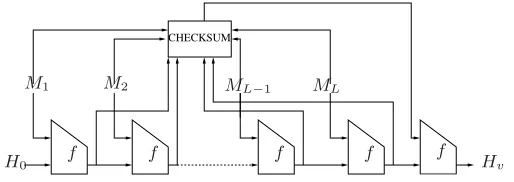
A number of variant constructions have been proposed, that augment the Damg˚ard-Merkle con-struction by computing some kind of XOR-linear/additive checksum on the message bits and/or intermediate hash values, and providing the XOR-linear/additive checksum as a final block for the hash function as shown in Figure 2.
CHECKSUM
M1 M2 ML−1
f f
f
f f
ML
H0 Hv
Fig. 2.Hash function structure with a linear-XOR/additive checksum
2.2 3C hash function and its XOR-linear checksum variants
computed by XORing all the intermediate states of the iterative chain. At any iteration ioff, the checksum value isij=1Hj. The hash valueHv is computed by processing the checksumZ padded with 0 bits as the final data block Z using the last compression functionf.
P A D
M1 M2 ML−1
f f
f
f f
ML
H0
0 Z Z
Hv
Fig. 3.The3C-hash function
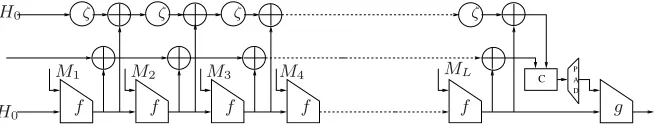
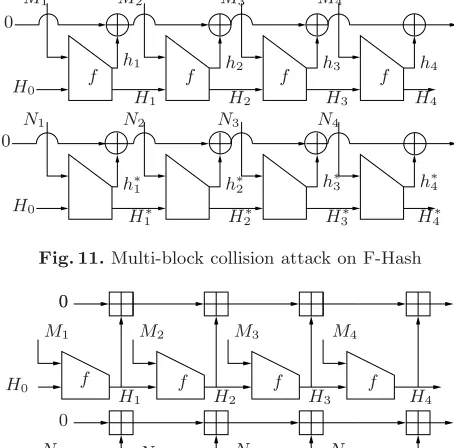
A 3-chain variant of 3C called 3CM is used as a chaining scheme in the MAELSTROM-0 hash function [10]. At every iteration of f in the iterative chain of 3CM, the t-bit value in the third chain is updated using an LFSR. This result is then XORed with the data in the iterative chain at that iteration. All the intermediate states in the iterative chain of 3CMare XORed in it’s second chain. Finally, the hash value is obtained by concatenating the data in the second and third chains and processing it using the lastf function. F-Hash [23,24], another variant of3C, computes the hash value by XORing part of the output of the compression function at every iteration and then processes it as a checksum block using the last compression function. See Appendix A for the description of these variants of 3C.
2.3 GOST and its additive checksum variants
GOST is a 256-bit hash function specified in the Russian standard GOSR R 34.11 [35]. The func-tionality of it’s compression function f is derived from the block cipher GOST specified in the standard GOST R 34.10-89 [34]. The functionf of GOST is iterated in the Damg˚ard-Merkle mode and a mod 2256 additive checksum is computed by adding all the 256-bit message blocks in an
accumulation chain. We generalise our analysis of GOST by assuming that it’s f function has a block length of bbits and hash value of t bits.
f f f
f f
f f
M1 M2 M3 ML−2ML−1
H0
ML
Hv
Z
Fig. 4.GOST hash function
An arbitrary length messageMto be processed using GOST is split intob-bit blocksM1, . . . , ML−1.
If the last block ML−1 is incomplete, it is padded by prepending it with 0 bits to make it a b-bit
block. The binary encoded representation of the length of the true message M is processed in a separate block ML as shown in Figure 4. At any iteration i, the intermediate state in the iterative and accumulation chains is Hi = f(Hi−1, Mi) and M1 +M2. . .+Mi mod 2b respectively where 1 ≤ i ≤ L. The hash value of M is Hv = f(Z, HL) where Z = M1 +M2. . .+ML−1 mod 2b.
3 New techniques to defeat linear-XOR checksums in hash functions
The linear-XOR/additive checksums in the Damg˚ard-Merkle hashes thwart the known techniques [8, 17,18] of performing long message second preimage and herding attacks [11]. These designs make it difficult for the attacker to find an expandable message, an intermediate multicollision of different length messages, for all the chains simultaneously using the techniques of [8, 18] to find a second preimage. Even if the attacker is provided with an expandable message for free, he must still find a linking message block to produce states in all the chains that match the corresponding intermediate states of the long target message. This requires about 2tcomputations off. Similarly, the attacker must find a linking message block to map the state data in all the chains to the state somewhere in the precomputed diamond structure to make the herding attack work [17]. This takes about 2t computations of f. While the Joux multicollision attack on 1-block messages work on these de-signs [11], the linear checksums in these dede-signs prevent the technique of Joux to find multicollisions over multiple message blocks.
3.1 Extending Joux 1-block multicollision attack on DM to multiple blocks
Let C(s, n) be a collision finding algorithm for a Damg˚ard-Merkle hash function where sdenotes the state at which the collision attack is applied and n, the number of message blocks present in each of the colliding messages. C(s, n) can be either a brute force or a cryptanalytic collision finding algorithm. On at-bit hash function, a brute forceC(s, n) requires about 2t/2 hash function
computations to find a collision with 0.5 probability whereas a cryptanalytic C(s, n) requires less effort than that. Joux multicollision attack [15] on at-bit Damg˚ard-Merkle hash uses a single-block brute force collision finder (n = 1) to find a 2k collision with a computational work of k×2t/2 computations of the compression function. This attack can be extended to multiple blocks (n≥2) without any additional work by calling this algorithm with at least two random message blocks in every call to it.
3.2 Checksum control sequences
We define checksum control sequence (CCS) as a chunk of data which lets an attacker to control the checksum value in the hash functions with linear checksums. The attacker constructs the CCS by building a Joux multicollision of the correct size using a random choice of message blocks. He then uses the CCS to actually control the checksum using a checksum control algorithm without changing any intermediate hash value on the iterative chain.
For example, a 2k 2-block collision on the underlying Damg˚ard-Merkle construction of 3C
(ignoring the linear-XOR checksum) using a brute-force collision finding algorithm gives the attacker
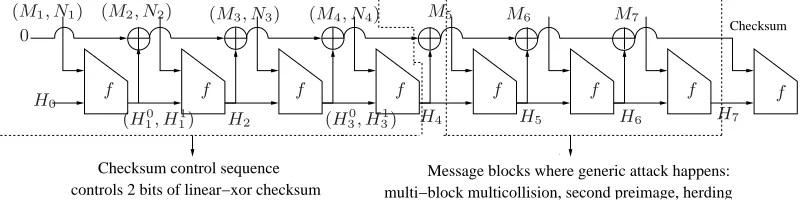
k independent choices of parts of the intermediate states that form the CCS. When the attacker wants a particular k-bit checksum value, he can turn the problem of finding which choices to make from the CCS into the problem of solving a system of k linear equations in k unknowns, something the attacker can do very efficiently using existing tools such as Gaussian elimination [3, Appendix A], [5, 43]. This is schematically shown in Figure 5 fork= 2 where the attacker performs a 22 collision using random 2-block messages to compute the CCS. Then he has a choice to choose
Checksum
multi−block multicollision, second preimage, herding Message blocks where generic attack happens: controls 2 bits of linear−xor checksum
Checksum control sequence
(M1, N1) (M2, N2) (M3, N3) (M4, N4) M5 M6 M7
(H10, H11) H2 (H30, H31) H4 H5
f f
f f
f f
f f
H6 H7
H0
0
Fig. 5.Using checksum control sequence to control 2 bits of the checksum
3.3 Defeating linear-XOR checksums in hash functions
ALGORITHM: Defeat linear-XOR checksum on 3C Variables:
1. (e0i,e1i) = A pair of independent choices of random values after every 2-block collision in the 2t 2-block collision on 3Cand e0i =e1i fori= 1,2, . . . , t.
2. a=a[1], a[2], . . . , a[t] = Any t-bit string.
3. D=D[1], D[2], . . . , D[t] = The desiredt-bit checksum to be imposed. 4. i, j = Temporary variables.
Steps:
1. Build a CCS for3Cby constructing a 2t2-block collision on the underlying Damg˚ard-Merkle of
3Cusing a brute force collision finding algorithm C(s,2). Now the CCS containstindependent choices of parts of the intermediate states where each choice imposes a random XOR difference on the t-bit linear-XOR checksum at the end of the 2t 2-block collision.
2. Each of the parts of the CCS gives one choice e0i or e1i for i = 1,2, . . . , t to determine some random t-bit value that either is or is not XORed into the final checksum value at the end of the 2t 2-block collision. Nowe0
i =H20i−1⊕H20i and e1i =H21i−1⊕H21i fori= 1,2, . . . , t. 3. For any t-bit stringa=a[1], a[2], . . . , a[t], letea=ea
1, . . . , eat.
4. Find a=a[1], a[2], . . . , a[t] such that ea1[1]⊕ea2[2]⊕. . .⊕. . . eat[t]=D. We now solve the equation: t
i=1e0i ×a[i]⊕e1i ×(1−a[i]) =D.
5. Each bit position of eai[i] gives one equation and turn the above into t equations, one for each bit. Let a[i] = 1−a[i].
6. The resulting system is: ti=1e0
i[j]×a[i]⊕e1i[j]×a[i] = D[j] (j = 1, . . . , t). Here there are t linear equations in t unknowns that need to be solved for the solutiona[1], a[2], . . . , a[t]. 7. The solutiona[1], a[2], . . . , a[t] lets us determine the blocks in the 2t2-block collision that form
the prefix to give the desired checksum D.
Work:It requires aboutt×2t/2 computations of the compression function to produce a 2t 2-block collision to construct the CCS and at most t3+t2 bit-XOR operations to solve a system of t×t
3.4 Defeating XOR-linear checksums in other designs
A similar technique defeats the checksum in F-Hash. To defeat the checksum in3CM, two sets of equations due to the XOR checksum in the second and third chains need to be solved. The attack algorithms on these designs have been placed in the Appendices B.1 and B.2 respectively. If a linear-XOR checksum is computed using message blocks and intermediate states, linear equations due to XOR of the intermediate states and message blocks need to be solved independently.
4 Techniques to defeat checksums in the designs with additive checksums
Consider an additive checksum mod 2k computed using messages. A 2(k/2)+1 Joux multicollision does not allow complete control of the checksum, but it does allow an attacker to usually find a pair of messages within the multicollision whose additive checksum differs by any desired value. This can be done by generating all 2(k/2)+1 possible checksum values from the multicollision, and doing a modified collision search for a pair of messages whose additive difference is the desired value.
Given this technique, a sequence of k successive 2(k/2)+1 Joux multicollisions can be used to completely control an additive checksum mod 2k. The first 2(k/2)+1 multicollision is used to find a pair of k/2 + 1 1-block messages whose checksum differs by 1, the next multicollision is used to find a pair of (k/2 + 1) 1-block messages whose checksum differs by 2, and so on through the kth
2(k/2)+1 multicollision, which yields a pair of (k/2 + 1) 1-block messages whose checksum differs by 2k−1. At this point, the attacker can easily choose a message to get any checksum he chooses, without affecting the intermediate hash value after the CCS.
MULTICOLLISION MULTICOLLISION MULTICOLLISION H0 H0 M1 1 M1 1∗ H1 1 H1 1 M1 2 M1 2∗ H1 2 H1 2 M1 (k/2+1)
M1 (k/2+1)∗
H1 z H1 z x1 y1 1st M2 1 M2 1∗ H2 1 H2 1 M2 2 M2 2∗ H2 2 H2 2 M2 (k/2+1)
M2 (k/2+1)∗
H2 z H2 z x2 y2 2nd Mk 1 Mk 1∗ Hk 1 Hk 1 Mk 2 Mk 2∗ Hk 2 Hk 2 Mk (k/2+1)
Mk (k/2+1)∗
Hk z Hk z xk yk kth f f f f f f f f f f
f f f
f f f f f 0 0
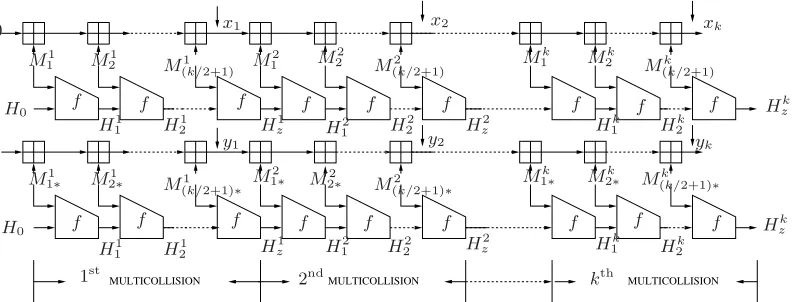
Fig. 6.Defeating additive checksum mod 2k computed using messages
This technique is schematically represented in Figure 6. In the first 2(k/2)+1 1-block multicolli-sion, f(Hi1−1, Mi1) =f(Hi1−1, Mi1∗) = Hi1 where i= 1 tok/2 + 1, H01 =H0 is the initial state, Hi1
are the intermediate states andMi1,Mi1∗ are the colliding blocks. The intermediate state at the end of the first multicollision isHz1 wherez=k/2 + 1. We then find a pair of collision paths from the 2k/2+1 different collision paths in this multicollision, such that their respective additive checksums
x1 and y1 satisfy the condition x1 ≡y1+ 1 mod 2b. In the second 2(k/2)+1 1-block multicollision,
f(H2
collision paths in this multicollision, such that their respective additive checksumsx2 andy2satisfy the condition x2 ≡y2+ 2 mod 2b. This process is repeated forktimes. In thekth 2(k/2)+1 1-block multicollision, f(Hik−1, Mik) =f(Hik−1, Mik∗) = Hik for i= 1 to k/2 + 1 and the intermediate hash value at the end of kth multicollision isHzk. We then find a pair of collision paths from the 2k/2+1 different collision paths in this multicollision, such that their respective additive checksums xk and
yk satisfy the conditionxk≡yk+ 2k−1 mod 2b. We now obtain the CCS by concatenating all these individual collision paths and then we force the additive checksum to the desired one by choosing either of the two available paths in each of the k 2k/2+1-collision paths. By now the attacker has found a message that forces the checksum to the desired value, without affecting the intermediate hash value after the CCS.
Below, we provide an algorithm to defeat the additive checksum in the GOST hash function.
ALGORITHM: Defeating checksum in GOST Variables:
1. i, j, k = integers.
2. chunk[i] = a pair of (b/2) + 1-message block sequences denoted by (e0i,e1i). 3. H0 = initial state.
4. Hji = the intermediate state on the iterative chain. 5. (Mji, Nji) = a pair of message blocks each ofbbits.
6. T = Table with three columns: a (b/2) + 1-collision path, addition modulo 2b of message blocks in that path and a value of 0 or 1.
Steps:
1. For i= 1 to b:
– Forj= 1 to (b/2) + 1:
• Find Mji and Nji such that f(Hji−1, Mji) = f(Hji−1, Nji) = Hji whereH01 =H0. That is, build a (b/2) + 1-block multicollision where each block yields a collision on the iterative chain and there are 2(b/2)+1 different (b/2) + 1-block sequences of blocks all hashing to the same intermediate state H(ib/2)+1 on the iterative chain.
– Find a pair of paths from the different (b/2) + 1-block sequences whose additive checksum differs by 2i−1. This is performed as follows:
• T = empty table. • forj= 1 to 2(b/2)+1
∗ Ci j ≡
(b/2)+1
k=1 Xki mod 2b whereXki can be either Mki orNki. ∗ Add to T: (Cji, 0,X1i||X2i||. . . X(ib/2)+1)
∗ Add to T: (Cji+ 2i−1, 1, X1i||X2i||. . . X(ib/2)+1).
• SearchT to find colliding paths between the entries with 0 and 1 in the second column of
T. Let these paths of (b/2)+1 sequence of blocks bee1i ande0i wheree1i ≡e0i+2i−1mod 2b.
– chunk[i] = (e0i, e1i).
2. Construct CCS by concatenating individual chunks each containing a pair of (b/2)+1 blocks that
hash to the same intermediate state on the iterative chain. The CCS ischunk[1]||chunk[2]. . . ||chunk[b]. 3. The checksum at the end of the 2b(b/2)+1-block collision can be forced to the desired checksum
D by choosing either of the sequences e0
Work:The work to defeat the additive checksum in GOST equals the work to construct b2(b/2)+1 1-block collisions plus the work to find a chunk in each 2(b/2)+1 1-block collision. It requires about
b×((b/2)+ 1)×2t/2 computations of the compression function and a time and space ofb×2b/2+1for a collision search to findbchunks. For GOST, it requires about 28×129×2128 ≈2143 computations of the compression function and a time and space of about 256×2129 = 2137.
Remark 1. A more efficient attack is available if the attacker can exert direct control over the message blocks, rather than simply using a large Joux multicollision. In this case, the attacker constructs a Joux multicollision in such a way that each pair of colliding messages has a fixed power of two difference in its lowkbits, and a random difference in its highb−k bits. This allows direct control over the low k bits of the checksum, while leaving the high b−kbits uncontrolled. A second Joux multicollision is then constructed, in which each pair of messages differs only in the high b−k bits. The second multicollision may then be used to control the high b−k bits of the checksum by brute force.
Using this technique on GOST with k = 128 leads to a CCS of only 256 message blocks. However, each attempt to control the checksum requires a 2128 brute force search in this case. Alternatively, with k= 32 (and using multi-block collisions to construct the Joux multicollision), the CCS is 1024 message blocks, and an attempt to control the checksum requires only a 232 brute force search.
4.1 Defeating additive checksums in other designs
Similarly, we can defeat additive checksums for the variants of GOST that compute additive check-sum mod 2kusing intermediate hash values by building a 2kJoux multicollision where each collision in it consists of 2(k/2)+1 multicollisions constructed using a sequence of (k/2 + 1) 2-block collisions as shown for the 3CA design in Appendix E. We note that this trick can also be used to defeat the additive checksum computed for a design using both the message blocks and intermediate hash values. In this case, a 2(k/2)+1 Joux multicollision using 2-block messages is performed to allow an attacker to find a pair of messages (resp. intermediate hash values) within the multicollision whose additive checksum differs by any desired value. This can be done by generating all 2(k/2)+1 possible checksum values due to messages (resp. intermediate hash values) from the multicollision, and doing a modified collision search for a pair of messages (resp. intermediate hash values) whose additive difference is the desired value. We note that the efficient attack discussed in Remark 1 does not work on the hash functions that compute additive checksum using intermediate hash values as the attacker cannot exert control over the input to the checksum formed using intermediate hash values.
5 Generic attacks on hash functions with linear checksums
The fundamental approach used to perform the generic attacks on all the hash functions with linear checksums is similar. Because the approach is similar, we discuss it here only for 3C and Appendices C and E discuss these generic attacks for other kinds of XOR-linear/additive checksums respectively. Broadly, it consists of the following steps:
1. Construct a CCS.
3. Carry out the generic attack, ignoring its impact on the linear checksum.
4. Use the CCS to control the linear checksum, forcing it to a value that permits the generic attack to work on the full hash function.
5.1 Meaningful multi-block multicollisions
Constructing and using the CCS does not imply random gibberish in the messages produced; using Yuval’s trick [47], a brute-force search for the multicollision used in the CCS can produce collision pairs in which each possible message is a plausible-looking one. Here, the attacker can create two documents where one is genuine and the other one a forgery and can vary their meaning in such a way that at some point of variation they collide when processed using the same hash function. For example, the attacker can use this trick to construct CCS for the hash functions that maintain checksums using meaningful colliding messages based on the brute force collision finding techniques. This is possible when the CCSs to defeat the checksums are constructed from individual collisions that span over multiple message blocks as in (Dear Fred/Freddie, )(Enclosed please find/I have sent you) (a check for $100.00/a little something) and so on, where the attacker can choose either side of the slash for the next part of the sentence. In that case, any choice for the CCS used to defeat the checksum will be a meaningful message. The impact of this attack is that one can construct not only meaningful collisions but also second preimages and herded messages with genuine meaning for these hash functions.
5.2 Long-message second preimage attack on 3C
Long message second preimage attack on at-bit 3C hash functionH is outlined below:
ALGORITHM: LongMessageAttack(Mtarget) on 3C Find the second preimage for a message of 2d+d+ 2t+ 1blocks.
Variables:
1. Mtarget = the target long message for which a second preimage is to be found.
2. Mlink = linking message block to connect the intermediate state on the iterative chain at the end of the expandable message to some point in the sequence of the intermediate states on the iterative chain of the target message.
3. Hexp= the intermediate state on the iterative chain at the end of theexpandable message. 4. Ht= the result of the 2t 2-block collision onH starting from the initial state.
5. Mf inal = the second preimage forH of the same length as Mtarget. 6. Mpref = the checksum control prefix obtained from the CCS.
Steps:
1. Compute the intermediate hash values for Mtarget usingH:
– H0 and h0 are the initial states of the iterative and accumulation chains respectively.
– Mi is the ith message block ofMtarget.
– Hi = f(Hi−1, Mi) and hi = Hi⊕hi−1 are the ith intermediate states on the iterative and
accumulation chains respectively.
2. Build a CCS forH by constructing a 2t 2-block collision starting from the initial state H0. Let
Ht be the multicollision value andht be the corresponding checksum value which is random. 3. Construct a (d, d+ 2d−1)-expandable message MexpwithHtas the starting state using
generic-expandable message algorithm from [18]. Append Mexp to the CCS and process it to obtain
Hexp.
4. Process message blocks from the end ofHexpto findMlinksuch thatf(Hexp, Mlink) collides with one of the intermediate states on the iterative chain stored in the hash table while processing
Mtarget. Let this matching value of the target message be Hu and the corresponding state in the accumulation chain behu where d+ 2t+ 1≤u≤2d+d+ 2t+ 1.
5. Use the CCS built in step 2 to find the checksum control prefixMpref by following the algorithm in Section 3.3. The prefixMpref adjusts the state in the accumulation chain at that point to the desired valuehu of the long target messageMtarget. This is equivalent to adjusting the checksum value at the end of the 2t 2-block collision.
6. Expand the expandable message to produce a message M∗ ofu−1 blocks long.
7. Return the second preimage Mf inal = Mpref||M∗||Mlink||Mu+1. . . M2d+d+1+2t of the same length as Mtarget such thatH(Mf inal) =H(Mtarget).
Work: The work required to find a second preimage on 3Cis the work to construct a 2t 2-block collision to build the CCS plus the work to solve a system oft×tlinear equations plus the work to find theexpandable messageplus the work to find the linking message block. So, theonlyadditional work required to perform the second preimage attack on 3Cover Damg˚ard-Merkle is the work to find a 2t 2-block collision and solve a system oft×tequations. Note that the work to produce the multicollision to build the CCS and solve the equations is very fast compared to the rest of the attack.
Illustration: The computational work required to find a second preimage for3C-SHA-256for a target message of 254+54+512+1 blocks is 2136+54×2129+2203compression function computations and 224+ 216 bit-XOR operations assuming abundant memory.
Remark 2. We note that 2k second preimages can be constructed for hash functions with linear checksums at negligible additional cost using a target message of length 2d+d+2t+k+1 blocks. We first find a 2kcollision over 1-block messages with a work ofk×2t/2computations of the compression function and then perform our second preimage attack from the end of the 2k collision.
5.3 Herding attack on 3C
The herding attack on at-bit 3Chash function H is outlined below:
1. Construct a 2d hash value wide diamond structure forH and output the hash value Hv as the chosen target which is computed using any of the possible 2d−1 checksum values or some value chosen arbitrarily. Let hc be that checksum value.
2. Build a CCS for H using a 2t collision over 2-block messages. LetH
tbe the intermediate state due to this multicollision onH.
3. When challenged with the prefix message P, processP usingHt. LetH(Ht, P) =Hp.
5. Use the CCS computed in step 2 to force the checksum of the herded message P to hc using the attack to defeat the checksum described in Section 3.3. LetMpref be the checksum control prefix obtained after solving the system of equations.
6. Finally, output the message M =Mpref||P||Mlink||Md whereMdare the message blocks in the diamond structure that connect H(Hp, Mlink) to the chosen target Hv2. NowHv =H(M).
Work:The computational work required to perform the herding attack on3Cis the work required to build the CCS plus the work to solve the system of equations plus the work required to perform the herding attack from [17]. This equals aboutt×2t/2+2t/2+d/2+2+d×2t/2+1+2t−d−1computations of the compression function and t3 +t2 bit-XOR operations assuming that all of the 2d+1 −2
intermediate states are used for searching in the diamond structure. Note that the work required to build the CCS using multicollision and to solve the system of equations is negligible compared to the rest of the attack.
Illustration: The work to perform the herding attack on 3C-SHA-256 with d = 84 is 2136+ 2172+ 84×2129+ 2171 ≈ 2172 computations of SHA-256 compression function and 224+ 216 bit-XOR operations.
Remark 3. We note that [12,13] shows only the application of Joux multicollision attack on3Cover 1-block messages. However, using our attack technique from Section 3.3, one can find multicollsions for3Cover multiple blocks by defeating the XOR-linear checksum.
5.4 Extending the generic attacks on to CRCs
The techniques used to defeat the checksums described in Sections 3.3 and 3.4 can be extended to any linear checksum which is reasonably short. Consider a 512-bit CRC computed over a message and used as the final checksum block. Now we construct the CCS using a 2512Joux multicollision and then append whatever message at the end of the multicollision to perform the generic 2nd-preimage and herding attacks. Each bit of the 512-bit CRC is a linear function of 512 binary variables
a[1], a[2], . . . , a[512] wherea[i] selects a message block from one of the sides of the collision in the CCS. One can perform the generic 2nd-preimage and herding attacks ignoring the checksum value, then solve the resultant system of 512×512 equations to force the checksum to the value necessary to make the attack work.
Remark 4. We note that for a hash function with XOR-linear/additive checksum of intermediate hash values producing checksum as the hash value, one can find preimages for a given target hash value cheaply by forcing the checksum to the target hash value. For example, assume that checksum value is used as the final hash value in the3C construction. The attacker performs the 2t 2-block multicollision and then processes the block with the encoding of the length (2t blocks) of the message used in the multicollision. Using the target hash value and output of the length encoded block, the attacker finds the desired checksum he needs at the end of the 2t 2-block multicollision so that he can force the hash value to the target hash value.
2Note that whenP is processed using the initial stateH
0ofH followed by a 2t2-block multicollision from the state
6 On the possibility of generic attacks using cryptanalytic collision attacks
We note that it is difficult to construct the CCSs using cryptanalytic collision finding algorithms such as the ones built on MD5 and SHA-1 [45, 46] in order to defeat linear checksums in hash functions to carry out generic attacks. For example, consider two 2-block colliding messages of format (M2.i−1, M2.i),(N2.i−1, N2.i) for i = 1, . . . , t on the underlying MD of 3C based on near collisions due to the first blocks in each pair of the messages. Usually, the XOR differences of the nearly collided intermediate states are either fixed or very tightly constrained as in the collision attacks on MD5 and SHA-1 [45, 46]. It is difficult to construct a CCS due to the inability to control these fixed or constrained bits. Similarly, it is also difficult to build the CCSs using collisions of the messages of format (M2.i−1, M2.i),(N2.i−1, M2.i) for i= 1, . . . , t. We note that one may create variants for the known cryptanalytic collision finding algorithms as in [41] that could be used to construct the CCS. This is an open question now. It is not possible to control the checksum due to 2-block collisions of the format (M2.i−1, M2.i), (M2.i−1, N2.i) for i= 1, . . . , t [44] as this format produces a zero linear-XOR checksum difference after every 2-block collision.
Alternatively, assume that two random message blocks are processed initially using f to ob-tain two different random intermediate states s1 and s2 and then a cryptanalytic collision finding algorithm C(s1, s2,1) is called with s1 and s2 as parameters which produces either the same or different message blocks that collide. In effect, the XORed-together intermediate states after every two blocks in the 2t 2-block collision are random and a CCS can be constructed to defeat the checksum.
6.1 Multi-block collision attacks on hash functions with linear checksums
Though we cannot perform generic attacks on the hash functions with linear checksums using structured collisions, we can still perform multi-block collision attacks. Consider a collision finding algorithmC(s,1) withs=H0 for the GOST hash functionH. A call to C(s,1) results in a pair of
b-bit message blocks (M1, N1) such that M1 ≡N1+Δmod 2b and f(H0, M1) =f(H0, N1) =H1. Now call C(s,1) with s = H1 which results in a pair of blocks (M2, N2) such that N2 ≡ M2+
Δmod 2b and f(H1, M2) =f(H1, N2) =H2. That is, H(H0, M1||M2) =H(H0, N1||N2). Consider
M1+M2 mod 2b = Δ+N1+N2−Δ mod 2b = N1+N2 mod 2b, a collision in the chain which computes additive checksum. Hence, by just appending two structured collisions end to end, we get a collision for the hash function with linear checksum. Similarly, structured collisions on Damg˚ ard-Merkle hash functions can be converted to multi-block collisions on other linear checksums as shown in Appendix F.
7 Comparison of our attack with that of Mironov-Narayanan
Independent to our work, Mironov and Narayanan [30] have found an alternative technique to defeat linear-XOR checksum computed using message blocks. We call this design GOST-x and is shown in Figure 7.
f f f
f f
f f
M1 M2 M3 ML−2 ML−1
H0
ML
Hv
Z
Fig. 7.GOST-x hash function
messages would result in a zero checksum at the end of the 2b multicollision on this structure and thwarts the attempts to perform the second preimage attack on GOST-x. The reason is that the attacker loses the ability to control the checksum after finding the linking message block from the end of the expandable message which matches some intermediate state obtained in the long target message.
However, we note that their technique with a twist can be used to perform the herding attack on GOST-x. In this variant, the attacker chooses the messages for the diamond structure that all have the same effect on the linear-XOR checksum. These messages would result in a zero checksum at every stage in the diamond structure. Once the attacker is forced with a prefix, processing the prefix gives a zero checksum to start with and then solving a system of equations will find a set of possible linking messages that will all combine with the prefix to give a zero checksum value.
When the approach of [30] is applied to defeat the checksums in 3C, 3CM and F-Hash, the 2t 2-block collision finding algorithm used to construct the CCS must output the same pair of message blocks on the either side of the collision whenever it is called. The technique of [30] imposes constraints not present in our technique, and is not quite as powerful. However, it could be quite capable of defeating linear-XOR checksums in many generic attacks. Because it is so different from our technique, some variant of this technique might be useful in cryptanalytic attacks for which our techniques do not work.
8 Concluding remarks
Our results demonstrate that maintaining large internal state sizes using XOR-linear/additive checksums is not good enough for the security of the hash function. In addition, widening the compression functions [27] along with the XOR-linear/additive checksums provide very little ad-ditional security against generic attacks compared to the wide-pipe hash. One question left open by our research is what properties would ensure that a checksum would block generic attacks. It is clear that it must be impossible for the attacker to build and use a CCS, but not clear that this is a sufficient condition.
References
1. Mihir Bellare. New Proofs for NMAC and HMAC: Security Without Collision-Resistance. In Cynthia Dwork, editor, Advances in Cryptology—CRYPTO ’06, volume 4117 ofLecture Notes in Computer Science. Springer-Verlag, 20–24 August 2006. Full version of the paper is available athttp://www-cse.ucsd.edu/users/mihir/ papers/hmac-new.html. Last access date: 7th of August 2007.
3. Mihir Bellare and Daniele Micciancio. A new paradigm for collision-free hashing: Incrementality at reduced cost. In Walter Fumy, editor,Advances in Cryptology: Proceedings of EUROCRYPT’97, volume 1233 ofLecture Notes in Computer Science, pages 163–192, 1997. The full version of the paper is available athttp://www-cse.ucsd. edu/~mihir/papers/incremental.html. Last access date: 29th of August 2007.
4. Eli Biham and Orr Dunkelman. A Framework for Iterative Hash Functions-HAIFA. Technical report, Au-gust 2006. The paper and slides of this work are available athttp://csrc.nist.gov/pki/HashWorkshop/2006/ program_2006.htm. Last access date: 15th of February 2007.
5. Don Coppersmith. Two Broken Hash Functions. Technical Report IBM Research Report RC-18397, IBM Research Center, October 1992.
6. Joan Daemen, Michael Peeters, and Gilles Van Assche. RadioGatun, a Belt-and-Mill Hash Function. Tech-nical report, August 2006. The paper and slides of this work are available at http://csrc.nist.gov/pki/ HashWorkshop/2006/program_2006.htm. Last access date: 15th of February 2007.
7. Ivan Damg˚ard. A Design Principle for Hash Functions. In Gilles Brassard, editor, Advances in Cryptology: CRYPTO 89, volume 435 ofLecture Notes in Computer Science, pages 416–427. Springer-Verlag, 1989. 8. Richard Drews Dean. Formal Aspects of Mobile Code Security. PhD thesis, Princeton University, 1999.
9. Federal Information Processing Standard (FIPS). Secure Hash Standard. National Institute for Standards and Technology, August 2002. This document is available at http://csrc.nist.gov/publications/fips/ fips180-2/fips180-2.pdf. Last access date: 11th of March 2007.
10. Decio Gazzoni Filho, Paulo Barreto, and Vincent Rijmen. The Maelstrom-0 Hash Function. Published at 6th
Brazilian Symposium on Information and Computer System Security, 2006.
11. Praveen Gauravaram. Cryptographic Hash Functions: Cryptanalysis, Design and Applications. PhD thesis, Information Security Institute, Queensland University of Technogy, June 2007.
12. Praveen Gauravaram, William Millan, Ed Dawson, Matt Henricksen, Juanma Gonzalez Nieto, and Kapali Viswanathan. Constructing Secure Hash Functions by Enhancing Merkle-Damg˚ard Construction (full ver-sion). Technical Report QUT-ISI-TR-2006-013, Information Security Institute (ISI), Queensland University of Technology (QUT), July 2006. This technical report is available athttp://www.isi.qut.edu.au/research/ publications/technical/qut-isi-tr-2006-013.pdf. Last access date: 12th of september 2007.
13. Praveen Gauravaram, William Millan, Ed Dawson, and Kapali Viswanathan. Constructing Secure Hash Functions by Enhancing Merkle-Damg˚ard Construction. InAustralasian Conference on Information Security and Privacy (ACISP), volume 4058 ofLecture Notes in Computer Science, pages 407–420, 2006.
14. Jonathan Hoch and Adi Shamir. Breaking the ICE: Finding Multicollisions in Iterated Concatenated and Ex-panded (ICE) Hash Functions. To appear in the Proceedings of 13th Annual Fast Software Encryption (FSE) International Conference, 2006. A preliminary version of this paper is available athttp://paginas.terra.com. br/informatica/paulobarreto/hflounge.html#HS06. Last access date: 27th of January 2007.
15. Antoine Joux. Multicollisions in Iterated Hash Functions. Application to Cascaded Constructions. In Matt Franklin, editor, Advances in Cryptology-CRYPTO 2004, volume 3152 of Lecture Notes in Computer Science, pages 306–316, Santa Barbara, California, USA, August 15–19 2004. Springer.
16. Burt Kaliski. RFC 1319: The MD2 Message-Digest Algorithm. Internet Activities Board, April 1992. This RFC is available athttp://www.ietf.org/rfc/rfc1319.txt. Last access date: 23rd of May 2007.
17. John Kelsey and Tadayoshi Kohno. Herding Hash Functions and the Nostradamus Attack. In Serge Vaudenay, editor, Advanes in Cryptology-EUROCRYPT 2006, volume 4004 of Lecture Notes in Computer Science, pages 183–200. Springer, 2006.
18. John Kelsey and Bruce Schneier. Second Preimages on n-bit Hash Functions for Much Less than 2ˆn Work. In Ronald Cramer, editor,Advances in Cryptology - EUROCRYPT 2005, volume 3494 ofLecture Notes in Computer Science, pages 474–490. Springer, 2005.
19. Lars Knudsen. SMASH – A cryptographic hash function. In Henri Gilbert and Helena Handschuh, editors,
IWFSE: International Workshop on Fast Software Encryption, volume 3557 ofLecture Notes in Computer Sci-ence, pages 228–242. Springer, 2005.
20. Lars Knudsen and John Mathiassen. Preimage and Collision attacks on MD2. In Henri Gilbert and Helena Handschuh, editors,Fast Software Encryption FSE: 12th International Workshop, volume 3557 ofLecture Notes in Computer Science, pages 255–267. Springer, 2005.
21. Xuejia Lai and James L. Massey. Hash Functions Based on Block Ciphers. In R. A. Rueppel, editor,Advances in Cryptology—EUROCRYPT 92, volume 658 ofLecture Notes in Computer Science, pages 55–70. Springer-Verlag, 24–28 May 1992.
23. Duo Lei. F-HASH: Securing Hash Functions Using Feistel Chaining. Cryptology ePrint Archive, Report 2005/430, 2005. The paper is available athttp://eprint.iacr.org/2005/430.pdf. Last access date: 11th of November 2006.
24. Duo Lei. New Integrated proof Method on Iterated Hash Structure and New Structures. Cryptology ePrint Archive, Report 2006/147, 2006. The paper is available athttp://eprint.iacr.org/2006/147.pdf. Last access date: 5th of November 2006.
25. Serguei Leontiev and Grigorij Chudov.RFC:4357 Additional Cryptographic Algorithms for Use with GOST 28147-89, GOST R 34.10-94, GOST R 34.10-2001, and GOST R 34.11-94 Algorithms. Internet Engineering Task Force, January 2006. This Informational RFC 4490 is available athttp://www.ietf.org/rfc/rfc4490.txt. Last access date: 12th of September 2007.
26. Serguei Leontiev and Dennis Shefanovski. RFC:4491 Using the GOST R 34.10-94, GOST R 34.10-2001, and GOST R 34.11-94 Algorithms with the Internet X.509 Public Key Infrastructure Certificate and CRL Profile. Internet Engineering Task Force, May 2006. This standards track RFC 4491 is available athttp://www.ietf. org/rfc/rfc4491.txt. Last access date: 11thof September 2007.
27. Stefan Lucks. A Failure-Friendly Design Principle for Hash Functions. In Bimal Roy, editor, Advances in Cryptology - ASIACRYPT 2005, volume 3788 ofLecture Notes in Computer Science, pages 474–494. Springer-Verlag, 2005.
28. Stefan Lucks. Hash Function Modes of Operation. Presented at ICE-EM RNSA 2006 Workshop on Recent Advances in Stream Ciphers and Hash Functions at the Queensland University of Technology (QUT), Brisbane, Australia., June 2006.
29. Ralph Merkle. One way Hash Functions and DES. In Gilles Brassard, editor, Advances in Cryptology: CRYPTO 89, volume 435 ofLecture Notes in Computer Science, pages 428–446. Springer-Verlag, 1989.
30. Ilya Mironov and Arvind Narayanan. Personal communication during the rump session of Crypto’06, August 2006.
31. Fr´ed´eric Muller. The MD2 Hash Function Is Not One-Way. In Pil Joong Lee, editor,Advances in Cryptology -ASIACRYPT 2004, 10th International Conference on the Theory and Application of Cryptology and Information Security, volume 3329 ofLecture Notes in Computer Science, pages 214–229. Springer, 2004.
32. Mridul Nandi and Douglas Stinson. Multicollision attacks on some generalized sequential hash functions. Cryp-tology ePrint Archive, Report 2006/055, 2006. The paper is available athttp://eprint.iacr.org/2006/055. Last access date: 19th of September 2006.
33. National Institute of Standards and Technology (NIST). Announcing the Development of New Hash Algorithms for the Revision of Federal Information Processing Standard (FIPS) 180-2, Secure Hash Standard, January 2007. This notice by NIST is available at http://www.csrc.nist.gov/pki/HashWorkshop/timeline.html with the Docket No: 061213336-6336-01. Last access date: 16th of February 2007.
34. Government Committee of the Russia for Standards. GOST R 34.10-94, Gosudarstvennyi Standard of Rus-sian Federation, Cryptographic Protection for Data Processing Systems Government Committee of USSR for Standards, 1989 (in Russian)., 1989.
35. Government Committee of the Russia for Standards. GOST R 34.11-94, Gosudarstvennyi Standard of Russian Federation, Information Technology, Cryptographic Data Security, Hashing function, 1994.
36. Vladimir Popov, Igor Kurepkin, and Serguei Leontiev. RFC:4357 Additional Cryptographic Algorithms for Use with GOST 28147-89, GOST R 34.10-94, GOST R 34.10-2001, and GOST R 34.11-94 Algorithms. Internet Engineering Task Force, January 2006. This Informational RFC 4357 is available athttp://www.ietf.org/rfc/ rfc4357.txt. Last access date: 11th of September 2007.
37. Norbert Pramstaller, Christian Rechberger, and Vincent Rijmen. Breaking a New Hash Function Design Strategy Called SMASH. In Bart Preneel and Stafford E. Tavares, editors,Selected Areas in Cryptography, volume 3897 ofLecture Notes in Computer Science, pages 233–244. Springer, 2006.
38. Vincent Rijmen and Paulo S. L. M. Barreto. The WHIRLPOOL hash function. This hash function was adopted as a standard by ISO/IEC 10118-3:2004, 2004. The specification is available athttp://paginas.terra.com.br/ informatica/paulobarreto/WhirlpoolPage.html. Last access date: 27th of August 2007.
39. Ronald Rivest. The MD5 message-digest algorithm. Internet Request for Comment RFC 1321, Internet Engi-neering Task Force, April 1992.
40. Ronald Rivest. Abelian Square-free Dithering and Recoding for Iterated Hash Functions. Technical report, October 2005. The paper and slides of this work are available at http://csrc.nist.gov/pki/HashWorkshop/ 2005/program.htm. Last access date: 15th of February 2007.
Computer Science, pages 1–22. Springer, 2007. A version of this paper is available with a different title at
http://eprint.iacr.org/2006/360. Last access date: 1st of September,2007.
42. Jiri Tuma and Daniel Joscak. Multi-block Collisions in Hash Functions based on 3C and 3C+ Enhancements of the Merkle-Damg˚ard Construction. In Min Surp Rhee and Byoungcheon Lee, editor,Information Security and Cryptology ICISC, volume 4296 ofLecture Notes in Computer Science, pages 257–266, 2006.
43. David Wagner. A Generalized Birthday Problem. In Moti Yung, editor, Advances in Cryptology - CRYPTO 2002, volume 2442 ofLecture Notes in Computer Science, pages 288–303. Springer, 2002.
44. Xiaoyun Wang, Yiqun Lisa Yin, and Hongbo Yu. Efficient collision search attacks on SHA-0. In Victor Shoup, editor,Advances in Cryptology—CRYPTO ’05, volume 3621 ofLecture Notes in Computer Science, pages 1–16. Springer, 2005, 14–18 August 2005.
45. Xiaoyun Wang, Yiqun Lisa Yin, and Hongbo Yu. Finding collisions in the full SHA-1. In Victor Shoup, edi-tor, Advances in Cryptology—CRYPTO ’05, volume 3621 ofLecture Notes in Computer Science, pages 17–36. Springer, 2005, 14–18 August 2005.
46. Xiaoyun Wang and Hongbo Yu. How to Break MD5 and Other Hash Functions. In Ronald Cramer, editor,
Advances in Cryptology - EUROCRYPT 2005, volume 3494 ofLecture Notes in Computer Science, pages 19–35. Springer, 2005.
47. Gideon Yuval. How to swindle Rabin. Cryptologia, 3(3):187–189, July 1979.
A Other proposals of hash functions with linear checksums
A.1 F-Hash hash function
M1 M2 ML−1
f f
f
f g
ML
H0
0 Z0
H1 H2
h
1 h2 hL−1
HL−1 HL
h1 h2 hL−1 hL
Hv
Fig. 8.The F-Hash hash function
The initial state of a t-bit F-Hash hash function shown in Figure 8 isH0 and the compression functionf is a Feistel structure based on a round function F of r rounds [23, 24]. The message M
to be processed using F-Hash is split into equal size blocks Mi fori = 1 to L including padding which is similar to the padding of Damg˚ard-Merkle hash functions. The two intermediate hash values hi and Hi) each of t bits for every iteration of the compression function f are given by
Hi = fr(Mi, Hi−1) and hi = fr−1(Mi, Hi−1) where i = 1,2, . . . , L; fr is the r-round iteration of
F and fr−1 is the r-1-round iteration of F. The accumulation value at any iteration i is given by hi =ij=1hj. The intermediate hash values (Hi, hi) together at any iteration iare considered as iterative intermediate hash values. F-Hash computes checksumZ0 =Li=1(hi) using parthi of the iterative intermediate hash values. The hash value isHv =g(HL, Z0) whereg is the iteration ofF
forr rounds.
A.2 3CM used in MAELSTROM-0
is updated using a linear feedback shift register (LFSR) denoted byζ in Figure A.2. The LFSRζ is an implementation of one-byte left shift of thet-bit accumulation chaining value and a conditional one byte XOR applied to that by a constant. Then modulo 2 addition of this result with the iterative chain data is performed. At every iteration i of the compression function in 3CM, the iterative intermediate hash values are denoted by Hi, the checksum values in the second chain by hi and the checksum values in the third chain by hi. At any iteration i, the checksum value of the second chain is hi = hi−1 ⊕Hi or
i
i=1Hi. At any iteration i, the checksum value in the third chain is hi = ζ(hi−1)⊕Hi. After processing all the message blocks including the last block containing the Merkle-Damg˚ard strengthening, the checksum values of the second and third chains are concatenated and padded with 0’s if necessary to obtain a b-bit data block. This block is processed using the final compression function denoted by g in Figure A.2. For example, if the compression function f is SHA-1, then the concatenated checksum values from both the chains are padded with 192 0 bits to obtain a 512-bit block. For example, if the compression function is SHA-256 then no padding is performed for the concatenated checksum block as it is already 512 bits.
C
P A D
0
M1 M2 M3 M4 ML
f f
f f
f g
H0
H0
ζ ζ
ζ ζ
Fig. 9.The3CMconstruction used in Maelstrom-0
B Techniques to defeat linear checksums in F-Hash and 3CM
B.1 Defeating linear checksum in F-Hash
The following algorithm is used to defeat the checksum in F-Hash.
ALGORITHM: Defeat linear checksum in F-Hash Variables:
1. (e0i,e1i) = A pair of independent choices of random values after every 2-block collision in the 2t 2-block collision on F-Hash and e0i =e1i fori= 1,2, . . . , t.
2. a=a[1], a[2], . . . , a[t] = Any t-bit string.
3. D=D[1], D[2], . . . , D[t] = The desiredt-bit checksum to be imposed. 4. i, j = Temporary variables.
Steps:
1. Build a CCS for F-Hash by building a 2t 2-block multicollision by calling a brute-force collision finding algorithm C(s,2) ttimes on the Damg˚ard-Merkle chain of F-Hash.
2. Each of the parts of the CCS gives us one choice (e0i ore1i) fori= 1,2, . . . , t to determine some randomt-bit value that either is or is not XORed into the final checksum value at the end of 2t multicollision. Note that e0
i =h02i−1⊕h02i and e1i =h21i−1⊕h12i fori= 1,2, . . . , t where e00 = 0
3. For anyt-bit stringa=a[1], a[2], . . . , a[t], letea=ea1, . . . , eat.
4. D is the desired checksum to be imposed at the end of the 2t 2-block multicollision.
5. Finda=a[1], a[2], . . . , a[t] such thatea1[1]⊕ea2[2]⊕. . .⊕. . . eat[t]=D. By treatinga[1], a[2], . . . , a[t] as variables, solve the equation
t
i=1e0i ×a[i]⊕e1i ×(1−a[i]) =D
6. Each bit position ofeai[i]gives us one equation and turn the above intotequations, one for each bit. Let a[i] = 1−a[i].
7. The resulting system is:
t
i=1e0i[j]×a[i]⊕ei1[j]×a[i] =D[j] (j= 1, . . . , t)
Here there are t equations in t unknowns over modulo 2 addition which can be solved for the solution a[1], a[2], . . . , a[t].
8. The solution a[1], a[2], . . . , a[t] lets us determine the blocks in the 2t 2-block multicollision that give the desired checksum D.
Work:It requirest×2t/2computations of the compression function to find a 2t2-block multicollision to construct the CCS and at mostt3+t2 bit-XOR operations to solve the system oft×tequations
using Gaussian elimination to find a solution with a significant probability.
B.2 Defeating linear checksum in 3CM
The following algorithm is used to defeat the checksum in3CM.
ALGORITHM: Defeat linear checksum in 3CM Variables:
1. (e0i,e1i) = A pair of independent choices of random values on the second chain after every 2-block collision in the 2t2-block multicollision on 3CMand e0i =e1i fori= 1,2, . . . , t.
2. (s0i,s1i) = A pair of independent choices of random values on the third chain after every 2-block collision in the 2t2-block multicollision on 3CMand s0i =s1i fori= 1,2, . . . , t.
3. a=a[1], a[2], . . . , a[t] andc=c[1], c[2], . . . , c[t] are any twot-bit strings.
4. D1 =D1[1], D1[2], . . . , D1[t] = The desired t-bit checksum to be imposed on the second chain. 5. D2 =D2[1], D2[2], . . . , D2[t] = The desired t-bit checksum to be imposed on the third chain. 6. i, j = Temporary variables.
Steps:
1. Build a CCS for 3CMby building a 2t 2-block multicollision by calling a brute-force collision finding algorithm C(s,2) ttimes on the Damg˚ard-Merkle chain of 3CM.