Study of the process
e
+e
−→
2(
π
+π
−π
0)
with the CMD-3 detector
at VEPP-2000 collider
P.A. Lukin1,2,a, R.R. Akmetshin1,2, A.V. Anisenkov1,2, V.M. Aulchenko1,2, V.Sh. Banzarov1,
N.S. Bashtovoy1, D.E. Berkaev1,2, A.E. Bondar1,2, A.V. Bragin1, S.I. Eidelman1,2, D.A. Epifanov1,3, L.B. Epshteyn1,4, A.L. Erofeev1, G.V. Fedotovich1,2, S.E. Gayazov1,2, A.A. Grebenuk1,2, D.N. Grigoriev1,2,4, E.M. Gromov1, F.V. Ignatov1,2, S.V. Karpov1, V.F. Kazanin1,2, B.I. Khazin1,2, I.A. Koop1,2, O.A. Kovalenko1,2, A.N. Kozyrev1, E.A. Kozyrev1,2, P.P. Krokovny1,2, A.E. Kuzmenko1,4, A.S. Kuzmin1,2, I.B. Logashenko1,2, K.Yu. Mikhailov1,2, N.Yu. Muchnoi1,2, V.S. Okhapkin1, Yu.N. Pestov1, E.A. Perevedentsev1,2, A.S. Popov1,2, G.P. Razuvaev1,2,
Yu. A. Rogovsky1, A.L. Romanov1, A.A. Ruban1, N.M. Ryskulov1, A.E. Ryzhenenkov1,2,
V.E. Shebalin1,2, D.N. Shemyakin1,2, B.A. Shwartz1,2, D.B. Shwartz1,2, A.L. Sibidanov1,5,
P.Yu. Shatunov1, Yu.M. Shatunov1, E.P. Solodov1,2, V.M. Titov1, A.A. Talyshev1,2, A.I. Vorobiov1,
and Yu.V. Yudin1,2
1Budker Institute of Nuclear Physics, Novosibirsk, 630090, Russia
2Novosibirsk State University, Novosibirsk, 630090, Russia
3University of Tokyo, Department of Physics, 7-3-1 Hongo Bunkyo-ku Tokyo, 113-0033, Japan
4Novosibirsk State Technical University, Novosibirsk, 630092, Russia
5University of Sidney, School of Physics, Falkner High Energy Physics, NSW 2006, Sydney, Australia
Abstract.Since 2010 the CMD-3 detector has been collecting data at the VEPP-2000
e+e−collider. CMD-3 is a general purpose detector designed to studye+e−annihilation into hadrons in the center-of-mass (c.m.) energy range from 0.3 up to 2 GeV. Preliminary results for thee+e− →2(π+π−π0) cross section were obtained in the c.m. energy range
from 1.5 up to 2 GeV. The analysis is based on a data sample of 22 pb−1.
1 Introduction
Measurements of the cross section ofe+e− annihilation into hadrons are important for a number of physical problems. The cross section is used for a calculation of the hadronic contribution to vacuum polarization while determining the anomalous magnetic moment of the muon [1]. Studies of the hadronic cross sections allow to determine parameters of light vector mesons and their excitations. And finally, it is possible to test the hypothesis of the vector current conservation (CVC) by comparing thee+e−cross sections with spectral functions of theτ-lepton decays.
The present analysis is devoted to the study of the processe+e−→2(π+π−π0). The final state with six charged pions has already been studied in the DM2 [2], BaBar [3] and CMD-3 [4] experiments. A sharp dip in the cross section near Ec.m.=1.9 GeV has been discovered by the DM2 detector and confirmed later by the BaBar and CMD-3 expirements. The BaBar detector also observed a similar
ae-mail: [email protected]
DOI: 10.1051/ C
Owned by the authors, published by EDP Sciences, 2014
/201
dip in the cross section of the 2(π π π
not clear to the moment, but one of the possible explanations is the existence of a “under-threshold” proton-antiproton resonance. Indirectly, the assumption was confirmed by fast growth up of a proton formfactor near threshold, observed in the BaBar experiment [5]. A narrow resonant structure near the pp¯ production threshold was also discovered by the FENICE experiment [6]. Here we report preliminary results on the measurement of the cross section of the processe+e−→ 2(π+π−π0) in the
Ec.m.=1.5 – 2.0 GeV energy range, performed with the CMD-3 detector [7] at the VEPP-2000e+e− collider [8].
2 Detector and experiment
The general purpose cryogenic magnetic detector CMD-3 is described in detail elsewhere [7]. The detector tracking system consists of the cylindrical drift chamber [9] with 19 layers of hexagonal cells and the proportional Z-chamber. Both chambers are inside the thin (0.2X0) superconducting solenoid with magnetic field of 1.3 T. Outside the solenoid there is the barrel electromagnetic calorimeter con-sisting of the LXe calorimeter [10] with 5.4X0thickness and the CsI calorimeter (1152 crystals) with a thickness of 8.1X0, placed outside the LXe calorimeter. The CMD-3 detector endcap calorimeter [11] consists of 680 BGO crystals and has a thickness of 13.4X0.
The beam energy during data taking was determined by the special system [12] using Compton backscattering of laser photons. Integrated luminosity was measured by events of large angle Bhabha scattering using a procedure described in [13]. In analysis we used an integrated luminosity of 22 pb−1collected with the CMD-3 detector in Ec.m.=1.5 – 2.0 GeV in 2011 – 2012.
Radiative corrections to the cross section due to radiative photon emission by inital particles were calculated using formulas from [14].
3 Analysis
To study thee+e− → 2(π+π−π0) process we select events with four charged tracks and two neutral pions. Each charged track should satisfy the following conditions:
• The number of track hits in the drift chamber is larger than 5. • A track momentum is greater than 40 MeV/c.
• Minimal distance of a track to the beam point in the plane, transverse to the beam axis, is less than 0.5 cm.
• Minimal distance of a track to the beam point along the beam axis is less than 10 cm. • Polar angle of a track is big ehough to cross more than half of the drift chamber.
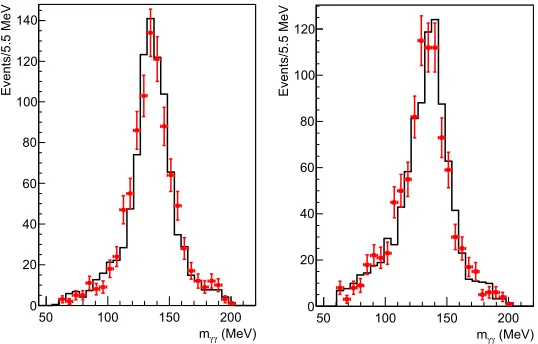
To search for neutral pions we studied the spectrum of invariant mass of the photon pair in the mass window 60< mγγ <200 MeV/c2 and the pair of photons withm
(MeV)
γ γ
m 50 100 150 200
Events/5.5 MeV
0 20 40 60 80 100 120 140
(MeV)
γ γ
m 50 100 150 200
Events/5.5 MeV
0 20 40 60 80 100 120
Figure 1. Invariant mass of photons formingπ0 with a higher momentum (left). Distribution of events over
invariant mass of two photons formingπ0with a lower momentum (right). Points with errors describe the
distri-bution of experimental data, while the histogram demonstrates the distridistri-bution of events of the signal Monte-Carlo simulation.
difference between the total energy of six particles and center-of-mass energy with the sum of three Gaussian functions describing a signal and a parabola describing background as shown in Fig. 2(left). To take into account a number of effects, which lead to the loss of one charged pion track (decays in flight, nuclear interactions, reconstruction inefficiency etc.), we also studied events with three charged and two neutral pions. Assuming that these events belong to the 2(π+π−π0) process, we describe the lost charged pions by missing parameters and calculate the same difference as in the case of six reconstructed particles as demonstrated in Fig. 2(right). To determine the number of events with one lost charged pion, the distribution was fitted with the sum of three gaussian functions describing signal and a parabola describing background. The result of the fit is also shown in Fig. 2(right).
The cross section of the processe+e− → 2(π+π−π0) was determined by the sum of number of events with four charged and two neutral pions and number of events with three charged and two neutral pions. The energy dependence of the cross section obtained is shown in Fig. 3 by dark points. In Figure 3 one can also see the cross section, obtained by the BaBar detector [3](light points). Rea-sonable agreement between two measurements can be seen. Our preliminary result also confirms the dip in the cross section near thepp¯threshold. The analysis is continuing and systematic errors of the cross section are under study.
4 Conclusion
(MeV)
beam
-2E
tot
E
-800 -600 -400 -200 0 200 400 600
Events/10 MeV
0 50 100 150 200 250 300 350
(MeV)
beam
-2E
tot
E
-800 -600 -400 -200 0 200 400 600
Events/10 MeV
0 20 40 60 80 100 120 140
Figure 2.Distribution of events with four charged and two neutral pions over the difference between total energy
of six particles and center-of-mass energy (left);Distribution of events with three charged and two neutral pions (lost charged pion described by the missing parameters) over the difference between total energy of six particles and center-of-mass energy (right). The distributions fitted with the sum of three gaussian function describing signal and parabola describing background
Figure 3.Cross section of the processe+e−→2(π+π−π0), measured in the present analysis (dark points) and in
the BaBar experiment [3](light points).
Acknowledgements
11-02-00112-a, 11-02-00328-a, 12-02-01032-a, 12-02-31498-a, 12-02-31499-a, 12-02-31501-a, 00215-a, 13-02-01134-a, 14-02-31478-mol, 14-02-00580-a, 14-02-00047-a.
References
[1] M. Davier, S. Eidelman, A. Hoecker and Z. Zhang. Eur. Phys. J. C31, 503 (2003). [2] R. Baldiniet al., reported at FENICE Workshop, Frascati (1988) and
A.B. Clegg and A. Donnachie. Z. Phys. C45, 677 (1990), M.R. Walley et al., J. Phys. G29, A1 (2003).
[3] B. Aubertet al., (BaBar Collab.), Phys. Rev. D73052003 (2006). [4] R.R. Akhmetshinet al., Phys. Lett. B72382 (2013).
[5] B. Aubertet al., (BaBar Collab.), Phys. Rev. D73012005 (2006). [6] A. Antonelliet al., (FENICE Collab.), Phys. Lett. B365, 427 (1996). [7] B.I. Khazinet al., Nucl. Phys. B (Proc. Suppl.)181-182, 376 (2008). [8] V.V. Danilovet al., Proc. Of EPAC96, Barcelona, 1593, (1996) and
I.A. Koopet al., Nucl. Phys. B (Proc. Suppl.)181-182, 371 (2008). [9] F. Grancagnoloet al., Nucl. Instrum. Meth. A623, 114 (2010). [10] A.V. Anisyonkovet al., Nucl. Instrum. Meth. A598, 266 (2009).