Discriminative Reranking for Spelling Correction
*Yang Zhang1, Pilian He1, Wei Xiang2, Mu Li3
1
School of Computer Science and Technology Tianjin University, China
{yangzhang, plhe}@tju.edu.cn 2
Department of Computer Science
Hong Kong University of Science and Technology, China [email protected]
3
Natural Language Computing Group Microsoft Research Asia
Abstract. This paper proposes a novel approach to spelling correction. It reranks the output of an existing spelling corrector, Aspell. A discriminative model (Ranking SVM) is employed to improve upon the initial ranking, using additional features as evidence. These features are derived from state-of-the-art techniques in spelling correction, including edit distance, letter-based n-gram, phonetic similarity and noisy channel model. This paper also presents a new method to automatically extract training samples from the query log chain. The system outperforms the baseline Aspell greatly, as well as previous models and several off-the-shelf spelling correction systems (e.g. Microsoft Word 2003). The results on query chain pairs are comparable to that based on manually-annotated pairs, with 32.2%/32.6% reduction in error rate, respectively.
1. Introduction
Spelling correction is used to suggest one or several hypothetical corrections for the assumed error once a spell checker detects some misspelling, which is typically identified when it cannot been found in a pre-compiled lexicon. In this paper, we focus on the problem of interactively correcting non-word errors
(e.g. teh for the). We do not deal with real word errors (such as from is written when form is intended).
We propose an approach that can be applied to text processing applications, such as the spelling corrector used in Microsoft Word or Aspell [2]. In these applications several suggestions (5 or 10 in most cases) are provided in an interactive manner, letting the user choose the desired one. In most cases the suggestion ranked first is preferred. For this reason top 1 suggestion is our most concern. We also care about the top 5/10 accuracies since they are presented to the user, too. Aspell [2] is a spelling program widely used on different platforms. As shown in [1], the top 5 accuracy of Aspell is more than 85%. However, it suffers from its poor performance on top 1 accuracy, which is less than 60%.
Our motivation is to improve the initial ranking of Aspell’s output to gain a higher performance. The main contributions are as follows:
1. We adapt a discriminative model (Ranking SVM) to rerank the output of Aspell’s N-best
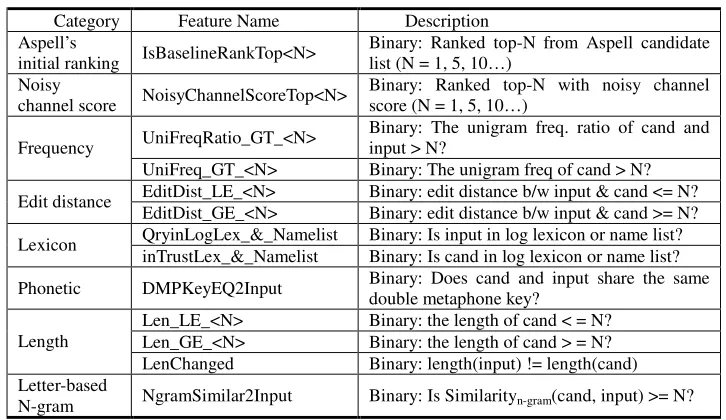
candidates, adding some global features as evidence. The model is general-purposed so that we can integrate state-of-the-art techniques in spelling correction into one model, including edit distance, n-gram, phonetic similarity and noisy channel model. Encouraging results are gained on this task.
2. A novel approach is proposed to actively solicit training pairs from query log chain. The quality
of this approach is verified in the evaluation that follows.
The rest of the paper is organized as follows: in Section 2, we conduct a literature research into spelling correction. The reranking problem is formulated in Section 3. Section 4 shows the experimental
* This work was conducted when the first author was visiting Microsoft Research Asia. It is supported by
evaluation. In this section we also specify the details to automatically extract training data from query log chain. The last section contains the conclusions and suggestions for possible further developments of the proposed model.
2. Related Work
Comprehensive reviews of the spelling correction literature can be found in [13] and [15]. There are some widely-used algorithms proposed to correct spelling errors. Edit distance algorithm and letter-based n-gram deal with typographic errors due to keyboard proximity. Soundex [15] and metaphone [21]
are for phonetic ones (e.g. fone for phone). Algorithms dealing with phonetic errors map a spelling to a
phonetic-encoded string: Soundex uses 7 codes; Phonix uses 9 codes, whereas the number of codes employed in [10] is 14. Metaphone and its descendant double metaphone [22] take not only spelling but also phonetic factors into account. Since the original versions of these algorithms do not work perfectly in real scenarios, variants or hybrid systems have been invented. Phonix [6] [7] is a variant of Soundex and is mainly used for human name detection. The popularity of Aspell is due to the excellent metaphone [21] algorithm and Ispell's [11] near miss strategy which is inserting a space or hyphen, interchanging two adjacent letters, changing one letter, deleting a letter, or adding a letter. Our system takes more than five cutting-edge techniques into account, rather than simply rely on one or two factors.
As for the models in this task, rule-based studies include [18] [19]. In recent years, statistical machine learning also makes contributions to spelling correction task. It falls into two categories: generative and discriminative. The heavily-used generative model in this domain is the noisy channel model: [1] [3] [5] [24]. It considers the phenomenon of making spelling mistakes as the process of sending text through a noisy communication channel, which introduces error in the text. As for each input (a potential misspelling) the candidate with largest posterior, P(cand|input) is chosen. By applying Bayes rule and dropping the constant denominator we can score each candidate by its prior P(cand) multiplying the likelihood, P(input|cand). The language model P(cand) can be estimated using n-gram statistics [3] [14]. The channel model P(input|cand) is generally modeled using letter-to-letter[14] or to-string confusion probabilities [3]. [3] has the best performance because it allows generic string-to-string edits. As for the discriminative models, Winnow [8], neural net [10] and maximum entropy [16] are adopted. [8] corrects contextual errors, which resolves ambiguity from the same confusion set. Our model is linearly discriminative, which can integrate some cutting-edge techniques into this model.
Other than applications in text processing, the emerging search engines pose an even bigger challenge on query spelling correction since searching for misspelled query is a waste of time and money. There are a large number of OOV words in queries. Statistics in [5] show that 10%-15% of queries contain one or more errors; the average length of a query is less than 3 words, with little contextual information available. Noisy channel model is dominant in query spelling correction research [1] [5]. Research in [16] exploits to use maximum entropy model for query spelling correction task. It also features the usage of distributional similarity between the correct word and its misspellings based on query log statistics. Although we aim toward single word spelling correction, we believe that our approach can also be adapted to this scenario because of its generality.
3. Problem Formulation
3.1 Definition for the reranking problem
4. Experimental Results
4.1 Training data (from query chain as well as human annotation)
In a discriminative learning task we need some (input, gold-standard) pairs for training purposes. This work is often conducted by human experts and is really a time-consuming and energy-draining job. In this paper we exploit an innovative approach to actively solicit training pairs from query log data. This
approach adopts the concept of query chain defined in [23], whose authors observe that users searching
the web often perform a sequence, of queries with a similar information need. They refer to a sequence
of reformulated queries from the user as a query chain and apply this finding to learn ranked retrieval
functions for web search results.
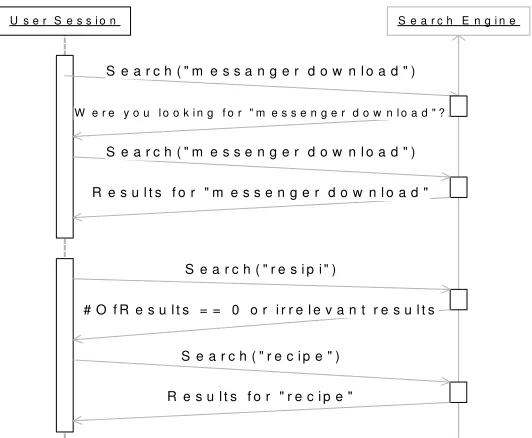
We adapt this idea to automatically extract training pairs from query log data. Take figure 1 for illustration. Suppose some user types query “messanger download” to a search engine intending to download the latest version of messenger software. This search engine returns results containing keyword “messanger” or “download” or both, along with a query suggestion “messenger download”. At first the user may get confused. After some effort, he realizes that the original query is misspelled and then corrects it. This time he gets web pages he really want, feeling satisfied. After some log mining work we can get training pair (messanger download, messenger download). The pair (resipi, recipe) can be mined in a similar way. As for single word spelling correction task, we care about one-to-one word pairs only. So we just keep (messanger, messenger) and (resipi, recipe) for our use.
U s e r S e s s i o n S e a r c h E n g i n e
S e a r c h ( " m e s s a n g e r d o w n l o a d " )
W e r e y o u l o o k i n g f o r " m e s s e n g e r d o w n l o a d " ?
R e s u l t s f o r " m e s s e n g e r d o w n l o a d "
# O f R e s u l t s = = 0 o r i r r e l e v a n t r e s u l t s
R e s u l t s f o r " r e c i p e " S e a r c h ( " r e c i p e " )
S e a r c h ( " r e s i p i " )
S e a r c h ( " m e s s e n g e r d o w n l o a d " )
Fig. 1. Query Chain
features. Since this model involves a relatively large amount of calculation, it may need more processing time. We believe this issue will be improved in future research.
Table 2. Top-N accuracy
EMBED [1] Microsoft Word 2003
Brill’s error model [3]
Aspell (baseline)
RSVM (query chain)
RSVM (manually)
Total pairs 508 508 508 508 508 508
Top 1 211 (41.5%) 306 (60.2%) 312 (61.4%) 269 (53.0%) 346 (68.1%) 347 (68.3%) Top 5 331 (65.2%) 377 (74.2%) 429 (84.4%) 410 (80.7%) 434 (85.4%) 440 (86.6%) Top 10 N/A 382 (75.2%) 445 (87.6%) 443 (87.2%) 448 (88.2%) 452 (89.0%) Top 25 386 (76.0%) N/A 460 (90.6%) 456 (89.8%) 460 (90.6%) 461 (90.7%) Top 100 402 (79.1%) N/A 462 (90.9%) 462 (90.9%) 462 (90.9%) 462 (90.9%)
4.5 Results without Aspell’s initial ranking (ranking model)
A question regarding the above approach is whether the features incorporating state-of-the-art techniques can work well without Aspell’s initial ranking. This leads to a ranking model rather than a reranking one, since no baseline information used.
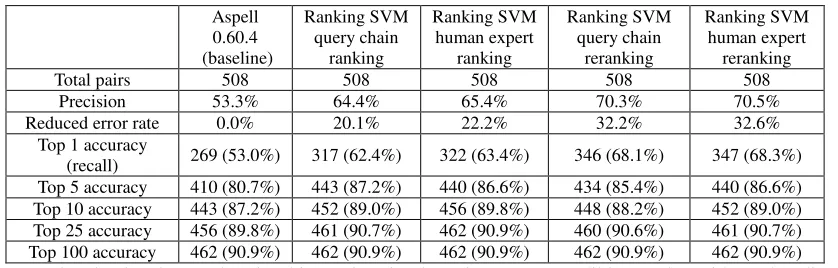
To verify the effectiveness of these features, we carry out two more experiments (training data from query chain pairs and manually-annotated ones) on ranking the N-best candidates, not using Aspell’s initial ranking. Table 3 shows the results.
Table 3. Performance of the ranking and reranking model
Aspell 0.60.4 (baseline)
Ranking SVM query chain
ranking
Ranking SVM human expert
ranking
Ranking SVM query chain
reranking
Ranking SVM human expert
reranking
Total pairs 508 508 508 508 508
Precision 53.3% 64.4% 65.4% 70.3% 70.5%
Reduced error rate 0.0% 20.1% 22.2% 32.2% 32.6%
Top 1 accuracy
(recall) 269 (53.0%) 317 (62.4%) 322 (63.4%) 346 (68.1%) 347 (68.3%) Top 5 accuracy 410 (80.7%) 443 (87.2%) 440 (86.6%) 434 (85.4%) 440 (86.6%) Top 10 accuracy 443 (87.2%) 452 (89.0%) 456 (89.8%) 448 (88.2%) 452 (89.0%) Top 25 accuracy 456 (89.8%) 461 (90.7%) 462 (90.9%) 460 (90.6%) 461 (90.7%) Top 100 accuracy 462 (90.9%) 462 (90.9%) 462 (90.9%) 462 (90.9%) 462 (90.9%)
It is clearly shown that in this setting it also gives very credible results without baseline information. The ranking model based on query chain training set gains 20.1% relative reduction in error-rate, whereas ranking model based on human expert training set is 22.2%. However, there is still a 5% gap between the ranking and the reranking model. We think it is due to the effectiveness of Aspell’s scoring strategy, which involves a lot of human-tuned rules.
5. Conclusion and Future Work
This paper presents a Ranking SVM-based approach for spelling correction. It reranks the output from Aspell, with a great improvement in top 1/5/10 accuracies. The discriminative model employed is general-purposed so that the state-of-the-art spelling correction techniques, including edit distance, phonetic similarity, n-gram and noisy channel model can be integrated into one single model and they do a great job as a whole. The training pairs extracted from query chain show their quality in the performance evaluation with human-annotated pairs.
effort will not only avoid false alarms but also detect real-word errors. Another improvement is to discover some more discriminant features. For example, users’ clickthrough data on the suggestion link posed by search engine is a promising heuristic. Since search engine is a large portal to information, we can take a step further to analyze the distribution of misspelling and its answer in web snippets (even the page from which they are extracted) in search results. Finally, the concept of query chain can be further explored, e.g. query expansion.
References:
[1] Farooq Ahmad and Grzegorz Kondrak. Learning a Spelling Error Model from Search Query Logs. Proceedings of EMNLP 2005, pp. 955-962.
[2] Aspell. Web page http://aspell.net
[3] Eril Brill, Robert C. Moore. An Improved Error Model for Noisy Channel Spelling Correction. In proceedings of 38th ACL, pp. 286-293, 2000.
[4] Michael Collins. Discriminative Reranking for Natural Language Parsing. In proceedings of 17th ICML, pp. 175-182, 2000.
[5] Silviu Cucerzan, Eric Brill. 2004. Spelling Correction as An Iterative Process That Exploits The Collective Knowledge of Web Users. In proceedings of EMNLP 04. 293-300.
[6] Klas Erikson. Approximate Swedish Name Matching - Survey and Test of Different Algorithms, 1997. [7] T. Gadd. PHONIX: The Algorithm. Program, 24(4):363-366, 1990.
[8] Andrew R. Golding, Dan Roth. Applying Winnow to Context-sensitive Spelling Correction. In proceedings of 13th ICML, pp. 182-190, 1996
[9] R. Herbrich, T. Graepel, K. Obermayer. Large Margin Rank Boundaries for Ordinal Regression. In Advances in Large Margin Classifiers, pp. 115-132, 2000.
[10]Victoria J. Hodge, Jim Austin. A Comparison of Standard Spell Checking Algorithms and a Novel Binary Neural Approach. IEEE TKDE, Vol. 15, No. 5, September 2003.
[11]Ispell. Web page http://www.gnu.org/software/ispell/ispell.html
[12]Thorsten Joachims. Optimizing Search Engines Using Clickthrough Data, In proceedings of the ACM SIGKDD, 2002.
[13]Daniel Jurafsky, James H. Martin, Speech and Language Processing, Prentice Hall, 2000.
[14]Mark D. Kernighan, Kenneth W. Church, Willian A. Gale. A Spelling Correction Program Based on Noisy Channel Model. In proceedings of 13th COLING, Vol. 2:pp 205-210, 1990.
[15]Karen Kukich. Techniques for Automatically Correcting Words in Text, ACM Computing Survey, Vol. 14, No. 4, pp 377-439, 1992.
[16]Mu Li, Muhua Zhu, Yang Zhang, Ming Zhou, Exploring Distributional Similarity Based Models for Query Spelling Correction, In proceedings of 44th ACL, pp. 1025-1032, 2006.
[17]Dekang Lin. An Information-Theoretic Definition of Similarity. In proceedings of 15th ICML 1998: 296-304 [18]Lidia Mangu, Eric Brill. Automatic Rule Acquisition for Spelling Correction, In proceedings of 14th ICML, pp.
187 - 194, 1997
[19]B Martins, M.J. Silva. Spelling Correction for Search Engine Queries, EsTAL 2004 [20]MSN Search. http://search.msn.com
[21]L. Philips. 1990. Hanging on the Metaphone. Computer Language Magazine, 7(12): 39. [22]L. Philips. 2000. The Double-metaphone Search Algorithm. C/C++ User's Journal, 2000.
[23]Filip Radlinski, Thorsten Joachims. Query Chains: Learning to Rank from Implicit Feedback, Proceeding of 11th ACM SIGKDD, pp. 239-248, 2005.