Camellia-192 and Camellia-256
?Jiazhe Chen1,2, Keting Jia3, Hongbo Yu4, and Xiaoyun Wang1,2,3??
1
Key Laboratory of Cryptologic Technology and Information Security, Ministry of Education, Shandong University, Jinan 250100, China
2
School of Mathematics, Shandong University, Jinan 250100, China [email protected]
3
Institute for Advanced Study, Tsinghua University, Beijing 100084, China
4 Department of Computer Science and Technology, Tsinghua University, Beijing 100084, China
{ktjia,yuhongbo,xiaoyunwang}@mail.tsinghua.edu.cn
Abstract. Camellia is a block cipher selected as a standard by ISO/IEC, which has been analyzed by a number of cryptanalysts. In this paper, we propose several 6-round impossible differential paths of Camellia with theF L/F L−1 layer in the middle of them. With the impossible differential and a well-organized precomputational table, impossible differential attacks on 10-round Camellia-192 and 11-round Camellia-256 are given, and the time complexity are 2175 and 2206.8 respectively. An impossible differential attack on 15-round Camellia-256 withoutF L/F L−1 layers and whitening is
also be given, which needs about 2236.1 encryptions. To the best of our knowledge, these are the best cryptanalytic results of Camellia-192/-256 with F L/F L−1 layers and Camellia-256 without
F L/F L−1 layers to date.
Key words: Camellia Block Cipher, Cryptanalysis, Impossible Differential Path, Impossible Dif-ferential Attack.
1 Introduction
Block cipher Camellia is proposed by NTT and Mitsubishi in 2000 [1]. Its block size is 128 bits and it supports 128-, 192- and 256-bit key sizes with 18, 24 and 24 rounds respectively. Camellia was selected as an e-government recommended cipher by CRYPTREC [5] and recommended in NESSIE [15] block cipher portfolio. Then it was selected as an international standard by ISO/IEC.
The structure of Camellia is Feistel structure withF L/F L−1 layers inserted every 6 rounds. The F L and F L−1 functions are keyed linear functions which are designed to provide non-regularity across rounds [1]. In the past years, Camellia has attracted the attention of the cryptanalytic community. The square-type attacks are efficient to attack Camellia, which can be used to analysis 9-round Camellia-128 and 10-round Camellia-256 [11]. Furthermore, Hatano et al. used the higher order differential attack to analysis the last 11 rounds Camellia-256 with complexity 2255.6 [7].
There are a number of results on simple versions of Camellia which exclude the F L/F L−1
layers and whitening being given in recent years [6,10,13,14,16,17,18,19]. Among them, the im-possible differential attacks [3] are most efficient [13,14,17,18]. Since the existence of F L/F L−1
layers will probably destroy the impossibility, non of the impossible differential paths in these attacks includes the F L/F L−1 layers. In this paper, we present 6-round impossible differen-tial paths withF L/F L−1 layers in the middle, which turn out to be first impossible differential
?
Supported by 973 Project (No.2007CB807902), the National Natural Science Foundation of China (Grant No.60931160442) and Graduate Independent Innovation Foundation of Shandong University (No. 11140070613183).
??
paths withF L/F L−1layers. Due to one of these impossible differential paths and a precomputa-tional table that is carefully consturcted, we propose impossible differential attacks on 10-round Camellia-192 and 11-round (Round 1-11) Camellia-256 with complexity 2175 and 2206.8 respec-tively.
For the attacks of Camellia-256 withoutF L/F L−1layers and whitening, the 14-round attack in [13] was pointed out to be incorrect by [20]. Later Mala et al. [14] pointed out a flaw in [20] and showed that the time complexities of the 12-round Camellia-128 and 16-round Camellia-256 attacks were more than exhaustive search. As a result, the best analysis of Camellia-256 without
F L/F L−1 layers and whitening dated back to [12], which was a 13-round attack with complexity 2211.7. By carefully using the subkey relations and one of the 8-round impossible differential paths without F L/F L−1 layers proposed in [18], we also present an impossible differential attack on 15-round Camellia-256 without F L/F L−1 layers and whitening, and the complexity is about 2236.1 encryptions.
The rest of this paper is organized as follows. We give some notations and a brief description of Camellia in Section 2. Some properties and 6-round impossible differential paths withF L/F L−1
layers of Camellia are given in Section 3. Section 4 describes the impossible differential attacks on reduced-round Camellia withF L/F L−1 layers and whitening. The impossible differential attack on 15-round Camellia-256 without F L/F L−1 layers and whitening is illustrated in Section 5. Finally, we conclude the paper in Section 6.
2 Preliminaries
Some notions used in this paper and a simple description of the Camellia algorithm are given in this section.
2.1 Notations
Lr−1, L0r−1 : the left half of the 128-bitr-th round input
Rr−1, R0r−1 : the right half of the 128-bitr-th round input
∆Lr−1 : the difference ofLr−1, L0r−1 ∆Rr−1 : the difference ofRr−1, R0r−1
Sr, S0r: the output value of the S-box of ther-th round
∆Sr: the output difference of the S-box of ther-th round
kr: the 64-bit r-th round subkey,
Ai: thei-th byte of a 64-bit value A (i= 1, ...,8)
B ≪j: left rotation ofB by j bits
XL(64): the left half of a 128-bit wordX XR(64): the right half of a 128-bit wordX YL(32): the left half of a 64-bit wordY YR(32): the right half of a 64-bit wordY ||: the cascade of two words
2.2 The Camellia Algorithm
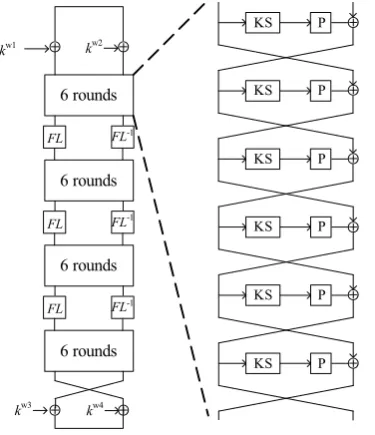
Camellia [1] is a 128-bit block cipher with Feistel structure. It has 18 rounds for 128-bit key, and 24 rounds for 192-/256-bit key. We give the encryption procedure of Camellia-192/-256 as follows, see Fig. 1.
Encryption Procedure. The input of the encryption procedure is a 128-bit plaintextM, and
Ͱ Ͱ
6 rounds
FL FL-1
6 rounds
FL FL-1
6 rounds
FL FL-1
6 rounds
Ͱ Ͱ
KS P Ͱ
KS P Ͱ
KS P Ͱ
KS P Ͱ
KS P Ͱ
KS P Ͱ
Ͱ
∩
<<<1klL
Ͱ
∩
klR
Ͱ Ͱ
∩
∩
<<<1
klR
klL
FL-function
FL-1-function kw1 kw2
kw3 kw4
Fig. 1.Camellia-192/-256
kw1 and kw2 to get two 64-bit intermediate value L0 and R0: L0||R0 =M ⊕(kw1||kw2). Then the following operations are carried out fori= 1 to 24, expect forr= 6, 12 and 18:
Lr=Rr−1⊕F(Lr−1, kr), Rr=Lr−1.
For r= 6, 12 and 18, do the following:
L0r =Rr−1⊕F(Lr−1, kr), R0r =Lr−1.
Lr =F L(L0r, kl2r/6−1), Rr=F L−1(R0r, kl2r/6).
Finally the 128-bit ciphertextC is computed as:C = (R24||L24)⊕(kw3||kw4).
TheF L function is defined as: (XL(32)||XR(32), klL(32)||klR(32))7→(YL(32)||YR(32)), where: YR(32)= ((XL(32)∩klL(32))≪1)⊕XR(32),
YL(32)= (YR(32)∪klR(32))⊕XL(32).
The F L−1 function is the inverse of F L function, andF L and F L−1 are linear as long as the key is fixed [2].
The round functionF is composed of the key-addition layer, S-box layer and linear transfor-mationP. In the key-addition layer, the input of the round function is XORed with the subkey. There are 4 8×8 S-boxes S1, S2, S3, S4 used in the S-box layer, and each S-box is used twice.
Finally, the linear transformation P : ({0,1}8)8 → ({0,1}8)8 maps (z
1, ..., z8) → (y1, ..., y8). P
function and its inverse functionP−1 are:
F
F F
F
F
F
KLͰKR
KL
KR
KA KB
C1
C2
C3
C4
C5
C6
Fig. 2. The Calculation of KA and KB
Key Schedule. For Camellia-256, the 256-bit main keyK=KL||KR, whereKLandKRare
128 bits. And for Camellia-192, the 192-bit main keyK =KL||KRL(64) andKRR(64)=KRL(64).
UsingKLand KR, the key schedule algorithm first calculateKAand KB, which is described in Fig. 2. Where F is the round function of Camellia and Ci (1≤i≤6) are constants used as the keys. Then the subkeys kwi(i= 1, ...,4), kr(r= 1, ...,24) andklj (j= 1, ...,6) are derived from rotating KL,KR,KAorKB. For details of Camellia, we refer to [1].
It can be known from Fig. 2 that, if KB and KR are known,KA is known. Therefore, one can get KL using the relation between KL and KA described in [14], Section 3.2. So once KB and KR are known, K can be computed.
3 Properties and 6-Round Impossible Differential Paths of Camellia with
F L/F L−1 Functions
In this section, we first give some useful properties of Camellia and then propose several impos-sible differential paths.
Property 1 For a 3-round Camellia structure, if the input difference is of the form ∆Li =
(0, a,0,0,0,0,0,0), ∆Ri = (0,0,0,0,0,0,0,0), then:
∆Li+1 = (0, b, b, b, b, b,0,0), ∆Si+2= (0, b
2, b3, b4, b5, b6,0,0), ∆Li+2 =∆Ri+3=P(a, b2, b3⊕a, b4⊕a, b5⊕a, b6⊕a,0,0),
and ∆Sli+3 = (P−1(∆Li+3))l, for l= 1,3,4, ...,8, where a, b, b2, b3, b4, b5, b6 are non-zero bytes.
Property 2 The necessary conditions of∆Li+3= (0, a,0,0,0,0,0,0)and∆Ri+3 = (0,0,0,0,0,
0,0,0) are:
∆Li+1 = (0, b, b, b, b, b,0,0), ∆Si+2= (0, b2, b3, b4, b5, b6,0,0), ∆Li =P(a, b2, b3⊕a, b4⊕a, b5⊕a, b6⊕a,0,0),
and ∆Sli+1 = (P−1(∆Ri))l, for l= 1,3,4, ...,8, where a, b, b2, b3, b4, b5, b6 are non-zero bytes.
KS P
Ͱ
KS P
Ͱ
KS P
Ͱ
KS P
Ͱ
KS P
Ͱ
KS P
Ͱ
ΔLi (0,a,0,
0,0,0,0,0)
ΔRi=(0,0,0,
0,0,0,0,0)
ΔLi+1=(0,b,b,
b,b,b,0,0)
ΔSi+2=(0,b
2,b3,
b4,b5,b6,0,0)
ΔSi+1
ΔLi+2=P(a,bͅ,
b͆Ҷa,b͇Ҷa,b͈ Ҷa,b͉Ҷa,0,0)
ΔSi+3
ΔLi+3 ΔRi+3
ΔLi=P(a,bͅ,b͆
Ҷa,b͇Ҷa,b͈Ҷa, b͉Ҷa,0,0)
ΔSi+1 ΔRi
ΔLi+1=(0,b,b,
b,b,b,0,0)
ΔSi+2=(0,b
2,b3,
b4,b5,b6,0,0)
ΔLi+2 (0,a,
0,0,0,0,0,0)
ΔLi+3=(0,0,
0,0,0,0,0,0) ΔR
i+3 (0,a,
0,0,0,0,0,0) ΔSi+3
Fig. 3. Properties of 3-round Camellia
Proof. Apparently, ∆Si+1 is of the form (0, b,0,0,0,0,0,0), where b an is unknown non-zero byte. And ∆Li+1 = (0, b, b, b, b, b,0,0) as P function is linear. After the key-addition layer and
S-box layer, it can be obtained that ∆Si+2 = (0, b2, b3, b4, b5, b6,0,0), whereb2, b3, b4, b5 and b6
are unknown non-zero bytes.
Since∆Li+2=∆Si+2⊕∆Li andP−1(∆Li) = (a,0, a, a, a, a,0,0),
∆Li+2 =P(a, b2, b3⊕a, b4⊕a, b5⊕a, b6⊕a,0,0).
Finally, because ∆Si+3 = P−1(∆Li+1 ⊕∆Li+3), P−1(∆Li+1) = (0, b,0,0,0,0,0,0) and P−1
function is linear,
∆Sli+3 = (P−1(∆Li+3))l, forl= 1,3,4, ...,8.
Property 3 (from [9]) Letx,x∗be 32-bit values, andx0 =x⊕x∗, then the differential properties of AND and OR operations are:
(x∩k)⊕(x∗∩k) = (x⊕x∗)∩k=x0∩k
(x∪k)⊕(x∗∪k) = (x⊕k⊕(x∩k))⊕(x∗⊕k⊕(x∗∩k)) =x0⊕(x0∩k)
Property 4 Let M = (m1, m2, m3, m4, m5, m6, m7, m8)be the input difference of F Lfunction, and N = (n1, n2, n3, n4, n5, n6, n7, n8) be the the output difference of F L, where nl, ml (l = 1, ...,8)are arbitrary 8-bit values. Then if ni= 0 (i∈ {5,6,7,8}), ni−4=mi−4.
Proof. Let us denote the subkey used for AND operation as kL and the subkey used for OR
operation as kR. By Property 3, the following equations must hold:
((ML∩kL)≪1)⊕MR=NR
ML⊕NR⊕(NR∩kR) =NL (1)
Then if ni= 0 (i∈ {5,6,7,8}), it can be deduced from Equation (1) that ni−4 =mi−4.
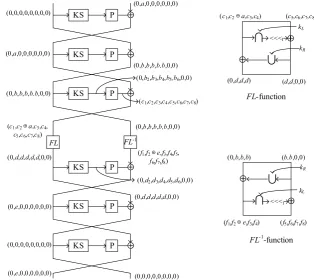
Impossible Differential. Now we demonstrate that the 6-round differential in Fig. 4 is
impos-sible. The input difference is
KS P
Ͱ
KS P
Ͱ
KS P
Ͱ
KS P
Ͱ
FL
KS P
Ͱ
KS P
Ͱ
(0,0,0,0,0,0,0,0)
(0,a,0,0,0,0,0,0)
(0,a,0,0,0,0,0,0)
(0,b,b,b,b,b,0,0)
(0,b,b,b,b,b,0,0)
(0,b2,b3,b4,b5,b6,0,0)
(c1,c2,c3,c4,c5,c6,c7,c8)
(c1,c2Ͱa,c3,c4, c5,c6,c7,c8)
(0,0,0,0,0,0,0,0) (0,0,0,0,0,0,0,0)
(0,e,0,0,0,0,0,0) (0,e,0,0,0,0,0,0)
(0,d,d,d,d,d,0,0) FL-1
(0,d,d,d,d,d,0,0)
(0,d2,d3,d4,d5,d6,0,0)
(f1,f2Ͱe,f3,f4,f5, f6,f7,f8)
(0,b,b,b,b,b,0,0)
Ͱ
∩
<<<1 kLͰ
∩
kR
(c1,c2Ͱa,c3,c4) (c5,c6,c7,c8)
(0,d,d,d) (d,d,0,0)
(0,b,b,b)
Ͱ
Ͱ
∩
∩
<<<1 kR
kL
(b,b,0,0)
(f1,f2Ͱe,f3,f4) (f5,f6,f7,f8)
FL-function
FL-1-function
Fig. 4. 6-round impossible differential path with theF L/F L−1 layer in the middle
where ais arbitrary non-zero byte. The output difference of the first round is ((0, a,0,0,0,0,0,0); (0,0,0,0,0,0,0,0)).
Then by Property 1, the output differences of the second and third round are
((0, b, b, b, b, b,0,0); (0, a,0,0,0,0,0,0)) and ((c1, c2⊕a, c3, c4, c5, c6, c7, c8); (0, b, b, b, b, b,0,0))
with probability 1, as long as
(c1, c2, c3, c4, c5, c6, c7, c8) =P(0, b2, b3, b4, b5, b6,0,0),
where b, b2, b3, b4, b5, b6 are unknown non-zero bytes, (0, b2, b3, b4, b5, b6,0,0) is evolved from
(0, b, b, b, b, b,0,0) after the S-box layer andcl (l= 1, ..,8) are unknown bytes.
Similarly, in the backward direction, we know that for arbitrary non-zero bytee, if the output difference of the sixth round is
((0, e,0,0,0,0,0,0); (0,0,0,0,0,0,0,0)), then the input difference of the forth round is
((0, d, d, d, d, d,0,0); (f1, f2⊕e, f3, f4, f5, f6, f7, f8)),
where dis an unknown non-zero byte andfl (l= 1, ..,8) are unknown bytes.
Now the input and output differences of theF Lfunction are determined. It can be deduced from Property 4 that c3 =dand c4 =d, which means c3 =c4. But this impliesb4 = 0 as
c3 =b2⊕b3⊕b5⊕b6, c4 =b2⊕b3⊕b4⊕b5⊕b6,
which contradict b4 6= 0. (By the input and output difference of F L−1 function, we can also
6-round impossible differential with FL/FL-1inside
(0,0,0,0,0,0,0,0) (0,a,0,0,0,0,0,0)
(0,e,0,0,0,0,0,0) (0,0,0,0,0,0,0,0)
KS P Ͱ
KS P Ͱ
KS P Ͱ
Ͱ Ͱ
KS P Ͱ
KS P Ͱ
Ͱ Ͱ
kw1 kw2
kw3 kw4
(0,a,0,0,0,0,0,0)
(0,g,g,g,g,g,0,0) (0,g,g,g,g,g,0,0)
(0,g2,g3,g4,g5,g6,0,0)
P(0,g2,g3,g4,g5,g6,0,0)
P(a,g2,aͰg3,aͰg4,
aͰg5,aͰg6,0,0)
(0,h,h,h,h,h,0,0)
(0,h2,h3,h4,h5,h6,0,0)
P(e,h2,eͰh3,eͰh4,eͰ
h5,eͰh6,0,0)
6-round impossible differential with FL/FL-1inside
(0,0,0,0,0,0,0,0) (0,a,0,0,0,0,0,0)
(0,e,0,0,0,0,0,0) (0,0,0,0,0,0,0,0)
KS P Ͱ
KS P Ͱ
KS P Ͱ
Ͱ Ͱ
KS P Ͱ
kw1 kw2
(0,a,0,0,0,0,0,0)
(0,g,g,g,g,g,0,0) (0,g2,g3,g4,g5,g6,0,0)
P(0,g2,g3,g4,g5,g6,0,0)
ΔS1
ΔS2
ΔS2
ΔS3
ΔS3
ΔS1
ΔS10
ΔS10
ΔS11 ΔL0=P
(a,g2,aͰg3,aͰ
g4,aͰg5,aͰg6,0,0)
ΔL1=
(0,g,g,g,g,g, 0,0)
ΔL11=
(0,h,h,h,h, h,0,0)
Ͱ Ͱ
kw3 kw4
Fig. 5. Impossible Differential Attacks on 10-round Camellia-192 and 11-round Camellia-256
with whitening and F L/F L−1
((0,0,0,0,0,0,0,0); (0, a,0,0,0,0,0,0))6−−→round((0, e,0,0,0,0,0,0); (0,0,0,0,0,0,0,0)) is impossible.
Actually, there are three more 6-round impossible differential paths with theF L/F L−1layer in the middle, which are:
((0,0,0,0,0,0,0,0); (a,0,0,0,0,0,0,0))6−round9 ((e,0,0,0,0,0,0,0); (0,0,0,0,0,0,0,0))
((0,0,0,0,0,0,0,0); (0,0, a,0,0,0,0,0))6−round9 ((0,0, e,0,0,0,0,0); (0,0,0,0,0,0,0,0))
((0,0,0,0,0,0,0,0); (0,0,0, a,0,0,0,0))6−round9 ((0,0,0, e,0,0,0,0); (0,0,0,0,0,0,0,0))
4 Impossible Differential Attack on Camellia with F L/F L−1 functions and
whitening
In this section, we present impossible differential attacks on 11-round Camellia-256 and 10-round Camellia-192 using the impossible differential in Section 3.
4.1 Impossible Differential Attack on 11-Round Camellia-256
We add 3 rounds on the top and 2 rounds on the bottom of the 6-round impossible differential path to analysis 11-round Camellia-256, see Fig. 5 in the right. Denote ka = kw1 ⊕k1, kb =
kw2⊕k2, kc=kw1⊕k3, kd=kw4⊕k10 and ke =kw3⊕k11. The attack is started by carrying out a precomputation.
Precomputation. A precomputational table H for Rounds 2-3 is set up here, which
For every (L1, g, kb, L22, a, k2c), compute L01 =L1⊕(0, g, g, g, g, g,0,0), T =F(L1, kb), T0 =
F(L01, kb),∆T =T ⊕T0 and sieve the ones satisfying S(L22⊕kc2)⊕S(L22⊕a⊕kc2) =g, where
g and a are non-zero bytes. There are 2160 (L1, g, kb, L22, a, kc2), and 2152 of which remain after the sieve. Then insert (kb, k2c) into the row indexed by (L1, g, ∆T ⊕a, L22⊕T2). Because there
are only 240 ∆T which lead to 248 ∆T ⊕a, there are 2128 rows inH and each row contains 224 72-bit subkeys (kb, kc2). Consequently, the memory complexity of the table is about 2155.2 bytes and the time complexity of the precomputation is less than 2161 one round encryptions.
Data Collection. Choose 2n structures of plaintexts, and each structure contains plaintexts
with the following form:
(P(y1, y2, y3, y4, y5, y6, α, β); (x1, x2, x3, x4, x5, x6, x7, x8))
where yi (i = 1, ...,6) and xj (j = 1, ...,8) take all possible values and α, β are fixed in each structure. As a result, there are 2112plaintexts in each structure and we can get 2n×2112×2−1 = 2n+223 plaintext pairs totally. For each of the pairs, ∆(P−1(L0))7= 0, ∆(P−1(L0))8 = 0.
Ask for the encryptions of the plaintexts in each structure to get the corresponding cipher-texts, and keep the pairs whose ciphertext differences satisfy the following form by birthday attack:
((0, h, h, h, h, h,0,0);P(e, h2, e⊕h3, e⊕h4, e⊕h5, e⊕h6,0,0)),
where e, h, h2, h3, h4, h5 and h6 are non-zero bytes. So there are 2n+223−72 = 2n+151 pairs
re-maining.
Key Recovery. In the key recovery procedure, we use Property 2 and the precomputational
table to discard the wrong keys.
1. Individually guess kal (l = 1,3, ...,8) and check whether the equation 4Sl1 = (P−1(4R0))l holds. About 2n+151×2−56 = 2n+95 pairs will be kept. Next guess k2a, so (L1, L01) can be computed. For each of the remaining pairs, do Step 2.
2. Initialize a table Γ of 2144 all possible values (kb, k2c, ke, kd2), for each of the remaining pairs, access the row (L1, ∆L1
2, ∆R1, R21) and the row (L11, ∆L112 , ∆L12, L122 ) in table H. Then
combining the values in the two rows to get (kb, kc2, ke, kd2), and remove the corresponding value fromΓ.
3. IfΓ is not empty, output the 208-bit value (ka, kb, k2c, kd2, ke), otherwise go to Step 1 and try another guess. The main key can be recovered when (ka, kb, k2c, kd2, ke) is obtained, which will be described as follows.
The following equations are deduced from Table 3 in [1]:
ka= (KL≪0)L⊕(KB ≪0)L, (2)
kb= (KL≪0)R⊕(KB ≪0)R, (3)
kc= (KL≪0)L⊕(KR≪15)L, (4)
ke= (KB≪111)L⊕(KA≪45)L, (5)
kd= (KB≪111)R⊕(KL≪45)R. (6)
Complexity. We choose n = 9, then the data complexity is 2121 chosen plaintexts. Step 2 removes 248 wrong (kb, kc2, ke, kd2), for each pair remained after Step 1, 2214448 = 2
−96 of wrong
(kb, kc2, kd2, ke) are removed. Consequently, the number of remaining wrong 208-bit value (ka, kb, kc2, kd2, ke) after analyzing all the pairs is 264×2144×(1−2−96)2104 ≈0.
The complexity of Step 1 is about 2×(
7
X
i=1
2128−8(i−1) ×28i)× 1
8 + 2×2
64×2104 ≈ 2169
one round encryptions, equivalent to 2165.7 encryptions. There are 224 values in H, so in Step 2, 2×224 memory access to H and 248 memory access to Γ are needed for each pair, which result in 264×2104×248 = 2216 memory access, equivalent to 2216× 1
52 × 1 11 ≈2
206.8 11-round
encryptions. The complexity of Step 3 is about 21846-round encryptions, so the time complexity is dominated by Step 2, which about 2206.8 encryptions. And the memory complexity is about 2155.2 bytes.
4.2 Impossible Differential Attack on 10-Round Camellia-192
We remove a round from the bottom of the 11-round attack, and give an attack on 10-round Camellia-192, see Fig. 5 in the left. The choice of plaintexts is the same as the 11-round attack, and the ciphertext pairs are sieved by the difference:
(0, e,0,0,0,0,0,0; 0, h, h, h, h, h,0,0),
where eand hare non-zero values. After the sieve, about 2120 pairs remain.
Denote the equivalent subkeyska=kw1⊕k1, kb =kw2⊕k2, kc=kw1⊕k3 andkd=kw3⊕k10
The key recovery phase is as follows:
1. Guesskd2 and check whether ∆S210=∆L112 , the number of remaining pairs after this step is about 2112.
2. Individually guess kal (l = 1,3, ...,8) and check whether the equation 4Sl1 = (P−1(4R0))l holds. About 2112×2−56= 256pairs will be kept. Next guessk2a, so (L1, L01) can be computed. For each of the remaining pairs, do Step 3.
3. Initialize a tableΓ0 of 272 all possible values (kb, kc
2), for each of the remaining pairs, access
the row (L1, ∆L12, ∆R1, R12) in tableH. For each value in the row, remove the corresponding value fromΓ0.
4. IfΓ0 is not empty, output the 144-bit value (ka, kb, k2c, kd2), otherwise try another guess. The main key can be recovered when (ka, kb, k2c, kd2) is obtained by the similar method of the 11-round attack, except that there are only for equations that can be used:
ka= (KL≪0)L⊕(KB ≪0)L, (7)
kb = (KL≪0)R⊕(KB ≪0)R, (8)
kc= (KL≪0)L⊕(KR≪15)L, (9)
kd= (KB≪111)L⊕(KL≪45)R. (10)
Again, we guess every possible value ofKL, for each guessKBcan be calculated by Equations (7) and (8), then sieve this (KL, KB) pair by Equation (10). For the (KL, KB) that satisfy Equation (10), compute 8 bits ofKR by Equation (9), and further guess the rest unknown 56 bits of KR. Furthermore, we test whether the (KL, KR) can pass the key schedule of Camellia-192. About 2184×2−8×2−128= 248keys will remain, and the correctK =KL||KR can be obtained by trial encryption.
KS P
KS P
KS P
KS P KS P KS P
KS P 8−round ID
ΔS1
ΔS2
ΔS3
ΔS4
ΔS13
ΔS14
ΔS15
ΔL0
ΔL1
ΔR0
ΔR1
ΔR2 ΔL2=(0,z,z,z,z,z,0,0)
ΔL3=(0,a,0,0,0,0,0,0)
(0,0,0,0,0,0,0,0)
(0,0,0,0,0,0,0,0) (0,a,0,0,0,0,0,0) (0,z2,z3,z4,z5,z6,0,0)
(0,i,0,0,0,0,0,0)
(0,j2,j3,j4,j5,j6,0,0) ΔR13=(0,i,0,0,0,0,0,0) ΔL13=(0,j,j,j,j,j,0,0)
ΔR14=(0,j,j,j,j,j,0,0) ΔL14
ΔL15 ΔR15
Fig. 6. Impossible Differential Attack on 15-round Camellia-256 withoutF L/F L−1 layers and
whitening
5 Impossible Differential Cryptanalysis of 15-round Camellia-256 without
F L/F L−1 layers and whitening
In this section, we give an improved impossible differential attack on Camellia-256 by using a 8-round impossible differential path without F L/F L−1 layer in Fig. 7, which was proposed in [18]. By adding 4 rounds on the top and 3 rounds on the bottom, we can attack 15-round Camellia-256 withoutF L/F L−1 layers and whitening, see Fig. 6.
Precomputation. First, we set up a table Γ1 for the first two round of the 15-round model.
Property 2 implies that ∆L1 =P(a, z2, z3⊕a, z4⊕a, z5⊕a, z6⊕a,0,0), so we choose all the 248 ∆L1 with the required form. Furthermore, all possible ∆L0,L0⊕k1 and (R0⊕k2)2 are chosen.
For each of the values, we compute T =P(S(L0⊕k1)), T0 = P(S(L0⊕k1 ⊕∆L0)), and get
the value (R0⊕k2)l (l= 1,3, ...,8) by∆L1l, (P
−1(∆L0))
l,T, and the corresponding differential table of S-box. InsertL0⊕k1 and R0⊕k2 into the row indexed by∆R0=T⊕T0⊕∆L1,∆L0, bits 61∼64 ofL0⊕k1, and bits 1∼4,13∼60 ofR0⊕k2. As 2184(∆L0,∆L1,L0⊕k1,(R0⊕k2)
2)
are totally chosen and there are 2184 rows in the table, we get about one (L0⊕k1,R0⊕k2) in each row on average.
The complexity of the precomputation is about 2×2184 2-round encryptions, equivalent to
2182.1 15-round encryptions. The table requires about 2184×16 = 2188 bytes of memory.
Data Collection. For 2122.5 known plaintexts, ask for the encryptions and insert the ciphertexts
into a hash table indexed by the 7-th and 8-th bytes of P−1(∆R15). Since by Property 1, the right half of ciphertexts must have the form
∆R15=∆L14=P(i, j2, j3⊕i, j4⊕i, j5⊕i, j6⊕i,0,0).
Key Recovery. We give in Table 2 the corresponding positions of k1, k2 and k15 in KB, and the corresponding positions of k3,k14, k24 and k132 in KR. It is obvious that there are close relations among the subkeys, i.e., there are common bits in some of the subkeys, which can be used to reduced the complexity of the attack. The key recovery phase is demonstrated as follows.
1. Individually guess kl15 (l = 1,3, ...,8) (KB : 61 ∼ 68,73 ∼ 124) and remove the pairs do not satisfy∆Sl15= (P−1(∆L15))l. About 2228−7×8= 2172 pairs are kept. From Table 2, bits 61∼64 ofk1 and bits 1∼4,13∼60 of k2 are known.
2. For each of the remaining pairs, compute bits 61 ∼ 64 of L0⊕k1 and bits 1∼ 4,13 ∼60 ofR0⊕k2, then access the value in the corresponding row in Γ1. Insert (∆L0, ∆R0, L0, R0)
to a table Γ2 indexed by bits 1 ∼ 60 of k1 (KB : 1 ∼ 60) and bits 5 ∼ 12,61 ∼ 64 of k2 (KB : 69∼76,124∼128). As a result,Γ2 has 272 rows with about 2100 (∆L0, ∆R0, L0, R0)
in each.
3. Guess bits 1 ∼ 60 of k1 and bits 5 ∼ 12,61 ∼ 64 of k2, access the corresponding row in
Γ2, and compute 2100 (L2, L02) and (R2, R02) by two-round encryptions as the whole KB is known.
4. From Property 1, it is clear that if a pair follows the path in Fig. 6, it has to satisfy∆Sl14= (P−1(∆L14))1⊕(P−1(∆L14))l (l= 3, ...,6) and∆S214= (P−1(∆L14))2.
(a) Further guessk142 (KR: 5∼12), partially decrypt round 15 and round 14 to discard the pairs which do not satisfy ∆S14
2 = (P−1(∆L14))2. After this procedure, the number of
remaining pairs is 2100−8 = 292.
(b) Individually guess kl14 (l = 3, ...,6) (kR : 13 ∼ 44) and keep the pairs which satisfy
∆Sl14= (P−1(∆L14))1⊕(P−1(∆L14))l. There are 292−8×4 = 260 pairs being kept. 5. (a) Guess bits 45 ∼ 47 of kR, now k32, k33, and k34 (KR : 24 ∼ 47) are known. Detect if
∆S23= (P−1(∆R2))2,∆S33= (P−1(∆R2))1⊕(P−1(∆R2))3, and∆S43 = (P−1(∆R2))1⊕
(P−1(∆R2))4. The number of remaining pairs is 260−8×3= 236.
(b) Individually guess kl3 (l = 5,6) (kR : 48 ∼ 63) and keep the pairs that satisfy ∆Sl3 = (P−1(∆R2))1⊕(P−1(∆R2))l. There are 236−8×2= 220 pairs being kept.
6. Guessk114(KR: 125∼128,1∼4) (now the wholek14is known) andk213(KR: 69∼76), keep the pairs that meet∆S213=∆L132 . The number of remaining of pairs will be 220−8= 212. 7. Guess the rest 8 bits of k3 (KR : 64 ∼ 68,77 ∼ 79), now the whole k3 (KR : 16 ∼ 79) is
known. We further guess k24 (KR: 88∼95) and check if there is a pair satisfy∆S24 =∆L22.
If there is a pair satisfy this, then discard the key guess. Otherwise for every 219-bit key guess, exhaustively search the rest 37 bits ofKR to calculateKA, use the relation ofKAand
KLto recoverKL, and test the resulting (KL, KR) by trial encryption.
Complexity. The data complexity is 2122.5 known plaintexts. In the data collecting phase, the
computation of the 7-th and 8-th bytes ofP−1(∆R16) is less then 2/8 one round encryption, so the complexity of computing the 7-th and 8-th bytes of P−1(∆R16) is at most 2122.5×1
4× 1 15 ≈
2116.6 15-round encryptions.
Below we elaborate the complexity of each step in the key-recovery phase.
1. The complexity is about 7×2×28×2228 = 2240 one round encryptions, which is about 2236.1 encryptions.
2. This step needs about 2×256×2172 = 2229 memory access and 272×2100×16 = 2176 bytes of memory.
3. The complexity of this step is about 2×2128×2100 = 2229 two round encryptions.
(b) The complexity of the each operation in this step is about one round encryption, so the complexity of is about: 2×P3
i=0(2
144+8×i×292−8×i× 1 15)≈2
235.1.
5. (a) The complexity of this step is about 2×151 ×2171×(260+ 252+ 244)≈2228.1. (b) The complexity of this step is about 2× 1
15×(2
179×236+ 2187×228)≈2213.1.
6. This step requires 2×2203×220× 1 15 ≈2
220.1 encryptions.
7. In step 8, we expect 2219 ×(1−2−8)212 ≈ 2196.6 of the key guess remained. So about 2196.6+37 = 2233.6 trail encryptions are request to recover the whole key. The complexity of this step is thus 2×2219×[1 + (1−2−8) +. . .+ (1−2−8)212]× 1
15+ 2
233.6≈2233.6. As a result,
the time complexity is dominated by Step 1, which is about 2236.1 15-round encryptions.
6 Conclusion
In this paper, we present several 6-round impossible differential paths with F L/F L−1 layers in the middle, which lead to impossible differential attacks on 10-round Camellia-192 and 11-round Camellia-256. Then an impossible differential cryptanalysis of 15-11-round Camellia-256 without F L/F L−1 layers and whitening is given by carefully using the subkey relation and a precomputational table. A summary of the previous attacks and our analysis of Camellia is given in Table 1.
Table 1. Summary of the attacks on Camellia
Block Size #Rounds F L/F L−1 Attack Type Data Time Source
Camellia-128 8 × Truncated DC 283.6CP 255.6 [10]
9 √ Square Attack 248CP 2122 [11]
9 × Collision Attack 2113.6CP 2121 [19]
9 × Square Attack 266CP 284.8 [6] 11 × Impossible DC 2118CP 2126MA [12] 12 × Impossible DC 2116.3CP 2116.6 [14]
Camellia-192 10 √ Square Attack 248CP 2210 [11]
/-256 10 √ Impossible DC 2121CP 2175 this paper last 11 rounds √ Higher Order DC 293CC 2255.6 [7]
11 √ Impossible DC 2121CP 2206.8 this paper 12 × Impossible DC 2120CP 2181 [18]
12 × Linear Attack 2119KP 2247 [16] 12 × Square Attack 266CP 2249.6 [6] 13 × Impossible DC 2120CP 2211.7 [12] 15 × Impossible DC 2122.5KP 2236.1 this paper KP: known plaintext; CP: chosen plaintext; CC: chosen ciphertext; DC: differential attack
References
1. Aoki, K., Ichikawa, T., Kanda, M., Matsui, M., Moriai, S., Nakajima, J., Tokita, T.: Camellia: a 128-bit Block Cipher Suitable for Multiple Platforms-Design and Analysis. In: Stinson, D.R., Tavares, S. (eds.) SAC 2000. LNCS, vol. 2012, pp. 39-56. Springer, Heidelberg (2001)
2. Aoki, K., Ichikawa, T., Kanda, M., Matsui, M., Moriai, S., Nakajima, J., Tokita, T.: Specification of Camellia-a 128-bit Block Cipher. version 2.0 (2001), http://info.isl.ntt.co.jp/crypt/eng/camellia/specifications.html 3. Biham, E., Shamir, A.: Differential cryptanalysis of the Data Encryption Standard. Springer, Heidelberg
(1993)
4. Biham, E., Biryukov, A., Shamir, A.: Cryptanalysis of Skipjack Reduced to 31 Rounds Using Impossible Differentials. In: Stern, J. (ed.) EUROCRYPT 1999. LNCS, vol. 1592, pp. 12-23. Springer, Heidelberg (1999) 5. CRYPTREC-Cryptography Research and Evaluation Committees, report, Archive (2002),
6. Duo, L., Li, C., Feng, K.: Square like attack on camellia. In: Qing, S., Imai, H., Wang, G. (eds.) ICICS 2007. LNCS, vol. 4861, pp. 269-283. Springer, Heidelberg (2007)
7. Hatano, Y., Sekine, H., Kaneko, T.: Higher order differential attack of Camellia (II). In: Nyberg, K., Heys, H.M. (eds.) SAC 2002. LNCS, vol. 2595, pp. 129-146. Springer, Heidelberg (2003)
8. International Standardization of Organization (ISO), International Standard- ISO/IEC 18033-3, Information technology-Security techniques-Encryption algorithms -Part 3: Block ciphers (2005)
9. K¨uhn, U.: Improved Cryptanalysis of MISTY1, In: Daemen, J. and Rijmen, V. (Eds.) FSE 2002, LNCS 2365, pp. 61–75. Springer-Verlag, Heidelberg (2002)
10. Lee, S., Hong, S.H., Lee, S.-J., Lim, J.-I., Yoon, S.H.: Truncated differential cryptanalysis of camellia. In: Kim, K.-c. (ed.) ICISC 2001. LNCS, vol. 2288, pp. 32-38. Springer, Heidelberg (2002)
11. Lei, D., Chao, L., Feng, K.: New observation on Camellia. In: Preneel, B., Tavares, S. (eds.) SAC 2005. LNCS, vol. 3897, pp. 51-64. Springer, Heidelberg (2006)
12. Lu, J.: Cryptanalysis of Block Ciphers. PhD Thesis, Department of Mathematics, Royal Holloway, University of London, England (2008)
13. Lu, J., Kim, J.-S., Keller, N., Dunkelman, O.: Improving the efficiency of impossible differential cryptanalysis of reduced camellia and MISTY1. In: Malkin, T.G. (ed.) CT-RSA 2008. LNCS, vol. 4964, pp. 370-386. Springer, Heidelberg (2008)
14. Mala, H., Shakiba, M., Dakhilalian, M., Bagherikaram G. New Results on Impossible Differential Cryptanal-ysis of Reduced-Round Camellia-128, SAC 2009, LNCS 5867, pp.281-294, 2009.
15. NESSIE-New European Schemes for Signatures, Integrity, and Encryption, final report of European project IST-1999-12324. Archive (1999), https://www.cosic.esat.kuleuven.be/nessie/Bookv015.pdf
16. Shirai, T.: Differential, Linear, Boomerang and Rectangle Cryptanalysis of Reduced-Round Camellia. In: Proceedings of the Third NESSIE Workshop, Munich, Germany, November 6-7 (2002)
17. Sugita, M., Kobara, K., Imai, H.: Security of Reduced Version of the Block Cipher Camellia against Truncated and Impossible Differential Cryptanalysis. In: Boyd, C. (ed.) ASIACRYPT 2001. LNCS, vol. 2248, pp. 193-207. Springer, Heidelberg (2001)
18. Wu, W., Zhang, W., and Feng, D. Impossible Differential Cryptanalysis of Reduced-Round ARIA and Camel-lia. Journal of Computer Science and Technology, 22(3), 449-456.
19. Wenling, W., Dengguo, F., Hua, C.: Collision attack and pseudorandomness of reduced-round camellia. In: Handschuh, H., Hasan, M.A. (eds.) SAC 2004. LNCS, vol. 3357, pp. 252-266. Springer, Heidelberg (2004) 20. W. Wu, L. Zhang, and W. Zhang, Improved Impossible Differential Cryptanalysis of Reduced-Round Camellia.
A 8-Round Impossible Differential Path without F L/F L−1 Layer
KS P
KS P KS P
KS P
KS P
KS P KS P KS P
(0,0,0,0,0,0,0,0) (0,
a,0,0,0,0,0,0)
(0,a,0,0,0,0,0,0)
(0,b,b,b,b,b,0,0)
(0,c2,c3,c4,c5,c6,0,0)
(d1,d2,d3,d4,d5,d6,d7,d8)
(d1,aͰd2,d3,d4,d5,d6,
d7,d8)
(0,0,0,0,0,0,0,0) (0,i,0,0,0,0,0,0)
(0,0,0,0,0,0,0,0) (0,i,0,0,0,0,0,0)
(0,h,h,h,h,h,0,0)
(0,h,h,h,h,h,0,0)
(0,g2,g3,g4,g5,g6,0,0)
(f1,f2,f3,f4,f5,f6,f7,f8)
(f1,iͰf2,f3,f4,f5,f6,f7,f8)
(f1,iͰbͰf2,bͰf3,bͰf4, bͰf5,bͰf6,f7,f8) (i,bͰg2,iͰg3,iͰg4,
iͰg5,iͰg6,0,0)
d7 =d8=0 →c3=0,
which contradicts c3≠0
Fig. 7. 8-round Impossible Differential Path withoutF L/F L−1 layer
B The process of key recovery attack on 15-round Camellia-256 without
F L/F L−1 layers and whitening
Table 2. Corresponding bit positions of the subkeys inKB and KR
Subkey Bit positions Subkey Bit positions Subkey Bit positions Subkey Bit positions bytes inKB bytes inKB bytes inKR bytes inKR
k1
1 1∼8 k25 97∼104 k13 16∼23 k141 125∼128,1∼4
k12 9∼16 k26 105∼112 k23 24∼31 k142 5∼12
k1
3 17∼24 k27 113∼120 k33 32∼39 k143 13∼20
k14 25∼32 k28 121∼128 k43 40∼47 k144 21∼28
k1
5 33∼40 k151 61∼68 k53 48∼55 k145 29∼36
k16 41∼48 k152 69∼76 k63 56∼63 k146 37∼44
k17 49∼56 k153 77∼84 k73 64∼71 k147 45∼52
k1
8 57∼64 k154 85∼92 k83 72∼79 k148 53∼60
k21 65∼72 k155 93∼100 k24 88∼95 k132 69∼76
k2
2 73∼80 k156 101∼108
k23 81∼88 k157 109∼116
k2