Commuting Signatures and Verifiable Encryption
and an Application to Non-Interactively Delegatable Credentials
Georg Fuchsbauer
´
Ecole normale sup´erieure, CNRS - INRIA, Paris, France http://www.di.ens.fr/∼fuchsbau
Abstract
Verifiable encryption allows to encrypt a signature and prove that the plaintext is valid. We introduce a new primitive calledcommuting signaturethat extends verifiable encryption in multiple ways: a signer can encrypt both signature and message and prove validity; more importantly, given a ciphertext, a signer can create a verifiably encrypted signature on the encrypted message; thus signing and encrypting commute. We instantiate commuting signatures using the proof system by Groth and Sahai (EUROCRYPT ’08) and the automorphic signatures by Fuchsbauer (ePrint report 2009/320). As an application, we give an instantiation ofdelegatable anonymous credentials, a powerful primitive introduced by Belenkiy et al. (CRYPTO ’09). Our instantiation is arguably simpler than theirs and it is the first to provide non-interactive issuing and delegation, which is a standard requirement for non-anonymous credentials. Moreover, the size of our credentials and the cost of verification are less than half of those of the only previous construction, and efficiency of issuing and delegation is increased even more significantly. All our constructions are proved secure in the standard model.
1
Introduction
A verifiably-encrypted-signature scheme [BGLS03] enables a signer to make a digital signature on a message, encrypt the signature under a third party’s encryption key, and produce a proof asserting that the ciphertext contains a valid signature. Suppose the message is only available as an encryption. The signer cannot make a signature on it, as this would contradict the security of the encryption scheme (given two messages and the encryption of one of them, a signature on the plaintext could be used to decide which message was encrypted). However, the following does not seem a priori impossible: given an encryption, instead of producing a signature on the plaintext, the signer produces a verifiably encrypted signature on it.
We show that—surprisingly—such a functionality is feasible and moreover give a practical instantiation of it. We then use this new primitive to build the first non-interactively delegatable anonymous credential scheme: given an encrypted public key, a delegator can make an encrypted certificate on the key together with a proof of validity.
Delegatable Anonymous Credentials.Access control that respects users’ privacy concerns is a challenging prob-lem in security. To gain access to resources, a participant must prove to possess the required credential issued by an authority. To increase manageability of the system, the authority does usually not issue credentials directly to each user, but relies on intermediate layers in the hierarchy. Belenkiy et al. [BCC+09] give the following example: a system administrator issues credentials for webmasters to use his server. The latter are entitled to create forums and delegate rights to moderators, who in turn can give posting privileges to users.
In the real world delegation of rights is realized by certifying the public key of the delegated user. Consecutive delegation leads to a credential chain, consisting of public keys and certificates linking them, starting with the
original issuerof the credential and ending with a user, say Alice. To delegate her credential to Bob, Alice simply extends the length of the chain by one by appending a certificate on Bob’s public key under hers.
6
6
? 6 9
:
: XX
XX XX
XXXz ``
`` ``
XXz %%
XXXX
XX XX
XXz
XXXX
XX XX
XXz
M, Σ
M CM
CM,Σ,π¯
M,cΣ,eπ
CM,cΣ, π
Sign(sk,·)
XX(sk,·)
ComM,Prove
ComM
Com,Prove Com,AdPrC AdPrDC(ρΣ,·)
ComM,AdPrCM
AdPrDCM(ρM,·)
SigCom(sk,·)
Figure 1: Commuting signatures
recently. Chase and Lysyanskaya [CL06] give delegatable anonymous credentials for which the size of a creden-tial is exponential in its length (i.e., the number of delegations), which makes them impractical. In [BCC+09] Belenkiy et al. introduce a new approach using a non-interactive zero-knowledge (NIZK) proof system [BFM88] withrandomizableproofs: a credential is a non-interactiveproof of knowledgeof a certification chain that can be randomized before being re-delegated or shown; this guarantees anonymity and unlinkability.
The functionality of the system can be sketched as follows: each user holds a secret key which she uses to produce multiple pseudonymsNym. A userAcan be known to user O asNymA(O) and toB asNym(AB). Given a credential issued byOforNym(AO),Acan transform it into a credential forNym(AB) and show it toB. MoreoverA
can delegate the credential to userC, known toAasNym(CA). Ccan then show a credential fromOforNym(CD) to userD(without revealing neitherNym(AC) norNym(CA)), or redelegate it, and so on.
Delegation preserves anonymity, i.e., delegator and delegatee learn nothing more about each other than their respective pseudonyms. In the instantiation of [BCC+09] (BCCKLS), the delegation protocol is fairly complex and highly interactive—as opposed to (non-anonymous) credentials, where it suffices to know a user’s public key in order to issue or delegate a credential to her. We correct this shortcoming by giving an instantiation of the BCCKLS model that enablesnon-interactivedelegation: pseudonyms areencryptionsof the public key; given a pseudonymNym, the delegator can produce a credential for the holder ofNymwithout any interaction, since she can make a proof of knowledge of a signature on a public key given to her as an encryptionNym. We note that, as for the BCCKLS instantiation, abuse prevention mechanisms such as anonymity revocation [CL01] or limited show [CHK+06] can be added to our construction.
Commuting Signatures and Verifiable Encryption. Our main building block to instantiate non-interactively delegatable anonymous credentials will be a new primitive we callcommuting signaturewhich we sketch in the following and formally define in Sect. 4. Assume we have a digital signature scheme and an encryption scheme combined with a proof system with the following properties: given a verification key, a message and a signature on it valid under the key, we can encrypt any subset of{key, message, signature}, and make a proof that the plaintexts constitute a triple of a key, a message and a valid signature. We also require that the proof does not leak any more information about the encrypted values besides validity.
For consistency with our instantiation using the Groth-Sahai methodology [GS08], we will saycommitment
instead ofencryption. Note that the commitments we use areextractable, and therefore constitute an encryption scheme (see below). We denote committing to signatures byComand committing to messages byComM. Besides
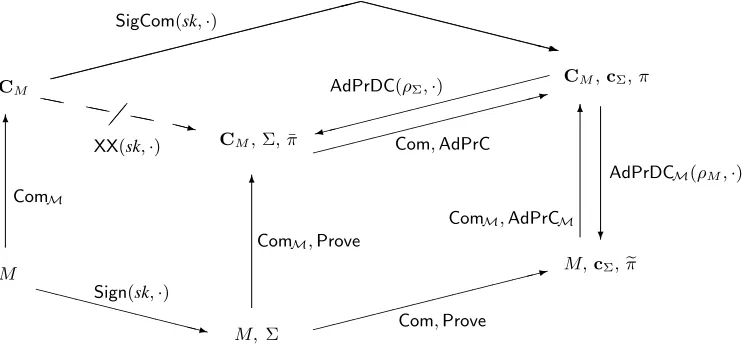
allowing to prove validity of committed values, a commuting-signature scheme provides the following additional functionalities (sketched in Figure 1). Note that none of them requires the extraction (decryption) key.
SigCom. Given a commitmentCM to a messageM and a signing keysk,SigComproduces a commitmentcΣto
AdPrC (“adapt proof when committing”). Given a commitmentCM toM, a signatureΣon M and a proof π¯
of validity ofΣon the content ofCM, we can make a commitmentcΣ toΣusing randomnessρΣand run
algorithmAdPrC onCM,Σ, ρΣ andπ¯. Its output is a proof π that the content ofcΣ is a valid signature
on the content ofCM. AdPrDC(“adapt proof when decommitting”) does the converse: given a committed
message CM, a committed signature cΣ together with the used randomness ρΣ, and a proof π, AdPrDC
outputs a proofπ¯of validity of the signatureΣon the committed message.
AdPrCM. Analogously we define algorithms for proof adaptation when committing and decommitting to the
mes-sage. Given a message M, a commitment cΣ to a signature on M and a proof of validity πe, AdPrCM transforms the proof to the case when the message is committed as well. AdPrDCMis given commitments
CM andcΣ to a signature and a messageM, the randomnessρM for CM and a proofπ. It adapts π to a
proofeπthat the content ofcΣis a valid signature onM.
AdPrCK. Finally, we can also adapt proofs when committing or decommitting to the verification key. Given
commitments CM andcΣ to a message and a signature, a proof of validity π, the verification keyvkand
randomnessρvk,AdPrCKoutputs a proofbπthat the content ofcΣ is a signature on the content ofCM valid under the keyvkgiven as a commitmentcvkwith randomnessρvk.AdPrDCKis given(vk, ρvk,CM,cΣ)and
adapts a proofπbfor(cvk,CM,cΣ)to a proof for(vk,CM,cΣ).
We require that committing, signing and the functionalities above commute with each other, that is, it does not matter in which order we execute them; e.g. signing a message, committing to the message and the signature and proving validity yields the same as committing to the message and then runningSigCom. Thus, the diagram in Fig. 1 commutes. Note that due to the argument given in the beginning there cannot exist a functionalityXXthat given a commitmentCM to a messageM and a secret keyskoutputs a signatureΣonM.
Instantiating Commuting Signatures.In [Fuc09], Fuchsbauer gave the first efficient implementation of blind sig-natures [Cha82] withround-optimalissuing [Fis06]: this means that the user who wants to obtain a blind signature sends one message to signer, who replies with one message from which the user can construct the blind signature. The scheme can be sketched as follows: the userrandomizesthe message by multiplying it with a random term, makes an (extractable) commitment to the message and the randomness and adds a witness-indistinguishable (WI) proof that the commitments contain the correct values. The signer therefore learns nothing about the message. Using the randomized message, the signer can fabricate a “pre-signature”, from which, knowing the random-izer, the user can retrieve an actual signature. To prevent the signer from linking the resulting signature to the signing session, the actual blind signature is a proof of knowledge (PoK) of the signature. The PoK consists of extractable commitments to the signature components and a WI proof that the committed values satisfy the signature-verification equation on the message, in other words, a verifiably encrypted signature.
We observe that the values sent from the user to the signer can be seen as a commitment to (or an encryption of) the message. We show that this commitment can be used by the signer todirectlyconstruct a proof of knowledge of a signature on the committed message (that is, extractable commitments to the signature components and a proof that the committed values constitute a valid signature on the committed message). As in [Fuc09], the commitments and WI proofs are instantiated with the Groth-Sahai methodology for committing to elements from a bilinear group and constructing proofs that they satisfypairing-product equations. These commitments are extractable, thus the extraction key acts as the decryption key and witness indistinguishability implies semantic security (cf. Sect. 3.1). We will use the notionsencryptionandextractable commitment interchangeably. An extractable commitment to a signature together with a proof of validity is averifiably encrypted signature(VES) and can also be interpreted as a proof of knowledge of a signature (since by decryption, the signature can be extracted). Our instantiation of commuting signatures is given in Sect. 6.
her own credential, which she randomizes before. The authors note that secret keys cannot be extracted from the commitments, and that an adversary against the authentication scheme must be allowed to ask for authenticators
on as well asunder the attacked key. They therefore give an F-unforgeable certification-secure authentication scheme.
We avoid this notion and interactivity of delegation by replacing the authenticators on secret keys by signatures on public keys, in particular we use the automorphic signatures from [Fuc09]. (Automorphic signatures are Groth-Sahai compatible signatures whose verification keys lie in the message space.) A credential is then a chain of
public keysandcertificates(as in the non-anonymous case), which are all given as commitments completed with proofs of validity. Commuting signatures enable non-interactive delegation (and issuing, which is a special case of delegation): given a pseudonym (i.e., a commitment to the public key) of a user, the issuer can produce a commitment cΣ to a signature on the committed user key and a proof π of validity using SigCom. If it is a
delegation, the issuer then randomizes her own credentialcredI, yielding a credentialcredI0on a new pseudonym
NymI0that is unlinkable tocredI. Finally, runningAdPrCK, she adapts the proofπto a proofπbof validity of the content ofcΣon the content of the user pseudonym under the content of the issuer’s new pseudonymNymI0. The
credential for the user is thencredI0kNymI0k(cΣ,πb).
Replacing the authenticators from [BCC+09], which consist of 11 group elements and are verified by 8 pairing-product equations (PPE), with automorphic signatures (consisting of 5 group elements and satisfying 3 PPEs) more than doubles efficiency of the scheme. More importantly, our delegation (and issuing) protocol outperforms theirs significantly (see Sect. 5.3 for a more detailed comparison).
Automorphic signatures were combined with Groth-Sahai proofs in [Fuc09] to construct anonymous proxy signatures [FP08]. This primitive is related to anonymous credentials in that it considers proving rights in an anonymous way; but it does not achieve mutual anonymity between the delegator and the delegated user. Note that if in our credential scheme we give the extraction key for the commitments to a tracing authority, and if we define aproxy signing algorithmwhich works like delegation but produces a committed signature on aclear
message rather than a committed user key, we get an instantiation of anonymous proxy signatures with mutually anonymous delegation, a feature not considered so far.
Overview. We start with giving an overview of our notation. In Sect. 3, we define extractable commitments and randomizable witness-indistinguishable proofs for them. We also define digital signatures and discuss how they can be combined with extractable commitments and proofs to verifiably encrypted signatures. In Sect. 4 we formally define commuting signatures and give some immediate black-box results, such as blind signatures. In Sect. 5 we recall the model for delegatable credentials from [BCC+09] and describe our instantiation providing non-interactive delegation. We prove security and conclude with a comparison to the BCCKLS instantiation in Sect. 5.3. In Sect. 6, we give the instantiations of the primitives defined in Sect. 3: Groth-Sahai proofs and automorphic signatures. In Sect. 7 we state and prove 5 lemmas about properties of Groth-Sahai proofs which are used in Sect. 8, where we instantiate our commuting-signature scheme. In Sect. 9 we give a variant of the automorphic signatures from [Fuc09] which enables a more efficient instantiation of delegatable credentials. In Sect. 10 we discuss some issues of simulatability of Groth-Sahai proofs that arise when they are used to instantiate delegatable credentials satisfying a simulation-based anonymity definition. The discussion concerns the BCCKLS instantation as well as ours. Finally, in Appendix C, we give some complementary results. In particular, we describe how to extend commuting signatures when several messages are to be signed at once.
2
Notation
Since we are going to combine quite a few concepts we give a guideline on notation. We tried to stick to our framework, but deviated sometimes for the sake of consistency with other work such as Groth and Sahai’s.
• Capital Roman letters denote elements of a bilinear group. Diffie-Hellman pairs of group elements are mostly two consecutive letters of the alphabet.
• Greek letters denote the randomness used in the commitments to a group element that is denoted by the corresponding Roman letter, e.g.cM =Com(ck, M, µ).
• M,V,RandCdenote spaces for messages, values, randomness and commitments, respectively;E denotes a class of equations,Ha hash function,Gdenotes a group,Zdenotes integers andNnon-negative integers.
• Special cases:
– pdenotes a prime,edenotes a bilinear map (pairing) andEdenotes a generic equation; – φandθdenote the components of Groth-Sahai proofs, whereasπdenotes generic proofs; – ~u,~vand their componentsuij andvij are the keys for Groth-Sahai commitments;
– c,dandCdenote commitments;
– tT denotes an element from the target groupGT;
– ΓandZ denote matrices in with entriesγij andzij inZp, respectively.
• In a bilinear group, we denote the group operation by “·”. For vectors of group elements, “◦·” denotes applying the group operation componentwise.
• By “:=”, we denote either a definition—with the definiens on the right-hand side (RHS) and the definiendum on the left-hand side (LHS)—or an assignment of the value on the RHS to the variable on the LHS.
• “←” denotes a random assignment. If the RHS is a set it denotes choosing a value from it uniformly and assigning it to the LHS. If the RHS is a probabilistic algorithm it denotes choosing its random tape uniformly and assigning the outcome to the LHS.
3
Preliminaries
We recall the definitions and security requirements of a number of primitives from the literature, which we will combine to a system of commuting signatures and verifiable encryption in Sect. 4.
3.1 Commitments
A (non-interactive) randomizable extractable commitment scheme Com is composed of the algorithms Setup, Com,RdCom,ExSetup,Extr, andWISetup, which defineV, the space of “committable” values,R, the random-ness space andCthe space of commitments.Setupoutputs acommitment key ck, andCom, on inputsck, a message
M ∈ Vand randomnessρ ∈ Routputs a commitmentc∈ C.ExSetupoutputs(ck,ek), whereckis distributed as the output ofSetup, andekis theextraction key. We require the following:
• The scheme is perfectly binding, i.e., for any commitment c ∈ C there exists exactly one M ∈ V s.t.
c=Com(ck, M, ρ)for someρ. Moreover,Extr(ek,c)extracts that valueM fromc.
• The scheme is computationally hiding, in particular, WISetup outputs keysck∗ that are computationally indistinguishable from those output by Setup, and which generate perfectly hiding commitments, i.e., for everycandM ∈ V there exists aρ∈ Rs.t.c=Com(ck∗, M, ρ).
• The scheme is randomizable, i.e., RdCom takes as input a commitment c and fresh randomness ρ0 ← R and outputs arandomized commitmentc0. If ρ0 is chosen uniformly from R thenc0 is distributed as Com(ck, M, ρ)whereρis picked uniformly fromR.
(In particular we haveRdCom(ck,Com(ck, M, ρ), ρ0) =Com(ck, M, ρ+ρ0).)
A commitment scheme with the above properties is actually a lossy encryption scheme [BHY09]; in particular, it satisfies the IND-CPA definition of semantic security.1
1
We write Com also when we commit to a vector in Vn: if M = (M1, . . . , M
n) and ρ = (ρ1, . . . , ρn)
thenCom(ck, M, ρ) := Com(ck, M1, ρ1), . . . ,Com(ck, Mn, ρn)
. Likewise, we defineExtr(ck,(c1, . . . ,cn)) := Extr(ck,c1), . . . ,Extr(ck,cn)
.
3.2 Proofs for Committed Values
Arandomizable witness-indistinguishable proof systemProof for a commitment schemeComfor a classE of equationsEconsists of the algorithmsProve, VerifyandRdProof. Given valuesM1, . . . , Mn ∈ V satisfying an
equation E ∈ E, the algorithm Prove, on input ck, (M1, . . . , Mn) andρ1, . . . , ρn ∈ R, outputs a proofπ. On
inputsck,E,c1, . . . ,cnandπ,Verifyoutputs 0 or 1, indicating acceptance or rejection of a proof. We require that
the system satisfies the following:
• Completeness.For all(M1, . . . , Mn)satisfyingE, andρ1, . . . , ρn∈ Rwe have
Verify ck,E,Com(ck, M1, ρ1), . . . ,Com(ck, Mn, ρn),Prove(ck,E,(M1, ρ1), . . . ,(Mn, ρn))
= 1 .
• Soundness. Let(ck,ek) ← ExSetup,E ∈ E, andc1, . . . ,cn ∈ C. If Verify(ck,E,c1, . . . ,cn, π) = 1 for
someπ, then lettingMi :=Extr(ek,ci), we have that(M1, . . . , Mn)satisfyE.
• Witness indistinguishability. Letck∗ ← WISetup, andM1, . . . , Mn, M10, . . . , Mn0 ∈ V be such that both
(M1, . . . , Mn) and(M10, . . . , Mn0)satisfy an equationE. Letρ1, . . . , ρn, ρ01, . . . , ρ0n ∈ Rbe such that for
all i, Com(ck∗, Mi, ρi) = Com(ck∗, Mi0, ρ0i). Then the outputs of Prove(ck
∗,E,(M
1, ρ1), . . . ,(Mn, ρn))
andProve(ck∗,E,(M10, ρ01), . . . ,(Mn0, ρ0n))are equally distributed.
• Randomizability. Given commitmentsc1, . . . ,cn, a proofπ for (c1, . . . ,cn)andE, and ρ01, . . . , ρ0n ∈ R,
algorithmRdProof outputs a proofπ0 for the randomized commitmentsc0i := RdCom(ck,ci, ρ0i). For alli,
letMi be the value committed inciand letρibe such thatci =Com(ck, Mi, ρi). Ifρ01, . . . , ρ0nare chosen
uniformly, then π0 and(c0i)ni=1 are distributed as the output ofProve ck,E,(M1,ρˆ1), . . . ,(Mn,ρˆn)
and Com(ck, Mi,ρˆi)
n
i=1withρˆichosen uniformly fromR.
If E is the conjunction of equations E1, . . . ,Ek over variables M1, . . . , Mn then for M = (M1, . . . , Mn) and ρ = (ρ1, . . . , ρn)we defineProve(ck,E,(M, ρ)) := Prove(ck,Ej,(Mi, ρi)ni=1)
k
j=1. Forπ = (π1, . . . , πk) we
defineVer(ck,E,(ci)ni=1, π) :=
Vk
j=1Ver(ck,Ej,(ci)ni=1, πj).
3.3 Digital Signatures
A digital signature scheme Sig consists of the following algorithms: SetupS outputs public parameters pp and defines a message space M. On input pp, KeyGenS outputs a pair (vk,sk) of verification and signing key. Sign(sk, M), for M ∈ Moutputs a signature Σ, which is verified by Ver(vk, M,Σ). We require that Sig sat-isfies the following:
• Strong unforgeability (under chosen message attack). No probabilistic polynomial-time (p.p.t.) adversary, givenvkand an oracle for adaptive signing queries on messages of its choice can output a pair(M,Σ), s.t. Ver(vk, M,Σ) = 1and(M,Σ)6= (Mi,Σi)for alli; whereMi are the queried messages andΣithe oracle
responses.
• CompatibilitywithComandProof. The verification keys and signatures are composed of values inV, the value space ofCom, and signature verification consists of checking equations fromE, the class of equations forProof.
3.4 Verifiably Encrypted Signatures
The triple(Com,Proof,Sig)constitutes averifiable encryption schemesatisfying the definitions of R¨uckert and Schr¨oder [RS09], who revisited those of Boneh et al. [BGLS03]—if a proof that a committed signature satisfies Ver(vk, M,·)can besimulated(see Sect. 10). This is the case for our instantiations2, given in Sect. 6.
Definition 1(Verifiably encrypted signatures (VES)). A verifiably encrypted signature scheme is defined as the tuple(Kg,AdjKg,Sig,Vf,Create,VesVf).Kgoutputs a signature key pair(vk,sk),SigandVfproduce and verify signatures. AdjKgoutputs a key pair(apk,ask)for theadjudicator. Create(sk,apk, M)returns a VESωwhich is verified byVesVf(apk,vk, ω, M)andAdj(ask,apk,vk, ω, M)returns a signatureσonM under vk. The security notions from [RS09] are the following:
• Unforgeability means that no adversary given the public keys and access to aCreateandAdjoracle can output a VES on a messageMthat it has never queried to its oracles.
• Abuse freenessstates that no malicious adjudicator provided with aCreateoracle can output a valid VES for a message it never queried.
• Extractabilitymeans that no malicious signer that can create its own vk and has access to aAdjoracle can output a valid VES from which cannot be extracted a valid signature.
• Opacitymeans that no adversary given vk and ck and access to oraclesCreateandAdjfor messages of its choice, can output a valid pair(M,Σ)if it has never queriedAdjonM.
A Straightforward Instantiation. Based on (Com,Proof,Sig) we instantiate a VES scheme as follows: we define the signer’s key generation, the adjudicator’s key generation, signing and verification as Kg:=KeyGenS, AdjKg:=ExSetup,Sig:=Sign,Vf:=Ver. Create(sk,ck, M)creates a VES onM by settingΣ ← Sign(sk, M), choosing ρ ← Rand returningω := cΣ := Com(ck,Σ, ρ),πe ← Prove(ck,EVer(vk,M,·),(Σ, ρ))
. Verification VesVf(ck,vk,(cΣ,πe), M)is defined asVerify(ck,EVer(vk,M,·),cΣ,πe). Finally,Adj(ek,ck,vk, ω, M)checks ifω= (cΣ,πe)is valid and if so returnsExtr(ek,cΣ).
The scheme(Kg,AdjKg,Sig,Vf,Create,VesVf,Adj)satisfies the security notions from Def. 1 The first three notions are reduced to unforgeability ofSigand soundness ofProof in a straightforward manner; note in partic-ular that Groth-Sahai proofs areperfectlysound, so no adversary even when given the extraction key can make a proof of a false statement.
Opacity can be proved by a reduction with a security loss that is exponential in the number ofAdjcalls:3 Let Game 0 be the original game. In Game 1 we abort if the adversary makes an Adjquery for a message it never queried Create for; or if it makes anAdj query for(cΣ,eπ) such that the committed valueΣ was never used to answer one of the Create queries. By strong unforgeability ofSigand soundness of Proof, the probability of aborting is negligible. In Game 2, when queriedOAdj(ek,ck,vk,·,·)((cΣ,eπ), M), instead of extracting the signature committed to incΣ, we return the signature produced when answeringOCreate(sk,ck,·)(M); if there have been more
such calls then we guess randomly. (If, in the worst case, the adversary queriesCreateqCtimes andAdjqAtimes on
thesamemessage then the probability of correctly simulating Game 2 is1/qqA
C .) Game 3 is Game 2 but replacingck
byck∗output byWISetup. Game 3 can now be simulated by a challenger playing the unforgeability game against
Sig: Given the trapdoor for Groth-Sahai proofs in the WI setting, the challengersimulatesthe commitments and proofs to answerCreatequeries, i.e., without using signatures. When queriedAdjon a messageM, it asks its own Signoracle for a signature onM and returns it (or returns a signature it had already returned, depending on the guess). A successful adversary outputs a signature onMfor which it has never queriedAdj(and thus never made the challenger querySignfor it) and can therefore be used to break strong unforgeability ofSig.
A Fully Secure Instantiation. The security reduction for opacity can be made tight if outputs of Create are
non-malleable (i.e., from anω returned byCreate on M, one cannot produce a different valid ω0 for M): the
2Groth-Sahai proofs for pairing-product equations can be simulated if the equations only contain elements from
G1andG2but not from
GT. This is the case for the equations in (9), which constituteVerof our instantiation.
3If the adversary is only allowed a
adversary can then makeAdjqueries only forω’s received from aCreatequery, and in the reduction the challenger need not guess the correct signature for a certain message. Non-malleability can be achieved by replacingω by (ω,Sign(sk, ω))in the definition ofCreateand adding a check of the second component toVesVf. (This relies on the fact thatSigis strongly unforgeable.)
Remark 1. In our application to delegatable credentials, we require somewhat different properties from the triple (Com,Proof,Sig). On the one hand, we do not require opacity, since no adversary can queryextraction of committed values—the exponential reduction of the straightforward instantiation is thus irrelevant.
On the other hand, we require that the verification keys are in M (i.e., Sig is automorphic) and that we can commit to messages and verification keys (for which we will introduce a commitment schemeComM) and
prove validity of an encrypted signature, possibly on an encrypted message or under an encrypted key; we also require that two verifiably encrypted signatures are indistinguishable. The last property is implied by witness-indistinguishability ofProof, and is not required for VES.
4
Commuting Signatures and Verifiable Encryption
4.1 Definition
Recall the primitives introduced in Sect. 3. LetCom = (Setup,Com,RdCom,ExSetup,Extr,WISetup)be an extractable commitment scheme with value space V; letProof = (Prove,Verify,RdProof)be a randomizable WI proof system forCom; letSig = (SetupS,KeyGenS,Sign,Ver)be an strongly unforgeable signature scheme with message spaceMthat iscompatiblewith(Com,Proof). We extend(Com,Proof,Sig)by the following functionalities presented in the introduction and formally defined in Def. 2:
• ComMis a randomizable extractable commitment scheme whose message space is that ofSig.
• AdPrCandAdPrCMare algorithms that, given a message/signature pair of which one is verifiably encrypted,
produce a proof of validity when both are encrypted.
• AdPrDC andAdPrDCM are algorithms that, given a verifiably encrypted message/signature pair and the
randomness for one of them, return an adapted proof; in particular,AdPrDCreturns a proof that a signature is valid on a committed message and AdPrDCM returns a proof that a committed signature is valid on a
given message.
• SigComtakes aComM commitment and a signing key, and produces a verifiably encrypted signature on
the committed value.
• AdPrCKis given a proof of validity for a committed signature and a committed message and adapts it to a
proof for when the verification key is also committed. AdPrDCK, given the randomness of the committed
verification key adapts a proof to when the key is given in the clear.
Definition 2. A system ofcommuting signatures and verifiable encryptionconsists of an extractable commit-ment schemeCom, a (randomizable) WI proof systemProofforCom, a compatible signature schemeSigand the functionalitiesComM,AdPrC,AdPrDC,AdPrCM,AdPrDCM,AdPrCK,AdPrDCK,SigCom, andSmSigCom
defined below.
ComM On input pp= (ck,ppS)returned bySetupandSetupS, respectively, a messageM ∈ Mandµ∈ RM,
algorithmComM outputs a commitment C ∈ CM, the space of commitments. RdComM takes inputs C,
µ0 ← RM and outputs a randomized commitment C0. On input ek output by ExSetup, and C, ExtrM
outputs the committed valueM.
We require that ComM := (Setup,ComM,RdComM,ExSetup,ExtrM,WISetup) is a randomizable
ex-tractable commitment scheme that is perfectly binding and computationally hiding as defined in Sect. 3.1. Moreover, it must becompatiblewithProof, i.e.,M ⊆ V,ProveandRdProofaccept inputs fromRMand
VerifyacceptsComMcommitments as inputs.
AdPrC(ck,vk,C,(Σ, ρ),π¯). IfVerify(ck,EVer(vk,·,Σ),C,π¯) = 1then the algorithm outputsπthat is distributed as
Prove(ck,EVer(vk,·,·),(M, µ),(Σ, ρ)
,
whereM andµare such thatC=ComM(ck, M, µ).
AdPrDC(ck,vk,C,(Σ, ρ), π). IfVerify(ck,EVer(vk,·,·),C,Com(ck,Σ, ρ), π) = 1, the algorithm outputsπ¯which is distributed as
Prove(ck,EVer(vk,·,Σ),(M, µ))
,
whereM andµare such thatC=ComM(ck, M, µ).
AdPrCM(ck,vk,(M, µ),cΣ,πe). IfVerify(ck,EVer(vk,M,·),cΣ,eπ) = 1then it outputsπwhich is distributed as
Prove(ck,EVer(vk,·,·),(M, µ),(Σ, ρ))
,
whereΣandρare such thatcΣ=Com(ck,Σ, ρ).
AdPrDCM(ck,vk,(M, µ),cΣ, π). IfVerify(ck,EVer(vk,·,·),ComM(ck, M, µ),cΣ, π) = 1, the algorithm outputseπ
which is distributed as
Prove(ck,EVer(vk,M,·),(Σ, ρ))
,
whereΣandρare such thatcΣ=Com(ck,Σ, ρ).
AdPrCK(ck,(vk, ξ),C,cΣ, π). IfVerify(ck,EVer(vk,·,·),C,cΣ, π) = 1, the algorithm outputsbπwhich is distributed
as
Prove(ck,EVer(·,·,·),(vk, ξ),(M, µ),(Σ, ρ))
,
whereM, µ,Σandρare such thatC=ComM(ck, M, µ)andcΣ=Com(ck,Σ, ρ).
AdPrDCK(ck,(vk, ξ),C,cΣ,bπ). If Verify(ck,EVer(·,·,·),Com(ck,vk, ξ),C,cΣ,bπ) = 1, the algorithm outputs π
which is distributed as
Prove(ck,EVer(vk,·,·),(M, µ),(Σ, ρ))
,
whereM, µ,Σandρare such thatC=ComM(ck, M, µ)andcΣ=Com(ck,Σ, ρ).
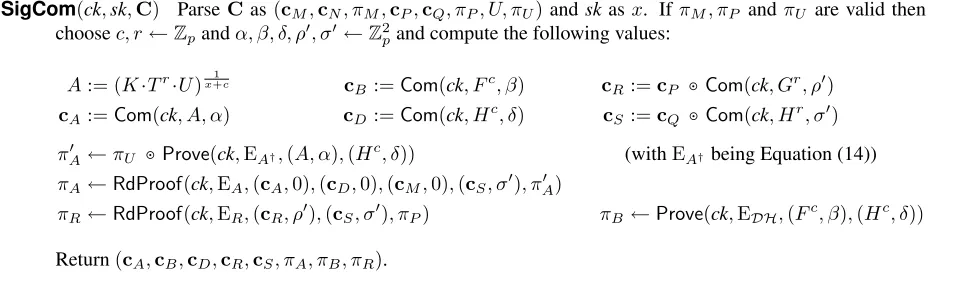
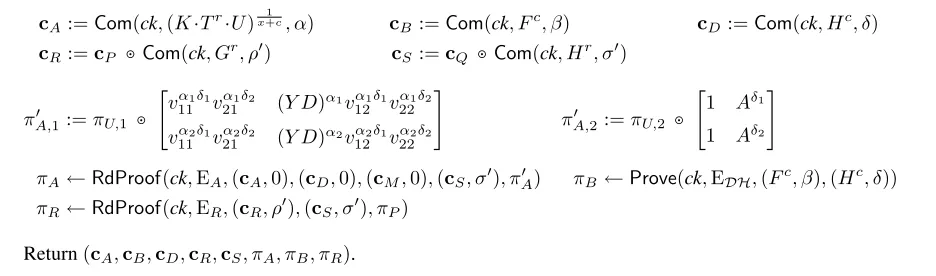
SigCom(ck,sk,C). IfC ∈ CM then the algorithm outputs a commitment to a signature and a proof of validity
(cΣ, π)which is distributed as
h
Σ←Sign(sk, M); ρ← R : Com(ck,Σ, ρ),Prove(ck,EVer(vk,·,·),(M, µ),(Σ, ρ))
i
,
whereM andµare such thatC=ComM(ck, M, µ).
SmSigCom(ck,ek,vk,C,Σ). Assume(ck,ek) ← ExSetup. If Ver(vk,ExtrM(ek,C),Σ) = 1 then the algorithm
outputs(cΣ, π)which is distributed as
ρ← R : Com(ck,Σ, ρ),Prove(ck,EVer(vk,·,·),(M, µ),(Σ, ρ))
,
whereM andµare such thatC=ComM(ck, M, µ). (4)
Remark 2. When we verify a signatureΣ on a message M runningVer(vk, M,Σ), we implicitly assume that Verifyalso checks whetherM ∈ M. Analogously, we assume that when verifying a proof of validity by running VerifyonEVerandC, it checks whetherC∈ CM, too.
Def. 2 implies that running ComM onM and thenSigComyields the same output as runningΣ ← Sign(sk, M)
and then ComM on M,Comon ΣandProveforEVer(vk,·,·); or runningSign, thenComM onM andProve for
EVer(vk,·,Σ), and then Com on Σ andAdPrC; or running Sign, thenCom on Σ andProve for EVer(vk,M,·), and
then ComM on M andAdPrCM. And similar statements hold for sequences of algorithm executions including
decommitments and proof adaptation. This means that the diagram in Fig. 1commutes.
4.2 Black-Box Results
Security notions for commuting signatures follow from the security of the used building blocks and the fact that all algorithms perfectly commute.
Unforgeability.Extractability ofComandComM, perfect soundness ofProof, strong unforgeability ofSigand
commutativity ofSigComwith signing and verifiably encrypting implies unforgeability, defined as the intractability for a p.p.t. adversaryAof winning the following game:
Run(ck,ek)← ExSetupand(vk,sk)←KeyGenS(SetupS); provideAwith(ck,ek,vk)and access to aSigComoracle that on inputC, a commitment to a message, outputsSigCom(ck,sk,C). LetCibe
the value submitted in thei-th oracle call and(ci, πi)be the response; defineMi :=ExtrM(ek,Ci)and
Σi :=Extr(ek,ci). ThenAwins if it outputs(C∗,c∗, π∗)such thatVerify(ck,EVer(vk,·,·),C∗,c∗, π∗) =
1and ExtrM(ek,C∗),Extr(ek,c∗)∈/ (M1,Σ1), . . . ,(Mn,Σn) .
This unforgeability notion is reduced to strong unforgeability ofSig. On receivingvk, run(ck,ek) ← ExSetup and give (ck,ek,vk) to the adversary. Answer a query for C as follows: using ek, extract M, query it to the signing oracle to receiveΣ; then run(cΣ, π)← SmSigCom(ck,ek,vk,C,Σ)and return(cΣ, π). Since by Def. 2, SmSigCom andSigCom both commute with ComM, Com and Prove, this perfectly simulates the adversary’s
oracle. If the adversary wins the game, we return ExtrM(ek,C∗) andExtr(ek,c∗) which yields a valid forgery
(M,Σ)by perfect soundness ofProof.
Indistinguishability. The message inCremains hidden to a signer runningSigCom, in a computational sense: replacing ck by ck∗ ← WISetup is computationally indistinguishable and results in perfectly hiding outputs of ComandComM.
Blind Signatures. Given a system of commuting signatures and verifiable encryption, we can easily build a blind-signature scheme in a black-box way. To get a blind-signature on a messageM, the user choosesµ← RMand sends the
commitmentC:=ComM(ck, M, µ)to the signer. The latter usesSigComto produce and send(cΣ, π), a
commit-ted signature onM and a proof of validity. The user can produce a proofeπ ← AdPrDCM(ck,vk,(M, µ),cΣ, π),
which asserts validity of the committed signature onM. The blind signature is defined as(cΣ,eπ)and is verified byVerify(ck,EVer(vk,M,·),cΣ,eπ).
This yields a generically more efficient construction than that from [Fis06], in which, besidescΣ andπ, the
blind signature containsCand a proof thatCopens toM.
5
Application: Non-Interactively Delegatable Anonymous Credentials.
Our main application of commuting signatures and verifiable encryption is a black-box construction of a delegat-able anonymous credential scheme with a non-interactive delegation protocol. Our scheme borrows the idea of combining Groth-Sahai proofs and automorphic signatures from the instantiation ofanonymous proxy signatures
from [Fuc09]. This primitive is similar in that it enables to prove knowledge of a certification chain, but there is no mutual anonymity of the users in the (non-interactive) delegation protocol. Commuting signatures now allow to define a delegation protocol where both delegator and delegatee remain anonymous w.r.t. each other. Moreover, the protocol isnon-interactive, that is, a user can publish a pseudonym, which can be used by the delegator to produce a credential for the user—as it would be in the non-anonymous case with public keys instead of pseudonyms.
We start by presenting the model for delegatable credentials defined in [BCC+09]. In Sect. 5.2 we give our instantiation of it, and compare it to that from [BCC+09] in the subsequent section.
5.1 The BCCKLS Model
The system parameters are set up by a trusted party. Every user holds a secret keysk, of which she can publish
other pseudonymNym0A. Moreover, credentials can bedelegatedto other users. A (non-interactively) delegatable anonymous credential system consists of the following algorithms:5
SetupC(1λ) outputs the system parameterspp
KeyGenC(pp)creates a user secret keysk
NymGen(pp,sk) outputs a new pseudonymNymand auxiliary informationauxrelated toNym
Issue(pp,NymO,skI,NymI,auxI,cred,NymU, L) : skI,NymIandauxIare the issuer’s secret key, pseudonym and
auxiliary information.credis a levelLcredential for the issuer rooted atNymO, andNymUis the pseudonym of the delegated user. IfL= 0thencred=∅. The algorithm outputscredproof.
Obtain(pp,NymO,skU,NymU,auxU,NymI, L,credproof) : skU,NymUandauxUare the user’s secret key, pseudo-nym and auxiliary information. NymO and NymI are the originator’s and the issuer’s pseudonym, and
credproof is the output ofIssue. The algorithm outputs a credentialcred.
CredProve(pp,NymO,cred,sk,Nym,aux, L) takes a levelLcredential fromNymO, andsk,Nymandaux, and out-puts acredproof forNym.
CredVerify(pp,NymO,credproof,Nym, L) verifies a levelLcredproof for a pseudonymNymrooted atNymO.
Security is defined by correctness,anonymityandunforgeability, which we sketch below. For a formal security definition we refer to Appendix A of the full version of [BCC+09].
Correctness. A credential is properif for all user pseudonyms, CredProve outputs a proof that is accepted by CredVerify. Run honestly,IssueandObtainmust produce a proper credential.
Anonymity.There exists a simulator(SimSetupC,SimCredProve,SimIssue,SimObtain)with the following
prop-erties:SimSetupCoutputs parameters that are indistinguishable from those produced bySetupand a trapdoorsim.
Under theses parameters the outputsNymofNymGenare distributed independently ofsk.
SimCredProvegetssiminstead ofcred,skandauxand outputscredproof that is indistinguishable from outputs ofCredProve. SimIssuehas inputsiminstead ofskI,auxI andcredand cannot be distinguished fromIssueby an
adversary interacting with it. SimObtaingetssiminstead ofskUandauxUand cannot be distinguished fromObtain
by an adversary interacting with it.
Note that for the case ofnon-interactivedelegation, this means:SimIssueproducescredproof that is indistin-guishable from outputs ofIssue. AndSimObtainis obsolete, since the issuer does notinteractwith it.
Unforgeability. (I) There existsExSetupC that outputs parameterspp(distributed as those fromSetupC) and an extraction keyek. Underpppseudonyms are perfectly binding forskandExtractCusingekoutputs the chain ofL
identities from a levelLcredproof.
(II) No adversary A can output a valid credential from which can be extracted an unauthorized chain of identities. This means thatA is given the parameters and has oracles to add honest users, request pseudonyms from them, request issuings between honest users, request proofs and it can run Issue and Obtain with the simulator. When A requestsIssue for (NymO,NymI,NymU,cred, L), the simulator extractsvkO,vkI,vkU from
the pseudonyms and adds (vkO, L+ 1,vkI,vkU) to a list ValidCredentialChains. The adversary wins if it out-puts a valid triple(NymO,credproof,Nym), from which can be extracted(vk0, . . . ,vkL)s.t.(vk0, i,vki−1,vki) ∈/ ValidCredentialChainsfor someiandvki−1is an honest user key.
5.2 Our Instantiation
In the instantiation from [BCC+09] the system parameters are a Groth-Sahai (GS) commitment key and parameters for an authentication scheme. Each user holds a secret keyxfor the authentication scheme. A pseudonym is made up of two GS commitments toHxandUx(from whichxcannot be extracted), respectively, for parametersHand U. To issue and delegate, the issuer and the user jointly compute a proof of knowledge of anauthenticatoron the user’s secret key, which is valid under the issuer’s secret key. The authors define a complex interactive two-party
5Since, as opposed to [BCC+
protocol for this. A credential is then a chain of pseudonyms and committed authenticators with GS proofs of validity.
We replace the authentication scheme by an automorphic signature scheme. A non-anonymous credential for
vkLrooted atvk0is a chain of public keys and signatures(Σ1,vk1,Σ2. . . ,vkL−1,ΣL), whereΣiis a signature on
vkiundervki−1. To achieve anonymity, the public keys and signatures in the credential are committed to and proofs
of validity are added. Using commuting signatures, given a commitment to a public key, the issuer can directly make a commitment to a signature on it and a validity proof. This is what enables non-interactive delegation.
Commuting Signatures with Partially Public Messages. To instantiate credentials, merely signing user public keys does not suffice. The issuer of a credential might want to add public information to the credential, such as attributes. For delegatable credentials it is also required to include the originator’s pseudonym and the delegation level in each certificate to prevent combining different credentials and changing the order within a credential.
In Sect. 9.1, we give an automorphic signature schemeSig00, where in addition to the message, the signer can specify some public value. The message space ofSig00isZp× M. Our scheme only extends the parameters ofpp
by one group element, but is otherwise as efficient asSig, in particular, Sig- andSig00signatures have the same size. We also defineVKthat on input a signing key outputs the corresponding verification key, which allows us to comply with the formal definition of credentials in [BCC+09]. In Sect. 9.2, we defineSigCom00, which isSigCom adapted toSig00and thus has the public part of the message as additional input. Moreover, we show that all other algorithms defined in Def. 2 and instantiated in Sect. 8 work equally forSigandSig00.
For our instantiation, we assume a collision-resistant hash functionH:CM×N→Zp.
More Intuition. We informally describe how our algorithms work. SetupCgenerates a key forComand param-eters forSig00,KeyGenCoutputs a secret key forSig00, and given a secret key,NymGenoutputs a commitment to the corresponding public key and the used randomness as auxiliary information. A levelLcredential fromNym0
toNymLhas the form
cred= (c1, π1,Nym1,c2, π2, . . . ,NymL−1,cL, πL) , (1)
whereciis a commitment to a signatureΣion the public valueH(Nym0, i)and the key committed inNymi, valid
under the key committed inNymi−1; andπiis a proof of validity ofΣi. We call it acredentialif it is valid on a
trivial NymL, i.e., whenNymL=Com(ck,vkL,0), and speak of acredential proof otherwise.
CredProve takes a credential and turns it into a credential proof by randomizing all its components, using
auxs.t.NymL = Com(ck,VK(sk),aux)for the last component. CredVerifyverifies acredproof by checking the proofs contained in it. Given a level Lcredential,Issueextends it by one level to a credential forNymL+1: if it is not an original issuing, it first makes acredproof for the issuer’s pseudonymNymI; usingSigCom00it produces (cL+1, πL+1)for NymL+1, and turns the proof into a proof for the committed verification keyNymI by running AdPrCKon randomnessauxI. Obtainturns thiscredproof into acredby adapting the randomness to make it valid
for a trivialNymL.
Algorithm Specification.We now formally define the algorithms of our schemeCred.
SetupC(1λ). Runck←Setup;ppS←Setup00S; returnpp:= (ck,ppS)
KeyGenC(pp). Parsepp (ck,ppS); run(vk,sk)←KeyGen00S(ppS); returnsk
NymGen(pp,sk). Chooseaux← RM; return Nym:=ComM(pp,VK(sk),aux),aux
Issue(pp,NymO,skI,NymI,auxI,cred,NymU, L).
• IfL= 0, andcred6=∅orNymO6=NymI then abort;
ifL >0then setcredproof ←CredProve(pp,NymO,cred,skI,NymI,auxI, L)and abort if it fails
• Parsecredas in (1); ifNymL:=NymI6=ComM(pp,VK(skI),aux)orNymU ∈ C/ M(pp)then abort
• (cL+1, πL+1)←SigCom00(pp,sk,H(NymO, L+ 1),NymU) π0L+1←AdPrCK pp,(VK(skI),auxI),NymU,cL+1, πL+1
Obtain(pp,NymO,skU,NymU,auxU,NymI, L;credproof0).
• Parsepp (ck,ppS); parsecredproof0 credproofL0 k(NymI0,c0L+1, πL0+1). IfNymI 6=Nym0Ior
NymU 6=ComM(pp,VK(skU),auxU)orCredVerify(pp,NymO,credproof0,NymU, L+ 1) = 0then abort
• πL+1←RdProof ck,EVer00ppS(·,H(NymO,L+1),·,·),(NymI,0),(NymU,−auxU),(cL+1,0), π
0
L+1
• ReturncredproofL0 k(NymI0,c0L+1, πL+1)
CredProve(pp,NymO,cred,sk,Nym,aux, L).
• Parsepp (ck,ppS)andcredas in (1)
• IfNym6=ComM(pp,VK(sk),aux)orCredVerify pp,NymO,cred,ComM(pp,VK(sk),0), L
= 0then abort
• Fori= 1. . . L, pickνi ← RM,γi← R. SetNym0:=NymO, ν0:= 0, NymL:=NymU, νL:=aux
• Fori= 1. . . Ldo
Nym0i :=RdComM(pp,Nymi, νi); c0i:=RdCom(ck,ci, γi) π0i←RdProof ck,EVer00
ppS(·,H(NymO,i),·,·),(Nymi−1, νi−1),(Nymi, νi),(ci, γi), πi
• Return(c01, π10,Nym01,c02, π20, . . . ,Nym0L−1,c0L, πL0 )
CredVerify(pp,NymO,credproof,Nym, L)
• Parsepp (ck,ppS),credproof (c1, π1,Nym1, . . . ,cL, πL), letNym0:=NymO,NymL:=Nym
• If∀1≤i≤L:Verify ck,EVer00
ppS(·,H(NymO,i),·,·),Nymi−1,Nymi,ci, πi
= 1andNymi ∈ CM(pp), return 1
Theorem 1. Let (Com,Proof) be a randomizable, extractable, composable zero-knowledge non-interactive proof-of-knowledge system, letSig00be a strongly unforgeable automorphic signature scheme, and letHbe colli-sion resistant. ThenCredas defined above is a secure anonymous delegatable credential scheme.
Proof sketch. We refer to the full version of [BCC+09] for the formal definition of the model, which is quite involved. Since the overall construction of our scheme is similar to the BCCKLS construction, in particular the use of (randomizable and simulatable) Groth-Sahai proofs to commit to a delegation chain and prove validity, our scheme is proved to satisfy the security definitions analogously. Our proof is a lot simpler though, since our certificates are on public keys and one can extract a complete certification chain from our credentials, avoiding thus partial-extractability notions. Moreover, our construction does not make use of interactive secure two-party protocols. We give a sketch of the security proof, highlighting the differences.
CORRECTNESS. Correctness of our scheme follows from a straightforward argument using the correctness of the underlying building blocks.
ANONYMITY. A witness-indistinguishability based definition of anonymity is an immediate consequence of perfectly hiding commitments and proofs, when ck is produced by WISetup: pseudonyms Nym information-theoretically hide the committed value and the proofs incred do not contain information either. We thus define SimSetupC using WISetup. The algorithms CredProve,Issueand Obtaincan be simulated without knowledge
of any private information; this follows from the zero-knowledge property of Groth-Sahai proofs; in particular, in the witness-indistinguishable (WI) setting, given the simulation trapdoorsimof GS proofs, we can make per-fectly hiding commitments and proofs for any equation with certain properties—which are satisfied by ours. (See Sect. 10.)
Our simulatorSimCredProveis the exact analogue ofSimProve, defined in the anonymity proof of the BC-CKLS scheme: it constructs a simulated certificate chain from NymO to NymI of lengthL, by simulating the intermediate pseudonyms, i.e., theComMcommitments (cf. Sect. 10.2), the commitments in ci, and the proofs πi.SimIssueis defined asSimCredProveforL+1except that it setsNymLasNymI. SinceObtaindoes not interact
UNFORGEABILITY. Soundness and extractability of GS proofs, unforgeability of Sig00 and simulatability of SigCom00imply that our scheme is unforgeable in the sense of [BCC+09]: (I) ForExSetupC, we substituteSetup by ExSetupinSetupC. This generates an identically distributed key ck (which leads to perfectly binding com-mitments) and an extraction key ekthat allows to extract the committed chain of public keys (“identities”) and certificates from a credential.
The notion defined in (II) is reduced to unforgeability ofSig: given a verification keyvkand a signing ora-cle, we simulate the game as follows: we guess which honest user the adversary will “frame”; we compute the parameters withExSetupC, and use extraction, the signing oracle andSmSigComto simulateIssuefor that user. Let (Nym0,credproof,NymL) be a successful forgery, thus when we extract(vk0,Σ1,vk1, . . . ,ΣL,vkL) from it
then for somei: (vk0, i,vki−1,vki) ∈/ ValidCredentialChains andvki−1 is honest. If we guessed correctly (i.e., vki−1 = vk) then we can return the Sig00 forgery(vki,Σi), since (by collision resistance ofH) we have never
queried our signing oracle on(H(Nym, i),vki)for anyNymofvk0.
Optimizing the Black-Box Construction for Concrete Commuting Signatures. When using our implementa-tion of commuting signatures (Sect. 6 and 8), we can make the following optimizaimplementa-tions. In the instantiaimplementa-tion we have M ⊆ G1 ×G2 for an asymmetric bilinear group. AComM commitment to a message(M, N) ∈ M is
defined ascM := Com(ck, M, µ),cN := Com(ck, N, ν),πN ← Prove(ck,EDH,(M, µ),(N, ν))and additional
components which enable the signer to make a committed signature on(M, N)and a proof of validity by running SigCom. These additional components are however not required for theNym’s contained in the credential, where giving(cM,cN, πM)is sufficient. Moreover, when issuing a new credential, the “public key” used to verify it can
be given in the clear, i.e., as(X, Y)∈ M, rather than as a commitment.
5.3 A Comparison to the BCCKLS Instantiation
The key building block of a delegatable-credential scheme is a certification scheme signing (or authenticating) user keys and some public information. The certificates (or “authenticator”) on user secret keys in the BCCKLS instantiation [BCC+09] are inG81×G32and are verified by evaluating 16 pairings. Our certificates on a user public
key (and a public value) are inG31×G22 and verified by evaluating 7 pairings. Proving validity of a committed
certificate requires Groth-Sahai proofs (which are inG21×2×G22×2for the SXDH instantiation) for 8 equations for
the BCCKLS instantiation and 3 equations for ours. The pseudonyms in [BCC+09] consist of two Groth-Sahai commitments and one proof, and are thus in G61 ×G62, as are the pseudonyms contained in our credentials. The
pseudonyms enabling non-interactive delegation are the size of two optimized pseudonyms and 3 G1 elements.6
A tuple(ci, πi,Nymi)contained in a warrant is thus inG501 ×G402 for the BCCKLS instantiation, whereas it is in G201 ×G182 for ours.7We conclude that the size of our credentials is less than half the size of BCCKLS credentials.
Most importantly, issuing and delegation in our scheme is substantially more efficient than in the BCCKLS scheme. In the latter the issuer and the user run a secure two-party protocol to jointly compute a proof of knowledge of an authenticator on the user’s secret key. This protocol uses homomorphic encryption and interactive ZK proofs asserting that certain blinding values are in the correct ranges. Since these tools are not made explicit it is not clear how many rounds the protocol requires nor what amount of data needs to be sent in each of them. In contrast, in our instantiation the issuer simply rerandomizes his credential and runs SigComandAdPrCK. She then sends a
ready credential to the user.
Concerning the assumptions on which security is based, they are bothnon-interactive, “q-type” assumptions and part of the generalized “Uber-Assumption” family [Boy08]. What is more, both are comparable variants of the
strong Diffie-Hellmanassumption [BB04], as was argued in [Fuc09] (cf. the discussion in Appendix C.1, ibid.).
6Note that if the size of pseudonyms is to be minimized, user could publishNym= (c
M,cN, πM)and send the remaining elements
(cP,cQ, πP, U, πUS)as a first step inObtain(see Sect. 10.2).
7This analysis is for the case when Groth-Sahai proofs are applied in a straightforward way and not considering simulatability. To make
inhomogeneousequations simulatable, a Groth-Sahai proof is augmented by one commitment inG21, one commitment inG22and one proof
fromG41×G22(see Sect. 10.2). Of our 3 equations only 1 is inhomogeneous, the size of a triple(ci, πi,Nymi)is thus augmented by 6G1
6
Instantiation of the Building Blocks
In this section we give instantiations of the building blocksCom,Proof andSig(Sect. 6.2, 6.3 and 6.4, respec-tively) on which we base our commuting signatures. We start with introducing bilinear groups and the assumptions under which our instantiations are secure.
6.1 Bilinear Groups and Assumptions
Abilinear group(cf. e.g. [GPS08]) is a tuplegrp = (p,G1,G2,GT, e, G1, G2)whereG1,G2andGT are cyclic
groups of prime order p, G1 andG2 generate G1 and G2, respectively, and e: G1 ×G2 → GT is an efficient
non-degenerate bilinear map, i.e., ∀X ∈ G1 ∀Y ∈ G2 ∀a, b ∈ Z : e(Xa, Yb) = e(X, Y)ab, ande(G1, G2)
generates GT. We assume that there exists a probabilistic polynomial-time algorithm GrpGenthat on input1λ
outputs a bilinear groupgrpfor whichpis aλ-bit prime.
Assumption 1 (SXDH). TheSymmetric External Diffie-Hellman Assumptionstates that given(G1r, Gs1, Gt1) for randomr, s∈Zp, it is hard to decide whethert=rsortis random; moreover, given(G2r0, Gs20, Gt20)for random r0, s0 ∈Zp, it is hard to decide whethert0=r0s0 ort0 is random.
The q-Asymmetric Double Hidden Strong Diffie-Hellman assumptionwas introduced in [Fuc09] and is a variant ofq-HSHD [BW07] in asymmetric bilinear groups. It was shown in [FPV09] that under theq-SDH assumption [BB04], givenq −1 tuples((K·Gvi)1/(x+ci), c
i, vi) for random ci, vi ← Zp, it is hard to produce a new tuple
of this form. The assumption below states that ifciandvi are given in ahiddenform(Fci, Hci)and(Gvi, Hvi),
respectively, it is intractable to produce a new tuple((K·Gv)1/(x+c), Fc, Hc, Gv, Hv).
Assumption 2(q-ADHSDH). Given(G, F, K, X=Gx;H, Y=Hx)←G4 1×G22,
Ai= (K·Gvi) 1
x+ci, B
i=Fci, Vi =Gvi, Di=Hci, Wi =Hvi
q−1
i=1 , forci, vi←Zp,
it is hard to output a new tuple (A, B, V, D, W)∈G31×G22 of this form, i.e., a tuple that satisfies
e(A, Y·D) =e(K·V, H) e(B, H) =e(F, D) e(V, H) =e(G, W) (2)
The next assumption was also introduced in [Fuc09] and is the weakest variant of the various flexible CDH
assumptions, adapted to asymmetric bilinear groups. It states that given G, Ga and H, it is hard to output (Gr, Gra, Hr, Hra)for an arbitraryr6= 0.
Assumption 3(AWFCDH). Given random generatorsG∈G1 andH ∈G2, andA=Gafora←Zp, it is hard
to output(Gr, Gra, Hr, Hra)∈(G1∗)2×(G∗2)2, i.e., a tuple(R, M, S, N)that satisfies
e(A, S) =e(M, H) e(M, H) =e(G, N) e(R, H) =e(G, S) (3)
Throughout the paper, we will assume two fixed generators GandHofG1andG2, respectively. We call a pair
(A, B)∈ G1×G2 aDiffie-Hellman pair(w.r.t.(G, H)), if there existsa∈Zp such thatA =GaandB =Ha. Using the bilinear mape, such pairs are efficiently decidable by checking
EDH(A;B) : e(G−1, B)e(A, H) = 1 .
We letDH:={(Ga, Ha)|a∈Zp}denote the set of DH pairs and implicitly assume them to be w.r.t.GandH.
6.2 SXDH Commitments.
We instantiateCom, defined in Sect. 3.1, by the commitment scheme based on SXDH given in [GS08].
Setup, on input(p,G1,G2,GT, e, G1, G2)choosesα1, α2, t1, t2 ←Zpand returnsck= (grp,u1,u2,v1,v2)with
u1 := (G1, Gα11 ) u2:= (Gt11 , G α1t1
1 ) v1:= (G2, Gα22 ) v2 := (Gt22 , G α2t2 2 )
Com(ck, X, r) is defined as follows: forX ∈ G1, Com(ck, X, r) := (ur11,1·u r2 2,1, X·u
r1 1,2·u
r2
2,2); forX ∈ G2,
Com(ck, X, r) := (vr11,1·vr22,1, X·vr11,2·vr22,2).
RdCom(ck,c, r0)returnsc ◦· Com(ck,1, r0) = (c1·u r01 1,1·u
r20 2,1,c2·u
r10 1,2·u
r02
2,2), whenc ∈G21 and similarly for the
case whenc∈G2
2. (“◦·” denotes component-wise multiplication.)
ExSetupconstructsckas inSetupand in addition outputs the extraction keyek:= (α1, α2).
Extr(ek,c) is defined as follows. Ifc∈G21then set outputc2·c
−α1
1 ; ifc∈G22then outputc2·c
−α2 1
WISetup producesck asSetup, but sets u2,2 andv2,2 asGα1t11 −1 andG α2t2−1
2 , respectively (which is
indistin-guishable by SXDH). This results in perfectly hiding commitments.
Remark 3. Comcommitments arehomomorphic: Com(ck, X, r)◦·Com(ck, X0, r0) = Com(ck, X·X0, r+r0); therefore ifc=Com(ck, X, r)thenRdCom(ck,c, r0) =Com(ck, X, r+r0).
Security. The scheme is perfectly binding, computationally hiding and randomizable as defined in Sect. 3.1.
6.3 SXDH Groth-Sahai Proofs for Pairing-Product Equations
In order to instantiate Proof, defined in Sect. 3.2, we use the proof system introduced in [GS08]. The class of equationsE for our proof system arepairing-product equations(PPE). A PPE over variablesX1, . . . , Xm ∈ G1
andY1, . . . , Yn∈G2is an equation of the form
E(X1, . . . , Xm;Y1, . . . , Yn) : n
Y
i=1
e(Ai, Yi) m
Y
i=1
e(Xi, Bi) m Y i=1 n Y j=1
e(Xi, Yj)γi,j = tT , (4)
defined byAj ∈G1,Bi ∈G2,γi,j ∈Zp, for1≤i≤mand1≤j ≤n, andtT ∈GT.
Proofs. We defineProve ck,E,(Xi, ri)mi=1,(Yj, sj)nj=1
forXi ∈G1, Yj ∈ G2andri, sj ∈ Z2p, and equationE
given by the values (Aj)nj=1,(Bi)mi=1,(γi,j)i,j∈Zpm×n,tT ∈GT. For notational convenience, let us first define
the following two shortcuts forZ = (zij)ij ∈Zp2×2, ~u∈G2
×2
1 , ~v∈G 2×2 2 .
Z⊗~u:= "
uz1111 uz1221 uz1112uz1222
uz2111 uz2221 uz2112uz2222
#
Z ⊗~v:= "
v11−z11v21−z21 v−12z11v−22z21 v11−z12v21−z22 v−12z12v−22z22
#
(5)
ProvechoosesZ = ((z11, z12),(z21, z22))>←Z2p×2and defines
t11:=Pn
j=1
Pm
i=1ri1γijsj1 t21:=
Pn j=1
Pm
i=1ri2γijsj1
t12:=Pn
j=1
Pm
i=1ri1γijsj2 t22:=
Pn j=1
Pm
i=1ri2γijsj2
(6)
The output(φ, θ)∈G22×2×G21×2ofProveis then defined as:
φ:=
vt1111v21t12 Qm
i=1B ri1 i
Qn
j=1Y
Pm i=1ri1γij
j
v12t11vt1222
vt2111v21t22 Qm
i=1B ri2 i
Qn
j=1Y
Pm i=1ri2γij
j
v12t21vt2222
◦· (Z⊗~v)
θ:=
1 Qn
j=1A sj1 j
Qm
i=1X
Pn j=1sj1γij
i
1 Qn
j=1A sj2 j
Qm
i=1X
Pn j=1sj2γij
i
◦·(Z⊗~u)
(7)
We writeProve ck,E,(Xi, ri)im=1,(Yj, sj)nj=1;Z
if we want to make the internal randomnessZ ∈Z2×2
p explicit.
Randomization. Randomization of a commitmentc =Com(ck, X, r)viaRdCom(ck,c, r0)replaces randomness
do the same to a proofπ = (φ, θ). We formally defineRdProof ck,E,(ci, ri)mi=1,(dj, sj)nj=1, π
: chooseZ = ((z11, z12),(z21, z22))>←Z2p×2, define(t11, t12, t21, t22)as in (6) and output(φ0, θ0)∈G2
×2 2 ×G2
×2
1 defined as:
φ0 :=φ ◦·
Qn
j=1d
Pm i=1ri1γij
j1
vt1111v21t12 Qm
i=1B ri1 i
Qn
j=1d
Pm i=1ri1γij
j2
v12t11vt1222
Qn
j=1d
Pm i=1ri2γij
j1
vt2111v21t22 Qm
i=1B ri2 i
Qn
j=1d
Pm i=1ri2γij
j2
v12t21vt2222
◦· (Z ⊗~v)
θ0 :=θ ◦·
Qm
i=1c
Pn j=1sj1γij
i1
Qn
j=1A sj1 j
Qm
i=1c
Pn j=1sj1γij
i2
Qm
i=1c
Pn j=1sj2γij
i1
Qn
j=1A sj2 j
Qm
i=1c
Pn j=1sj2γij
i2
◦· (Z⊗~u)
which has the same distribution as the output ofProve ck,E,(Xi, ri0+ri)mi=1,(Yj, s0j+sj)nj=1
, wherer0iands0j
are such thatci=Com(ck, Xi, ri0)anddj =Com(ck, Yj, s0j), as we will show now.
Remark 4. In additive notation, the commitments and proofs can be written as follows (cf. the full version of [GS08]), when the cumulated randomness for all variables isR= (rik) ∈Zmp×2andS = (sjk)∈Znp×2, and we
setΓ = (γij)∈Zmp×nand defineιi(X~) := [~0|X~ ].
~c=ι(X~) +R~u φ=R>ι(B~) +R>Γι(Y~) + (R>ΓS−Z>)~v
~
d=ι(Y~) +S~v θ=S>ι(A~) +S>Γ>ι(X~) +Z~u
To randomize the commitments and proofs, chooseRˆ←Zmp×2, Sˆ←Zpn×2, Zˆ ←Z2p×2and set
~c0 :=~c+ ˆR~u=ι(X~) + (R+ ˆR)~u ~d0 :=~d+ ˆS~v=ι(Y~) + (S+ ˆS)~v
φ0 :=φ+ ˆR>ι(B~) + ˆR>Γ~d+ ( ˆR>Γ ˆS−Zˆ>)~v
=R>ι(B~) +R>Γι(Y~) + (R>ΓS−Z>)~v+ ˆR>ι(B~) + ˆR>Γι(Y~) +S~v+ ( ˆR>Γ ˆS−Zˆ>)~v
= (R+ ˆR)>ι(B~) + (R+ ˆR)>Γι(Y~) +
(R+ ˆR)>Γ(S+ ˆS)− (Z>+ ˆZ>+R>Γ ˆS)
| {z }
=(Z+ ˆZ+ ˆS>Γ>R)>=:(Z0)>
~v
θ0 :=θ+ ˆS>ι(A~) + ˆS>Γ>~c+ ˆZ~u
=
S>ι(A~) +S>Γ>ι(X~) +Z~u
+ ˆS>ι(A~) + ˆS>Γ>
ι(X~) +R~u + ˆZ~u
= (S+ ˆS)>ι(A~) + (S+ ˆS)>Γ>ι(X~) + (Z+ ˆZ+ ˆS>Γ>R)
| {z }
=Z0
~
u
The output of RdProof ck,E,(ci,rˆi)im=1,(cj,sˆj)nj=1, π
using randomness ((ˆz11,ˆz12),(ˆz21,z22ˆ ))> is therefore the same as that ofProve ck,E,(Xi, ri+ ˆri)mi=1,(Yj, sj+ ˆsj)
when the randomness used is
"
z11+ ˆz11+P P ˆ
sj1γijri1 z12+ ˆz12+P Psˆj1γijri2
z21+ ˆz21+P P ˆ
sj2γijri1 z22+ ˆz22+P Psˆj2γijri2
#
, (8)
which is uniformly distributed overZ2p×2ifZˆis.
Verification. Letck = (u1,u2,v1,v2) ∈ G21×2 ×G2
×2
2 be a commitment key, let~c ∈ Gm
×2
1 , ~d ∈ Gn
×2 2 be
vectors of commitments, and let(φ, θ)∈G22×2×G2
×2
1 be a proof for an equationEgiven byA~ ∈G1n,B~ ∈Gm2 ,
Γ = (γi,j)i,j ∈Zmp×n, andtT ∈GT. Verify(ck,E, ~c, ~d,(φ, θ))outputs 1 if and only if the following 4 equations
hold.
Qm
i=1e ci,1,
Qn
j=1d γi,j
j,1
= e(u1,1, φ1,1)e(u2,1, φ2,1)e(θ1,1, v1,1)e(θ2,1, v2,1)
Qm
i=1e ci,1, BiQnj=1d γi,j
j,2
= e(u1,1, φ1,2)e(u2,1, φ2,2)e(θ1,1, v1,2)e(θ2,1, v2,2)
Qn
j=1e Aj
Qm
i=1c γi,j
i,2 , dj,1
= e(u1,2, φ1,1)e(u2,2, φ2,1)e(θ1,2, v1,1)e(θ2,2, v2,1)
Qn
j=1e(Aj, dj,2)Qim=1e ci,2, BiQnj=1d γi,j
j,2
Remark 5. Blazy et al. [BFI+10] show that by using techniques of batch verification, the number of pairing computations can be reduced from4m+n+ 16to2m+n+ 8.
Security. It follows from the results of [GS08] and Remark 4 that (Prove,Verify,RdProof) is a randomizable witness-indistinguishable proof system forComfrom Sect. 6.2, as defined in Sect. 3.2.
6.4 Automorphic Signatures
We instantiate the signature scheme Sig = (SetupS,KeyGenS,Sign,Ver) with the scheme from [Fuc09]. It is compatible since signature components are inV =G1∪G2, the space for committed values, and the verification
equations are pairing-product equations, thus inE. It is moreoverautomorphicsince the verification keys lie in the message space.
Scheme 1(Sig). SetupS has input grp = (p,G1,G2,GT, e, G, H) and outputs grp and additional generators F, K, T ←G1. The message space isDH:={(Gm, Hm)|m∈Zp}.
KeyGenS choosesx←Zp and outputs(vk= (Gx, Hx),sk=x).
Signhas inputs a secret keyxand a message(M, N)∈ DH. It chooses randomc, r←Zpand outputs
A:= (K·Tr·M)x+1c, B :=Fc, D:=Hc, R:=Gr, S :=Hr
Ver on inputs a public key(X, Y) ∈ DH, a message (M, N) ∈ DHand a signature(A, B, D, R, S)outputs 1 (and 0 otherwise) iff the following hold:
e(A, Y·D) =e(K·M, H)e(T, S) e(B, H) =e(F, D) e(R, H) =e(G, S) (9)
Security. Underq-ADHSDH and AWFCDH,Sigis strongly existentially unforgeable against adversaries making up toq−1adaptive chosen-message queries [Fuc09].
Automorphic Signatures on Two Messages. Fuchsbauer [Fuc09] shows how to transform the above construction into an automorphic signature scheme that signs two messages at once—if we restrict the message space toDH∗:= {(Gm, Hm)|m ∈Zp\ {0}}. Sign∗(sk,(V, W),(M, N))for(V, W),(M, N)∈ DH∗is defined as follows: pick
a key pair(vk∗,sk∗)←KeyGenSand output8
vk∗, Sign(sk,vk∗), Sign(sk∗,(M, N)), Sign(sk∗,(V, W)◦·(M, N)), Sign(sk∗,(V, W)3◦·(M, N)) .
Ver∗ vk,(V, W),(M, N),ΣparsesΣas(vk∗,Σ0,Σ1,Σ2,Σ3)and outputs
Ver(vk,vk∗,Σ0) · Ver(vk∗,(M, N),Σ1) · Ver(vk∗,(V, W)◦·(M, N),Σ2) · Ver(vk∗,(V, W)3◦·(M, N),Σ3) .
Sig∗= (SetupS,KeyGenS,Sign∗,Ver∗)is strongly unforgeable under ADHSDH and AWFCDH [Fuc09].
In Sect. 9.1, we give a variant of the schemeSigwith messages inZp × DH(required by our application to
credentials in Sect. 5) which doesnotincrease the size of a signature.
7
Additional Properties of Groth-Sahai Proofs
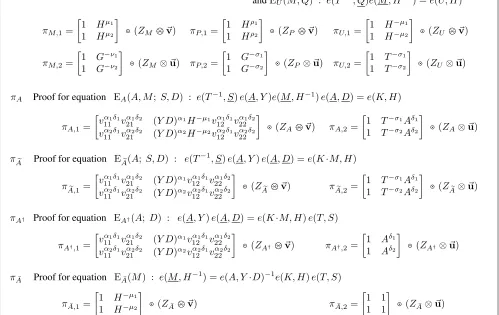
We identify five properties of Groth-Sahai proofs that will allow us to instantiate commuting signatures. The first is that proofs are constructed independently of the right-hand side of the equation; if the equation islinear, i.e., if
γij = 0for alli, j, then they are even independent of the committed values. Given two independent (i.e., with no
common variables) equations and commitments and proofs for them then the product of the proofs is a proof of the “product of the equations” and the concatenated vectors of commitments. The fourth property states that if we change a committed value by exponentiation then we can adapt the proof. And lastly, given commitments and a proof for an equation, if we commit to a constant of the equation then we can turn the proof into one for the set of commitments extended by the new commitment and the equation where the constant is now a variable.
8
Exponentiation of a DH pair is defined componentwise:(M, N)k:= (Mk, Nk)