Super Resolution Image Generation Using Wavelet Domain
Inter Polation with Edge Extraction Via A Sparse
Representation
P
1
P
U.Rakesh, P 2
P
Mrs. T.K.Lakshmi, P 3
P
Mr. Dr.V.V.Krishna, P 4
P
Mr. P RAVINDRA REDDY
P
12
P
Assistant Professor Department of Computer Science and Engineering, S.V College of Engineering Tirupathi
P
2
P
Assistant Professor ,Department of Information Technology, S.V College of Engineering Tirupati,
P
3
P
Principal, Professor, Department of Computer Science and Engineering, GITE, Engineering college,
P
4
P
Asst.Professor, Department of Computer Science and Engineering, S.V College of Engineering Tirupathi,
41T
ABSTRACT41T
This letter addresses the problem of generating a
super-resolution (SR) image from a single
low-resolution (LR) input image in the wavelet
domain. To achieve a sharper image, an
intermediate stage for estimating the
high-frequency (HF) sub bands has been proposed.
This stage includes an edge preservation
procedure and mutual interpolation between the
input LR image and the HF sub band images, as
performed via the discrete wavelet transform
(DWT). Sparse mixing weights are calculated
over blocks of coefficients in an image, which
provides a sparse signal representation in the LR
image. The entire sub band images are used to
generate the new high-resolution image using
the inverse DWT. Experimental results indicated
that the proposed approach outperforms existing
methods in terms of resolution This stage
includes an edge preservation procedure and
mutual interpolation between the input LR
image and the HF sub band images, as
performed via the discrete wavelet transform
(DWT). Sparse mixing weights are calculated
over blocks of coefficients in an image, which
provides a sparse signal representation in the LR
image. All of the sub band images aroused to
generate the new high-resolution image using
the inversed. Experimental results indicated that
the proposed approach outperforms existing
methods in terms of objective criteria and
subjective perception improving the image
resolution
INTRODUCTION
THE images and video sequences that register
from radar, ptical, medical and other sensors and
that are presented on high-definition television,
in electron microscopy, etc., are obtained from
electronic devices that use a variety of sensors.
Therefore, a preprocessing technique that
permits enhancement of image resolution should
be used. This step can be performed by
estimating a high-resolution (HR)
imagefrommeasurements of a low-resolution
(LR) imagethatwere obtained through a linear
operator that forms a degraded version of the
unknown HR image, which was additionally
contaminated by an additive noises a sub
sampling operator that should be inverted to
restore an original image size, and this problem
usually should be treated as an ill-posed
problem. In remote sensing monitoring and
navigation missions with small airborne or
unmanned flying vehicle platforms, LRsensors
with simple and cheap hardware, such as
unfocused fractional SAR systems, optical
cameras, etc., and using the Manuscript received
The authors are with the School of Mechanical
and Electrical Engineering(ESIME) Culhuacán
Unit, Institute Polytechnic National, 07738
Mexico City, Mexico (e-mail:
[email protected]).Color versions of one or
more of the figures in this paper are available
online Digital Object Identifier
10.1109/LGRS.2014.2308905onboard
processors are attractive. However, such cheap
sensors or fractal synthesis mode inevitably
sacrifices spatial resolution. The system could
also suffer from the uncertainties that are
attributed to random signal perturbations,
imperfect system calibration, etc. Therefore, the
SR algorithms that are the cost-effective
decisions have an important application in the
pro-cussing of satellite or aerial images obtained
by radar or optical sensors [1], [2].The wavelet
technique as a simple sparse representation also
plays a significant role in many image
processing applications, in particular in
resolution enhancement, and recently, many
novel algorithms have been proposed [3].Prior
information on the image sparsely has been
widely used for image interpolation [4]. The
principal idea behind the restriction of the sparse
SR algorithms is that the HR results can be
improved by using more prior information on
the imageproperties.The predominant challenge
of this study is to employ an approach that is
similar to the approach of these wavelet-based
algorithms, accounting for both spatial and
spectral wavelet pixel information to enhance
the resolution of a single image. The principal
difference of the novel SR approach in
com-parson with existing methods consists in the
mutual interpolation via Lenclos [5], [6] and
nearest neighbor interpolation (NNI) techniques
for wavelet transform (WT) high-frequency
(HF) sub band images and edge extracting
images via discrete wavelet transform (DWT);
additionally, an adaptive directionally image
interpolation is computed by estimating sparse
image mixture models in a DWT image. To
obtain robustness for these process in presence
of noise, the novel framework uses special
demising filtering, employing the nonlocal
means (NLM)technique for the input LR image
[7].Finally, all of the subbandimages are
combined, reconstructing via inverse DWT
(IDWT)the output HR image that appears to
demonstrate superiority of the designed
algorithm in terms of the objective criteria and
subjective perception (via the human visual
system), in comparison with the best existing
techniques. To justify that the novel algorithm
called super resolution using wavelet domain
interpolation with edge extraction and sparse
representation (SR-WDIEE-SR) has real
advantages, weave compared the proposed SR
procedure with other similar techniques, such as
the following: Demirep - Anbarjafari Super
Resolution [8], Wavelet Domain Image
Resolution Enhance-mint Using Cycle-Spinning
[9], Image Resolution Enhance-mint by using
Discrete and Stationary Wavelet Decomposition
The technology of image magnification focuses
on how to magnify a low resolution (LR) image
and at the same time recover some high
resolution (HR) details. The methods of this
technology can be divided into three categories:
the method based on up scaling the method
based on reconstruction and the method based
on learning Some methods based on up scaling,
such as bilinear and bucolic interpolation (BI)
are popular since they have low computational
complex, but they always produce blurring
edges and suffer from artifacts since they use the
invariant kernels for all kinds of local textures.
Methods based on reconstruction aim at
reconstructing the HR image by imitating the
inverse process of degradation these methods
rely on the rationality of the reconstructing
model. The methods based on up scaling and
reconstruction has smaller memory space costs
than the learning-based methods in most of the
cases. But it is difficult to use some simple
mathematical models to fit the sophisticated
natural conditions. This makes these methods
cannot recover many texture details. The
learning-based methods are more flexible to deal
with the problem they use the training images to
learn the relationship between the HR and LR
images, and many existing works have
demonstrated their good effect for the high
magnification factors
Image super-resolution (SR) are techniques aiming estimation of a high-resolution (HR) image from one or several low-resolution (LR) observation
Proposed algorithm
If the input LR image has noise, how could we
deal with it? An idea that flashed into the mind
may be firstly demising the LR image and then
magnify it. But it is difficult to be executed,
since the textures are dense and incomplete in
the LR image. Therefore, we propose an
algorithm to solve this problem. The framework
of the proposed algorithm is shown in A TV
regularization-based algorithm is employed to
simultaneously accomplish magnification and
demising at first. The details of the proposed TV
regularization model will be described in
Section 2.1. After the TV regularization, some
texture details are damaged. We use an OCDT
algorithm to compensate the texture details. The
details of this step will be shown in Section
MULTIRESOLUTION
DIRECTIONAL TRANSFORMS
One of the main goals of a transform
representation is to determine efficient linear
expansions for images. Efficiency is generally
measured in terms of the number of elements
needed in a linear expansion. To quantify the
number of elements needed for a linear
expansion, image models are employed.
Commonly, images are considered as uniform
2D functions separated by singularities (e.g.,
edges). The singularities them-selves are
modeled as smooth curves. In the past decades,
developments in applied harmonic analysis have
provided many useful tools for signal
processing. Wavelets are good at isolating
singularities in 1D. Extending wavelets to 2D
makes
They well adapted to capture point-singularities.
But in natural images, there are mostly line- or
curved- singularities (e.g., directional edges).
These are also known as anisotropic features as
they are dominant along certain directions. To
capture such features, there has been extensive
study in constructing and implementing
directional transforms aiming to obtain sparse
representations of such piecewise smooth data.
The curvelettransform is a directional transform
which can be shown to provide optimally sparse
approximations of piecewise smooth images
However, curve lets offer limited localization in
the spatial domain since they are band limited.
Also, they are based on rotations which
introduce difficulties in achieving consistent
discrete implementation. Contour lets are
com-partly supported directional elements
constructed based on
directional filter banks [17]. Directional
selectivity in this approach is artificially
imposed by a special sampling rule of filter
banks which often causes artifacts. Moreover, no
theoret-icalguarantee exists for sparse
approximations for piecewise smooth images.
Recently, a novel directional representation
system known as shear lets has emerged, which
provides unified treatment of continuous as well
as discrete models, allowing optimally sparse
representations of piecewise smooth images [25,
29]. This simplified model of natural images,
which emphasizes anisotropic features, most
notably edges, is found to be consistent with
many models of the human visual system [26].
The framework proposed in this paper
inapplicable for all these transforms, although
shear lets is ob-served to provide the best
performance among the
consideredtransforms.Multi-resolution
directional transforms can also be seen as filter
banks. The decomposition is implemented using
an analysis filter bank, while the reconstruction
is implemented using a synthesis filter bank.
One branch of the filterbankis designed as a low
pass channel that captures a coarse
representation of the input signal followed by
band- or high-
Image Super-resolution
images, which offer the promise of overcoming someoftheinherent resolution limitations of low-cost imaging sensors (e.g., cell phone cameras or survey-lance cameras), and allow better utilization of the growing capability of HR displays (e.g., HD LCDs).Conventional super-resolution approaches normally require multiple LR inputs of the same scene with sub-pixel motions. The SR task is thus cast as an inverse problem of recovering the original HR image by fusing the LR inputs, based on reasonable assumptions or prior knowledge about the observation model. However, SR image reconstruction is typically severely ill-conditioned because of the insufficient number of observations and the unknown registration parameters. Various regularization techniques are therefore proposed to stabilize the inversion of this ill-posed problem [13]–[15].However, the performance of conventional approaches is only
acceptable for small up scaling factors (usually less than 2) [16], leading to the development of later example-based learning approaches, which aim to learn the co-occurrence prior between the HR and LR image local structures from an external raining database [17]–[19]. This training database is usually required to contain millions of HR/Linage patch pairs in order to represent a generic image well, which makes the algorithms computationally intensive. Instead of relying on an external database, several recently proposed approaches exploit the self-similarity properties of local image patches within and across different spatial scales in the same image for super-resolution [20]–[24]. These approaches either need a separate deploring process [20], [23], which is ill-posed and requires parameter tuning by itself, or relies too much on local image singularities,e.g., edges and corners, thus generating super-resolution results which are not photo realistic [22], [24].Motivated by the recent compressive sensing theories [10], Yanked align [8], [25] proposed to use sparse representation to recover the HR image patch. The method can generate both photo realistic textures and sharp edges from a single input image. However, the joint dictionary training method proposed in [8]does not guarantee that the sparse representation of a LR image patch can well reconstruct its underlying image patch. We will show that our coupled dictionary learning method can overcome this problem and demonstrate superior performance both qualitatively and quantitatively. Despite its strength in sparse signal recovery, sparse representation cannot be calculated in an efficient way due to the1-norm minimization, which hinders its application in many real time scenarios with constrained computational resources. For example, it typically takes more than one minute to magnify air image of size128×128by a factor of2, which is intolerable to most users. In this paper, to enable the practical application of our sparse recovery
based super-resolution in consumer photo editing,e.g.,inPhotoshopTM, we further propose an efficient implementation of our algorithm based on two strategies:
IMAGE RESOLUTION
ENHANCEMENT METHOD USING
SWTAND DWT
The main loss in image resolution enhancement
by using interpolation is on its
highfrequencycomponents (i.e., edges), which is
due to the smoothing caused by interpolation.
Edges plays very important role in image. To
increase the quality of the super resolved image,
it is essential to preserve althea edges in image.
In [7] work, DWT has been employed in order
to preserve the high frequency components of
the image (i.e. edges). The redundancy and shift
invariance of the DWT mean that DWT
coefficients are inherently interpolable.In this
correspondence, one levelDWT (with
Daubechies 9/7 as wavelet function) is used to
decompose an input image into different sub
band images. Three high frequency sub bands
(LH, HL, and HH) contain the high frequency
components of the input image (i.e. edges).In
this technique, bucolic interpolation with
enlargement factor of 2 is applied thigh
frequency sub band images. Information loss
occur due to down sampling in each of the DWT
sub bands cause din the respective sub bands.
That is why SWT (Stationary Wavelet
Transform) is used to minimize this loss The
SWT is an inherently redundant scheme as the
output of each level of SWT contains the same
number of samples as the input –so for a
decomposition of N levels there is a redundancy
of N in the wavelet coefficients. The
interpolated high frequency sub bands and the
SWT high frequency sub bands have the same
size which means they can be added with each
other. The new corrected high frequency sub
bands can be interpolated further for higher
enlargement. Also it is known that in the wavelet
domain, low pass filtering of the high resolution
image produce the low resolution image.
Another word, low frequency subbed is the low
resolution of the original image. Therefore,
instead of using low frequency subbed, which
contains less information than the original high
resolution image, Has an Demirep and
Gholamreza Anbarjafari [7] are Using the input
image for the interpolation of low frequency
subbed image.Thequality of thesuperresolved
image increases using input image instead of
low frequencysubband. Illustrates the block
diagram of the used image resolution
enhancement technique. By interpolating input
image by3, and high frequency sub bands by 2
and in the intermediate and final interpolation
stages respectively, and then by applying IDWT,
as illustrated in , the output image will contain
sharper edges than the interpolated image
obtained by interpolation of the input image
directly. This is due to the fact that, the
interpolation of isolated high frequency
components in high frequency sub bands and
using the corrections obtained by adding high
frequency sub bands of SWT of the input image,
will preserve more high frequency components
after the interpolation than interpolating input
image directly
PROPOSED ALGORITHM
displays the flowchart of proposed algorithm for
single image super resolution that is based on
the algorithm presented in [11]. Here some
changes have been done in original algorithm of
[11] as down sampling method is changed, new
up sampling algorithm is used and wavelet based
demising algorithmic Below each step of
flowchart is explained in detail
Down sampling to get low-resolution
image
To acquire the low-resolution image, take
high-resolution image and convert it into
low-resolution image using below method (Figure 2).
Here block of 2 x 2 is chosen and 1 pixel of
low-resolution image for every 4 pixel of
high-resolution image is derived.
Up sampling of the image
Method proposed in [9] is used for up sampling.
Some of the changes have been made in original
method like instead of Bucolic, Bucolic
smoother method of Photoshop cs5 (as shown in
figure) is used, demising algorithm is applied on
HH band and HAAR wavelet is chosen and
instead of Cohen-Daubechies-Feauveau (CDF)
9/7 wavelet as a mother wavelet transform
because HAAR wavelet is computationally fast.
Many other wavelets are available which
provide better results like sym; db4 etc. but all
require more time for computation. During
experiment on program using HAAR, it has
taken 8.37 seconds while DB4 has taken 9.13
seconds. New modified algorithm for image up
sampling is shown in the figure. Below
explained is the complete method of image
up-sampling.
Gaussian Filter and Down sampling
After up sampling due to point spread function(PSF) image can be look blurred little bit. So
Gaussian filter merely work like smoothing
kernel. As the blurred effect is very low or
ignorable Gaussian filter applies only once.
Instead of Gaussian filter, winey filter can be
used or Iterative blur DE convolution, Lousy
Richardson algorithm can be used[6]. Same as
step1 using bucolic sharper algorithm image is
down-sampled.
Reconstruction and up sampling the error
In this stage of algorithm error is calculatedbetween original low-resolution image of step 1
and down sampled image of step 4. This is the
most important part of algorithm because the
error that we find in this stage is used as the
correction parameter in getting super resolution
image and also used for refining coefficients of
sub bands. By experiments it has been observed
that after three to four iteration error becomes so
small that it can be neglected
Resolution enhancement technologies
Are methods used to modify 32Tphoto masks32T for
32T
integrated circuits32T (ICs) to compensate for
limitations in the 32Tlithographic processes32T used to
manufacture the chips? Traditionally, after an IC
design has been converted into a physical 32Tlayout32T,
the 32Ttiming verified32T, and the polygons certified to
be 32TDRC-clean32T, the IC was ready for fabrication.
The data files representing the various layers
were shipped to a mask shop, which used
mask-writing equipment to convert each data layer
into a corresponding mask, and the masks were
shipped to the fib where they were used to
repeatedly manufacture the designs in silicon. In
the past, the creation of the 32TIC layout32T was the
end of the involvement of 32Telectronic design
automation32T
.
RET Technique
Manufacturability Improvement
U
Scattering Bars Sub resolution assist features that improve the depth of focus of isolated features.
32TU
Phase-shift MaskU32T Etching quartz from certain areas of the mask (alt-PSM) or replacing Chrome with
phase shifting Molybdenum Silicate layer (attenuated embedded PSM) to improve
CD control and increase resolution
32TU
Double or Multiple
PatterningU32T
Involves decomposing the design across multiple masks to allow the printing of tighter pitches.
THEORETICAL BACKGROUND AND
IMPLEMENTATION
Preprocessing of MODIS Images
The calibrated and geo-referenced MODIS data
is directly available, but the products are
available in sinusoidal (SIN) projection grid.
Therefore, band1 and band 2 of Medicare
geometrically converted into UTM projection
using ENVI4.8 software. An important problem
in the use of optical images is occurrence of
clouds. The land surfaces of those areas can be
seen only which are not affected by the presence
of clouds. The preprocessed MODIS data
consists of two bands one in the near infrared
(NIR) and other is red wavelength. These two
bands may be fused or processed individually as
per the application [16
]
Vegetation Parameter
Surface reflectances at two or more wavelengths
are combined to produce vegetation indices
(VIs) which are designed to emphasize
particular feature of vegetation. There is quite a
lot of vegetation indices published in the
scientific literature; each accentuates a particular
vegetation property. ENVI4.8 is used to
calculate the NDVI values of the image. NDVI
is used to analyze the vegetation cover over a
region. The Normalized Difference Vegetation
Index (NDVI) is mainly used to characterize the
vegetation regions, as it isalmostlinearly
associated to the vegetation abundance. NDVI is
defined as the ratio of the difference and sum of
the spectral response at thenearinfrared (NIR)
wavelength and red wavelength as [17]
Reconstruction and up sampling the error
In this stage of algorithm error is calculated
between original low-resolution image of step 1
and down sampled image of step 4. This is the
most important part of algorithm because the
error that we find in this stage is used as the
correction parameter in getting super resolution
image and also used for refining coefficients of
sub bands. By experiments it has been observed
that after three to four iteration errors becomes
so small that it can be neglected
.
Up sampling the error is most important step of
the proposed algorithm.
Forreconstructingsuperresolution image, error
must be back projected and for that error matrix
must be up-sampled to meet super resolution
image. Bucolic smoother algorithm of
Photoshop cs5 is used for up-sampling error
matrix
Back projecting error
Finally error matrix generated in step 6 is
added with high-resolution image generated
in step 3. Repeat the above procedure as
shown in the figure till we acquire
satisfactory results. Within three iterations
appropriate result comes.
QUALITY ASSESSMENT PARAMETERS
Technique
Correlation Coefficient
RMSE
PSNR
Proposed Algorithm 0.99 0.0066 40.5850
BicubicInterpolation
0.9954 0.0076 39.3750Bilinear Interpolation
0.9887
0.011935.487
EXPERIMENT AND RESULT
Experiment of proposed algorithm is performed
on the computer with configuration of Intel i3
processor, 4GB RAM and 512MB Vida graphics
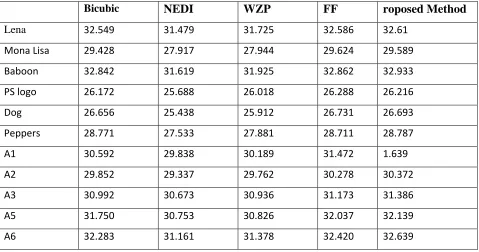
card. For performance evaluation of algorithm,
PNSR ratio and visual quality are considered as
parameters. The PSNR is defined as: PSNR = 20 · log 10(MAX i /√MSE). Comparison of cubic interpolation, new edge directed interpolation
[33], wavelet zero padding (WZP) same as
image up-sampling using DWT [55], algorithm
proposed in [11](denoted as FF) and proposed
method have been done for six different images
of line, Mona Lisa, Baboon, Pepper, Dog, PS
logo and some textures (A1 to A6). For doing up
sampling in algorithm, Photoshop is used. Same
algorithm is also implemented in MATLAB
without using Photoshop (used bucolic
interpolation function). It gives almost same
result as manual method. Sample MATLAB
code for proposed algorithm is also given.
Apply Bucolic smoother interpolation of
Photoshop cs5 as expounded in step1 on
low-resolution image that produces up-sampled
image. On these up-sampled image, apply DWT
which produces four sub bands of size m x n
each. Now LH, HL and HH sub bands produced
by DWT and by SWT are incremented to correct
the estimated coefficients.
Table 1. Comparison of different methods using PSNR ration (512 x 512 resolutions)
Bicubic
NEDI
WZP
FF
roposed Method
Lena 32.549 31.479 31.725 32.586 32.61
Mona Lisa 29.428 27.917 27.944 29.624 29.589
Baboon 32.842 31.619 31.925 32.862 32.933
PS logo 26.172 25.688 26.018 26.288 26.216
Dog 26.656 25.438 25.912 26.731 26.693
Peppers 28.771 27.533 27.881 28.711 28.787
A1 30.592 29.838 30.189 31.472 1.639
A2 29.852 29.337 29.762 30.278 30.372
A3 30.992 30.673 30.936 31.173 31.386
A5 31.750 30.753 30.826 32.037 32.139
A6 32.283 31.161 31.378 32.420 32.639
LITERATURE SERVEY
Previously numerous of techniques are used forresolution enhancement of images in different
applications. As discussed earlier, images such
as satellite images consists of important details
that plays vital role in many image processing
applications and hence resolution enhancement
is must for the same. Many of the researchers
have proposed different methods to increase
quality of images in accordance with resolution.
SIMULATION OUTPUT AND
DISCUSSION
This section reports the results of the applied
mathematics simulations
andtheperformanceanalysisthat'sconducted via objective metrics (Peak signal-to-noise ratio, Mean square Error, andStructuralSimilarity Index Measure) [17]. additionally, a subjective visual comparison of the SR pictures performed by different algorithms was used and so created it to evaluate the performance of the analyzed techniques during different mane Numerous aerial optical and radar measuring system satellite pictures from [13] and [14], notably Aerial-A and SAR-B pictures of various nature and physical characteristics, were studied applying the designed and higher existing SRprocedures. In simulations, the pixels of the LR image are obtained by downsamplingthe original time unit image by an element of four in every axis. within the demising stage, the NLM filter from (2) was applied, the neighborhood Q was found within the simulation as 5×5five pixels, and the parameter δ = two was chosen. In this letter, the subsequent families of classic waveletfunctionsis used lifting wavelet. In the Aerial-A image , it's straightforward to envision higher performance in accordance with the target criteria and via subjective beholding in SR once the planned algorithmic programs-IGFL-Wits utilized with the , demonstrating better preservation of the fine feature within the zoomed part of the image. it's higher sharpness and fewer smoothing at the sides, preventing pixel block (known as jaggier), blurreddetails, and ringing artifacts around edges
.
CONCLUSIONS AND FUTURE WORK
Proposed algorithm uses advantage of both
wavelet and spatial domain. PSNR ratio and
visual quality of images are also shows the
effectiveness of algorithm. Algorithm gives
almost same result as algorithm proposed in
[11]. Proposed algorithm is faster. Some more
work on up sampling algorithm will surly
improves result. In future more work on wavelet
domain and texture-based up sampling will be
conducted and comparison will be done to see
which algorithm work better for which kind of
image
.
ACKNOWLEDGMENT
Authors are thankful to IFCAMfor providing the funds to support this work
.
REFERENCES
1. T. Celia, C. Direkoglu, H. Ozkaramanli, H.
Demirep, and M. Uyguroglu, “Region-based
super-resolution aided facial feature extraction
from low resolution video sequences,” Proc.
IEEE ICASSP, Philadelphia, PA, vol. 2, pp.
789–792, Mar. 2005
2 H. Demirep, G. Anbarjafari, and S.
Izadpanahi, “Improved motion-based localized
super resolution technique using discrete
wavelet transform for low resolution video
enhancement,” Proc. 17th EUSIPCO,
Edinburgh, U.K., pp. 1097–1101, Aug. 2009
3 H. Demirep and G. Anbarjafari, “Satellite
image resolution enhancement using complex
wavelet transform,” IEEE Goes. Remote Sens.
Let. vol. 7, no. 1, pp. 123–126, Jan. 2011.
4 H. Sheen, M. K. Ng, P. Li and L. Zhang,
“Super-resolution reconstruction algorithm to
MODIS remote sensing images”, Compute. J.,
2013.
5 Y. Piano, L. Shin, and H. W. Park, “Image
resolution enhancement using inter-sub band
correlation in wavelet domain,” Proc. IEEE
ICIP, vol. 1, pp. I-445–I-448, 2007.
6 C. B. Atkins, C. A. Bauman, and J. P.
Allebach, “Optimal image scaling using pixel
classification,” Proc. ICIP, vol. 3, pp. 864–867,
Oct. 2001.
7 S. Mallet, A Wavelet Tour of Signal
Processing, 2nd Ed. New York: Academic,
1999.
8 S. Nail and N. Patel, “Single image
super-resolution in spatial and wavelet domain,” Int. J.
of Multimedia & Its Applications, vol. 5, no. 4,
Aug. 2013.
9 H. Chavez-Roman and V. Ponomaryov,
“Super resolution image generation using
wavelet domain interpolation with edge
extraction via a sparse representation,” IEEE
Gossip and Remote Sens. Let., vol. 11, no. 10,
Oct. 2014.
P. Ravindr reddy is an Assistant Professor at the Department of Computer
Science Previously; he served as a lecturer and researcher S.V.COLLEGE
OF ENGINEERING, and in the Department of Computer Science
S.V.COLLEGE OF ENGINEERING TIRUPATI. He has 3 years of
teaching experience. His area of Interests are cloud computing, Data
Communications & Networks, data mining Database Management
Systems, C Programming and Applications
32TU
[email protected]
U32TDr.V.V.krishna principal & Professor in Department of Computer Science and
Engineering, GITE, Engineering collage,
32TU[email protected]
U32T25 years of
Teaching experience. His area of Interests is data mining and image processing, Data
Communications & Networks, data mining Database Management Systems, C Programming
and Applications , advanced data stretchers, computer organization
Cloud computing,
Mining, Big data, Software engineering, biocomputing, genetic engineering, drug discovery.
T.K.LAKSHMI is an Assistant Professor, Department of Information Technology,
S.V.COLLEGE OF ENGINEERING, Tirupati. She has 9 years of teaching experience and
published papers on cloud computing, Networks & Network Security, data mining, Computer
Applications. Her areas of interests are Software Engineering, Network Security, Proteomics,
Genetic Engineering and Drug Discovery.
32TU[email protected]
U32TU.
U.rakesh is an Assistant Professor at the Department of Computer Science Previously; he served
as a lecturer and researcher S.V.COLLEGE OF ENGINEERING, and in the Department of
Computer Science S.V.COLLEGE OF ENGINEERING TIRUPATI. He has 4years of teaching
experience. His area of Interests are cloud computing, Data Communications & Networks, data
mining Database Management Systems, C Programming and Applications
U