Nursing-sensitive indicators: a concept analysis
Liza Heslop & Sai Lu
Accepted for publication 12 July 2014
Correspondence to L. Heslop: e-mail: [email protected]
Liza Heslop PhD RN Associate Professor
College of Health and Biomedicine, Victoria University, Melbourne, Victoria, Australia
Sai Lu BMed PhD Senior Lecturer
College of Health and Biomedicine, Victoria University, Melbourne, Victoria, Australia
H E S L O P L . & L U S . ( 2 0 1 4 ) Nursing-sensitive indicators: a concept analysis.
Journal of Advanced Nursing70(11), 2469–2482.doi: 10.1111/jan.12503
Abstract
Aim. To report a concept analysis of nursing-sensitive indicators within the applied context of the acute care setting.
Background. The concept of ‘nursing sensitive indicators’ is valuable to elaborate nursing care performance. The conceptual foundation, theoretical role, meaning, use and interpretation of the concept tend to differ. The elusiveness of the concept and the ambiguity of its attributes may have hindered research efforts to advance its application in practice.
Design. Concept analysis.
Data sources. Using ‘clinical indicators’ or ‘quality of nursing care’ as subject headings and incorporating keyword combinations of ‘acute care’ and ‘nurs*’, CINAHL and MEDLINE with full text in EBSCOhost databases were searched for English language journal articles published between 2000–2012. Only primary research articles were selected.
Methods. A hybrid approach was undertaken, incorporating traditional strategies as per Walker and Avant and a conceptual matrix based on Holzemer’s Outcomes Model for Health Care Research.
Results. The analysis revealed two main attributes of nursing-sensitive indicators. Structural attributes related to health service operation included: hours of nursing care per patient day, nurse staffing. Outcome attributes related to patient care included: the prevalence of pressure ulcer, falls and falls with injury, nosocomial selective infection and patient/family satisfaction with nursing care.
Conclusion. This concept analysis may be used as a basis to advance understandings of the theoretical structures that underpin both research and practical application of quality dimensions of nursing care performance.
Keywords: acute care, concept analysis, nursing performance measurement, nurs-ing-sensitive indicators, quality of nursing care
Introduction
In this paper, nursing-sensitive indicators (NSIs) is the concept selected for analysis.
In the past three decades, there has been great change and evolution in the concepts and theories that underpin nursing practice. This has been a time when ‘what nurses do’ needs to be quantified and measured to justify funding, and improve
©2014 The Authors.Journal of Advanced Nursingpublished by John Wiley & Sons Ltd. 2469
practice and patient outcomes–even though we know that practice is not generic and is most often subject to context.
‘Nursing sensitive indicators’ (NSIs) has been subject to considerable research development within the domain of the acute care setting where nurses have a degree of auton-omy and control over processes of nursing care delivery (Naylor 2007, Aiken et al. 2009, Lake et al. 2010). The application of NSIs has developed from the vast and ongo-ing dialogues held between nursongo-ing executives, who manage nursing-related clinical performance and strategy initiatives in tertiary care facilities, and nursing academics who have an interest in the complex performance measurement and decision-making characteristics of contemporary healthcare organizations (Brown et al. 2010, Doranet al. 2011, Beck
et al.2013).
Research to develop NSIs for use and application in the acute care domain must continue for several important rea-sons. First, NSIs have become an increasingly valid and reli-able means to support nursing care quality and performance measurement in the hospital unit setting, including the evaluation of nursing clinical practice
improvement (Brown et al. 2010, Patrician et al. 2010, Doran et al. 2011). Secondly, NSIs as variables have been increasingly drawn upon in primary research studies that empirically tested effects of nursing practice enhancement strategies on nursing-related outcomes (cf. Aiken et al.
2002, 2008, 2009, Needleman et al.2007, 2011, Patrician
et al. 2010, Blegen et al. 2011). Generally, those studies point to the complexity of, and variation within, the nurs-ing practice environment of the acute care settnurs-ing and the need for attention to related measures, models and theories. Thirdly, within the wider context of health system reform and heath policy development, considerable evidence advo-cates the building of NSI databases to support evidence-based healthcare practice (Aydin et al. 2004, Kurtzman & Corrigan 2007).
Background
The use of the concept of NSIs remains problematic. There are considerable inconsistencies and irregularities of defini-tions of the concept (Burstonet al.2013). The concept has been applied in primary research without referring to a clearly linked nursing conceptual framework (cf. Lindberg & Ludvigsen 2012, Liu et al. 2012, Wilson et al. 2013). Such a practice may threaten how the concept is studied and theoretically integrated for nursing knowledge develop-ment ,which, in turn, has bearing upon the meaningfulness and boundaries of the concept and relevance to clinical practice (Morseet al.1996).
Despite growing support for the use and application of the NSIs as metrics, their pattern of usage in primary research is not explicit. Moers et al. (2011) observed that nursing sci-ence had ‘. . .a fruitful decade of knowledge development from 1980 till 1990’; since then, theoretical discourse in nursing has been marginalized by an increase in empirical studies. We concur with Moerset al.(2011) and suggest that empirical studies and academic reviews related to the use of NSIs as metrics have received growing interest, whereas the-oretical development of NSIs for application to the realm of acute care practice has advanced at a slower pace.
This suggests that further study on the conceptual clarity of NSIs and their relationship with theory and practice is warranted. As concept analysis is known to enhance under-standing of a concept’s meaning (Baldwin 2008), it may help address the problem of ambiguity (Fawcett 2012). Hence, the aim of this study is to report a concept analysis of NSIs within the applied context of the acute care setting. This analysis involved integrating a modified method of concept analysis, as proposed by Walker and Avant (2005), Why is this research or review needed?
● Recently established and valid nursing performance mea-surements are referred to as nursing-sensitive indicators. ● Many nursing-sensitive indicators can measure outcomes
of nursing care.
● The concept of ‘nursing sensitive indicators’ has often been used without a theoretical or conceptual basis.
What are the key findings?
● Holzemer’s outcome model-guided matrix provides unique explanatory power for concept analysis.
● Attributes of nursing-sensitive indicators are revealed. ● This concept analysis shows the insufficient use and
appli-cation of nursing process measures.
How should the findings be used to influence policy/ practice/research/education?
● The concept of nursing-sensitive indicators and its congru-ence with nursing theoretical models must be clearly artic-ulated in research.
● Development of the concept of nursing-sensitive indicators remains a necessary step for the building of robust and distinctive nursing theories.
with an organizing framework based on Holzemer’s (1994) outcomes model for health care research. The steps adapted from Walker and Avant (2005) included identifying uses of the concept from literature, determining attributes, and describing surrogate terms, antecedents and consequences. Although Walker and Avant’s method (2005) has been the most commonly used and is especially suitable for novice concept analysis due to its well-defined structured approach (Xyrichis & Ream 2008), Fawcett (2012) had suggested the need to commence concept analysis with a ‘frame of refer-ence’. Given that Walker and Avant’s method had been criticized for its lack of theoretical context (Paley 1996, Baldwin 2008), and that Penrod and Hupcey (2005) had argued that a concept’s meaning should be examined within an existing theory, a conceptual matrix was incorporated to offset this deficit and to enhance the step ‘determining attri-butes’. Holzemer’s model (1994) was chosen because it draws heavily upon Donabedian’s Structure-Process-Out-come (SPO) model (1984) where foundations to the concep-tual development of quality dimensions of nursing care performance have been studied using NSIs (cf. American Nurses Association 1995, 1996, Irvine et al. 1998, Doran & Sidani 2007, Dunton et al. 2007, Montalvo 2007, Clarke & Donaldson 2008, Loan et al. 2011). Known as Donabedian’s model of quality care (1984), the SPO com-ponents are important to each other. As explained by Mak-ary et al. (2006), “structure is how we organize care, process is what we do, and outcomes are what we achieve”. SPO components as measures of quality have been, to some extent, validated to guide understandings about interactions within the model (Kobayashi et al. 2011, Tvedt et al.
2012). More importantly, Holzemer’s model (1994) pro-vides an additional organizing framework to the SPO model by distinguishing patterns between patients, nursing and the healthcare setting. In this analysis, the purpose of introduc-ing the matrix was to map ‘uses of the concept’ as a precur-sor to determine attributes.
Data sources
Using ‘clinical indicators’ or ‘quality of nursing care’ as subject headings, and incorporating additional keywords ‘acute care’ and ‘nurs*’, literature searches were conducted in CINAHL and MEDLINE with full text within EBSCO-host databases. The keywords were incorporated to reflect the domain of the analysis and ensure the discipline focus of the study. As the term NSIs originated in 1996 (Maas & Delaney 2004), the searches were limited to English lan-guage journal articles published between 2000–2012 to reflect the development of NSIs history. The searches
resulted in 179 journal articles. A hand search was con-ducted of the reference lists of these journal articles. After reviewing the abstracts of those articles, only primary research articles with a focus on using indicators in the acute care setting to measure quality dimensions of nursing care performance were selected. Primary research was selected because the use of the concept expressed as terms shows a level of maturity as the characteristics can be iden-tified as indicators or variables. Journal articles that did not explicitly have this focus were excluded. To avoid repetitive information, we followed the method adopted by Baars
et al. (2010). If multiple articles were written by the same author with a similar topic, only one article was included. Based on these criteria, the final sample of data sources for analysis comprised 38 journal articles. In this study, uses of the concept were operationalized as terms that denoted a nursing performance measurement that have an influence upon or are associated with an impact on quality.
Results
Definitions and surrogate terms
In general, most authors who referred to NSIs (or related surrogate terms) in the selected data sources omitted a definition. Within selected data sources, Kunaviktikul
et al. (2005) referred to the NSIs definition of the American Nurses Association (1996), which is noted as: ‘those indicators that capture care or its outcomes most affected by nursing care’. Albanese et al. (2010) provided two definitions, that of the American Nurses Association and the definition of the National Quality Forum (2004): “a nursing-sensitive performance measure as processes and outcomes – and structural proxies for these processes and outcomes (e.g. skill mix and nurse staffing hours) – that are affected, provided, and/or influenced by nursing personnel but for which nursing is not exclusively responsible”.
Surrogate terms may express an alternative term for a concept that has similar meaning (Tofthagen & Fagerstrøm 2010). Our review of the data sources revealed several sur-rogate terms used to describe NSIs including: ‘outcome indicators/measurements’ (Ingersollet al.2000, Doranet al.
2006), ‘nursing performance quality indicators’, ‘indicators of quality’ (Aydin et al. 2004, Donaldson et al. 2005, Kunaviktikulet al.2005, Pazargadiet al.2008, Loanet al.
2011), ‘patient safety indicators’ (Thornlow 2009) and ‘outcomes potentially sensitive to nursing’ (Needleman
Use of the concept
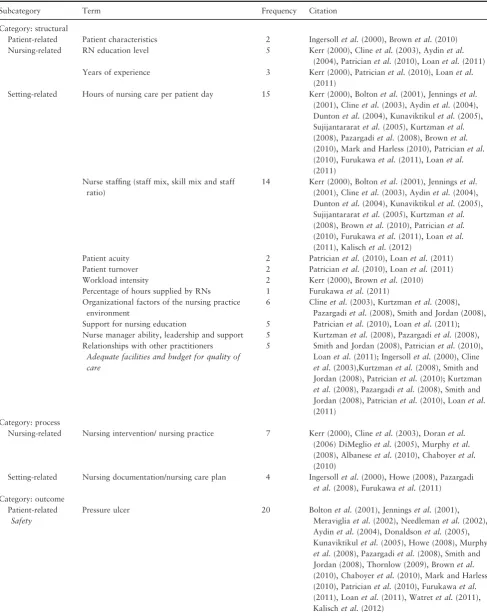
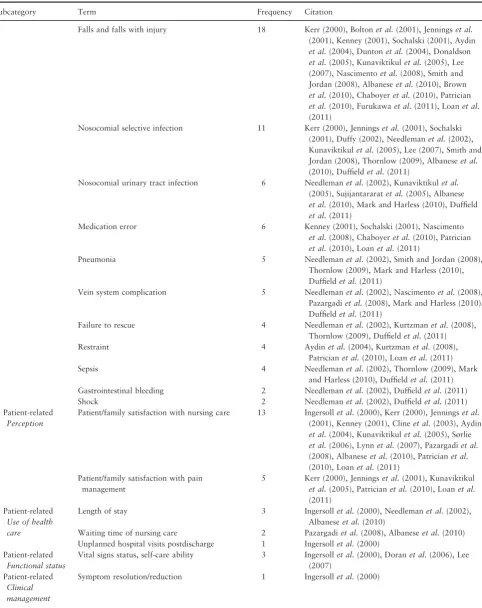
Table 1 lists the categories, terms and frequency counts of terms and shows the pattern of usage in the identified categories and subcategories. All terms were included, even if the term was used only once in the selected data source.
Structural terms
The structural terms identified included subcategory terms related to patients, nursing and setting. Patient-related structural terms were identified as ‘patient characteristic’. The term ‘patient characteristic’ generally refers to demo-graphics such as the patients’ gender, age and other vari-ables such as duration of hospitalization, the type of ward, and the type of procedure undertaken.
Nursing-related structural terms comprised Registered Nurses’ (RNs) ‘education level’ and ‘years of experience’. Setting-related structural terms included ‘hours of nursing care per patient day’, ‘nurse staffing’, ‘patient acuity’, patient turnover’, ‘workload intensity’, ‘percentage of hours supplied by RNs’, and ‘organizational factors of the nurse practice environment’ such as support for nursing educa-tion, nurse managers’ ability related to leadership and sup-port, relationships with other practitioners, and adequate facilities or budget for quality of care.
Process terms
Two subcategories were identified: nursing and setting. Nursing-related processes were denoted as ‘nursing inter-vention’ and/or ‘nursing practice’. A nursing intervention is described as any treatment based on a nurse’s clinical judg-ment and knowledge that is applied to enhance patient out-comes (McCloskey & Bulechek 2000). A setting-related process term referred to ‘nursing documentation’ and ‘nurs-ing care plan’.
Outcome terms
Three subcategories for outcome terms were identified. Terms for patient-related outcomes were the most frequent and were clustered according to a modified classification proposed by Jennings et al. (1999) and Doran (2011): safety, perception, use of health care, functional status and clinical management.
Patient-related safety was generally operationalized as adverse occurrences, which included prevalence of ‘pressure ulcer’, ‘falls and falls with injury’, ‘nosocomial selective infection’, ‘nosocomial urinary tract infection’, ‘medication error’, ‘pneumonia’, ‘vein system complication’, ‘failure to rescue’, ‘restraint’, ‘sepsis’, ‘gastrointestinal bleeding’ and ‘shock’; Patient-related perception included ‘patient/family
satisfaction with nursing care’ and ‘patient/family satisfac-tion with pain management’; Patient-related use of health care included ‘length of stay’, ‘waiting time of nursing care’ and ‘unplanned hospital visits postdischarge’; Patient-related functional status included ‘vital sign status and self-care ability’; Patient-related clinical management included ‘symptom resolution/reduction’. Nursing-related outcome terms identified included: ‘nursing satisfaction with job’ and ‘safety of nursing job’. Setting-related outcome terms included: ‘mortality’ and ‘nurse turnover’.
Attributes
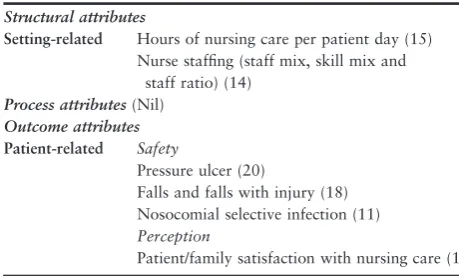
Attributes of a concept are the characteristics most fre-quently associated with the concept, appear repeatedly in reference to it and are necessary for theory building (Walker & Avant 2005). As no standard has been widely accepted for defining empirically derived attributes, a pro-visional criterion is proposed in this paper in keeping with the atypical approaches to conduct a concept analy-sis. In this analysis, attributes were operationalized as the terms that were frequently cited. The measure of fre-quency was operationalized as use of a term ‘more than 10 times’.
When this operation was applied, within the category ‘structural’, neither patient-related terms nor nursing-related terms had sufficient counts to meet the criterion, while ‘hours of nursing care per patient day’ (15) and ‘nurse staff-ing’ (14) remained in the setting-related subcategory. With regard to terms identified in the category ‘process’, none had sufficient counts. In the category ‘outcome’, only a lim-ited number of patient-related terms reached the cut-off point. They included safety-related terms and included prev-alence of ‘pressure ulcer’ (20), ‘falls and falls with injury’ (18), ‘nosocomial selective infection’ (11) and perception-related ‘patient/family satisfaction with nursing care’ (13). Interestingly, none of the terms identified in the nursing- or setting-related outcome indicators reached the cut-off point. These results are set out in Table 2.
Antecedents and consequences
Table 1 The matrix of categories, subcategories and frequency of terms used in NSIs concept analysis.
Subcategory Term Frequency Citation
Category: structural
Patient-related Patient characteristics 2 Ingersollet al.(2000), Brownet al.(2010)
Nursing-related RN education level 5 Kerr (2000), Clineet al.(2003), Aydinet al.
(2004), Patricianet al.(2010), Loanet al.(2011)
Years of experience 3 Kerr (2000), Patricianet al.(2010), Loanet al.
(2011)
Setting-related Hours of nursing care per patient day 15 Kerr (2000), Boltonet al.(2001), Jenningset al.
(2001), Clineet al.(2003), Aydinet al.(2004), Duntonet al.(2004), Kunaviktikulet al.(2005), Sujijantararatet al.(2005), Kurtzmanet al.
(2008), Pazargadiet al.(2008), Brownet al.
(2010), Mark and Harless (2010), Patricianet al.
(2010), Furukawaet al.(2011), Loanet al.
(2011) Nurse staffing (staff mix, skill mix and staff
ratio)
14 Kerr (2000), Boltonet al.(2001), Jenningset al.
(2001), Clineet al.(2003), Aydinet al.(2004), Duntonet al.(2004), Kunaviktikulet al.(2005), Sujijantararatet al.(2005), Kurtzmanet al.
(2008), Brownet al.(2010), Patricianet al.
(2010), Furukawaet al.(2011), Loanet al.
(2011), Kalischet al.(2012)
Patient acuity 2 Patricianet al.(2010), Loanet al.(2011)
Patient turnover 2 Patricianet al.(2010), Loanet al.(2011)
Workload intensity 2 Kerr (2000), Brownet al.(2010)
Percentage of hours supplied by RNs 1 Furukawaet al.(2011) Organizational factors of the nursing practice
environment
6 Clineet al.(2003), Kurtzmanet al.(2008), Pazargadiet al.(2008), Smith and Jordan (2008), Patricianet al.(2010), Loanet al.(2011); Kurtzmanet al.(2008), Pazargadiet al.(2008), Smith and Jordan (2008), Patricianet al.(2010), Loanet al.(2011); Ingersollet al.(2000), Cline
et al.(2003),Kurtzmanet al.(2008), Smith and Jordan (2008), Patricianet al.(2010); Kurtzman
et al.(2008), Pazargadiet al.(2008), Smith and Jordan (2008), Patricianet al.(2010), Loanet al.
(2011)
Support for nursing education 5
Nurse manager ability, leadership and support 5 Relationships with other practitioners
Adequate facilities and budget for quality of care
5
Category: process
Nursing-related Nursing intervention/ nursing practice 7 Kerr (2000), Clineet al.(2003), Doranet al.
(2006) DiMeglioet al.(2005), Murphyet al.
(2008), Albaneseet al.(2010), Chaboyeret al.
(2010)
Setting-related Nursing documentation/nursing care plan 4 Ingersollet al.(2000), Howe (2008), Pazargadi
et al.(2008), Furukawaet al.(2011) Category: outcome
Patient-related
Safety
Pressure ulcer 20 Boltonet al.(2001), Jenningset al.(2001),
Meravigliaet al.(2002), Needlemanet al.(2002), Aydinet al.(2004), Donaldsonet al.(2005), Kunaviktikulet al.(2005), Howe (2008), Murphy
et al.(2008), Pazargadiet al.(2008), Smith and Jordan (2008), Thornlow (2009), Brownet al.
(2010), Chaboyeret al.(2010), Mark and Harless (2010), Patricianet al.(2010), Furukawaet al.
Table 1 (Continued).
Subcategory Term Frequency Citation
Falls and falls with injury 18 Kerr (2000), Boltonet al.(2001), Jenningset al.
(2001), Kenney (2001), Sochalski (2001), Aydin
et al.(2004), Duntonet al.(2004), Donaldson
et al.(2005), Kunaviktikulet al.(2005), Lee (2007), Nascimentoet al.(2008), Smith and Jordan (2008), Albaneseet al.(2010), Brown
et al.(2010), Chaboyeret al.(2010), Patrician
et al.(2010), Furukawaet al.(2011), Loanet al.
(2011)
Nosocomial selective infection 11 Kerr (2000), Jenningset al.(2001), Sochalski (2001), Duffy (2002), Needlemanet al.(2002), Kunaviktikulet al.(2005), Lee (2007), Smith and Jordan (2008), Thornlow (2009), Albaneseet al.
(2010), Duffieldet al.(2011)
Nosocomial urinary tract infection 6 Needlemanet al.(2002), Kunaviktikulet al.
(2005), Sujijantararatet al.(2005), Albanese
et al.(2010), Mark and Harless (2010), Duffield
et al.(2011)
Medication error 6 Kenney (2001), Sochalski (2001), Nascimento
et al.(2008), Chaboyeret al.(2010), Patrician
et al.(2010), Loanet al.(2011)
Pneumonia 5 Needlemanet al.(2002), Smith and Jordan (2008),
Thornlow (2009), Mark and Harless (2010), Duffieldet al.(2011)
Vein system complication 5 Needlemanet al.(2002), Nascimentoet al.(2008), Pazargadiet al.(2008), Mark and Harless (2010), Duffieldet al.(2011)
Failure to rescue 4 Needlemanet al.(2002), Kurtzmanet al.(2008),
Thornlow (2009), Duffieldet al.(2011)
Restraint 4 Aydinet al.(2004), Kurtzmanet al.(2008),
Patricianet al.(2010), Loanet al.(2011)
Sepsis 4 Needlemanet al.(2002), Thornlow (2009), Mark
and Harless (2010), Duffieldet al.(2011) Gastrointestinal bleeding 2 Needlemanet al.(2002), Duffieldet al.(2011)
Shock 2 Needlemanet al.(2002), Duffieldet al.(2011)
Patient-related
Perception
Patient/family satisfaction with nursing care 13 Ingersollet al.(2000), Kerr (2000), Jenningset al.
(2001), Kenney (2001), Clineet al.(2003), Aydin
et al.(2004), Kunaviktikulet al.(2005), Sørlie
et al.(2006), Lynnet al.(2007), Pazargadiet al.
(2008), Albaneseet al.(2010), Patricianet al.
(2010), Loanet al.(2011) Patient/family satisfaction with pain
management
5 Kerr (2000), Jenningset al.(2001), Kunaviktikul
et al.(2005), Patricianet al.(2010), Loanet al.
(2011) Patient-related
Use of health care
Length of stay 3 Ingersollet al.(2000), Needlemanet al.(2002),
Albaneseet al.(2010)
Waiting time of nursing care 2 Pazargadiet al.(2008), Albaneseet al.(2010) Unplanned hospital visits postdischarge 1 Ingersollet al.(2000)
Patient-related
Functional status
Vital signs status, self-care ability 3 Ingersollet al.(2000), Doranet al.(2006), Lee (2007)
Patient-related
Clinical management
(GDP), a model of managed competition was introduced to form the basis of the Clinton administration’s healthcare reform plan during the 1990s (Costello 1995, Baldor 1996).
In reality, the implementation of the model in the compet-itive US healthcare environment became the driving force for the need to improve patient safety and contain costs. Outcome indicators, in general, were necessary to standard-ize measurements for internal and external comparisons. Hence, these organizational reconfigurations provided the impetus for the need to identify, develop and assess mea-sures to support nursing practice enhancements and perfor-mance strategies. Indeed, it was in the US that the concept of NSIs was first coined in 1996 (Harrington 2009).
The consequences of the concept of NSIs has meant that the development of NSIs as standardized nursing data ele-ments remains a critical and expanding area of research. Without nursing standardized data elements, researchers must rely on proxy measures to establish associations between nursing practice and workplace enhancements and their effects on patient outcomes. As discussed by Kurtzman and Corrigan (2007, p. 25), consensus standards on data elements have additional benefits as they are:
‘. . .intended for use by the public and other health care stakehold-ers to evaluate the extent to which and ways in which nurses in acute care hospitals contribute to patient safety, health care quality, and a professional work environment’.
Development of the concept of NSIs has meant that sig-nificant steps in nursing research have supported associa-tions, whether conclusive or not, between setting-related structural terms such as staffing and patient-related out-comes such as pressure ulcer. NSIs have been used to build robust nursing-sensitive databases that incorporate execu-tive and clinical reporting information systems (Donaldson
et al.2005, Aydinet al.2008). A consequence of the appli-cation and use of standardized NSIs is improved patient safety and workforce planning through enhanced knowl-edge that can specifically support decision-making (Aydin
et al. 2004). In the USA, the development of the NSIs has incorporated the use of common nursing data definitions and collection methodologies that has enabled nursing data to be compared across units, hospital regions and states (Pazargadi et al. 2008, Brown et al. 2010). This has led to public reporting of quality indicators likely to inform consumers’ hospitals choices, but also may assist busines-ses and insurers with their purchasing and reimbursement decisions.
Discussion
This analysis is positioned within quality dimensions of nursing care performance in the acute care setting where important relationships between the SPO model of Donabe-dian (1984) and other nursing models or frameworks are recognized (Needleman et al. 2007, Dubois et al. 2013). This Holzemer model-guided concept analysis has provided a synthesis of relevant primary research and has since revealed a helpful set of attributes. The defining attributes are not all-encompassing; rather this paper intends to offer a modest contribution to nursing science where the attributes Table 2 Attributes identified via the concept analysis*.
Structural attributes
Setting-related Hours of nursing care per patient day (15) Nurse staffing (staff mix, skill mix and
staff ratio) (14)
Process attributes(Nil)
Outcome attributes
Patient-related Safety
Pressure ulcer (20)
Falls and falls with injury (18) Nosocomial selective infection (11)
Perception
Patient/family satisfaction with nursing care (13)
*Cut-off point remains at 10. Table 1 (Continued).
Subcategory Term Frequency Citation
Nursing-related Nursing satisfaction with job 8 Ingersollet al.(2000), Kerr (2000), Jenningset al.
(2001), Best and Thurston (2004), DiMeglioet al.
(2005), Pazargadiet al.(2008), Patricianet al.
(2010), Duntonet al.(2007)
Safety of nursing job 3 Pazargadiet al.(2008), Patricianet al.(2010),
Loanet al.(2011)
Setting-related Mortality 2 Needlemanet al.(2002), Albaneseet al.(2010)
determined are measurable, observable or verifiable compo-nents of the concept.
Omission of process attributes
While the literature shows that refinements to the use and application of standardized nursing process measures have been the subject of recent research based on the SPO model (Endacottet al.2009, Jeffset al.2012), of note in the findings of this study was the omission of defining process attributes. Needleman et al. (2007) described nursing process measures as obscure. Nursing process measures have been proven to be very difficult to manage in primary research. Reviews con-ducted by Burneset al.(2007) and Savitzet al.(2010) found little evidence of research activity that measured the pairing of nursing process indicators and outcome indicators.
Confinement to the structural domain
Most of the attributes identified in this concept analysis were confined to the structural domain. One possible expla-nation may be that structural indicators are readily obtain-able from hospital administrative databases, which support their frequent use as data sources. As shown in a systematic review by Pearson et al. (2006), the breadth of empirical studies has a tendency towards the use of structural nurse staffing indicators. Hearld et al. (2008) concurred that structural indicators appeared to be overused and in their review of 58 studies they found a preponderance (63%) of structure-outcome pairings. Needleman et al. (2007) also highlighted the need for refined research processes to verify structural and outcome associations as conclusions are not always consistent. For example, a Belgian study exploring the associations between nurse staffing and selected patient outcomes at the hospital level did not confirm North Amer-ican findings that acute care hospitals with the most (or best trained) nursing staff have better patient outcomes than those with less (or worst trained) nursing staff (Van den Heedeet al.2008). Certainly, the evidence is conclusive that the collection of NSIs for translation in practice remains inherently appealing; nevertheless, there is a need for larger studies and cross-site comparisons to test associa-tions using existing frameworks (Clarke & Aiken 2008, Aikenet al.2009).
Implications for nursing knowledge development and theory building
Holzemer’s (1994) matrix was used to structure and show a pattern of use of terms as a precursor to determine
attributes; future research to inform quality dimensions of nursing care performance should continue to cement under-standings of interactions across SPO components with designs that specify and connect conceptual, theoretical and empirical study components, so that theoretical knowledge development may advance at a faster pace. As recom-mended by Doran et al. (2002) and Ausserhofer et al.
(2013), nursing research based on the SPO framework must consider methodological approaches that ensure adequate control of potentially confounding variables.
Implications for healthcare systems and nursing service improvement
The concept of NSIs has far-reaching implications for informing national health policies and, in particular, poli-cies related to an array of information system development associated with administrative activity, clinical activity, clinical management and business management including costing. It is known that data and information on perfor-mance are often tied, or inherently built into, administra-tive systems to support activity-based funding schemes where the data are used for hospital quality improvement initiatives (McNair et al. 2009, Duckett 2012). Yet nurs-ing-sensitive hospital data remain, to some extent, invisible within information systems, even when policy efforts have been directed to link quality and payment (Kavanaghet al.
2012).
The published literature concerning the safety and quality of health care attests that undesirable clinical behaviours persist without recourse to some sort of intervention (Doran et al.2006, Van Herck et al.2010, Nicholaset al.
2011). It has been established that meaningful quality mon-itoring information motivates health professionals to change practice and improve the quality and safety of clinical care if incentives are passed down to the service (Ryan 2009, Jha et al. 2012). Hence, the delivery of performance-based incentives directly to health professionals including nurses has received growing support on national quality and safety policy agendas (Eagar et al. 2012, Beck et al. 2013). Still, studies suggest that nurses, one of the largest groups of health professionals in acute care providing vital service at the bedside, are not particularly engaged with quality moni-toring activities due to the lack of meaningful data reported to them at the service level (Burhans & Alligood 2010, Clineet al.2011).
and phenomena of interest to its discipline and the refine-ment of conceptual terms including their attributes, proper-ties and dimensions. NSIs must be underpinned by efforts to develop common data standards and information system terminology, which are interoperable within national healthcare data systems. Attributes of NSIs have potential to interface and feature as performance measures within clinical quality information systems.
Study limitations
This concept analysis was limited to primary research data sources based upon a specified search strategy. Due to the evolving nature of the science on the topic of NSIs, the fre-quent use of surrogate terms and the limitations of database searching strategies, some relevant data sources may have been excluded. Nevertheless, all reference lists in selected articles were reviewed with an attempt to mitigate this limi-tation.
Risjord’s (2009) commentary on concept analysis has sought to strengthen its epistemological foundations as he argued that empirical justification should not be compro-mised. Risjord (2009) emphasizes that ‘gaps’ between ‘evi-dence and results’ are frequent in journal articles using concept analysis methodology, and that such gaps should be avoided to fulfil a complete understanding of the con-cept. With an attempt to minimize the limitations in previ-ous concept analysis studies, as noted by Risjord (2009), this concept analysis was predominately based upon data sources from primary research. However, no specific evalu-ative criteria were applied when choosing the primary research articles; this may have affected the validity of this analysis. Commonly known traditional methods including those of Walker and Avant (2005) provide little direction on how empirically derived attributes can be justified (Pen-rod & Hupcey 2005, Risjord 2009). As there has been no concrete guidance available in the literature to support vali-dation processes for the use and operationalization of empirical measurements to determine attributes in concept analysis, a cut-off point was introduced to establish a mea-sure of frequency based on supporting empirical evidence. Given that only a small number of attributes were revealed by the use of the cut-off point, not only does this suggest that the concept of NSIs is immature but also implies that the cut-off point itself presents as a limitation.
Considering that the science of nursing quality and per-formance is not static or concrete, but dynamic and evolv-ing, the attributes determined in this concept analysis, although more definitive than descriptive, are open to fur-ther review, interpretation and verification. In general, this
concept analysis remains largely a theoretical illustration to show where uses of the concept are embedded in evidence. These few structural and outcome attributes are offered as the most prevalent characteristics of the concept, given their frequent use in primary research.
Conclusion
This paper provides an analysis of the concept of NSIs where the need to develop a clear concept becomes ever more apparent on two key fronts: theory building for nurs-ing science in acute care and informnurs-ing the development of quality dimensions of healthcare information systems.
A theory comprises concepts, definitions and proposi-tions. A theory with clarified concepts ensures understand-ing of the theory itself, as well as the relationships among the concepts within the theory. Inroads have been made to progress understandings of the science of nursing quality and performance measurement (Needleman et al. 2007, Dubois et al.2013). A key finding of this concept analysis is the attributes identified, which may be justified at least to some extent by the evidence used to support their determi-nation.
The insufficient use and application of nursing process measures is another key finding of this study; hence, a concerted effort must now ensue for their development, refinement and standardization. Donabedian (2005) con-sidered the most direct approach to assess quality of care is an examination of the process of care itself. Doran
et al. (2006) noted that nursing process measures are, in the main, poorly conceptualized as standard measure-ments.
Doran (formerly known as Irvine) went on to use elements stemming from the SPO model to develop the Nursing Role Effectiveness Model (NREM) to support nursing-related quality improvement and clinical evaluation (Irvine et al. 1998). The NREM elaborates three distinct nursing role typologies in its process domain. It has been used to help understand and generate nursing process measures inherent to different nursing role requirements (Manojlovich 2005, Endacott et al. 2009, White et al.
2013). Other examples of clinical utilization of NREM include assessing the effectiveness of nursing interventions on patient outcomes in a general nursing setting (Morris
Nurses provide many services in acute care where NSIs have emerged as a substantive but partially immature con-cept. Often nursing services are neither properly understood by health service officials at many levels, nor appropriately communicated to them. Development of the concept of NSIs may illuminate the nature of nursing services and support nurses’ engagement with quality monitoring and reporting. With ongoing support from primary research, further refine-ment of this concept may also enhance theoretical knowl-edge that supports connections between clinical processes and the development of health information systems.
Acknowledgements
We thank Xiaoquan Xu, a doctoral candidate from the College of Health and Biomedicine, Victoria University, Melbourne, Australia, for her assistance with data collec-tion and for providing comments.
Funding
This research received no specific grant from any funding agency in the public, commercial, or not-for-profit sectors.
Conflict of interest
No conflict of interest has been declared by the authors.
Author contributions
All authors have agreed on the final version and meet at least one of the following criteria [recommended by the ICMJE (http://www.icmje.org/ethical_1author.html)]:
•
substantial contributions to conception and design, acquisition of data, or analysis and interpretation of data;•
drafting the article or revising it critically for important intellectual content.References
Aiken L.H., Clarke S.P. & Sloane D.M. (2002) Hospital staffing, organization, and quality of care: cross-national findings. International Journal for Quality in Health Care 14
(1), 5–13.
Aiken L.H., Buchan J., Ball J. & Rafferty A. (2008) Transformative impact of Magnet designation: England case study.Journal of Clinical Nursing17(24), 3330–3337.
Aiken L.H., Clarke S.P., Sloane D.M., Lake E.T. & Cheney T. (2009) Effects of hospital care environment on patient mortality
and nurse outcomes. Journal of Nursing Administration39(7–8 Suppl.), S45–S51.
Albanese M.P., Evans D.A., Schantz C.A., Bowen M., Disbot M., Moffa J.S. & Polomano R.C. (2010) Engaging clinical nurses in quality and performance improvement activities. Nursing Administration Quarterly34(3), 226–245.
American Nurses Association (1995)Nursing Care Report Card for Acute Care. American Nurses Publishing, Washington, DC. American Nurses Association (1996) Nursing Quality Indicators
-Definitions and Implications. American Nurses Publishing, Washington, DC.
Ausserhofer D., Schubert M., Desmedt M., Blegen M.A., De Geest S. & Schwendimann R. (2013) The association of patient safety climate and nurse-related organizational factors with selected patient outcomes: a cross-sectional survey.International Journal of Nursing Studies50(2), 240–252.
Aydin C.E., Bolton L.B., Donaldson N., Brown D.S., Buffum M., Elashoff J.D. & Sandhu M. (2004) Creating and analyzing a statewide nursing quality measurement database. Journal of Nursing Scholarship36(4), 371–378.
Aydin C.E., Bolton L.B., Donaldson N., Brown D.S. & Mukerji A. (2008) Beyond nursing quality measurement: the nation’s first regional nursing virtual dashboard. In Advances in Patient Safety: New Directions and Alternative Approaches (Vol. 1: Assessment) (Henriksen K., Battles J.B., Keyes M.A. & Grady M.L., eds), Agency for Healthcare Research and Quality, Rockville, MD. Retrieved from http://www.ncbi.nlm.nih.gov/ books/NBK43614 on 28 April 2013.
Baars I.J., Evers S.M.A.A., Arntz A. & Van Merode G.G. (2010) Performance measurement in mental health care: present situation and future possibilities.International Journal of Health Planning and Management25(3), 198–214.
Baldor R.A. (1996) Managed Care Made Simple. Blackwell Science, Cambridge, MA.
Baldwin M.A. (2008) Concept analysis as a method of inquiry.
Nurse Researcher15(2), 49–58.
Beck S., Weiss M., Ryan-Wenger N., Donaldson N., Aydin C., Towsley G. & Gardner W. (2013) Measuring nurses’ impact on health care quality: progress, challenges, and future directions.
Medical Care51(4 Suppl. 2), S15–S22.
Best M.F. & Thurston N.E. (2004) Measuring nurse job satisfaction.Journal of Nursing Administration34(6), 283–290. Blegen M.A., Goode C.J., Spetz J., Vaughn T. & Park S.H. (2011)
Nurse staffing effects on patient outcomes: safety-net and non-safety-net hospitals.Medical Care49(4), 406–414.
Bolton L.B., Jones D., Aydin C.E., Donaldson N., Brown D.S., Lowe M., McFarland P.L. & Harms D. (2001) A response to California’s mandated nursing ratios. Journal of Nursing Scholarship33(2), 179–184.
Brown D.S., Donaldson N., Burnes Bolton L. & Aydin C.E. (2010) Nursing-sensitive benchmarks for hospitals to gauge high-reliability performance.Journal for Healthcare Quality32(6), 9–17.
Burhans L.M. & Alligood M.R. (2010) Quality nursing care in the words of nurses. Journal of Advanced Nursing 66(8), 1689–
1697.
future research.Medical Care Research and Review64(2), 123– 143.
Burston S., Chaboyer W. & Gillespie B. (2013) Nurse-sensitive indicators suitable to reflect nursing care quality: a review and discussion of issues. Journal of Clinical Nursing 23(13–14), 1785–1795. doi: 10.1111/jocn.12337. [Epub ahead of print] Chaboyer W., Johnson J., Hardy L., Gehrke T. & Panuwatwanich K.
(2010) Transforming care strategies and nursing-sensitive patient outcomes.Journal of Advanced Nursing66(5), 1111–1119. Clarke S.P. & Aiken L.H. (2008) An international hospital
outcomes research agenda focused on nursing: lessons from a decade of collaboration. Journal of Clinical Nursing 17(24), 3317–3323.
Clarke S.P. & Donaldson N.E. (2008) Nursing staffing and patient care quality and safety. In Patient Safety and Quality: An Evidence-Based Handbook for Nurses (Hughes R.G., ed.), Agency for Healthcare Research and Quality, Rockville, MD. Retrieved from http://www.cochrane-handbook.org on 11 May 2012.
Cline D., Reilly C. & Moore J.F. (2003) What’s behind RN turnover?Nursing Management34(10), 50–53.
Cline D.D., Rosenberg M.C., Kovner C.T. & Brewer C. (2011) Early career RNs’ perceptions of quality care in the hospital setting.Qualitative Health Research21(5), 673–682.
Costello K. (1995) Managed care – the corporatization of healthcare.California Nurse91(6), 10–11.
DiMeglio K., Padula C., Piatek C., Korber S., Barrett A., Ducharme M., Lucas S., Piermont N., Joyal E., DeNicola V. & Corry K. (2005) Group cohesion and nurse satisfaction: examination of a team-building approach. Journal of Nursing Administration35(3), 110–120.
Donabedian A. (1984) Quality, cost, and cost containment.
Nursing Outlook32(3), 142–145.
Donabedian A. (2005) Evaluating the quality of medical care.
Milbank Quarterly83(4), 691–729.
Donaldson N., Brown D.S., Aydin C.E., Bolton M.L.B. & Rutledge D.N. (2005) Leveraging nurse-related dashboard benchmarks to expedite performance improvement and document excellence.
Journal of Nursing Administration35(4), 163–172.
Doran D.M. (2011)Nursing Outcomes: The State of the Science, 2nd edn. Jones & Bartlett Leaning, Sudbury, MA.
Doran D.M. & Sidani S. (2007) Outcomes-focused knowledge translation: a framework for knowledge translation and patient outcomes improvement. Worldviews on Evidence-Based Nursing
4(1), 3–13.
Doran D.I., Sidani S., Keatings M. & Doidge D. (2002) An empirical test of the Nursing Role Effectiveness Model. Journal of Advanced Nursing38(1), 29–39.
Doran D., Harrison M.B., Laschinger H., Hirdes J., Rukholm E., Sidani S., Hall L.M., Tourangeau A.E. & Cranley L. (2006) Relation between nursing interventions and outcome achievement in acute care settings. Research in Nursing & Health29(1), 61–70.
Doran D., Mildon B. & Clarke S. (2011) Towards a national report card in nursing: a knowledge synthesis.Canadian Journal of Nursing Leadership24(2), 38–57.
Dubois C.A., D’Amour D., Pomey M.P., Girard F. & Brault I. (2013) Conceptualizing performance of nursing care as a
prerequisite for better measurement: a systematic and interpretive review.BMC Nursing12(7), 1–20. doi:10.1186/1472-6955-12-7. Duckett S.J. (2012) Designing incentives for good-quality hospital
care.Medical Journal of Australia196(11), 678–679.
Duffield C., Diers D., O’Brien-Pallas L., Aisbett C., Roche M., King M. & Aisbett K. (2011) Nursing staffing, nursing workload, the work environment and patient outcomes.Applied Nursing Research24(4), 244–255.
Duffy J.R. (2002) Nosocomial infections: important acute care nursing-sensitive outcomes indicators. AACN Clinical Issues 13
(3), 358–366.
Dunton N., Gajewski B., Taunton R.L. & Moore J. (2004) Nurse staffing and patient falls on acute care hospital units. Nursing Outlook52(1), 53–59.
Dunton N., Gajewski B., Klaus S. & Pierson B. (2007) The relationship of nursing workforce characteristics to patient out-comes.Online Journal of Issues in Nursing12(3). Manuscript 3. Eagar K., Sansoni J., Loggie C., Elsworthy A., McNamee J., Cook
R. & Grootemaat P. (2012) A Review of Options for Iintegrating Quality into Hospital Pricing Systems. Centre for Health Service Development, Australian Health Services Research Institute, University of Wollongong, Wollongong, NSW. Endacott R., Eliott S. & Chaboyer W. (2009) An integrative review
and meta-synthesis of the scope and impact of intensive care liaison and outreach services.Journal of Clinical Nursing18(23), 3225–3236.
Fawcett J. (2012) Thoughts on concept analysis: multiple approaches, one result.Nursing Science Quarterly25(3), 285–287. Furukawa M.F., Raghu T.S. & Shao B.B. (2011) Electronic medical records, nurse staffing, and nurse-sensitive patient outcomes: evidence from the national database of nursing quality indicators.Medical Care Research and Review68(3), 311–331. Harrington L. (2009) Hardwriting nursing quality. Nurse Leader
7(2), 44–46.
Hearld L.R., Alexander J.A., Fraser I. & Jiang H.J. (2008) Review: how do hospital organizational structure and processes affect quality of care?: a critical review of research methods. Medical Care Research and Review65(3), 259–299.
Holzemer W.L. (1994) The impact of nursing care in Latin America and the Caribbean: a focus on outcomes. Journal of Advanced Nursing20(1), 5–12.
Howe L. (2008) Education and empowerment of the nursing assistant: validating their important role in skin care and pressure ulcer prevention, and demonstrating productivity enhancement and cost savings.Advances in Skin & Wound Care
21(6), 275–281.
Ingersoll G.L., McIntosh E. & Williams M. (2000) Nurse-sensitive outcomes of advanced practice.Journal of Advanced Nursing32
(5), 1272–1281.
Irvine D., Sidani S. & Hall L.M. (1998) Linking outcomes to nurses’ roles in health care. Nursing Economics 16(2), 58–64, 87.
Jennings B.M., Staggers N. & Brosch J.R. (1999) A classification scheme for outcome indicators.Journal of Nursing Scholarship
31, 381–388.
Jennings B.M., Loan L.A., DePaul D., Brosch L.R. & Hildreth P. (2001) Lessons learned while collecting ANA indicator data.
Journal of Nursing Administration31(3), 121–129.
Jha A.K., Joynt K.E., Orav E.J. & Epstein A.M. (2012) The long-term effect of premier pay for performance on patient outcomes.
Obstetrical and Gynecological Survey67(7), 391–393.
Kalisch B.J., Tschannen D. & Lee K.H. (2012) Missed nursing care, staffing, and patient falls.Journal of Nursing Care Quality
27(1), 6–12.
Kavanagh K.T., Cimiotti J.P., Abusalem S. & Coty M.B. (2012) Moving healthcare quality forward with nursing-sensitive value-based purchasing. Journal of Nursing Scholarship 44(4), 385– 395.
Kenney P.A. (2001) Maintaining quality care during a nursing shortage using licensed practical nurses in acute care.Journal of Nursing Care Quality15(4), 60–68.
Kerr P. (2000) Comparing two nursing outcomes reporting initiatives. Outcomes Management for Nursing Practice 4(3), 144–149.
Kobayashi H., Takemura Y. & Kanda K. (2011) Patient perception of nursing service quality; an applied model of Donabedian’s structure-process-outcome approach theory. Scandinavian Journal of Caring Sciences25(3), 419–425.
Kunaviktikul W., Anders R.L., Chontawan R., Nuntasupawat R., Srisuphan W., Pumarporn O., Hanuchareonkul S. & Hirunnuj S. (2005) Development of indicators to assess the quality of nursing care in Thailand.Nursing and Health Sciences7(4), 273–280. Kurtzman E.T. & Corrigan J.M. (2007) Measuring the
contribution of nursing to quality, patient safety, and health care outcomes.Policy, Politics & Nursing Practice8(1), 20–25. Kurtzman E.T., Dawson D.E. & Johnson J.E. (2008) The current
state of nursing performance measurement, public reporting, and value-based purchasing.Policy, Politics & Nursing Practice9(3), 181–191.
Lake E.T., Shang J., Klaus S. & Dunton N.E. (2010) Patient falls: association with hospital Magnet status and nursing unit staffing.
Research in Nursing & Health33(5), 413–425.
Lee B. (2007) Identifying outcomes from the nursing outcomes classification as indicators of quality of care in Korea: a modified delphi. International Journal of Nursing Studies 44(6), 1021–
1028.
Lindberg M. & Ludvigsen M.S. (2012) Ultrafiltration rate as a nursing-sensitive quality indicator in haemodialysis.International Journal of Nursing Studies49(10), 1320–1324.
Liu L.F., Lee S., Chia P.F., Chi S.C. & Yin Y.C. (2012) Exploring the association between nurse workload and nurse-sensitive patient safety outcome indicators. The Journal of Nursing Research20(4), 300–309.
Loan L.A., Patrician P.A. & McCarthy M. (2011) Participation in a national nursing outcomes database: monitoring outcomes over time.Nursing Administration Quarterly35(1), 72–81.
Lynn M.R., McMillen B.J. & Sidani S. (2007) Including the provider in the assessment of quality care: development and testing of the Nurses’ Assessment of Quality Scale– acute care version.Journal of Nursing Care Quality22(4), 328–336.
Maas M.L. & Delaney C. (2004) Nursing process outcome linkage research: issues, current status, and health policy implications.
Medical Care42(2), 1140–1148.
Makary M.A., Sexton J.B., Freischlag J.A., Millman E.A., Pryor D., Holzmueller C. & Pronovost P.J. (2006) Patient safety in surgery.Annals of Surgery243(5), 628–632.
Manojlovich M. (2005) Linking the practice environment to nurses’ job satisfaction through nurse-physician communication.
Journal of Nursing Scholarship.37(4), 367–373.
Mark B.A. & Harless D.W. (2010) Nurse staffing and post-surgical complications using the present on admission indicator.Research in Nursing & Health33(1), 35–47.
McCloskey J.C. & Bulechek G.M. (2000) Nursing Interventions Classification (NIC), 3rd edn. Mosby, Missouri, USA.
McNair P., Borovnicar D., Jackson T. & Gillett S. (2009) Prospective payment to encourage system wide quality improvement.Medical Care47(3), 272–278.
Meraviglia M., Becker H., Grobe S.J. & King M. (2002) Maintenance of skin integrity as a clinical indicator of nursing care.Advances in Skin & Wound Care15(1), 24–29.
Moers M., Schaeffer D. & Schnepp W. (2011) Too busy to think? Essay on the sparse, theories of the german nursing science.
Pflege24(6), 349–360.
Montalvo I. (2007) The National Database of Nursing Quality IndicatorsTM
(NDNQIâ).Online Journal of Issues in Nursing12
(3). Manuscript 2.
Morris R., Matthews A. & Scott A.P. (2014) Validity, reliability and utility of the Irish Nursing Minimum Data Set for General Nursing in investigating the effectiveness of nursing interventions in a general nursing setting: a repeated measures design.
International Journal of Nursing Studies 51(4), 562–571. doi:10.1016/j.ijnurstu.2013.07.011.
Morse J.M., Hupcey J.E., Mitcham C. & Lenz E.R. (1996) Concept analysis in nursing research: a critical appraisal.
Scholarly Inquiry for Nursing Practice10(3), 253–277.
Murphy T.H., Labonte P., Klock M. & Houser L. (2008) Falls prevention for elders in acute care: an evidence-based nursing practice initiative. Critical Care Nursing Quarterly 31(1), 33–
39.
Nascimento C.C.P., Toffoletto M.C., Goncßalves L.A., Freitas W.G. & Padilha K.G. (2008) Indicators of healthcare results: analysis of adverse events during hospital stays. Revista Latino-Americana de Enfermagem16(4), 746–751.
National Quality Forum (2004) National Voluntary Consensus Standards for Nursing Sensitive Care: An initial Performance Measure Set. Retrieved from http://mhdo maine.gov/imhdo/_ pdf/NQF-Nursing%20sensitive%20indicators.pdf on 12 May 2012
Naylor M.D. (2007) Advancing the science in the measurement of health care quality influenced by nurses.Medical Care Research & Review64(2 Suppl.), 144S–169S.
Needleman J., Buerhaus P., Mattke S., Stewart M. & Zelevinsky K. (2002) Nurse-staffing levels and the quality of care in hospitals. New England Journal of Medicine 346(22), 1715–
1722.
Needleman J., Kurtzman E.T. & Kizer K.W. (2007) Performance measurement of nursing care.Medical Care Research & Review
Needleman J., Buerhaus P., Pankratz V.S., Leibson C.L., Stevens S.R. & Harris M. (2011) Nurse staffing and inpatient hospital mortality.New England Journal of Medicine364(11), 1037–1045. Nicholas L.H., Dimick J.B. & Iwashyna T.J. (2011) Do hospitals
alter patient care effort allocations under pay-for-performance?
Health Services Research46(1 part 1), 61–81.
Paley J. (1996) How not to clarify concepts in nursing.Journal of Advanced Nursing24, 572–578.
Patrician P.A., Loan L., McCarthy M., Brosch L.R. & Davey K.S. (2010) Towards evidence-based management: creating an informative database of nursing-sensitive indicators. Journal of Nursing Scholarship42(4), 358–366.
Pazargadi M., Tafreshi M.Z., Abedsaeedi Z., Majd H.A. & Lankshear A.J. (2008) Proposing indicators for the development of nursing care quality in Iran. International Nursing Review55
(4), 399–406.
Pearson A., Pallas L.O., Thomson D., Doucette E., Tucker D., Wiechula R., Long L., Porritt K. & Jordan Z. (2006) Systematic review of evidence on the impact of nursing workload and staffing on establishing healthy work environments.International Journal of Evidence-Based Healthcare4(4), 337–384.
Penrod J. & Hupcey J.E. (2005) Concept advancement: extending science through concept driven research. Research and Theory for Nursing Practice19(3), 231–241.
Risjord M. (2009) Rethinking concept analysis. Journal of Advanced Nursing65(3), 684–691.
Rondinelli J.L., Omery A.K., Crawford C.L. & Johnson J.A. (2014) Self-reported activities and outcomes of ambulatory care staff registered nurses: an exploration. The Permanente Journal
18(1), e108–e115.
Ryan A. (2009) Hospital-based pay-for-performance in the United States.Health Economics18(10), 1109–1113.
Savitz L.A., Jones C.B. & Bernard S. (2010) Quality indicators sensitive to nurse staffing in acute care settings. InAdvances in Patient Safety: From Research to Implementation(Henriksen K., Battles J.B., Marks E.S. & Lewin D.I., eds), Agency for Healthcare Research and Quality, Rockville, MD. Retrieved from http://www.ahrq.gov/ downloads/pub/advances/vol4/Savitz.pdf on 12 May 2012.
Smith D.P. & Jordan H.S. (2008) Piloting nursing-sensitive hospital care measures in Massachusetts.Journal of Nursing Care Quality
23(1), 23–33.
Sochalski J. (2001) Quality of care, nurse staffing, and patient outcomes.Policy, Politics & Nursing Practice2(1), 9–18.
Sørlie V., Torjuul K., Ross A. & Kihlgren M. (2006) Satisfied patients are also vulnerable patients– narratives from an acute care ward.Journal of Clinical Nursing15(10), 1240–1246. Sujijantararat R., Booth R.Z. & Davis L.L. (2005) Nosocomial
urinary tract infection: nursing-sensitive quality indicator in a Thai hospital. Journal of Nursing Care Quality 20(2), 134– 139.
Thornlow D.K. (2009) Increased risk for patient safety incidents in hospitalized older adults. MEDSURG Nursing 18(5), 287– 291.
Tofthagen R. & Fagerstrøm L.M. (2010) Rodgers’ evolutionary concept analysis–a valid method for developing knowledge in nursing science. Scandinavian Journal of Caring Sciences 24
(Suppl. 1), 21–31.
Tvedt C., Sjetne I.S., Helgeland J. & Bukholm G. (2012) A cross-sectional study to identify organisational processes associated with nurse-reported quality and patient safety.BMJ Open2(6), 1–10.
doi:10.1136/bmjopen-2012-Van den Heede K., Sermeus W., Diyab L., Clarke S.P., Lesaffrebd E., Vleugels A. & Aiken L.H. (2008) Nurse staffing and patient outcomes in Belgian acute hospitals: cross-sectional analysis of administrative data.International Journal of Nursing Studies
46(7), 928–939.
Van Herck P., De Smedt D., Annemans L., Remmen R., Rosenthal M.B. & Sermeus W. (2010) Systematic review: effects, design choices, and context of pay-for-performance in health care.BMC Health Services Research10, 247.
Walker L.O. & Avant K.C. (2005) Strategies for Theory Construction in Nursing, 4th edn. Pearson Prentice Hall, Upper Saddle River, NJ.
Watret L., Middler F.M. & Wilson J. (2011) Challenges facing district nurses in the prevention of pressure ulcers. European Wound Management Journal11(3), 7–10.
White D.E, Jackson K., Besner J. & Norris J.M. (2013) The examination of nursing work through a role accountability framework.Journal of Nursing Management1–9. doi: 10.1111/
jonm.12186. [Epub ahead of print]
Wilson S., Bremner A.P., Hauck Y. & Finn J. (2013) Evaluation of paediatric nursing-sensitive outcomes in an Australian population using linked administrative hospital data.BMC Health Services Research13(1), 396. [Epub ahead of print]
Xyrichis A. & Ream E. (2008) Teamwork: a concept analysis.
TheJournal of Advanced Nursing (JAN)is an international, peer-reviewed, scientific journal.JANcontributes to the advancement of evidence-based nursing, midwifery and health care by disseminating high quality research and scholarship of contemporary relevance and with potential to advance knowledge for practice, education, management or policy.JANpublishes research reviews, original research reports and methodological and theoretical papers.
For further information, please visitJANon the Wiley Online Library website: www.wileyonlinelibrary.com/journal/jan
Reasons to publish your work inJAN:
• High-impact forum:the world’s most cited nursing journal, with an Impact Factor of 1·527–ranked 14/101 in the 2012 ISI Jour-nal Citation Reports©(Nursing (Social Science)).
• Most read nursing journal in the world:over 3 million articles downloaded online per year and accessible in over 10,000 libraries worldwide (including over 3,500 in developing countries with free or low cost access).
• Fast and easy online submission:online submission at http://mc.manuscriptcentral.com/jan. • Positive publishing experience:rapid double-blind peer review with constructive feedback.
•Rapid online publication in five weeks:average time from final manuscript arriving in production to online publication.