147 |
P a g e
www.ijarse.com
PERFORMANCE ANALYSIS OF AD-HOC ON
DEMAND DISTANCE VECTOR FOR MOBILE
AD-HOC NETWORK
Anjali Sahni
1, Ajay Kumar Yadav
21,2Department of Electronics and Communication Engineering,
Mewar Institute, Vasundhara, Ghaziabad-201012, (India)
ABSTRACT
Ad-hoc networks are characterized by a lack of infrastructure, and by a random and quickly changing network
topology; thus the need for a robust dynamic routing protocol that can accommodate such an environment.
Consequently, many routing algorithms have come in to existence to satisfy the needs of communications in such
networks. This paper presents a performance comparison between two categories of routing protocols,
table-driven (Proactive) and on-demand (Reactive) routing protocols, this two categories were illustrated by using
two different examples of routing protocols, first example is DSDV (Destination Sequenced Distance-Vector)
from the Proactive family and the second example is AODV (Ad Hoc On-Demand Distance Vector) from the
Reactive family. Both routing protocols were compared in terms of average throughput (packets delivery ratio)
and packet loss ratio, while varying number of nodes and by using the Trace file. Although DSDV perfectly
scales to small networks with low node speeds, AODV is preferred due to its more efficient use of bandwidth.
Keywords : MANET, DSDV, AODV, Proactive, Reactive
I INTRODUCTION
A Mobile Ad-Hoc Network (MANET) is a set of wireless mobile nodes which forms a temporary
infrastructure-less network and does communicate with each other and support de-centralized administration. Quick and easy
deployment of ad-hoc network makes them feasible to use in battlefield environments, disaster relief and
conference [1]. In MANET, nodes can move independently thus, each node function as a router and forward
packet. Due to high node mobility network topology changes frequently. Therefore, routing in ad-hoc network
becomes a more challenging task. The main aim of this paper is to compare the performance between two
categories of routing protocols, table-driven (Proactive) and on-demand (Reactive) routing protocols, this two
categories were illustrated by using two different examples of routing protocols, first example is DSDV
(Destination Sequenced Distance-Vector) from the Proactive family and the second example is AODV (Ad Hoc
On-Demand Distance Vector) from the Reactive family. Both routing protocols were compared in terms of
average throughput (packets delivery ratio) and packet loss ratio, while varying number of nodes and by using
148 |
P a g e
www.ijarse.com
II. DESCRIPTION FOR ROUTING PROTOCOL FOR AD-HOC NETWORK
2.1 Ad-Hoc on Demand Distance Vector (AODV)
The Ad-hoc On-demand Distance Vector routing protocol [2, 3, 4, and 5] is a reactive protocol that enables
multi-hop routing between the participating mobile nodes wishing to establish and maintain an ad-hoc network.
Different types of messages have been used in AODV to discover and maintain links. Whenever a node wants to
try and find a route to another node it broadcasts a Route Request (RREQ) to all its neighbors. The RREQ
propagates through the network until it reaches the destination or the node with a fresh enough route to the
destination. Then the route is made available by uncasing a RREP back to the source. The algorithm uses hello
messages (a special RREP) that are broadcasted periodically to the immediate neighbors. These hello messages
are local advertisements for the continued presence of the node, and neighbors using routes through the
broadcasting node will continue to mark the routes as valid. If hello messages stop coming from a particular
node, the neighbor can assume that the node has moved away and mark that link to the node as broken and
notify the affected set of nodes by sending a link failure notification (a special RREP) to that set of nodes.
2.2 Destination Sequence Distance Vector
In DSDV [6] routing messages are exchanged between neighboring mobile nodes. Routing updates are triggered
in case routing information from one of the neighbors forces a change in the routing table. The entry of data
packet for which the route to its destination is not known is cached while routing queries are sent out. The
packets are cached until route-replies are received from the destination. There is a maximum buffer size for
caching the packets waiting for routing information beyond which packets are dropped. The main contribution
of the algorithm was to solve the routing loop problem. Each entry in the routing table contains a sequence
number, the sequence numbers are generally even if a link is present; else, an odd number is used. The number
is generated by the destination, and the emitter needs to send out the next update with this number. Routing
information is distributed between nodes by sending full dumps infrequently and smaller incremental updates
more frequently. If a router receives new information, then it uses the latest sequence number. If the sequence
number is the same as the one already in the table, the route with the better metric is used. Stale entries are those
entries that have not been updated for a while. Such entries as well as the routes using those nodes as next hops
are deleted.
III. SIMULATION SETUP
For simulation we have used NS-2.34[7, 8] which is a discrete even simulator in the platform Linux Ubuntu
11.10. The performance measures which have been used for evaluating the performance of the two routing
protocols by using the Trace file and compare the results with different nodes number.
3.1 Packet Delivery Ratio
It is also called "Throughput", it is the rate at which a network sends or receives data. It is a good channel
capacity of network connections and rated in terms bits per second (bit/sec). Throughput (T p) = Pa / Pf, where
149 |
P a g e
www.ijarse.com
In this work, the throughput evaluation through two different ad-hoc wireless networks is done just to confirm
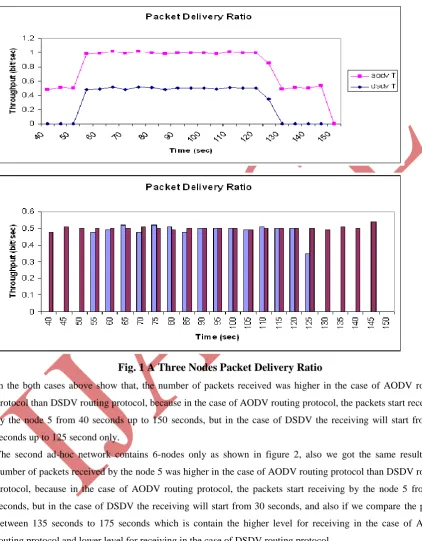
the results. The first ad-hoc wireless network contains 3-nodes only as shown in figure 1.
Fig. 1 A Three Nodes Packet Delivery Ratio
In the both cases above show that, the number of packets received was higher in the case of AODV routing
protocol than DSDV routing protocol, because in the case of AODV routing protocol, the packets start receiving
by the node 5 from 40 seconds up to 150 seconds, but in the case of DSDV the receiving will start from 55
seconds up to 125 second only.
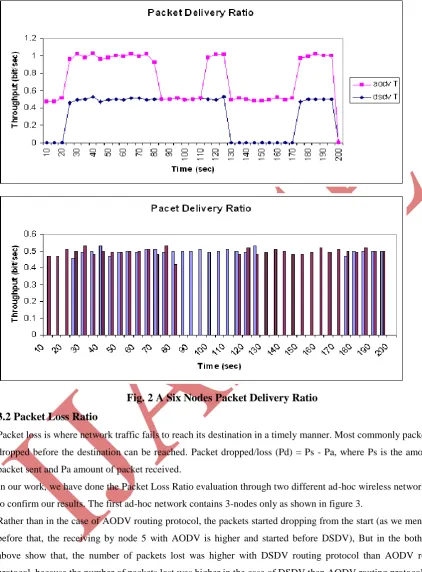
The second ad-hoc network contains 6-nodes only as shown in figure 2, also we got the same results, the
number of packets received by the node 5 was higher in the case of AODV routing protocol than DSDV routing
protocol, because in the case of AODV routing protocol, the packets start receiving by the node 5 from 10
seconds, but in the case of DSDV the receiving will start from 30 seconds, and also if we compare the period
between 135 seconds to 175 seconds which is contain the higher level for receiving in the case of AODV
150 |
P a g e
www.ijarse.com
Fig. 2 A Six Nodes Packet Delivery Ratio
3.2 Packet Loss Ratio
Packet loss is where network traffic fails to reach its destination in a timely manner. Most commonly packets get
dropped before the destination can be reached. Packet dropped/loss (Pd) = Ps - Pa, where Ps is the amount of
packet sent and Pa amount of packet received.
In our work, we have done the Packet Loss Ratio evaluation through two different ad-hoc wireless networks just
to confirm our results. The first ad-hoc network contains 3-nodes only as shown in figure 3.
Rather than in the case of AODV routing protocol, the packets started dropping from the start (as we mentioned
before that, the receiving by node 5 with AODV is higher and started before DSDV), But in the both cases
above show that, the number of packets lost was higher with DSDV routing protocol than AODV routing
151 |
P a g e
www.ijarse.com
Fig. 3 A Three Nodes Packet Loss Ratio
The second ad-hoc network contains 6-nodes only as shown in figure 4, and also we got the same results, the
number of packets lost was higher with DSDV routing protocol than AODV routing protocol, because in the
period between 85 seconds to 110 seconds contain higher level for dropping in the case of DSDV and lower
case for dropping in the case of AODV.
152 |
P a g e
www.ijarse.com
IV. CONCLUSION
The performance of DSDV (Destination Sequenced Distance-Vector) from the Proactive family with the second
type is AODV (Ad-hoc On-Demand Distance Vector) from the Reactive family is compared. To demonstrate
the performance characteristics of these protocols a detailed simulation model is used. By simulation it is noted
that if delay is the main criteria than DSDV can be the best choice but if reliability and throughput are main
parameters for selection then AODV gives better results compare to others because its throughput and packet
delivery ratio is best among others.
REFERENCES
[1] Chakeres AND C. Perkins: Dynamic MANET On-demand RoutingProtocol (DYMO), Internet Draft,
http: //tools.ietf. org/ html/draft-ietf-manet-dymo, work in progress, June 2008. RFC 4728
[2] S. Corson, and J. Macker, Mobile Adhoc Networking(MANET) , Routing Protocol Performance Issues and
Evaluation Considerations, RFC 2501, January 1999.
[3] S. Das, C. E. Perkins, E. Royer, “Ad Hoc On Demand Distance Vector (AODV) Routing”, IETF Draft, June
2002.
[4] Elizabeth M. Royer and Chai-Keong Toh, “A Review of Current Routing Protocols for Ad Hoc Mobile Wireless Networks”, IEEE Personal Communications, pages 46-55, April 1999.
[5] C.E. Perkins and E.M.Royer, “Ad-Hoc On Demand Distance Vector Routing”, Proceedings of the 2nd IEEE
Workshop on Mobile Computing Systems and Applications, New Orleans, LA, USA, pages 90-100,
February 1999.
[6] Perkins C. E. and Bhagwat P., “Highly Dynamic Destination-Sequenced Distance-Vector Routing (DSDV) for Mobile Computers”, SIGCOMM 94 -8/94 London England UK @ 1994 ACM 0-89791 -682-4/94/0008.
[7] “The network simulator– ns-2.” [Online]. Available: http: // www.isi.edu /nsnam /ns/ index.html
[8] K. Fall, and K.Vardhan, Eds., 1999, Ns notes and documentation, available from http://www .mash.cd
.berkeley .edu/ ns/.