Power Analysis Attacks against IEEE 802.15.4
Nodes
(Extended Version of COSADE 2016 Paper)
Colin O'Flynn and Zhizhang Chen
Dalhousie University, {coflynn, zchen}@dal.ca
Abstract. IEEE 802.15.4 is a wireless standard used by a variety of higher-level protocols, including many used in the Internet of Things (IoT). A number of system on a chip (SoC) devices that combine a radio transceiver with a microcontroller are available for use in IEEE 802.15.4 networks. IEEE 802.15.4 supports the use of AES-CCM* for encryption and authentication of messages, and a SoC normally includes an AES accelerator for this purpose. This work measures the leakage character-istics of the AES accelerator on the Atmel ATMega128RFA1, and then demonstrates how this allows recovery of the encryption key from nodes running an IEEE 802.15.4 stack. While this work demonstrates the at-tack on a specic SoC, the results are also applicable to similar wireless nodes and to protocols built on top of IEEE 802.15.4.
Keywords: AES, side-channel power analysis, DPA, IEEE 802.15.4
1 Introduction
IEEE 802.15.4 is a low-power wireless standard which targets Internet of Things (IoT) or wireless sensor network (WSN) applications. Many protocols use IEEE 802.15.4 as a lower layer, including ZigBee (which encompasses many dierent protocols such as ZigBee IP and ZigBee Pro), WirelessHART, MiWi, ISA100.11a, 6LoWPAN, Nest Weave, JenNet, IEEE 802.15.5, Thread, Atmel Lightweight Mesh, and DigiMesh. As part of the IEEE 802.15.4 standard a security suite based on AES is included, which allows encrypting and adding an authentication code on the wireless messages.
the higher-layer protocol decoder logic. With this ability an attacker can ex-ploit security aws in higher-layer protocol decoding logic, since the lower-layer messages will be successfully decrypted and presented to higher layers.
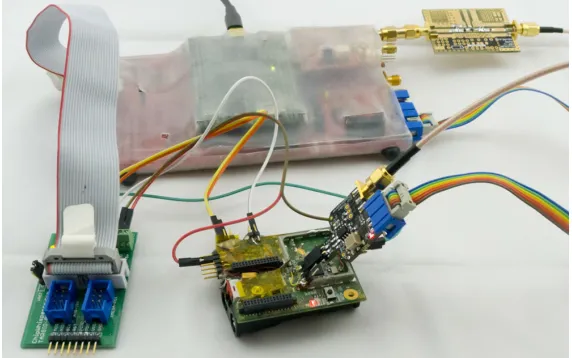
This paper presents an attack against a wireless node that uses the IEEE 802.15.4 protocol. We present the following important results from developing this attack: (1) an attack against the hardware AES engine in the Atmel AT-Mega128RFA1, (2) an attack on AES-128 in CCM* mode as used in IEEE 802.15.4 [1], (3) a method of causing the AES engine in the target device to perform the desired encryption, and (4) a shunt-based measurement method for devices with internal voltage regulators. This attack is validated with a hardware environment (shown in Fig. 1).
The attack demonstrated here uses side-channel power analysis [2], speci-cally a correlation-based attack [3]. We obtained the power measurements in this work by physically capturing a node and inserting a shunt resistor. In general, side-channel attacks can be performed with a noncontact electromagnetic (EM) probe instead, which does not require modication to the device [4]. The EM measurement typically achieves similar results to the resistive shunt [5,6].
This attack does not destroy the node under attack, and the node will con-tinue to function during the attack. This makes detection more dicult: although a node is captured, it still appears on the network. The feasibility of capturing wireless nodes and performing side-channel power analysis has previously been demonstrated against AES and ECC [7].
This previous demonstration was limited to software implementations of AES (i.e., not the actual hardware AES used by most nodes), and did not attack the AES-CCM* operating mode used by IEEE 802.15.4. Instead the attack in [7] assumed the encrypted data packet transmitted by the node allowed recovery of the last-round state of the AES algorithm. This is not the case in AES-CCM* used by IEEE 802.15.4 and most higher-layer protocols: recovering the last-round state would require a plaintext and ciphertext pair.
In practical scenarios the ability to capture a node, perform the attack, and return the node all within a short window reduces the risk of detection. The approach of [7] requires an attacker to passively wait for a transmissions to record power traces. While passively waiting is a reasonable approach for the 2060 traces required by [7] to break a software AES implementation, this could entail an unreasonably long wait period for the thousands of traces typically required to break a hardware AES peripherals [8]. Our work allows an attacker to rapidly force the operation to occur, and collecting 20 000 traces can be accomplished in 1560 minutes (depends on network stack and how much other trac node must process).
vul-nerable AES primitive as the IEEE 802.15.4 layer. Users of these protocols must carefully evaluate how the vulnerabilities detailed in this paper might apply to the higher-layer protocols.
We begin by describing the attack on the ATMega128RFA1 AES hardware peripheral in Section 2. Next, we look at specics of the use of AES encryption on the IEEE 802.15.4 wireless protocol in Section 3. This outlines the challenges of applying the side-channel attack to the AES-CCM* mode of operation, which is solved for the case of IEEE 802.15.4 in Section 4. Our application of this to a real IEEE 802.15.4 node is discussed in Section 5, and our conclusions follow.
2 ATMega128RFA1 Attack
Fig. 1. The ChipWhisperer capture hardware is used in this attack, although a regular oscilloscope will also work.
The Atmel ATMega128RFA1 is a low-power 8-bit microcontroller with an integrated IEEE 802.15.4 radio, designed as a single-chip solution for Internet of Things (IoT) or wireless sensor network (WSN) applications [9]. As part of the IEEE 802.15.4 radio module, a hardware AES-128 block is present, designed to work with the AES security specication of IEEE 802.15.4. Other examples of such chips (chips that include an IEEE 802.15.4 radio, microcontroller, and AES block) include devices from Freescale [10], Silicon Laboratories [11], STMi-croelectronics [12], and Texas Instruments [13].
2.1 Side-Channel Power Analysis
Side channel power analysis was rst reported in 1998 by Kocher et al [2]. When performing a side-channel power analysis attack on AES-128, we will be attacking the 16-byte encryption key, denoted k = {k0, k1,· · ·, k15}. We
assume the input plaintext value is known, the 16-byte plaintext being p =
{p0, p1,· · · , p15}. Finally, we also need to determine a sensitive value" in the
targeted operation.
For AES, one example of a sensitive value is the output of the S-box after a byte of the key has been XOR'd with a byte of the plaintext (i.e.,SBox(ki⊕pi)).
We use a leakage assumption" on the sensitive value, such as that the power consumption of the device depends on the Hamming weight (HW) of the sensitive value [3].
To perform the side-channel attack, we attack a single byte of the secret key,k, at a time. We do this by enumerating all possibilities for the byte being
attacked and calculating a hypothetical intermediate value along with a hypo-thetical leakage for each guess. Using a tool such as correlation power analysis (CPA) [3], we can compare the measured power traces to our hypothetical power traces.
Hopefully, one of the hypothetical power traces will have a large correlation with the measured power used by the device. Knowing the input values to the leakage model that resulted in the power trace with the largest correlation gives us the most likely values the real system was operating on. This requires us to perform the comparison against a number of traces if our model is very good and there is little system noise, it will take few traces for the output of the attack algorithm to determine the correct key. The CPA attack can break a software AES-128 implementation on an 8-bit microcontroller in fewer than 30 traces [14]. If our model is incorrect or the system noise is too high, the attack algorithm may not determine the correct key, even with millions of traces.
The CPA attack has parallels in other elds. Communications systems, for example, use a matched lter to match a received signal to one of several possi-ble candidates (called symbols) [15]. In image processing, the normalized cross-correlation is used to match a feature of an image [16]. Both of these are math-ematically equivalent to the CPA attack, demonstrating that the CPA attack is fundamentally an attempt to solve the same problem of matching a noisy signal with various possible candidates.
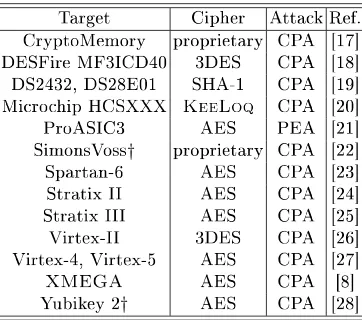
Side-channel power analysis has previously been used to break a variety of hardware devices. Table 1 summarizes published power analysis attacks against commercially available hardware cryptographic devices. This table does not in-clude software implementations running on commercially available hardware or hardware implementations that are not commercial products (i.e., research projects).
Table 1. Power analysis attacks against commercially available hardware crypto-graphic implementations. Entries marked with † indicate rmware-based implemen-tations, but still being commercially available.
Target Cipher Attack Ref. CryptoMemory proprietary CPA [17] DESFire MF3ICD40 3DES CPA [18] DS2432, DS28E01 SHA-1 CPA [19] Microchip HCSXXX KeeLoq CPA [20]
ProASIC3 AES PEA [21]
SimonsVoss† proprietary CPA [22]
Spartan-6 AES CPA [23]
Stratix II AES CPA [24] Stratix III AES CPA [25] Virtex-II 3DES CPA [26] Virtex-4, Virtex-5 AES CPA [27]
XMEGA AES CPA [8]
Yubikey 2† AES CPA [28]
be needed before applying the CPA attack. For example in the attack on the DESFire [18], a preprocessing technique realigned the traces before applying CPA.
There are more advanced attacks that use a template of the device leak-age [29]. Such a template does not use a leakleak-age model based on assumptions, but instead the leakage model is based on measurements of the target device as it performs known encryptions. This requires that the attacker has access to a device that closely matches the target device that they can manipulate or program.
While such template attacks are considerably more powerful being able to recover the encryption key with less measurements the CPA attack using a simple assumption is more versatile, since it only requires access to the sin-gle target device of interest. A device vulnerable to a CPA attack will always be vulnerable to a template attack, and it is almost certain that the template attack will improve the success rate further. For this reason, this work deals solely with the CPA attack, which also aligns this work with previous pub-lications of successful CPA attacks against commercially available encryption hardware [20,8,26,23,27,24,18,28,19,22,25].
This paper uses the partial guessing entropy (PGE) to measure the attack success. PGE provides an indicator of the reduction in search space for each of the 16 key bytes. A PGE of zero for every key byte indicates that a full encryption key was recovered. Details of this metric are given in Appendix 8.
rounds of the AES algorithm in Section 2.5; these later-round attacks are re-quired for the AES-CCM* attack.
2.2 Power Measurement
Power measurement can be typically performed by inserting a resistive shunt into the power supply of the target device, and measuring the voltage drop across the shunt. Because devices often have multiple power supplies (such asV CCcore,
V CCIO,V CCRF), the shunt must be inserted into the power supply powering
the cryptographic core. As with many similar IEEE 802.15.4 chips [10,11,12,13], the core voltage of the ATMega128RFA1 is lower (1.8 V) than the io voltage (typically 2.83.3 V) [9]. Since these chips are designed to operate from a single 3 V coin cell battery, the lower core voltage reduces power consumption, whereas the higher io voltage allows the device to operate directly from the coin cell.
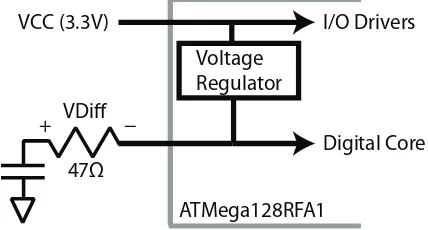
ATMega128RFA1 Voltage Regulator VCC (3.3V)
VDiff
+ −
47Ω
Digital Core I/O Drivers
Fig. 2. Because of the internal connection of the voltage regulator for the core voltage, the measurement shunt resistor must be mounted in the decoupling capacitor path.
To avoid requiring an external voltage regulator for the lower core voltage, most of these devices also contain an integrated 1.8 V voltage regulator. Some devices require an external connection from the regulator output pin to the V CCcorepin. With this type of device we could perform the power measurements
by either (a) inserting a shunt resistor between the output and input, or (b) using an external low-noise power supply with a shunt resistor (as in [7]). The ATMega128RFA1 is not such a device it internally connects the regulator to the V CCcorepin, but does require a decoupling capacitor placed on theV CCcorepin
(which also serves as the output capacitor for the voltage regulator). By inserting a shunt resistor into the path of the decoupling capacitor, we can measure high-frequency current owing into the V CCcore pin. Note that this measurement
will be fairly noisy, as we will also have noise from current owing out of the voltage regulator. This is shown schematically in Fig. 2.
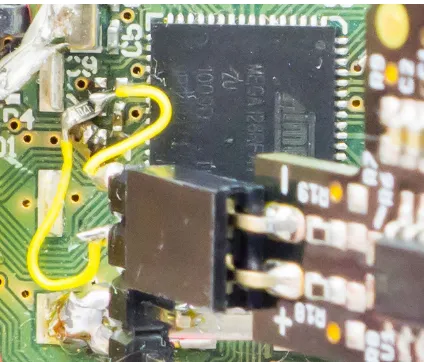
Fig. 3. A 0603-sized 47-ohm resistor was inserted into theV CCcore decoupling capac-itor, and a dierential probe is used to measure across this resistor.
regular oscilloscope are overlaid to provide an indication of the repeatability of the measurement.
Alternatively, an external power source can be fed into the V CCcore pin.
While this pin is not designed as an input, in practice if this voltage is slightly higher voltage than the internal regulator output setting, it will disable the in-ternal regulator. The inin-ternal regulator still contributes some noise to the power line even with this setup, as we observed little dierence in attack performance for the ATMega128RFA1 device comparing external VCC power and internal regulator.
2.3 Related Hardware Attack
To the authors' knowledge, the only previous published attack of an Atmel prod-uct with hardware AES acceleration was the XMEGA attack by Kizhvatov [8]. We used the XMEGA attack as a starting point, with the assumption that dif-ferent Atmel products may use the same internal AES design.
Kizhvatov determined that for a CPA attack on the XMEGA device, a vulner-able sensitive value was the Hamming distance between successive S-box input values. These input values are the XOR of the plaintext with the secret key that occurs during the rst AddRoundKey. This suggests a single S-box is implemented in hardware, with successive applications of the input values to the S-box.
Our notation considerspi andkito be a byte of the plaintext and encryption
key respectively, where 0 ≤ i ≤ 15. To determine an unknown byte ki, we
rst assume we know a priori the value of pi, pi−1, and ki−1. We discuss the
0.0 0.2 0.4 0.6 0.8 1.0 1.2
Time (
µS)
0.000.05 0.10 0.15
Po
we
r C
on
su
mp
tio
n
ATMega128RFA1 Power Trace
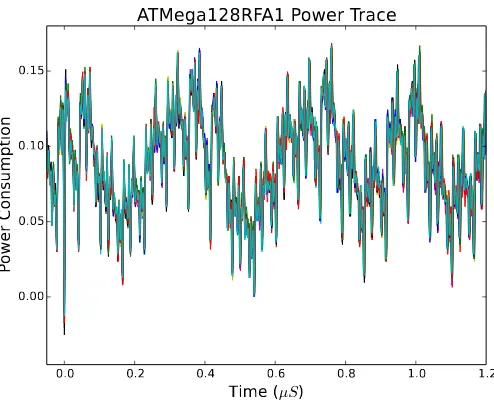
Fig. 4. This gure shows the power trace for the rst1.2µSof the AES-128 encryption. A total of ten such traces have been overlaid to demonstrate the consistent nature of the signal.
This allows us to perform a standard CPA attack, where the sensitive value is given by the Hamming weight of (1). That is to say the leakage for unknown encryption key byte iis: li = HW(bi). Provided k0 is known, this attack can
proceed as a standard CPA attack, with only 28 guesses required to determine
each byte.
bi= (pi−1⊕ki−1)⊕(pi⊕ki), 1≤i≤15 (1)
As suggested in [8], if k0 is unknown in practice, an attacker can simply
proceed with an attack for all 28 possibilities ofk0. The attacker may then test
each of the resulting 256 candidate keys to determine the correct value of k0.
This would entail a total of28×(28×15)guesses.
For the specic case ofk0, a more straightforward approach exists. The author
of [8] later determined that k0 can be determined directly by using a leakage
assumption based on the Hamming distance from the xed value 0x00. This leakage function is shown in (2).
l0=HW(b0) =HW(p0⊕k0) (2)
This allows the entire encryption key to be attacked with a total of16×28
guesses.1
1 This is not published in their paper, but was described in private communication
We now attempt to apply this attack to a dierent device, the ATMega128RFA1.
2.4 Application to ATMega128RFA1
Our experimental platform was a Dresden Elektronik radio board, model number RCB128RFA1 V6.3.1. As mentioned previously, power measurements were taken by inserting a resistor between theV CCcorepower pin and decoupling capacitor.
A dierential probe was used to measure the voltage across this resistor. Fig. 1 shows the complete capture setup.
To sample the power measurements, we used an open-source platform called the ChipWhisperer Capture Rev2 [14]. This capture hardware synchronizes its sampling clock to the device clock, and we congured it to sample at 64 MS/s (which is 4 times the ATMega128RFA1 clock frequency of 16 MHz).
To reduce noise in the power traces used for side-channel analysis, a band-pass lter with a band-passband of 314 MHz was inserted between the output of the dierential probe and the low-noise amplier input of the ChipWhisperer.
We implemented a simple test program in the ATMega128RFA1 that en-crypts data received over the serial port on the experimental platform. This encryption is done via either a software AES-128 implementation or the hard-ware AES-128 peripheral in the ATMega128RFA1. When using the hardhard-ware peripheral, the encryption takes25µsto complete, or about 400 clock cycles.
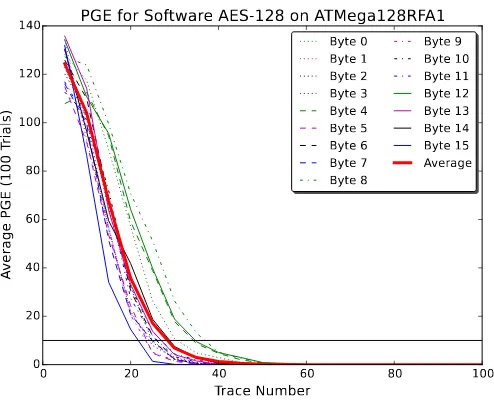
We used a standard correlation power analysis (CPA) attack [3], ranking the most likely byte as the one with the highest correlation values. To evaluate our measurement toolchain, we rst performed an attack against a software AES implementation on the ATMega128RFA1.
Fig. 5 shows the results of the CPA attack against the software AES-128 implementation: we recovered the complete key in under 60 traces. These results can be compared to similar attacks using the ChipWhisperer hardware, where a software AES implementation on an AVR microcontroller is broken in around 30 traces [14].
We then recorded a total of 50 000 power traces, where the ATMega128RFA1 was performing AES-128 ECB encryptions using random input data during the time each power trace was recorded. For each trace, 600 data points were recorded at a sampling rate2of 64 MS/s. Each trace therefore covered about the rst third of the AES encryption.
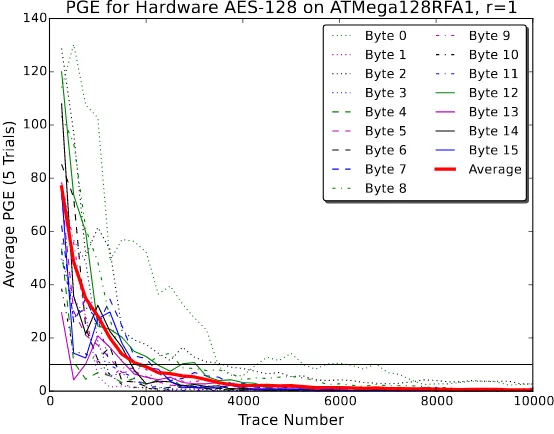
Our initial CPA attack was repeated ve times over groups of 10 000 traces. The resulting average partial guessing entropy for each byte is shown in Fig. 6. The rst byte (which uses the leakage assumption of (2)) has the worst perfor-mance, as the guessing entropy does not reach zero with 10 000 traces.
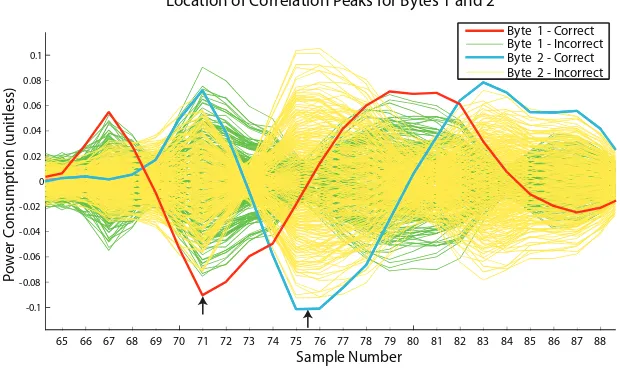
Examples of the correlation output vs. sample point are shown in Fig. 7, which shows the peaks at the output of the correlation function on the CPA
2 Note that this 64 MS/s sample rate is successful because the capture hardware
0 20 40 60 80 100
Trace Number
0 20 40 60 80 100 120 140
Av
era
ge
PG
E (
10
0 T
ria
ls)
PGE for Software AES-128 on ATMega128RFA1
Byte 0 Byte 1 Byte 2 Byte 3 Byte 4 Byte 5 Byte 6 Byte 7 Byte 8
Byte 9 Byte 10 Byte 11 Byte 12 Byte 13 Byte 14 Byte 15 Average
Fig. 5. Attacking a software AES algorithm on the ATMega128RFA1 is used to conrm that the measurement setup is a viable method of measuring the leakage. Here the PGE across all bytes falls to zero in under 60 traces, completely recovering the key.
attack for the correct" key guess. The sign of the peak is not important the sign will ip depending on probe polarity but note that the correct key guess results in a larger magnitude correlation than the incorrect guess at certain points. These points are when the physical hardware is performing the operation in (1).
Guessing of ki−1 This attack used the leakage (2) of the rst byte i= 0 to
bootstrap the key recovery. Once we know this byte, we can use (1) to recover successive bytes.
Practically, we may have a situation wherei−1is not recoverable. Previous
work assumed either some additional correlation peak allowing us to determine i−1, or the use of a brute-force search across all possibilities of the bytei−1[8].
We can improve on this with a more ecient search algorithm, described next. The leakage function (1) could be rewritten to show more clearly that the leaked value depends not on the byte values, but on the XOR between the two successive bytes, as in (3).
bi= (ki−1⊕ki)⊕(pi−1⊕pi), 1≤i≤15 (3)
The side-channel attack can be performed with the unknown byte ki−1 set
the value that has to be XOR'd with the previous byte to generate the correct byte.
The 256 candidate keys can then be generated with almost no computational work, by iterating through each possibility for the unknown byteki−1, and using
the XOR values recovered from the CPA attack to generate the remaining byte valueski, ki+1,· · ·, kI.
This assumes we are able to directly test those candidate keys to determine which is the correct value. As is described in the next section, we can instead use a CPA attack on the next-round key to determine the correct value ofki−1.
0 2000 4000 6000 8000 10000
Trace Number
0 20 40 60 80 100 120 140
Av
era
ge
PG
E (
5 T
ria
ls)
PGE for Hardware AES-128 on ATMega128RFA1, r=1
Byte 0 Byte 1 Byte 2 Byte 3 Byte 4 Byte 5 Byte 6 Byte 7 Byte 8
Byte 9 Byte 10 Byte 11 Byte 12 Byte 13 Byte 14 Byte 15 Average
Fig. 6. The CPA attack on the hardware AES peripheral reduces the guessing entropy to reasonable levels in under 5000 traces, and is able to recover the key in around 10 000 traces.
2.5 Later-Round Attacks
Whereas our work so far has been concerned with determining the rst-round encryption key, we will see in Section 4 that information on the round keys used during intermediate rounds is also required.
We determined that for intermediate rounds the leakage assumption of (1) and (2) still holds, where the unknown byte ki is a byte of the round key, and
70 80
66 68 72 74 76 78 82 84 86 88
65 67 69 71 73 75 77 79 81 83 85 87
Sample Number
-0.1 0 0.1
-0.08 -0.06 -0.04 -0.02 0.02 0.04 0.06 0.08
P
o
w
er C
onsumption (unitless)
Location of Correlation Peaks for Bytes 1 and 2
Byte 2 - Correct Byte 1 - Correct
Byte 2 - Incorrect Byte 1 - Incorrect
Fig. 7. Correlation peaks for byte i= 1and i= 2. The incorrect guess" means the 28−1guesses which are not the value ofki. The sample number refers to the sample points since start of the encryption operation, again sampling at 64 MS/s.
our notation such that the leakage from round rbecomes lri =HW(bri), where
each byte of the round key iskri, and the input data to that round ispri. Examples of the PGE when attacking the start of the third round (r= 3)
are given in Fig. 8. The entropy change for all rounds tested (r= 1,2,3,4) was
similar.
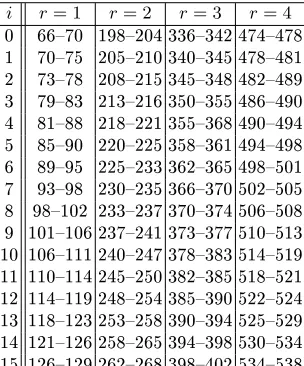
For details of the execution time of the hardware AES implementation, refer to Table 2. This table shows the samples used for each byte in determining the most likely encryption key for the rst four rounds. For byte 0 (the rst byte), (2) is the sensitive operation. For later bytes (1) is the sensitive operation.
Note the sample rate is four times the device clock, and in Table 2 the sample delta from start to end of the sensitive operations within each round is about 64 samples, or 16 device clock cycles. This suggests that a sensitive operation is occurring on each clock cycle. Each round takes approximately 3234 cycles based on the repeating nature of the leakages in intermediate rounds.
Determiningki−1Using Intermediate Rounds As described in Section 2.4,
we can perform the CPA attack on bytekiwhereki−1is unknown by determining
not the value of the byte, but the XOR of each successive byte with the previous key. This means performing the attack rst whereki−1 is assumed to be 0x00.
By then enumerating all28 possibilities fork
i−1, we can quickly generate28
0 2000 4000 6000 8000 10000
Trace Number
0 20 40 60 80 100 120
Av
era
ge
PG
E (
5 T
ria
ls)
PGE for Hardware AES-128 on ATMega128RFA1, r=3
Byte 0 Byte 1 Byte 2 Byte 3 Byte 4 Byte 5 Byte 6 Byte 7 Byte 8
Byte 9 Byte 10 Byte 11 Byte 12 Byte 13 Byte 14 Byte 15 Average
Fig. 8. Attacking intermediate rounds in the AES peripheral is also successful using the same leakage assumptions as the rst-round attack.
Table 2. A small range of points is selected from each trace, corresponding to the location of the device performing (2) for i = 0, or (1) for i ≥ 1. The variable r corresponds to the AES round being attacked, andiis the byte number.
i r= 1 r= 2 r= 3 r= 4
If we knew the initial (rst-round) key, we could determine the input to the second round, and thus perform a CPA attack on the second-round key. Instead we have 256 candidates for the rst round (r= 1), and want to determine which
of those keys is correct before proceeding.
To determine which of the keys is correct, we can perform a CPA attack on the rst byte of the second round,k2
0, repeating the CPA attack 256 times, once
for each candidate rst-round key.
The correlation output of the CPA attack will be low for all guesses of k2 0
where k1 is wrong, and only for the correct guess ofk2
0 and k1 will there be a
peak.
This technique will be used in Section 4.1, where we cannot test candidate keys as we are not recovering the complete key.
3 IEEE 802.15.4 Security
IEEE 802.15.4 is a low-power wireless standard, sending short data packets of up to 127 bytes at bit-rate of 250 kbit/s. Devices running IEEE 802.15.4 can achieve extremely low power consumption, running for years on a small bat-tery [30]. When we refer to IEEE 802.15.4," we are specically targeting the IEEE 802.15.4-2006 standard.
The IEEE 802.15.4 standard is generally used as a lower layer with another network on top, as IEEE 802.15.4 does not specify details such as routing or dis-tribution of keying material. Examples of popular higher-layer protocols include ZigBee and ISA100.11a (see Section 1 for a full enumeration). These higher-layer protocols often use IEEE 802.15.4 level security in combination with higher-level security but this higher-layer security frequently uses the cryptographic prim-itives provided by IEEE 802.15.4. This paper demonstrates the vulnerabilities of these primitives, and those vulnerabilities may also exist in higher-layer pro-tocols.
The IEEE 802.15.4 standard uses AES-128 as the basic building block for both encryption and authentication of messages. The standard denes a mode of operation called CCM*, which extends the regular CCM mode by allowing the use of encryption without authentication [1].
CCM itself is a combination of counter mode of AES with cipher block chain-ing message authentication code (CBC-MAC) [31]. For the side-channel attack, we are only concerned with the details of data passed to the AES-128 block, and not the further processing that occurs after this block.
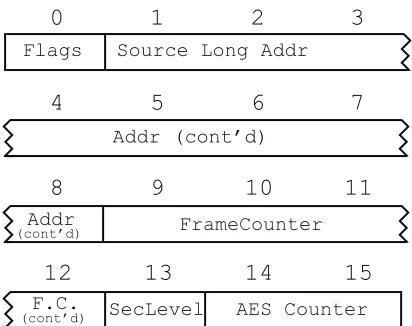
The AES-128 block itself is used in AES-CTR mode, with an input format as shown in Fig. 9. The rst 14 bytes are the nonce, and the last two bytes are the AES-CTR mode counter. Each received frame must use a new nonce, as the counter itself only counts the number of 16-byte blocks in the frame.
Flags
0
1
2
3
4
5
6
7
8
9
10
11
12
13
14
15
Source Long Addr
Addr (cont’d)
Addr FrameCounter
F.C. SecLevel AES Counter
(cont’d)
(cont’d)
Fig. 9. The following data is used as the input to AES-128 when a frame is decrypted by an IEEE 802.15.4 stack. The FrameCounter can be controlled by the attacker.
A typical secure IEEE 802.15.4 wireless packet adds a message authentica-tion code (MAC),3 which ensures both the integrity and authenticity of this message. The MAC and payload can optionally be encrypted. Although the MAC is optional, conguring nodes to require a MAC is generally recommended, since accepting encrypted but unauthenticated packets presents a serious secu-rity risk [32].
The address and header information are never encrypted. This is mostly because it signicantly simplies message ltering: otherwise nodes would need to decrypt every message to determine the address information.
On receiving a packet, the IEEE 802.15.4 layer rst returns an acknowledg-ment to the sender. If the packet has security enabled (it is encrypted or simply has a MAC appended) the following operations are performed on the received packet, where processing stops if a step fails:
1. Validate headers and security options.
2. Check that the received frame counter is numerically greater than the last stored frame count.
3. Look up the secret key based on message address and/or key index. 4. Decrypt the payload (and MAC if present).
5. Validate the MAC (if present). 6. Store the frame counter.
For our side-channel attack we only care that step 4 is performed; this means our packet must successfully pass through steps 13. This requires that the
3 The name message integrity code (MIC) is used in place of message
packet is properly addressed and has an acceptable security conguration, such as using a valid key identier and address. Generating such a message is discussed next.
3.1 Detailed Message Format
As mentioned, we need to ensure our 802.15.4 message is decrypted by the target device. Specic requirements vary depending on the network conguration, but as an example the frame used in our experiments was:
09 d8 01 ff ff ff ff ba ad 01 02 03 04 05 06 07 08 0d FC FC FC FC 01 AA AA AA AA AA AA AA AA AA AA AA AA AA AA AA AA AA AA AA AA 00 00
Where details of each portion of the frame are described as follows:
09 d8 Frame header
01 Sequence number
ff ff ff ff Broadcast frame ba ad Source network ID 01 02 · · · 08 Source address 0d Security level
FC FC FC FC FrameCounter used as part of the AES nonce
01 Key ID
AA AA · · · AA 16 bytes of encrypted data and 4 bytes of MAC 00 00 Replace with CRC-16
The encrypted data and MAC are not used in the attack; only the value of the FrameCounter is used. The attacker can send a frame with random values inserted into the FrameCounter; they only need to ensure the random values are larger than the last valid received value.
Since the attacker's packets will be rejected as invalid once decrypted, the attacker will not update the internal frame counter eld. An attacker could dis-cover the approximate current FrameCounter value through sning valid packets sent to the device, since the frame counter is sent unencrypted.
Alternatively, an attacker can simply send very high values the attacker could ensure the highest two bits are always 10, 01, or 11. Provided the node has received fewer than a billion messages using the same key, this frame counter will be accepted.
They might assume either this node is malfunctioning, or the node is using some proprietary protocol that sends encrypted broadcast messages.4
3.2 Brute-Force Search
In Section 2.1, the side-channel attack is described as not always fully recovering the encryption key. This necessitates a key search, which requires a comparison function such as having a plaintext/ciphertext pair.
For IEEE 802.15.4, any message with a MAC present can be used as this plaintext/ciphertext pair. It is sucient for the attacker to sni a single wireless message secured with a MAC using the target key; the attacker can then use a given hypothetical key to calculate the hypothetical MAC, and compare the resulting MACs to determine if the hypothetical key matches the true key.
This attack is trivial in practice: most networks using 802.15.4 security have message authentication enabled (i.e., messages have MACs) [32], so the attacker can simply capture a packet directed at or sent from the target. As the MAC may be shorter than the key, they may wish to capture several packets to conrm the true key was found, and not a collision for this particular message.
4 Application to AES-CCM* Mode
For a standard CPA attack, we require the ability to cause a number of en-cryption operations to occur with known plaintext or ciphertext material. In addition, the data being encrypted must vary between operations, as otherwise each trace will generate the same hypothetical intermediate values during the search operation of the CPA attack.
From Section 3 and Fig. 9, we know that a number of the bytes are xed during the AES encryption operation. Practically all the bytes except for the FrameCounter are considered xed in this attack. The Flags and SecLevel bytes will have constant (and known) values. Initially it would appear that the Source Long Address and AES Counter elds may vary, but as we discuss next, this is not the case.
The Source Long Address eld comes from internal tables in the 802.15.4 stack containing keying material, and is not simply copied blindly from the incoming packet address. This eld can be considered eectively xed. The AES Counter eld changes during operation, as it increases for each 16-byte block encrypted in AES-CCM* mode. But as the IEEE 802.15.4 packet is limited to a total of 127 bytes, the AES Counter eld could never exceed 0x0007. Thus, between these 10 bytes, at most 3 bits vary during operation.
We instead rely on the ability of the attacker to control the FrameCounter eld to mount a successful attack on an IEEE 802.15.4 wireless node. For
4 Sending a data message that is broadcast across both the network ID and device
our work we will assume an attack on the rst encryption operation when a packet is received, meaning the AESCounter eld is also xed. The sent value of FrameCounter must simply be higher than a previously accepted value, which can either be determined by passive listening, or the most signicant bit(s) can simply be set high to guarantee values which are likely to be accepted.
4.1 Previous AES-CTR Attacks
The AES-CCM* mode used by IEEE 802.15.4 is a combination of CBC-MAC and CTR modes of operation. Our attack is on the AES-CTR portion of the algorithm, with some modications to reect the use of a frame counter for the nonce material.
Previous work on AES-CTR mode has focused on the assumption that we can cause a number of encryptions to occur in sequence (i.e., with increasing counter number), but with unknown but constant nonce material [33]. Our work uses many of the constructs developed by Jae in [33], but with dierent assump-tions of inputs on the AES block and a dierent leakage model. These dierences necessitate the development of new techniques to recover partial keying infor-mation, and we cannot simply apply the previous attack directly.
In our case, we have the ability to change 4 bytes of the input plaintext (bytes 9, 10, 11, and 12). The CPA attack only allows us to recover these four bytes of the key, as the keying material associated with bytes 912 can be recovered by a standard CPA attack using the leakage model identied in Section 2. The remaining bytes cannot be recovered, as the input data is constant, and hence our leakage target of the dierence between S-Box inputs is also constant.
Consider the steps in the AES-ECB encryption algorithm:AddRoundKey(), SubBytes(), Shif tRows(), and M ixColumns(). All four functions can be
as-sumed to operate on a 16-byte AES state matrix. The rst three operate in a byte-wise manner that is, a single-byte change of the state matrix before the op-eration results in a single-byte change after the opop-eration. TheM ixColumns()
operation introduces diusion, which operates on a column of the AES state a single-byte change in the AES state results in 4 bytes changing after the M ixColumns()operation.
For the M ixColumns() operation, we can represent the four input bytes
one column of the state matrix with s0,· · ·, s3, and the resulting output
bytes with S0,· · ·, S3. The M ixColumns() operation uses multiplication over
the Galois eld GF(28), where we represent this multiplication operation with
the symbol ◦". TheM ixColumns()operation then becomes:
S0= (2◦s0)⊕(3◦s1)⊕s2 ⊕s3 (4)
S1=s0 ⊕(2◦s1)⊕(3◦s2)⊕s3 (5)
S2=s0 ⊕s1 ⊕(2◦s2)⊕(3◦s3) (6)
Where the input state to theM ixColumns()operation was the AES state
after the Shif tRows()operation. The output of theM ixColumns()operation
is used as the input state for the next round.
Constant Inputs For the M ixColumns() operation, we can lump all xed
input bytes into a single constant. As described in [33], if bytess1, s2, s3 of the
input were xed, we could rewrite (4)(7) as:
S0= (2◦s0)⊕E0 (8)
S1=s0 ⊕E1 (9)
S2=s0 ⊕E2 (10)
S3= (3◦s0)⊕E3 (11)
Note that these bytes are constant but unknown. This occurs because al-though we do know the xed plaintext input bytes (i.e., the nonce), we do not know the keying material used for those bytes. These outputs will become the inputs to the next round of the AES algorithm.
Again using the method from [33], our objective is now to recover the next-round key. Consider that we have gone through one next-round of AES, and our objective is to recover the second-round key. We do not know the actual input data for this round, which is the output of the M ixColumns() step from the
previous round. For example, to recover the rst key byte k0, we would need
to know the output S0 from M ixColumns(). If some of the input bytes to
M ixColumns()are xed but unknown, we would instead recover the modied
outputS00.
Performing the CPA attack, we could recover instead a version of this key (we will refer to it ask00) XOR'd with the unknown constantE0, that isk00=k0⊕E0.
We can use this modied key as one input to the AddRoundKey() function,
where the other input is our modied input to this round S00. Note that the output ofAddRoundKey()will be equivalent to the case where we had both the
true key and true input:
AddRoundKey(k00, S00) =k00 ⊕S00
= (k0⊕E0)⊕(S0⊕E0)
=k0⊕S0
This is sucient information to perform the attack on the next round of the AES algorithm. Thus, if the entire modied version of a key can be recovered for a given encryption round, we can recover the entire unmodied key by attacking the next encryption round. This unmodied key can then be rolled backwards using the AES key schedule.
Description of Attack We describe the attack by working through a symbolic example, using the following variables:
pr
i :text" input toAddRoundKey() X :variable and known inputs
kr
i :key" input toAddRoundKey() Y :variable and known intermediates
Er
i :a constant, see Section ?? Z :variable and known intermediates
nr
i :the modied round key,kri ⊕Eri c :constant values sr
i :the output ofSubBytes() ? :variable and unknown values
vr
i :the output ofShif tRows() N :known modied round-key values (n
r i) mr
i :the output ofM ixColumns() K :known key or round-key values (k
r i) X* :group of variables which has a small set of candidates for the correct value
Initially, we have the known input plaintext, where 12 of the bytes are con-stant, and the 4 variable bytes are under attacker control (FrameCounter):
p1 = [c c c c c c c c c X X X X c c c]
From this, we can perform a CPA attack to recover 4 bytes of the key. Note that in practice the bytek91cannot be recovered becausek18is unknown. Instead we use the technique detailed in Section 2.5 to generate 256 candidate keys for k19,· · ·, k112, and test them at a later step. This means we can assume the
fol-lowing is the state of our initial-round key:
r1 = [c c c c c c c c c K*K*K*K* c c c]
This can be used to calculate the output of theSubBytes()andShif tRows()
functions, where the majority of bytes are constant (but unknown):
s1 = [c c c c c c c c c Y*Y*Y*Y* c c c ] v1 = [c c Y* c c Y* c c c c c c Y* c c Y*]
At this point we need to symbolically deal with theM ixColumns(v1)
out-put, as we will be working with the modied output that has been XOR'd with the constantEdescribed in Section 4.1. As in [33], this is accomplished in practice by setting unknown constants c to zero, and calculating the output of theM ixColumns(v1)function. The unknown constants are all pushed into the
variableE, which we never need to determine the true value of. This means our output of roundr= 1becomes:
m1 = [Z*Z*Z*Z*Z*Z*Z*Z* c c c c Z*Z*Z*Z*]
p2 = [Z*Z*Z*Z*Z*Z*Z*Z* 0 0 0 0 Z*Z*Z*Z*]
We are not able to recover n2
8,· · ·, n211 yet, as the inputs associated with
those key bytes are constant.
We rst attempt to recovern20, which is performed for all 256 candidates for
k19,· · ·, k112. As mentioned in Section 2.5, the highest correlation peak determines
both k1
9,· · ·, k112 and n20. This means we no longer have a group of candidates
for the input, but a single value:
p2 = [Z Z Z Z Z Z Z Z 0 0 0 0 Z Z Z Z]
We can then proceed with the CPA attack on the remaining bytes ofn2. Bytes
n21,· · · , n26 can be recovered by application of the CPA attack from Section 2.4.
Recovery ofn2
7using the same process is not possible, asM ixColumns(v1)
interacts with the leakage model. The inputs to this roundp26 andp27, which are generated by (6) and (7) respectively as the previous-roundM ixColumns(v1)
outputsm16andm17. When attackingn27, we apply (1) to (6) and (7). This means
our leakage is:
HW (n26⊕(6))⊕(n27⊕(7))
(12)
The XOR cancels common terms in (6) and (7), and in this case that term is s1. Heres1 is the variable and known input to theM ixColumns(v1), the result
being that the leakage appears constant and the attack fails.
Instead, we can recover this value using a CPA attack on the next round, which is described later.
Returning to our CPA attack on the modied round key, we are unable to recovern28,· · ·, n211as the associated inputs are constant.
Asn2
11is unknown, we cannot directly recovern212,· · ·, n215. Instead we again
use the method of Section 2.5 to generate 256 candidates forn2
12,· · ·, n215.
At this point we assume the CPA attack has succeeded, meaning we have recovered the following bytes of the modied round key, where the nal 4 bytes are partially known we have 256 candidates for this group, as we know the re-lationship between each byte, but simply don't know the starting byte to dene the group:
n2 = [N N N N N N N c c c c c N*N*N*N*]
Remember, once we applyAddRoundKey(n2,p2), the constantEwill be
re-moved Eis included in both the output ofM ixColumns(v1)and the modied
key meaning we can determine the true value of the input to this round. The outputs8,· · ·,11ofM ixColumns(v1)from the rst round are constant,
so we also know these inputs are constant, and the four unknown modied bytes n2
8,· · · , n211 can be ignored at this point. The result of AddRoundKey(n2,p2)
The unknown byten2
7 is associated with variable input data, meaning this
output will be unknown and variable. At this point we can represent the known outputs ofSubBytes()andShif tRows():
s2 = [Y Y Y Y Y Y Y ? c c c c Y* Y*Y*Y*]
v2 = [Y Y c Y* Y c Y* Y c Y* Y ? Y* Y Y c]
As before, we can set unknown constant values to zero to determine the modied output m2 = M ixColumns(v2). The unknown variable byte means
4 bytes of the M ixColumns(v2) output are currently unknown. In addition,
we have 256 candidates for the remaining known values, since the four modied bytesn2
12,· · ·, n215have been mixed into all output bytes byShif tRows(p2)and
M ixColumns(v2):
m2 = [Z*Z*Z*Z*Z*Z*Z*Z* ? ? ? ? Z*Z*Z*Z]
This becomes the input to the next round:
p3 = [Z*Z*Z*Z*Z*Z*Z*Z* ? ? ? ? Z*Z*Z*Z]
We again apply the CPA attack onn3
0 across all values for n30 and the 256
candidates for the previous modied round key (a total of216guesses), the peak
telling us the value ofn3
0andn212,· · ·, n215. We now know which of the candidates
to select for further processing:
p3 = [Z Z Z Z Z Z Z Z ? ? ? ? Z Z Z Z]
We can apply a CPA attack to discover the modied key valuesn31,· · ·, n37.
The unknown plaintext byte ? represents a changing value. We cannot ignore it as we can constant values in the M ixColumns(v2), and thus cannot apply the
CPA attack on the remaining bytes.
Instead we enumerate all possibilities forn27, and apply a CPA attack against n38, similarly to previously described attacks from Section 2.5. We veried
exper-imentally that the correlation value with the highest peak for n38 resulted only
whenn27was the correct value, as in Fig. 10. This means we now have the entire
modied output of M ixColumns(v2), and thus the complete modied input
plaintext to round 3:
p3 = [Z Z Z Z Z Z Z Z Z Z Z Z Z Z Z Z]
Withn2
7 and n38 now known, we can continue with the CPA attack against
n3
9,· · · , n315. At this point we have an entire modied key:
0 1 2 3
Sample Number
−0.02 0.00 0.02 0.04 0.06 0.08 0.10
CP
A A
tta
ck
O
utp
ut
Determination of
n2 7Fig. 10. Determining n2
7 means generating 256 candidate keys, which are tested by
attacking a byte in the next round. This gure shows the correlation output of the CPA attack when attackingn3
8 for the correct value ofn27andn38 in red. The incorrect
values are displayed in green.
We can again apply the modied keyn3to the modied output of the
previ-ous roundm2 to recover the complete output of roundr= 3, which will be the
actual input to roundr= 4. This allows us to perform a CPA attack and recover
the true round keyk4. This round key can then be rolled backwards using the
AES key schedule to determine the original encryption key.
We have now attacked an AES-CCM* implementation as specied in the IEEE 802.15.4 standard. This attack requires only the control of the four FrameCounter bytes, which are sent as plaintext over the air, as detailed in Section 3.1.
The computational load of the attack is minimal: performing these steps on an Intel i5-2540M laptop using a single thread program written in C++ takes under ten minutes with the 20 000 traces, using only the subset of points in each trace from Table 2. Note when performing the hypothetical value calculation for later rounds, the calculation was accelerated using the Intel AES-NI instruction set for performing the SubBytes(), Shif tRows(), and M ixColumns()
opera-tions, which form part of a single AES round executed by this instruction [34].
5 Attacking Wireless Nodes
determine where in the power signature the encryption occurred. This section demonstrates the ability of an attacker to perform these operations, and thus gives a complete attack against an IEEE 802.15.4 wireless node.
In Section 3.1 we detailed the message format that would cause an IEEE 802.15.4 wireless node to automatically decrypt the message on receipt. To val-idate this we used the same Dresden Elektronik RCB128RFA1 V6.3.1 board as in Section 2, programmed with Atmel's IEEE 802.15.4 stack version 2.8.0. We used the Secure Star Network" example application for this, which initializes a standard IEEE 802.15.4 networking using security.
In order for the sichannel attack to be successful, the attacker needs to de-termine when the AES encryption is occurring. As a starting point, the attacker can use information on when the frame should have been received by the target node. Practically, this would be either the attacker's transmitter node toggling an io line when the packet goes over the air, or the attacker could use another node that also receives the transmitted messages to toggle an io line.
To determine the reliability of such a trigger, we measured the time between the frame being received and the actual start of AES encryption on the target node. Over 100 transmitted frames the delay varied between 311 and 338 µs. The mean value of the delay was 325µs, with a standard deviation of 7µs.
The jitter in the delay is assumed to be due to the software architecture, which uses an event queue process the frames. Practically, the issue of aligning or resynchronizing power traces before applying power analysis is well known, and a number of solutions have been proposed, such as comb ltering or windowing [35], dierential frequency analysis [36], dynamic time warping [37], and principal component analysis [38].
To test the ability of an attacker to realign captured power traces, we used a simple normalized cross-correlation algorithm [39] to match a feature across multiple power traces for realignment, using the scikit-image implementation of this feature matching. This is an example of a static alignment method [40].
The selected feature was a window at 9.229.2µsafter the start of the AES encryption in one reference trace, meaning the matched feature extended slightly beyond the actual AES encryption. A plot of the output of the cross-correlation for dierent osets of the template against another trace is shown in Fig. 11. We conrmed that a high correlation peak was generated only for a single sample around the AES algorithm with many sample power traces. A threshold of 0.965 on the correlation output (determined empirically) was used; if a power trace had no correlation peak higher than this level, the trace was dropped. This eliminates problems with a particularly noisy trace being matched incorrectly.
The successful realignment of traces is an important step when attacking real systems. As an example of trace realignment on another platform, see the attack on DESFire [18] which demonstrated how dierential frequency analysis was used as a preprocessing step for CPA attack.
Future work on this IEEE 802.15.4 attack can include applying more ad-vanced preprocessing techniques (such as dierential frequency analysis or prin-cipal component analysis). But such preprocessing techniques are not required to fundamentally prove that (a) the AES core is leaking, and (b) the AES operation has some unique signature allowing realignment to succeed.
Fig. 11. Correlation can be used to match a template from the power signature to align traces in the time domain, here the correct match should be at 9.2µs, the location of the largest correlation peak.
6 Conclusions
The IEEE 802.15.4 wireless standard is a popular lower layer for many protocols being used in or marketed for the coming Internet of Things" (see Section 1 for an enumeration of some of these). Such protocols often use the same underlying AES primitive as the IEEE 802.15.4 layer for security purposes.
While this attack targeted a specic IEEE 802.15.4 SoC from Atmel, we believe similar attacks would be successful against AES peripherals on other devices. Users of IEEE 802.15.4 wireless networks, including users of protocols running on top of IEEE 802.15.4, need to seriously consider their security re-quirements in light of these attacks.
7 Acknowledgments
The authors would like to thank the anonymous reviewers at COSADE 2016 for their insightful comments. Colin O'Flynn is funded by the Natural Sciences and Engineering Research Council of Canada (NSERC) under the CGS program.
References
1. : Part 15.4: Wireless Medium Access Control (MAC) and Physical Layer (PHY) Specications for Low-Rate Wireless Personal Area Networks (WPANs). IEEE Std. 802.15.4-2006 (2006)
2. Kocher, P., Jae, J., Jun, B.: Dierential power analysis. In: Advances in Cryp-tology - CRYPTO' 99, Springer-Verlag (1999) 388397
3. Brier, E., Clavier, C., Olivier, F.: Correlation Power Analysis with a Leakage Model. In Joye, M., Quisquater, J.J., eds.: Proceedings of 6th Workshop on Cryp-tographic Hardware and Embedded Systems (CHES '04). Volume 3156 of Lecture Notes in Computer Science., Springer Berlin Heidelberg (2004) 1629
4. Gandol, K., Mourtel, C., Olivier, F.: Electromagnetic Analysis: Concrete Results. In Koç, Ç., Naccache, D., Paar, C., eds.: Proceedings of 3rd Workshop on Cryp-tographic Hardware and Embedded Systems (CHES '01). Volume 2162 of Lecture Notes in Computer Science., Springer Berlin Heidelberg (2001) 251261
5. Agrawal, D., Rao, J., Rohatgi, P.: Multi-channel Attacks. In Walter, C., Koç, Ç., Paar, C., eds.: Proceedings of 5th Workshop on Cryptographic Hardware and Em-bedded Systems (CHES '03). Volume 2779 of Lecture Notes in Computer Science., Springer Berlin Heidelberg (2003) 216
6. O'Flynn, C., Zhizhang, C.: A case study of Side-Channel Analysis using Decoupling Capacitor Power Measurement with the OpenADC. Volume 7743 of Proceedings of Workshop on Foundations and Practices of Security (FPS '13)., Springer (2013) 328344
7. de Meulenaer, G., Standaert, F.X.: Stealthy Compromise of Wireless Sensor Nodes with Power Analysis Attacks. In Chatzimisios, P., Verikoukis, C., Santamaría, I., Laddomada, M., Homann, O., eds.: Proceedings of 2nd Conference on Mobile Lightweight Wireless Systems (MLWS '10). Volume 45 of Lecture Notes of the Institute for Computer Sciences, Social Informatics and Telecommunications En-gineering., Springer Berlin Heidelberg (2010) 229242
8. Kizhvatov, I.: Side Channel Analysis of AVR XMEGA Crypto Engine. In: Pro-ceedings of 4th Workshop on Embedded Systems Security (WESS '09). WESS '09, New York, NY, USA, ACM (2009) 8:18:7
9. Atmel Corporation: ATmega128RFA1 Datasheet (2014) 10. Freescale: MC1323x Datasheet (2011)
12. STMicroelectronics: STM32W108xx Datasheet (2013) 13. Texas Instruments: CC2530F Datasheet (2015)
14. O'Flynn, C., Chen, Z.: ChipWhisperer: An Open-Source Platform for Hardware Embedded Security Research. In: Proceedings of 5th Workshop on Constructive Side-Channel Analysis and Secure Design (COSADE '14). Volume 8622 of Lecture Notes in Computer Science., Springer International Publishing (2014) 243260 15. North, D.: An analysis of the factors which determine signal/noise discrimination
in pulsed-carrier systems. RCA Labs. (1943)
16. Duda, R., Hart, P.: Pattern Classication and Scene Analysis. John Wiley and Sons (1973)
17. Balasch, J., Gierlichs, B., Verdult, R., Batina, L., Verbauwhede, I.: Power Analysis of Atmel CryptoMemory Recovering Keys from Secure EEPROMs. In Dunkel-man, O., ed.: Proceedings of 12th International Conference on Topics in Cryptol-ogy (CT-RSA '12). Volume 7178 of Lecture Notes in Computer Science., Springer Berlin Heidelberg (2012) 1934
18. Oswald, D., Paar, C.: Breaking Mifare DESFire MF3ICD40: Power Analysis and Templates in the Real World. In Preneel, B., Takagi, T., eds.: Proceedings of 13th Workshop on Cryptographic Hardware and Embedded Systems (CHES '11). Volume 6917 of Lecture Notes in Computer Science., Springer Berlin Heidelberg (2011) 207222
19. Oswald, D.: Implementation Attacks: From Theory to Practice. PhD thesis, Ruhr University Bochum (September 2013)
20. Eisenbarth, T., Kasper, T., Moradi, A., Paar, C., Salmasizadeh, M., Shalmani, M.: On the Power of Power Analysis in the Real World: A Complete Break of the KeeLoq Code Hopping Scheme. In Wagner, D., ed.: Advances in Cryptology CRYPTO 2008. Volume 5157 of Lecture Notes in Computer Science., Springer Berlin Heidelberg (2008) 203220
21. Skorobogatov, S., Woods, C.: Breakthrough silicon scanning discovers backdoor in military chip. In Prou, E., Schaumont, P., eds.: Proceedings of 14th Workshop on Cryptographic Hardware and Embedded Systems (CHES '12). Volume 7428 of Lecture Notes in Computer Science., Springer Berlin Heidelberg (2012) 2340 22. Oswald, D., Strobel, D., Schellenberg, F., Kasper, T., Paar, C.: When
Reverse-Engineering Meets Side-Channel Analysis Digital Lockpicking in Practice. In Lange, T., Lauter, K., Lison¥k, P., eds.: Proceedings of 20th Conference on Selected Areas in Cryptography (SAC '13). Volume 8282 of Lecture Notes in Computer Science., Springer Berlin Heidelberg (2014) 571588
23. Moradi, A., Kasper, M., Paar, C.: On the Portability of Side-Channel Attacks An Analysis of the Xilinx Virtex 4, Virtex 5, and Spartan 6 Bitstream Encryption Mechanism. Cryptology ePrint Archive, Report 2011/391 (2011) http://eprint. iacr.org/.
24. Moradi, A., Oswald, D., Paar, C., Swierczynski, P.: Side-channel Attacks on the Bitstream Encryption Mechanism of Altera Stratix II: Facilitating Black-box Anal-ysis Using Software Reverse-engineering. In: Proceedings of 21st ACM/SIGDA Symposium on Field Programmable Gate Arrays (FPGA '13), ACM (2013) 91 100
26. Moradi, A., Barenghi, A., Kasper, T., Paar, C.: On the Vulnerability of FPGA Bitstream Encryption Against Power Analysis Attacks: Extracting Keys from Xil-inx Virtex-II FPGAs. In: Proceedings of 18th ACM Conference on Computer and Communications Security (CCS '11), ACM (2011) 111124
27. Moradi, A., Kasper, M., Paar, C.: Black-Box Side-Channel Attacks Highlight the Importance of Countermeasures. In Dunkelman, O., ed.: Proceedings of 12th International Conference on Topics in Cryptology (CT-RSA '12). Volume 7178 of Lecture Notes in Computer Science., Springer Berlin Heidelberg (2012) 118 28. Oswald, D., Richter, B., Paar, C.: Side-Channel Attacks on the Yubikey 2
One-Time Password Generator. In Stolfo, S., Stavrou, A., Wright, C., eds.: Proceedings of 16th Symposium on Research in Attacks, Intrusions, and Defenses (RAID '13). Volume 8145 of Lecture Notes in Computer Science., Springer Berlin Heidelberg (2013) 204222
29. Chari, S., Rao, J., Rohatgi, P.: Template Attacks. In Kaliski, B., Koç, Ç., Paar, C., eds.: Proceedings of 4th Workshop on Cryptographic Hardware and Embedded Systems (CHES '02). Volume 2523 of Lecture Notes in Computer Science., Springer Berlin Heidelberg (2003) 1328
30. Gutierrez, J., Naeve, M., Callaway, E., Bourgeois, M., Mitter, V., Heile, B.: IEEE 802.15.4: a developing standard for low-power low-cost wireless personal area net-works. IEEE Network 15(5) (Sept 2001) 1219
31. Whiting, D., Ferguson, N., Housley, R.: Counter with CBC-MAC (CCM) https: //tools.ietf.org/html/rfc3610.
32. Sastry, N., Wagner, D.: Security Considerations for IEEE 802.15.4 Networks. In: Proceedings of 3rd ACM Workshop on Wireless Security (WiSe '04), ACM (2004) 3242
33. Jae, J.: A First-Order DPA Attack Against AES in Counter Mode with Unknown Initial Counter. In Paillier, P., Verbauwhede, I., eds.: Proceedings of 8th Workshop on Cryptographic Hardware and Embedded Systems (CHES '06). Volume 4727 of Lecture Notes in Computer Science., Springer Berlin Heidelberg (2007) 113 34. Gueron, S.: Intel Advanced Encryption Standard (AES) New Instructions Set.
Whitepaper (2012) Doc No. 323641-001.
35. Clavier, C., Coron, J.S., Dabbous, N.: Dierential Power Analysis in the Pres-ence of Hardware Countermeasures. In Koç, Ç., Paar, C., eds.: Proceedings of 2nd Workshops on Cryptographic Hardware and Embedded Systems (CHES '00). Volume 1965 of Lecture Notes in Computer Science., Springer Berlin Heidelberg (2000) 252263
36. Gebotys, C.H., Ho, S., Tiu, C.C.: EM Analysis of Rijndael and ECC on a Wireless Java-Based PDA. In: Proceedings of 7th Workshop on Cryptographic Hardware and Embedded Systems (CHES '05). Volume 3659 of Lecture Notes in Computer Science., Springer (2005) 250264
37. van Woudenberg, J.G.J., Witteman, M.F., Bakker, B.: Improving Dierential Power Analysis by Elastic Alignment. In: Proceedings of 11th International Con-ference on Topics in Cryptology (CT-RSA '11). CT-RSA'11, Berlin, Heidelberg, Springer-Verlag (2011) 104119
38. Batina, L., Hogenboom, J., van Woudenberg, J.: Getting More from PCA: First Results of Using Principal Component Analysis for Extensive Power Analysis. In Dunkelman, O., ed.: Proceedings of 12th International Conference on Topics in Cryptology (CT-RSA '12). Volume 7178 of Lecture Notes in Computer Science., Springer Berlin Heidelberg (2012) 383397
40. Mangard, S., Oswald, E., Popp, T.: Power Analysis Attacks: Revealing the Secrets of Smart Cards. Advances in information security. Springer (2008)
41. Massey, J.: Guessing and entropy. In: Proceedings of IEEE International Sympo-sium on Information Theory (ISIT '94). (1994) 204
42. Rivain, M.: On the Exact Success Rate of Side Channel Analysis in the Gaussian Model. In Avanzi, R., Keliher, L., Sica, F., eds.: Proceedings of 16th Conference on Selected Areas in Cryptography (SAC '09). Volume 5381 of Lecture Notes in Computer Science., Springer Berlin Heidelberg (2009) 165183
43. Standaert, F.X., Malkin, T., Yung, M.: A Unied Framework for the Analysis of SideChannel Key Recovery Attacks. In Joux, A., ed.: Advances in Cryptology -EUROCRYPT 2009. Volume 5479 of Lecture Notes in Computer Science., Springer Berlin Heidelberg (2009) 443461
44. Clavier, C., Danger, J.L., Duc, G., Elaabid, M., Gêrard, B., Guilley, S., Heuser, A., Kasper, M., Li, Y., Lomné, V., Nakatsu, D., Ohta, K., Sakiyama, K., Sauvage, L., Schindler, W., Stöttinger, M., Veyrat-Charvillon, N., Walle, M., Wurcker, A.: Practical improvements of side-channel attacks on AES: feedback from the 2nd DPA contest. Journal of Cryptographic Engineering 4(4) (2014) 259274
45. Duc, G., Guilley, S., Sauvage, L., Flament, F., Nassar, M., Selmane, N., Danger, J.L., Graba, T., Mathieu, Y., Renaud, P.: Results of the 2009-2010 `DPA contest v2'. In: Proceedings of 2nd Workshop on Constructive Side-Channel Analysis and Secure Design (COSADE '11). (February 2011)
8 Appendix A: Meaning of PGE
The results of this work use the partial guessing entropy (PGE) as a metric of the attack success. A brief description of this within the scope of the side-channel analysis power attacks is presented here.
The guessing entropy" is dened as the average number of successive guesses required with an optimum strategy to determine the true value of a random variableX [41]. The optimum strategy" here is to rank the possible values of the byte from most to least likely based on the value of the correlation attack (higher correlation output is more likely).
The partial" refers to the fact that we are nding the guessing entropy on each byte. This gives us a PGE for each of the 16 bytes. A PGE of 0 indicates the byte is perfectly known, and a PGE of 10 indicates that 10 guesses were (incorrectly) ranked higher than the correct guess.
The attack algorithm is given access to 1,2,· · ·, N traces, and the PGE for each byte is calculated. To improve consistency, the PGE for each byte is averaged over several attacks (trials). Finally, we can average the PGE over all 16 bytes to generate a single average PGE" for the attack.