American
Society of Range Management
The American Society of Range Management was created allied technologists, and to encourage professional improvement in 1947 to foster advancement in the science and art of grazing of its members.
land management, to promote progress in the conservation and Persons shall be eligible for membership who are interested greatest sustained use of forage and soil resources, to stimu- in or engaged in practicing range or pasture management or late discussion and understanding of scientific and practical animal husbandry ; administering grazing lands; or teaching, range and pasture problems, to provide a medium for the or conducting research, or engaged in extension activities in exchange of ideas and facts among society members and with range or pasture management or related subjects.
The JOURNAL OF RANGE MAN- AGEMENT, published b&monthly, is the official organ of the American Society of Range Management. The Society, however, assumes no responsibility for the statements and opinions expressed by authors and contributors.
Off ice, Executive Secretary. Address all inquiries and correspondence including memberships, renewals, replacements of JOURNALS, etc., to Executive Secretary, American Society of Range Management, P.O. Box 5041. Portland 13, Oregon. Dues. Membership dues should be sent to the Executive Secretary. The dues are $8.00 per year including a subscrip- tion to the JOURNAL OF RANGE MAN- AGEMENT. Dues for student members are $4.08 per year, including the JOURNAL. All subscriptions mailed outside the North American continent and insular possessions of the U. S. are $8.50 per year. Subscrip- tions must be paid in advance. Remit by draft or check on U. S. banks in U. S. funds. Reprinting. The reprinting of articles or parts of articles published in the JOURNAL OF RANGE MANAGEMENT is author- ized on the express condition that full credit be given the JOURNAL and the author. The date of original publication must be shown with the credit line.
Posf Office Enfry. Second-class post- age paid at Portland, Oregon, and at ad- ditional offices.
Change of Address. Notices of change of address should be received by the Execu- tive Secretary one month before the date of issue on which the change is to take effect. Both the new and old addresses should be sent to the Executive Secretary, American Society of Range Management, P.O. Box 5041, Portland 13, Oregon.
Printers. The Nebraska Farmer Company, I428 P Street, Lincoln, Nebraska.
Copyright 1961 by the American Society of Range Management.
JOURNAL OF RANGE MANAGEMENT EDITOR
E. J. WOOLFOLK
Pacific Southwest Forest & Range Exp. Sta. Berkeley 1, California
EDITORIAL BOARD 1958-60
ARNOLD HEERWAGEN W. R. HANSON
Soil Conservation Service Eastern Rockies Forest 321 New Customs Building Conservation Board
Denver 2, Colorado Calgary, Alberta i959-61
GEORGE E. GLENDENING U.S. Forest Service
Tempe, Arizona
DONALD R. CORNELIUS JACK R. HARLAN
Agricultural Research Service P. 0. Box 245
Oklahoma State University Berkeley 1, California
Stillwater, Oklahoma 1960-62
F. A. BRANSON U.S. Geological Survey
Federal Center Denver, Colorado
L. T. BURCHAM LYNN RADER
California Division of Forestry Pacific Southwest Forest Sacramento, California & Range Exp. Sta.
Susanville, California OFFICERS OF THE SOCIETY
President: V. A. YOUNG 733 West 2nd St.
Mesa, Arizona
President Elect: Executive Secretary:
E. WM. ANDERSON JOHN G. CLOUSTON
215 N.W. 10th P. 0. Box 5041
Pendleton, Oregon Portland 13, Oregon BOARD OF DIRECTORS
1959-61
JOHN CHOHLIS C. H. MCKINNON
Western Livestock Journal LK Ranches, Ltd. Sacramento, California Calgary, Alberta
1960-62
KARL G. PARKER GERALD W. THOMAS
Montana State College Texas Technological College
Bozeman, Montana Lubbock, Texas
1961-63
AVON DENHAM OTTO J. WOLFF
Box 4137 912 St. Patrick St.
Portland 8, Oregon Rapid City, S.D. Past President:
FRED H. KENNEDY U. S. Forest Service Albuquerque, N. Mex.
Land
Utilization
Consultants
20 Years experience in public and private landproblems and procedures
Services
in:
Range and Ranch Management
Technical
data analysis
Consulting-Land,
Minerals,
Water
and
Grazing
Privileges
Federal and State applications
Real Estate Appraisals
for Sales, Purchases,
Le.ases, Exchanges & Condemnations.
Throughout
the Mountain
West
Licensed and Bonded Real Estate Broker-State of Utah
Marcellus
Palmer & Associates
351 South State Street-Suite 5 SALT LAKE CITY, UTAH
Phone EM 4-9511
FRED
B. HARRIS
Broker
Rankitynd
Counselor
NEVADA
RANCH
SERVICE
Professional Center, 575 Court Street
Box 1010, Elko, Nevada Phone: RE 8-5611
RANCH * Management Service * Consulting and Appraisals * Reseeding Contractors * Ranch Loans
Throughout the Western States and Canada, CalI or Write:
R. B. (Dick) Peck, WESTERN RANCHING SERVICES
IN THIS
ISSUE
Editorial-Where Do We Stand Infernafionally?_...HaroZd F. Heady
Editorial-Range Management as a Profession_._...______________~eZ~~~ S. lMorris
The Use of Molasses fo Increase fhe Utilization of Rank, Dry Forage and Molasses-Urea as Supplement for Weaner Calves
Kenneth A. Wagnon and Harold Goss
Carbohydrate Content of Underground Parts of Grasseis as Affected by Clipping ____ _____ ____ ______ ____ . . . ..FZoyd E. Kinsinger and Harold H. Hopkins
A Quantitative Method for the Description land Classification of Range Vegefafion...__________CharZes E. Poulton and E. W. Tisdale
A Comparison of the Loop and Point Methods of Analyzing Vegetation C. Wayne Cook and Thadis W. Box
The Influence of Perennial Vegefaiion and Precipitation on Occurrence of Halogefon Glomeratus and Bromus Tedorum in Arid and Semi-Arid
Regions .________________________________________--~--_--___--_______.___________._---___.---- W. C. Robocker
Effect of Three Intensifies of Clipping on the Density and Production of Meadow Vegetation... ______ ____ ._____ _____ .______ ____ ____.. _.__._ _____. ____ _______ Floyd W. Pond
Availability of Nitrogen, Phosphorus and Sulfur after Brush Burning J. Vlamis and K. D. Gowans
Technical Notes
A Technique for Estimating Grass Yields in Greenhouse Experiments Raymond A. Evans, Richard E. Eckert and Floyd E. Kinsinger Identifying Greenbriar Growih..._..._...________~~H. S. Crawford
Book Reviews: The Range Cattle Industry-Ranching on fhe Great Plains from 1965 io 1925 (Dale); Beef Caffle (Snapp and Neumann); Politics and Grass; The Administration of Grazing on fhe Public Domain (Foss);
Dictionary of Economic Plants (Uphof)... ____ __.__ _____ _ .____ _______________________________
Current Literature .:..._.... _.____ _______ __________._ __ ____________________________.~~~~._._____.___~._._~___~__.___~~__
With the Secfions..._.._.___~_~___~___________________~__~__________~_____~__~_________________________~_________~________~__
Range Management Theses Since 1955... _______ ____ ________ _ ____ ________________._______________________~
1
3
5
9
13
22
28
34
38
41 42
43
44
47
49
51
Cover Photo-WINTER
ON THE PLAINS
Journal of
Volume 14, Number 1 January 1961RANGE MANAGEMENT
Editorial
Where Do We Stand Internationallv?
JThe 8th International Grass- land Congress was held on the campus of the University of Reading, Reading, England, July 11 to 21. The main objective of the Congress was to encourage worldwide exchange of grass- land information. Previous con- gresses have been held in dif- ferent countries but this was a return engagement in the British Isles. A unique aspect of the Congress until this year was that no international continuing or- ganization existed to carry on its affairs. Members were those in attendance at the business meet- ing. They voted to decide the next host country. That country, or rather the host agencies there- in, was given the reins complete- ly for programs, arrangements and publications. For the 8th Congress, the British Grassland Society was in charge and did a masterful job with some 20 com- mittees taking active part. For the 9th, the host country will be Brazil.
Success of the 1960 Congress may be measured in several ways. Full and associate mem- bers numbered 697 and they rep- resented 53 countries. Day mem- bers and visitors probably in-
creased the number to 1,000. The University of Reading believed in and supported the Congress to an extent beyond providing fa- cilities. They staged an honorary degree granting ceremony which included His Royal Highness, The Prince Phillip, who was President of the Congress. His presence and remarks were men- tioned in Time magazine. The Congress heard 188 papers, in- cluding 7 p 1 en a r y addresses. Even though 52 papers were by people working in Britain, the program was truly international as 34 other countries were rep- resented. The U.S.A. was re- sponsible for 31 papers and the U.S.S.R. for 13.
The 32 sessional meetings were arranged in two main groups, one dealing with animals and the other with plants. There were seven days of technical papers with three given each morning and two each afternoon. Four pre-congress tours of about 10 days gave 150 visitors a chance to see the technical and practical sides of agriculture in England, Scotland and Northern Ireland. In addition the dele- gates had opportunities to visit many of the 20-some research
Harold
F.
Headyestablishments located within 25 miles of Reading. Entertainment included exhibits, numerous and well attended receptions, a dance program, and other features. For many, a highlight in enjoyment was an evening at the Shake- speare Memorial Theater at Stratford-on-Avon.
The handling of papers de- serves special comment. Each person was given a printed copy of all the technical papers at registration. Some authors read their papers, but most used the opportunity to show slides and to elaborate upon the printed word. Each session included about an hour for discussion. At times these were lively. The
2 HEADY
published proceedings will in- clude a summary of the discus- sions and the plenary papers. For those interested, these may be purchased by addressing a request to Mr. W. F. Raymond, Grassland Research Institute, Hurley, Berkshire, England.
The value of any meeting such as this rests in many things; hearing the papers, taking part in the formal discussions, mak- ing international friends, ex- change of ideas over coffee
(tea), seeing the experiments of others on the tours. I believe it will be of interest to pass on some of the more interesting technical aspects of the Congress as I saw them.
Range Management as we know it in the U. S. was nearly ignored. (I have been told it was more prominent in the recent World Forestry Congress at Seattle.) Emphasis was on the many aspects of what is com- monly called pasture. Subjects appearing frequently included breeding, selection, testing, de- scription and nomenclature of pasture plants; fertilization; for- age intake, digestibility and chemical composition; ensilage making and use; and manage- ment systems such as zero, strip and rotation grazing. About 50 papers included some aspect of plant breeding and fertilization. By grouping the papers accord- ing to the plants studied about 50 (duplicates the above to some extent) gave prominent atten- tion to Lolium perenne, Dactylis glomerata, Festuca arundicaceae, Festuca pratensis, Phleum pra- tense and two legumes, Trifoli- urn sp. and Medicago sp. The preoccupation with these species and research functions is under- standable in Britain, northern Europe, parts of New Zealand and Australia and the eastern U.S. because they combine high
forage production, long season of growth, a degree of permanency and also flexibility in crop-grass rotations. In spite of diligent work by many people much re- mains unknown in the manage- ment and use of pastures.
The problem of measuring ani- mal intake is far from being solved and correlations are often small between pasture yields, grazing days and animal outputs. Conflicting results were heard in the evaluation of management systems with the extremes of continuous grazing and zero grazing (green feed cut and hauled to the animals each day) as well as various rotations turn- ing out best in different studies. It was not always clear whether the grass, the animal or the man- agement was being evaluated. The importance of stocking rates in grazing trials became increas- ingly evident as the Congress progressed. We were told that not until the animal potential to produce has been surpassed will differences in the pastures be measured in animal products. As long as the limiting factor is in- herent in the animal, they deter- mine production rather than the grass. This consideration applies to range grazing trials as well and I wonder if it is not time for some re-examination of conflict- ing results from our own experi- ments with grazing animals. Cer- tainly, specialists on the plant and animal sides of this problem should be working together more closely.
Another area of conflicting re- sults was in the testing of forage species and varieties, which were frequently called cultivars. A common test procedure was to measure plant development and production on spaced plants. At one time we were told that the ranking so determined was con- siderably different from one
found with plants in close com- petition, even without grazing. Furthermore, grazing compari- sons with long recommended varieties of ryegrass did not show signif icant differences in animal products. It was not al- ways clear whether “late” and “early” referred to beginning of growth, peak of growth or time of maturity. My impression was that new plant varieties were being recommended before ade- quate tests were made with the grazing animal.
EDITORIAL
lems in common. Outside the that the Council had rescinded U.S. they have hardly been the authority for the Middle East touched with research programs. Section of the Society came as a The few workers in other coun- jolt to those interested in pro- tries know more of our efforts moting range management in than we know of theirs. The other parts of the world. Isn’t notice in the September Journal the Society missing an opportun-
Range Management
As a Profession
At present, many members of the American Society of Range Management are c o n c e r n e d about the professional status of range managers. Civil Service requirements for range manage- ment positions appear to be somewhat less than desired. In- dividuals with a wide variety of educational backgrounds h a v e responsibility for administration of range lands or lands .having several uses including grazing. The pressure for securing more satisfactory levels of manage- ment of public lands has been viewed apprehensively by stock- men. The professional compe- tence of range managers has been questioned recently. It is, therefore, timely that the Society review the characteristics of the profession, perhaps give some di- rection to current thinking, and clarify, if possible, the profession as to definition. This can lead to better educational standards and internship for development of qualified range managers. This article attempts to present a viewpoint on the matter.
and to society. The three main elements involved are:
1. A satisfactory intellectual background.
2. Specialized skills and ability to use them.
3. An ethical basis for associa- tion with people.
A satisfactory intellectual background is fundamental. Bi- ological and physical principles and laws must be known and understood. E c o n o m i c s and political ideas and concepts are also elements of knowledge which must be related to phe- nomena in nature before satis- f a c t o r y conclusions may be
It is first necessary to char- acterize the training of a pro- fessional man regardless of the particular field involved. Pro- fessional t r a i n i n g must have both breadth and depth, it should include a code of conduct defining limits of individual be- havior and responsibility rela-
tive to others in the profession Melvin S. Morris
3
ity for International good will, exchange of information and im- provement of human needs?- Harold F. Heady, Associate Pro- fessor, School of Forestry, Uni- versity of California, Berkeley, Calif.
drawn. Analysis, synthesis, and ultimately proper generalization to practical situations must be part of the intellectual equip- ment of well-educated individu- als. At the professional level of competence, the best of a variety of possible solutions, is the goal. The professional individual must be competent to work under a variety of conditions. A facility for communication through skill in speaking and writing is de- sirable and will enhance his effectiveness.
Next in importance is an un- derstanding of the principles and the acquisition of the techniques and skills used in the specialized field. This includes both the unique and those developed in related areas which have appli- cation to the particular field. The essential elements are an understanding and recognition of biotic successions, knowledge of food habits and requirements of herbivores, the measurement of herbage production and utiliza- tion, the seasonal manipulation of herbage in various vegetative types as well as the control measures needed to fit grazing habits of animals to the particu- lar local conditions. Further- more, maximum professional competence is manifest when the technician can interpret prin- ciples and develop practices to fit local conditions which will result in sound economic objec- tives.
EDITORIAL
lems in common. Outside the that the Council had rescinded U.S. they have hardly been the authority for the Middle East touched with research programs. Section of the Society came as a The few workers in other coun-
tries know more of our efforts
jolt to those interested in pro-
than we know of theirs. The
moting range management in other parts of the world. Isn’t notice in the September Journal the Society missing an opportun-
3
ity for International good will, exchange of information and im- provement of human needs?- Harold F. Heady, Associate Pro- fessor, School of Forestry, Uni- versity of California, Berkeley, Calif.
Range Management
As a Profession
At present, many members of the American Society of Range Management are c on c e r n e d about the professional status of range managers. Civil Service requirements for range manage- ment positions appear to be somewhat less than desired. In- dividuals with a wide variety of educational backgrounds h a v e responsibility for administration of range lands or lands having several uses including grazing. The pressure for securing more satisfactory levels of manage- ment of public lands has been viewed apprehensively by stock- men. The professional compe- tence of range managers has been questioned recently. It is, therefore, timely that the Society review the characteristics of the profession, perhaps give some di- rection to current thinking, and clarify, if possible, the profession as to definition. This can lead to better educational standards and internship for development of qualified range managers. This article attempts to present a viewpoint on the matter.
It is first necessary to char- acterize the training of a pro- fessional man regardless of the particular field involved. Pro- fessional t r a in i n g must have both breadth and depth, it should include a code of conduct defining limits of individual be- havior and responsibility rela- tive to others in the profession
and to society. The three main elements involved are:
1. A satisfactory intellectual background.
2. Specialized skills and ability to use them.
3. An ethical basis for associa- tion with people.
A satisfactory intellectual background is fundamental. Bi- ological and physical principles and laws must be known and understood. E c o nom i c s and political ideas and concepts are also elements of k n o w 1 e d g e which must be related to phe- nomena in nature before satis- factory conclusions may be
Melvin S. Morris
drawn. Analysis, synthesis, and ultimately proper generalization to practical situations must be part of the intellectual equip- ment of well-educated individu- als. At the professional level of competence, the best of a variety of possible solutions, is the goal. The professional individual must be competent to work under a variety of conditions. A facility for communication through skill in speaking and writing is de- sirable and will enhance his effectiveness.
Next in importance is an un- derstanding of the principles and the acquisition of the techniques and skills used in the specialized field. This includes both the unique and those developed in related areas which have appli- cation to the particular field. The essential elements are an understanding and recognition of biotic successions, knowledge of food habits and requirements of herbivores, the measurement of herbage production and utiliza- tion, the seasonal manipulation of herbage in various vegetative types as well as the control measures needed to fit grazing habits of animals to the particu- lar local conditions. Further- more, maximum professional competence is manifest when the technician can interpret prin- ciples and develop practices to fit local conditions which will result in sound economic objec- tives.
4 MORRIS
functional need, i.e, the best way to harvest herbage, and not with an administrative organization such as the Forest Service, or with a related field such as Agronomy. A test of the unique- ness of a professional field is in the demand by ranchers, game departments and others for its specialized assistance.
When the public associates a high level of ethical behavior with a group of practitioners, and when the relationship be- tween individuals working the field is based on mutual respect, a profession begins to h a v e maturity and stature. Specifical- ly, an ethical basis for profes- sional identity should include:
a. Socially-oriented ends b. Objectivity in all problems c. Loyalties within the profes-
sion.
The Problem of Related Fields
Ranchers and others may ex- pect a range manager to have competence in related fields far beyond those needed for the major profession. Also, adminis- trative agencies concerned with multiple use of land frequently require generalists rather than specialists in every-day adminis- tration under present intensities of land management, and may try to adapt specialists to their administrative needs. The fact that the range manager must utilize knowledge of several sub- jects, including soils, ecology, taxonomy, animal nutrition and disease as well as economics; and must be concerned with the needs of ranchers, wildlife man- agers, water users and forest managers, presents problems in their training and in maintain- ing professional uniqueness.
It may be considered desirable to be competent in a wide vari- ety of fields, but there are some significant limitations. It should
be recognized that a four-year educational program at the col- lege level can cover only a limited area of knowledge and training. The sum of knowledge is expanding at a tremendous rate. Few individuals have the time to review and absorb the amount of literature which ap- pears each year in any one field. Many technicians are active land managers. The diversif ied de- mand on their time retards ac- quisition of more specialized knowledge a f t e r graduation. Even in the case of researchers or teachers, limitations exist. Specialization is more intensive, and the scope of knowledge among these individuals may be more limited.
Perhaps it would be desirable at this point to indicate what a range manager is and what he is not. He needs to know how to grow , and harvest vegetation, both tame and native, but he need not necessarily be compe- tent to operate a ranch. To meas- ure a range man by his ability in {ranch operation would be to presume that all ranch owners are competent operators or to ignore the fact that a fair num- ber of range managers have be- come good ranch operators. It can also be said that the ability to be a cowboy is desirable, but cowboys do not always qualify as good range managers. Being a good cowboy has little relation- ship to the total knowledge and skill required to manage range. Similarly, a range man age r should have some degree of com- petence in botany, animal nutri- tion, animal production, genetics, agronomy, engineering and eco- nomics, and yet he may lack the proficiency expected of a trained specialist in each of these fields. To paraphrase an old saying, he should not be a “jack of all trades and a master of none”,
but a “jack of all trades and a master of one”. In other words, he should be characterized as having a combination of diverse talents with high competence in one field. He will be employed for this particular capability, and his recommendations will be accepted and used with con- fidence. He will know when to call a professional in a related field. The public will recognize the special nature of range and seek out the range manager for the special skills which he has.
Qualif icafions of a Professional Range Manager
EDITORIAL
5
Perhaps three of the most sig-
In the final analysis, the prob-
land management. Their atti-
nificant qualifications of a range
lem of obtaining satisfactory re- tudes, interests and range knowl-
manager should be:
source use depends upon a num- edge may be more significant in
To understand the basic
ecological relations in two
or more major plant com-
munities.
To be able to manipulate
and use these communities
for sound economic ends.
To be capable of recogniz-
ing problems of improper
management and to recom-
mend and secure satisfac-
tory solutions.
her
ofthings. The availability of
de&&ng management andproperly qualified technicians is the general condition of the re-
only one aspect of the problem.
source than anything done to im-
Research must be more compre-
prove the quality of research or
hensive, particularly with refer-
the competence of professional
ence to the development of tools managers. The man who controls
to adequately measure the pro-
the grazing animal on the range
ductive characteristics of the re- is
actually the range manager. SOUrCe. It mUStbe
mOre Clearly _-Melvin S. Morris_PrOfeSSOr,recognized that the actual
usersSchool of Forestry,
Montana
of the resource, ranchers and State University, Missoula, Mon-
sportsmen, are the key
to bettertana.
The Use of Molasses to Increase the Utilization
of Rank, Dry Forage and Molasses-Urea as a
Supplement for Weaner Calves
KENNETH A. WAGNON AND HAROLD GOSS Specialist in Animal Husbandry and Professor of Ani- mal Husbandry,
Davis, California.
At times forage grows very
rank on some California annual
ranges. As it matures and dries,
palatability
decreases to the
point where cattle, especially
younger animals, largely reject
it. The accumulation of exces-
sive litter decreases the quality
of next year’s vegetation by
shading out some of the more
valuable species (Talbot et al.,
1939).
Spraying molasses on coarse
roughage to increase palatability
is an old practice. Besides test-
ing this use of molasses, urea was
mixed with the molasses to see if
it would replace a portion of the
animal’s protein requirements
when on deficient forage. Other
studies have indicated that about
one-third of the animal’s protein
requirements could be supplied
by urea. This study was con-
ducted at the San Joaquin Ex-
perimental Range, O’Neals, Cali-
fornia (Hutchinson and Kotok,
1942).
Emeritus, University of California,
The annual foothill vegetation
varies
considerably, both in
quantity and quality, from year
to year and season to season. It
is composed of a mixture of
grasses, broad-leafed herbs and
grass-like plants, usually about
two-thirds soft chess
(Bromus mollis),b r o a d - 1 e a f filarees
(Erodium botrysand
E. obtusi- plicatum),and foxtail fescue
(Festuca megalum).
There are
appreciable amounts of t r u e
clovers
(Trifolium spp.),b u t
little of the more valuable bur
clover
(Medicago hispida)and
red-stem filaree
(E. cicutarium)(Talbot and Biswell, 1942; Bent-
ley and Talbot, 1951). Analyses
of the dry, mature herbage have
shown that crude protein runs 5
percent or less (Wagnon et al.,
1942). Total digestible nutrients
were estimated to be about 40
percent and digestible protein
about 2 percent. Thus, 12 to 14
pounds of such dry herbage
would provide weaner calves
less than one-third of their daily
digestible protein requirement
(Guilbert
et al.,1945).
ProcedureThe experiments were con-
ducted through the dry forage
period, early July until the onset
of fall rains in 0 c t o b er or
November, in 1947, 1951, 1952,
and 1953. Because winter rain-
fall for 1946-47 was below nor-
mal, the 1947 forage crop was too
thin to spray without losing most
of the molasses-urea mixture on
the ground. Therefore, in 1947 a
group of heifers was self-fed
molasses-urea as a check, and
another group received daily
supplements of c o t t o n s e e d
pellets. Further study was de-
layed until better range condi-
tions occurred.
EDITORIAL
5
Perhaps three of the most sig-
In the final analysis, the prob-
land management. Their atti-
nificant qualifications of a range
lem of obtaining satisfactory re- tudes, interests and range knowl-
manager should be:
source use depends upon a num- edge may be more significant in
To understand the basic
ecological relations in two
or more major plant com-
munities.
To be able to manipulate
and use these communities
for sound economic ends.
To be capable of recogniz-
ing problems of improper
management and to recom-
mend and secure satisfac-
tory solutions.
her
ofthings. The availability of
de&&ng management andproperly qualified technicians is the general condition of the re-
only one aspect of the problem.
source than anything done to im-
Research must be more compre-
prove the quality of research or
hensive, particularly with refer-
the competence of professional
ence to the development of tools managers. The man who controls
to adequately measure the pro-
the grazing animal on the range
ductive characteristics of the re- is
actually the range manager. SOUrCe. It mUStbe
mOre Clearly _-Melvin S. Morris_PrOfeSSOr,recognized that the actual
usersSchool of Forestry,
Montana
of the resource, ranchers and State University, Missoula, Mon-
sportsmen, are the key
to bettertana.
The Use of Molasses to Increase the Utilization
of Rank, Dry Forage and Molasses-Urea as a
Supplement for Weaner Calves
KENNETH A. WAGNON AND HAROLD GOSS Specialist in Animal Husbandry and Professor of Ani- mal Husbandry,
Davis, California.
At times forage grows very
rank on some California annual
ranges. As it matures and dries,
palatability
decreases to the
point where cattle, especially
younger animals, largely reject
it. The accumulation of exces-
sive litter decreases the quality
of next year’s vegetation by
shading out some of the more
valuable species (Talbot et al.,
1939).
Spraying molasses on coarse
roughage to increase palatability
is an old practice. Besides test-
ing this use of molasses, urea was
mixed with the molasses to see if
it would replace a portion of the
animal’s protein requirements
when on deficient forage. Other
studies have indicated that about
one-third of the animal’s protein
requirements could be supplied
by urea. This study was con-
ducted at the San Joaquin Ex-
perimental Range, O’Neals, Cali-
fornia (Hutchinson and Kotok,
1942).
Emeritus, University of California,
The annual foothill vegetation
varies
considerably, both in
quantity and quality, from year
to year and season to season. It
is composed of a mixture of
grasses, broad-leafed herbs and
grass-like plants, usually about
two-thirds soft chess
(Bromus mollis),b r o a d - 1 e a f filarees
(Erodium botrysand
E. obtusi- plicatum),and foxtail fescue
(Festuca megalum).
There are
appreciable amounts of t r u e
clovers
(Trifolium spp.),b u t
little of the more valuable bur
clover
(Medicago hispida)and
red-stem filaree
(E. cicutarium)(Talbot and Biswell, 1942; Bent-
ley and Talbot, 1951). Analyses
of the dry, mature herbage have
shown that crude protein runs 5
percent or less (Wagnon et al.,
1942). Total digestible nutrients
were estimated to be about 40
percent and digestible protein
about 2 percent. Thus, 12 to 14
pounds of such dry herbage
would provide weaner calves
less than one-third of their daily
digestible protein requirement
(Guilbert
et al.,1945).
ProcedureThe experiments were con-
ducted through the dry forage
period, early July until the onset
of fall rains in 0 c t o b er or
November, in 1947, 1951, 1952,
and 1953. Because winter rain-
fall for 1946-47 was below nor-
mal, the 1947 forage crop was too
thin to spray without losing most
of the molasses-urea mixture on
the ground. Therefore, in 1947 a
group of heifers was self-fed
molasses-urea as a check, and
another group received daily
supplements of c o t t o n s e e d
pellets. Further study was de-
layed until better range condi-
tions occurred.
6 WAGNON AND GOSS
FIGURE 1. Upper: Rank growth of slender wild oats with understory of other annual forage plants. Rank growth of grass-like plants and grasses in swale in foreground. Below: Same area as above showing good utilization
had been sprayed with molasses-urea mixtures.
of the poor quality forage after it
yards from the self-feeder and judged to be of equal conven- ience. One group was on dry, rank forage sprayed with mo- lasses-urea mixture, the second on dry, rank forage sprayed only with molasses, and the third on untreated dry range. The group with only molasses sprayed on the forage was added to see if differences in gain might be due to greater net energy intake rather than to protein alone. The purpose of the 1953 test was to
see if one-third of the protein requirements could be supplied by urea. Two groups of steers were used that received their supplement of cottonseed pellets hand fed to obtain better control of the intake of this feed. The group on range sprayed with mo- lasses-urea received one pound of cottonseed pellets per head daily, whereas the second group on untreated range received one and one-half pounds, the objec- tive being to promote daily gains
of about a pound per head. Each year there was a control group on natural dry range without supplements.
Cane molasses was used throughout. The molasses-urea mixture had a crude protein equivalent of 30 percent’. Before spraying, the molasses and the mixture were diluted one-fourth to one-third with water, depend- ing on consistency as affected by temperature. To minimize losses of material, only thick stands of dry grasses or grass-like plants were sprayed (Figure 1). The spraying was done by hand with a 50-gallon spray rig mounted in a pickup.
W e e k 1 y applications of 14 pounds of molasses or molasses- urea mixture per-? animal were made on areas selected to pro- vide about 12 pounds of herbage per animal day. Spraying was done along area margins to pre- vent excessive trampling. The cottonseed pellets and meal had a 41 percent crude protein con- tent. It was estimated that when cottonseed meal was mixed with salt and fed free choice, daily in- take of at least one pound of meal per head would result.
To s e c u r e information on losses of urea through weather- ing a protected patch of rank, dry grass was sprayed July 26, 1951, with the molasses-urea mixture diluted with an equal volume of water. This sprayed herbage was sampled for chemi- cal analysis the day following spraying and at frequent inter- vals until after the first fall rains.
The calves were grade Here- fords produced at the station. Initial experimental w e i g h t s were the July weaning weights. Periodic weights were taken at about monthly intervals after an overnight shrink in dry lot. Ten or more animals were in each lot
1The Pacific Molasses Company
MOLASSES ON RANGE FORAGE 7
Table 1. Chemical analyses of grasses sprayed wifh molasses-urea mixture and exposed fo weafher July 26 fo November 19, 1951 (Average 10 samples)
~- -_-- --
Date of collection July 27 Aug. 7 Aug. 17 Sept.? Sept. 28s Nov. 19; Days after spraying 1 12 22 43 64 114
_-_--.--- Percent --- Solids extracted by hot
water 32.2 28.9 28.4 30.0 27.8 6.3
Crude protein (N x 6.25)
extracted by hot water 8.2 7.6 8.2 8.1 6.6 1.3 Insoluble solids 67.8 71.1 71.6 70.0 72.2 93.7
Grass equivalent2 79 83 82 82 84 -
Molasses residue 21 17 18 18 16 -
_ .~
125 days after 0.72 inches rain; most of urea-molasses leached out.
2Grass equivalent calculated from insoluble solids by dividing by 0.86. Molasses residue is a measure of the partly dried molasses-urea mixture remaining on the grass. The original dry grass before spraying with urea- molasses contained 14 percent solids soluble in hot water and 0.84 percent hot water soluble crude protein.
sFew light dews between September 7-28.
except in 1947 when the control group consisted of nine heifers.
FkSUltS
Under prevailing high tem- peratures and low humidities the molasses and molasses-urea mix- tures, even though diluted with water, “candied” quickly when sprayed on the dry forage. There was no loss of urea nitrogen or molasses solids until light dews occurred between 43 and 63 days after the initial spraying (Table 1). These dews diluted the mo- lasses-urea mixture so that some material ran down the plant stems, causing a small loss. Prac- tically all molasses-urea mixture was washed from the forage by 0.72 inch of rain received 90 days after the initial spraying.
Self-feeding Molasses-urea
Group 1, self-fed the molasses- urea without additional natural protein, and group 3, subsisting entirely on native forage, did not make worthwhile gains during the first 66 days (Table 2). How- ever, group 2, fed 0.88 pound of cottonseed pellets per h e a d daily, gained 0.65 pound per head daily. The responses of groups 2 and 3 were similar to those of groups similarly treated i n previous experiments
(Wagnon et al., 1959). Group 1 took about as much molasses-
urea per head (2.10 p o un d s daily) as later groups consumed when the mixture was sprayed on the dry forage. Under these conditions molasses-urea was not an effective supplement.
By September 5, deteriora- tion of the dry forage warranted increasing supplements to group 2 to 1% pounds cottonseed pellets per animal. At the same time, group 1 was given one pound of cottonseed pellets per head daily. During this period consumption of molasses-urea in- creased markedly. Group 1 made average daily gains of 1.22
pounds, group 2 gained 0.91 pound, and group 3 lost 0.47 pound per day. It seems likely that there were benefits from the urea; however, the greater gains of group 1 may have been due to greater digestible nutri- ent intake.
Molasses-urea Sprayed on Forage
The use of salt, mixed with cottonseed meal, to regulate in- take of that supplement self-fed, was not too successful in 1951 and 1952 as daily consumption was below the desired levels both years (Tables 3 and 4). Furthermore, the drying-up of the water source near the self- feeder, in mid-period of 1951, resulted in a further marked de- crease in consumption. D a i 1 y consumption of cottonseed meal in the 1952 experiments was not equal in supplemented groups, even though the water sources were near the self-feeders.
The average gain of 24 pounds for the group of 4 calves in the first period in 1951, compared with 28 pounds for group 5, in- dicates that the urea promoted weight gains similar to those produced by a 0.7 pound daily intake of cottonseed meal per animal. The average gain of 5 pounds for control group 6 indi-
Table 2. Growfh of weaner heifers and feed consumed on dry range wifh a free choice molasses-urea supplemenf wifh coffonseed pellefs: and wifh no supplemenf.
____ ___
July 1 to Sept. 5 to Sept. 5, 1947 Oct. 7, 1947
(66 days) (32 days)
.-~-____-~
Group 1 Group 2 Group 3 Group 1 Group2 Group 3 Range Range Range Range Range Range
and and only and and only molasses- cotton- molasses- cotton-
urea seed urea seed mixture cake mixture cake
10 -10 10 -
Number of heifers 9 10 9
________ (Pounds)-_---___
8
WAGNON
AND GOSS
Table 3. Growth of weaner heifers on dry range plus molasses and urea; cottonseed meal-salt supplement and with no supplement.
July 7 to Sept. 6 to Sept. 6, 1951 Nov. 3, 1951
(63 days) (58 days)
Group 4 Group 53 Group 6 Group 4 Group 53 Group 6 -~
Range Range Range Range
and plus Range plus plus Range molasses salt- only molasses salt- only
urea cotton- urea cotton- mixture seed mixture seed
meal meal
Number of heifers 23 12 10 23 12 ~- 10 ----_-_- (Pounds)---
Average initial weight 487 479 526 511 507 531 Average final weight 511 507 531 550 505 487 Average gain or loss +24 +28 +5 +39 -2 -44 Average daily gain
or loss +0.38 + 0.44 + 0.08 +0.67 -0.03 -0.76 Cottonseed meal-salt
mix daily None 1.01 None None 0.64 None Cottonseed meal
daily None 0.71 None None 0.45 None
Salt Daily1 None 0.30 None None 0.19 None Molasses-urea fed
daily2 1.81 None None 1.94 None None Cottonseed cake fed
daily None None None 1.00 None None
.~- IDoes not include salt provided in salt licks.
2 Protein equivalent 30bercent. 3 Included two steers.
cates the nutritional qualities of
the forage were similar to those
of the first period in 1947.
During the second phase of the
experiment, group 4 made an
average 39-pound gain, whereas
group 5 lost 2 pounds and control
group 6 lost 44 pounds. These
differences can be explained by
the 0.72 inch of rain which fell
October 24. Unpublished studies
have shown a sudden change. in
cattle grazing habits immediate-
ly following the first substantial
fall rain. The cattle commence
to graze the newly germinated
forage plants, rejecting the old,
leached forage as much as possi-
ble, which results in a weight
loss due to a marked reduction
in ruminal fill. In this instance
group 4 continued to eat the old
forage that had been sprayed
with molasses-urea mixture.
Over the 113-day period in
1952 group 7, receiving the mo-
lasses-urea mixture on forage
and consuming 0.27 pound of
cottonseed meal per head daily,
made weight gains comparable
to group 9 (74 and 70 pounds,
respectively) that subsisted on
natural forage and 0.66 pound of
cottonseed meal per head daily.
Further evidence that the urea
was effective in supplying part
of the calves’ protein require-
ments lies in the data from group
8 (Table 4). This group with
its forage sprayed with molasses
and an average daily consump-
tion of 0.49-pound cottonseed
meal only made an average 45
pounds gain. These data also in-
dicate that under these forage
conditions available protein is a
more restrictive factor in weight
gains than total energy intake.
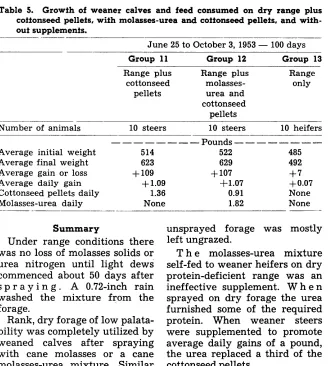
Data from the 1953 study show
that urea effectively supplied
one-third of the needed protein
supplements to promote average
daily weight gains of about a
pound daily (Table 5). Over the
loo-day experimental p e r i o d
groups 11 and 12 made similar
daily gains (1.09 and 1.07 pounds,
respectively).
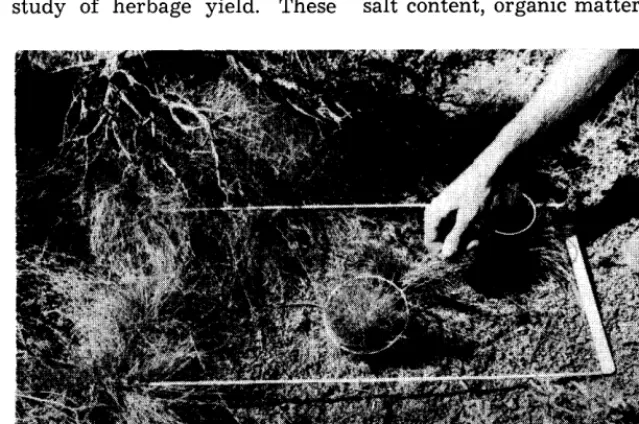
Spraying the coarse dry for-
age with molasses-urea mixture
or molasses resulted in its com-
plete utilization even though
more desirable fine-stemmed
forage was abundant (Figure 2)
.Table 4. Growth of weaner heifers and feed consumed on annual type range with molasses-urea plus cottonseed meal-sal,t, molasses plus meal- salt, meal-salt and without any supplement.
~-
July 8 to October 29, 1952 (113 days)
--
Group 7 Group 6 Group 9 Group kl Molasses- Molasses Meal- Range urea plus plus salt only meal-salt meal-salt
Number of heifers 15 15 10 10
._--_----(Pounds) _--_----
Average initial weight 461 459 488 457 Average final weight 535 504 558 444 Average gain or loss +74 +45 +70 -13 Average daily gain or loss +0.64 +0.39 +0.61 -0.11 Cottonse’ed meal-salt mix daily 0.38 0.70 0.94 None
Cottonseed meal daily 0.27 0.49 0.66 None
Salt daily1 0.11 0.21 0.28 None
Molasses-urea fed daily2 1.86 None None None Cane molasses fed daily None 1.86 None ___~ None
MOLASSES ON RANGE FORAGE
9
Table 5. Growth of weaner calves and feed consumed on dry range plus cottonseed pellets, with molasses-urea and cottonseed pellets, and wifh- ouf supplemen&.
June 25 to October 3, 1953 - 100 days
Group 11 Group 12 Group 13
Number of animals
Average initial weight Average final weight Average gain or loss Average daily gain Cottonseed pellets daily Molasses-urea daily
Range plus cottonseed
pellets
Range plus molasses- urea and cottonseed
pellets
Range only
10 steers 10 steers 10 heifers -.
----_-_- Pounds-_-_-_-___
514 522 485
623 629 492
+ 109 + 107 +7
+1.09 +1.07 +0.07
1.36 0.91 None
None 1.82 None
-_
Summary
Under range conditions there
was no loss of molasses solids or
urea nitrogen until light dews
commenced about
50days after
spraying.
A 0.72-inch rain
washed the mixture from the
forage.
Rank, dry forage of low palata-
bility was completely utilized by
weaned calves after spraying
with cane molasses or a cane
molasses-urea mixture. Similar
unsprayed forage was mostly
left ungrazed.
T h e molasses-urea mixture
self-fed to weaner heifers on dry
protein-deficient range was an
ineffective supplement. W h e n
sprayed on dry forage the urea
furnished some of the required
protein. When weaner steers
were supplemented to promote
average daily gains of a pound,
the urea replaced a third of the
cottonseed pellets.
LITERATURE CITED
BENTLEY, J. R. AND M. W. TALBOT. 1951. Efficient use of annual plants on cattle ranges in the California foothills. U. S. Dept. of Agr. Cir. 870.
GUILBERT, H. R., PAUL GERLAUGH, AND L. L. MADSEN. 1945. Recommended nutrient allowances for beef cattle. A Report of the Committee on Animal Nutrition, National Re- search Council.
HUTCHISON, C. B. AND E. I. KOTOK. 1942. The San Joaquin Experi- mental Range. Calif. Agr. Exp. Sta. Bul. 663.
TALBOT, M. W. AND H. H. BISWELL. 1942. The forage crop and its management. In Hutchison, C. B. and E. I. Kotok. The San Joaquin Experimental Range. Calif. Agr. Exp. Sta. Bul. 663.
AND A. L. HOR~VIAY: 1939. Fluctuations in the annual vegetation of California. Ecology 20: 394-402.
WAGNON, K. A., H. R. GUILBERT, AND G. H. HART. 1942. Experimental herd management. In Hutchison, C. B. and E. I. Kotok. The San J o a q u i n Experimental Range. Calif. Agr. Exp. Sta. Bul. 663.
.
1959. Beef cattle investigations at the San Joaquin Experimental Range. 1935-1948. Calif. Agr. Exp. Sta. Bul. 765.
Carbohydrate Content of Underground
Parts
’ of Grasses as Affected by Clipping’
FLOYD E. KINSINGER AND HAROLD I-I. HOPKINS
Associate Plant Ecologist, Nevada Agricultural Experi- ment Station, Rena, Nevada; and Chairman, Dept. of Biology, St. Cloud State College, St. Cloud, Minnesota
A grazing system which per-
mits maximum herbage produc-
tion with a minimum of harm to
the plant becomes increasingly
important as a growing popula-
tion demands more and more
meat. Sustained herbage pro-
duction depends to a great ex-
tent upon the ability of the plant
to withstand moderate to heavy
utilization. Preservation of per-
ennial grasses depends upon the
manufacture and storage of car-
bohydrates in excess of those re-
quired for growth. Any system
of grazing that consistently re-
moves most of the photosyn-
thetic tissue, thus preventing
manufacture and storage of car-
bohydrates, will eventually re-
sult in destruction of the grass.
Therefore, it is important to
know the effects of defoliation
upon the amount of carbohy-
drates stored in the underground
parts. The present study was
made to determine the influence
of different intensities and sea-
son of clipping on the carbohy-
drate content of roots, rhizomes,
and crowns of big bluestem
(An-dropogon gerardi
Vitmani.),
western wheatgrass
(Agropyron smithiiRydb.), and a mixture
of blue grama
(Bouteloua gra- cilis(H.B.K.) Lag. ex Steud.)
and buffalo grass
(Buchloe dac- ty Zoides(Nutt.) Engelm.)
.Review
of
LiferafureMany workers have found that
a moderate system of clipping or
grazing is less likely than intense
MOLASSES ON RANGE FORAGE
9
Table 5. Growth of weaner calves and feed consumed on dry range plus cottonseed pellets, with molasses-urea and cottonseed pellets, and wifh- ouf supplemen&.
June 25 to October 3, 1953 - 100 days
Group 11 Group 12 Group 13
Number of animals
Average initial weight Average final weight Average gain or loss Average daily gain Cottonseed pellets daily Molasses-urea daily
Range plus cottonseed
pellets
Range plus molasses- urea and cottonseed
pellets
Range only
10 steers 10 steers 10 heifers -.
----_-_- Pounds-_-_-_-___
514 522 485
623 629 492
+ 109 + 107 +7
+1.09 +1.07 +0.07
1.36 0.91 None
None 1.82 None
-_
Summary
Under range conditions there
was no loss of molasses solids or
urea nitrogen until light dews
commenced about
50days after
spraying.
A 0.72-inch rain
washed the mixture from the
forage.
Rank, dry forage of low palata-
bility was completely utilized by
weaned calves after spraying
with cane molasses or a cane
molasses-urea mixture. Similar
unsprayed forage was mostly
left ungrazed.
T h e molasses-urea mixture
self-fed to weaner heifers on dry
protein-deficient range was an
ineffective supplement. W h e n
sprayed on dry forage the urea
furnished some of the required
protein. When weaner steers
were supplemented to promote
average daily gains of a pound,
the urea replaced a third of the
cottonseed pellets.
LITERATURE CITED
BENTLEY, J. R. AND M. W. TALBOT. 1951. Efficient use of annual plants on cattle ranges in the California foothills. U. S. Dept. of Agr. Cir. 870.
GUILBERT, H. R., PAUL GERLAUGH, AND L. L. MADSEN. 1945. Recommended nutrient allowances for beef cattle. A Report of the Committee on Animal Nutrition, National Re- search Council.
HUTCHISON, C. B. AND E. I. KOTOK. 1942. The San Joaquin Experi- mental Range. Calif. Agr. Exp. Sta. Bul. 663.
TALBOT, M. W. AND H. H. BISWELL. 1942. The forage crop and its management. In Hutchison, C. B. and E. I. Kotok. The San Joaquin Experimental Range. Calif. Agr. Exp. Sta. Bul. 663.
AND A. L. HOR~VIAY: 1939. Fluctuations in the annual vegetation of California. Ecology 20: 394-402.
WAGNON, K. A., H. R. GUILBERT, AND G. H. HART. 1942. Experimental herd management. In Hutchison, C. B. and E. I. Kotok. The San J o a q u i n Experimental Range. Calif. Agr. Exp. Sta. Bul. 663.
.
1959. Beef cattle investigations at the San Joaquin Experimental Range. 1935-1948. Calif. Agr. Exp. Sta. Bul. 765.
Carbohydrate Content of Underground
Parts
’ of Grasses as Affected by Clipping’
FLOYD E. KINSINGER AND HAROLD I-I. HOPKINS
Associate Plant Ecologist, Nevada Agricultural Experi- ment Station, Rena, Nevada; and Chairman, Dept. of Biology, St. Cloud State College, St. Cloud, Minnesota
A grazing system which per-
mits maximum herbage produc-
tion with a minimum of harm to
the plant becomes increasingly
important as a growing popula-
tion demands more and more
meat. Sustained herbage pro-
duction depends to a great ex-
tent upon the ability of the plant
to withstand moderate to heavy
utilization. Preservation of per-
ennial grasses depends upon the
manufacture and storage of car-
bohydrates in excess of those re-
quired for growth. Any system
of grazing that consistently re-
moves most of the photosyn-
thetic tissue, thus preventing
manufacture and storage of car-
bohydrates, will eventually re-
sult in destruction of the grass.
Therefore, it is important to
know the effects of defoliation
upon the amount of carbohy-
drates stored in the underground
parts. The present study was
made to determine the influence
of different intensities and sea-
son of clipping on the carbohy-
drate content of roots, rhizomes,
and crowns of big bluestem
(An-dropogon gerardi
Vitmani.),
western wheatgrass
(Agropyron smithiiRydb.), and a mixture
of blue grama
(Bouteloua gra- cilis(H.B.K.) Lag. ex Steud.)
and buffalo grass
(Buchloe dac- ty Zoides(Nutt.) Engelm.)
.Review
of
LiferafureMany workers have found that
a moderate system of clipping or
grazing is less likely than intense
10
utilization to harm the plant and still maintain high yields (To- manek, 1948; Weaver and Hou- gen, 1939; Weaver and Darland, 1948; and Weaver, 1950). Hanson and Stoddart (1940) reported carbohydrate food reserves of bunch wheatgrass were reduced 19.4 percent in heavily grazed plants as compared to protected plants. As a result of this weak- ened condition, its dominant pos- ition was taken over by sage- brush. McCarty and Price (1942) found that root reserves of all clipped plants were lower than those of unclipped plants in a study of grasses and herbs of the Wasatch Mountains. McCarty
(1935, 1938) concluded that starch and sugars were the most potent stored foods. Sampson and McCarty (1930) reported an inverse correlation between sea- sonal fluctuations of the carbo- hydrates and growth rate of Stipa pulchra. Graber et al. (1927) and Graber (1930) re- ported retardation of both root and top growth and a decrease of organic reserves in the roots fol- lowing frequent defoliation. Cook et al. (1958) found decreased carbohydrate content in the roots of crested wheatgrass as clipping intensity and frequency in- creased. Hyder and Sneva (1959) reported the fluctuations of car- bohydrate storage with growth of crested wheatgrass. Dodd and Hopkins (1958) studied the car- bohydrate content of roots and crowns of young stands of blue grama and found that stored foods declined following defolia- tion.
Methods of Study Three plots were staked out in each of the communities of grasses studied. Two plots con- sisted of 9 square-meter quad- rats each and one contained 5 quadrats. The short grasses had not been grazed for 10 years; big bluestem and western wheat- grass had never been grazed by domestic livestock. The clipping treatments were as follows: un- clipped; moderately clipped
KINSINGER AND HOPKINS
every 3 weeks to a stubble height of 2,3, and 7 inches, respectively, for the two short grasses, big bluestem, and western wheat- grass; and heavily clipped every 2 weeks to a stubble height of
y2, 1, and 3 inches on the same grasses. Samples of underground parts were removed to a depth of 4 inches from each treatment monthly except for 5 winter and early-spring months. The roots were washed free of soil, dried quickly, finely ground, and stored for chemical analysis. Starch was determined in ac- cordance with McCarty and Price (1942)) and hemicellulose, sucrose, and reducing sugars by methods outlined in Official Methods (1945) of the Associa- tion of Official Agricultural Chemists. Starch, sucrose, and reducing sugars are reported as total readily available carbohy- drates.
Environmental Conditions Climatic conditions during the 2 years of this study varied con- siderably. Precipitation for April through September in 1951 was 37.45 inches, considerably above the normal of 18.03 inches. Tem- peratures for the same period were below normal resulting in
cool, moist weather, ideal for plant growth. In contrast, during 1952, precipitation w a s 9.06 inches, far below average. Ample soil moisture was present to a depth of 5 feet for rapid plant growth during the entire 1951 growing season. But in 1952, available moisture was present only in May and June.
Results
Soluble Carbohydrafes
Blue grama and buffalo grass Sugar and starch content of the underground parts in the un- clipped quadrats varied with the growth of the grasses (Figure 1). When growth was rapid in the spring, the amount of readily available carbohydrates was low, but as these warm-season grasses were approaching maturity and dormancy in the fall, a peak in stored foods occurred. In 1951 a low of 8.1 percent occurred on July 31, during flowering and seed set. On January 1, 1952, a high of 12.0 percent had been reached, but this decreased to 8.8 percent by May 6 when growth was rapid. Further fluc- tuations, which can apparently be correlated with growing con- ditions and phenological de-
t i
26
n WESTER WHEAT GRASS 2, 23 ?2