On linear hulls in one round of DES
Tomer Ashur and Raluca Posteuca
imec-COSIC, KU Leuven, Leuven, Belgium [tomer.ashur, raluca.posteuca]@esat.kuleuven.be
Abstract. At Indocrypt 2016, Ashur et al. showed that linear hulls are sometimes formed in a single round of a cipher (exemplifying on Simon ciphers) and showed that the success rate of an attack may be influenced by the quality of the estimation of one-round correlations. This paper improves the understanding regarding one-round linear hulls and trails, being dedicated to the study of one-round linear hulls of the DES cipher, more exactly of itsf-function. It shows that, in the case of DES, the existence of one-round hulls is related to the number of active Sboxes and its correlation depends on a fixed set of key bits. All the ideas presented in this paper are followed by examples and are verified experimentally.
1
Introduction
Together with differential cryptanalysis, linear cryptanalysis is one of the most powerful techniques used in the security evaluation of a block cipher. It was introduced in early 1990 by Mitsuru Matsui in [1], who applied the technique to the DES cipher. The technique became intensively studied, its formalism being extended in [2], [3] and [4]. The attack has been generalised in many subsequent works such as [6], [8].
In general, the idea behind linear cryptanalysis is to find a linear approxima-tion between a set of plaintext bits and ciphertext bits that holds with probabil-ity different from 0.5. Estimating the qualprobabil-ity of a linear approximation, usually measured by its bias or correlation, is one of the most important problems in linear cryptanalysis, being directly related to the success rate of a linear attack. The idea introduced by Matsui was to construct a linear approximation for
n rounds of a block cipher by concatenating n one-round linear approxima-tions. The estimation of the correlation of a linear trail is computed using the Pilling-Up Lemma, by multiplying the correlations of each one-round linear ap-proximation.
1.1 Related work
During the last three decades, many papers tried to find ways to obtain a better estimation of the correlation of a linear approximation.
trails, with a fixed set of input and output bits, is called a linear hull. The correlation of a hull is the sum of the linear trails correlations, so the correlation of one trail may be different than the correlation of the hull containing it. In practice, when using an attack based on linear cryptanalysis, the correlation of a linear hull is used, so the success rate of the attack is closely related to the quality of the hull correlation.
In [7] the authors show that the linear hull effect may sometimes appear at a micro-level, inside a single round of a cipher. They also show that overlooking this phenomenon may lead to wrong estimations of the linear correlation, offering examples and experiments on round-reduced versions of ciphers of the Simon family.
1.2 Our contribution
In this paper we extend the study regarding one-round linear hulls introduced in [7]. In the first part of the paper we recall some definitions and terminology of linear cryptanalysis. In the second part we present an analysis, similar to the one described in [7], but applied to the DES cipher. We prove the existence of the linear hull effect on the f-function. We also prove the connection between the number of active Sboxes, the existence and the number of linear trails in one-round linear hulls. Finally we present a simple and illustrative example of a hull containing 4 linear trails, and the manner in which its correlation is computed.
2
Notations
In this section we recall some terminology regarding linear cryptanalysis and we introduce the notations that will be used in this paper.
2.1 Masks and approximations
Leta be a hexadecimal value smaller than 2n and let atx=Pn−1
i=0 aixi, where
ai andxi represent the ithbit of aandx, respectively. We will callathe mask
ofx. Given the fact that applying a mask to a number represents, in essence, a selection of bits ofx, in this paper we will also use the description of a mask as a set of positions:
¯
a={i1, i2, ..., iv} ⇔
(
aj = 1,∀j∈ {i1, i2, ..., iu}
aj = 0,∀j /∈ {i1, i2, ..., iu}
LetRk(x) =ydenote the round function of a cipher, wherekdenotes the key.
The explicit function will always be clear from context. A linear approximation forRk is the tuple (iM, oM, kM), whereiM represents the input mask,oM the
output mask, andkM the key mask. Letpbe the probability that the equation
(iM, oM, kM) is defined ascorr(iM, oM, kM) = 2p−1. In general, bothpand
corr(iM, oM, kM) are key-dependent.
A pair (iM, oM) is called connectable if and only ifoMcan be obtained from
iM using the rules of propagation of linear trails introduced in [2, 3]. The pair (iM, oM) is non-connectable otherwise. In this paper only connectable pairs are used.
2.2 Linear hulls and trails for more rounds
A linear trail for rrounds represents a concatenation of linear approximations such that the output mask of the round i equals the input mask of round
i+ 1. Hence, a linear trail may be represented as an (r + 1)-length vector (m1, m2, ...mr+1), where (mi, mi+1) represents the input and output masks at round i, respectively. The correlation of the linear trail is computed by multi-plying the correlation of all single-round linear approximations:
corr(m1, ...mr+1) =
r
Y
i=1
corr(mi, mi+1)
A linear hull coveringr rounds is a tuple (α, β) and represents the set of all linear trails such as m1 =α and mr+1 =β, i.e., the input and output masks are the same, but that intermediate masks may be different. The correlation of a linear hull is computed by adding the correlations of all linear trails:
corr(α, β) = X
m1=α,mr+1=β
corr(m1, ...mr+1)
2.3 DES’ round function
DES is a block cipher developed by IBM in the early 1970s. It was standardized by the National Bureau of Standards (later NIST) in 1977. The plaintext and the key are 64-bit blocks, even though only 56 out of 64 key-bits are actually used by the algorithm. DES has a Feistel structure where the round function uses a non-linear functionf. The overall structure of DES consists of an initial permutation, 16 enciphering rounds and a final permutation.
The input of the round function is a 48-bit round key (denoted by k) and two 32-bit intermediate cipherwords (denoted byxandy).
The round function of DES is given by:
Rk(x, y) = (y⊕f(x, k), x).
Thef-function consists of four functions:
1. The expansion function: the 32-bit inputxis expanded to 48-bit
We denote the expansion function byE;
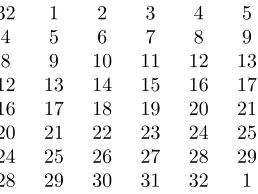
Table 1. The expansion functionE. We see that 16 out of the 48 bits appear twice.
32 1 2 3 4 5
4 5 6 7 8 9
8 9 10 11 12 13
12 13 14 15 16 17
16 17 18 19 20 21
20 21 22 23 24 25
24 25 26 27 28 29
28 29 30 31 32 1
2. Key addition: the output of the expansion function is XORed with
the 48-bit round key;
3. The substitution layer: the output of the key addition is divided into
eight 6-bit blocks. Each of these blocks is given as input to a different 6-to-4 Sbox, resulting in eight 4-bit outputs. The first two Sboxes used in DES are described in Table 2, while the remaining six Sboxes are described in [10].
The Sboxes of DES are applied as follows: for the inputx0x1x2x3x4x5, the output after applying theithSbox is the value found at the intersection of the rowx0x5 and the columnx1x2x3x4 of the table ofSi. We denote the
substitution layer byS.
4. The permutation layer: a fixed 32-bit to 32-bit permutation is applied
to the result of the substitution layer; the permutation, denoted by P, is described in [10].
Table 2. DES’ Sboxes
S1
0 14 4 13 1 2 15 11 8 3 10 6 12 5 9 0 7
1 0 15 7 4 14 2 13 1 10 6 12 11 9 5 3 8
2 4 1 14 8 13 6 2 11 15 12 9 7 3 10 5 0
3 15 12 8 2 4 9 1 7 5 11 3 14 10 0 6 13
S2
0 15 1 8 14 6 11 3 4 9 7 2 13 12 0 5 10
1 3 13 4 7 15 2 8 14 12 0 1 10 6 9 11 5
2 0 14 7 11 10 4 13 1 5 8 12 6 9 3 2 15
3 13 8 10 1 3 15 4 2 11 6 7 12 0 5 14 9
3
One round hulls in DES
3.1 One round hulls and trails in DES
In order to describe the behavior of linear trails through one round of DES, it is sufficient to analyze thef-function. This will be the focus of this section.
The permutation layer represents a bijective function so the behavior of a mask through this layer is given by: oM =P(iM), i.e., the bits of the output mask are a shuffle of input mask’s bits. The permutation layer does not influence the number of linear trails in the one-round hull, nor the value of the correlations. For simplicity, in the following two subsections, we will ignore the permutation layer.
We use the notation (R, kM, A, B, C) to describe a linear trail of the f -function in DES, where the input mask isiM=R= (ri)i∈{1,..8}and the output
mask isoM=C= (ci)i∈{1,..8}. We denote byA= (ai)i∈{1,..8}the output of the
expansion layer. We denote byB = (bi)i∈{1,..8} and C= (ci)i∈{1,..8} the input
and the output masks of the substitution layer, respectively. kM= (ki)i∈{1,..8}
represents the key mask. Note that in the remaining of this paper,ri,ai,bi and
ki are represented as sets of position values, depending on the input mask R
and the key mask respectively, whileci’s are represented as 4-bit decimal values,
being nonlinear functions ofR’s bits.
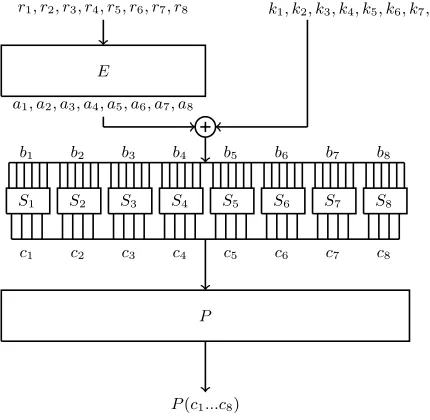
Figure 1 depicts the propagation of linear masks through thef-function of DES.
P E
S1 S2 S3 S4 S5 S6 S7 S8
b1 b2 b3 b4 b5 b6 b7 b8
c1 c2 c3 c4 c5 c6 c7 c8
r1, r2, r3, r4, r5, r6, r7, r8 k1, k2, k3, k4, k5, k6, k7, k8
P(c1...c8)
a1, a2, a3, a4, a5, a6, a7, a8
We now study the behavior of linear trails through thef-function of DES, using the rules of propagation of linear trails introduced in [1–3]. The rule of propagation regarding the XOR operation (used in the key addition layer) im-plies the following constraint:
ai=ki=bi,∀i∈ {1, ...8}.
The rule of propagation of linear masks through the Sboxes is given by the linear approximation tables (LATs) of each Sbox, described in [1, 2].
For the expansion layer we use the rule for linear propagation over the branch operation, as follows:
IfRhas an active bit inM0={2,3,6,7,10,11,14,15,18,19,22,23,26,27,30,31}, i.e., those bits that appear only once after the expansion layer, the corresponding bit inAis an active bit.
If a bit ofM0 is not active inR then the corresponding bit inA is not an active bit.
ExampleIfr1={2}, thena1={2}.
IfRhas an active bit inM1={1,4,5,8,9,12,13,16,17,20,21,24,25,28,29,32}, i.e., those bits that appear twice after the expansion layer, only one of the cor-responding bits inAis an active bit.
If a bit ofM1 is not active inR, then either none of the corresponding bits in Aare active bits or both of the corresponding bits inAare active bits.
ExampleIfr1={4}, then •a1={4}, a2=∅, or •a1=∅, a2={4}, or •a1={4,5}, a2={5}, or •a1={5}, a2={4,5}.
DefinitionIfbi, ci6=∅, thenSi is called an active Sbox.
Lemma 1. Let (R, C) be a fixed pair of input and output masks and let
s denote the number of pairs of active adjacent Sboxes. Then the maximum number of linear trails contained in the hull (R, C) is 22s.
Let⊕be defined as an operation between two sets by:
A⊕B= (A∪B)\(A∩B)
Let S1 and S2 be active Sboxes, i.e., b1 6= ∅ and b2 6= ∅. After applying the expansion layer, one may easily notice the fact that any two adjacent Sboxes share two input bits; in the case of S1 and S2 the shared bits are the ones in positions 4 and 5 fromR. Given the fact thatb1⊕b2is constant then four linear trails can be defined such that the input masks of the Sbox layer are:
• (b1, b2)
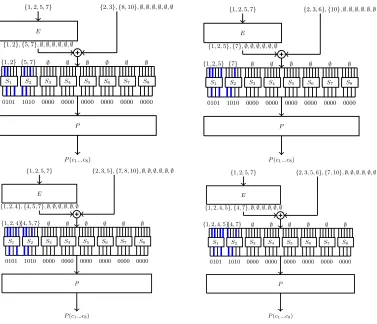
Figure 2 depicts a linear hull that contains exactly 4 linear trails. Note that, even though ai and ki appear to be different, their corresponding bit locations
are the same.
P E
S1 S2 S3 S4 S5 S6 S7 S8
{1,2} {5,7} ∅ ∅ ∅ ∅ ∅ ∅
0101 1010 0000 0000 0000 0000 0000 0000
{1,2,5,7} {2,3},{8,10},∅,∅,∅,∅,∅,∅
P(c1...c8) {1,2},{5,7},∅,∅,∅,∅,∅,∅
P E
S1 S2 S3 S4 S5 S6 S7 S8
{1,2,5} {7} ∅ ∅ ∅ ∅ ∅ ∅
0101 1010 0000 0000 0000 0000 0000 0000
{1,2,5,7} {2,3,6},{10},∅,∅,∅,∅,∅,∅
P(c1...c8) {1,2,5},{7},∅,∅,∅,∅,∅,∅
P E
S1 S2 S3 S4 S5 S6 S7 S8
{1,2,4}{4,5,7} ∅ ∅ ∅ ∅ ∅ ∅
0101 1010 0000 0000 0000 0000 0000 0000
{1,2,5,7} {2,3,5},{7,8,10},∅,∅,∅,∅,∅,∅
P(c1...c8)
{1,2,4},{4,5,7},∅,∅,∅,∅,∅,∅
P E
S1 S2 S3 S4 S5 S6 S7 S8
{1,2,4,5}{4,7} ∅ ∅ ∅ ∅ ∅ ∅
0101 1010 0000 0000 0000 0000 0000 0000
{1,2,5,7} {2,3,5,6},{7,10},∅,∅,∅,∅,∅,∅
P(c1...c8)
{1,2,4,5},{4,7},∅,∅,∅,∅,∅,∅
Fig. 2.Four trails of a one-round hull through DESf-function
3.2 Correlations of one-round hulls
correlation is eithercorr= 1 orcorr=−1, depending on the actual value of the round key bits.
In the case of the substitution layer, the correlation is usually computed by multiplying the correlation of each active Sbox - usually extracted from the Sbox’s LAT.
Given the fact that bi = ki,∀i ∈ {1, ..8}, for every linear trail in the
hull, and given the fact thatbi are different for every trail, the correlations of
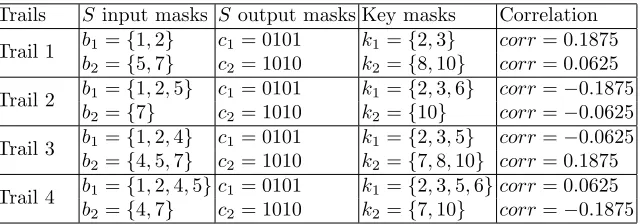
different trails are influenced by different key bits. The correlation of each linear trail described in Figure 2, up to a sign, together with the corresponding key bits can be found in Table 4.
Table 4. Correlations of linear trails described in Figure 2
Trails S input masks S output masks Key masks Correlation
Trail 1 b1={1,2} c1= 0101 k1={2,3} corr= 0.1875
b2={5,7} c2= 1010 k2={8,10} corr= 0.0625
Trail 2 b1={1,2,5} c1= 0101 k1={2,3,6} corr=−0.1875
b2={7} c2= 1010 k2={10} corr=−0.0625
Trail 3 b1={1,2,4} c1= 0101 k1={2,3,5} corr=−0.0625
b2={4,5,7} c2= 1010 k2={7,8,10} corr= 0.1875
Trail 4 b1={1,2,4,5}c1= 0101 k1={2,3,5,6}corr= 0.0625
b2={4,7} c2= 1010 k2={7,10} corr=−0.1875
We will now show that the correlation of the hull depends on the actual values of the round key. One may get some information regarding the round key just by looking at the value of the hull’s correlation. From Table 4 one may notice the fact that there are 7 key bits that influence the value of the hull’s correlation: k[2], k[3], k[5], k[6], k[7], k[8] and k[10]. Three of these values, more precisely k[2], k[3] andk[10] influence all the trails’ correlation. We will denote their XOR sum by l. Notice the fact that the remaining 4 key bits are exactly the ones that are applied to the two plaintext bits that are shared among S1 andS2.
The correlation of the hull is computed by adding the correlation of all the linear trails contained in it:
corrhull=corrT rail1+corrT rail2+corrT rail3+corrT rail4
Letc= 0.1875·0.0625. According to Table 4, the correlation of each trail is:
corrT rail1=c·(−1)k[2]⊕k[3]⊕k[8]⊕k[10] corrT rail2=c·(−1)k[2]⊕k[3]⊕k[6]⊕k[10]
corrT rail3=−c·(−1)k[2]⊕k[3]⊕k[5]⊕k[7]⊕k[8]⊕k[10]
Taking into account the fact thatc and (−1)k[2]⊕k[3]⊕k[10]= (−1)lare
com-mon to all the trails’ correlation formulas, the correlation of the hull can be computed as:
corrhull=c·(−1)l·[(−1)k[8]+ (−1)k[6]−(−1)k[5]⊕k[7]⊕k[8]−(−1)k[5]⊕k[6]⊕k[7]]
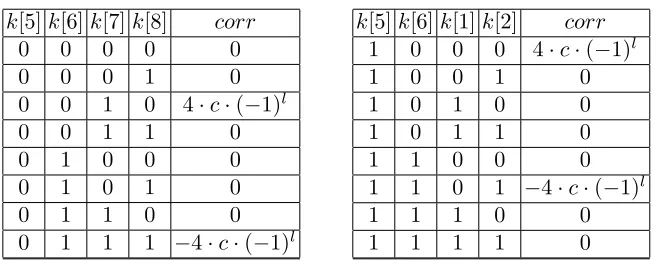
Table 5 considers all possible values ofk[5], k[6], k[7], k[8] and the correspond-ing correlation values of the hull. Note that the value oflwill only influence the sign of the correlation.
Table 5. Key-dependent correlation values for the Figure 2 hull
k
[5]
k
[6]
k
[7]
k
[8]
corr
0
0
0
0
0
0
0
0
1
0
0
0
1
0
4
·
c
·
(
−
1)
l0
0
1
1
0
0
1
0
0
0
0
1
0
1
0
0
1
1
0
0
0
1
1
1
−
4
·
c
·
(
−
1)
lk
[5]
k
[6]
k
[1]
k
[2]
corr
1
0
0
0
4
·
c
·
(
−
1)
l1
0
0
1
0
1
0
1
0
0
1
0
1
1
0
1
1
0
0
0
1
1
0
1
−
4
·
c
·
(
−
1)
l1
1
1
0
0
1
1
1
1
0
From the table above results the condition of the key that leads to zero-correlation one-round hull for DES:
1. corrhull= 0 ⇐⇒
k[5] =k[7] or
k[5]6=k[7] andk[6]6=k[8]
2. corrhull6= 0 ⇐⇒ k[5]6=k[7] andk[6] =k[8]
3.3 Key recovery based on the correlation
Looking the other way around, if the correlation of this hull is different from zero, one knows two equalities of the key bits:
k[5] =k[7]⊕1 and
k[6] =k[8].
Our experiments confirm that the only key bits that influence the absolute value of the correlation are the ones applied on the plaintext bits shared between
S1 andS2.
4
Conclusion
In this paper we extended the knowledge regarding the subject of one-round linear hulls, analyzing this phenomenon on the DES cipher. We proved the fact that thef-function of DES exhibits one-round linear hulls. We also studied the connections between the properties of input and output masks and the existence, the size or the correlation values of one-round linear hulls.
The work described in this paper can be extended in different manners. For example, it will be interesting to identify other block ciphers that exhibit zero-correlation one-round linear hulls and to describe the properties of the round function that led to it. It also remains to be investigated how the properties described in this paper may be extended to more rounds of DES. Future research should also revisit the linear attacks on DES, attacks in which only one trail correlation is used in order to estimate the hull’s correlation.
Acknowledgments
The authors would like to thank Vincent Rijmen for all the useful discussions.
References
1. Mitsuru Matsui,Linear cryptanalysis method for DES cipher, In: Helleseth, T. (ed.) Advances in Cryptology - EUROCRYPT ’93, Workshop on the Theory and Appli-cation of Cryptographic Techniques, Lofthus, Norway, May 23-27, 1993, Proceed-ings. Lecture Notes in Computer Science, vol. 765, pp. 386–397. Springer (1993). 2. Eli Biham, On Matsui’s linear cryptanalysis, In: Santis, A.D. (ed.): Advances
in Cryptology - EUROCRYPT ’94, Workshop on the Theory and Application of Cryptographic Techniques, Perugia, Italy, May 9-12, 1994, Proceedings, Lec-ture Notes in Computer Science, vol. 950. Springer (1995) , pp. 341–355, http: //dx.doi.org/10.1007/BFb005344p
3. Florent Chabaud, Serge Vaudenay, Links between differential and linear cryptanal-ysis, In: Santis, A.D. (ed.): Advances in Cryptology - EUROCRYPT ’94, Workshop on the Theory and Application of Cryptographic Techniques, Perugia, Italy, May 9-12, 1994, Proceedings, Lecture Notes in Computer Science, vol. 950. Springer (1995) , pp. 356–365, http://dx.doi.org/10.1007/BFb0053450
4. Kaisa Nyberg, Linear approximation of block ciphers, In: Santis, A.D. (ed.): Ad-vances in Cryptology - EUROCRYPT ’94, Workshop on the Theory and Ap-plication of Cryptographic Techniques, Perugia, Italy, May 9-12, 1994, Proceed-ings, Lecture Notes in Computer Science, vol. 950. Springer (1995) , pp. 439–444, http://dx.doi.org/10.1007/BFb0053460
5. Ray Beaulieu, Douglas Shors, Jason Smith, Stefan Treatman-Clark, Bryan Weeks, Louis Wingers,Simon and Speck: Block Ciphers for the Internet of Things, Cryp-tology ePrint Archive, Report 2013/404 (2013), http://eprint.iacr.org/.
6. Andrey Bogdanov, Vincent Rijmen,Linear hulls with correlation zero and linear cryptanalysis of block ciphers. Des. Codes Cryptography 70(3) (2014), pp. 369–383 7. Tomer Ashur, Vincent Rijmen,On linear hulls and trails. In: Progress in
8. Alex Biryukov, Christophe De Canni´ere, Micha¨el Quisquater, On Multiple Lin-ear Approximations. In Franklin, M.K., ed.: Advances in Cryptology - CRYPTO 2004, 24th Annual International CryptologyConference, Santa Barbara, California, USA, August 15-19, 2004, Proceedings. Volume 3152 of Lecture Notes in Computer Science., Springer (2004) 1–22
9. Joan Daemen, Ren´e Govaerts, Joos Vandewalle:Correlation matrices. In: Preneel, B. (ed.) Fast Software Encryption: Second International Workshop. Leuven, Bel-gium, 14-16 December 1994, Proceedings. Lecture Notes in Computer Science, vol. 1008, pp. 275–285. Springer (1994), http://dx.doi.org/10.1007/3-540-60590-8 21 10. FIPS Publication 46-3, Data Encryption Standard (DES), https://csrc.nist.gov/