A. Stalin IJSRE Volume 05 Issue 11 November 2017 Page 7739
Volume||5||Issue||11||November-2017||Pages-7739-7748||ISSN(e):2321-7545 Website: http://ijsae.in Index Copernicus Value- 56.65 DOI: http://dx.doi.org/10.18535/ijsre/v5i11.05
Women Entrepreneurs in Tamilnadu: Problems And Challenges
Authors A. Stalin
PhD Scholar, Centre for study of social Exclusion and Inclusive policy, Bharathidasan university, Trichy.
Email- [email protected] ABSTRACT
Woman entrepreneurship in India is a recent phenomenon. Women in India started entering in to the entrepreneurial world only after the 1970s with the introduction of the Women Decade (1975 to 1985). This phenomenon was visible only among women hailing from the metropolitan cities and state capitals. It took a much longer time to percolate to the other cities and municipalities of nation. Even now rural women of the state are not showing any interest to alter their ascribed roles out of fear for social backlash and taboo.The spread of education and thereon the awareness developed out of it arehelping urbanwomen to spread their wings in to areas which are hither to the monopolized by men. As an entrepreneur today, they are emerging as potential entrepreneurs and started plunging into different entrepreneurial activities.The entrepreneurial process is though the same for men and women, however; women have to confront many problemsof varying dimensions and magnitudesin practice, which prevent them from realizing their full potential as entrepreneurs. Entrepreneurship by definition implies being in control of one’s life and activities. It is precisely this independence that societies in the region have denied women. It is a fact that problems follow women entrepreneurs like a shadow. When a woman has overcome a problem, many more will crop up. The women entrepreneur has to face initial problems i.e. starting problems. She is confronted with more problems when the enterprise is in the running state. She, therefore, has to look after the entire spectrum of problems despite the great limitations under which she functions.
Keywords- Woman entrepreneur, problems & prospects, woman enterprise, woman contribution, woman business
INTRODUCTION
A. Stalin IJSRE Volume 05 Issue 11 November 2017 Page 7740
spheres of economic activitiessuch as designers, interior decorators, exporters, publishers, garment manufacturers and so on .They have been making significant impact thus in all segments of the economy too. However, women hail from the middle and lower class showing no interest to alter theirascribed rolesout of fear for social backlash and taboo. Similarly, theawareness anent entrepreneurship is visibleonly among the women of upper class families from urban centers.
The challenges and opportunities provided to the women of digital era are growing rapidly and view entrepreneurship as a challenge to prove their powers, to do something meaningful in life, to become economically independent or even as a means of better livelihood. In India, although women folk are numerically dominant, the entrepreneurial world is still a male dominated one. Indian women are still struggling to attain theprominent position as in the advanced countriesin the business world. However, there is a greater dynamism in the rate of growth of female employment.
Women in advanced nations are recognized and are more prominent. In the 60 years' of independence, an emphasis on the socialistic pattern of the society and the role assigned to the public sector, limited the scope for the growth of private entrepreneurship. The liberalization policy of the government has now thrownopen a vast area of the economy for private entrepreneurship. As anupshot, many women have entered in to the world of business and become successful with all their hard work, diligence, competence and will power in their endeavor as entrepreneur.
Now, women have emerged as an important part of industrial growth. To achieve equal status with men, women have to come out of their traditional roles and responsibilities and create an identity for themselves, assuming a variety of functions. To make this dream a reality, women have to consider their labour as not drudgery but a delight. The participation of women in the economic development process can be mainly categorized into four segments namelyEmployment in unorganized sector, Employment in organized sector, Self-employment and Entrepreneurs.
The women employed in unorganized and organized sectors are predominantly in unskilled and semi-skilled categories. Even the newer industries like engineering, electronics and pharmaceuticals which are increasingly employing educated women as skilled workers, tend to limit their participation to a few processes where the job involves dexterity of fingers of or is repetitive and monotonous in nature.
Over the last few decades, only a few women have come forward to establish their own enterprises. The survey conducted by Washington-basedGender-Global Entrepreneurship and Development Institute affirms it .More recently, a new trend has emerged where women are venturing as entrepreneurs and contributing to the economic development. Their skill and knowledge, their interest in business and a pushing desire to do something positive are among the reasons for women to establish and manage organized industries and take up challenging ventures.
Table –No: 1 Gender-Global Entrepreneurship and Development Institute (GEDI) Index for 2014 Rank Top 5 Countries Rank Bottom 5 Countries
1 United States 26 India
2 Australia 27&28 Uganda & Egypt
4 Sweden 29 Bangladesh
4 & 5 Germany & France 30 Pakistan
LITERATURE REVIEW
A. Stalin IJSRE Volume 05 Issue 11 November 2017 Page 7741
women entrepreneurs reiterates that constraints such as financial, marketing, production, work place facility and health problems were the main one being faced by women folk as an entrepreneur.Srivastava and Chaudhary, (1995) in their work on „Women Entrepreneurs: Problems Perspective and role expectations from banks found thatwomen faced problems mainly in the areas of marketing of products and approaching the banks for getting loans. Personal problems like time constraint and family stress were also cited. Caputo and Dolinsky, (1998) have examined the role of financial and human capital of household member to pursue self-employment among females. The analysis revealed that business knowledge and cooperation of husband in family matters contribute a lot to pursue the business. Findings further suggested that government should provide necessary skill to women to ensure rapid growth of entrepreneurship. Punitha et al. (1999) examined the problems and constraints faced by women entrepreneurs in the Pondicherry region. The major problems faced by rural women entrepreneurs were competition in the business, marketing and in availing bank loan both for startup capital and for working capital.Mani. C (2013)in his research work had found thatnon-availability of long-term finance, regular and frequent need for working capital, long procedures to avail financial help in the bank and high cost of required machine or equipment were the important problems faced by the women intheir business. Deepak Kumar (2014) in his study on “Women entrepreneurship in India: Obstacles and opportunities” come up with the findings that obstacles such as lack of confidence, socio cultural barrier, market oriented risk, motivational factors, knowledge in business administration, awareness about the financial assistance, exposed to the training program, identifying the available resources common phenomena in the entrepreneurial life of Indian women. Veena.M&Nagaraja. N, (2014) in their study found thatfinancial constraint, Inadequate Institutional support, Problems in Marketing, Social Attitude, and Non- availability of good workers/employees were the impediments come across by the women entrepreneur.
STATEMENT OF THE PROBLEMS
Women Entrepreneurship is one of the important outcomes of industrialization. Women‟s compelling desire of wanting to do something positive is the main reasons for them to start the business enterprises. Women hailingboth from the urban and rural areas have been taking increasing interest in income generating activities, self-employment and entrepreneurship. In the process they have taken up both traditional activities (knitting, pickle making, toy making, jam and jelly) as well as non-traditional activities (computer training, catering services, beauty parlour, gym etc.). It is clear that more and more women are coming forward to set up enterprises. In the progression starting up and running the entrepreneurship, women have to face various problems associated with entrepreneurship and these problems get doubled because of her dual role as a wage earner and a homemaker. As an upshot of dual role, they feel frustrated at times because they need to spare their time and energy, both towards their business as well as domestic affairs. Critical evaluation of the existing governmental and nongovernmental efforts indicate that training and technical assistance offered are not geared to suit the individual needs. They are only “capsule” inputs focusing rested interests of individual trainers and considering the training as an “end” in itself. (Ramachandran , 1993). The studies conducted by Kale (1990); Kirve and Kanitkar (1993), revealed that training approach is an important one for helping women to build confidence among women to meet the specific needs. Intensified effort has to be taken to assess the social attitude, mentality, needs and abilities of the women and to impart training. Flexible training programme and interest based skill training can push the women towards entrepreneurial activities. Training to develop good managerial skills is useful and essential to women (Padmavati, 2002 and Sathyasundaram, 2004). Therefore, with a view to develop guidelines on the basis of problems faced by them, this study has been done with the following specific objectives:
OBJECTIVES OF THE STUDY
A. Stalin IJSRE Volume 05 Issue 11 November 2017 Page 7742
To examine entrepreneurial traits of the women entrepreneurs of Dindiugul District
To find out the problems faced by the women entrepreneurs in their business front. RESEARCH DESIGN
In Tamilnadu , Dindigul district was selected being one of the most backward district of the state . The researcher used descriptive research design in the present study. In order to carry out the present study, the researcher collected the list of registered women enterprise at first from the District Industries Center (DIC) of Dindigul district. Women of the district were facilitated to start the business under three schemes through DIC. They were Unemployed Youth Employment Generation Programme (UYEGP), New Entrepreneur and Enterprise Development Scheme (NEEDS) and Prime Minister‟s Employment Generation Programme (PMEGP) Scheme. Of the three schemes, more women have availed loan from the District Industries Center of Dindigul districtto start the business under Unemployed Youth Employment Generation Programme
(UYEGP) compare to other two schemes as this scheme did not prescribe any educational qualification for
the applicant. Under this scheme, 90 women who were running their own business at the time of data collection were taken in to consideration for the present study. Hence, the researcher selected all the 90 respondents‟ availed loan under Unemployed Youth Employment Generation Programme (UYEGP) Scheme for this study by applying census sampling method.
RESULT AND DISCUSSION
Today‟s world is changing at a startling pace. Political and economic transformations seem to be occurring everywhere-as countries convert from command to demand economies, dictatorships move toward democracy, and monarchies build new civil institutions. These changes have created economic opportunities for women who want to own and operate businesses. As a result women have shifted their work place from kitchen premises and cottage industries to non-traditional and techno-savvy activities. These changes have offered tremendous opportunities for women across the world by opening doors to operate their own businesses. As a result , women are coming out of their veil and been have started plunging into industry and running their enterprises successfully as designers, interior decorators, exporters, publishers, garment manufacturers and still exploring new avenues of economic participation.
Table –2 Socio economic Conditions of Women Entrepreneurs
Sl.No Age Frequency Percentage
1 Below 25 1 1.1
2 26-30 13 14.4
3 31-35 51 56.7
4 36 and Above 25 27.8
Total 90 100
S. No Religion Frequency Percentage
1 Hindu 70 77.8
2 Muslim 3 3.3
3 Christian 17 18.9
Total 90 100
S. No Community Frequency Percentage
1 Scheduled
Caste 25 27.8
2 Backward
Community 36 40.0
3 Most
A. Stalin IJSRE Volume 05 Issue 11 November 2017 Page 7743
Total 90 100
S. No Educational
Status Frequency Percentage
1 Secondary
Education 49 54.4
2 Higher
Secondary 32 35.6
3 Collegiate
Education 9 10.0
Total 90 100.0
S. No Marital Status Frequency Percentage
1 Married 75 83.3
2 Unmarried 15 16.7
Total 90 100
S. No Type of
Family Frequency Percentage
1 Nuclear
Family 15 16.7
2 Joint Family 75 83.3
Total 90 100
Sources: Primary
SOCIAL BACKDROP OF WOMEN ENTREPRENEURS
The above table (No-2) reveals that more than half of the respondents (56.7%) come under the age group of 31-35years and 27.8% of the respondents belong to the age group of 36and above .Only 15.5% of the respondents were in the age group of 30and below. It is understood from the table given above that vast majority of (84.55%) of the women entrepreneurs were in the middle age. As the middle age earmarks risk taking behavior as well in coping it, majority of our respondent were found in the said age.
The table also reiterates that 77.8% of the respondents were belongs to Hindu religion followed by Christians with 18.9%and only 3.3% of the respondents were comes under the category of Muslim. As per 2011 census, India‟s total population was registered as 121.09 corers, in which Hindus constituted 79.8 percent, Muslims 14.2 percent, Christians 2.3 percent, Sikh 1.7 percent. Comparison of the census data with our sample reveals the overwhelming numerical strength of Hindu population in our research universe. The abnormal representation of Hindus in our sample is an unintended consequence of the actual numerical strength of Hindus in the total population.
It was also evident from the table that less than half of the respondents were (40%) belongs to backward community and32.2 % of the respondents were comes under Most Backward Community. The remaining 27.8% of the respondents were schedule caste .The data presented in the table highlights the rise of backward communities in endeavor to improve their social and economic conditions by starting their own business.
The table indicates that 54.4%of the respondents did complete their education up to secondary level and 35.6% of the respondents have hadeducation up to higher secondary .Remaining 10% of the respondents completed their graduation throw collegiate education . This shows that irrespective of educational qualification, women for our research universe have taken effort to start their own business and also disproved as well the need of higher education to maintain the own business by the women folk of our society
A. Stalin IJSRE Volume 05 Issue 11 November 2017 Page 7744
life due to economic necessities than the spinsters .Family-wise information furnished in the above table (No-4.6) reiterates that 83.3% of the respondents were living in the joint family and the remaining 16.7% of the respondents were in the nuclear family system. Joint Family system which is slowly disintegrating in many parts of our society due to education and employment mainly, found intact to an extent in our research universe.
Table –3.Entrepreneurial Traits of the Respondents of the Study Area
Sl. No First Women Entrepreneur Frequency Percentage 1 First Generation Entrepreneurs 71 78.8
2 Parents as Entrepreneurs 3 3.3
3 Husband as Entrepreneurs 16 17.8
Total 90 100
SlNo Size of Enterprise Frequency Percentage
1 Micro Enterprise 83 92.2
2 Small Enterprise 4 4.4
3 Medium Enterprise 3 3.3
Total 90 100
Sl. No Nature Business Frequency Percentage
1 Manufacturing Enterprise 30 33.3
2 Service Enterprise 32 35.6
3 Trade & Business 28 31.1
Total 90 100
Sl. No Forms of Business Frequency Percentage
1 Sole Proprietorship 70 77.7
2 Partnership with others 1 1.1
3 Joint Hindu Family Business 19 21.1
Total 90 100
S. No Nature of Business Activities Frequency Percentage
1 Hotel / Restaurant 4 4.4
2 Textile fabric/ Handlooms /
Garments 15 16.6
3 Tailoring / Button Stitching 12 13.3
4 Beauty Parlor 9 10.0
5 Readymade cloths store 28 31.1
6 Xerox/computer centre 5 5.5
7 Food products 11 12.2
8 Flour Mill 6 6.6
Total 90 100
Source: Primary
ENTREPRENEURIAL TRAITS OF THEWOMEN ENTREPRENEURS
A. Stalin IJSRE Volume 05 Issue 11 November 2017 Page 7745
majority of the respondents (94.4%) were of first generation and only very meager percentage (5.6%) of the respondents hails from the second generation. Though vast majorit y of the respondents did not have any background to be an entrepreneur,their deep-seated need for a sense of independence along with a desire to do something meaningful with their time and to have their own identity instead of remaining behind the shadow of their husband, made them to become an entrepreneur
The data presented in the above table also indicates that vast majority of the respondents (92.2%) having micro enterprises followed by 4.45 of the subjects running small enterprises .Of the remaining, 3.3% were maintaining medium size enterprise. This shows that women are yet to get facilitated by the financial institutions and related government agencies to start the more number of medium and small scale enterprise, out traditional outlook over women folk of our society.
It is obvious from the table presented above that more number of respondents (35.6%) did have service enterprise followed by 33.3% of the study subjects who have had manufacturing enterprise and the remaining 31.1% got involved in Trade and business. Generally women like to start and maintain riskless service based enterprise out of their familial responsibility to which women entrepreneurs of our study were not an exception. However, the percentage of our respondents maintaining manufacturing (33.3%) and trade and business also found more or less same. This shows the risk taking ability of our study subjects The abovetable elucidates the classification of different forms of organization being maintained by our respondents in the research universe. The data presented in the table reveals that vast majority of the respondents (77.7%) did run their enterprise under the form of sole Proprietorship. A sole proprietorship company is a form of the organization managed and owned by a single person. This form of organization is the most popular business entity in India as these forms known for easy start-up,easy compliances as well to haveutmostcontrol over theorganization for which our study area was not an exception. Moreover, 21.1%, 1.1% comes under Joint Hindu Family Business and Partnership with others respectively.
The above table enumerates the nature of business of the respondents in the study area. The data reveals that more number of respondents (31.1%) were having readymade cloths store followed by 16.6% indulged in Textile fabric/ Handlooms / garments. Respondents having Tailoring / Button Stitching,units of food products and running beauty parlor constitutes13.3%,12.2% and 10% respectively .Of the remaining 6.6%,5.5% and 4.4% of the respondents maintaining flour Mill, Xerox/computer center and Hotel / Restaurant. This shows that the women entrepreneurs of our respondents have taken up the traditional oriented business activities as it was risk free comparatively for their entrepreneurial activities.
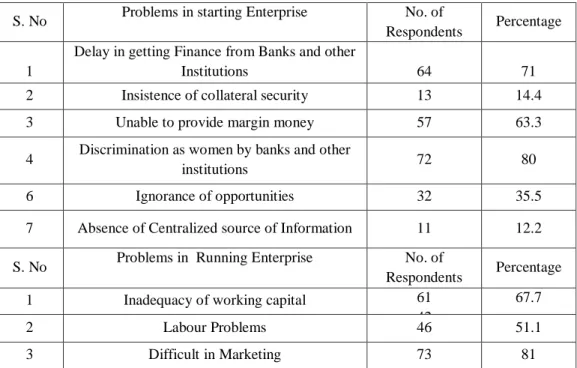
Table No-4 Problems faced by the women Entrepreneurs (Multiple Choice)
S. No Problems in starting Enterprise No. of
Respondents Percentage
1
Delay in getting Finance from Banks and other
Institutions 64 71
2 Insistence of collateral security 13 14.4
3 Unable to provide margin money 57 63.3
4 Discrimination as women by banks and other
institutions 72 80
6 Ignorance of opportunities 32 35.5
7 Absence of Centralized source of Information 11 12.2
S. No Problems in Running Enterprise No. of
Respondents Percentage 1 Inadequacy of working capital 61
42
67.7
2 Labour Problems 46 51.1
A. Stalin IJSRE Volume 05 Issue 11 November 2017 Page 7746 4 Cheating and misbehaviour by
customers and suppliers 55 61
6 Lack of support from family members 36 40
9 Irregular orders 14 15.6
Source: Primary
PROBLEMS OF WOMEN ENTREPRENEURS
Entrepreneurial process is though the same for men and women, women have to confront many problems of varying dimensions and magnitudes in practice, which prevent them from realizing their full potential as entrepreneurs. It is a fact that problems follow women entrepreneurs like a shadow. When a woman has overcome a problem, many more will crop up. The women entrepreneur has to face initial problems i.e. starting problems. She is confronted with more problems when the enterprise is in the running state. She, therefore, has to look after the entire spectrum of problems despite the great limitations under which she functions. Table No: 3 pointed out that 80% respondents faced discrimination as women by banks and other institutions while start-up the business unit followed by 71% respondents who had a problem of delay in getting finance from banks and other institutions. Further, 63%, 35.5% and 14.4% were facing the problems of inadequate margin, ignorance of opportunities meant for all the levels of business processing and insistence of collateral security. This shows that among the problems encountered by the women entrepreneurs, discrimination met out by them as women by banks and other government institutions was found very prime one. So, an effort has to be made to overwhelm the prejudiced and discriminative attitudes towards women in all spheres of business process including the discriminatory practices of banking institutions by dedicated policies and education.
The above table (No.3) also speaks that 81% subjects of the study area reported about difficulty in marketing their products followed by 67.7% respondents who referred inadequacy of working capital as their problems in running business unit. Moreover, 61%, 51.7% and 40% of the respondents did report cheating and misbehavior by customers and suppliers, Lobour Problems and Irregular orders were difficulties they were facing in running their business unit.
CONCLUSION
In the past, womenwere confined to within four walls as they have been unrecognized and undervalued. As a result they have been placed in the inferior position of the society and considered assecond sex. But the changing socio-economic conditions of women out of westernization, industrialization and urbanization altered the grim scenario drastically and opened new vista in social, structural issues of women. Particularly, it opened the way for economic independence of women. This has made them to indulgein every line of business successfullyin the society despite of the hurdles they face in the male dominated society.
Women entrepreneurs often face gender-based barriers at various stages beginning from their initial commencement of enterprise to in running their enterprise. Our respondents were also not an exception for the gender based problems .As per the revelations of the respondents; money is the most important problem they face as an entrepreneur .Whether it is for seed money or for working capital, our study subjects having problem in mobilizing it. Especially they were been subject to undue discrimination in the banking sector. Suggestions for the Development of Women Entrepreneurship
It is suggested to treat women as a specific target groups in all their entrepreneurial ventures.
It is suggested not prescribe any specific qualification for women folk to avail government assistance to start the business on their own.
A. Stalin IJSRE Volume 05 Issue 11 November 2017 Page 7747
Efforts should be made in the direction of simplification of the procedures. Formalities, rules and regulations, etc. required to be fulfilled by the women entrepreneurs in all matter of registration of their and seeking assistance, subsides, concessions, relief etc, from different departments and governments sponsored organization involved in providing a variety of services to women entrepreneurs.
Efforts should be made to increase their efficiency and productivity through appropriate technologies, equipments and practices.
Central and State governments should assist for marketing the products produced by women entrepreneurs.
REFERENCE
1. Ayadurai, Selvamalar, (2005), An Insight into the “Constraints” Faced by Women Entrepreneurs in A War-Torn Area: Case Study of The Northeast of Sri Lanka, presented at the 2005 50th World Conference of ICSB Washington D.C.
2. Bowen, Donald D. & Hirsch Robert D. (1986), The Female Entrepreneur: A career Development Perspective, Academy of Management Review, Vol. 11 no. 2, Page No. 393-407.
3. Cohoon, J. McGrath, Wadhwa, Vivek& Mitchell Leas, (2010), The Anatomy of an Entrepreneur- Are Successful Women Entrepreneurs Different From Men? Kauffman, The foundation of Entrepreneurship.
4. Damwad, (2007), Women Entrepreneurship – A Nordic Perspective, August 2007, Nordic Innovation Centre.
5. Caputo R.K. and Dolinsky Arthur (1998), “Women‟s Choice of Pursue Self-Employment: The Role of Financial and Human Capital of Household Members‟‟, Journal of Small Business Management, Vol. 36 (2), pp. 8-18.
6. Greene, Patricia G., Hart, Myra M, Brush, Candida G, & Carter, Nancy M, (2003), Women Entrepreneurs: Moving Front and Center: An Overview of Research and Theory, white paper at United States Association for Small Business and Entrepreneurship.
7. HarinarayanaRao, C (1991), “Promotion of Women Entrepreneurship: A Brief Comet”, SEDME, Vol.18 (2), pp. 331-334.
8. Hisrich, R. D., & O'Brien, M. (1981). The woman entrepreneur from a business and sociological perspective. In K. H. Vesper (Ed.) Frontiers in entrepreneurship research, pp. 21-39. Wellesley, MA: Babson College.
9. Henry M. Bwisa. (2013). Factors Influencing Growth of Women owned Micro and Small Enterprises-A Survey of Kitale Municipality. International Journal of Academic Research in Business and Social Sciences, 3(10), 182-196.
10. Jalbert, Susanne E., (2008), Women Entrepreneurs in the Global Economy, education research. http://research.brown.edu/pdf/1100924770.pdf.
11. Julieth Elimri Njau & Cyril KalembanaKomba (2014) Women Food Vendors‟ (WFV‟s) Contribution in Household Income in Tanzania: The case of Morogoro Municipal. International Journal of Development Research, 4(11), 2364-2371.
12. Jyothi. (2015) Women Micro Entrepreneurs-Issues & Challenges. International Journal of Innovative Research in Computer and Communication Engineering, 3(7), 343-348.
13. Kale, J.D. (1990), Women Entrepreneurship in Gujarat –Role of Centre forEntrepreneurship Development. Journal of Indian Management 29(7-12): 99-101.
A. Stalin IJSRE Volume 05 Issue 11 November 2017 Page 7748
15. Lall, Madhurima, &SahaiShikha, (2008), Women in Family Business, presented at first Asian invitational conference on family business at Indian School of Business, Hyderabad.
16. Mathew, Viju, (2010), “Women entrepreneurship in Middle East: Understanding barriers and use of ICT for entrepreneurship development”, Springer Science + Business Media, LLC 2010
17. Moore, D. P. &Buttner, E. H. (1997). Women entrepreneurs: Moving beyond New Generation of Women Entrepreneurs Achieving Business Success.
18. Nayyar, Poojaet. al. (2007), “Causes and Constraints Faced by Women Entrepreneurs in Entrepreneurial Process”, The Journal of Social Science. 14(2): 99-102.
19. Orhan M. & Scott D. (2001), why women enter into entrepreneurship: an explanatory model. Women in Management Review, 16(5): 232-243.
20. Padmavati, D. (2002) Training Women for Entrepreneurship, Social Welfare, 49(2):15-18
21. Punitha. M. Sangeetha, S. Padmavathi (1999), “Women Entrepreneurs: Their problems and constraints”, Indian Journal of Labour Economics, Vol 42, No: 4, p 701-706.
22. Ramachandran, K. (1993) Poor women entrepreneurs – Lesson from Asian countries, Small Enterprise Development, 4: 46-48 (1993).
23. Sathyasundaram, I (2004) Encouraging Women‟s Entrepreneurship, Social Welfare, 50(12): 13-15. 24. Singh, Surinder Pal, (2008), An Insight Into The Emergence Of Women-owned Businesses as an
Economic Force in India, presented at Special Conference of the Strategic Management Society, December 12-14, 2008, Indian School of Business, Hyderabad
25. Srivastav, AK &Chaudhary Sanjay (1991): “Women Entrepreneurs- Problems, Perspective and Role Expectations from Banks”, Punjab University Chandigarh.
26. Tambunan, Tulus, (2009), Women entrepreneurship in Asian developing countries: Their development and main constraints, Journal of Development and Agricultural Economics Vol. 1(2), Page No. 027-040.the glass ceiling. Thousand Oaks, CA: Sage.
27. Veena. Rao, Venakatachalam, A. & Joshi, H.G. (2012). Challenges Faced by Women Entrepreneurs Running Micro, Small and Medium Scale Fashion and Apparel Business: A Study on Fashion and Apparel Enterprises in Coastal Karnataka. International Conference on Trade, Tourism and Management, 21-22.
28. Winn, Joan, (2005), “Women Entrepreneurs: Can we remove the Barriers?” International Entrepreneurship and Management Journal, 1(3): 381-397,
29. Yordanova, D.I. (2011). The effects of Gender on Entrepreneurship in Bulgaria: An Empirical Study. International Journal of Management, 28(1). https://en.wikipedia.org/wiki/Female_entrepreneur
Gender-Global Entrepreneurship and Development Institute (GEDI) Index for 2014 RANK TOP 5 COUNTRIES RANK BOTTOM5 COUNTRIES
1 United States 26 India
2 Australia 27&28 Uganda & Egypt
4 Sweden 29 Bangladesh