Corresponding Author: Soroush Avakh Darestani, Faculty of Industrial and Mechanical Engineering, QazvinBranch, Islamic Azad University, Qazvin, Iran.
E-mail: [email protected]
595
A Compensatory Fuzzy Approach to Multi-Objective Supplier Selection Problem in
All-Unit Discount Environments With Multiple-Item
Soroush Avakh Darestani, Samane Ghavami
Faculty of Industrial and Mechanical Engineering, QazvinBranch, Islamic Azad University, Qazvin,
Iran.
Abstract: Supplier selection has become more crucial for today’s production companies due to the variety of products volume of production and competitive environment. This research presented a linear programming model which proposed a compensatory fuzzy approach for finding the optimum strategy to select suppliers. In a real condition, vendors dedicate discount models as an advantageous feature for dealing. In this research, “all-unit” discount was considered a compensatory fuzzy using Werners’ “Fuzzy and”(µand)operatorwas employed. The fuzzy compromise solutions achieved by employing “fuzzy and” (µand)operator showed that the compromise solutions obtained by ‘‘fuzzy and’’ (µand)operator were efficient in multi-objective supplier selection problem multiple-item with discount (MOLSSP-MID). The results demonstrated that by decreasing a compensation parameter from to , utilization of compensatory objective function increased effectively from 0.5621 to 0.6550by 16.5%.
Key words: Compensatory operators, Fuzzy mathematical programming, Supplier selection, Quantity discount, multi-objective.
INTRODUCTION
Supplier selection strategy is an important decisionin a supply chain management (SCM) system. Operation managers rely on purchasing function to achieveproduction inputs from suppliers and to ensure supplierutilization. Selecting appropriatesuppliers can have a significant impact on the reduction of the material purchasing cost, reduction of purchasing risks, quality improvement of final product, improvement of service quality and competitiveness of firms. Assessing a group of suppliers along with selecting one or more of them is a conflicting task. Traditionally, while assessing supplier performance, companies have considered criteria such as price, quality, flexibility, service quality and on-time delivery.
Also, mostsuppliers dedicatequantity discounts which should be considered an extraoption in selecting suppliers and setting optimal orders.Thus, the problem is to select the best suppliers and optimal order quantities for each supplier under the determined limitations .
Management of the firmswants to determine the best suppliers and optimal quantity of the items to be purchased from each supplier under the limitationssuch as quantity discount, demand, capacity, rejected quantity and budget.
Therefore, it is important to select the potential suppliers so that differentobjectivesof the supply chain are achieved.
In fact, a reliable supplier may lead to havingless suppliers in a supply chain, whereas selection of a huge number of suppliers may be done to minimize the risk associated with the purchase, cost increment associated with this approach. Hence, optimization of supplier-base is needed to recognize better performing suppliers in a supply chain.
The restof this paper is organized as follows: In Section 2 some previous studies on supplier selection problem are reviewed. In Section 3, mathematical formulation of the supplier selection model is presented under multi-supplier quantity discount with multiple-items. In Section 4, description of the present methodology is proposed using Werner’s compensatory “fuzzy and” operator to solve multi-objective linear supplier selection problem in quantity discount environment with multiple-items. In Section 5, a numerical example is employed in order to validate feasibility and efficiency of the proposed method using “fuzzy and” operator. Finally in Section 6, the conclusions achieved from this research are discussed.
2. Literature Review:
596
2.1 Reviewing Supplier Selection Problem When Discount is not Considered:
Liu et al.(2000) presenteda simplified data envelopment analysis (DEA) model to evaluate the overall
efficiencyof suppliers with respect to three input and two output criteria. The proposed model at selecting a supplier has higher supply diversity so the number of suppliers can be decreased.
Gao and Tang (2003) developed a multi-objective linear programming model to purchase raw materials for a big-scale steel plant in china.
Hammami et al. (2003) presented a mathematical model to solve the supplier selection and order allocation problem. They employed a long-term optimization based on the analytical hierarchy process (AHP) and weighted point methods.
Hong et al. (2005) presented a mathematical model for supplier selection considering the modification in supplier’s supply capabilities and customer’s requirements over a period of time. This model optimized the revenue and customer requirements concurrently.
Pi and Low (2006) presenteda method for supplier evaluation and selection based on quality, on-time delivery, price and service. The model quantifies these four multiple criteria in terms of Taghuchi quality loss and then uses an AHP to incorporate term into one global variable for decision making.
Li et al. (2009) proposeda short term periodical purchasing and a long term commitment model to select
suppliers under price and demand ambiguity. They created a stochastic dynamic program to incorporate both strategies for deriving optimal supplier selection decisions.
2.2 Reviewing Fuzzy Supplier Selection Problem When Discount is not Considered:
Zarandi and Saghiri (2003) used multi-objective programming approach and fuzzy methodology jointly to extend thea fuzzy multiple objectives decision making model for supplier selection process. In introducedmodel, firstly a fuzzy supplier selection model with multiple products/suppliers, fuzzy objective functions, fuzzy constraints and fuzzy coefficients are targeted and then the developed model is converted to a single objective one step by step.
Then, Kumar et al. (2004) has quantifieda supplier selection problem as a fuzzy mixed integer goal programming supplier selection problem that contains three primary goals, minimizing the net cost, minimizing the net rejections and minimizing the late deliveries. In their model, Zimmermann’s weightless technique is employed, in which there is no difference between objective functions.
In this context, Chen et al. (2006) extended fuzzy Topsis method with trapezoidal fuzzy numbers. They firstly used linguistic values to evaluate the weights of each criterion. They computed the distances among the candidate suppliers and the fuzzy positive and negative ideal solution. To distinguish the priority of all suppliers, the closeness coefficient was defined.
Amid et al. (2006) presented a symmetric fuzzy multi-objective linear model that enables the decision-makers to allocate various weights to various criteria in the problem.
Later on, Sarker and Mohapatra (2006) concluded that performance and capability were two main measures in the supplier evaluation and selection problem. The authors appliedthe fuzzy set approach to account for the imprecision involved in numerous subjective characteristics of suppliers. A hypothetical case was adopted to show how the best suppliers were selected with respect to four performance-based factors.
Finally, Onut et al. (2009) introduced an integrated fuzzy analytic network process (FANP) and fuzzy TOPSIS (FTOPSIS) methodology. Contrary to conventional FANP method, triangular fuzzy numbers in all pairwise comparison matrices are considered. Therefore, criteria cost, references, quality of the product delivery time, and weights are inserted to the FTOPSIS methodology to rank the suppliers for selection.
2.3 Reviewing Supplier Selection Problem Considering Discount:
Benton (1991) extended a non linear program and a heuristic procedure using Lagrangian under status of multiple items, resource constraints and quantity discount. The single objective is to minimize the whole purchasing costs, inventory costs and order costs.
Then, Rosenthal et al. (1995) representeda mixed integer programming model for supplier selection with bundling, in which a buyer needs to buy multiple products from multi suppliers with limited capacity and also with various quality and delivery efficiencywhich buffer bundled items at discount prices. They engaged a single objective programming in their model. They were the first authors the pertained about bundling discount when supplier selection is addressed.
Crama et al. (2004) explained the purchasing decisions faced by a multi plant company and quantified cost minimization problem as a non-linear mixed 0-1 programming problem where suppliers developed discount intervals based on the total quantity of ingredients purchased. In these model, the cost is considered as a single objective function and other criteria such as quality and demand are shaped into limitations.
all-597
unit discount plan. They pertained that not only this problem is NP-hard but also exists no polynomial time approximation algorithm with a constant index.
Also, Xia and Wu (2007) presented a model that integrates approach improved AHP by rough sets theory and multi-objective mixed integer programming to cover supplier selection decisions in business volume discount conditions. The multi-objective model is formulated in such a way as to concurrently assign the number of suppliers to employ and the order quantities assigned to the supplier simultaneously to minimize total purchase cost, maximize total weighted quantity of purchasing, minimize the number of defective goods, and maximize on-time delivery (OTD), while satisfying supply capacity and demand limitation.
In addition, Kokangul and Susuz (2009) an integration of analytical hierarchy process and non-linear integer and multi-objective programming under some limitationssuch as quantity discount, capacity, and budget is used to determine the foremost suppliers and to place the optimal order quantities among them. The objective of the developed mathematical models are maximizing the total valueof purchase (TVP), minimizing the total cost of purchase (TCP) or maximizing TVP and minimizing TCP at the same time.
Sarfraz (2011) dedicatedan integrated model of AHP and preemptive goal programming (PGP). The model attempts to represents a solution methodologywhere vendors offer discounts on total amount of sales worth and not on the quantity or diversity of goods in a conflicting multi-objective scenario wherein one needs to maximize the wholepurchasing worth and minimize the whole cost.
2.4Reviewing Fuzzy Supplier Selection Problem in Discount Environment:
Amid et al. (2009) formulated a weighted additive fuzzy multi-objective model for the supplier selection problem under all-unit price discounts. They developed the problem in such a way as to concurrently consider the imprecision of information and specify the order quantities to each supplier based on price breaks. The problem contains the three objective functions: minimizing the cost, minimizing the rejected goods and delayed deliveries, while satisfying capacity and demand requirement limitations. They argued in actfor supplier selection problems. Most of the input information is not known accurately, so they employ the fuzzy optimization theory to deal with this vagueness. Moreover, a fuzzy weighted additive and mixed integer linear programming is extended.
In the same discount strategy, Wang and Yang (2009) presented a fuzzy multi-objective model for supplier selection under all-unit discount environment for single item. In their model, minimize the net price with a variable quantity discount rate, minimize defective rate and minimize delivery lateness rate are the three most important objectives in evaluation alternative suppliers. Their AHP and fuzzy compromise programming are noted outin their study to simplify such decision making.
Later on, Elahi et al. (2011) worked on the quantity discount and introduced a multi-objective linear programming included three objective functions for minimizing cost, defective rate and delivery lateness for amounts of product which are purchased from different suppliers and employeda fuzzy compromise programming in order to transform this problem to a single objective model and incorporate the weights of objective through different decision maker’s opinion.
Seifbarghy et al. (2011) introduceda comprehensive model for ranking an arbitrary number of them and allocating a quota of an order to them considering three objective functions: minimizing for all the net cost, the net rejected items and the net delivers. The two-stage logarithmic goal programming method for producing weights from interval comparison matrices (Wang et al. 2005) is used for ranking and selecting the suppliers. It is presumed that the suppliers give price discounts. A fuzzy multi-objective model is furnishedin such a way as to consider imprecision of information.
Ozkok and Tiryaki (2011) introduced “a compensatory fuzzy approach to multi-objective linear supplier selection problem with multiple-item”. This research is developed based on their research with considering discount.
3. Model Development:
A general multi-objective for the supplier selection problem can be defined as follows (Weber, 1993,Ghodsypour and O’Brien, 2001):
Where are the negative objectives or criteria-like cost, late delivery, etc and
598
In this section, a mathematical model of the supplier selection decision under the condition that each supplier offers all-unit quantity discount for any item is formulated. Following set of assumptions, index set, decision variable and model parameters are defined in order to describe the model as follows:
Assumptions:
1. All-unit discount are considered.
2. No shortages of the items are permitted for any of suppliers.
3. Multi-item can be purchased as required quantity from different suppliers. 4. The buyer can purchase required quantity from multiple suppliers. Index:
iIndex for supplier, i=1, 2,..., n s Index for items, s=1, 2,..., r
j Index for price level, j=1, 2,... ..,m(i,s) k Index for objectives, k=1,2,..,q Decision Variable:
Order quantity of item s from supplier i in price level j Model Parameter:
Demanded quantity of item s
Upper limit of the quantity of item s obtained by supplier i Number of suppliers competing for selection
Number of quantity ranges in supplier i’s price level for item s Unit price of item s in price level j obtained by supplier i
The jth price level from supplier i for item s
If the ith supplier for item s is selected at price level j and otherwise Percentage of service quality level of item s from supplier i
Percentage of quality level of item s from supplier i Percentage of rejected quantityof item s from supplier i Upper limit of rejected quantity for item s
Budget constraint allocated to item s 3.1 Objective Functions:
The objective function of the model is defined by three sub objective function as follows: 3.1.1 Total Purchased Cost Minimization:
The buyer expects to minimize the total purchase cost, in which each supplier offers “all-unit” quantity discount for any item, so that the objective function can be stated as:
(1) Where at most one of the variables for j=1,2,....,m(i,s) can be positive and the rest should be equal to zero and it is assumed that:
> > ...>
3.1.2 Service Quality Maximization:
Supplier’s service quality rating is very critical indicator for supplier selection problem. This rating value include after sale service, item delivery on time, etc. The objective function maximizes the total service quality and can be represented as follows:
(2) 3.1.3 Item Quality Maximization:
599
(3) 3.2 Constraints:
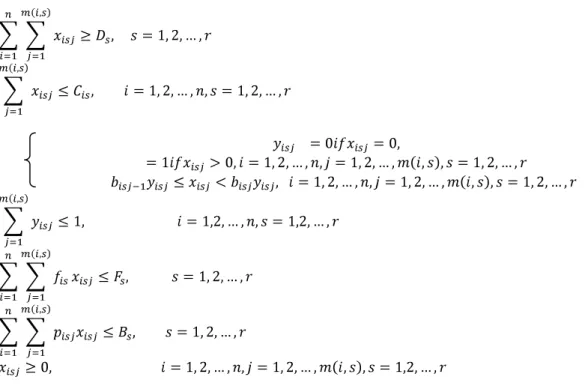
There are some constraints which associated with the supplier selection problem. In the following these constraints are illustrated and modeled:
3.2.1 Demand Constraint:
The first constraint which we have faced is the demand constraint that implies the total purchased quantity of any item and should be equal to the total demand item of the buyer. This is modeled as follows:
(4)
3.2.2 Capacity Constraints:
This constraint reveals that the total purchased quantity from each supplier for each item must be equal or less than the supply capacity of considered supplier for any item. So we have the following inequality:
(5) 3.2.3 Discount Intervals Constraints:
Constraints set (6) is an integrality constraint to represent the binary nature of the supplier selection decision, constraint set (7) is a quantity range constraint to meet the number of quantity range for any item in a supplier’s price level and constraint set (8) prove the price level per supplier for any item among which can be chosen only one or none.
(6) (7)
(8)
3.2.4 Rejected Quantity Constraint:
Since is acceptable defective rate for item s and is the percentage of rejected quantity of supplier i for item s, the rejected quantity constraint for item s can be noted follows:
(9) 3.2.5 Budget Constraint:
Since is budget allocated to item s and unit price of item s in price level j obtained by supplier i, the budget constraint for item s be constructed as follows:
(10)
3.3The Final Mathematical Programming Model:
600
4. A Compensatory Fuzzy Approach to Multi-Objective Supplier Selection in Quantity Discount Environment for Multiple-Item:
In this research, according to Ozkok and Tiryaki (2011), Werners’ compensatory “fuzzy and”
(
µ
and)
operatorwas used for supplier selection problem since the compensatory solutions generated by this operator do guarantee Pareto-optimally for the supplier selection problem.4.1 Fuzzy Membership Function Determination:
The shape of the fuzzy membership functions is considered linear. To determine fuzzy membership function for each particular objective in the problem, the objective function should be individually maximized and minimized subject to the existing constraints.
Thus, two acceptable values of bottom ( and top ( ) can be obtained for each objective.
The linear membership function for the minimization objective , can be defined as follows: minimization objective function:
k
µ
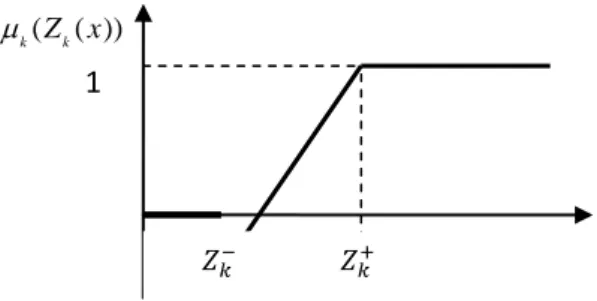
The linear membership function for minimization objective function isshown in Figure 1.
1
Fig. 1: The linear membership function for the minimization function. ( ( ))
k Zk x
601
According to Figure 1, increase in the amount of objective function linearly decreased value of membership function until was equal to zero.
But, the linear membership function for the maximization objective , can be defined as follows:
maximization objective function:
k
µ
The linear membership function for maximization objective function is presented in Figure 2.
Fig. 2: The linear membership function for the maximization function.
According to Figure 2, increase in the amount of objective function linearly decreased value of membership function until equaled zero.
4.2 A Compensatory Fuzzy Approach forMOLSSP-MID:
Zimmermann (1978) developed fuzzy programming approach for multi-objective linear programming problem.
Using the linear membership function, Zimmermann (1978) proposed the “min” operator model to the multi-objective linear problem which could be written as:
max min (z ( ))x
k k
µ
k k. .
s t
d
x∈X
(13)
Equation (13) introduces an auxiliary variable , which can be transformed into the following equivalent conventional linear programming problem:
maxλ . .
s t
( ( ) ,
k Z xk λ
µ
≥ k=1, 2, ...,qd
x∈X
0≤ <λ 1 (14)
According to Lee and Li (1993), Guu and Wu (1997) and Wu and Guu (2001) researches, Zimmermann’s min operator model does not always yield a strongly-efficient solution. Using Werner’s
µ
and operator, (14) can be converted into the following form (Ozkok and Tiryaki, 2011):1
(1 )
max
q
and k
k
k
γ
λ λ
µ
= −
= +
∑
. .
s t
d
x∈X
1, 2, ..., ,
k= q µk(Zk( ))x ≥ +λ λk,
1
( ( ))k Zk x
602 1,
k
λ λ+ ≤
[ ]
, k 0,1 λ λ∀ ∈
[ ]
0,1 .
γ
∈
(15) 5. Numerical Example:
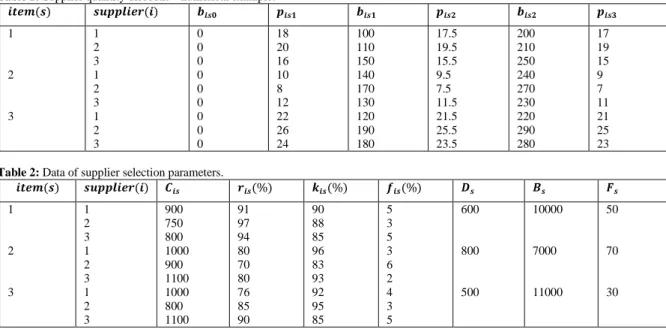
In this section, authors employ a numerical example to test the presented model. The buyer wishes to purchase three items from the best suppliers and allocate optimal order quantities to them. Assume that three suppliers are ready to supply for any item. The price of any items offers in the three price level ( in $) for any supplier are provided in Table1. The supplier’s capacity for any item ( ), the percentage of quality level of item s from supplieri ( ), the percentage of service quality level of item s from supplier i ( ), the percentage of rejected quantity of item s from supplier i ( ), demand quantity of item s ( ), Budget allocated to item s ( ) and upper limit of rejected quantity for item s ( presented in Table 2.
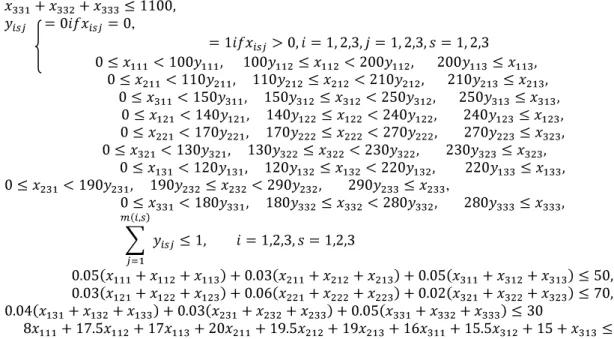
Therefore, for the numerical example multi-objective programming model obtained by equations from (1) to (10) can be written as:
Table 1: Supplier quantity discount – numerical example.
1 2 3 1 2 3 1 2 3 1 2 3 0 0 0 0 0 0 0 0 0 18 20 16 10 8 12 22 26 24 100 110 150 140 170 130 120 190 180 17.5 19.5 15.5 9.5 7.5 11.5 21.5 25.5 23.5 200 210 250 240 270 230 220 290 280 17 19 15 9 7 11 21 25 23
Table 2: Data of supplier selection parameters.
603 ,
,
The maxima and minima for three objectives are shown in Table 3.
So, by using (11),(12) and Table 3, the membership functions can be defined as follows:
1 1 1
28000 ( )
( ( )) ,
28000 25100
Z x Z x
µ
= −−
2 2 2
( ) 1620
( ( )) ,
1861.7 1620
Z x Z x
µ
= −−
3 3 3
( ) 1490.5
( ( )) ,
1720.1 1490.5
Z x Z x
µ
= −−
So, for our compensatory problem corresponding to (15) will be in the form as follows:
1 2 3
(1 )
( )
3
max
µ
and = +λ
−γ
λ λ
+ +λ
. .
604 ,
,
7000,
( ) ,
1 x 1
µ ≥ +λ λ
( ) ,
2 x 2
µ ≥ +λ λ
( ) ,
3 x 3
µ
≥ +λ λ
1 1,
λ λ
+
≤2
1,
λ λ
+
≤
3
1,
λ λ
+
≤
0,
x
isj ≥
i
=
1, 2, 3,
s
=
1, 2, 3,
j
=
1, 2, 3
0,
1 2 3
λ λ
+ +λ
+λ
≥where γ ∈
[ ]
0,1 .Table 3: The individual maxima and minima.
1
Z
Z
2Z
3k
Z− 25100 1620 1490.5
k
Z+ 28000 1861.7 1720.1
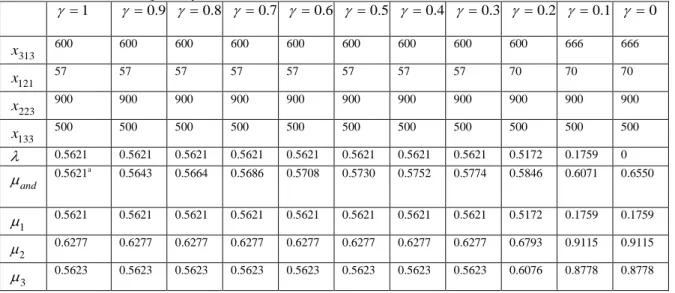
Table 4 shows that the solutions and the values of the membership functions obtained by solving (17)fordifferent 11 values of the compensation satisfactory level .
Hence, our compensatory model creates the following tree compensatory compromise efficient solutions (Solution 1, Solution 2 and Solution 3) for MOLSSP-MIDmodel. Forγ =1, µandequals to min (non compensatory) operator that isµand =0.5621 and it gives Solution 1. This solution remain the same fromγ =1to
0.3
605
Table 4: The results of our compensatory model.
1
γ = γ =0.9 γ =0.8 γ =0.7 γ =0.6 γ =0.5 γ =0.4 γ =0.3 γ =0.2 γ =0.1 γ =0
313
x 600 600 600 600 600 600 600 600 600 666 666
121
x 57 57 57 57 57 57 57 57 70 70 70
223
x 900 900 900 900 900 900 900 900 900 900 900
133
x 500 500 500 500 500 500 500 500 500 500 500
λ 0.5621 0.5621 0.5621 0.5621 0.5621 0.5621 0.5621 0.5621 0.5172 0.1759 0
and
µ 0.5621a 0.5643 0.5664 0.5686 0.5708 0.5730 0.5752 0.5774 0.5846 0.6071 0.6550
1
µ 0.5621 0.5621 0.5621 0.5621 0.5621 0.5621 0.5621 0.5621 0.5172 0.1759 0.1759
2
µ 0.6277 0.6277 0.6277 0.6277 0.6277 0.6277 0.6277 0.6277 0.6793 0.9115 0.9115
3
µ 0.5623 0.5623 0.5623 0.5623 0.5623 0.5623 0.5623 0.5623 0.6076 0.8778 0.8778
aAlternative optimal solutions exist.
Solution 1:
600, 57, 900, 500,
313 121 223 133
x = x = x = x =
( ) 26370, ( ) 1771.72, ( ) 1619.6.
1 2 3
Z x = Z x = Z x =
From
γ
=
0.2
, the compensatory model produce the Solution 2. Forγ =0.2, µandequals to 0.5846. As it is observed, the satisfactory level of the objectives is equal 0.5172, 0.6793, 0.6076,respectively.Solution 2:
600, 70, 900, 500,
313 121 223 133
x = x = x = x =
( ) 26500, ( ) 1784.2, ( ) 1630.
1 2 3
Z X = Z X = Z X =
Fromγ =0.1toγ =0, the compensatory model produces the Solution 3. Forγ =0, µand equals to average (full-compensatory) operator that isµand=0.6550. As seen here, the satisfactory level of the objectives is 0.1759, 0.9115, 0.8778, respectively. The efficiency of the purchasing process for this supplier selection problem is averagely 0.6550, that is what management averagely guarantees this level.
Solution 3:
666, 70, 900, 500,
313 121 223 133
x = x = x = x =
( ) 27490, ( ) 1840.3, ( ) 1692.04.
1 2 3
Z X = Z X = Z X =
6. Conclusion:
According to the findings of this research, the objective of authors was to construct a compensatoryfuzzy method for MOLSSP-MID problem under an “all-unit” condition to select appropriate suppliers for each of the required products and also specify how much should be ordered from each of the selected suppliers. In the literature, there are several studies which have donesupplier selection problem using many applications. However, no compensatory fuzzy approach has been reported so far for MOLSSP model under discount condition.
From the present authors’ view points, therefore, an operator can generate a compromise solution which is more efficient compared with Zimmermann’s min operator for multi-objective supplier selection problem.
606 REFERENCES
Amid, A., S.H. Ghodsypour, C. O’Brien, 2006. Fuzzy multi-objective linear modelfor supplier selection in a supply chain. International Journal of Production Economics, 104: 394-407.
Amid, A., S.H. Ghodsypour, O’Brien, Ch., 2009. A weighted additive fuzzy multi-objective model for the supplier selection problem under price breaks in a supply Chain. International Journal of Production Economic, 121: 323-332.
Benton, W.C., 1991. Quantity discounts decision under conditions of multiple items, multiple suppliers and resource limitation. International Journal of Production Research, 29(10): 1953-1961.
Chen, T.C., C.T. Lin, S.F. Huang, 2006. A fuzzy approach for supplier evaluation and selection in supply chain management. International Journal of Production Economics, 102: 289-301.
Crama, Y., R. Pascual, A. Torres, 2004. Optimal procurement decisions in the presence of total quantity discounts and alternative product recipes. Journal Operational Research, 159: 364-378.
Elahi, B., S.M. Seyed-Hosseini, A. Makui, 2011. A Fuzzy Compromise Programming Solution for Supplier Selection in Quantity Discounts Situation. International Journal of Industrial Engineering & Production Research, 22(2): 107-114.
Gao, Z., L. Tang, 2003. A multi-objective model for purchasing of bulk rawmaterials of a large-scale integrated steel plant. International Journal ofProduction Economics, 83(3): 325-334.
Goossens, D.R., A.J.T. Maas, F.C.R. Spieksma, J.J. Klundert, 2007. Exact algorithms for procurement problems under a total quantity discounts structure. European Journal Operation Research, 178: 603-626.
Ghodsypour, S.H., C. O’Brien, 2001. The total cost of logistic in supplier selection, under conditions of multiple sourcing, multiple criteria and capacity constraints. International Journal of Production Economics, 73: 15-27.
Guu, S.M., Y.K. Wu, 1997. Weighted coefficients in two-phase approach forsolving the multiple objective programming problems. Fuzzy Sets and Systems, 85: 45-48.
Hammami, A., P. Burlat, J.P. Campagne, 2003. Evaluating orders allocation within networks of firms. International Journal of Production Economics, 86: 233-249.
Hong, G.H., S.C. Park, D.S. Jang, H.M. Rho, 2005. An effective supplier selection method for constructing a competitive supply-relationship. Expert Systems withApplications, 28(4): 629-639.
Kokangul, A., Z. Susuz, 2009. Integrated analytical hierarch process and mathematical programming to supplier selection problem with quantity discount. Applied Mathematical Modeling, 33: 1417-1429.
Kumar, M., P. Vart, P. Shankar, 2004. A fuzzy goal program- ming approach for supplier selection problem in a supply chain. Computer and Industrial Engineering, 46: 69-85.
Lee, E.S., R.J. Li, 1993. Fuzzy multiple objective programming and compromise programming with Pareto optimum. Fuzzy Sets and Systems, 53: 275-288.
Li, S., A. Murat, W. Huang, 2009. Selection of contract suppliers under price and demand uncertainty in a dynamic market. European Journal of Operational Research, 198 (3): 830-847.
Liu, J., F.Y. Ding, V. Lall, 2000. Using data envelopment analysis to compare suppliers for supplier selection and performance improvement. Supply ChainManagement: An International Journal, 5(3): 143-150.
Onut, S., S.S. Kara, E. Isik, 2009. Long-term supplier selection using a combined fuzzy MCDM approach: a case study for a telecommunication company. Expert Systems with Applications, 36(2): 3887-3895.
Ozkok, B.A., F. Tiryaki, 2011. A compensatory fuzzy approach to multi-objective linear supplier selection problem with multiple-item. Expert Systems with Applications, 38: 11363-11368.
Pi, W.N., C. Low, 2006. Supplier evaluation and selection via Taguchi loss functions and an AHP. International Journal of Advanced ManufacturingTechnology, 27(5-6): 625-630.
Rosenthal, E.C., J.L. Zydiak, S.S. Chaudhry, 1995. Vendor selection with bundling. Decision Sciences, 26(1): 35-48.
Sarfraz, A., 2011. An integrated multi objective decision making process for supplier selection with volume discounts. Proceedings on Industrial Engineering and Operations Management Kuala Lumpur, Malaysia, January, 22-24.
Sarkar, A., P.K.J. Mohapatra, 2006. Evaluation of supplier capability and performance: A method for supply base reduction. Journal of Purchasing and Supply Management, 12(3): 148-163.
Seifbarghi, M., A. Pourebrahim, M. Alidoost, 2011. A comprehensive fuzzy multiobjective supplier selection model under price brakes and using interval comparison matrices. Journal of Industrial and Systems Engineering, 4(4): 224-244.
Wang, T.Y., Y.H. Yang, 2009. A fuzzy model for supplier selection in quantity discount environments. Expert Systems with Applications, 36: 12179-12187.
607
Weber, C.A., J.R. Current, 1993. A multi objective approach to vendor selection. European Journal of Operational Research, 68: 173-184.
Wu, Y.K., S.M. Guu, 2001. A compromise model for solving fuzzy multiple objective problems. Journal of the Chinese Institute of Industrial Engineers, 18(5): 87-93.
Xia, W., Wu, Zh., 2007. Supplier selection with multiple criteria in volume discount environments. Omega, 35: 494-504.
Zarandi, M.H.F., S. Saghiri, 2003. A comprehensive fuzzy multi-objective model for supplier selection process. Fuzzy systems the 12th IEEE international conference, 368-373.