BIOSORPTIVE-FLOTATION OF Pb
2+AND Cd
2+FROM WATER
USING EGGSHELLS AS SORBENT AND OLEIC ACID AS
SURFACTANT
S. E. Samra,
[a]A. M. El-Nokrashy,
[b]and A. A. El-Asmy
[a,c]*Keywords: Ionic flotation, Eggshells, Cadmium, Lead, Surfactant
The removal and recovery of Pb2+ and Cd2+ is important for environmental protection and economic reasons. A new method, sorptive
flotation, for the removal of Pb2+ and Cd2+ from aqueous solutions and water samples using eggshells as sorbent and oleic acid (HOL) as
surfactant has been investigated. The process parameters (solution pH, initial concentration of metal ions, sorbent dose, shaking time, oleic acid (HOL) concentration, and temperature) on the flotation of Pb2+ and Cd2+ were studied in batch system. Under the optimum
experimental conditions suggested, the removal of ~ 100 % of Pb2+ and Cd2+ was attained. The procedure was successfully applied for the
removal of Pb2+ and Cd2+ from different natural water samples.
* Corresponding Authors Tel.: +96566734989: E-Mail: [email protected]
[a] Chemistry Department, Faculty of Science, Mansoura University, Mansoura, Egypt.
[b] Central Laboratory of drinking water, Dakahliya Company for Water & Wastewater, Mansoura, Egypt.
[c] Chemistry Department, Faculty of Science, Kuwait University, Kuwait.
Introduction
Toxic heavy metals such as cadmium and lead are released into the environment. They are environmental pollutants due to strong tendency to concentrate in environment and in food chains.1-5
Heavy metal contamination exists in aqueous waste streams of metal plating facilities, mining operations and tanning, metal finishing industries, chemical and battery manufacturing, paints and metal extraction.5-7 Wastewaters from chemical industry polluted by heavy metal ions represent a hazard for all living organisms especially for human.8,9 These metals can cause danger for ecosystems and human health if they are discharged into natural water resources and may pose finally a serious health hazard.10-12 As these toxic metals accumulate by living organisms, they produced diseases and disorders.13
Lead is one of the major pollutants because of its presence in automobile fuel and subsequent emission into the atmosphere in the exhaust gases.14,15 Pb(II) is very toxic, causing many health problems to human such as: nausea, renal disturbances ending with renal failure hepatitis, encephalopathy, anemia, lung inefficiency, bone lesions, hypertension, cancer, nervous disorder, coma, convulsions and subtle effects on metabolism, intelligence and sickness even death.14 17 Due to toxic effects of lead ions, its removal from waters and wastewaters is important in terms of
Also, cadmium is one of the heavy metals with a greatest potential hazard to humans and environment. It makes a way to water bodies through wastewater from metal plating industries, industries of Cd–Ni batteries, phosphate fertilizer, lead–zinc mining, pigments, stabilizers, ceramics, photograph development, textile printing industries and alloys.20,21 The poisoning of cadmium in human causes high blood pressure, kidney damage, destruction of testicular tissue and red blood cells. In small amounts, cadmium is associated with hypertensive diseases and considered as carcinogenic to men.20
One of the cheap and easily available materials having great sorption for heavy metals is eggshells. Due to its high calcium content, eggshells usually have no commercial importance. Disposal of eggshells is also a serious problem for egg processing industries due to stricter environmental regulations and high landfill costs.22 It is proposed to apply hen eggshells as low-cost biological sorbent of metal ions. In USA annually 120,000 tons of waste eggshells is generated and disposed in landfills.23,24 The hen eggshells consists of mammillary matrix (i.e., eggshell membrane) consisting of interwoven protein fibers and spherical masses, and spongy matrix (i.e., calcified eggshell) made of calcium carbonate.25,26
The by-product eggshell weighs approximately 10 % of the total mass (~ 60 g) of hen egg,27 representing a significant waste from the egg-derived products processor because it was traditionally useless and commonly disposed of in landfills without any pretreatment.26 The chemical composition (by weight) of byproduct eggshell is calcium carbonate (94 %), magnesium carbonate (1 %), calcium phosphate (1 %) and organic matter (4 %).27,28
must have a high surface area, high reactivity with the pollutants to be removed and good characteristics of coagulation/flocculation and flotation.29-31
Experimental
Chemicals and solutions
Unless otherwise stated, all chemical reagents used in this study were of analytical grade.
Surfactant preparation
Oleic acid (HOL) stock solution (6.36 × 10² mol L-1) was prepared from the food grade with sp.gr, 0.895 (provided from J.T. Baker chemical Co.) by dispersing 20 ml of oleic acid in one liter of kerosene. Further dilution was prepared as required for another concentration.
Pb2+ and Cd2+ stock solutions
Stock solution (1000±2 mg L-1) was prepared from Merck CRM (Germany) Pb(NO3)2 or Cd(NO3)2, respectively, in HNO3. The working solutions were made by diluting with deionized water. Standard aqueous solutions of HNO3 and/or NaOH were used for controlling the pH.
Eggshells (ES)
The eggshells were obtained from eggshells processing markets. The sample was washed, dried for 2 h in an oven maintained at 125°°C allowed to cool to room temperature and crushed. The sample sieved with size (25-63 µm) and stored in a desiccator. The functional groups of ES were characterized through IR spectra. The observable bands at 710, 875, 1420, 1797 and 2516 cm-1 coincide with pure CaCO3.25 The chemical analysis of the sample was found to be CaCO3 (94 %), MgCO3 (1 %), Ca3(PO4)2 (1 %) and organic matter (4 % ) as previously mentioned.27,28
Apparatus
Atomic Absorption Spectrometer (AAS)-Varian AA240FS, Australian, was used for the determination of lead and cadmium concentrations at 217 and 228 nm respectively, provided with micro burette 5 and 10 ml. The infrared analysis was undertaken via a Mattson 5000 FT-IR Spectrophotometer and using KBr disc. The X-ray diffraction was recorded via a XRD Bruker, Germany. The scan electron microscope analysis was undertaken via SEM-JEO/JSMS 410, Japan with energy dispersive X-ray EDX Unit, Oxford, England. The pH was measured using a Symphony pH meter, USA, provided with a glass electrode. Also, Milli-Q A10/ Elix Millipore-deionizer, France was used for deionized water, Binder FD240-drying oven, Germany. The flotation cell was a cylindrical tube of 1.5 cm inner diameter and 29 cm length with a stopcock at the bottom and a quick-fit stopper at the top.
Procedures
To study the different parameters affecting the sorptive-flotation process, 10 ml aliquot of suspension containing defined amounts of metal ions, sorbent sample, HCl or HNO3 and/or NaOH (for controlling pH) was introduced into a flotation cell. The flotation cell was shaken for the optimized time, to ensure complete flotation of metal ions with sorbent. To this suspension inside the cell, 2 ml of HOL was added. Again, the cell was inverted upside down many times by hand and kept standing for 5 min to complete flotation.
The flotation efficiency (Re %) of metal ion was calculated from the following relation:
where
Ci and Cf denote the initial and final concentrations, respectively.
Results and Discussion
Effect of pH
As a function of solution pH, Pb and Cd species may exist as soluble Pb2+, hydroxo-species [Pb(OH)+, Pb(OH)3- or [Pb(OH)4]2- in addition to insoluble lead hydroxide, Pb(OH)2, and hydrolytic species, Cd(OH)+.32,33
The tendency of hydroxyl species in the float is sensitive to the solution pH. In order to find the optimal pH value for the sorptive-flotation process, the removal efficiency of Pb2+ and Cd2+ at pH 3, 6, 7 and 9 was studied. Figure 1 shows the effect of pH on the sorption-flotation for the removal 10 mg L-1 M2+ using 0.3 g ES and 5 x 10⁻² mol L-1 HOL.
It should be noted that the removal of Pb2+ and Cd2+ increases with pH reaching ~ 100 % at pH 6- 9 due to the adsorption of hydrolytic species in the same manner as that reported34 and/or surface precipitation of the metal as insoluble carbonate, forming successive layers on the sorbent surface,35 the predominant species at this pH range and the negatively charged surface of eggshells and precipitation of metal carbonate on ES surface. The aggregates of ES-M2+ precipitate, being made hydrophobic by combination with undissociated oleic acid through hydrogen bonding and/or chemically with oleate anions. These hydrophobic aggregates are floated to the solution surface. Therefore, pH 6 was recommended throughout all other experiments. At pH < 6, the hydrolytic species of M2+ may adsorb or ion exchange with calcium sites of the ES sorbent. The adsorbent-adsorbate system is hydrophobic by combining with undissociated oleic acid molecules. Such combination may occur through hydrogen bonding of the hydroxide group of HOL.
i f e
i
( )
100 C C
R
Figure 1. Removal of 10 mg L-1 metal ions on 0.3 g ES at different
pH and 5 min shaking time.
Effect of ES and M2+ concentrations
Series
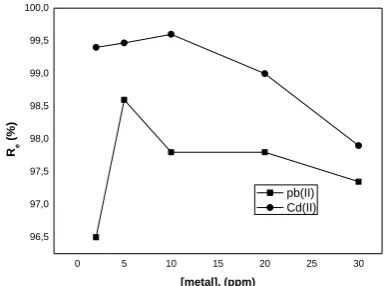
of experiments were performed to study the influence of the eggshell dose (Figure 2) and changing the M2+ concentrations (Figure 3) on the removal percentage of Pb2+ and Cd2+ from aqueous solutions at pH 6 using 5 x 10⁻² mol L-1 HOL. As the concentration of M2+ increases, the removal % of the M2+ ions on ES increases.Figure 2. Removal % of 10 mg L-1 M2+ using different
concentrations of ES and 5 × 10⁻² mol L-1 HOL at pH 6 and 4 min
shaking time
Figure 3. Removal % of different concentrations of M2+ using 0.3
g ES and 5 × 10⁻² mol L-1 HOL at pH 6
Effect of HOL concentration
Series of experiments was undertaken to float 10 mg L-1 M2+ from aqueous solution at pH 6 in presence of 0.3 g of ES using different concentrations of HOL. The obtained results (Figure 4) showed that a maximum removal of M2+ (~100 %) was attained over HOL concentration of 5 x 10⁻² mol L-1. Consequently, the concentration of HOL employed was fixed at 5 x 10⁻² mol L-1 throughout the study.
Figure 4. Removal % of 10 mg L-1 M2+ using 0.3 g ES and
different concentrations of HOL at pH 6
Effect of shaking time
The % removal of M2+ with shaking time was studied using 10 mg L-1 M2+, 0.3 g ES and 5 × 10⁻² mol L-1 of HOL at pH 6. The shaking time was varied from 0.5 to 5 min. The obtained results (Figure 5) showed that the % removal increases to ~100 % after 4 min for 10 mg L-1 M2+. Therefore, 4 min shaking was considered sufficient for the adsorption and flotation of M2+ having a concentration of 10 mg L-1 at pH 6.
Figure 5. Removal % of 10 mg L-1 M2+ using 0.3 g ES and 5 × 10⁻²
mol L-1 HOL at different shaking time
3 4 5 6 7 8 9
95,0 95,5 96,0 96,5 97,0 97,5 98,0 98,5 99,0 99,5 100,0 Re (% ) pH Pb(II) Cd(II)
0,1 0,2 0,3 0,4 0,5 0,6 0,7 0,8 86 88 90 92 94 96 98 100 Re (% )
Eggshell dose, (g)
Pb Cd
0 5 10 15 20 25 30
96,5 97,0 97,5 98,0 98,5 99,0 99,5 100,0 Re (% ) [metal], (ppm) pb(II) Cd(II)
0 10 20 30 40 50
96,0 96,5 97,0 97,5 98,0 98,5 99,0 99,5 100,0 Re (% )
[HOL] x10-3
Pb Cd
0 1 2 3 4 5
Effect of temperature
Solutions of definite pH containing 10 mg L-1 M2+ and 0.3 g of ES and another solution containing 5 × 10⁻²mol L-1 HOL were either heated or cooled. The surfactant solution was quickly poured onto the M2+ solution in the flotation cell. The mixture was then floated using the previous procedure. The obtained results (Figure 6) indicate that the % removal of M2+ increases as the temperature increases. Such data proposed that the adsorption of Pb2+ and Cd2+ may proceed through chemical-bond formation and ion exchange. Moreover, the increase of temperature to 60°C resulted in an increase in the rate of M2+ removing for the same dose of ES sorbent, 0.3 g. Such results suggest the creation of new active sites on ES surface available for adsorption of M2+.
Figure 6. The removal of 10 mg L-1 metal ions using 0.3 g of ES
and 5 × 10⁻² mol L-1 HOL at different Temperature.
Application
The recommended procedure was performed to recover 10 mg L-1 M2+ added to aqueous and some natural water samples. The sorptive-flotation experiments were carried out using 10 ml of sample solutions with its initial pH. The obtained results (Table 1) show that the recovery is satisfactory.
Table 1. Recovery of 10 mg l-1 metal ions added to some water
samples using 0.3 g of ES sorbent and 5 x 10⁻² mol L-1.
Sample (location) Found (mg L-1)
Re % Pb(II) Cd(II) Pb(II) Cd(II)
Distilled water 9.95 9.961 99.50 99.61
Tap water (our laboratory)
9.87 9.846 98.70 98.46
Nile water (Mansoura City)
9.92 9.910 99.20 99.10
Underground water (Mansoura City)
9.89 9.786 98.90 97.86
Sea water (Sharm El-Sheikh)
9.78 9.698 97.80 96.98
Instrumental studies
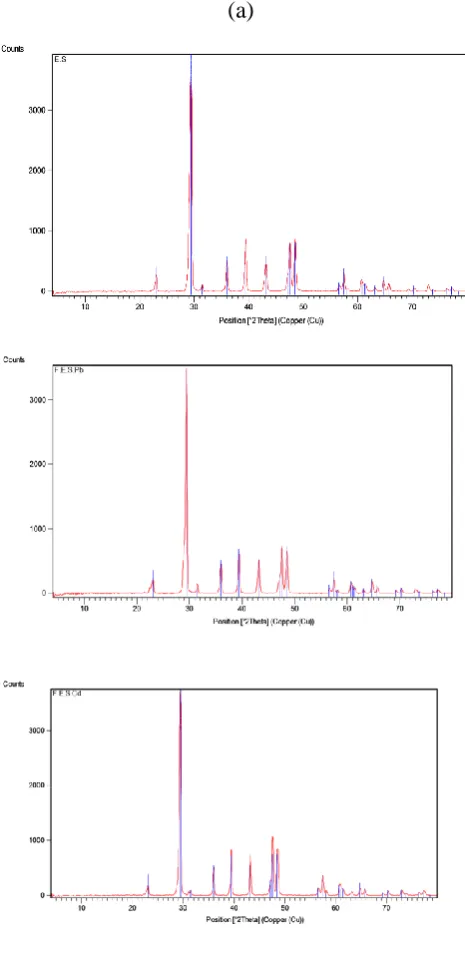
The Pb2+ and Cd2+ sorption by ES is interpreted by XRD, EDX and SEM analyses. Powered XRD studies help in understanding the changes occurred on the structure of ES sorption. XRD data (Figures 7a-7c) provided clear evidence of modification in the surface morphologies in form of cleavage.
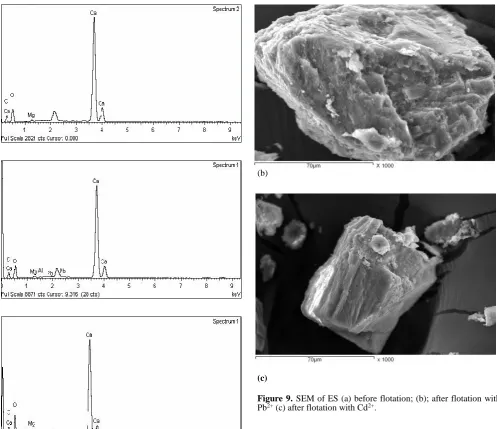
In the EDX graph (Figures 8a-8c), the presence of Pb2+ and Cd2+ after treatment is observed. The SEM image of ES before and after metal ions adsorption (Figures 9a-9c) is corresponding to the morphological changes in the surface of the adsorbents in the coverage of pores of the ES due to the adsorption of Pb2+ and Cd2+.
(a)
Figure 7. XRD of ES (a) before flotation; (b) after flotation with Pb2+ (c) after flotation with Cd2+.
0 10 20 30 40 50 60
86 88 90 92 94 96 98 100
Re
(%
)
Temp, 0
C
Figure 8. EDX of ES (a) before flotation; (b); after flotation with Pb2+ (c) after flotation with Cd2+.
(a)
(b)
(c)
Figure 9. SEM of ES (a) before flotation; (b); after flotation with Pb2+ (c) after flotation with Cd2+.
References
1Conti, M. E. and Botre, F., Environ. Monit. Assess., 2001, 69,
282-267.
2Nyangababo, J. T., Henry L. and Omutange, E., Bull. Environ.
Contam. Toxicol., 2005,750, 196-189.
3Hora, S., Simu, G., Rad, R., Papa, A. and Milos, M., Rev. Chem.,
2004, 55, 948-951.
4Yao, J., Jankowiski , K., Tuo, Y., Yao, Z. F., Xiao, Y., Xiao, S. H.
and Tan, Z. Z., J. Wuhan Univ. Tech. Mater. Sci. Edit., 2004,
19, 17-20.
5Bulut, Y. and Baysal, Z., J. Enviton. Manag.,2006, 78, 107-110. 6Carrillo-Morales, G., Davila-Jimenez, M. M., Elizalde-Gonzalez,
M. P. and Pelaez-Cid, J. Chromy. A, 2001,938, 237-242.
7Matheickal, J. T. and Yu, Q., Miner. Eng.,1997, 10, 947-957. 8Rao, M. M., Ramesh, A., Rao, G. P. C. and Seshaiah, K., J.
Hazard. Mater. B,2006, 129, 123-129.
9Bayrak, Y., Yesiloglu, Y. and Gecgel, U., Microporous
Mesoporous Mater., 2006, 91, 107-110.
10Kadirvelu, K., Thamordiselvi, K. and Navasivayam, C., Sep.
11Hasar, H., J. Hazards Mater. B, 2003,97, 49-54.
12Al-Asheh S. and Duvnjok, Z., J. Hazards Mater.,1997, 56, 35-51. 13Palma, G., Freer, J. and Baeza, J., Water Res., 2003, 37,
4974-4980.
14Li, X., Zheng, W., Wang, D., Yang, Q., Cao, J., Yue, X., Shen, T.
and Zeng, G., Desalination, 2010, 258, 148-153.
15Santos, A. C. V. and Masini, J. C., Anal. Bioanal. Chem., 2006,
385, 1538-1544.
16 Prado, A. G. S., Moura, A. Q., Holand M. S., Carvalho, T. O.,
Andrade, R. D. A., Pescara, I. C., Oliveira A. H. A., Okino, E.Y. A., Pastore, T. C. M., Silvea, D. J. and Zara, L. F.,
Chem. Eng. J.,2010, 160, 549-555.
17Kul, A. R. and Koyuncu, H., J. Hazard. Mater., 2010, 179,
332-339.
18Unlu, N. and Ersoz, M., J. Hazard. Mater., 2006,136, 272-280. 19Karatas, M., J. Hazard. Mater., 2012,200, 383-389.
20Krika, F., Azzouz, N. and Ncibi, M. C., Arabian J. Chem., 2014,
in press.
21Tang, Q., Tang, X., Hu, M.,. Li, Z., Chen, Y. and Lou, P., J.
Hazard. Mater., 2010, 179, 95-103.
22Ozcan A. S., Erdem, B. and Ozcan A., Colloids Surf. A, 2005,
266, 73-81.
23Chojnacka, K., J. Hazard. Mater., 2005, 121, 167-173.
24Anonymous, Food Eng. Int.., 2000, 25, 45-48.
25Ghazy, S. E., El-Asmy, A. A. and El-Nokrashy, A. M., Int. J. Ind.
Chem., 2011, 2, 242-252.
26Tsai, W. T., Hsein, K. J., Lin, C. M., Lin, K. Y. and Chiu, C. H.,
Bioresource Tech., 2008, 99, 1623-1629.
27Stadelman, W. J. “Eggs and Egg Products”, John Wiley & Sons,
New York, 2000.
28Poland, A. L. and Sheldon, B. W., J. Food Prot., 2001, 54,
486-492.
29Mizuike, A. and Hiraide M., Appl. Chem., 1982, 54, 1555-1563. 30Rubio, J. and Tessele, F., Miner. Eng.,1997, 10, 671-679. 31Zouboulis, A. I. and Matis, K. A., “The 4th International
conference, Flotation in Water and Waste Water Treatment”
Helsinki, 2000.
32Bradi, H. B., A Hubbard (Ed.), “Encyclopedia of surface and
colloid science”, Dekker, New York, 2002.
33Ghazy, S. E., Kabil, M.A, Shallaby, A. M. and Ammar, N. S., Ind.
J. Chem. Technol., 2001, 8, 211-218.
34Ghazy, S. E., Samra, S. E., Mahdy, A. M. and El-Morsy, S. M.,
Sep. Sci. Tech., 2005, 40, 1797-1815.