The interplay between surface–water and hydrogen bonding in a water adlayer on Pt(111) and
Ag(111)
This article has been downloaded from IOPscience. Please scroll down to see the full text article. 2007 J. Phys.: Condens. Matter 19 242101
(http://iopscience.iop.org/0953-8984/19/24/242101)
Download details:
IP Address: 18.101.16.161
The article was downloaded on 15/03/2010 at 16:15
Please note that terms and conditions apply.
The Table of Contents and more related content is available
J. Phys.: Condens. Matter 19 (2007) 242101 (7pp) doi:10.1088/0953-8984/19/24/242101
FAST TRACK COMMUNICATION
The interplay between surface–water and hydrogen
bonding in a water adlayer on Pt(111) and Ag(111)
Luigi Delle Site1, Luca M Ghiringhelli1, Oliviero Andreussi2, Davide Donadio3and Michele Parrinello2,3
1Max-Planck-Institut f¨ur Polymerforschung, Ackermannweg 10, D-55128 Mainz, Germany
2Scuola Normale Superiore, Piazza dei Cavalieri 7, 56100 Pisa, Italy
3Computational Science, Department of Chemistry and Applied Biosciences, ETH Zurich,
USI-Campus, via Giuseppe Buffi 13, CH-6900 Lugano, Switzerland
Received 25 April 2007 Published 9 May 2007
Online atstacks.iop.org/JPhysCM/19/242101
Abstract
The structure of a water adlayer on a Pt(111) surface is investigated by means of extensive first-principles calculations. Allowing for proton disorder, the ground state energy for the(√3×√3)R30◦structure can be found. This results from an interplay between water/metal chemical bonding and the hydrogen bonding of the water network. This picture is supported by substituting Pt(111) with Ag(111): the almost inert surface allows for the reconstruction of the hydrogen network.
(Some figures in this article are in colour only in the electronic version)
The investigation of the interaction of water with solid metal surfaces is of extremely high interest in surface chemistry, catalysis and many other technological applications and is being carried out extensively by means of experiments and theoretical calculations [1, 2]. In particular, much attention has been devoted to the initial stages of the wetting of transition metal surfaces [3–5], which occurs through the adsorption of monomers or small clusters, and to the structure and stability of very thin water overlayers on Ru(1000) [6], Rh(111) [7], Pt(111) [8,9] and Cu(110) [10]. In spite of these important efforts, the determination of the stable structure of water overlayers is in several cases still controversial, as experiments cannot provide conclusive information at the atomistic level. On metals with low proton affinity, as in the cases of Pt, Ni and Cu, water arranges in an undissociated hexagonal pattern [11], while on Ru(1000) a half-dissociated monolayer structure has been shown to be energetically favoured [6,12]; however the activation barrier for the dissociation is competitive with desorption and in several cases it is induced by the probe [13–15].
The interaction of water monomers and small clusters on Pt(111) is by far the best studied [3,16]. Water is adsorbed at the top site and the bond with the substrate is mainly due to the interaction of the unoccupied 5d states of Pt atoms with the 1b1occupied molecular state
J. Phys.: Condens. Matter 19 (2007) 242101 Fast Track Communication
namely (√39×√39)R16.1◦ (RT39), (√37×√37)R25.3◦ (RT37) and (√3 ×√3)R30◦ (RT3) [17–19], with competing adsorption energies [5]. While ab initio calculations showed that RT39 is the most energetically favoured structure [5,20], RT3 has been identified in low energy electron diffraction [21] and STM experiments [22]. In addition, the difference in the adsorption energy between the RT3, RT37 and RT39 structures of the wetting layer vanishes to zero as the water coverage increases [5]. Partially dissociated (OH+H2O) structures
have only been observed in connection with water production reactions [23] and theoretically studied [24,25]. Given this, it is clear that one structure prevails over another as a function of the kinetics and the thermodynamic conditions of the experiments.
While most of the experimental evidence is well described by the remarkable wealth of theoretical results in the literature, recent XAS and XPS results indicate that a chemical bond is established between the metal surface and the water adlayer [9]. This would yield a platinum– oxygen distance similar to that found for the case of the water monomer [3] (∼2.4 ˚A), by far shorter than the theoretically predicted one. Indeed, the previously reported theoretical studies predict that the most stable water configuration is a bilayer, where the shortest Pt–O distance (2.8 ˚A) is the result of a weak water–platinum bond. In this configuration the water network is strongly bound and it is left essentially unchanged by the interaction with the metal substrate. This discrepancy between experimental evidence and theoretical results is still an open problem and in this communication we address this issue via a computational approach. We use a large unit cell, since it allows for a less biased search for the lowest energy structure as underlined in [26], and investigate the possible role of proton disorder which is known to be essential for stabilizing not only bulk crystals4, but also crystalline films [27]; moreover it has been already supposed to play an important role in determining the wetting structures on transition metal surfaces [7,23,28]. We show that for this kind of system the proton disorder is essential for understanding the ground state structure. In addition, for the fully proton disordered system, some of the water molecules form a strong bond with the substrate leading to a short bonding distance (2.3 ˚A). The formation of these strong bonds leads to a weakening of the hydrogen bond network and the remaining molecules move to a larger distance (3.1–3.5 ˚A). The resulting picture agrees with the experimental findings and allows for an interpretation of the adsorption mechanism. The interplay between the hydrogen bond network weakening and the formation of bonds with the surface is further elucidated by adsorbing the ground state structure onto Ag(111), which is almost inert to water adsorption.
We use the DFT based finite electronic temperature method (FEMD) [29] implemented in the plane-wave based CPMD code [30]. In this method the electron density and the Hellmann– Feynman forces are determined via a subspace diagonalization of the high temperature electron density matrix. The subspace is expanded in a plane-wave basis set that in our set-up is cut off at 60 Ryd, a value which, according to our previous work [4], is sufficient for describing satisfactorily the molecule/metal interaction. We use pseudopotentials generated according to the Troullier–Martins [31] scheme; all the pseudopotentials were accurately tested for reproducing bulk and surface properties of the metal, and correct structural properties for the molecule. We use the PBE [32] generalized gradient corrected functional. The prototype system consists of a (111) surface of platinum represented by three and four layers (as explained later on regarding the geometry optimization procedure) and a layer of water composed of 24 molecules. We employ a 6×6 supercell of hexagonal symmetry with the cell dimension in the direction perpendicular to the surface equal to 25.5 ˚A so that the thickness of the vacuum between the water molecules and the bottom layer of the image slab of Pt(111) is equal to about 15 ˚A; due to the extended size of the box, we performed the calculations using the
4 The most common polymorphs of ice are indeed proton disordered.
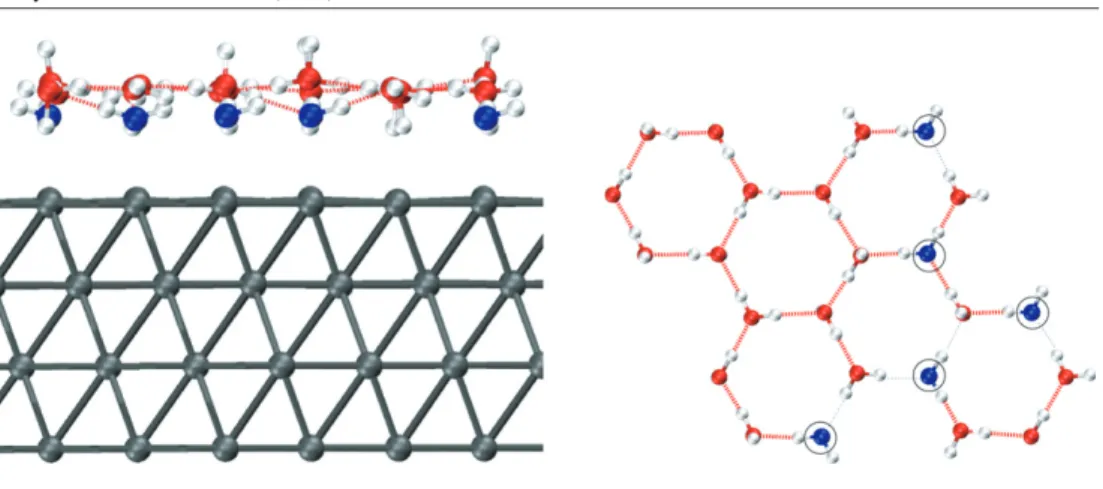
Figure 1. Side and top views of the proton disordered Hmixconfiguration. The five Pt atoms bonded to the oxygens are raised by 0.1 ˚A with respect to the average z position of the remaining 31 first-layer Pt atoms. The five bonded oxygen atoms (circled in the top view) stay at 2.33 ˚A from the closest Pt atoms, while the rest of the water network lies 3.1–3.4 ˚A away from the surface. Hydrogen bonds are drawn in red/thick (blue/thin) when the O–O distance is smaller (greater) than 3.0 ˚A (see the text).
-point approximation. Geometry optimizations, using the BFGS algorithm, were done first with only three layers until the maximum component of the ionic forces was below 2×10⁻³atomic units; then we added a fourth layer and further optimized the structure until the convergence of the root mean square force was below 10−3 atomic units, the maximum component of the ionic force was at least below 3×10⁻³and the energy changes were below 0.01 eV, i.e. about 10−4eV per molecule, in the adsorption energy of water.
Five different proton arrangements are considered: a fully proton ordered configuration (Hord
down), similar to those already studied in the literature, two in-plane proton disordered
structures (Hup and Hdown) and two fully proton disordered structures, one dissociated (Hdiss)
and one undissociated (Hmix). Following the convention of previous works [33] we define
Hup and Hdownas the configurations where the hydrogen atoms not participating in hydrogen
bonds point toward the vacuum or metal surface, respectively. The initial configuration of the water film is the one of an ideal (0001) bilayer of hexagonal ice stretched in the x y plane so as to match the surface lattice parameter of the metal. All the oxygen atoms are located at atop sites, with coverage 2/3 ML. In this respect our 6 ×6 supercell is a twelvefold replica of the RT3 structure, but, except for the completely ordered structure (Horddown), for all the other structures proton disorder makes the 6×6 supercell the minimal one. While it is not the most thermodynamically stable adlayer configuration on Pt(111), RT3 has been observed experimentally [21,22]. In addition this choice gives us the advantage that a direct comparison with other metal surfaces can be made for which RT3 is the standard adsorption structure, e.g. Ag(111), Pd(111) and Rh(111). In the case of Pt this mismatch is∼8%. The proton disordered configurations have been generated by a Monte Carlo method [34], so as to minimize either the global or the in-plane dipole moment. Obviously the z component of the dipole moment can be set to zero only if there is no constraint on the number of protons pointing toward the metal surface: in this case we have the so-called Hmix film. In the initial
configurations the water molecules are on the top sites of the platinum surface, the vertical separation between the oxygen atoms in the water bilayer is 0.6 ˚A, and the lower layer is 2.6 ˚A apart from the metal slab. In the partially dissociated configuration (Hdiss), the dissociated
protons sit at the free top sites. In figure1the final geometry of the Hmixsystem is reported;
J. Phys.: Condens. Matter 19 (2007) 242101 Fast Track Communication
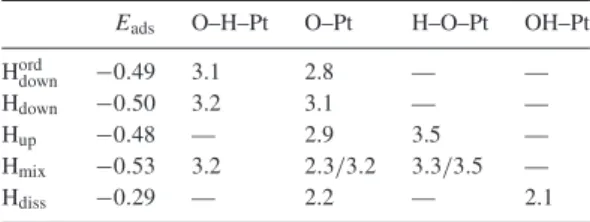
Table 1. The adsorption energies (in eV) and the distances between oxygen and platinum (in ˚A) are here reported for the five systems that we studied. The labels of the columns have to be interpreted as follows: O–H–Pt, the water molecule has a proton that points toward the Pt surface; O–Pt, the water molecule is flat with respect to the metal surface; H–O–Pt, the water molecule has a proton that points toward the vacuum; OH–Pt refers to a dissociated OH group.
Eads O–H–Pt O–Pt H–O–Pt OH–Pt
Hord
down −0.49 3.1 2.8 — —
Hdown −0.50 3.2 3.1 — —
Hup −0.48 — 2.9 3.5 —
Hmix −0.53 3.2 2.3/3.2 3.3/3.5 —
Hdiss −0.29 — 2.2 — 2.1
The total adsorption energies per molecule are computed as Eads = (Etot − EPt −
24EH2O)/24, where Etotis the energy of the optimized Pt+water film system, EPtthe energy of
the bare Pt surface and EH2Othe energy of a water molecule. The values are reported in table1
and show very good agreement with those of [33] for Horddown. We point out that Hmixresults
as the most stable and that introducing proton disorder systematically increases the binding energy, even if the differences between the reported adsorption energies are of the same order of magnitude as the uncertainties of the DFT calculations. What is more important than the values of the adsorption energy is that the Hmixadlayer displays very different features from the other
structures, namely shorter O–Pt bonds for some molecules and a number of weakened hydrogen bonds. In order to characterize the tendency of the hydrogen bonding network to become less tight as a result of the chemical interaction with the surface, we monitor the number of ‘strong’ hydrogen bonds. An H bond is defined as ‘strong’ when the O–O distance is smaller than 3.0 ˚A. In the initial configurations this distance is 2.98 ˚A.
In all the undissociated structures but Hmix, the H bond network stiffens during the
optimization. All the H bonds shorten, so as to recover the ideal O–O distance (∼2.78 ˚A). Since the underlying metal surface acts as a topological confinement, this process (i.e. O–O shortening) is achieved via a reduction of the vertical spacing of the bilayer (initially as long as 0.9 ˚A). The water bilayer relaxes at a rather large distance from the Pt surface, with which it does not interact chemically, as confirmed by the charge density plot in figure2. In Hdiss
both the OH groups and the undissociated H2O bind chemically to the metal surface and form
a H bond pattern where strong (O–O distance: 2.6 ˚A) and very elongated (3.1 ˚A) H bonds alternate. This picture, confirmed by experiments [35] and previous calculations [36], suggests a competition between the chemical O–Pt bonding and the strength of the H bond network.
This balance determines the adsorption mechanism of the Hmixadlayer, which is by far
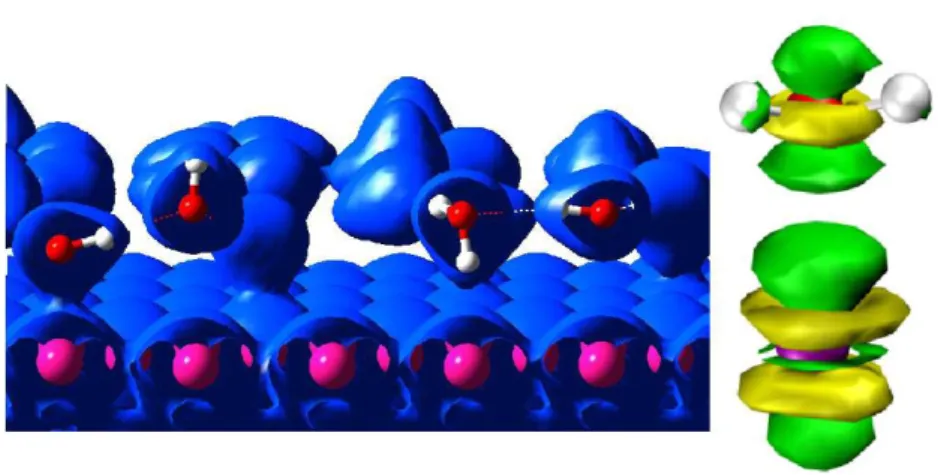
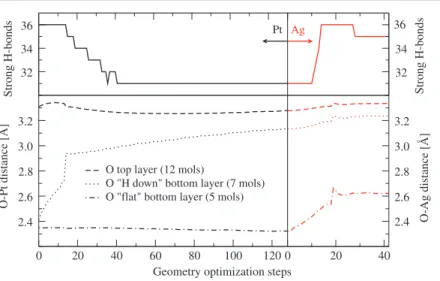
the most stable of the configurations investigated. Due to the full proton disorder, the system is less constrained. This enhanced flexibility allows the optimal balance to be achieved by sacrificing some of the hydrogen bond energy of the two-dimensional water adlayer network (top panel of figure3) and gaining chemical energy with the formation of stronger water–metal bonds. Although the periodicity constraints are relaxed, the water molecules maintain the initial ordered arrangement in the x y plane, while the distribution of vertical heights is clearly bimodal (bottom panel of figure3). The majority of the water molecules (80%) form a flat overlayer where the Pt–O distance is distributed between 3.2 and 3.5 ˚A, while the flat water molecules of the bottom layer bind tightly to Pt atoms at a distance of∼2.3 ˚A. The electronic density profiles for the latter molecules (see the right panel in figure2) show the formation of chemical bonds with the surface which are much stronger than in the other structures. Moreover the electron density difference of the Pt–Me bonding for the Hmix case (left panel in figure2) shows the
Figure 2. Electron density profiles for the Hmixcase. The four possible configurations of water molecules are shown in the left panel (the isosurface level is 0.270e ˚A−3). From left to right: a flat water molecule in the bottom layer forming a O–Pt bond, a water molecule with a hydrogen atom pointing to the vacuum, a water molecule forming a hydrogen bond with the surface and a flat water molecule in the top layer displaying no interaction with the surface. Right panel: electron density difference maps for one of the flat water molecules in the bottom layer, adsorbed via an O–Pt bond. The green/darker grey (yellow/lighter grey) surface indicates depletion (accumulation) of electronic density of 0.036e ˚A−3. Note that this snapshot compares very well to the monomer adsorption electron density difference maps shown in [3].
strong chemical bond to resemble that of an isolated monomer [3], i.e. the ideal conformation for the molecular adsorption. This comparison proves that the molecule–surface interaction of those water molecules that are adsorbed via the O–Me bond is almost exactly the same as for an isolated monomer in the same position. Note that the monomer already adsorbs with the hydrogens pointing away from the surface, and thus in a geometry compatible with the embedding in the hydrogen network of the water layer. As a chemical bond is established between metal and oxygen atoms, the hydrogen bonding of the water adlayer is weakened, as proven by the elongation of a number of hydrogen bonds occurring during the optimization of the Hmixsystem (figure3).
In order to provide further evidence of the interplay between the Pt–O chemical bond and the stiffness of the hydrogen bonding network in the Hmixsystem, we substituted Pt with Ag,5
which has a substantially smaller affinity than the adsorption of water [3]. In this manner the metal–oxygen chemical bond is weakened, and performing the geometry optimization we observe upshifting of the previously chemisorbed flat H2O molecules and the restoration of a
tight H bond network (figure 3). The calculated adsorption energy of−0.46 eV is in good agreement with the ones reported for proton ordered systems in [33]. This means that for metal surfaces with low water affinity the issue of proton disorder is not relevant.
While providing novel insights into the adsorption mechanism, it is also remarkable that the Hmixon Pt is the only configuration that accounts for the x-ray absorption/photoemission
spectroscopy measurements in [9], indicating a relatively strong Pt–O bonding, with a layer of oxygen atoms 2.3–2.4 ˚A away from the surface. It must be noticed that in none of the other undissociated structures considered in this work or in the many previously reported
5 The computational details are the same as for the other systems treated here. For Ag we use an LDA pseudopotential
J. Phys.: Condens. Matter 19 (2007) 242101 Fast Track Communication
0 20 40 60 80 100 120
Geometry optimization steps 2.4
2.6 2.8 3.0 3.2
O-Pt distance [Å]
O top layer (12 mols)
O "H down" bottom layer (7 mols) O "flat" bottom layer (5 mols)
0 20 40
2.4 2.6 2.8 3.0 3.2
O-Ag distance [Å]
32 34 36 Strong H-bonds 32 34 36 Strong H-bonds Ag Pt
Figure 3. Top panels: the number of ‘strong’ hydrogen bonds during the geometry optimization
process for the Hmixcase on a Pt (Ag) surface is reported on the left (right). Bottom panels: evolution of the distances from the metal surface of the water molecules for the Hmixconfiguration. In the left (right) panel we show the distance from the Pt (Ag) surface of the oxygen of the top water layer (dashed line), of the oxygen of the Hdownwater molecules in the bottom layer (dotted line), and (dashed–dotted line) of the ‘flat’ water molecules, i.e. those circled in figure1.
calculations [5,8,9,33] has such a short Pt–O bond been observed. We stress that the proposed Hmix structure is just one configuration in a virtually infinite ensemble of proton disordered
configurations, which cannot be explored with present day computational resources. The most stable proton disordered water adlayer should be obtained by a procedure that optimizes the ratio between hydrogen being up and down, and as a consequence the amount of strong water– metal bonds and hydrogen bonds.
In conclusion, we have performed an extensive DFT study of the structure and bonding of water adlayers on a Pt(111) surface, where, in particular, we have investigated the role of the proton disorder. We have found that on this particular surface the most stable adlayer is an undissociated configuration with a fully proton disordered arrangement. The higher stability of the Hmixconfiguration is given by the interplay between the Pt–water chemical bonding and
the ability of the water adlayer to preserve its hydrogen bond network intact, though weakened. We provide evidence that the main features of the mixed layer/metal interaction cannot be extrapolated from the study of homogeneously oriented (all down or all up) layers. In this sense, this study sheds new light on the nature of the mechanism of interaction of water on metal substrates and thus opens new paths of experimental and theoretical investigations into the field.
LDS acknowledges the RZG of the Max Planck Society for computational resources, LMG the financial support of the von Humboldt Foundation. Useful suggestions from K Kremer are acknowledged.
References
[1] Taylor C D and Neurock M 2006 Curr. Opin. Solid State Mater. Sci.9 49 [2] Michaelides A 2006 Appl. Phys. A85 415
[3] Michaelides A, Ranea V A, de Andres P L and King D A 2003 Phys. Rev. Lett.90 216102
[4] Sebastiani D and Delle Site L 2005 J. Chem. Theory Comput.1 78 [5] Meng S, Wang E G and Gao S 2004 Phys. Rev. B69 195404 [6] Feibelman P J 2002 Science295 99
[7] Feibelman P J 2003 Phys. Rev. Lett.90 186103
[8] Meng S, Xu L F, Wang E G and Gao S 2002 Phys. Rev. Lett.89 176104
[9] Ogasawara H, Brena B, Nordlund D, Nyberg M, Pelmenschikov A, Pettersson L G M and Nilsson A 2002 Phys. Rev. Lett.89 276102
[10] Ren J and Meng S 2006 J. Am. Chem. Soc.128 9282 [11] Doering D L and Madey T E 1982 Surf. Sci.123 305 [12] Held G and Menzel D 1994 Surf. Sci.316 92
[13] Clay C, Haq S and Hodgson A 2004 Chem. Phys. Lett.388 89
[14] Faradzhev N S, Kostov K L, Feulner P, Madey T E and Menzel D 2005 Chem. Phys. Lett.415 165 [15] Andresson K, Nikitin A, Pettersson L G M, Nilsson A and Ogasawara H 2004 Phys. Rev. Lett.93 196101 [16] Morgenstern M, Michely T and Comsa G 1996 Phys. Rev. Lett.77 703
[17] Haq S, Harnett J and Hodgson A 2002 Surf. Sci.505 171
[18] Glebov A, Graham A P, Menzel A and Toennies J P 1997 J. Chem. Phys.106 9382 [19] Firment L E and Samoraj G A 1979 Surf. Sci.84 275
[20] Feibelman P J 2003 Phys. Rev. Lett.91 059601
[21] Jacobi K, Bedurftig K, Wang Y and Ertl G 2001 Surf. Sci.472 9
[22] Morgenstern M, Muller J, Michely T and Comsa G 1997 Z. Phys. Chem. 198 43 [23] Clay C, Haq S and Hodgson A 2004 Phys. Rev. Lett.92 046102
[24] Karlberg G S, Olsson F E, Persson M and Wahnstroem G 2003 J. Chem. Phys.119 4865 [25] Karlberg G S and Wahnstroem G 2004 Phys. Rev. Lett.92 136103
[26] Vassilev P, van Santen R A and Koper M T 2005 J. Chem. Phys.122 054701
[27] Andreussi O, Donadio D, Parrinello M and Zewail A H 2006 Chem. Phys. Lett.426 115 [28] Haq S, Clay C, Darling G R, Zimbitas G and Hodgson A 2006 Phys. Rev. B73 115414 [29] Alavi A, Kohanoff J, Parrinello M and Frenkel D 1994 Phys. Rev. Lett.73 2599
[30] Hutter J et al CPMD version 3.10 Copyright IBM Corp. 1990–2006, Copyright MPI fuer Festkoerperforschung Stuttgart 1997–2001
[31] Troullier N and Martins J L 1991 Phys. Rev. B43 1993
[32] Perdew J P, Burke K and Ernzerhof M 1996 Phys. Rev. Lett.77 3865 [33] Michaelides A, Alavi A and King D A 2004 Phys. Rev. B69 113404 [34] Buch V, Sandler P and Sadlej J 1998 J. Phys. Chem. B102 8641