Healthy Fisheries,
Healthy Fisheries,
Sustainable Trade
Sustainable Trade
CRAFTING NEW RU
CRAFTING NEW RULES
ES
ON FISHING SUB
ON FISHING SUBSIDIES
IDIES
in the
in the
WORLD TRADE
WORLD TRADE
ORGANIZATION
ORGANIZATION
A WWF Position Paper
and Technical Resource
June 2004
David K. Schorr
WWF’s Endangered Seas Programme
is the world's largest marine program, working in more than 40 countries at a range of levels—from local communities through regional authorities and industry, to national governments and international conventions.To turn the tide from decline to a healthy marine environment, WWF has set up two global targets for the year 2020:
(1) Within a generation, we aim to stop overfishing and ensure that all exploitation of fish stocks is sustainable.
(2) We shall also work toward establishing networks of well-managed and ecologically representative marine protected areas covering at least 10 percent of the world's oceans, including the high seas.
WWF’s mission
is to stop the degradation of the planet's natural environment and to build a future in which humans live in harmony with nature by■ conserving the world’s biological diversity,
■ ensuring that the use of renewable natural resources is sustainable, and
■ promoting the reduction of pollution and wasteful consumption.
For further information:
Scott Burns Aimée Gonzales
Director, Marine Conservation Program Senior Trade Policy Advisor WWF-US WWF-International
1250 24th Street, NW Avenue du Mont-Blanc
Washington, DC 20037 CH-1196, Gland
USA Switzerland
Tel: +1 202 861-8327 Tel: +41 22 364 9002 Fax: +1 202 530-0743 Fax: +41 22 364 8219 [email protected] [email protected] http://www.worldwildife.org/ http://www.panda.org/
LOGO © 1986,
WWF – known internationally as the
W
orld
Wide Fund for Nature
,®
Registered
Trademark owner
.
© 2004 WWF. All rights reserved by World Wildlife Fund, Inc.
Healthy Fisheries
,
Sustainable
Tr
ade:
Crafting New Rules on F
ishing Subsidies in the
W
orld
Trade Organization
Healthy Fisheries,
Sustainable Trade
CRAFTING NEW RULES ON
FISHING SUBSIDIES
in the
WORLD TRADE
ORGANIZATION
A WWF Position Paper and
Technical Resource
June 2004
David K. Schorr
mia, nongovernmental organizations and intergovernmental organizations over the course of 2002–04. Special thanks for their extensive and interactive commentary on earlier drafts of this paper are due to Clare Coffey, Raul Garcia, Charlotte Mogensen, and Ronald Steenblik. We would also like to thank Anthony Cox, Simon Cripps, David Evans, Mark Linscott, Roy Malmrose, Sebastian Mathew, Alice Mattice, Ana Novik, Gareth Porter, Tobias Reichert, Greg Schneider, Katherine Short, Mark Sinclair, and John Ward for their helpful comments. The author wishes to thank Norman Shore (the only person known to have read substantial portions of this paper without the profession-al obligation to do so) for his morprofession-al support and constructive kibitzing.
Notwithstanding the foregoing, the views and opinions expressed in this paper, as well as any factual errors it may contain, are those of the author and WWF alone, and do not in any way reflect the opinions or viewpoints of any other individual, institution, or government.
R
Reellaatteedd WWWWFF ppuubblliiccaattiioonnss::
Towards rational disciplines on subsidies to the fishery sector: A call for new international rules and mechanisms, September 1998.
Underwriting overfishing (Issue Summary), September 1999.
Fishing in the dark (Issue Summary), November 2000.
Fishing in the dark: Symposium proceedings, January 2001.
Hard facts, hidden problems: A review of current data on fishing subsidies, October 2001.
Turning the tide on fishing subsidies: Can the World Trade Organization play a positive role?
October 2002.
David Schorr can be contacted in Washington, D.C., at [email protected].
Copyright © 2004, WWF. All rights reserved by World Wildlife Fund, Inc. Any reproduction in full or in part of this publication must mention the title and credit WWF as the copyright owner.
Summary Table of Contents
Preface . . . .v
Detailed Table of Contents and Outline of Analysis . . . .vii
Executive Summary . . . .xiii
Introduction and Overview . . . .1
Part I—Background and General Context . . . .5
Part II—WWF’s Definition of Success . . . .23
Part III—Approaches to Classifying Fishing Subsidies . . . .33
Part IV—Current WTO Rules: Overview and Gap Analysis . . . .37
Part V—Clarifying and Improving Fishing Subsidies Disciplines . . . .51
References . . . .107
Acronyms and Abbreviations . . . .123
Appendix 1—Outline of WWF's Proposals . . . .125
Appendix 2—Who Says So?—A Sampling of Authorities Who Agree That Subsidies
Contribute to Overcapacity and Overfishing . . . .141
Appendix 3—Excerpts from the Doha Declaration . . . .145
Appendix 4—Excerpts from the SCM Agreement . . . .147
Appendix 5—Detailed Table Comparing Current Red and Amber Light
Provisions . . . .169
Appendix 6—Crafting a WTO Definition of "IUU Fishing" . . . .171
Preface
Few things more dramatically illustrate the interdependent nature
of life on Earth than the biological, economic, and social crisis now facing the world’s marine fisheries. Once viewed as boundless and inexhaustible, global fisheries today are straining under an unprecedented combination of human activities and natural limits. As stocks decline and fishing communities suffer, governments have turned increasingly to untangling the maze of factors behind the problem—imperfectmanagement, outsized fleets, scientific uncertainty, cultural and commercial pressures, rising demand, improved technology, and worsening pollution and global warming, just to name a few. Among the least considered factors underlying the worldwide fisheries crisis, but not least important, is the perverse international economics of the fishing industry. In particular, government subsidies applied in often under-regulated fisheries have contributed to overcapacity, competitive distortions, and strong incentives to overfish.
Fortunately, the problem of harmful fishing subsidies has gained international attention in recent years, and manageable and concrete solutions may soon be at hand. A recent decision by the world community to pursue binding international disciplines on fishing subsidies represents an especially important opportunity to get the economics of marine fisheries onto a more even keel.
The fishing subsidies issue also presents a unique opportunity for the World Trade Organization (WTO), where the negotiations toward new disciplines are now under way. Having been the subject of controversies since its inception, the WTO continues to seek its way between the primacy of its trade-oriented mandate and its broader responsibilities as a leading organ of global economic governance. The issue of fishing subsidies presents the first instance of a WTO negotiation centered explicitly at the nexus of trade policy, natural resource economics, and environmental conservation. It is also the first time in the history of modern trade diplomacy that a major negotiating topic has been placed on the multilateral table in response to not-for-profit voices within civil society. In short, the issue poses a fundamental test of the WTO’s ability to regulate trade in the broadest public interest, and in cooperation with other relevant intergovernmental bodies.
But complex, interdisciplinary problems require nuanced, interdisciplinary solutions. If the WTO fishing subsidies talks are to produce a real “win-win-win” outcome for trade, environment, and human development, it will require imagination, rigor, and a solid measure of political will. By publishingHealthy Fisheries, Sustainable Trade, WWF brings forward an unusual “position paper and technical resource” that itself hopes to be both imaginative and rigorous. Developed over the course of multiple consultations with governments, intergovernmental bodies, academics, and other stakeholders, this paper represents a substantial effort to grapple seriously with the technical,
institutional, and political realities surrounding the fishing subsidies negotiations, without sacrificing WWF’s commitment to helping achieve an ambitious result.
Governments and international institutions have so far shown a remarkable convergence around the problem of harmful fishing subsidies. But there is still a long way to go to find a lasting consensus on a binding and effective solution. WWF is convinced that such a solution is within grasp—if
negotiators and their governments can match actions to their words.
Dr. Claude Martin Director General, WWF
June 2004
Detailed Table of Contents and
Outline of Analysis
Preface . . . .v
Detailed Table of Contents and Outline of Analysis . . . .vii
Executive Summary . . . .xiii
Introduction and Overview . . . .1
Part I—Background and General Context . . . .5
A. The world is facing a global fisheries crisis. . . .5
1. The world’s fisheries are seriously depleted. . . .5
2. The human, ecological, and economic costs are profound, especially for
developing countries . . . .6
3. Several critical challenges lie at the heart of the fisheries crisis. . . .6
B. Harmful fishing subsidies are a real part of the problem . . . .10
1. Worldwide, fishing subsidies total roughly 20 percent of industry
revenue . . . .10
2. Fishing subsidies come in many forms and are justified by a wide variety of
purposes . . . .11
3. Subsidies intensify many of the problems at the root of the worldwide
fisheries crisis . . . .11
4. The harmful nature of many fishing subsidies has been widely recognized . .12
5. Nearly all fishing subsidies programs lack transparency and accountability . .12
6. The majority of fishing subsidies are granted by a small number of
countries . . . .12
7. Subsidies can be damaging and trade distorting even in effectively managed
fisheries . . . .13
8. Fishing subsidies are even more likely to do harm where management is
inadequate . . . .13
9. Developing countries are particularly disadvantaged . . . .13
10. Nevertheless, not all fishing subsidies are harmful . . . .14
C. Disciplining subsidies must be part of the solution . . . .14
D. Fishing subsidies have been taken up in a variety of international fora . . . .15
E. The WTO also has a significant role to play on fishing subsidies . . . .17
1. The mandate of the WTO calls for “win-win-win” results . . . .17
2. Fishing subsidies fall squarely within the WTO’s core competence . . . .18
Contents3. Preparatory work has been under way in the WTO since 1997 . . . .18
4. WTO disciplines on fishing subsidies are to complement—not replace—
improved fisheries management . . . .19
F. The Doha Declaration calls for WTO disciplines that are specific to fishing
subsidies and oriented toward “win-win-win” results. . . . .19
1. The mandate calls for specific treatment of fishing subsidies. . . . .19
2. The mandate is oriented toward a win-win-win outcome. . . . .20
3. World leaders have called on WTO members to deliver a win-win-win
result. . . . .20
Part II—WWF’s Definition of Success . . . .23
A. Governments must deliver more than “business as usual” . . . .23
B. The challenges WTO negotiators must meet. . . . .23
1. The outcome must achieve a true “win-win-win” without overstepping the
“thin green line.” . . . .23
2. New fishing subsidies disciplines must cover all significant fishing subsidy
programs. . . .23
3. New fishing subsidies disciplines must forbid harmful subsidies while
accommodating beneficial ones. . . . .25
4. New fishing subsidies disciplines must take account of the special needs of
developing countries . . . .25
5. New disciplines must effectively promote the administration of fishing
subsidies programs on a fisheries-specific basis . . . .25
6. Fishing subsidies disciplines must include mechanisms to improve
transparency and accountability. . . . .26
7. New fishing subsidies disciplines must be coordinated with the authority of
international fisheries bodies. . . . .26
8. Fishing subsidies disciplines require specific textual treatment within the
WTO system. . . . .26
C. The “thin green line” and the need for new institutional mechanisms . . . .27
1. What is the thin green line? . . . .27
2. WWF’s effort to avoid the thin green line . . . .28
3. The sometimes inevitable relevance of the fisheries context . . . .28
4. Confronting context without overstepping the thin green line—two key
concepts . . . .29
5. The concept of a “patently at risk” fishery . . . .29
6. The concept of a “patently undermanaged” fishery . . . .30
Part III—Approaches to Classifying Fishing Subsidies . . . .33
A. The importance of classification . . . .33
B. Approaches to classification . . . .33
1. Taxonomic versus normative classification . . . .33
2. WWF’s proposal effectively creates four normative categories of fishing
subsidies . . . .33
C. Technical distinctions among classification methods . . . .34
1. There are three potential methods of normative classification of fishing
subsidies . . . .34
2. Robust fishing subsidies disciplines require more than design-based
classifications . . . .35
3. Classification methods and the thin green line . . . .35
Part IV—Current WTO Rules: Overview and Gap Analysis . . . .37
A. Current rules do cover fishing subsidies . . . .37
1. General coverage of the SCM . . . .37
2. A broad definition of “subsidy” . . . .37
3. Ambiguities at the margins . . . .37
B. The SCM’s “traffic light” approach . . . .38
1. The “red light”—prohibiting export and “domestic supply” subsidies . . . .38
2. The “amber light”—disciplining subsidies having “adverse effects” . . . .40
3. Red and amber lights compared . . . .41
4. Complexity and burdens of the amber light . . . .41
5. The lapsed “green light” . . . .44
C. Special and differential treatment (S&D) for developing countries . . . .46
1. Synopsis of the SCM’s current S&D provisions . . . .46
2. The growing link between the green light and S&D issues . . . .46
D. Surveillance and transparency . . . .48
1. The generalized failure of Article 25 . . . .48
2. The particular insufficiency of fishing subsidies notifications . . . .48
E. Why current SCM rules need to be improved and clarified (synopsis) . . . .48
1. Ambiguities in definition of “subsidy” . . . .48
2. Absence of an affirmative prohibition . . . .48
3. Obstacles to “amber light” challenges . . . .48
4. Insufficient protection for positive subsidies . . . .49
5. Inadequate transparency and surveillance . . . .49
6. Incomplete institutional mechanisms . . . .49
ContentsPart V—Clarifying and Improving Fishing Subsidies Disciplines . . . .51
A. Preliminary comments . . . .51
1. These proposals build on the “traffic light” approach . . . .51
2. For purposes of discussion, the provisions proposed below are located within
the SCM. . . . .51
3. The elements of WWF’s proposals need to be read together: . . . .51
B. Defining “fishing subsidies” . . . .52
1. Preliminary comments . . . .52
2. Government payments for access to foreign fisheries should be explicitly
covered by fishing subsidies disciplines . . . .52
3. Public “fisheries management services” should not be considered “subsidies”
within the meaning of the SCM . . . .56
4. The “fishing industry” should include all “wild capture” fisheries . . . .56
5. Subsidies to ports, processors, or other actors should be considered “fishing
subsidies” if they benefit fishing enterprises . . . .57
C. Prohibiting the most harmful fishing subsidies—the “red light” . . . .57
1. The most harmful fishing subs should be subject to an outright ban. . . . .57
2. There is substantial support for a “red light” for fishing subsidies . . . .58
3. New red light provisions should cover three broad categories of fishing
subsidies. . . . .58
4. A ban on “capacity- or effort-enhancing” subsidies can focus on specific kinds
of subsidy programs. . . . .61
5. A ban on subsidies to IUU fishing should establish a strong international
norm . . . .65
6. A ban on “domestic fish supply” subsidies should be introduced into SCM
Article 3.1(b) . . . .69
7. Prohibited fishing subsidies should be exempt from the specificity
requirement . . . .70
D. Exceptions to the red light prohibitions. . . . .71
1. Some exceptions to the ban on capacity- or effort-enhancing subsidies are
necessary . . . .71
2. Subsidies to be included within the exception . . . .71
3. Definitions of “patently at risk” and “patently undermanaged” fisheries . . . .72
4. Prerequisites to the exceptions . . . .74
5. Supplementary disciplines applicable to exempt subsidies . . . .75
6. Additional comments regarding artisanal fishing . . . .75
E. Allowing environmentally positive fishing subsidies—the “green light” . . . . .76
1. Preliminary comments . . . .76
2. The case for a green light: Allowing public investment in the pursuit of
sustainable fisheries . . . .77
4. The scope of a green light for fishing subsidies . . . .78
5. All green light fishing subsidies should be subject to certain basic conditions
and limits . . . .79
6. Capacity-reducing subsidies should be subject to special disciplines . . . .80
F. Disciplining all other fishing subsidies—the “amber light” . . . .82
1. Preliminary comments . . . .82
2. The narrow scope of an amber light for fishing subsidies. . . .83
3. Clarifying the concept of “adverse effects” for fishing subsidies . . . .84
4. Shifting the burden of proof—“dark amber” provisions for fishing
subsidies . . . .88
5. Requiring withdrawal of offending subsidies . . . .89
G. Improving notifications and surveillance . . . .90
1. The importance—and the failure—of WTO subsidy notification
requirements . . . .90
2. The poor transparency of fishing subsidies is particularly problematic . . . . .91
3. Fisheries-specific and enterprise-specific information is needed . . . .92
4. The formal requirements of Article 25 need to be clarified . . . .92
5. Efforts to improve WTO subsidies notifications have borne little fruit . . . . .93
6. Recent negotiating proposals include calls for reform . . . .94
7. WWF’s proposals for improving fishing subsidies notifications . . . .95
8. Special notification requirements generated by specific fishing subsidies
disciplines . . . .96
9. A radical, plausible, and most effective solution—an independent
monitoring mechanism . . . .97
10. Confronting the administrative burden problem through “special and
differential treatment” . . . .97
11. Beyond notifications—proactive monitoring and surveillance . . . .98
H. Special and differential treatment for developing countries . . . .98
1. Preliminary comments . . . .98
2. The problem of “major fishing” developing countries . . . .99
3. Some concepts for S&D provisions on fishing subsidies . . . .99
4. Requirement of advance notification . . . .101
I.
Improving institutional mechanisms . . . .101
1. The need for new mechanisms . . . .101
2. The kinds of issues likely to arise under new disciplines . . . .101
3. “Expert input” mechanisms would ensure well-informed deliberations . . . .102
4. “Shared authority” mechanisms would allow direct consideration of fisheries
contexts . . . .102
5. Potential institutional partners for implementing new WTO disciplines on
fishing subsidies . . . .105
6. Other institutional considerations . . . .105
ContentsReferences . . . .107
Acronyms and Abbreviations . . . .123
Appendix 1—Outline of WWF's Proposals . . . .125
Appendix 2—Who Says So?—A Sampling of Authorities Who Agree That Subsidies
Contribute to Overcapacity and Overfishing . . . .141
Appendix 3—Excerpts from the Doha Declaration . . . .145
Appendix 4—Excerpts from the SCM Agreement . . . .147
Appendix 5—Detailed Table Comparing Current Red and Amber Light
Provisions . . . .169
Appendix 6—Crafting a WTO Definition of "IUU Fishing" . . . .171
Appendix 7—Scope and Content of Current Article 25 Notifications . . . .177
Executive Summary
*
The inclusion of fishing subsidies on the WTO negotiating agenda
adopted by trade ministers in Doha, Qatar, in November 2001, responds to the need for urgent action to confront an unprecedented crisis of depletion now facing the world’s fisheries. With a billion people directly dependent on fish for food, with hundreds of millions dependent on fishing for their livelihoods, and with demand for fish projected to rise sharply for decades to come, the sobering reality is that the great majority of the world’s most important fisheries have been fished to—and in many cases well past—their biological limits. The costs of this crisis are evident in a steady parade of collapsed fisheries, unprofitable fishing enterprises, and economically troubled coastal communities.Developing countries hoping to increase the productivity of their fishing sectors often stand the most to lose.
While the failure of governments to establish effective, science-based fisheries management regimes is the most fundamental issue confronting the world’s fisheries, harmful fishing subsidies are now widely understood to be a significant part of the problem in their own right. It could scarcely be otherwise in a world where subsidies represent nearly 20 percent of fishing industry revenue, and flow to fleets whose aggregate size and power is already as much as 250 percent over capacity. The problem, as has been so often said, is one of “too many boats chasing too few fish.”
Harmful fishing subsidies simultaneously interfere with sustainable resource management and disturb international competitive relationships. For this reason the fishing subsidies issue provides a clear opportunity for the WTO to live up to the promises set forth in its charter to pursue trade liberalization while fostering protection of the Earth’s environment and sustainable development. The importance of the WTO fishing subsidies talks has been highlighted by the United Nations General Assembly, the Organisation for Economic Co-operation and Development (OECD), the G-8 leaders of major industrialized nations, and scores of heads of state gathered at the World Summit for Sustainable Development (Johannesburg, 2002). Achieving a true “win-win-win” result, however, will require both political will and technical finesse.
Many delegations and other stakeholders have questioned how the WTO can play a positive role on the fishing subsidies issue without overstepping the bounds of its trade-related mandate—a boundary that WWF has dubbed “the thin green line.” As one of the leading nongovernmental voices calling for WTO action on fishing subsidies, WWF has worked in dialogue with governmental and
nongovernmental experts to bring forward this detailed technical description of how the challenge on fishing subsidies might be met in an effective and suitable manner.
The basic need for improved and clarified WTO rules on fishing subsidies
How do the provisions of the WTO Agreement on Subsidies and Countervailing measures (SCM) currently fall short on disciplining fishing subsidies? Why is it necessary for new rules to focus on
Executive Summary
* This executive summary provides a narrative overview of WWF’s approach to fishing subsidies, as explored in depth in the main body of this publication. A more detailed summary of WWF’s technical proposals is included in outline form as Appendix 1.
issues such as the overcapacity of fleets or increased fishing effort? If fishing subsidies cause both trade distortions and environmental damage, why not just focus on the trade distortions and let the benefits to the environment simply follow?
Put simply, the answer is this: despite the much broader terms of its charter, the WTO has traditionally defined “trade distortion” almost exclusively in terms of the distortion of export
markets—a narrow focus that has failed to capture many of the international economic distortions at the heart of the fishing subsidies problem.
Specifically, fishing subsidies distort patterns of production more directly than they distort patterns of international trade. The fishing industry is not simply involved in a competition for markets; it is also engaged in a race for resources. Subsidies have a less direct impact on the ability of unsubsidized competitors to export than on their ability to produce in the first place. In some cases, this impact may be to raise the costs of production for the competitor, who must expend greater effort to harvest a catch from dwindling stocks. In more extreme cases, the unsubsidized competitor may be unable to produce at all—either because a stock has become “commercially extinct” or because government authorities intervene to close a fishery.
When compounded by other factors—such as data limitations and problems of “causality” that are particularly severe with regard to fishing subsidies—the WTO’s traditional focus on export markets has sharply limited its ability to discipline even the most harmful fishing subsidies.
How WWF has dealt with the “thin green line”
The central challenge in addressing fishing subsidies at the WTO is to do so effectively without overstepping the boundary between the WTO’s legitimate competence and its counterproductive entanglement in questions of fisheries policy. Such problems of the “thin green line” arise wherever trade issues and environmental issues overlap—that is, under the very same circumstances that create important “win-win-win” opportunities. In the case at hand, delivering true “win-win-win” results will require dealing directly with issues at the intersection of commercial economic activity and fisheries management. It is an irreducibly interdisciplinary question.
WWF shares with many others a strong desire to help the WTO avoid trespassing across the thin green line. To accomplish this, WWF has offered proposals that avoid this line to the greatest possible extent. For example:
• Wherever possible, WWF has proposed rules using terms and tests similar to the familiar economic vocabulary of the WTO. The basic concept of a “capacity- or effort-enhancing” subsidy, for example, raises questions that are standard fare for the SCM (such as whether a subsidy is of a kind that tends to lower production costs, or to increase productivity).
• Where technical concepts of fisheries economics are used, WWF has proposed definitions that are sufficiently broad and noncontroversial to avoid the WTO’s entanglement in specialized debate.
• By subjecting the most harmful fishing subsidies to an ex anteprohibition based largely on considerations of program design (see the next section of this summary), WWF’s proposals sharply reduce the number of cases in which WTO decision makers (such as dispute panels) would have to judge the actual impacts of a subsidy on a given fishery. Where fishery impacts may be relevant, WWF has wholly avoided tests that would require judgments about the health of fish stocks or the effectiveness of particular management regimes.
By applying these approaches, much of the danger of the thin green line has been successfully avoided in WWF’s proposed rules. Unfortunately it has not been possible to avoid the proximity of the thin green line completely, simply because in some significant cases a subsidy may be harmful or benign depending in part on the “fisheries context”—i.e., the biological, industrial, and regulatory context— in which it is applied.
The intermittent relevance of the fisheries context has been stretched by some WTO members into the theory that the fishing subsidies problem is entirely a question of fisheries management, and thus should be addressed only in fora other than the WTO. This argument is false in several ways. First, fishing subsidies can cause dangerous overcapacity in fisheries subject to all but the most idealized management controls. Second, even management that successfully avoids the depletion of a fishery cannot offset many of the negative effects of fishing subsidies, such as distorted catch shares or sales prices. And third, inappropriate subsidies themselves can create significant political impediments to improving or even maintaining good fisheries management.
Nevertheless, it is true that the potential relevance of the fisheries context raises the risk of the thin green line. WWF confronts and contains that risk in several ways. First, and most fundamentally, WWF proposes that the fisheries context be relevant to legal outcomes only where the condition of the fishery is both obvious and extreme. That is, WWF proposes rules that avoid questions such as “How healthy is the fishery?” or “How good is the management of the fishery?” Instead, the legal outcome would only depend on whether a fishery was failing even the most basic tests of its condition. In particular, WWF has proposed the concept of a “patently at risk” fishery. By definition, a fishery is considered patently at risk if the perilous condition of its stocks, overcapacity of its fleets, or
insufficiency of its management can be recognized easily on the basis of clear, simple, and objective criteria. In particular, such criteria can focus on obvious legal facts (such as whether the subsidizing government has published a capacity management plan in accordance with a formal UN Food and Agriculture Organization (FAO) International Plan of Action) or on the preexisting judgments of competent international authorities (such as whether the stock in question is considered
“overexploited,” “depleted,” or “recovering” by the FAO). Determinations of this kind would not require judgments beyond the competence of the WTO.
Unfortunately, given some significant gaps in the existing international system governing fisheries, the foregoing definition of a “patently at risk” fishery fails to cover many fisheries whose condition would render certain classes of subsidies harmful. In order to capture some of these fisheries, WWF proposes the concept of a “patently undermanaged” fishery. A “patently undermanaged” fishery is one that is missing one or more “objective indicia of minimum adequate management,” such as whether a fishery has any catch limits or other effort controls in place, or whether a fishery involving a straddling or migratory stock exploited by two or more states is subject to cooperative management. This definition does not, however, reach into whether management is effectivein a given fishery. While the concept of a patently undermanaged fishery would call only for judgments about extreme cases based on relatively simple and objective evidence, its application by the WTO alone might nevertheless run too great a risk of crossing the thin green line. Accordingly, WWF proposes that determinations about the “patently undermanaged” status of a fishery be made through new authority-sharing mechanisms designed to involve appropriate fisheries management and marine conservation experts and authorities (see the next section of this summary).
The suggestions summarized up to this point are obviously not a recipe for nuanced or perfect outcomes. They constitute, however, a workable solution to the problem of the thin green line that would allow the creation of meaningful and effective WTO fishing subsidies rules.
WWF’s definition of “success” for the fishing subsidies negotiations
With the foregoing in mind, the main body of this publication proposes six specific criteria for judging the success of the fishing subsidies negotiations. WWF believes that new WTO fishing subsidies disciplines must include the following characteristics:
1. Covering all significant fishing subsidy programs.In geographic terms, this means that all wild-capture fisheries, whether high-seas, exclusive economic zone (EEZ), littoral, or inland should be covered. In categorical terms, this means that all significant types of subsidy programs need to be covered, including government payments for access by national fleets to fisheries in foreign EEZs. WWF does not support treating the public service of fisheries management as a subsidy.
With regard to subsidies granted for the purchase of foreign access rights, WWF recognizes both the important role access agreements play in the development strategies of many developing countries, and the status given to access agreements by the United Nations Convention on the Law of the Sea (UNCLOS). WWF does not propose banning government-funded access payments, but rather proposes subjecting them to certain disciplines and limiting the circumstances under which they may be granted.
Note also that WWF has not addressed subsidies to aquaculture in its definition of “fishing subsidies.” While WWF remains concerned with aquaculture subsidies, including with their direct and indirect impacts on fisheries, the disciplines required to address them would differ in important respects from those WWF proposes for fishing subsidies.
2. Forbidding harmful fishing subsidies while accommodating beneficial ones.WWF seeks rules that are as strict and effective as possible with regard to the most harmful types of fishing subsidies, while seeking to preserve the right of governments to make use of fishing subsidies in those relatively few cases where they promote clear environmental benefits.
With regard to the most harmful fishing subsidies, WWF focuses on three broad classes that have the most direct impact on fisheries production and productivity:
i. Subsidies of a kind that tend to increase fishing capacity or effort;
ii. Subsidies that contribute to “illegal, unreported, or unregulated” (IUU) fishing; and iii. Subsidies pursuant to policies of encouraging a domestic supply of fish.
The focus on capacity and effort is nearly self-explanatory. These are subsidies directly to the elements of production. Subsidies that enlarge already oversized fleets or that encourage fishing effort in an overfished world obviously have a negative impact on competing producers and on resources alike. Subsidies that contribute to IUU fishing—apart from their illegitimacy—can also have dramatic impacts at the level of production, whether by causing rapid resource depletion or by allowing pirate competitors an absolute escape from the costs of regulation. Finally, subsidies to domestic fish supply can be a direct incentive to increase or maintain domestic production, and also obviously have strong trade-distorting tendencies.
With regard to these three most harmful categories of fishing subsidies, WWF is proposing that they be banned by an ex anteprohibition similar to the SCM’s current “red light” on export- and import-preventing subsidies. WWF notes that there is already substantial support among some WTO members for such a red light.
Given the breadth of such a ban, WWF is also proposing a few narrow exceptions to its red light rule. In particular, WWF proposes exceptions for short-term emergency relief and adjustment
support, for payments associated with access agreements, and for certain subsidies to artisanal fishing. In each case, these exceptions would be narrowly defined, and subject to conditions, some of which are discussed later in this summary.
Beyond these exceptions to its proposed red light, WWF also proposes creating a nonactionable “green light” category for subsidies to certain research activities undertaken to improve fisheries management or environmental protection, for the adoption of environmentally preferable gear or techniques, for compliance with safety or sanitary standards, and for capacity reduction. Here again, WWF recognizes the need for narrow and strictly conditioned rules (some discussed below). Subsidies intended to promote the reduction of fishing capacity are seen as both particularly important and particularly fraught with risk. Accordingly, WWF proposes special disciplines on such subsidies, including time limits on them.
In addition to the foregoing red light and green light proposals, WWF also proposes strengthening the SCM’s amber light (or “actionable”) category to allow more effective challenges to fishing subsidies that have negative impacts but that are not captured by the red light prohibitions. This is accomplished principally by (i) broadening the current definition of “adverse effects” to move beyond export market distortions to allow attention to production-level impacts within fisheries, and (ii) reinstating a burden-shifting device (“dark amber”) that, under certain circumstances, raises a rebuttable presumption that a particular subsidy has caused an adverse effect. WWF also proposes that fishing subsidies found to cause adverse effects be required to be withdrawn, and not simply modified to remove those effects.
3. Taking account of the special needs of developing countries.Neither WWF’s mission nor its expertise allows WWF to propose definitive answers on how the interests of developing countries should best be met in the context of WTO rules. Nevertheless, WWF fully supports the Doha Declaration’s mandate to take into account the importance of the fisheries sector to developing countries. WWF recognizes the fact that the heaviest dependence on fisheries is in developing countries. WWF further appreciates that many developing countries have not yet developed their fishing industries to be able to take maximum advantage of the resources lying within their own EEZs. Accordingly, WWF offers some preliminary thoughts on how “special and differential treatment” for developing countries could be implemented in the context of disciplines on fishing subsidies. These ideas are offered with the intention of contributing to the ongoing dialogue, rather than of articulating a particular position.
Two caveats should be noted, however:
First, WWF proposes that China be treated in accordance with its status as a major fishing power, and not as a developing country for the purposes of new fishing subsidies. It is possible that other developing countries that are “major fishing powers” should be similarly treated. Second, WWF has purposefully dealt with the topic of “artisanal fishing” separately from the question of “special and differential treatment.” WWF does not endorse a blanket exception for subsidies to “artisanal” fishing, because experience has shown that under the wrong
circumstances subsidies to artisanal fishing can have very negative economic and environmental consequences. Accordingly, in addition to being restricted to developing countries, artisanal fishing is treated along with other exceptions to the red light, and subject to the same limits and conditions.
4. Promoting the administration of fishing subsidies on a fisheries-specific basis.Given the unavoidable relevance of the fisheries context in some cases, it is important for the reform of
fishing subsidies that governments move effectively toward management of their fishing subsidies programs on a fishery-specific basis. WWF acknowledges that this may at times present
significant hurdles from an administrative perspective. Nevertheless, this is a challenge that must be substantially met if fishing subsidies are to be designed and implemented in a more rational and economically healthy way.
5
5.. IInncclluuddiinngg mmeecchhaanniissmmss ttoo iimmpprroovvee ttrraannssppaarreennccyy aanndd aaccccoouunnttaabbiilliittyy.. One of the major failings of the current SCM is the very poor track record of WTO members in their compliance with SCM subsidy notification rules (SCM Article 25). Given the particular need for improved transparency of fishing subsidies, WWF proposes several approaches to strengthening subsidy notifications in the fisheries sector, including (i) requiring much more detailed information about fishing subsidies in future notifications; (ii) allowing punitive consequences (e.g., fines or loss of certain legal advantages) when governments fail to comply with reporting requirements; and (iii) using certain proactive surveillance and monitoring mechanisms to review the operation of new fishing subsidies disciplines. In addition, WWF proposes that WTO members consider creating an independent mechanism within the WTO secretariat to collect, analyze, and report data on subsidies being maintained by WTO members.
6
6.. BBeeiinngg aaddmmiinniisstteerreedd iinn eeffffeeccttiivvee ccoooorrddiinnaattiioonn wwiitthh iinntteerrnnaattiioonnaall ffiisshheerriieess bbooddiieess.. Given the interdisciplinary nature of the fishing subsidies issue, and in light of the questions surrounding the thin green line (discussed in the first section of this summary), WWF proposes that new fishing subsidies rules be accompanied by improvements in WTO institutional mechanisms. WWF divides its proposal for improved mechanisms into two parts.
First, WWF suggests strengthening and institutionalizing certain existing mechanisms for obtaining expert input into questions related to fishing subsidies, such as the inclusion of individuals with relevant expertise on dispute panels and the proactive solicitation by panels of expert advice.
Second, WWF proposes the creation of limited authority-sharing mechanisms, as discussed earlier in this summary. Such mechanisms are not new to the WTO system, although in the past they have been restricted to linkages with international entities having a more trade-oriented mission. WWF proposes that the mechanisms for fishing subsidies include a formal means by which dispute panels could solicit authoritative opinions from relevant fisheries management bodies. WWF also proposes the creation of a standing group of experts who could assist panels when no other international authorities are adequately placed to do so.
Finally, WWF calls on the WTO to increase substantially the public transparency of its own proceedings, both generally and with regard to fishing subsidies in particular, including by opening its dispute resolution process to public observation.
Status of this publication
This publication is the product of substantial consideration and dialogue. The “tests of success” presented by WWF represent a firm view of what the fishing subsidies negotiations ought to produce. However, the technical details of WWF’s proposals may be subject to revision as the negotiation process continues.
I N T R O & O V E R V I E W
Introduction and Overview
In November 2001, trade ministers from around the world
met in Doha, Qatar, to launch a new round of multilateral trade talks. The mandate they ultimately issued included a commitment to negotiate new WTO disciplines on fishing subsidies. This commitment has created anunprecedented opportunity for governments to improve the economic and environmental health of the world’s oceans, while simultaneously presenting WTO members with a crucial test of their willingness to adopt trade policies that deliver “win-win-win” outcomes for trade, environmental conservation, and sustainable development. The success of the WTO fishing subsidies negotiations is therefore critical for those who would help ensure the vitality of the Earth’s marine resources as well as for those who would see the WTO live up to the balanced promises of its charter. But achieving this success will require governments to overcome significant technical and political challenges— some familiar, others quite new.
This paper is intended as a resource to governments and other stakeholders actively involved in the WTO fishing subsidies negotiations. It seeks to analyze a range of technical issues confronting negotiators, while proposing an approach to new disciplines that would meet WWF’s vision of a successful result. While the proposals in this paper can be taken as an indication of WWF’s current position on the talks, the objective here is to stimulate rather than limit creative thinking toward robust solutions. And, of course, WWF reserves the right to develop its thinking on these complex issues as the negotiations progress.
WWF is an organization dedicated to helping conserve the Earth’s living resources. In pursuit of this mission, and as the largest privately funded environmental group in the world, WWF works in hundreds of communities around the globe to achieve a sustainable balance between human activities and the natural environment.1For nearly 15 years, WWF has also been an active participant in the
dialogue surrounding the multilateral trade system. WWF’s early involvement in the “trade and environment” policy arena grew out of a conviction that economic integration and environmental cooperation cannot be treated as entirely separate spheres of governance.
With the majority of its field-based activities located in developing countries, WWF has long understood that sustainable economic activity and human development are essential to effective conservation. International trade can play a vital role in helping achieve these goals. At the same time, WWF is deeply concerned by the tendencies of many governments to overlook the human and environmental dimensions of globalization. Accordingly, WWF has consistently worked toward improving global trade policies and the operation of the WTO, with an eye to achieving real world solutions to the many challenges these issues present.
As developed in Part II of this paper, the goal of the fishing subsidies negotiations should be to achieve the first meaningful “win-win-win” outcome at the WTO. This will require crafting disciplines that assign high priority to environmental and developmental concerns alongside efforts
1.Further information about WWF’s worldwide activities can be obtained at http://www.panda.org, or by contacting WWF’s communications department at WWF’s headquarters in Gland, Switzerland (tel. +41 22 364 9111).
delegations regarding the introduction of “nontrade” issues into the WTO. This paper seeks to address and accommodate those concerns head-on, in technical rather than rhetorical terms.
Obviously, WWF’s expertise and mission fall mainly on the “environment” side of the “win-win-win” triangle. Nevertheless, this paper gives some attention to the other two legs, and particularly to development issues. Any insufficiencies in WWF’s approach to developing-country concerns should be regarded as an invitation to dialogue rather than as an effort to promote specific “trade and development” policies.
This paper covers a lot of technical, theoretical, and historical ground. It is aimed principally at readers with substantial technical knowledge, although Part IV offers some explanatory material for readers unfamiliar with WTO rules, while footnotes throughout provide additional explanatory material and references to additional technical resources.
The paper uses an elaborated outline format to facilitate skimming and easy reference to specific points. The executive summary provides a narrative overview of WWF’s approach, including the basic policy considerations that guided WWF’s effort to avoid entangling the WTO in questions beyond its trade-related mandate. The detailed table of contents on p. vii also serves as an analytic synopsis, while Appendix 1 contains a summary of WWF’s technical proposals. For those reading this document in electronic format, the table of contents, all cross-references, and citations to Internet resources contain hyperlinks for easy navigation through the materials.
The basic order of argument is as follows:
Part I—Background and General Context
opens with a brief discussion of the context surrounding the fishing subsidies negotiations: the fisheries crisis now confronting global policy makers; the contribution of fishing subsidies to that crisis; the development of the fishing subsidies issue outside of the WTO; the potential relevance of WTO rules; and the history of the issue at the WTO, culminating with the inclusion of fishing subsidies within the Doha mandate.Part II—WWF’s Definition of Success
sets out WWF’s basic hopes and concerns regarding the outcome of the WTO fishing subsidies negotiations. The section articulates six specific tests and two general criteria by which WWF believes the eventual outcome of the negotiations should be judged. Also prominent is a frank discussion of the challenges to finding an outcome that makes a real contribution to sustainable resource management without causing the WTO to overstep the boundaries of its proper mandate and competence (a challenge WWF has called the problem of the “thin green line” between a proper and an improper expansion of WTO activities).Part III—Approaches to Classifying Fishing Subsidies
provides a brief theoretical discussion of approaches to classifying fishing subsidies. This section aims both to elucidate the variety of classification methods already in use and to develop a vocabulary for analyzing the kinds of classifications needed for making legal and normative distinctions among fishing subsidies. Some understanding of this vocabulary may be of use to participants in the fishing subsidies negotiations, particularly as they consider how best to avoid trespassing across the “thin green line.”Part IV—Current WTO Rules: Overview and Gap Analysis
reviews the treatment of fishing subsidies under current WTO rules. After giving a brief synopsis of the relevant provisions of the WTO Agreement on Subsidies and Countervailing Measures (the SCM Agreement), this section summarizes why clarifying and improving the current rules is necessary to strengthen the disciplining of fishing subsidies.Part V—Clarifying and Improving Fishing Subsidies Disciplines
offers a detailed discussion of specific proposals for new WTO fishing subsidies rules. At the heart of these are proposals that build on the “traffic light” approach of the current SCM. Thus, the provisions include a “red light” prohibition on the most harmful fishing subsidies, a “green light” to protect fishing subsidies that contribute to conservation and sustainable development, and an “amber light” to discipline those subsidies that fall between the harmful and beneficial extremes. Following the discussion of these basic disciplines, Part V explores ideas for: improving the monitoring, reporting, and transparency of fishing subsidies; accommodating the interests of developing countries through “special anddifferential treatment”; and establishing institutional mechanisms to ensure the effective and appropriate implementation of the new fishing subsidies rules. This last section is particularly important, since the willingness of governments to adopt innovative institutional mechanisms has a direct bearing on the location of the “thin green line.”
WWF invites questions and comments on this paper, particularly from participants and stakeholders in the fishing subsidies negotiations themselves. Criticisms and inquiries can be directed to Ms. Aimée Gonzales, senior trade policy advisor. WWF will not publish, repeat, or cite any remarks submitted to it without express permission.
Introduction and Overview
I N T R O & O V E R V I E W
Background and General Context
P A R T I
I.A.1
Part I
Background and General Context
I.A The world is facing a global fisheries crisis.
The need for effective WTO disciplines on fishing subsidies arises in the context of the dangerous predicament now confronting the world’s wild-capture fisheries and the communities that depend on them for their livelihoods.I.A.1 The world’s fisheries are seriously depleted.
Dramatic improvements in fishing technology, matched with rising demand for fish products and aggressive government efforts to develop fishing industries, has resulted in the deepest and most widespread reduction in fish stocks known to recorded history. This pattern of overfishing now reaches into practically every ocean and sea on the planet. A few statistics suffice to illustrate the severity of this crisis:• Seventy-five percent of the world’s most valuable commercial fisheries are overexploited, fully exploited, significantly depleted, or recovering from overexploitation.2
• The amount of fish landed has more than quintupled in the past 50 years.3
• Globally, the biomass of large predatory fish (which includes some of the world’s most valuable species) has dropped by 90 percent since the onset of industrial fishing, causing significant change and damage to marine ecosystems.4
• Industrialized fishing generally reduces the biomass of large predatory fish stocks by 80 percent within 15 years of the start of industrial exploitation.5
• Hence, for at least the past 30 years, there has been a steady decline in the “trophic” level of fish landed from commercial fisheries, likely indicating a depletion of fish stocks at the higher end of the food chain.6
• While demand for fish protein is projected to continue rising sharply,7global fish
catches leveled off five years ago, leading a senior OECD official to conclude, “It would seem that the sea’s harvest capacity has been reached and will yield no more fish.”8
2.FAO, SOFIA 2002, Part I., p. 23; see also NRC (1999, 19–35).
3.Pauly and Watson (2003, 47).
4.Id.
5.Myers and Worm (2003, 280-83).
6.Pauly et al. (2002, 689–95). The “trophic level” of a marine species refers to the number of steps up the food chain it is removed from eating algae.
7.In the Asia-Pacific region alone, for example, the demand for fish is predicted to grow by 24 tonnes between 1999 and 2010—a figure that contrasts starkly with total marine fisheries production of around 85 tonnes in the year 2000. See Hongskul (1999); FAO, SOFIA 2002, Part I, p. 4, Table 1.
I.A.2 The human, ecological, and economic costs are profound, especially for
developing countries.
Nearly a billion people depend on fish as their primary source of dietary protein, with dependence highest in the developing world.9Estimates of thenumber of people who depend on fishing for all or part of their income range from 120 million to 200 million.10 As depletion affects fishery after fishery, communities—and
particularly poor communities—lose both food and jobs.11Developing countries have
also at times suffered disproportionate impacts on their domestic fishery resources as a result of fishing by “distant water fleets” from richer nations.12Even rising
international trade in fish products does not always return benefits to local
communities, particularly when international market incentives combine with a lack of adequate resource management to cause the depletion of coastal resources.13With
demand for fish protein projected to continue rising sharply,14the impacts of the
fisheries crisis are certain to be ever more keenly felt in the years to come.
I.A.3 Several critical challenges lie at the heart of the fisheries crisis.
The sad condition of the world’s fisheries results from a number of diverse, complex, and interrelated problems—all of which are the unfortunate consequence of wide and deep failures by governments and intergovernmental bodies to adopt and implement effective policies for managing fisheries resources. Among the leading elements of the current fisheries crisis are the following:(a) Fishing effort is far above sustainable levels. To many observers, the most fundamental cause of overfishing has been the failure of governments to impose effective limits on fishing activity, whether through direct limits on total catch size, limited fishing seasons, individual fishing quotas to establish “property rights,” or otherwise. Under-regulated fisheries are often said to present a classic illustration of the “tragedy of the commons,” in which every player has a perverse incentive to race ever faster to extract an overused and dwindling resource. Despite universal acknowledgment of the need to limit fishing, many management regimes continue to be characterized by insufficient rules, ineffective enforcement, and catch limits far in excess of what can be biologically sustained. While national and international efforts to improve fisheries management are making slow progress, the challenges to fisheries management are growing at least as quickly, as factors such as pollution and climate change complicate the resource picture.15The FAO has concluded that 60
percent of the world’s major fish resources are “in urgent need of management action to halt the increase in fishing capacity or to rehabilitate damaged resources.”16
9.FAO, SOFIA 2002, p. 33. In some developing countries (including Gambia, Ghana, Equatorial Guinea, Indonesia, Sierra Leone, Togo, Guinea, Bangladesh, the Republic of the Congo, and Cambodia), fish accounts for half or more of the dietary protein consumed by people. Id. SeealsoUNEP (2000); McGinn (2002).
10.See, e.g., FAO (2004), which estimates 120 million; McGinn (1998, 40), which estimates 200 million.
11.See, e.g., Weber (1994); Brown (2000); Underhill (2002).
12.See, e.g., de Vries (1996).
13.See, e.g., McGinn (2002, 37–39), noting the increasingly prohibitive cost of domestic fish products in, e.g., the Philippines, and concluding that “[i]n many ways, growth in fish trade is a double-edged sword for developing countries.... trade can also pose serious threat to the growing need for food security.”
14.See fn. 7.
15.See FAO, SOFIA 2002, Part 1, p. 46 (“[T]he demands of fisheries management have grown beyond the need to address purely biological issues, and must now address and attempt to resolve an array of social concerns and multiple-use issues. As a result, there is an urgent need to reconsider the use of many of the management approaches that have been used to date.”)
(b) Fishing capacity is far above sustainable levels.The world’s commercial fishing fleets are suffering serious overcapacity17—that is, there are “too many boats
chasing too few fish.” The extent of this overcapacity is not known with precision, although some estimates suggest it may be as high as 250 percent.18Whatever the
exact figure, there is no meaningful dissent from the view that overcapacity is an important and direct cause of widespread overfishing.19
(i) Overcapacity is both a cause and an effect.The capacity problem exists in dynamic relation with the more generalized problem of inadequate fisheries management. On the one hand, poor management can be a strong incentive for overinvestment in fishing capacity. Once it exists, however, overcapacity is itself an independent driver of overfishing.
(ii) Overcapacity can be a problem even in actively managed fisheries.
Overcapacity is obviously most problematic in under-regulated fisheries, but even in fisheries with operating management regimes, it can be problematic in several ways:
• Not all management measures are effective disincentives to overinvestment. For example, license limitations, gear restrictions, and total allowable quotas are frequently ineffective in reducing overcapacity.20
• The mobility of fishing vessels causes capacity spillover. The reduction of fishing in one fishery (whether as a result of effective management or the biological collapse of a fishery) may cause excess capacity from that fishery to be transferred into other fisheries, often without regard for the consequences. Some governments have in the past made an affirmative policy of “exporting” their overcapacity problems in this manner, often to the waters of developing countries.21Thus, until good management is achieved on a more universal
basis, overcapacity in a well-regulated fishery can quickly become overcapacity in other waters where regulation is weak or absent.
Background and General Context
P A R T I
I.A.2–I.A.3
17.For a discussion of the sometimes difficult technical term “capacity”, and also of “effort”, see ¶ V.C.4(a).
18.Porter (1998a). For the lower extreme of current estimates, see Gréboval in FAO (1999a, Ch. 4, § 5), defending a figure of 30 percent global overcapacity for “high value” fisheries, but admitting that this figure is subject to several significant caveats, and must be considered “a minimum.” Porter has written an as-yet unpublished technical critique of Gréboval’s analysis, along with a defense of his 250 percent estimate, available on request from WWF.
19.See, e.g., FAO (2002a, Part III-2), which states:
Overcapacity is often cited as the primary cause of overfishing, economic waste, and the unsustainable development of living marine resources. Numerous international and domestic fisheries studies indicate that overcapacity and excessive fish harvesting capacity are prevalent in many common property and open access fisheries, regardless of the scale of fishing or the type of fishery. Overcapacity and excessive fish harvesting capacity can also occur in limited access fisheries. Wherever these situations occur, overcapacity contributes to overfishing, economic waste and unsustainable development.
One of the great challenges to achieving sustainable fisheries involves the management of fishing capacity in such a way that avoids or, at least, mitigates the deleterious effects—such as overfishing and/or economic inefficiency—of overcapacity.
20.Id., Part III, § 5.3.
21.Greenpeace (2004a). It should be noted that the EU has recently taken a substantial step toward ending this practice, by adopting proposed reforms of its Common Fisheries Policy that, if fully implemented, will put an end to the subsidized export of capacity by the end of this calendar year. See European Communities, Council Regulation (EC) No. 2369/2002 of 20 December 2002, ¶ 8 and Article 1.7(b) (full citation in the National and Local Laws and Regulations section of References); see also IEEP (2002a).
• Overcapacity can create strong political pressures on regulators to relax catch limits rather than impose the more immediately painful management measures often needed to ensure healthy fisheries.
In short, the interaction among overcapacity, inadequate management, and resource depletion is complex. Overcapacity and depletion are both symptoms of inadequate management; and while proper management may theoretically protect resources regardless of capacity levels, truly effective management remains rare indeed among commercial fisheries. In the meantime, the radical overcapacity of the world’s fishing fleets reinforces both the pressure on fish stocks and the tendency of some shortsighted fishing interests to resist stricter controls. (iii) Overcapacity has drawn growing international attention, including at the
FAO.The problem of overcapacity has been the subject of international attention since the 1980s, with concern about the trend toward overcapacity dating back at least to the 1960s.22In the late 1990s, the FAO included
overcapacity as one of the first issues to be addressed in implementing the 1995 UN Code of Conduct for Responsible Fisheries.The result was the adoption in February 1999 of the FAO International Plan of Action for the Management of Fishing Capacity (IPOA-Capacity). The IPOA-Capacity is the first (and so far the only) global instrument directly addressing the problem of overcapacity.23
(iv) To date, however, FAO efforts to confront overcapacity have proved weak. While the IPOA states that overcapacity “contributes substantially to
overfishing, the degradation of marine fisheries resources, the decline of food production potential, and significant economic waste,”24the plan is purely
voluntary, and its implementation is far behind schedule.25
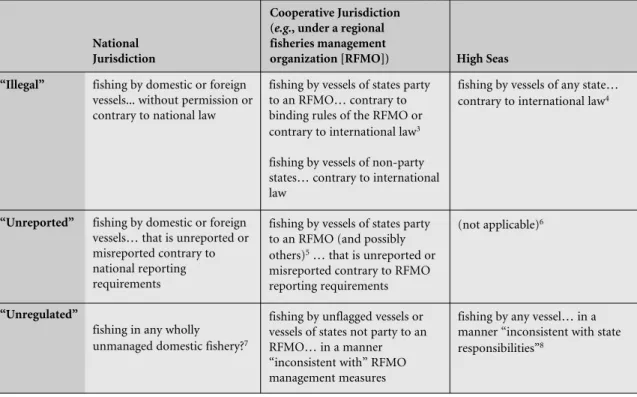
(c) Illegal, unreported, and unregulated (IUU) fishing is widespread. The generalized weakness of national and international fisheries management regimes is painfully evident in the pervasive problem of IUU fishing. Although the term “IUU” covers a variety of phenomena,26it refers in essence to fishing that takes place in
contravention of applicable regulations or in fisheries where no meaningful regulation exists. In recent years, IUU fishing has emerged as a specific and high-priority focus of international attention,27and has been of particular concern to
countries such as Japan28and Australia.29
22.See Newton, in FAO (1999a, Ch. 2, § 1).
23.The core provisions of the IPOA-Capacity call on member countries to assess the state of capacity in their fisheries and to develop national plans for the management of that capacity. The IPOA also contains provisions calling for international cooperation toward management of capacity in high-seas fisheries, and for addressing capacity issues related to the export of vessels from one national fishery to another.
24.IPOA-Capacity, ¶ 1.
25.For example, paragraph 21 of the IPOA calls on member states to publish national capacity management plans by the end of 2002. In February 2003, the FAO Committee on Fisheries reported that only nine members had done so, including the landlocked countries of Malawi and Nepal (presumably with regard to their inland fisheries). The remaining seven were Argentina, Madagascar, Mozambique, Namibia, New Zealand, Spain, and Venezuela. See FAO (2003a, ¶ 52 and fn. 58).
26.For a discussion of the technical definition of “IUU fishing”, see ¶ V.C.5(e) and Appendix 6.
27.See, e.g., FAO (2001a); UN (1999), ¶ 249 (IUU fishing “is considered to be one of the most severe problems currently affecting world fisheries”); WSSD Plan of Implementation, ¶ 31(d).
28.See, e.g., FAO (2003b).
29.Id. Australia’s leadership on the IUU issue was also evident in its cosponsorship of an FAO expert consultation on the subject in May 2000. See FAO (2000a); seealsoAustralia (2004) in Other Government Documents in the References section.
(i) In some fisheries, IUU fishing has devastating consequences. While obviously not a problem everywhere, IUU activities nevertheless affect many important fisheries. In the most notorious example, Patagonian toothfish (sometimes known as “Chilean sea bass”) has been fished nearly to commercial extinction as a result of IUU fishing in the Southern Ocean surrounding Antarctica.30In more northerly seas, the nongovernmental
organization TRAFFIC has documented Spanish fishing ports where 83 percent of bluefin tuna landed from the Mediterranean and over half landed from the eastern Atlantic were below the minimum size limits set to protect fish stocks, while more than one-third of the swordfish caught in the north Atlantic and more than 80 percent caught in the Mediterranean were smaller than the allowed size minimums.31Many other major fisheries face significant
IUU problems, often with serious impacts on stocks.32
(ii) IUU fishing is the subject of a recently adopted FAO voluntary code. In March 2001, members of the FAO adopted an International Plan of Action to confront IUU fishing (IPOA-IUU). The IPOA-IUU provides a series of voluntary steps that national governments and regional fisheries management organizations can take to reduce IUU activities.
For a further discussion of IUU fishing, see¶¶ V.C.3(b) and V.C.5 et seq.
(d) Many traditional tools for sustainable fisheries management are underutilized. The tools of modern fisheries management are widely known, but less widely applied in a fully effective manner. Such tools include the use of selective fishing gear, by-catch and discard limits; recovery plans; no-take zones; “monitoring, control, and surveillance”; and catch limits. Extending the effective application of these tools remains a high priority of WWF’s Endangered Seas Programme. (e) Some important new tools for sustainable fisheries management are
underutilized. Although improved fisheries management remains a top priority, many conservation organizations—and some governments—have recently begun to look beyond traditional management policies for additional ways to promote sustainable fishing. Several new approaches hold particular promise, but have yet to realize their potential:
(i) Better market incentives for sustainable fishing are needed.WWF has been a strong proponent of the responsible use of certification and ecolabeling to help
Background and General Context
P A R T I
I.A.3
30.According to Bray (2000a, App. 2, ¶ 70), the Scientific Committee of CCAMLR (the intergovernmental body charged with conservation of Antarctic marine resources) has reported its “grave concern over the virtual commercial extinction of some stocks of toothfish (Dissostichus spp.) due to IUU fishing,” noting that IUU catches of toothfish may be double the level of legal catches. SeealsoTRAFFIC (2001).
31.TRAFFIC (1999, 30).
32.For example, according to Bray (2000a, App. 2), the Indian Ocean Tuna Commission estimated that in 1996 approximately 10 percent of all tuna landings in the Indian Ocean were from IUU activities, going on to say that this estimate was “certainly greatly underestimated”; the International Commission for the Conservation of Atlantic Tunas (ICCAT) has called IUU fishing “a major concern for more than ten years,” and has reported that the impact of IUU fishing on fish stocks can be “very significant.” Serious concern about the level of IUU fishing within their
jurisdictions have also been expressed by International Council for the Exploration of the Sea (ICES), the Northwest Atlantic Fisheries Organization (NAFO), and the Commission for Conservation of Southern Bluefin Tuna (CCSBT), among others.