*Corresponding author:Sara Shafiei ISSN:0976-3031
ResearchArticle
TRANSIT ORIENTED DEVELOPMENT: A STRATEGY FOR AN EFFECTIVE URBAN GROWTH
Sara Shafiei* and Nagendra H.N
School of planning and architecture, University of Mysore, Karnataka, India
DOI: http://dx.doi.org/10.24327/ijrsr.2018.0908.2467
ARTICLE INFO ABSTRACT
Today, obstacles such as air pollution, traffic congestion, and high transport expenses, etc. have led to lower quality of life in cities, especially in metropolitan areasand struggle to accommodate more growth and development though the city has its own potential for growth. For this reason, it has been many years to come up with solutions to improve this situation by the experts of urban authorities.One of the ways which can solve this issue is the use of public transport with transit-oriented development.The goal of this paper is to consider the challenges of the use of public transport with transit-oriented development (TOD) specifically with the emphasis on the use of bus and rail transportusing a descriptive-analytical method.The main question is, whether TOD can be used as a good solution to the current problems of the cities? The hypothesis is, whether using TOD can improve the current situation of cities to some extent or not?The result is that both methods have advantages and disadvantages.For instance, the use of Bus and BRT is suitable for smaller population size lower population density areas and less costly for implementation and operation. But successful implementation of TOD based on the bus is more difficult for longer cities than an implementation of TOD based on rail. Also, the cost of implementing rail transport during the implementation the project costishigh, but fora longtime, this will be beneficial for the city.Hence, this paper attempted to create a dynamic, energetic, and vibrant central business district in urban areas through integration with other land use and transport-oriented development.
INTRODUCTION
In the current world planning system, public transport development has been at the center of attention of urban designers and planners, which is due to the increase in the length of city trips and traffic congestion, especially around travel attraction land use such as commercial, administrative, etc. The relationship between urban development and transportation has always been of great concern. On the other hand, the dynamics of economic growth tempo of commercial centers are declining; one of the most important reasons being the poor public transportation system in these areas and increased traffic and transport based problems in the center of acity. As different literature says ,urban growth based on public transport in the central part of the city can be a good solution to these problems to bring back the lost vitality of urban centers and economic growth(Meymandi Parizi, 2018).
The conception of transit oriented development, or "transit based development" popularly abbreviated as TOD is recommended to many cities under the new urbanism in the postmodern context by considering it as a response to the issues of urban traffic and transport problems in relation to
uncontrolled urban development under the approach of urban decentralization. However, several planners and urban decision makers look after TOD to be in favour of an opinion that was known as common suburban area expansion too (Raziyebeygi & Shirmohammadi, 2007). These days, with the high density growth of central part of the city and less density growth spread over the larger extent of lands in the suburban areas results horizontal city growth and have caused significant issues in cities like metropolises, around the world, which in turn have caused increasing dependency on the personalised vehicle when there is a lack of integration of urban growth and transport planning for both short and long trips to different places in the cities. To take care of these, it was felt that TOD can balance all urban human needs by valuing both environmental and socio-economic viabilities and hence the transit-oriented development can be used as an urban growth strategy of the present need to encounter all urban problems in both small and large cities.
This paper has been planned to consider the relation between transit-oriented development for the planned urban growth in the city by considering the traffic and transportation problems which are interrelated to massive urban growth around a single
International Journal of
Recent Scientific
Research
International Journal of Recent Scientific Research
Vol. 9, Issue, 8(C), pp. 28478-28483, August, 2018
Copyright © Sara Shafieiand Nagendra H.N, 2018, this is an open-access article distributed under the terms of the Creative Commons Attribution License, which permits unrestricted use, distribution and reproduction in any medium, provided the original work is properly cited.
DOI: 10.24327/IJRSR CODEN: IJRSFP (USA)
Article History:
Received 13thMay, 2018 Received in revised form 11th June, 2018
Accepted 8thJuly, 2018
Published online 28th August, 2018
Key Words:
CBD of the city. Hence these aspects have been carried further to purpose the TOD as a planning strategy for the future growth of prosperity with a different growth pattern.
Literature Review and Case Studies
According to Turner(1975)in the paper titled “The design of urban growth models for strategic land-use transportation studies suggested that urban growth models can play a significant role in the analysis and evaluation of strategic land-use transport alternatives, however to certain important modifications being made considering the changing nature of the urban transportation planning process. He also drawnConclusions on the direction in which the design of urban growth models should be moving if their potential in this area is to be fully realized, and on the particular implications of this for conventional transportation models.SimilarlyCervero, Ferrell, & Murphy(2002) have mentioned that the idea of TOD easily promotes suitable and high-density housing, beside complementary public, uses, jobs, retail and services, and will be made the focus on mixed-use developments at strategic points on the zonal traffic system. He found TOD could produce another type of growth such as transit villages, transit-supportive development, and transit-friendly design. HoweverCarlton (2007) has defined the Transit Oriented Development as “Traditional Neighborhood Developments, Pedestrian Pockets, Compact Communities or Urban Villages.”and other has summarized the TOD on urban style principles related to utilization of TOD ,that :
Organizes growth on a regional level which is to be compact and transit-supportive;
Provides places of commercial, housing, jobs, parks, and civic uses within walking distance of transit stops;
Creates pedestrian-friendly street networks which directly connect local destinations;
provide a mix land use types ,densities, and expenses;
preserves sensitive habitat, riparian zones, and high quality open space;
makes public spaces focusedon building orientation and neighborhood activity;
Encourage infill and redevelopment along transit corridors within existing neighborhoods.
A study with title “Defining Transit Areas of Influence” by Zimbabwe&Greenberg(2009)have described factors that affect the transit area of influence, which refers generally to the area around stations where land use development desire to be more transit-oriented and households desire to use fewer vehicles and rely significantly on public transportation including the type and quality of transit service, area walkability and street design, land use patterns, and other supportive policies.SimilarlyJed Kolko (2011)have mentioned for making the most of transit density, employment growth, and ridership around new stations by analyzing 200 transit stations that opened in California from 1992 to 2006. According to them these new stations tend to be located in areas with high residential area and more employment density,but opening of new stations did not cause significant station area employment growth relative to comparison areas, on average, and so recommends more incentives to encourage commercial development in those transit station areas to maximize transit ridership and Vehicle Miles Travelled (VMT) reduction impacts.Daniels & Mulley
(2011)in the paper titled” Explaining walking distance to public transport: the dominance of public transport supply” demonstrated that the transit passengers tend to walk significantly farther to access rail stations than bus stops. Variations in the models of services presented by these modes: rail tends to be faster, has more attractive stations often involving amenities including shops, ticket vendors, and washrooms, serves longer trips especially rail trips average about twice the distance, and are more dispersed have forcing people to walk farther to access train stations. The bus services are good to serve urban areas within conurbation boundaries and transit is good for the city region or urban region. Guo, Weinstein, Dill, & Quirk (2011) in their paper titled “The Intersection of Urban Form and Mileage Fees: Findings from the Oregon Road User Fee Pilot Program” have analyzed the data from the year 2006-2007 in the Oregon Road User Fee Pilot Program, which charged motorists for driving in congested situation. The study found that households in denser, mixed use, transit-accessible neighborhoods reduced their peak-hour and overall travel significantly more than comparable households in automobile dependent suburbs and that congestion pricinghas increased the value of more accessible and multi-modal locations.Curtis (2012) has focus his article with the title” Transitioning to Transit-Oriented Development: The Case of Perth, Western Australia” has shown the ability of transition to TOD, whether the planning system provides an effective implementation approach. Perth has seen one of the most deliberate attempts worldwide to move from car-dependent development patterns to transit-oriented development (TOD). His study explains three different town planning models which have been applied to implement TOD along the suggestion of findings says that, planned transition to TOD requires policy clarity and consistent application, integration of land-use planning and transport planning actions at the project level and incentives for local government and development industry. The paper with title “The analysis of transit-oriented development (TOD) in Washington, D.C. and Baltimore metropolitan areas”by Nasri & Zhang (2014)have tried to understand how travel behavior is different for TOD residents in the two metropolitan areas of Washington, D.C., and Baltimore.
examined whether scrutinizing planning history, particularly regarding rural–urban interplay, can differentiate TOD strategies and facilitate a discussion on desirable kinds of future TOD. A case study isSkurup, a Swedish town in a region with ambitious plans for TOD. The analysis in the paper has focused on rural–urban linkages and on a reinterpretation of the railway and its role in the town, as revealed by the strategic planning of the municipality and its materialization in the terrain. It also informed a discussion on alternative strategies for urban development and on bringing rural–urban relations into the TOD debate. However,Wey (2015)in this literature titled “Smart growth and transit-oriented development planning in site selection for a new metro transit station in Taipei, Taiwan” has aimed to portraythe transit-oriented development (TOD) concept to past modern urban development proposals based on the planning principles of smart growth and sustainable development. The methodology used is a combination of Fuzzy Analytic Hierarchy Process (FAHP) and Data Envelopment Analysis (DEA) model with assurance region approach is applied to select the most suitable station from a given set of possible station sites. Both the selected station and the proposed developments through this methodological approach are provided to the public sector. These literature studies throw the light on TOD and its utilization at various contexts. This study also helps to draw out characteristics and benefits of TOD, which are summarized as follows.
BriefSummary of History & Implementation of Transit-Oriented Development
The idea of Urban Centralities emerged in the 19th century in the middle of Europe when the rail network started growing on around European cities. About 140 years after the theory was rediscovered in the United Stated on the flow of de-suburbanization of American megapolises. Transit-oriented developments were stamped as Urban Centralities, as we know them now, and started making its way among professionals. In 1993 Peter Calthorpe, famous American architect &Urbanist, in his book “The Next American Metropolis: Ecology, Community, and the American Dream.” For the first time summarized the urban design principles associated with Transit Oriented Development. According to him, the concept is simple medium and high-density housing, accompanying with perfect public uses, businesses, retail, and services are focused in mixed-use developments at vital points along the regional transit system. Since that time the concept became increasingly popular in the United States, and there are so many successful cases of its application across the country. Today maximum of the planners considers Transit-oriented development to be a growing attitude.The value of Transit-oriented Development is well known through the entire world; it has appeared from Curitiba in Brazil, Singapore, and Hong Kong in Asia to London in Europe and Washington DC in America. Pedro B.Ortiz says "Polycentrism is built on urban centralities" Centralities are built around the main nodes constructed around the train stations. They have different urbanism roles such as residential, tertiary, cultural, logistics, etc. but they all have seven components; Intermodality, Civic Spaces, Commerce and Offices, Housing, Social Facilities, Administrative and Social Icons.Africa is extracting the idea of transit-oriented development to its growing cities with the assistance of the
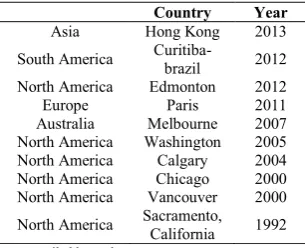
World Bank;andstill, they have to do a lot in term of stakeholder’s engagement as well as more adapted legal system and the answer to these challenges which has laid in the efficient governance (Cervero, 2004). A below table has shown a brief history of global experience for implementing transit oriented developmentin the countries.
Table 1 Global experience for implementing transit oriented development in the countries
Country Year
Asia Hong Kong 2013
South America Curitiba-
brazil 2012
North America Edmonton 2012
Europe Paris 2011
Australia Melbourne 2007
North America Washington 2005
North America Calgary 2004
North America Chicago 2000
North America Vancouver 2000
North America Sacramento,
California 1992
Source:compiled by author
TheRole of Transit-Oriented Developmentin Urban planning Design
Urban sustainability demands a balance among economic, social, and environmental concerns. The development of urban sustainability involves several aspects, including populations, land use, urban structure, and mobility behavior. The dynamic of urban is reflected in the interaction between human and environment in spatial and temporal context. With that such complex system, spatial structure strategy alone or partial strategies, such as transportation infrastructure policies, cannot be relied upon for achieving sustainability; instead, integrated land use, transportation, and environmental strategies are required (Hasibuan &et al., 2013).
Programming, Maintenance, Density and Scale, Public spaces for human use, Safety, Variety and complexity, Connections, Pedestrian/non-motorized orientation, Transit in the urban pattern, Car movementand parking.
There are two things to learn in this study which are First, the processes such as controlling the development of a transit-oriented development over time and facilitating public engagement. In terms of urban growth and development over time, these authors and others in the broader urban planning and design field realize that TODs will rise as the numbers of riders, residents, and shoppers increase but do not address the question of how future growthcan be factored into the comprehensive TOD design stage. In addition, while a number of authors indicate the importance of mixed income housing to increase the use of transit, there has not been as much attention to the role of such housing in participatory processes in a TOD context.Second, some of the design features described by the dimensions are difficult to reconcile with one another. For example, in TOD areas where transit access is presumed to be frequent, there should be “quiet and intimate” thoroughfares, as well as access for bicyclists and, finally, some allowances made for short trip automobiles. Accomplishing all this in a confined space of a quarter-mile, or even a half-mile, obviously entails some complicated choices between the needs of different types of transportation modes, as increased efficiency for one mode may come at the expense of another mode’s users. The high density that characterizes TOD further increases the possibility of less-than- perfect trade-offs.The planning and design process can help to make some features of very higher densities to fit into an existing and less or high intensively-developed context and bring amenities that provide benefits for both existing and new residents. Given that the particular circumstances of TOD projects are widely varied, so too are the solutions undertaken at thevarious design scale. Yet, in analysing the urban planning and design characteristics of a number of TOD projects and plan formulations,it is clear that there are some solutions that work better than others, and that there are lessons to be learned from past experiences(Jacobson & Forsyth, 2008).
Characteristics &Benefites of Transit-Oriented Development
Many authors have acknowledged the specific characteristics and the benefits of TOD at various contexts, fallowing are some of them in specific.
Characteristics of Transit-Oriented Development
Transit-oriented Developments Must Have the Following Features
Local routs system must be clear and recognizable,
Proper linkage and converging to transit stations,
CBD or open spaces; roads must be safe and a friendly area for the pedestrian; and
Located to maximize access to the central part of the city.
In addition, create a healthy environment area for walking can succeed without transit, but a transportation system cannot exist without pedestrians. Thereforepedestrian is a major precondition of a TOD(Silvestre, 2015).
Benefites of Transit-Oriented Development
As several authors have considered the advantages from TOD which might increase thecomfortable living in the future as summarised a California Department of Transportation that classified the benefits of TOD are as follows(Hess & Lombardi, 2004):
• Provides mobility choices, • Increases public safety, • Increases transit ridership,
• Reduces rates of vehicle miles travelled, • Increases households’ disposable income,
• Reduces air pollution and energy consumption rates, • Helps conserve resource lands and open space, • Plays a role in economic development, • Decreases infrastructure costs,
• Contributes to more affordable housing, and • Save the environment from pollution
Overall, study of literature and after reviewing many articles, it can be suggest and it is the opinion as expressed by different authors that, other transportation measures, such as transit-based housing or transit-adjacent employment centres are not enough influential in the urban context; instead, transit-oriented development is more useful when it involves a mixture of all types of uses and along with asupportive policies
Transit-Oriented Development Challenges
Notwithstanding various benefits, many transit-oriented development plans remain on the drawing board. There can be a set of several reasons and challenges asplanning, economic, social and environmental. In addition, it could be administrative limitations such as long-term program implementation, lack of stakeholder’s obligation and people participation, less chance for land procurement, flaws of urban plan framework. Prices fluctuating on the different land use and housing as a consequence of raise accessibility can result in the so-called transit-induced planning processes. While some development can be done by improving the spatial planning and design and satisfying the operational and real estate interests with respect to transit issue as a base, however, the real difference can be obtained through the integration of physical and socio-economic changes of the settlement accordingly not irrespective of class, size, type, etc.
Based on the knowledge compiled, by studying the relevant literature to carry out any research on the intended topic, this paper has been written with the fallowing aim and objectives:
Aim & Objectives
The study intends to utilize the concept of TOD for resolving urban traffic and transport problem and planning for effective urban growth.
Aim: the principle aim of the study is to consider the Transit Oriented-Development planning as a strategy for a planned effective future growth of city of any type.
Objectives:the objectives of the article are as follows:
1. To review the TOD and study its efficiency of service in different urban context,
planning which directly depend on the urban transport system.
3. To study the existing attempts on utilization of TOD for accommodating the future growth and development of the cities.
4. To introduce the transit-oriented development (TOD) strategy as an option for most types of urban planning processes.
Always a critical part of any research is to demonstrate the data and the orientation of analysis to set a methodological research approach for utilization of Transit Oriented-Development with the intendedaim of research. It has been chosen for developing as an effective planning strategy to resolve the problem of urban traffic and transportation along with the problems of city development and growth management in the urban planning process. Hence a principal component of city growth and development planning based on TOD require a detailed study on existing road transport network and modes of existing urban transport along with urban growth and development dynamics.
Purpose and Scope of the Paper
The purpose of this paper is to present examples of Transit Oriented-Development which has direct relation with the transportation systems and characteristics of growth and development of different cities marked presently by high rates of private car usage and relatively low public transport usage and also, significance of TOD utilization ,for the public transport systems which heads towards central part of the cities and also fringe areadevelopments in different part of the urban areas under the intention ofrural-urban integration, sustainable development ,smart growth planning ,etc.
CONCLUSION
This paper has demonstrated some selected literature review which is classified into two main topics: literature related to the “transit-oriented development “and “urban growth”. Different people have a different idea for using TOD development in the urban area. Here most of the articles collected based on the transit oriented development and its impact on urban growth for a better understanding of the issue regarding the subjects under discussion to utilize them in the present context. This study suggestsa strategy for an effective utilization of TOD for the effective urban growth where thecity was planned as a city with single nucleus CBD without giving much importance to its surrounding developments and future transport and traffic along with a city which encourages continuous urban growth and thoseleads to a typical urban growth problems and traffic transportation problems. The missing component of understanding the TOD in the planning process could be the reason. Hence, the same has been considered as gapand highlighted in this paper,along with the summary of various nature of definition for Transit-Oriented Development which demonstrates, that, the strategy of TOD could be utilized for goal changes.Because as observed TOD in most of the literatures and case studies has envisaged aiming at creating well-set new trend of development, which can integrateboth land use land use and transit by curtailingother modes of transport through the highest usage of public transport. It can create a shifting from car to transit, sustainable development,smart growth,etc. It is confirmed that in the overall planning process of the cities, the strategy of TOD can
be used as a strategy to resolve the existing traffic transportation problem and urban growth problems of city of all types. Since TOD has that capability to resolve the problems of the city’s traffic transportation & urban growth problems. These are considered as main issues to fill the research gap in different thematic context of the present urbanplanning processes. Hence there is a need for TOD planning approach and it is appropriate in the present context to provide not only efficient service quality of transit system but also ensure augmentation of public transportation towards an effective urban growth.Hence the transportation planning is in the wake of new ideas of TOD which embraces the concept of "multi modalism" that recognizes the urban and regional mobility which is served not only by streets and highways but also by sidewalks, bus routes, railways and other transport technologies. The study will also be useful for the future development of the cities.
Transit Oriented Development is required be seen not only as traffic and transportation prublem, it can be utulized to provide solutions to the problems of urban growth and development. If TOD is to be generally adopted as a real option to the automobile-oriented urban planning and design, it needs to attract a comprehensive market in terms of household types, income levelson both urban and regional locations. Success in this effort will bepromoteda functions of the livability, accessibility, and attractiveness created by particular physical planning and good urban pattern. This paper has a relation of hope to demonstrate many options for creating a well-designed transportation environment and multiple solutions capabilities for solving site-specific problems. Thisstudy also demonstrates a requirement of range of methods to be adopted for assessing urban planning and design features of TODs. How future plans solve the multiple and difficult planning and design challenges inherent in TOD will up to the particular conditions surrounding each scheme, and on the ability of planners, policymakers, engineers, architects, urban designers and local citizens to balance competing objectives. Overall, physical design both in terms of visual quality and livability is a significant aspect of making TOD plans work and is deserving of further attention.
Acknowledgment
The author wish to appreciate all of those who have supported this study for their useful comments during its completion. In specific, I would like to acknowledge the University of Mysore (UOM) and Department of School of Planning and Architecture (SPA).This study was supported by Dr. Nagendra.H.N. who is the Director and Professor in the school of planning and architecture provided insight and expertise that greatly helpful to the research. I thank to my colleagues from Institute Development Studies, Shobna Sabnam Hassanfor for her valuable comments that greatly improved the manuscript.
References
Carlton, I. (2007). Histories of Transit-Oriented Development: Perspectives on the Development of the TOD Concept Real Estate and Transit, Urban and Social Movements, Concept Protagonist. Institute of Urban and Regional Development University of California, Berkeley.
United States: Experiences, challenges, and prospects(Vol. 102). Transportation Research Board. Cervero, R., Ferrell, C., & Murphy, S. (2002).
Transit-Oriented Development and Joint Development in the United States: A Literature Review. Research Results Digest, (52), 1–144. https://doi.org/10.1068/a38377 Curtis, C. (2012). Transitioning to Transit-Oriented
Development: The Case of Perth, Western Australia. Urban Policy and Research, 30(3), 275–292. https://doi.org/10.1080/08111146.2012.665364
Daniels, R., & Mulley, C. (2011). Explaining walking distance to public transport: the dominance of public transport supply. World Symposium on Transport and Land Use Research.
Guo, Z., Weinstein, A., Dill, J., & Quirk, M. (2011). The Intersection of Urban Form and Mileage Fees: Findings from the Oregon Road User Fee Pilot Program, Research
Report 10-04. Retrieved from
http://scholarworks.sjsu.edu/mti_publications
Hasibuan, H. S., &et.al. (2013). the role of transit oriented development in constructing urban environment susyainability,the case of Jabodetabek,Indonesia. Elsevier, (20(2014)622-631).
Hess, D., & Lombardi, P. (2004). Policy Support for and Barriers to Transit-Oriented Development in the Inner City: Literature Review.Transportation Research Record, 1887(1), 26-33. https://doi.org/10.3141/1887-04 Jacobson, J., & Forsyth, A. (2008). Seven American TODs :
Good practices for urban design in Transit-Oriented Development projects. Journal of Transport and Land Use, 2(Fall), 51–88. https://doi.org/10.5198/jtlu.v1i2.67 Jed Kolko. (2011). Making the Most of Transit Density,
Employment Growth, and Ridership around New Stations. Public Policy of Institute Os California. Retrieved from http://www.ppic.org/main/home.asp Meymandi Parizi, S. (2018). urban growth based
transit-oriented development (TOD) in the context of business improvement districts(BID). Geography And Territorial Spatial Arrangement,7(25), 5.
Nasri, A., & Zhang, L. (2014). The analysis of transit-oriented development (TOD) in Washington, D.C. and Baltimore metropolitan areas. Transport Policy, 32, 172–179. https://doi.org/10.1016/j.tranpol.2013.12.009 Qviström, M., & Bengtsson, J. (2015). What Kind of
Transit-Oriented Development? Using Planning History to Differentiate a Model for Sustainable Development. European Planning Studies, 23(12), 2516–2534. https://doi.org/10.1080/09654313.2015.1016900
Raziyebeygi, R., & Shirmohammadi, H. (2007). Studying various aspects of applying transit oriented development (TOD) approach in metropolises and new towns. In 12th International Conference.
Silvestre, D. A. (2015). Loosening The U-Belt: Creating A Transit-Oriented Academic CORE.
Turner, C. G. (1975). The design of urban growth models for strategic land-use transportation studies. Regional
Studies, 9(3), 251–264.
https://doi.org/10.1080/09595237500185261
Wey, W. M. (2015). Smart growth and transit-oriented development planning in site selection for a new metro transit station in Taipei, Taiwan.Habitat International,
47, 158–168.
https://doi.org/10.1016/j.habitatint.2015.01.020
Widyahari, N. L. A., & Indradjati, P. N. (2015). The Potential of Transit-Oriented Development (TOD) and its Opportunity in Bandung Metropolitan Area. Procedia Environmental Sciences, 28(SustaiN 2014), 474–482. https://doi.org/10.1016/j.proenv.2015.07.057
Zimbabwe, S., & Greenberg, E. (2009). Defining Transit Areas of Influence. APTA.
How to cite this article:
Sara Shafieiand Nagendra H.N. 2018, Transit Oriented Development: A Strategy for an Effective Urban Growth. Int J Recent Sci Res. 9(8), pp.28478-28483.DOI: http://dx.doi.org/10.24327/ijrsr.2018.0908.2467