The Thirty-Third AAAI Conference on Artificial Intelligence (AAAI-19)
Scalable Distributed DL Training: Batching Communication and Computation
Shaoqi Wang, Aidi Pi, Xiaobo Zhou
Department of Computer ScienceUniversity of Colorado, Colorado Springs, CO, USA {swang, epi, xzhou}@uccs.edu
Abstract
Scalability of distributed deep learning (DL) training with parameter server architecture is often communication con-strained in large clusters. There are recent efforts that use a layer by layer strategy to overlap gradient communication with backward computation so as to reduce the impact of communication constraint on the scalability. However, the ap-proaches cannot be effectively applied to the overlap between parameter communication and forward computation. In this paper, we propose and design iBatch, a novel communication approach that batches parameter communication and forward computation to overlap them with each other. We formulate the batching decision as an optimization problem and solve it based on greedy algorithm to derive communication and com-putation batches. We implement iBatch in the open-source DL framework BigDL and perform evaluations with various DL workloads. Experimental results show that iBatch improves the scalability of a cluster of 72 nodes by up to 73% over the default PS and 41% over the layer by layer strategy.
Introduction
Deep learning (DL) (LeCun, Bengio, and Hinton 2015), a class in machine learning (ML) field, has achieved re-markable success across a wide range of applications, in-cluding image recognition, object detection, and natural language processing. In DL, deep neural network (DNN) models achieve high accuracy through the use of deeply layered structures with many parameters (He et al. 2016; Szegedy et al. 2017).
In order to reduce the training time of DNN models in a sin-gle compute node, DL frameworks (e.g., TensorFlow (Abadi et al. 2016), BigDL (Wang et al. 2018c)) implement dis-tributed DNN models, in which the training data is parti-tioned over distributed clusters with multiple nodes by taking advantage of data parallelism. Among the distribution imple-mentations, parameter server (PS) architecture (Li et al. 2014; Dai et al. 2015; Xing et al. 2015) is a common communica-tion architecture that synchronizes parameter updates (i.e., gradients) among multiple nodes. PS separates the cluster nodes into workers and servers. The servers serve as a dis-tributed storage of model parameters. In the default setting,
Copyright c2019, Association for the Advancement of Artificial Intelligence (www.aaai.org). All rights reserved.
the one iteration execution contains four sequential opera-tions. First, the workers pull the parameters from the servers. Then, they conduct forward computation based on the pulled parameters, and compute the gradients through backward computation. Finally, they push the gradients during each synchronization into the servers.
However, as the number of nodes in a cluster increases, the distributed implementation with PS often scales poorly. For instance, a recent study (Zhang et al. 2017) shows that training VGG19-22K network that contains 229M (million) parameters with open-source TensorFlow on 32 nodes can be slower than training on a single node. The reason is that when the number of nodes increases, more nodes share the network bandwidth of the cluster so that the available bandwidth for each node decreases (Ahmad et al. 2014; Wang et al. 2018b). As the result, the parameter commu-nication time and gradient commucommu-nication time increase, prolonging the execution time of one iteration. Thus, the cluster network bandwidth becomes a severe bottleneck for large-scale distributed DL training.
Previous efforts reduce the impact of communication con-straint on the scalability of distributed DNN model training from two aspects. From the aspect of algorithm, Gradient Quantization (Zhou et al. 2016; Wen et al. 2017; Micikevi-cius et al. 2018) and Sparsification (Aji and Heafield 2017; Lin et al. 2018; Chen et al. 2018) reduce the gradient com-munication time by cutting down the size of gradients in communication. These techniques need to balance the trade-off between the model accuracy and the size of gradients. From the aspect of PS design, Poseidon (Zhang et al. 2017) proposes a novel PS architecture, in which gradient commu-nication is overlapped with backward computation layer by layer to reduce the execution time of these two operations. With the layer by layer strategy, the gradients of each layer are pushed to the servers immediately after the backward computation in the layer. However, Poseidon does not over-lap parameter communication with forward computation.
and forward computation time. However, the layered model structures of DNN pose severe challenges on the overlap so that the straightforward layer by layer overlap strategy cannot be effectively applied here. First, we find that pulling parameters from the servers layer by layer brings significant overhead in parameter communication. Second, the param-eter communication time can be longer or shorter than the forward computation time across layers so that the communi-cation can only be partially overlapped with the computation. For instance, the communication time is usually much longer than the computation time in fully-connected layers, while the computation time is usually much longer than the commu-nication time in convolutional layers (Krizhevsky, Sutskever, and Hinton 2012).
We propose and design iBatch, a novel communication approach that batches parameter communication and forward computation to overlap them with each other. Instead of us-ing a constant batch size, iBatch uses communication and computation batches with various sizes in order to maximize the overlap. Specifically, we first profile the parameter com-munication time and the forward computation time in DNN model training. Then, we formulate the batching decision as an optimization problem of execution time minimization based on the profile. Finally, we use greedy algorithm that maximizes the overlap to solve the optimization problem and derive the batches.
In a nutshell, we make the following technical contribu-tions: 1) We find the naive implementation of the layer by layer strategy is not effective to overlap parameter communi-cation with forward computation. 2) We design iBatch based on problem formulation and algorithm design to conduct the overlap through batching parameter communication and forward computation. 3) We implement iBatch in the open-source DL framework BigDL and perform comprehensive evaluations with various DL workloads. Experimental results show that iBatch achieves up to 45x speedup for VGG19-22K network in a cluster of 72 nodes, 73% improvement over the default PS (26x speedup) and 41% improvement over the layer by layer strategy (32x speedup).
Related Work
Distributed DL frameworks with PS. Based on PS ar-chitecture (Li et al. 2014; Dai et al. 2015), a number of distributed DL frameworks have been developed. DistBe-lief (Dean et al. 2012) is a distributed framework that trains deep networks using asynchronous stochastic gradient descent. TensorFlow (Abadi et al. 2016) is Google’s dis-tributed DL framework that uses a dataflow graph to repre-sent DL models and synchronizes model parameters via PS. MXNet (Chen et al. 2015) is another DL framework that uses PS for distributed execution and supports graph repre-sentations for DL models. The above frameworks, however, lack the benefits of tight integration with general-purpose computational frameworks such as Apache Spark (Zaharia et al. 2012). To this end, BigDL (Wang et al. 2018c) is proposed as a distributed DL library for Spark. With BigDL, users can write their DL applications as standard Spark programs that can directly run on top of existing Spark clusters.
Distributed DL implementation based on PS has limited scalability due to the high volume of communication in pa-rameter synchronization. Thus, there are techniques to reduce network communication. Poseidon (Zhang et al. 2017) uses wait-free backpropagation that overlaps the backward prop-agation computation with the gradient communication. It also uses a hybrid communication scheme that optimizes the number of bytes required to synchronize each layer. How-ever, the layer by layer overlap strategy is not efficient for overlapping the forward propagation computation with the parameter communication.
Gradient Quantization and Sparsification that reduce the size of data in communication are also extensively studied. In gradient quantization, 1-bit SGD (Seide et al. 2014) is pro-posed to reduce gradients transfer data size and achieved 10x speedup in traditional speech applications. TernGrad (Wen et al. 2017) uses 3-level gradients and DoReFa-Net (Zhou et al. 2016) uses 1-bit weights with 2-bit gradients. In gradient sparsification, threshold quantization (Strom 2015) and gradi-ent dropping (Aji and Heafield 2017) are proposed to sparsify the gradients by a single threshold based on the absolute value. However, the threshold is hard to choose in practice. AdaComp (Chen et al. 2018) proposes to automatically tune the compression rate depending on local gradient activity. DGC (Lin et al. 2018) reduces the communication bandwidth through momentum correction, local gradient clipping, mo-mentum factor masking, and warm-up training. These tech-niques need to balance the trade-off between model accuracy and the size of data in communication.
Distributed DL frameworks without PS.There are DL frameworks that make use of decentralized training to re-move the burden of PS deployment in distributed environ-ments while maintaining data parallelism. In MALT (Li et al. 2015), workers exchange gradients with a subset of work-ers selected by a Halton sequence. Due to the synchroniza-tion delay, it suffers from slow convergence, especially for complex neural network models. SFB (Xie et al. 2016) and Ako (Watcharapichat et al. 2016) parallelize DL applications using peer-to-peer communication.
Motivation
In this section, we first introduce the PS architecture for par-allelizing DNN training on clusters. We then describe the communication and computation overlap that takes advan-tage of decomposing the procedure of DNN training into a sequence of communication and computation operations. Finally, we provide a case study to show the potential gain of overlapping parameter communication and forward computa-tion in a batch of layers.
Parameter Server Architecture
Figure 1: The parameter server architecture.
gradients) locally through forward and backward propagation computation using its data partition. The forward computa-tion computes the value of an objective funccomputa-tion (i.e., loss function) based on the parameters. The backward computa-tion generates the gradients based on the value of objective function. The workers then push the gradients to the servers. After receiving the gradients, the servers update the model parameters based on Stochastic Gradient Descent algorithm. There are different types of synchronizations between the servers and the workers, such as BSP (Zaharia et al. 2012), A-BSP (Wang et al. 2018a), SSP (Xing et al. 2015), and ASP (Chilimbi et al. 2014).
Communication and Computation Overlap
In the default PS, each worker conducts four operations se-quentially in one iteration: parameter communication (i.e., pulling parameters), forward computation, backward compu-tation, and gradient communication (i.e., pushing gradients). The four operations are defined asPt,F Ct,BCt, andGt,
respectively, wheretdenotes the number of iterations. Thus, the procedure of DNN training in iterationtcan be notated as [Pt, F Ct, BCt, Gt].
The forward and backward computation is performed through DNN layer by layer. If we define a forward and a backward computation through thelth layer of a network asf cl
t andbclt, respectively, the computation [F Ct, BCt]
is notated as [f clt, f c2t, ..., f cLt, bcLt, bc L−1
t , ..., bclt], whereL
denotes the number of layers in the network. Meanwhile, as every layer of a network contains an independent set of parameters,PtandGtcan be decomposed as [p1t, p2t, ..., pLt]
and [gLt, g L−1
t , ..., g1t], respectively, wherepltis defined as
pulling the parameters of layerlandgl
tis defined as pushing
the gradients of layerl. Thus, the training procedure can be written as [p1
t, ..., pLt, f clt, ..., f cLt, bcLt, ..., bclt, gtL, ..., g1t], as
illustrated in Figure 2(a). The communication and computa-tion perform sequentially, waiting for each other to finish.
The communication can be overlapped with computation based on two independencies in the training procedure: (1) the parameter communicationpl
tis independent of the
for-ward computation f cit(i < l); (2) the gradient
communi-cationgl
tis independent of the backward computation bcit
(i > l). As the result, two overlaps can be performed as shown in Figures 2(b) and 2(c): (1) The overlap between parameter communication and forward computation; (2) The overlap between gradient communication and backward com-putation. Previous efforts explored the latter overlap by over-lapping gradient communication with backward computation
p1
t pLt fc1t fcLt bcLt bc1t gLt g1t
(a) The procedure of DNN training in iterationt.
1
t 2t lt
1
t 2t l+1t l+1
t
l+2
t Lt
L t
(b) The overlap between parameter communication and forward compu-tation in iBatch.
L
t L-1t 1t
L
t L-1t lt l-1t
l+1
t lt
1 t
(c) The overlap between gradient communication and backward com-putation in previous efforts.
Figure 2: The communication and computation overlap.
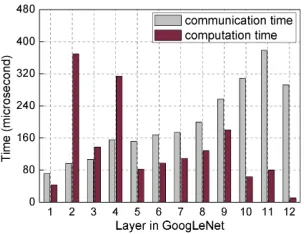
Figure 3: The parameter communication time and the forward computation time in each layer in GoogLeNet.
layer by layer. Specifically,gltis performed immediately af-ter finishingbcl
tso thatgtlandbcit(i > l)can be executed
concurrently without blocking each other. In contrast, iBatch explores the former overlap through batching parameter com-munication and forward computation.
Case Study
The straightforward layer by layer strategy cannot be ef-fectively applied to overlap parameter communication with forward computation due to two reasons. First, this strat-egy brings significant overhead in parameter communication. Specifically, the total parameter communication time depends on two factors: the number of communications and the time in each communication (Lee et al. 2017). The time in each communication consists of a startup time (e.g., searching the servers that store parameters and handling TCP connections) and a transfer time. The startup time is independent of the size of parameters in the communication and the transfer time is in direct proportion to the size. Thus, if a worker pulls the parameters in a neural network layer by layer, the number of communications equals the number of layers in the network, leading to significant overhead in the startup time.
6WDUWXSWLPHLQSDUDPHWHUFRPPXQLFDWLRQ 7UDQVIHUWLPHLQSDUDPHWHUFRPPXQLFDWLRQ )RUZDUGFRPSXWDWLRQWLPH
OD\HUVWR OD\HUVWR
([HFXWLRQWLPH
(a) Sequential execution of communication and computation in the default PS without overlap.
([HFXWLRQWLPH
(b) Overlap the communication with computation layer by layer.
WR WR WR
WR WR WR
([HFXWLRQWLPH
(c) Overlap the communication with computation in a batch of layers with iBatch.
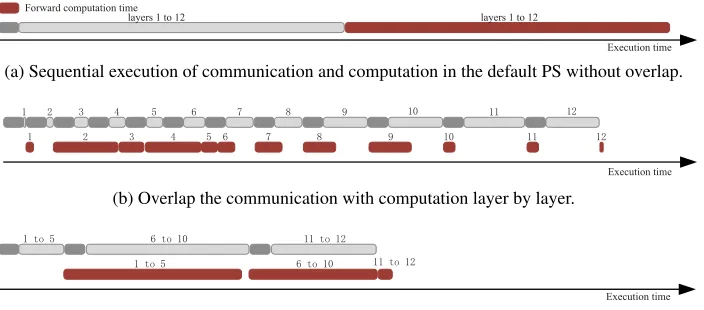
Figure 4: The procedure of parameter communication and forward computation with three communication approaches. The time in each communication is divided into a startup time and a transfer time. The number denotes the layer in the network.
As the result, the communication can only be partially over-lapped with the computation. To validate this, we created a BigDL cluster containing 6 workers and 6 servers and ran the representative GoogLeNet (Szegedy et al. 2015) using the data from Imagenet (Krizhevsky, Sutskever, and Hinton 2012). Figure 3 illustrates the communication time and the computation time in each layer (adjacent convolutional layer and pooling layer are regarded as one layer since there are no parameters in pooling layers). The result shows that the com-munication and computation time varies across layers. The communication time is much longer than the computation time in fully-connected layers (e.g., layer 11). The compu-tation time is much longer than the communication time in convolutional layers (e.g., layer 2).
According to the time in Figure 3, we present the procedure of parameter communication and forward computation with the default PS, the layer by layer strategy, and iBatch in Figure 4. In the default PS, a worker pulls all parameters from the servers once and then conducts the forward computation layer by layer. Figure 4(a) illustrates the timeline of this procedure. The figure shows that there is only one startup time since the number of communications is one. However, this procedure is highly sequential, in which the computation waits for the communication to finish.
With the layer by layer strategy, a worker pulls the parame-ters from the servers layer by layer and conducts the forward computation in each layer once the corresponding parameters are pulled from the servers. We present the timeline of this procedure in Figure 4(b). The figure shows that the communi-cation is partially overlapped with the computation. However, this strategy brings significant overhead (i.e., multiple startup time) since the number of communications equals the num-ber of layers. In some layers (e.g., layers 10 and 11), the forward computation has to wait for a long time before the communication finishes, prolonging the execution time.
iBatch proposes to overlap the communication with the computation in a batch of layers as shown in Figure 4(c). Con-cretely, a worker pulls all parameters through three batches.
The first batch pulls the parameters from layers 1 to 5. The second batch pulls the parameters from layers 6 to 10. The third batch pulls the parameters from layers 11 to 12. Com-pared with the layer by layer strategy, the startup time is saved in iBatch since the number of communications is re-duced to three. Also, with iBatch, more communication is overlapped with the computation in this case, leading to a significant reduction in the execution time.
iBatch Design and Implementation
The goal of iBatch is to minimize the execution time includ-ing the total parameter communication time and the forward computation time. We first formulate the batching decision as an optimization problem of execution time minimization based on the profile of the parameter communication time and the forward computation time. Then, we use greedy al-gorithm that maximizes the overlap to solve the problem and derive communication and computation batches.Given a cluster and a neural network, we measure the forward computation time in each layer in the network and define the time inith layer asCi. For the parameter
commu-nication, we measure the startup time as well as the transfer time in each layer. The startup time is notated asTsand the
transfer time inith layer is notated asTi t.
Problem Formulation
The computation in this part cannot be overlapped with any communication since there is no communication in the part. To formulate the execution time, the number of batches in aL-layer network is notated asNand the batches are notated as [[l0+ 1 = 1,l1], [l1+ 1,l2], ..., [lN−1+ 1,lN =L]],
where li denotes the last layer in batch i. In other words,
batchiincludes layers fromli−1+ 1toli. For instance, batch
1 (i.e., the first batch) includes layers from 1 tol1. BatchN
(i.e., the last batch) includes layers fromlN−1+ 1toL. The batches in Figure 4(c) is [[1, 5], [6, 10], [11, 12]].
Based on the notations, the first part in the execution time is formulated as:
EXE1=Ts+ X
1≤i≤l1
Tti (1)
In the second part, the number of communications isN-1. So, the total startup time is(N−1)∗Tsand this part is formulated
as:
EXE2=Ts+ X
l1+1≤i≤l2
Tti+...+Ts+ X
lN−1+1≤i≤L
Tti
= (N−1)∗Ts+ X
l1+1≤i≤L
Tti
(2) The third part is formulated as:
EXE3=
X
lN−1+1≤i≤L
Ci (3)
We define the execution time asExeT ime. Thus, we mini-mizeExeT imeby solving the following optimization prob-lem:
min EXET ime=EXE1+EXE2+EXE3 (4)
subject to
Ts+ X
lk+1≤i≤lk+1
Tti> X lk−1+1≤i≤lk
Ci 0< k < N (5)
Objective Eq. 4 minimizes the sum of the three parts in the execution time. Constraint Eq. 5 ensures the overlap between the communication in batchk+1and the computation in batch
k.
Algorithm Design
To minimize the execution time,li (0 < i < N) in the
batches is derived one by one through greedy algorithm. Specifically, we use two greedy algorithms that makes greedy choices at each step to ensure that the objective function in Eq. 4 is optimized. Each algorithm derives one candidate of communication and computation batches. From two candi-dates of the batches, we choose the one with the minimal execution time to batch parameter communication and for-ward computation.
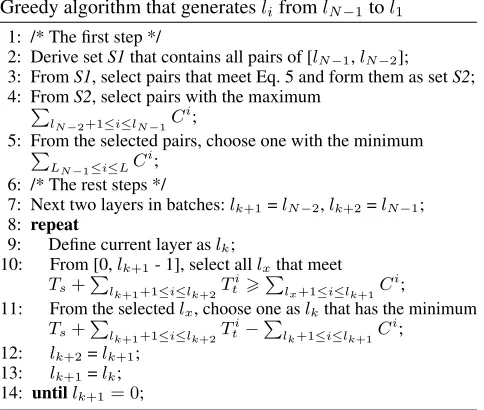
Algorithm 1 generateslifroml1tolN. The first step (lines
2 to 5) that choosesl1andl2decides the communication time
EXE1and the overlapping time between the communication in the second batch and the computation in the first batch. Thus, the greedy choice maximizes the overlapping time
while minimizing the communication time. Specifically, lines 2 to 3 first construct a set of pairs S2 that meet Constraint Eq. 5. That is, for all pairs in S2, the communication in the second batch can be overlapped with the computation in the first batch. From S2, line 4 then selects the pairs with the maximum overlapping time. Finally, from the pairs selected by line 4, line 5 selects one with the minimum communication time in the first batch. In the rest steps (lines 7 to 13), the algorithm chooses one layer in one step. For instance, the choice of layerlkdecides the overlapping time between the
communication in batchkand the computation in batchk−1. Thus, the greedy choice maximizes the overlapping time by minimizing the difference between the communication time in batchkand the computation time in batchk−1.
Algorithm 1
Greedy algorithm that generateslifroml1tolN−1
1: /* The first step */
2: Derive setS1that contains all pairs of [l1,l2];
3: FromS1, select pairs that meet Eq. 5 and form them as setS2; 4: FromS2, select pairs with the maximumP
1≤i≤l1C i
; 5: From the selected pairs, choose one with the minimum
Ts+P1≤i≤l1T i t; 6: /* The rest steps */
7: Previous two layers in batches:lk−1=l2,lk−2=l1,;
8: repeat
9: Define current layer aslk;
10: From [lk−1+ 1,L], select alllxthat meet
Ts+Pl
k−1+1≤i≤lxT i t >
P
lk−2+1≤i≤lk−1C i
;
11: From the selectedlx, choose one aslkthat has the minimum
Ts+Pl
k−1+1≤i≤lkT i
t −Plk−2+1≤i≤lk−1C i
; 12: lk−2=lk−1;
13: lk−1=lk; 14: untillk−1=L;
Algorithm 2 generateslifromlN−1tol1. The first step (lines 2 to 5) that chooseslN−1andlN−2decides the com-putation timeEXE3and the overlapping time between the communication in the last batch and the computation in batch
N−1. Thus, the greedy choice maximizes the overlapping time while minimizing the computation time. Specifically, lines 2 to 3 first construct a set of pairs S2 that meet Con-straint Eq. 5. That is, for all pairs in S2, the communication in the last batch can be overlapped with the computation in batchN−1. From S2, line 4 then selects the pairs with the maximum overlapping time. Finally, from the pairs selected by line 4, line 5 selects one with the minimum computation time in the last batch. In the rest steps (lines 7 to 13), the algo-rithm chooses one layer in one step. For example, the choice of layerlkdecides the overlap between the communication in
batchk+ 1with the computation in batchk. Thus, the greedy choice maximizes the overlapping time by minimizing the difference between the communication time in batchk+ 1 and the computation time in batchk.
Implementation
Algorithm 2
Greedy algorithm that generateslifromlN−1tol1
1: /* The first step */
2: Derive setS1that contains all pairs of [lN−1,lN−2];
3: FromS1, select pairs that meet Eq. 5 and form them as setS2; 4: FromS2, select pairs with the maximum
P
lN−2+1≤i≤lN−1C i
;
5: From the selected pairs, choose one with the minimum P
LN−1≤i≤LC i;
6: /* The rest steps */
7: Next two layers in batches:lk+1=lN−2,lk+2=lN−1;
8: repeat
9: Define current layer aslk;
10: From [0,lk+1- 1], select alllxthat meet
Ts+Plk+1+1≤i≤lk+2T i t >
P
lx+1≤i≤lk+1C i
;
11: From the selectedlx, choose one aslkthat has the minimum
Ts+Plk+1+1≤i≤lk+2T i t −
P
lk+1≤i≤lk+1C i;
12: lk+2=lk+1;
13: lk+1=lk; 14: untillk+1= 0;
Computation and communication profile. The forwardfunction inAbstractModule.scalatakes a layer as input and performs the forward computation of the layer. Thus, the forward computation timeCiis profiled by
measuring the runtime of this function. ThegetWeights
function in AllReduceParameter.scala
first locates the parameters (i.e., on which servers) using function getWeightBlockId and then calls function fetchBlockSync in BlockTransferService.scala to transmit the parameters from the first layer to the last layer. Thus, the transfer timeTi
t is profiled by measuring the runtime of
fetchBlockSync. The runtime difference between getWeightsandfetchBlockSyncis regarded asTs.
Computation and communication overlap. To batch the forward computation, we implemented a new func-tion iBatchforward that takes batch i as input and calls forward to perform the computation from layers
li−1 + 1 to li. To batch the parameter communication,
we modified the functiongetWeightsand rename it as iBatchgetWeights. The modified function takes batch
ias input, locates the parameters in the batch, and transmits the parameters from layersli−1+ 1toli. Default PS
imple-mentation in BigDL uses one thread to rungetWeights and forward sequentially without the overlap. To en-able the overlap, we implemented two threads that concur-rently run iBatchgetWeights input with batch i and iBatchforwardinput with the previous batchi−1.
Evaluation Setup
Testbed
We conduct our experiments on a CPU cluster in a private cloud. The cloud runs on 8 HP BL460c G6 blade servers interconnected with 10Gbps global Ethernet. The number of nodes in the cluster ranges from 1 to 72 to evaluate the scala-bility of distributed DL. All nodes run Ubuntu Server 14.04
Table 1: Neural networks for evaluation.
Model # Params Dataset GoogLeNet 5M ILSVRC12 Inception-V3 27M ILSVRC12 VGG19 143M ILSVRC12 VGG19-22K 229M ImageNet22K
with Linux kernel 4.4.0-64. To achieve high performance in the forward and backward computation, BigDL uses Intel Math Kernel Library and multithreaded programming in each computation task.
Dataset and DL Models
Our experiments focus on the image classification applica-tions where DL is most successfully applied. We use two well-known image classification datasets. (1) ImageNet22K, the largest public dataset for image classification, includ-ing 14.2 million labeled images from 21841 categories. (2) ILSVRC12, a subset of ImageNet22K that has 1.28 million of training images;
The scalability of distributed DL is evaluated using differ-ent neural networks: (1) GoogLeNet: a 22-layer convolutional neural network with 5M parameters. (2) Inception-V3: an improved version of GoogLeNet; (3) VGG19: a 16 convolu-tional layers and 3 fully-connected layers network, in total 143M parameters; (4) VGG19-22K: an improved version of VGG19 network (Zhang et al. 2017). The improved net-work has 229M parameters. Table 1 lists their statistics and configurations in.
Metrics
The performance metrics include scalability and normal-ized execution timeExeT ime. The scalability denotes the speedup on throughput (number of iterations finished per hour) compared with single node DL. We evaluate the perfor-mance of three communication approaches: iBatch, sequen-tial execution in the default PS (default), and the layer by layer overlap strategy (layer by layer). The performance is compared with the ideal linear speedup. Note that the per-formance metrics do not include DNN model accuracy since iBatch does not impact the accuracy. iBatch does not change the synchronization model in PS and it also does not change any hyperparameters in DNN.
Evaluation
Scalability
(a) GoogLeNet. (b) Inception-V3. (c) VGG19. (d) VGG19-22K.
Figure 5: Speedup vs. number of nodes when training GoogleNet, Inception-V3, VGG19, and VGG19-22K.
(a) Inception-V3. (b) VGG19.
Figure 6: Speedup vs. number of nodes with Gradient Sparsi-fication when training Inception-V3 and VGG19.
When the cluster size is medium (6<the number of nodes ≤30), the available bandwidth for each node is less than that in the small clusters and the communication time becomes non-negligible compared with the computation time. Thus, the scalability is constrained by the communication time. For example, the default PS only achieves 26x, 25x, 23x, and 22x speedup on 30 nodes for the four networks. The scalability with the layer by layer strategy is better than that with the de-fault PS, achieving 25x, 24x, 22x, and 21x speedup. Among the three approaches, iBatch achieves has the best scalability with 29x, 28x, 26x, and 25x speedup. Also, compared with GoogLeNet and Inception-V3, the communication time in VGG19 and VGG19-22K accounts for a larger part of the to-tal execution time since the two VGG networks have a larger size of parameters. Thus, the scalability of the two VGG networks is worse than that of GoogLeNet and Inception-V3. When the cluster size further increases (the number of nodes>30), the communication time accounts for an in-creasingly large part of the total execution time, leading to the worse scalability. However, the scalability with iBatch is much better than that with the other two approaches. For in-stance, iBatch achieves 45x speedup on 72 nodes in VGG19-22K, 73% improvement over the default PS (26x speedup) and 41% improvement over the layer by layer strategy (32x speedup). iBatch has the best performance improvement in VGG19-22K since the communication time in the network is larger than that in the other three networks.
Although the scalability with iBatch is much better than that with the other two approaches, it is not close to the ideal scalability with linear speedup since the scalability is still constrained by the gradient communication time. To remove the constraint, we apply a simple Gradient Sparsification tech-nique (Aji and Heafield 2017) on the gradient communication.
(a) Inception-V3. (b) VGG19.
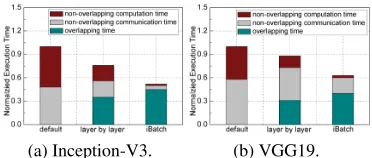
Figure 7: Execution time decomposed into the overlapping time, the overlapping communication time, and the non-overlapping computation time in two networks on 72 nodes.
Figure 6 further illustrates the scalability with the technique using two different neural networks. The result shows that iBatch achieves almost linear speedup on 72 nodes in two networks. Note that there is no technical challenge for the combination between iBatch and the Gradient Sparsification technique. iBatch batches parameter communication and for-ward computation, which does not impact gradient communi-cation that can be optimized by the Gradient Sparsificommuni-cation technique.
Execution Time
Figure 7 plots the normalized execution time ExeT ime
in Inception-V3 and VGG19 when the cluster size is 72. Specifically, the time is decomposed into the overlapping time, the overlapping communication time, and the non-overlapping computation time. The result shows that the overlapping time in the default PS is zero since the communi-cation and the computation are performed sequentially. The layer by layer strategy can overlap the communication with the computation to some extent. The overlapping time in iBatch is longer than that in the layer by layer strategy, show-ing that batchshow-ing the communication and the computation is more effective in the overlap. Also, since the layer by layer strategy brings significant communication overhead, its the non-overlapping communication time is longer than that in iBatch.
Conclusion
communication time and the forward computation time in the network training. Then, we formulate the batching decision as an optimization problem of execution time minimization and use greedy algorithm that maximizes the overlap to solve the problem as well as derive communication and computa-tion batches. We have implemented iBatch in the open-source DL framework BigDL and performed evaluations with var-ious DL workloads. Experimental results show that iBatch improves the scalability of a cluster of 72 nodes by up to 73% over the default PS and 41% over the layer by layer strategy. In future work, we plan to extend iBatch to other DL frameworks (e.g., TensorFlow).
Acknowledgments
We thank the anonymous reviewers for their feedback. This research was supported in part by U.S. NSF award CNS-1422119.
References
Abadi, M.; Barham, P.; Chen, J.; Chen, Z.; Davis, A.; Dean, J.; Devin, M.; Ghemawat, S.; Irving, G.; Isard, M.; et al. 2016. Ten-sorflow: a system for large-scale machine learning. InProc. of OSDI.
Ahmad, F.; Chakradhar, S. T.; Raghunathan, A.; and Vijaykumar, T. 2014. Shufflewatcher: Shuffle-aware scheduling in multi-tenant mapreduce clusters. InProc. of USENIX ATC.
Aji, A. F., and Heafield, K. 2017. Sparse communication for distributed gradient descent. InProc. of EMNLP.
Chen, T.; Li, M.; Li, Y.; Lin, M.; Wang, N.; Wang, M.; Xiao, T.; Xu, B.; Zhang, C.; and Zhang, Z. 2015. Mxnet: A flexible and efficient machine learning library for heterogeneous distributed systems.
arXiv preprint arXiv:1512.01274.
Chen, C.-Y.; Choi, J.; Brand, D.; Agrawal, A.; Zhang, W.; and Gopalakrishnan, K. 2018. Adacomp: Adaptive residual gradient compression for data-parallel distributed training. InProc. of AAAI. Chilimbi, T. M.; Suzue, Y.; Apacible, J.; and Kalyanaraman, K. 2014. Project adam: Building an efficient and scalable deep learning training system. InProc. of OSDI.
Dai, W.; Kumar, A.; Wei, J.; Ho, Q.; Gibson, G. A.; and Xing, E. P. 2015. High-performance distributed ml at scale through parameter server consistency models. InProc. of AAAI.
Dean, J.; Corrado, G.; Monga, R.; Chen, K.; Devin, M.; Mao, M.; Senior, A.; Tucker, P.; Yang, K.; Le, Q. V.; et al. 2012. Large scale distributed deep networks. InProc. of NIPS.
He, K.; Zhang, X.; Ren, S.; and Sun, J. 2016. Deep residual learning for image recognition. InProc. of IEEE CVPR.
Krizhevsky, A.; Sutskever, I.; and Hinton, G. E. 2012. Imagenet classification with deep convolutional neural networks. InProc. of NIPS.
LeCun, Y.; Bengio, Y.; and Hinton, G. 2015. Deep learning.nature
521(7553):436.
Lee, S.; Jha, D.; Agrawal, A.; Choudhary, A.; and Liao, W.-k. 2017. Parallel deep convolutional neural network training by exploiting the overlapping of computation and communication. InProc. of HiPC.
Li, M.; Andersen, D. G.; Park, J. W.; Smola, A. J.; Ahmed, A.; Josifovski, V.; Long, J.; Shekita, E. J.; and Su, B.-Y. 2014. Scaling distributed machine learning with the parameter server. InProc. of OSDI.
Li, H.; Kadav, A.; Kruus, E.; and Ungureanu, C. 2015. Malt: distributed data-parallelism for existing ml applications. InProc. of EuroSys.
Lin, Y.; Han, S.; Mao, H.; Wang, Y.; and Dally, W. J. 2018. Deep gradient compression: Reducing the communication bandwidth for distributed training. InProc. of ICLR.
Micikevicius, P.; Narang, S.; Alben, J.; Diamos, G.; Elsen, E.; Gar-cia, D.; Ginsburg, B.; Houston, M.; Kuchaev, O.; Venkatesh, G.; et al. 2018. Mixed precision training. InProc. of ICLR.
Seide, F.; Fu, H.; Droppo, J.; Li, G.; and Yu, D. 2014. 1-bit stochas-tic gradient descent and its application to data-parallel distributed training of speech dnns. InProc. of Interspeech.
Strom, N. 2015. Scalable distributed dnn training using commodity gpu cloud computing. InProc. of Interspeech.
Szegedy, C.; Liu, W.; Jia, Y.; Sermanet, P.; Reed, S.; Anguelov, D.; Erhan, D.; Vanhoucke, V.; and Rabinovich, A. 2015. Going deeper with convolutions. InProc. of IEEE CVPR.
Szegedy, C.; Ioffe, S.; Vanhoucke, V.; and Alemi, A. A. 2017. Inception-v4, inception-resnet and the impact of residual connec-tions on learning. InProc. of AAAI.
Wang, S.; Chen, W.; Pi, A.; and Zhou, X. 2018a. Aggressive synchronization with partial processing for iterative ml jobs on clusters. InProc. of ACM Middleware.
Wang, S.; Chen, W.; Zhou, X.; Zhang, L.; and Wang, Y. 2018b. Dependency-aware network adaptive scheduling of data-intensive parallel jobs.IEEE Transactions on Parallel and Distributed Sys-tems.
Wang, Y.; Qiu, X.; Ding, D.; Zhang, Y.; Wang, Y.; Jia, X.; Wan, Y.; Li, Z.; Wang, J.; Huang, S.; et al. 2018c. Bigdl: A distributed deep learning framework for big data.arXiv preprint arXiv:1804.05839. Watcharapichat, P.; Morales, V. L.; Fernandez, R. C.; and Pietzuch, P. 2016. Ako: Decentralised deep learning with partial gradient exchange. InProc. of ACM SoCC.
Wen, W.; Xu, C.; Yan, F.; Wu, C.; Wang, Y.; Chen, Y.; and Li, H. 2017. Terngrad: Ternary gradients to reduce communication in distributed deep learning. InProc. of NIPS.
Xie, P.; Kim, J. K.; Zhou, Y.; Ho, Q.; Kumar, A.; Yu, Y.; and Xing, E. P. 2016. Lighter-communication distributed machine learning via sufficient factor broadcasting. InProc. of UAI.
Xing, E. P.; Ho, Q.; Dai, W.; Kim, J. K.; Wei, J.; Lee, S.; Zheng, X.; Xie, P.; Kumar, A.; and Yu, Y. 2015. Petuum: A new platform for distributed machine learning on big data.IEEE Transactions on Big Data1(2):49–67.
Zaharia, M.; Chowdhury, M.; Das, T.; Dave, A.; Ma, J.; McCauley, M.; Franklin, M. J.; Shenker, S.; and Stoica, I. 2012. Resilient dis-tributed datasets: A fault-tolerant abstraction for in-memory cluster computing. InProc. of USENIX NSDI.
Zhang, H.; Zheng, Z.; Xu, S.; Dai, W.; Ho, Q.; Liang, X.; Hu, Z.; Wei, J.; Xie, P.; and Xing, E. P. 2017. Poseidon: An efficient communication architecture for distributed deep learning on gpu clusters. InProc. of USENIX ATC.