119
Copyright © 2018. IJEMR. All Rights Reserved.
Volume-8, Issue-4, August 2018
International Journal of Engineering and Management Research
Page Number: 119-125
Using an Innovative Model to Automate an Efficient Taxi Dispatching
System in Mauritius
Pillay Kanaksabee1 and Aviyash Domah2
1Lecturer, Department of Business Informatics and Software Engineering, University of Technology Mauritius (UTM), MAURITIUS
2
Software Engineer, Agileum, MAURITIUS
1Corresponding Author: [email protected]
ABSTRACT
The world is rapidly changing with the introduction of innovative technologies to meet the ever-changing demands of consumers. This research focuses mainly on the study of the actual taxi system in Mauritius to manage their everyday activities in an efficient way to earn a good and a decent earning. With over 6000 drivers in Mauritius, this has caused a major issue in the transportation sector. According to the survey conducted in Shanghai, China, the percentage of empty miles ((total miles-service miles)/total miles) for taxi is 32%, while the waiting time for passenger may extend more than 1 hour in the rush hours at the worst. The taxi employed under this actual system is rarely capable of reaching the customers in the shortest possible time. This is an exigent problem actually confronting current taxi systems. Thus, an alternative Interactive Taxi dispatching system is proposed, whereby the system will be fast and cost effective to transfer the customer’s request from the operator to the most suitable vehicle. This dispatch ensures that customers are served within the shortest time, resulting in satisfying customer’s demands. Since existing taxi system are working manually, there is a need to have automatic taxi trip system which would be easy and efficient. [14] Therefore, the aim of this paper is to research the pertinence of the use of an Interactive Taxi Dispatching System as an alternative mode for taxi drivers to easily be connected with their riders.
Keywords--- Taxi Drivers, Taxi Dispatching System, Taxi
Booking, Quick Transport, Cost Effective Taxi
I.
INTRODUCTION
Taxis have an imperative role in contributing constructive services within Mauritius transportation sector. In the midst of the growing prominence for providing satisfaction to customers, it is fundamental for taxi drivers to continuously improve their current systems and facilities to guarantee quality and superior service. Our everyday life has changed rapidly and is connected always with devices around us. We can have anything we need at any time and people simply expect to be able to connect
wherever they are. Thus, this interactive taxi dispatching system helps riders to quickly find the most suitable taxi for their transportation and allow drivers to simply connect to passengers through a fair reward system. In the end, what we want is to have a smarter, faster, and more effective transportation platform for all people to use daily. Nowadays, taxis are available everywhere in Mauritius to provide services to serve their customers in each region. However, many taxis roaming on the streets counter to request passengers on their way, and take passengers to their specific and desired destinations. As a result, existing taxi networks are dependent on drivers to drive around in the region randomly to pick up passengers on the roads. This service model has successfully served up to 25% public passengers in metropolitan such as San Francisco and New York [1], [2].
In TAS (Taxi Automation System), online dispatching of available taxis to meet the current customer bookings are done normally with the help of a satellite-based taxi automation system to meet the current customer bookings; that is the system uses a Global Positioning System (GPS) to repeatedly locate taxis location in factual time. [3]. The current method consists of assigning the nearest taxi in first come first serve queue basis without taking into consideration the passengers who are in the request queue. To improve performance of taxi fleet service, preferably, the assignment taxis should be done concomitantly and optimally in order to service all customer bookings within the time frame. [4]
120
Copyright © 2018. IJEMR. All Rights Reserved.
The existing taxi operation approach features elevated number of empty taxies wandering around the streets, whilst plenty of potential riders are irritated with the fact of not finding a taxi when needed. [6] The key reason for this inadequacy is that the current taxi dispatch system is unable to exchange appropriate information in a real-time manner between taxi drivers, riders and the dispatching system.
The inefficiency in dispatching system not only makes a major impact on passenger waiting time and passenger satisfaction, but also increases the taxi driver idling time. Though, drivers said that though they do not mind waiting for hours, but still they find waiting at the terminal enormously time-consuming and tiring. [7] The drivers are likely to wander near residential areas during morning peak and wait until they get a passenger. The incompetency of the system arises; even when the market is correctly synchronized and harmonized, due to the deficiency of the perfect widely spread information sharing between taxi drivers and passengers. [8]
To improve taxi fleet service performance, ideally, we should concurrently and optimally assign taxis to service all customer bookings that are made within the time window. This is an exigent problem confronting current taxi dispatch systems. [12]
II.
PROBLEM
STATEMENT
The inefficiency in the current approach of booking a taxi is that it is incapable of reaching the rider in the shortest time and determining the actual rider’s real-time location. As a result, many people are deprived from using taxi service. it is difficult to gain the distribution of passengers since passengers can appear at any place and any time in the city. [15]
III.
OBJECTIVES
The objective of this Interactive Taxi Dispatching system is to provide riders with taxi services effectively and safely, based on the location of the taxi driver and rider. In other word, match the rider and available taxi properly in term of distance and availability of the nearest taxi first.
IV.
HYPOTHESIS
An Android app for both drivers and riders along with the implementation of an online booking website and the online operator dispatch system will ease the task for the booking process.
V.
RESEARCH
QUESTIONS
1) What are the actual procedures for searching for a taxi in Mauritius? 2) What are the problems faced by
Mauritians when searching for a taxi?
VI.
LITERATURE
REVIEW
A. Procedures for seraching for a Taxi
In this random searching mode, passenger is waiting for a taxi on street and empty taxi is moving around looking for a passenger, both passenger and taxi do not know each other’s location. Passengers and taxis are randomly searching for each other as shown in the figure below.
Figure 1.0: Procedures for searching a taxi randomly
In this mode, when a passenger needs a taxi, the only thing he or she can do is standing on street and waiting for a vacant taxi passes by. The waiting time of the passenger depends on the probability that a vacant taxi passes by during his/her waiting. [9]
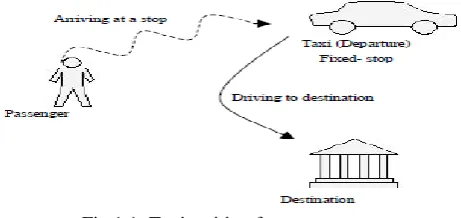
Another mode is when a taxi is waiting for a passenger at a heavy traffic center or stop point. The location for taxi is known but the arriving passenger is unknown as shown in the figure below.
Fig 1.1: Taxi waiting for a passenger
For a vacant taxi, it reduces empty driving searching for passengers but the waiting time could be very long. After several interviews with taxi drivers, we find that the average day waiting time of taxi at Pudong International Airport in Shanghai to get a passenger is 15 minutes. [10]
B. Problems faced when searching for a taxi
121
Copyright © 2018. IJEMR. All Rights Reserved.
lack of taxi and passenger location information. In a big city, usually there are so many idle taxis roaming around causing traffic jam and air pollution. This may also cause accidents when a taxi driver is looking for a passenger without paying enough attention on driving. [11]
From a taxi driver’s point of view, an efficient taxi system is one in which his or her taxi is never empty. By contrast, a customer’s idea of an efficient taxi system is one that delivers an empty taxi to his or her location at the instant one is desired. Obviously, these goals are in conflict. [13]
VII.
METHODOLOGY
In order to develop a suitable system, requirement determination process was taken into consideration. Software tools used are HTML/HTML5, CSS3, Javascript/Bootstrap/AngularJS, JQuery/Jquery Mobile, PHP 5.0, Wamp Server, Android Studio 5.0 ADT for executing the application, MySQL for storing the database of users and Ionic framework/ Cordova environment for coding the program for the application. Moreover, Agile approach was used for the software development process. Additionally, to contrast between the current booking system and the Dispatching system, a table is provided below:
Table 1.0: Contrast between current system and Dispatching Centre
Current system Dispatching Centre Reservation You wander around the street to find a taxi or
phone a taxi driver to come and pick you up.
You connect to Fast Taxi app on your Smartphone.
The Ride The driver is barely polite and he doesn’t care because he may never see you again. The car is not always clean.
The driver is nice and polite and the car is tidy. The drivers know that they will be evaluated after the ride
Paying The price is determined by the driver himself and sometimes these prices may exaggerate.
Fast Taxi calculates the tariff based on the distance travelled.
Emergency Wait until someone comes for help. Press the alarm button and the operator will take immediate actions
Afterwards That’s it! It’s over! Rate the driver to improve our reputation for future customers
VIII.
PROPOSED
SYSTEM
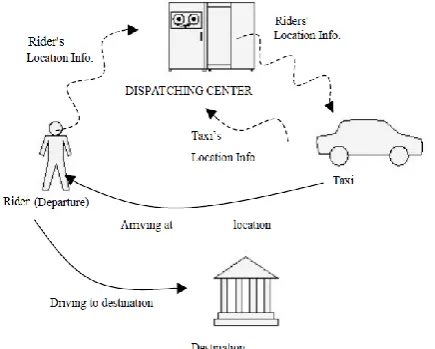
The ideal solution is to develop an interactive dispatching system which will be android-based and web– based applications and which can be accessible on mobile devices such as smart phones and tablets. Several APIs will be integrated in the system. The content can also be customized to be used on any devices, including PDAs, mobile phones, etc., that are connected to the internet depending on the users’ device. Furthermore, extending the user’s ability to receive and interact with the information.
Fig 1.2: The Proposed System
Initially, there are three modes for a booking a taxi. 1) Instant Booking using the app
122
Copyright © 2018. IJEMR. All Rights Reserved.
CENTER in case some problems arise. Both the rider and the driver can make use of the panic button to alert the DISPATCHING CENTER in case of emergencies.
IX.
RESULT
The splash screen of the Fast Taxi app will appear, and will check if the phone’s WI-FI is on and if it’s not it asks users to turn it on.
The booking process takes place as follows:
1) Once both the drivers and riders open their app, their current location is displayed.
2) Both drivers and riders must login to use their app.
3) Rider can make an instant booking using the app as shown below.
Assume that the booking is being done from UTM BPML Road, Port Louis, Mauritius and its destination to Triolet, Pamplemousses, Mauritius
4) Once the rider will click on the book button, the following notification will appear on his screen.
5) The rider receives a confirmation about his/her particular booking and will receive another notification to confirm the booking.
123
Copyright © 2018. IJEMR. All Rights Reserved.
7) Once the driver confirms the ride, the rider will be alerted on his app.
8) Simultaneously, the driver will receive a notification to pick up his rider.
9) A rider can also cancel a booking. However, the rider cannot cancel a ride more than 3 times in a month or else he will be blocked. The driver will receive a notification that the booking has been cancelled.
10) Upon arrival, the driver will notify the rider by clicking on the notify button
11) Concurrently, rider will receive the notification that the driver has arrived and the driver will receive a confirmation message that he has notified the rider.
12) During the ride, both the rider and the driver can view the booking details on their app.
124
Copyright © 2018. IJEMR. All Rights Reserved.
14) On completion of ride, the driver will click on the ride completed button and the rider will receive the following message. At the same time, the driver will also be notified to login for a new ride.
15) When rider will click on Rate button, the following will appear to rate the booking.
16) Both the rider and the driver can view live news, sport news, and play games.
X.
CONCLUSION
This Interactive Taxi Dispatching system is an innovative approach to the Mauritian people. As a whole, this proposed system will allow the Dispatching center to lessen the time to pick up the rider, consequently improving the accuracy and efficiency of their dispatch systems accordingly, and thus delivering a superior level of
guaranteed service to the riders. With the diminution in waiting times, more riders would agree to take on taxis through bookings, rather than using other means of hiring them when needed. This would let the taxi operators to better manage and optimize the taxi fleets in an efficient way, as a much better match of demand and supply of taxis could be met to satisfy customer’s needs.
In the near future, to further improve the performance of this proposed system and at the same time to use the system to its full potential, advanced research can be carried out to gain and ascertain new methods or ways to obtain accurate estimations of the signal delays on the road, so that they can be incorporated into the estimated travel times to give the rider much more accurate information about the drivers’ arrivals. This will help during the decision-making moment of dispatch to give a better estimate of the arrival time of a taxi. This needs a function that will predict the delays caused by signals that normally an individual vehicle experiences at intersections, would enhance the accurateness of the proposed system.
REFERENCES
[1] Hara Associates Inc. and Corey, Canapary & Galanis.(2013). Taxi user surveys. Available at: http://www.sfmta.com/sites/default/
files/Draft%20SF%20UserSurvey%2055%20WEB% 20version04042013.pdf, 2013
[2] Taxi of tomorrow survey results. New York City Taxi and Limousine Commission. (2001). Available at: http://www.nyc.gov/html/tlc/
downloads/pdf/tot_survey_results_02_10_11.pdf, 2011. [3] Marshall Brain & Tom Harris. How GPS receivers work. Available at:
http://electronics.howstuffworks.com/gadgets/travel/gps.ht m
[4] Anurag Mandle, Akshay Jaiswal, Bhushan Dod, & Roshan Lokhande. (2014). Taxi automation using real time adaptive scheduling. International Journal on Recent and Innovation Trends in Computing and Communication, 2(3), 592-594. Available at:
http://www.ijritcc.org/download/Taxi%20Automation%20 Using%20Real%20Time%20Adaptive%20Scheduling.pdf [5] Clarke G. & Wright J. (1964). Scheduling of vehicles from a central depot to a number of delivery points. Operations Research, 12(4), 568-581.
[6] Para Kalpana & Dr. A.Lakshmi Devi. (2013). Placement and sizing of distributed generators in distributed network based on lric and load growth control.
Journal of Theoretical and Applied Information
Technology, 47(1), 1-9.
[7] Anil Yazici et. al. (2011). Challenges in managing centralized taxi dispatching at high-volume airports: A case study of John. F. Kennedy international airport. 1-18. http://docs.trb.org/prp/12-2980.pdf
[8] Xianyuan Zhan, Xinwu Qian, & Satish V. Ukkusuri. (2014). Measuring the efficiency of urban taxi service system. 1-8. Available at:
125
Copyright © 2018. IJEMR. All Rights Reserved.
[9] Y. Yuan, J. Zhang. (2003). Towards an appropriate business model for m-commerce. International Journal of Mobile Communication, 1(1-2), 35-56.
[10] Marco Kouwenhoven. (2008). The role of accessibility in passengers' choice of airports. OECD, 1-38.Available at: https://www.itf-oecd.org/sites/default/files/docs/dp200814.pdf
[11] XU Zhengchuan, YUAN Yufei, JIN Huiliang, & LING Hong. (2005). Investigating the value of location information in taxi dispatching services: A case study of
DaZhong tax. Available at:
http://www.pacis-net.org/file/2005/273.pdf
[12]Khadaroo, A. J. & Seetanah, B. (2007). Assessing the contribution of land, sea and air transport capital to the economic performance of the small island state of Mauritius. Applied Economics Letters, 14(15), 1151-1155. [13] D. Santani, R. K. Balan, & C. J. Woodard. (2008,June). Understanding and improving a GPS-based taxi system. 1-2. Avalable at:
https://apollo.smu.edu.sg/papers/MobiSys08_poster.pdf [14] Maryam Ahmed, Zahara Batool, & Mahrukh Raheel. (2015). Automatic taxi trip sensing and indicating system through gsm. American Journal of Computer Science and Engineering, 2(5), 42-48.
[15] N. Streitz, C. Stephanidis (Eds.). (2013). Distributed, ambient, and pervasive interactions. Berlin, Heidelberg: Springer-Verlag, 326–335. Available at:
https://www.springer.com/gp/book/9783642393501 [16] M. Qu, H. Zhu, J. Liu, G. Liu, & H. Xiong. (2014). A cost-effective recommender system for taxi drivers. In 20th ACM SIGKDD International Conference on KDD, New York: USA, 45-54. Available at:
https://www.cse.cuhk.edu.hk/irwin.king/_media/presentati ons/p45-qu.pdf