Vol.8 (2018) No. 4
ISSN: 2088-5334
The Combination between the Individual Factors and the Collective
Experience for Ultimate Optimization Learning Path Using Ant
Colony Algorithm
Imane Kamsa
#, Rachid Elouahbi
#, Fatima El khoukhi
* #Department Mathematics and Computer Science, University Moulay Ismail, Meknes, Morocco E-mail: [email protected], [email protected]
*
Team Modelling Applied Informatics in Humanities, University Moulay Ismail, Meknes, Morocco E-mail: [email protected]
Abstract— The approach that we propose in this paper is part of the optimization of the learning path in the e-learning environment.
It relates more precisely to the adaptation and the guidance of the learners according to, on the one hand, their needs and cognitive abilities and, on the other hand, the collective experience of co-learners. This work is done by an optimizer agent that has the specificity to provide to each learner the best path from the beginning of the learning process to its completion. The optimization of this approach is determined automatically and dynamically, by seeking the path that is more marked by success. This determination is concluding according to the vision of the pedagogical team and the collective experience of the learners. At the same time, we search of the path that is more adapted to the specificities of the learner regarding preferences, level of knowledge and learner history. This operation is accomplished by exploiting their profile for perfect customization, and the adaptation of ant colony algorithm for guidance tends towards maximizing the acquisition of the learner. The design of our work is unitary; it is based on the integration of individual, collective factors of the learner. Moreover, the results are very conclusive. They show that the proposed approach can efficiently select the optimal path and that it participates fully in the satisfaction and success of the learner.
Keywords— e-learning; adaptation; guidance; customization; ant colony algorithm
I. INTRODUCTION
In the framework of online learning, it is necessary to consider the optimization aspect in collective individual context. Several types of research have been conducted in this direction and converge towards the essential aim, which is to guide learners and ensure their interests effectively.
Indeed, seen under this angle, the primary interest of our study is to put in place an optimization approach to guide the learners in their privileged atmosphere. This guidance is accomplished by taking advantage of the profits of the collective experience of co-learners and takes into consideration their particularities, which can contribute to the improvement of the excellence of the proposed path.
At the opposite to the free navigation, where the learners should seek themselves a course or susceptible path that might be of their interest and increase the chances of success, the approach proposed here has to do it automatically and efficiently. This allows us to achieve our primary goal, which is: the maximization of the acquisition of the learner by sociable guided navigation with individual interaction. In this context, we have adapted the heuristic ant colony trying
to join the adaptation and customization to the optimization in the sense of an optimal quality of the recommendation. This concept presents particularly the multiple benefits, which have the merit of having made a very solicited and competitive approach.
other paths that can maximize the acquisition of the learner, and the detection of other constituents conform to the propriety of the learner. With this in mind, we aim to identify the prominent factors leading to customization and adaptation in order to combine them with the common factors for an ultimate optimization.
In the context of online learning, it is necessary to consider the aspect of optimization in a collective context to individual properties. The primary interest of our work is to put in place an approach based on intelligent agent called an optimizer agent to build dynamically. Another interest is to place a learning path for maximizing the assimilation of the learners in their personal and privilege environment through the adjustment of ant colony algorithm given the complexity of the problem. This study also aims at finding out the path tends to optimality in a personal atmosphere among a set of possible routes.
The study of existing works has allowed us to arrive to determine the main lines leading to the implementation of our approach. These principal axes are, indeed, the result of the benefits and shortcomings that emerged from the study that we conducted. Low customization of learners' path in the case of works [1], a content adaptation based only on students’ scores as in the case of works [2], and an optimal recommendation-learning path based on both individual and collective traits [3].
Adaptation and customization would allow us to exploit the particular satisfaction of the learner, the learning speed (effectiveness), the performance (yield), and the motivation (commitment) [4]. Guidance leads the process aimed to propose to the learner a path susceptible to carry him to the success. It would decrease the cognitive overload which may have occurred to find a course or a path, responding to the training needs and objectives [5]. This study also is rooted in dynamism. The dynamic processing will enable us to improve the proposed learning paths taking into account the changes made to the pedagogical graph and the learner profile.
The combination of these three factors ensures effective learning and ongoing motivation. In a distance learning system, state of the art on the optimization of the learning path is presented in two parts. The first concerns the used solutions for adaptation and customization of learning paths, and the second, the guidance of learners in the e-learning system.
A. Adaptation and Customization in e-Learning
Several studies have proposed solutions for adapting and customizing learning paths to help the learners in their progression. We quote mainly and as examples:
• In the work of Dahbi [6] has been proposed the design and modeling of an adaptive hypermedia educational system based on the learning styles that are supported on the model of Honey and Mumford. This adaptation will maximize learning and improve the performance of learners. However, it is not extensive. It focuses on a limited number of cognitive styles of the learner.
• In the work of Balla [7] is presented a model of the adaptive educational system based on XML to facilitate the production, use of educational resources, and adapt the contents to the learner profile. The advantage of
this adaptation is to enable the learner to have active behavior, responsible and motivated. However, it confined the presentation of information that does not reflect a faithful adaptation and customization.
• The work of Wong and Law [8] illustrates a method for the recommendation of an adaptable path based on the application of the ant colony algorithm. The adaptation of this work is based on the learner profile and specifically about their preferences and learning abilities. It is dynamic, taking into account any change occurring in the learner profile.
• For the customization in the work of Ginon et al. [9] we find the presentation of the model of customization of learning activities based on a multitude of unified criteria which represent, on the one hand, the knowledge and the skills learners and, on the other hand, the particularities, the capacities and the preferences of each one.
B. Guidance and Optimization in e-Learning
Since a few years, many solutions have been proposed in the context of the optimization of the distance learning. The majority of these solutions favor an approach focused on making available to learners in an automatic way an optimal path leading to success. As an example:
• In the work of Talhi et al. [10] is presented a generic guardian canvas, which integrates a technique of intelligent tutors and those of the hypermedia systems in the design of guidance, assistance, and adaptation of courses to different learners.
• The work of Dahbi et al. [11] proposes an approach of the recommendation of learning path in an online course through the adjustment of ant colony optimization. This approach is based both on the recommendation of relative paths by the teacher and the results stored progressively by learners on borrowed paths.
• A procedure inspired by ant colony algorithm has been treated in the work of Vazquez et al. [12] to differentiate the links that connect the various activities and to establish the best learning path. This procedure allows designing a dynamic learning path useful in a rapidly changing world.
• Similarly, Valigiani et al. [3] have proved the adaptation of ant colony optimization technique in the e-learning environment. This adaptation seeks to provide to learners the courses that can help them to progress. However, this adaptation is based only on learners’ scores.
II. MATERIAL AND METHOD
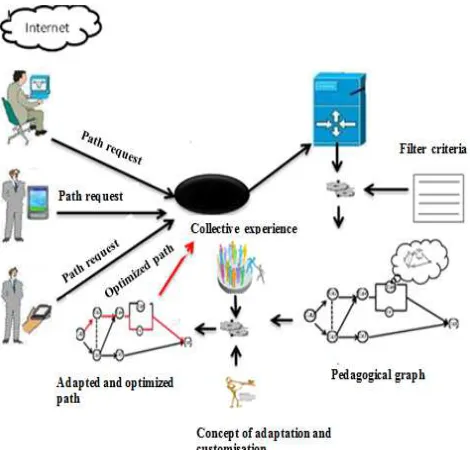
The following Fig. 1 provides a brief description of our approach and the AO features.
Fig. 1 Approach of an optimized personalized and dynamic learning system
A. Pedagogical Graph
The modeling that we have evaluated adequately, to present the various possible paths that the learners can follow to achieve their pedagogical goal, is the modeling as a weighted graph defined as the triplet G= (V, E, W),(See Fig. 2) where:
V: represents the set of Learning Units LUi. LUi can represent a curriculum, a course, a chapter or evaluation created to achieve a pedagogical goal [13].
E: is the set of links between learning units expressing the possible navigation between LU.
W: weight arcs have a positive decimal value W: E → . This value represents the relevance of an arc relative to its neighbors. The detailed of connection type between the LUi are presented in Table 1.
TABLEI
CONNECTION TYPE BETWEEN THE LUI
Connection Type Description
The oriented arc between LU1 and LU2 defined by the teaching
The oriented arc between LU3 and LU4 created by learners in the learning process
The choice between LU5 and LU6 having different characteristics
Fig. 2 Pedagogical graph
The pedagogical graph shown in Fig. 2 provides an overview of modeling different possible path in order to achieve a pedagogical goal.
B. Adaptation and Customization
In order to improve the image of online teaching, the notion of customization is born. In this context, the e-learning has known a notable success thanks to the contributions that it has brought, maximizing mainly the motivation of the learner, by adapting learning to the needs, preferences, goals, and rhythms of the learner. In effect, propose an adapted and customized learning path to each learner, fully participates in the reduction of failures and endowments learners. Some studies have been conducted in this direction and that release the customization guiding principles [14]-[19] to determine our customization criteria that seem to be realistic and achievable and that maximally satisfying the interests of learners. Customized and optimized path is provided while seeking to find out the compromise and the ideal consistency between these two concepts of "customization" and "optimization."
In order to customize the learning path of the learners, we sought in their profiles the criteria that allow distinguishing him from others. These properties will allow us to find in learning units, which is best for the learners. We have chosen as properties: the preference, the level of knowledge and the history of the learner. The modeling of these criteria will promote the individualization of learning paths, increasing the chances of success and the motivation of the learner.
1) Preference: The preference has a strong influence on
the interactivity, the motivation, and the learners’ performances. It significantly increases their satisfaction, and it encourages them more to focus on their learning. By contrast, the generalization can cause the performance slips, the exhaustion, and even the learning failure [20].
Each learner has his styles and preferences that allow us to distinguish him from others. We have chosen three types of preferences, which are:
• the preference of language learning unit
• the preference of the learning unit format
• the preference of the learning unit author
Let PR, set of learner preferences and L, F, A, are subsets of PR.
L= {(L1, L2, ..., Ln)/ Li ϵ [1, n] ϵTOj}
F: the subset of course formats preferences Fi of the training objective j TOj
F= {(F1, F2, …, Fn)/ Fi ϵ [1, n] ϵTOj}
A: the subset of course author preferences Ai of the training objective j TOj
A= {(A1, A2, …, An)/ Ai ϵ [1, n] ϵTOj}
with i is the index of elements of the subset L, F, and A, n is the size of the subset F, L and A
The personality is the set of traits and characteristics specific to each. It is manifested by behavior influencing ample on the choices and reactions in the face of a situation of decision-making [21]. We were inspired by the work carried out in the framework of the modeling of consumer behavior [22] since the behavior of human beings are alike in selecting situations and expression of choice.
You can define the behavior of the learner in the face of a situation of expression of preferences according to 4 assumptions:
Let E is a set that can represent either L, F, A and let U; a function represents the degree of utility preferences of the learner.
= { , ,……, } with i is the index of elements of the set E.
Hypothesis 1: complete preorder. The learner may classify the entire set of preference i.
In this case, all the set E is well ordered regarding preference for a learner.
>) ⟺ ={ > >…….> }
, ϵ >) > U ( )>U )
U: ( />)D=]0,1] U ( ) =1/i
Hypothesis 2: relative pre-order. Sometimes the student is unable to classify all items of preference i due to (lack of information on some items, the set of preference i is too long or the learner prefer only the k elements of the set, k<n where n is the size of the set).
=( >)∪
U: D=] 0, 1]
Hypothesis 3: equivalence. Means that the learner considers in point of view of taste-to-taste every element of the set preferably i providing the same utility.
Hypothesis 4: No saturation. Means that the learner considers all elements of the set of the preference i providing the same utility.
U ( ) =
Once the degree of usefulness of learning units is calculated, their degree of adaptation about the preference
factor is deducted by adding all the utilities of the characteristics of the learning unit U then dividing this sum by the number of the characteristics that describe this unit. This calculation allows obtaining the average value of the degree of adaptation of the learning unit relative to the preference DAp.
2) Level of Knowledge: “The knowledge is the act of
knowing an idea, a notion or concept. It represents all known things of knowledge. The knowing is linked to the individual who possesses them. When a person "Takes knowing" of knowledge, he appropriates this knowing in their own way and transforms this knowing into knowledge. This “knowing” belongs to her. It is an assimilated knowledge” [23].
It is indisputable to adapt the learning content to their level of knowledge to optimize the efficiency and effectiveness of the learners. Indeed, each one has his own level of knowledge about a learning unit.
We can classify the knowledge level of the learners' into 3 classes:
1 = beginner level 2 = intermediate level 3 = excellent level
By analogy, a pedagogical resource can also be classified according to three levels of difficulty:
1 = easy level 2 = average 3 = difficult level
Let KL set of possible knowledge levels for a learner whose elements are formed of the pair (key, value)
KL = {(1, beginner level), (2, intermediate level), (3, excellent level)}
LD is the set of possible levels of difficulty for a learning unit whose elements are also trained pair (key, value) LD = {(1, easy level), (2, intermediate level), (3 difficult level)}
There is an x representing the level of knowledge of the learner for a learning unit LUi l of a level difficulty y.
We say that the difficulty level of the learning unit is well adapted to the knowledge level of the learner if their keys are equal.
The algorithm below allows calculating the adaptation of learning units to the learner's knowledge.
If = then adaptation =
Else
If > then adaptation =
Else adaptation= ( + )/2*difference End If
End If
with a difference is -key, is the maximum value that can be given to muscular adaptation and is the minimum value that can be given to a small adaptation.
better understanding of their level of knowledge [24], and formative assessments during the learning process for excellent clarity of their progression [25]. In the diagnostic test, the prediction of the level of knowledge of the learner is evaluable in term of their performance and estimate, whose formalism is the following:
where P is the learner performance.
E is the self-estimation; each learner can be more or less on his knowledge. The performance and estimation must be in the interval ranging from 0 to1; 0≤ P, E≤1.
Note: we were given more importance to the performance than estimation because the learner can fall into a situation of underestimation or overestimation.
Prediction algorithm of the level of knowledge of the learner:
• A time : the system predicts the level of knowledge of the learner through a diagnostic evaluation.
• A time : during the learning process, the learner can acquire new knowledge that can be evaluated in the form of formative evaluation. In this context, it may be that some of the prerequisites to start a LUk (Incorrect answers in the diagnostic evaluation are acquired and validated in LUs predecessors of LUk). In this case, a dynamic update of the knowledge level of the learner is required.
is the time of the diagnostic evaluation and is the time of the formative evaluation 1. The action of learning operation: means the new knowledge acquired by the learner during the learning process.
The difficulty level of LUi can also be determined from three parameters, which are:
• : each creator author of a LUi described using a metadata the difficulty of his course.
• : each learner can determine the difficulty of a course according to his pre-acquired (The number of wrong answers in the LU compared to the total number of questions).
• : each learner followed a LUi can leave comments and semantic annotations on the difficulty of this LUi.
The values of should be in the interval [0, 1]
TABLEII
LEVEL OF KNOWLEDGE OF LEARNER &LEVEL OF DIFFICULTY OF LU
Calculated Value
Semantic Value
Level of Knowledge of learner
[0,0.4] [0.5,0.6]
Beginner Intermediate
[0.7,1] Excellent Level of Difficulty
LU
0,0.4] [0.5,0.6] [0.7,1]
Easy Average Difficult
3) Historic: To promote the acquisition and the
assimilation of the learner, it is clear that the optimization of long-term memory assigned for the completion of this desire and to the retention of acquired knowledge.
In this regard, we have defined a historical function H that is intended to provide information about units previously followed by the learner. This function aims to reduce the loss of memory and the oblivion of the meadow-acquired. The concept of H was inspired by the work emanating from the problem of memory and the forgetting [26], [27]. This research affirmed that in the absence of repetition and the consolidation the newly acquired knowledge is lost with time if they are not taught in a repeated fashion over a given period [28]. For this purpose, the historical factor is essentially based on this concept to enhance the assimilation of the learner.
To assess the relevance of the indicator History of a learning unit LUi for a learner e, we are inspired by the curve of forgetting which has been proposed by Hermann Ebbinghaus in 1855 [29]. Its objective tends to reduce the probability of loss of memory over time. In this regard, the value of our indicator H is determined from two primordial parameters, which are the number of repetitions and the elapsed time since the last visit.
The principle of the algorithm that calculates the value of H is straightforward. Indeed, it is to do a test on the two parameters reported previously to determine the usefulness of H. This test is conducted as if the number repetition of a learning unit followed by the learner is insufficient or the time of the last visit is too long and the unit offer is similar in content to the units already visited. However, it is different from characteristics (format, author, language ...), the value of H pushes the learner to follow this unit. This is accomplished by increasing the probability that this unit to be proposed to the learner. This helps to maintain the gains and ensure more motivation because avoiding putting the same unit (same characteristics) has strengthened the activation of the learner.
On the other hand, if the number of repetitions are satisfactory, then the value of H will decrease the likelihood that this learning unit to be proposed a new again. Unlike these two cases, H can play a neutral role by providing for him a median value.
The algorithm representing the principle of the historical factor is [27]:
Let V the set of visited learning unit and S the set of learning unit to follow,
uv ϵ V and us ϵ S , uv=(uvi) iϵ[1,n] and us=(usi) iϵ[1,n] If uv=us then
If R>=max ||k/ >=threshold then H= If not d(uv, us) =1 then H=
If not H= ( + )/2 End if
End if End if (2)
End if
where k is a constant, t is the repetition time interval. R is the number of times of repetition; the threshold is the threshold memory trace fixed beforehand. uv is the visited course (belongs to the learner history), us is the course to follow (belongs to the list of possible proposals for a learner). i is a particular course. d is the Hamming distance. Hamming distance will allow us to choose the learning units dissimilar in characteristics. All the individual factors described above is unified in a function, call individual objective function FI to give a value of customization and adaptation exploitable by the selection operator. This function is intended to ensure the active participation of the learners in the construction of their best-customized path.
FI=p.P+kl.KL+h.H (6)
where P is the preference of the learner, KL his level of knowledge, and H his historic. p, kl, h are configuration parameters of interest ported to each factor.
C. Collaborative Guidance and Adaptation of the Ant
Colony Algorithm
To emerge adaptive learning paths maximizing the success and motivation of the learner, we combined the individual factors specific to each learner with other collective factors are shareable by all learners. Individual factors will be used as a multiplicative parameter to apply to collective factors to the better guidance of the learner.
In order to model the collective factors, we have adopted the algorithm of ant’s colony optimization ACO. The choice of this algorithm proves the favorable solution to resolve our problem for two reasons:
Modeling our approach by the pedagogical graph: modeling for which optimization algorithms by ant colony are very well established given the huge size of teaching resources that can be modeled in the pedagogical graph.
ACO is a favorable concept to the establishment of a system consisting of a set of intelligent entities communicating using a specific language and coordinating their tasks to achieve their goals effectively. It well adapts to the individual situation. Learners can be assimilated into virtual ants performing distributed tasks where the communication between them play a central role, as a process enabling the emergence of an optimal learning path.
The proposed adjustment has the effect to its simulate by artificial pheromones released by learners browsing in the pedagogical graph. These pheromones will act in the construction of paths, which tends towards optimality.
The collective factors developed in our approach are represented as stigmergic information used to help learners to cooperate with them in order to maximize their learning. This information is stored in the form of pheromones on each arc to represent its relevance and its probability of being selected [30]. The value of this information is calculated from three types of pheromones:
• Initialization pheromones: modeling the suggestion of the teaching team.
• Trace and rescue pheromones: representing learner results.
1) Initialization Pheromones: Beforehand the system
needs time and some learners to initialize correctly and directing the learner to the optimal path. The vision of the teaching staff is considered useful to initiate at the beginning of the graph adequately.
The initialization pheromones of the set of links out of a
learning unit LUi is modeled by a
polynomial of degree n, such as n= card
(
∨arcϵ ), its pedagogical significance is defined by its power multiplied by Qi indicating its pedagogical relevance.
= + +…….+ + (7)
= + (8)
with >= >=……> and ϵ{ /2≤P≤10},
=0.1. Is the value of an arc created by the learner during their learning process in the case of free navigation.
2) Trace Pheromones: Trace pheromones symbolize the
quality of the path followed by learners during their learning process [31]. The value of these pheromones is calculated from the evaluation done by each learner. The function of trace pheromones is defined as follows:
Let the number of trace pheromones to drop on the last n arcs followed by the learner. This amount is calculated from the score obtained in the test unit LUi and the degree of
importance of tracking path. Moreover, let depositing on each arc belonging to this path.
This amount is deducted from the amount and
degree of importance of .
(9)
The degree of importance of path is the numbers of learners follow this path regarding the set of learners who travel the subgraph.
= (10)
With NB_P The number of path visitors and NB_T is the set of learners who travel the subgraph.
and
= . (11)
where NB_ is the number of the visitor of and
is the number of visitor of such as ϵto the path learner.
3) Rescue Pheromones: In the case where the learner
will be deposited on other paths not followed by the learner to increase their chances to be proposed and reduce the risk of failure for the following learners.
The rescue pheromones are calculated as follows:
If the obtained mark<= eliminatory mark
=0.4+ (1- .0.4
End if
j is the set of arcs not followed by the learner and having the same predecessor node and k and is the arc followed by the learner.
D. Exploration a Paths by Learners and the Deposit of
Pheromones
Once the implementation of all collective factors has been made, we define a function FC combining the three factors defined earlier and allowing to note the outgoing arcs from learning units. The following expression describes FC:
FC= Qi+ Qt+ Qs (12)
where FC is the calculated weight of each arc, Qi is the initialization pheromones; Qt is the trace pheromones, Qs is rescued pheromones and is the interest brought to each factor.
E. Evaluation of the Relevance of Individual SocioPath
Recommend to the Learner
A path is considered the most appropriate for a learner; if it is more stimulated by the teaching team (initialization pheromone is high), best rated by the learners' success (the amount of trace or rescue pheromones is important) and more suited to the learner in question (FI adjusted). Then we have defined our assessment function of the relevance of an arc by multiplying FC to FI. The following equation expresses this function:
(13)
WithFI=p.P+h.H+n.NC FC=i.Qi+ t.PR.Qt+ s.Qs
i, t, a, p, h, and n are adjustment parameters
F. Recommendation of the path according to a probability
selection
Analogously to the principle of ant colony algorithm, a probabilistic selection procedure was introduced in our approach to preserving the basis of random exploration of all arcs while pulling the most relevant regarding the value of the evaluation function F [32, 33].
The following formula defines the selection procedure:
(14) α and β control the relative importance to the FI and FC.
is the list of possible moves for a learner k when it is on the node i
G. The principle of Intensification and Diversification for a
Good Setting of α and β
The intensification and diversification concepts were introduced in the ant colony algorithm to find a good compromise between the relative influence of pheromone trails and heuristic information [34, 35]. In our artificial system, we adopted these concepts to generate the ideal tradeoff between individual factors and collective factors. To this end, we propose a dynamic adjustment of parameters α and β taking into consideration a certain number of cognitive and psychological changes of the learners during the learning process.
Begin α = β=1 Repeat
If |FC-FI|<= epsilon thenα=β If else
If t=t° ||note++ then If α≥β then
β’=β End if
End if
If t=t°+∆t then ’=β =α||β End if
If t>t°+∆t || note-- then If α≤β then
End if End if End if
While (the learner is learning process) End
with:
, ,
Note++: the mark of the learner is above average Note--: the mark of the learner is below average
: the average offset of the mark and concentration time of the learner.
: the gap between the score of the learner and the average mark.
: the gap between the learning time and the concentration time.
is essential to enhance the enthusiasm of the learner in the case where there would be a total lack of motivation of the learner
H. Updating Pheromones
As in real life, the natural pheromones evaporate by the time to allow the ant colony to rely on information updated continuously. In our artificial system, it is essential to implement this phenomenon in order to avoid the learner to be trapped in the sub-optimal solutions. The pheromone update in our approach is produced as follows:
The learner travels the pedagogical graph, at the end of an evaluation LUi. The system calculates the new amount of pheromone (Qt / or Qa) to drop on the last n arcs followed by the learner and / or the last n arcs not followed by the learner and out of n last LUi visited. At this moment, the evaporation takes place on all outgoing arcs of n LUi last visited by the learner. Similar to work [8], the function of evaporation takes place at the same time as the deposit pheromones.
where P is the weight of an arc, Qt is the new amount of calculated traces of pheromones, Qs is the new amount of the calculated life pheromones, and φ is the evaporation parameter.
III.RESULTS AND DISCUSSION
The objective of the experiment presented here is to optimize the acquisition and the motivation of the learner, by better recommendation of the learning path. This optimization based on the application of the ACO and the integration of individual factors favoring the customization and the characterization of learning. This experiment will allow one hand to affirm the adaptability of the ant colony algorithm in the merger of the community to the individuality for optimal guidance of the learner, and on the other hand to choose the right setting variables and weightings of the objective function.
A. Description of the Experiment
To simulate the desired behavior of the heuristic ant colony, we have transposed our experience on a typical oriented pedagogical graph where these nodes represent the learning units (chapter course, exercise ....) and its arcs, the links that allow going from one unit to another.
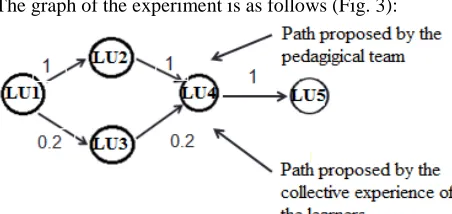
The graph of the experiment is as follows (Fig. 3):
Fig. 3 Typical pedagogical path
where LU1 is the start vertex, LU2 and LU3 are intermediate vertexes, LU4 is the evaluation vertex, and LU5 is the end vertex.
To realize this simulation, we assume that the teaching team proposes, preferably, to follow the path 1 instead of the path 2 to achieve the best results desired in LU4. While the collective experience of the learners shows the opposite, i.e., learners derive the best results when they follow the path 2.
Check that the proposed approach can restore the situation and encourage the choice of path 2 instead of path 1?
To simulate the desired behavior of our approach, each learner who travels the pedagogical graph, when he/she reaches the top of LU4 evaluation, an evaluation note is generated automatically and randomly in the interval [0.1, 0.4] if the pedagogical team proposes the track path, otherwise the evaluation note is generated in the interval [0.5, 1].
if the pedagogical team suggests the path
(16)
B. Analysis and Results of Experiment 1
The objective of this first simulation is to verify that the proposed algorithm can find, automatically, the optimal path as regards learners’ performance between these two paths and correct it if necessary.
Fig. 4 Evolution of the objective function on the arc LU1LU2 and the arc LU3LU4
Fig. 4 shows the evolution of the objective function on the arc LU1LU2 suggested by the pedagogical team “Red “and on the arc LU1LU3 emerged by the collective experience “Blue” depending on the number of successful learners and their results.
The result indicates that the system interacts as desired. We note that the value of the objective function on the arc LU1LU2 decreases steadily while its value on the arc LU1LU3 grows which increases the chances of being selected by future learners.
inversion of the arc to be proposed is taking place. This is the dynamic interactivity of the learners which will allow the system to offer the optimal path continually and will also serve as an audit tool for the pedagogical team to detect semantic inconsistencies and to refine the modeling and the proposed sequencing.
We conclude that the ant colony algorithm can select a solution tends towards optimality in an educational graph of large size. To verify also the ability of ACO to find the optimal path, bringing learners to success and ensure their motivation, we will apply our approach on a typical handmade pedagogical graph shown in Fig. 5.
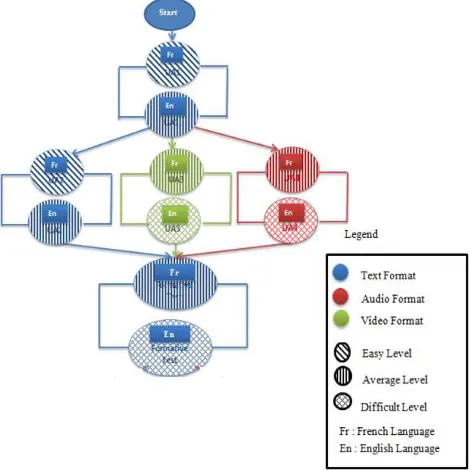
Fig. 5 Typical pedagogical graph
On each arc of our graph, we define an initialization pheromone value that represents the distinction given by the teaching team in an arc. More the value of these pheromones is essential; the teaching staff recommends more this link. Of course, the importance of each arc would be automatically adjusted as by the quality of the traces and rescues of pheromones that are calculated dynamically. In order to ensure that our approach is feasible and the recommended path to each learner in conformity with the one he wants we have created 3 paths. A path on which all learners failed, A second on which learners have well enough marks, and a third on which the learners have excellent grades. Also, we associate with each learner simulated in our experiment two features that allow customizing the learning path; namely, the knowledge level of the learner and his preference.
Similarly, its format, its language and its level of difficulty for a better adaptation describe each learning unit. The level of knowledge of learners is generated at random way in the range of integers [1], [3].
We assume that the choices available for the features mentioned previously are:
Language = {French, English, Arabic} Format = {text, audio, video}
Author = {Author 1, Author2, Author3}
The result of our experiment is projected on two learners whose characteristics are shown in Table below.
TABLEII
THE PREFERENCES OF THE LEARNERS AND THEIR CLASSIFICATIONS
Learner 1 Learner Behaviour
Preference
Language Complete Pre-order
French Arabic English Format Pre-order
Relative
Text Video Audio Author Equivalence
Author1-Ahthor2- Author3
Learner 2 Learner Behaviour
Preference
Language No Saturation --- Format Complete
Pre-order
Audio Video Text Author Equivalence
Author1-Ahthor2- Author3
C. Analysis and Results of Experiment 2
To ensure the success of online learners, an optimum and customized path is suggested to each learner according to his characteristics and what the collective experience has shown.
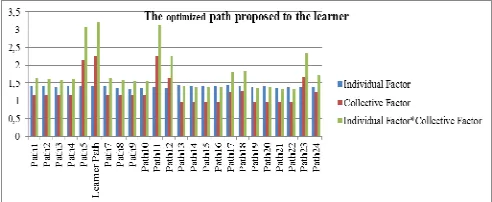
Fig. 6 The path proposed to the learner 1 regarding his factor and the collective factor (α = β =1)
The results of these first experiments are conducted according to the specifications listed in Table 2. As shown in Fig. 6, the recommended path is the one who maximizes the best the satisfaction of the learner by choosing who is the most adapted to his preferences and his level of knowledge and also marked by the success of co-learners (learner path).
Similar to Fig. 6, the Fig. 7 shows the path proposed to the learner 2 regarding his preferences, his level of knowledge and from the collective experience of learners.
We notice that the proposed path it changes according to the learner's properties and common factor. The path proposed to the learner 1 is different to path offered to learners 2.
D. Verification of the Automatic Adjustment of α and β
This simple experiment was used to check the dynamic adjustment of α and β and justify their influence on the selection of the path that optimizes better learning. In this context, we assume that our students have already passed an assessment test that influenced their behaviors (concentration and demotivation) to simulate the impact of this effect on the concentration and demotivation and automatic adaptation of α and β. The goal of this simulation is to simulate the impact of learner behavior on the automatic adaptation of α and β.
We assume that our learner (learner 1) has passed, at the beginning of its process of learning, a diagnostic test and that the result is very encouraging. This implies that this learner is well motivated and enthusiastic. However, we assume that the learner 2 got a bad result. That would say he is a bit unmotivated.
This assumption has been made to thoroughly test the relative influence of automatic adjustment α and β on choosing the optimal path to be proposed to each learner.
Fig. 8 The path proposed to the learner 1 regarding his factor, the collective factor and automatic adjustment of α and β
As shown in Fig. 8, the algorithm gave more importance to the collective factor that the individual factor. Since our learners are well motivated, he is directed to discover other routes less adapted to these peculiarities, but more marked by the success of other learners.
We notice that the algorithm adapts automatically to the cognitive behavior of learner, and it changes dynamically the path that will be proposed to the learner by an automatic adjustment of α and β.
The automatic adjustment of α and β is well worked, we note that there is a difference between the path offered to the learner 1 in the second experiment (Fig. 6) and this experiment (Fig. 8).
In Fig. 9 we note although the algorithm gives more interest to the individual factor for good motivate and encourage the learner by offering a path highly adapted to his peculiarities.
We observe that there is a difference between the path offered to learners in the first experiment and that of the
second experiment. In the first test α = β = 1, in this case, the algorithm gives due importance to the individual part (the part heuristic) and the common part (the part pheromone). However, in the second test, a dynamic adjustment of α and β will find the optimal path to each learner according to his cognitive changes that maximize more his satisfaction and his success. The results are very encouraging, and they respond well to our initial goal.
Fig. 9 The path proposed to the learner 2 regarding his factor, the collective factor and automatic adjustment of α and β
In conclusion, we can say that our approach is validated experimentally. It can effectively and automatically select the most optimal path and tailored to each learner. Also, the automatic adjustment of α and β participates fully in choosing the path that will be led the learner to a successful acquisition.
IV.CONCLUSIONS
The concept of e-learning presents particularly multiple benefits, including the approximation of learning to learners. Indeed, the internet has become, thanks to this concept, a means of learning either individual or collective accessible to the general public. Moreover, in this context, we have directed our work to offer our optimization approach of the learning path of online learning. The primary focus of our work is to maximize the acquisition of the learners by proper and exclusive selection of the path that will be recommended. The advantage of our approach is mainly due to a productive alliance between the concept of individuality and community for the optimality of the quality of the proposed path. The result is very conclusive; it shows the scientific and pedagogical usefulness of our approach thus, it represents a starting point for other applications and approaches seeking to optimize the acquisition of learners in e-learning.
REFERENCES
[1] Y. Semet, E. Lutton, and P. Collet “Ant colons optimization for E-learning: observing the emergence of pedagogic suggestions, ” IEEE Swarm Intelligence Symposium, pp. 46-52, 2003.
[2] N. Pandey, S. Sahu, R.K. Tyagi, and A. Dwivedi, “Learning Algorithms For Intelligent Agents Based eLearning System,” 3rd IEEE International Advance Computing Conference (IACC), numéro de catalog CFP1339F-CDR, 2013, pp. 1034 – 1039.
[3] G. Valigiani, E. Lutton, C. Fonlupt, and P.Collet “Optimisation par «hommilière» de chemins pédagogique pour un logiciel d’e-learning, ”Journal Technique et Science Informatiques, vol. 26, no. 10, pp. 1245-1267, 2007.
[4] E. Popescu, Dynamic adaptative hypermedia systems for e-learning. Thèse de doctorat, Université de Technologie de Compiègne. 2008. [5] M. Hafidi, P. Trigano, T. Bensebaa, and A. Benmimoun, “Guidage
traces, ”. Hypermédias et pratiques numériques: Actes de H2PTM'11, pp. 316, 2011.
[6] N. Dahbi, El kamoun, and A. Berraissoul, “Conception d’un système hypermédia d’enseignement adaptatif centré sur les styles d’apprentissage : modèle et expérience, ” International Journal of Technologies in Higher Education, vol. 6, no. 1, pp. 55-71, 2009. www.ijthe.org.
[7] A. Balla, K.W. Hidouci, N. Ihadadene, and A. Hanouh, “Un Modèle de Système Pédagogique Adaptatif, ” Journal i3, vol. 5, no. 1, pp. 1-19, 2005
[8] L.H. Wong and C.K. Looi, C.K. “Adaptable learning pathway generation with ant colony optimization,” Educational Technology & Society, vol. 12, no. 3, pp. 309-326. 2009
[9] B. Ginon, and S.J Daubias, “Prise en compte des connaissances, capacités et préférences pour une personnalisation multi-aspects des activités sur les profils des apprenants,” Revue STICEF, vol. 19, 2012.
[10] S. Talhi, M. Djoudi, and S. Zidat “Un Canevas de Tuteur Intelligent Hypermédia pour l’Apprentissage à Distance Universitaire, ” International Conference on Computer Integrated Manufacturing, CIP’2007.
[11] A. Dahbi, N. El Kamoun, A. Aqqal, and A. El Hannani, “Application d’une approche inspirée des colonies de fourmis pour la recommandation des chemins d’apprentissage dans UN cours en ligne: modèle et,”Revue internationale des technologies en pédagogie universitaire, vol. 11, no. 2, pp. 6-18, 2014.
[12] J.M.M. Vazquez, J.A.O. Ramirez, L.G. Abril, and F.V. Morente “Designing adaptive learning using features modeling and swarm intelligence,” Neural Computing & Applications, vol.20, no. 5, pp. 623-639, 2011.
[13] I. Kamsa, R. Elouahbi and F. El khoukh, “Using The Intelligent Agents for Planning The Learning Time in A Distance Learning System,” International Journal on Advanced Science, Engineering and Information Technology, vol. 7, no. 3, pp. 754-762, 2017. [14] I. Kamsa, F. Elghibari, R. Elouahbi, S. Chehbi, and F. El Khoukhi,
“Learning time planning in a distance learning system using intelligent agents,” IEEE In Information Technology Based Higher Education and Training (ITHET), International Conference on, pp. 1-4, 2015
[15] L. Sauvé, (2014). Des dispositifs en ligne pour personnaliser
l’apprentissage tout au long de la vie: quelques
recommendations, Distances et médiations des savoirs, 2014. http://dms.revues.org/629.
[16] M. Lefevre, A. Cordier, S.J. Daubias, and N. Guin “Quels modèles de connaissances pour une personnalisation unifiée de l’apprentissage?, ” 22èmes Journées francophones d’Ingénierie des Connaissances, IC 2011, pp. 657-672.
[17] I. Kamsa, R. Elouahbi and F. El khoukhi, “Interaction in online system is a favor key for learners’ success,” International Journal on Advanced Science, Engineering and Information Technology, vol. 7, no, 2, 2017.
[18] I. Kamsa, R. Elouahbi, R. and F. El Khoukhi, “Intelligent Agents for Dynamic Optimization of Learner Performances in an Online System,” Journal of Information Technology Education: Research (JITE: Research), volume 16, pp. 31-45, 2017. [Online]. Available: https://www.informingscience.org/Publications/3627
[19] M. Lefevre, Personnalisation de l’apprentissage en EIAH, Cours en ligne, 2013. http://liris.cnrs.fr/~mlefevre/ens/M2R-EIAH/M2R-EIAH-2013-CM6-PersonnalisationApprentissage.pdf
[20] J. Wang “L’impact des stratégies et styles d’apprentissage sur le sentiment de réussite ou d’échec dans l’apprentissage de langues étrangères, ” Recherche et pratiques pédagogiques en langues de spécialité, Vol. 34, no. 2, 2015. http://apliut.revues.org/5223. [21] Les facteurs psychologiques du comportement, Cours d’Information
et gestion 1er STMG.
[22] Nguoiyeuqui. Therie du consommateur. Research, Business & Economics, 2009.
[23] J. Gilbert, Connaissances et Compétences. Préparation au CAPES de Mathématiques, 2015..
[24] Richelle, Corinne, Céline, Holly, and Daniel, Profil du groupe classe, Démarche d'évaluation diagnostique en début d'année, Learning Resources Distributing Centre.
[25] D. Wiliam “Le rôle de l'évaluation formative dans les environnements d'apprentissage efficaces, in Comment apprend-on?” La recherche au service de la pratique, OECD Publishing, Paris, 2010. DOI: http://dx.doi.org/10.1787/9789264086944-8-fr.
[26] M. Corcos, “La mémoire et l’oubli,” de la psychanalyse aux neurosciences. Le Carnet PSY, vol. 3, no. 125, pp. 32-35, 2008. [27] H. Pieron, La loi d'oubli, L'Année psychologique, vol. 21, 1914, pp.
135-137.
[28] S. Savara, the Ebbinghaus Forgetting Curve–And How to Overcome It, Personal Development Articles, 2012.
[29] M. Bertolini, Comment tout memorizer rapidement avec les répétitions espacées, Formation 3.0, 2014.
[30] C. Andrea, L. Thé Van, and M. Guillaume, “Optimisation par colonies de fourmis, ” Rapport d’études, 2006.
[31] A. Colorni, M. Dorigo, and V. Maniezzo, (1991, “Distributed optimization by ant colonies,” In Proceedings of the first European conference on artificial life, vol. 142, pp. 134-142, 1991.
[32] C. Andrea, A. Pétrowski, P. Siarry, and E. Taillard, Métaheuristiques pour l’optimisation difficile, Ouvrage coordonné par Patrick Siarry, 2003.
[33] I. Kamsa, R. Elouahbi, F. El Khoukhi, T. Karite, and H. Zouiten “Optimizing collaborative learning path by ant’s optimization technique in e-learning system,” In Information Technology Based Higher Education and Training (ITHET), 2016 International Conference on, (pp. 1-5). IEEE, 2016.
[34] J. Dréo, A. Pétrowski, P. Siarry, and E. Taillard, Métaheuristiques pour l'optimisation difficile, pp. 356, Eyrolles, 2003.