Vol.7 (2017) No. 4-2
ISSN: 2088-5334
A Hybrid of Integer Differential Bees and Flux Balance Analysis for
Improving Succinate and Lactate Production
Mohd Fahmi Arieef
#, Yee Wen Choon
#, Mohd Saberi Mohamad
*,+,^, Safaai Deris
*,+,^, Suhaimi Napis
$,
Shahreen Kasim
%#
Artificial Intelligence and Bioinformatics Research Group, Universiti Teknologi Malaysia, 81310, Johor Bahru, Johor, Malaysia
*
Faculty of Creative Technology and Heritage, Universiti Malaysia Kelantan, Karung Berkunci 01,16300, Bachok, Kelantan, Malaysia
E-mail: [email protected]
+Center for Computing and Informatics, Universiti Malaysia Kelantan,
City Campus, Pengkalan Chepa, 16100, Kota Bharu, Kelantan, Malaysia
^
Artificial Intelligence and Big Data Institute, Universiti Malaysia Kelantan, City Campus, Pengkalan Chepa, 16100, Kota Bharu, Kelantan, Malaysia
$
Department of Cell and Molecular Biology, Faculty of Biotechnology and Biomolecular Sciences, Universiti Putra Malaysia, 43400, Serdang, Selangor, Malaysia
%
Faculty of Computer Science and Information Technology, Universiti Tun Hussein Onn Malaysia, 86400, Batu Pahat, Johor, Malaysia
Abstract— The production of succinate and lactate from E.coli become a demand in pharmaceutical industries. To increase the yield
of the production, gene knockout technique was implemented in various hybrid optimization algorithms. In recent years, several hybrid optimizations have been introduced to optimize succinate and lactate production. However, the previous works were ineffective to produce the highest production due to the size and complexity of metabolic networks and the dynamic interaction between the components. Therefore, the main purpose of this study is to overcome the limitation of the existing algorithms which hybridizing Integer Differential Bees and Flux Balance Analysis (IDBFBA). The experimental results show a better performance in terms of growth rate and production yield of desired phenotypes compared to the method used in previous works.
Keywords— Flux Balance Analysis; metabolic engineering; E.coli
I. INTRODUCTION
High consumption of resources and the mass production of manufacturing products had caused the rising demand for biochemical. With the concern of resource depletion and environmental problem, the quest for developing biorefineries has gained lots of interest. In order to fulfil the high demand, microorganisms that can generate higher production need to be produced. The mass production of biochemical requires commonly used industrial or laboratory microorganisms as a host. In the traditional method, only the microorganisms that natively produced the desired metabolites are used as microbial cell factories. However, inevitably, microorganisms are not naturally optimized for maximum production rates of important industrial
compounds. Typically, random mutagenesis and screening are used for strain improvement of microorganism metabolism [1]. However, these traditional methods are costly and time-consuming. Nevertheless, current advances in genetic engineering based design strategies often referred as metabolic engineering, have been widely utilized to address the problems and has produced promising results.
the biochemical reactions and pathways of the chosen microorganism to give an insight of their behaviour and capabilities. This will then become the prior knowledge for researchers in the biological domain to conduct experiments for the microbial cell factories strain optimization.
Propels in genomics and metabolomics have created a lot of information that gives a profound comprehension of the usefulness of the microorganism that fit the reason [3]-[4]. Numerous methodologies have been produced to break down these information and model the biochemical response and pathways, for example, differential conditions based model and requirement based methodologies.
Some quality cancellation considers have concentrated on separation of deadly and non-deadly qualities that influence the development rate. Notwithstanding, the effect of erasures of these qualities on the flux circulation and item arrangement is still under scrutiny. The centrality of qualities has picked up bunches of enthusiasm over the previous years. Understanding metabolite centrality requires the joined information of natural and topological significance of the system.
Various measures of examination consolidate the hereditary elements that add to the capacity of metabolic systems [4]-[6]. In any case, they can just recognize gatherings of determined qualities are essential albeit just a few qualities inside this known gathering are adding to the watch reaction. Probabilistic system models, for example, Markov Random Field [7] and Mixture Model on Graph [8] then again ready to affirm that the components to be coherently associated inside the metabolic system, however, an assumption must be made that is the quality expression is discretely dispersed. This may not accurately depict the underlying structure and components of the framework.
II. MATERIAL AND METHOD
The proposed method of this research is the hybridization of Integer Differential Bees and Flux Balance Analysis (IDBFBA) to overcome the limitations of DBFBA and previous works. In order to complete this algorithm, it needs to undergo six main phases as follows:
• Initialization of population Phase
• Scoring fitness of individuals using FBA
• Differential Evolution Algorithm
• Generation of new population
• Random assignment and termination
• Validation
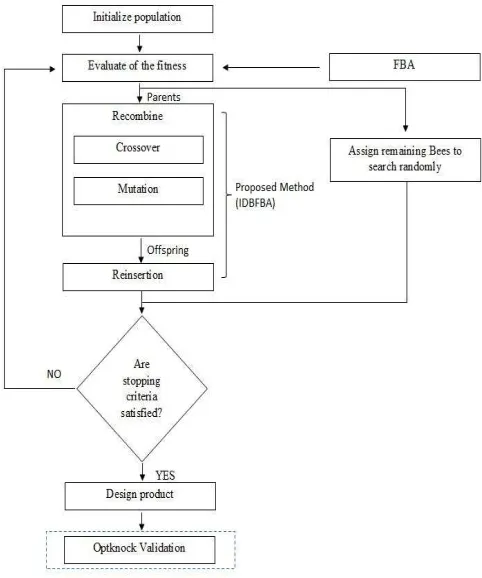
Some of the phases are derived and taken directly from the previous method. IDBFBA in this works differs from the DBFBA in the representation of each chromosome. Fig. 1 shows the flowchart of our proposed method that is Integer Differential Bees and Flux Balance Analysis (IDBFBA). This shows the part of this research that contributes to the improvement of previous (DBFBA). Each of this phase performs in this study will be explained clearly in Table 1.
Fig. 1 Flowchart of IDBFBA
TABLE I
EXPLANATION FOR EACH PHASE OF IDBFBA
Phase Explanation
Initialization of population
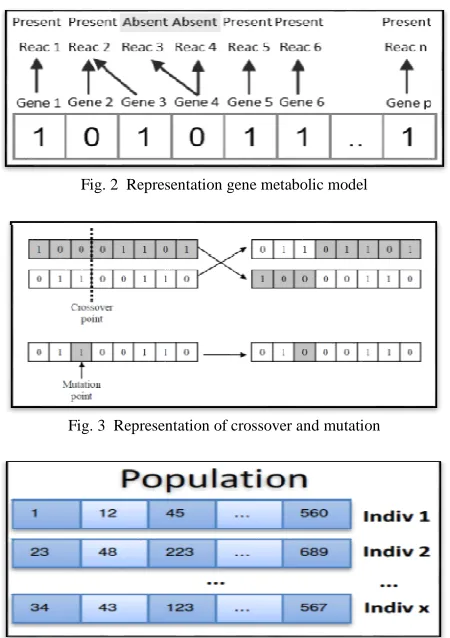
The calculation begins with an underlying populace of n scout honey bees. Every honey bee is introduced as by accepting a re-activity with n qualities. Honey bees in the populace are instated by setting present or truant status to every quality haphazardly. Instatement of the populace is done arbitrarily so that all honey bees in the population have an equivalent opportunity to be selected. Particular principles like co-controlled qualities having a tendency to be grouped did not influence the aftereffect of selecting the qualities. The outcome may not genuinely mirror the populace on the off chance that it is finished with inclination setting. In this stage, a parallel representation is connected to the qualities in the metabolic system as "0" to demonstrate knockout and "1" to show the quality is kept up as in Fig. 2 from the arrangement of qualities with the double status, it can be resolved which responses that will display in the metabolic framework and which is taken out.
Scoring fitness of individuals using Flux Balance Analysis
Every site is given a wellness score that figures out if to enlist more honey bees or ought to be deserted. The scoring wellness of people was completed utilizing FBA. The scoring wellness process proceeds until the greater part of the people have been given a wellness esteem. FBA utilizes Linear Programming (LP) to amplify a goal function under various imperatives. For instance, to streamline a target capacity indicates by Z at a specific timeframe, regularly the LP is formalized as in condition:
subject to S.v=0
and lower bound ≤x≤upper bound
where v speaks to the vector of fluxes, S is the stoichiometric grid. The expression (cTv) to be amplified or minimized is known as the goal capacity; cell development is boosted in this examination, where c is a vector of weights, demonstrating how much every response adds to the goal capacity [8]. The disparities of the lower bound and upper bound characterize the maximal rates of flux for each response relating to the sections of the stoichiometric grid.
In the study made by Garcı'a Sa'nchez [9] the best expectations were gotten utilizing ''expansion of development'', and with a few mixes that incorporated this goal. Henceforth, in this paper, augmentation of development is connected. In the wake of boosting the cell development, mutant with a development rate of more than 0.1 proceeds with the procedure by augmenting the craved item flux at altered ideal cell development esteem. In the wake of directing a little number of trial, the ideal cell development worth was settled at 90% from the quality acquired from FBA, since the production yield of the fancied metabolite is dependably 0 when the development is at most extreme.
Differential Evolution Algorithm
This calculation does neighbourhood looks in the favoured locales (m) by utilizing DE calculation. DE calculation works by keeping up a populace of applicant solutions and making new hopeful arrangements through the transformation and hybrid operation of DE and keeps the wellness competitor arrangement. In this paper, the hopeful arrangements are the m favoured locales from the populace initialized by utilizing BA. The calculation begins with the solution, then experiences the change and hybrid operation to make new hopeful arrangements. Since the candidate arrangement was introduced by BA haphazardly, subsequently the particular guidelines on the circulation of quality on chromosome did not influence the outcome of neighbourhood quality determination as well.
The change of the populace is done through the determination in view of wellness and modification utilizing hybrid and transformation. The procedure will bring about a populace with a better arrangement, and it will proceed until an adequate arrangement is found or achieve the greatest number of eras.
Hybrid can be viewed as the mating of two chromosomes of people to create another person that have both of the mating singular segments for the people to come. The procedure includes joining two chromosomes from two individuals at the hybrid focuses and swapping the grafted part to supplant each other. The basis behind this is, a superior arrangement can be made by joining the qualities with great attributes from both chromosomes. Transformation is a procedure of changing the dog rent estimation of quality to an alternate one to make an arbitrary alteration in the chromosome creation. For a chromosome with a parallel string, the transformation will flip from 0 to 1 or the other way around at a specific change point. The representation of hybrid and change can be found in Fig. 3.
Generation of new population
This progression required progressions of the representation of the quality from paired to the whole number. A set-based Evaluation Algorithm (SEA) proposed by Ro-cha [10] was utilized to produce another populace with whole number qualities. Ocean utilizes the set-based representation and characterizes two reproduction administrators who are traverse and change. The hybrid administrator is propelled on conventional uniform hybrid administrators and fills in as takes after: the qualities that are available in both guardian sets are kept in both posterity; the qualities that are available in one and only of the guardians are sent to one of the posterity, chose haphazardly with equivalent probabilities. The change administrator is an arbitrary mutation that replaces a component of the set by another, randomly created in the permitted range (1 to N).
In SEAs, a base and the greatest worth for the set size are characterized. On the off chance that these qualities are equivalent, the hunt just experiences sets of a given cardinality. The administrators conform to this imperative by making solutions dependably of the same size. On account of the hybrid, this infers, while selecting the destination of the qualities that are available in the standout guardian, if a posterity achieves the most extreme number of components in the set, the remaining qualities go to the next posterity.
SEA utilizes a choice method that comprises in changing over the wellness esteem into a straight positioning of the people in the populace, and after that applying a roulette wheel plan [11]. In every era, half of the people are kept from the past era, and half are reared by the use of the generation administrators. An elitism estimation of 1 is utilized, permitting the best individual of the populace to be constantly kept.
An underlying populace is arbitrarily made, and the end rule depends on an altered number of eras (in this work this is ascertained to accomplish a given most extreme number of arrangement assessments). In the variable size SEAs, the measure of the sets encoded in the initial people is haphazardly set to a worth somewhere around 1 and 10. In Fig. 4 demonstrates the case of another populace with a number representation was shaped.
Random Assignment and termination
Fig. 2 Representation gene metabolic model
Fig. 3 Representation of crossover and mutation
Fig. 4 Example of new population with integer representation
The dataset used in this research is a genome-scale metabolic network reconstructive of E.coli K -12 MG1655 model iJR1904. As shown in Fig. 5, this model consists of 904 genes, 1075 reactions, and 761 metabolites. This model is picked mostly as a result of the portrayal and measurement of the biomass parts, and upkeep necessities are connected with the development of E.coli.
In this examination, the crude model of iJR1904 is pre-prepared before it is actualized in the crossover IDFBA calculation. Pre-processing of the model is done with a specific end goal to lessen the computational time. Likewise, there are deadlocks present inside the responses and metabolites. The deadlocks ought to be evacuated on the grounds that they can bring about a course of blocked responses. Along these lines, the deadlocks can be expelled by pre-processing of the model, and this is the initial step of model processing. The second step in model pre-processing is the model decrease. The unusable capacities in the model are expelled completely in this progression. Via doing the model decrease, the negligible limits for the flux through every capacity can be found. The outcomes will the arrival and utilized for flux variability investigation. After connected the model pre-processing, the reactions number is diminished to 667 responses while the quantity of metabolites is lessened to 450 metabolites.
With a specific end goal to accomplish the principal destinations of this re-look, some fundamental necessities for the exploration are likewise should be determined. For equipment necessities, a computer preparing unit (CPU) with high handling power and bigger memory is best keeping in mind the end goal to diminish star processing time. A portable PC with Intel Core i5 1.7 GHz, 4GB of Random
Access Memory (RAM) and OS X 10.11.3 operating framework were utilized to lead this exploration. Whereby, the outside hard circle is additionally required to store essential information in PC framework.
In this research, the study was led utilizing Macintosh,OS X 10.10.2. Since the exploration is executed in Matlab environment, MATLAB R2014a was introduced. COBRA Toolbox-4.0.1 was introduced into MATLAB so as to run OptKnock for assessment by contrasting the outcomes and this exploration. For the documentation part Microsoft Office Word, Mac 2011 was utilized to finish all the documentation procedure. What's more, there are some of other programming utilized as a part of this exploration that is TextMate to altering some coding part and Adobe Reader to peruse some examination and editing paper.
Fig. 5 List of data in iJR904
III.RESULTS AND DISCUSSION
In order to justify the results obtained and the performance of the developed algorithm, there are three performance methods are measured and have been dis-cussed in chapter three. There are sample standard deviation, the accuracy of valid solutions and accuracy of optimal solutions. Total runs (n) for measured the performance is 50 times each. To prove the newly hybrid algorithm is effective and outperform, the result of this hybrid algorithm, IDBFBA, is compared with baseline result of computing researches. There are two methods going to compare and analysis the results which are OptKnock, the hybrid method of Bees Algorithm with Flux Balance Analysis (BAFBA) [12], combination be-tween Simulated Annealing with Flux Balance Analysis (SA+FBA) [13] and the combination of Differential Bees with Flux Balance Analysis (DBFBA) [14]. The result to be compared and analysis are in the term of gene knockout, production and the growth rate of succinate and lactate respectively.
A. Performance of IDBFBA for Succinate Production
erasure of qualities fumA, fumC, zwf, aceE, aceF and lpdA the BPCY accomplishes 14.0168, and the development rate is 0.9197 hr-1. The capacity of qualities fumA and fumC are encoding fumA fumarase and fumC fumarase which capable of the oxidation of fumarate to malate [16]. Fumarate takes an interest in the reductive pathway from oxaloacetate to succinate amid the anaerobic development of E .coli. Thus, expand-ing fumarate is hence incremented succinate creation. zwf is quality for compound glucose-6-phosphate dehydrogenase which separates glucose-6-phosphate to δ -6-phosphogluconolactone) [17]. The current of zwf extraordinarily diminishes the creation of glucose-6-phosphate. Glucose-6-phosphate is crucial to the creation of succinic corrosive in E.coli. Subsequently, the cancellation of zwf help in improves succinic corrosive volume. Next, aceE, aceF, lpdA are a quality that in charge of produce pyruvate-dissimilating compounds which change over pyruvate to acetyl-CoA. Acetyl-CoA is further catalysed to acetic acid derivation and ethanol. These genes do not involve in the succinic acid generation [17].
B. Performance of IDBFBA for Lactate Production
Table 2 summarizes the outcomes got from ID-BFBA for lactate creation in E.coli. As appeared from the outcomes, this calculation delivers better results than the previous works as far as BPCY and development rate and the potential qualities that can be expelled additionally had distinguished. It demonstrates IDBFBA for the expulsion of three responses from the model that gets result succinate development rate achieving 0.9197 and BPCY achieving 14.0168, which is superior to anything past works. Thump out of pflB, pta, and ppc genes can best BPCY which is 17.0615 and with the 0.9200 hour-1 development rate. As indicated by Zhu and Shimizu [19], the deletion of pflB, pta,and ppc qualities bring to over the generation of lactate. With the knockout of those qualities expressed, the resulting items, for example, Acetate, Formate, and Succinate were practically inconsequential. The mutant of pyruvate formate lyase (PFL) is coming about the over-articulation of lactate dehydrogenase (LDH) and advance the lactate advancement. By and by, the compound expression and intracellular states are bringing about the huge measure of Lactate creation. By disposing of the by-items, the pathway is driving to concentrate on the certain pathway. For this situation, Lactate is the main pathway. Without the contend pathways, the creation of Lactate can increment.
IV.CONCLUSIONS
The modelling and simulation genome-scale metabolic models have sufficiently accepted an imperative part in helping the metabolic building, especially for the advancement of metabolite creation and other scientific and mechanical essential biochemical. The incorporation and coordination of genome gathering information, framework topology and test data of metabolic fluxes into FBA has enabled the researchers to make metabolic models that keep up the normal structure and plausibly correct to suspect the phenotype at the phone level.
This research proposed an iterative algorithm based on FBA to identify the essential genes that able to form a
minimal genome without degrading the biological function using FBA. With the minimize genome and essential genes identified, the number of genes to be considered to find the best combination to be knocked out become less thus reducing the search space and computational cost. At that point, in light of the key qualities acquired, a metabolic pathway is developed from quality expression information for a specific creation of metabolites of interest. The FBA is utilized to upgrade a target capacity with the presumption that the genome is in a relentless state condition whereby streamlining of the target capacities can be led.
In view of the test directed on E. coli, the outcomes demonstrated that the data gave by quality expression examination has enhanced the forecast of the constraint-based investigation, for example, FBA and can conceivably be developed. This research managed to obtain the minimal functional genome for E. coli models without degrading the growth rate and the production of metabolites.
The proposed hybrid algorithm IDBFBA has successfully perceived the perfect quality knockout method to upgrade the era of looked for metabolites while keeping up the perfect improvement rate of the living being. Using the limit of IDE and BA with FBA set as the objective work, the results gained demonstrates a change respecting the creation and the advancement rates. The results exhibit a basic change of metabolite manifestations stood out from the present methodology. Before long, the results presented in this investigation are constrained to in silico test which may contrast from certified examination, however, can be used as a wellspring of point of view.
TABLE II
THE COMPARISON BETWEEN DIFFERENT METHODS FOR PRODUCTION OF SUCCINATE AND LACTATE
Because of constrained time of advancement of IDBFBA, improvement should be possible on IDBFBA for more exhaustive elements and ease of use of it. The future heading of examination on IDBFBA should be possible as per a couple of proposals that is by doing some change of the calculation's for better execution, apply IDBFBA calculation with various datasets to test its power and test ID-BFBA calculation with quality or response knockout numbers more than 5.
ACKNOWLEDGMENT
This research is supported by Universiti Teknologi Malaysia through the Tier 1 research grant (Grant number: Q.J130000.2528.11H05).
REFERENCES
[1] Long, M. R., Ong, W. K., & Reed, J. L. (2015). Computational methods in metabolic engineering for strain design. Current opinion in biotechnology, 34, 135-141.
[2] Thompson, J. D. and Poch, O. (2006). Multiple Sequence Alignment as a Workbench for Molecular Systems Biology. Current Bioinformatics. 1: 95-104.
[3] Edward, J. S. and Palsson, B. O. (2000). The Escherichia coli MG1655 in silico metabolic genotype: its definition, chracteristics, and capabilities. Proc. Natl Acad. Sci USA. 97: 5528-5533.
[4] Feist, A. M. And Palsson, B. Ø. (2008). The growing scope of applications of genome-scale metabolic reconstructions using Escherichia coli. Nat. Biotechnol. 26 659-67.
[5] Pereira, R., Nielsen, J., & Rocha, I. (2016). Improving the flux distributions simulated with genome-scale metabolic models of Saccharomyces cerevisiae. Metabolic Engineering Communications, 3, 153-163.
[6] Karp, P. D., Paley, S. M., Krummenacker, M., Latendresse, M., Dale, J. M., Lee, T. J., Kaipa, P., Gilham, F., Spaulding, A., Popescu, L., Altman, T., Paulsen, I.,Keseler I. M., and Caspi, R. (2010). Pathway tools version 13.0: integrated software for pathway/genome informatics and systems biology. Brief Bioinform. 11(1), 40–79. [7] Mlecnik, B., Scheideler, M., Hackl, H., Hartler, J., Sanchez-Cabo, F.,
and Trajanoski, Z. (2005). PathwayExplorer: web service for visualizing high-throughput expression data on biological pathways. Nucleic Acids Research, Vol. 33(1): 633-637.
[8] Kim, J., Fabris, M., Baart, G., Kim, M. K., Goossens, A., Vyverman, W. & Lun, D. S. (2016). Flux balance analysis of primary metabolism in the diatom Phaeodactylum tricornutum. The Plant Journal, 85(1), 161-176.
[9] Wei, Z. and Li, H. (2007). A markov random field model for network-based analysis of genomic data. Bioinformatics, Vol. 23(12): 1537-1544.
[10] Sanguinetti, G., Noirel, J., and Wright, P. C. (2008). Mmg: a probabilistic tool to identify submodules of metabolic pathways. Bioinformatics, Vol. 24(8): 1078-84.
[11] Garcia Sanchez, C.E.,Vargas Garcia, C.A., and Torres Saez, R.G. (2012). Predictive potential of Flux Balance Analysis of Saccharomyces cerevisae using as optimization function combinations of cell compartmental objectives. PLoS ONE. 7(8):e43006.
[12] Rocha, M., Maia, P., Mendes, R., Pinto, J. P., Ferreira, E. C., Nielsen, J., Patil, K. R. and Rocha, I. (2008). Natural Computation Meta-heuristics for The In-silico Optimization of Microbial Strains. BMC Bioinformatics 2008. 9(499), 1-16.
[13] De Jong K (1975) : An analysis of the Bahavior of a Class of Genetic Adaptive Systems PhD thesis : University of Michigan.
[14] Pham., D.T., Ghanbarzadeh, A., Koc, E., Otri, S., Rahim, S., and Zaidi, M. (2006).The Bees Algorithm-A novel tool for complex optimization problems. Intelligent Production Machine and Systems. 454-459. [15] Rocha, M., Maia, P., Mendes, R., Pinto, J. P., Ferreira, E. C., Nielsen,
J., Patil, K. R. and Rocha, I. (2008). Natural Computation Metaheuristics for The In-silico Optimization of Microbial Strains. BMC Bioinformatics 2008. 9(499), 1-16.
[16] Choon YW, Mohamad MS, Deris S, Illias RM, Chong CK, et al. (2014) Differential Bees Flux Balance Analysis with OptKnock for In Silico Microbial Strains Optimization. PLoS ONE 9(7): e102744. doi:10.1371/journal.pone.0102744.
[17] Burgard, A.R., Pharkya, P., and Maranas, C.D. (2003). OptKnock: A bilivel programming framework for identifying gene knockout strategies for microbial strain optimization. Biotechnology and Bioengineering. 8:57.
[18] Tseng, C., Yu, C., Lin, H., Chang, C. and Kuo, J., (2001). Oxygen- and Growth Rate-Dependent Regulation of Escherichia Coli Fumarase (FumA, FumB, and FumC) Activity. Journal of Bacteriology 183(2): 461-467.
[19] Zimenkov, D., Gulevich, A., Skorokhodova, A., Biriukova, I., Kozlov, Y. and Mashko, S., (2005). Escherichia Coli ORF ybhE is pgl gene encoding 6-phosphogluconolactonase (EC 3.1.1.31) that has no homology with known 6PGLs from other organisms. FEMS Microbiology Letters 244, 275-280.
[20] Lee, D., Kim, T.Y., Kim, B.H., Lee, J. and Lee, S.Y., (2005). Metabolic Engineering of Escherichia coli for Enhanced Production of Succinic Acid, Based on Genome Comparison and In Silico Gene Knockout Simulation. Applied and Environmental Microbiology 71(12): 7880-7887.
[21] Zhu, J. and Shimizu, K. (2004). Effect of a Single-gene Knockout on the Metabolic Regulation in Escherichia coli for D-lactate production under micro aerobic condition. Journal of Metabolic Engineering. 7(2005), 104-115.
[22] Joyce, A. R., Palsson, B. Ø. , Fu, P., and Panke, S. (2009). In silico genome-scale metabolic models: The Constraint-Based Approach and Its Application. John Wiley & Sons Inc.: Hoboken, NJ, USA 2009, pp. 193-233.
[23] Covert, M. W., Xiao, N., Chen, T. J., Karr, J. R. (2008). Integrating metabolic, transcriptional regulatory and signal transduction models in Escherichia coli. Bioinformatics. 24(18): 2044-2050.
[24] Ovacik, M. A., and Androulakis, I. P. (2008). On the potential for integrating gene expression and metabolic flux data. Current Bioinformatics. 3(3): 142-148.
Method Succinate production Lactate production
List of Gene Knockout (KO) Growth Rate (1/hour)
BPCY List of Gene Knockout (KO)
Growth Rate (1/hour)
BPCY
IDBFBA FUM, G6PDH2r, PDH 0.9197 14.0168 pflB,pta,ppc 0.9200 17.0615
DBFBA ENO, PFL,PYK 0.7453 13.5800 ACALD, MDH, TALA 0.8672 16.1905
BAFBA FUM, PTAr, RPE 0.5851 3.8489 GAPD, L_LACD2, PTAr 0.5859 3.5656
OptKnock ldhA, pdh 0.3100 N/A ACKr, PTAr, ACALD 0.28 N/A
SA +FBA
MALS, ORNDC, FUM, GLYCL, GHMT2, ADPT, DCYTD, DUTPDP, URIDK2r, NTD8, PUNPI, THD2, GND, PFL, SUCFUMt
N/A 0.3579 ACLD19, DRPA, GLYCDx, F6PA, TPI, LDH_D2, EDA, TKT2, LDH_D