T
HE
B
ALASSA
-S
AMUELSON
E
FFECT IN
R
OMANIA
Vasile DEDU
Bogdan Andrei DUMITRESCU
Abstract
This paper aims to provide estimates of the the Balassa-Samuelson effect in Romania – the extent to which differences in productivity growth between tradables and non-tradables industries explain the observed differences in inflation between Romania and the euro area. The Balassa-Samuelson effect has major implications for interpretation of the inflation and the exchange rate criteria for European Monetary Union membership. The conclusion is that the Balassa-Samuelson effect explains only marginally the observed inflation differential. Unlike previous studies which estimated higher values for this effect, this paper considers the productivity differential of each sector and the weight of the tradables sector in Romania in relation to the Euro Area. The results show that there is very unlikely that the productivity differential endangers the nominal convergence criterions.
Keywords: Balassa-Samuelson effect, productivity differential, inflation differential, nominal convergence
JEL Classification: E30, F33, F41
1
. Introduction
This paper aims to provide estimates for the Balassa-Samuelson effect in Romania – the extent to which differences in productivity growth between tradable and non-tradable industries explain the observed differences in inflation between Romania and the Euro Area. This effect is very important because it can affect the inflation and the exchange rate criteria and, thus, the adoption of the euro can be delayed. The nominal convergence criteria, stated in the Maastricht treaty impose that the domestic inflation must be lower than 1.5 percentage points above the most efficient EU member states in this respect. Also, the currency must be integrated into ERM II and thus is it cannot fluctuate more than ±15% against the central parity. In order to
Academy of Economic Studies, Bucharest, email: [email protected].
Academy of Economic Studies, Bucharest, email: [email protected].
4.
accomplish this objective the central parity should be chosen to reflect the equilibrium exchange rate. The equilibrium real exchange rate is the real exchange rate that is consistent with the macroeconomic balance, which is achieved when the economy functions at full employment and low inflation (internal balance) and a sustainable current account (external balance). This equilibrium real exchange rate is very important for an economy because deviations of the real exchange rate from its equilibrium value can affect the competitiveness of a country. An overvalued real exchange rate will determine a lack of external competitiveness and deteriorate the country’s real activity. An undervalued exchange rate will increase exports on short term and it will lower the current account deficit but, on the long term, it will increase the inflationary pressures
The first attempt to determine a country’s equilibrium exchange rate was made by Gustav Cassel (1922), who introduced the purchasing power parity. The PPP theory states that exchange rates tend to equalize relative price levels in different countries. This theory can be seen as a long-term tendency of the exchange rate (the value predicted by the PPP theory is an equilibrium value). However, the convergence to PPP is a slow process. Consensus estimates set the half-life of deviations from PPP at about 4 years for exchange rates among major industrialized countries. The theory is not valid on short term for various reasons: first, the existence of the non-tradable sector (a sector where prices do not equalize because they are not subject of international competition) creates important deviations from the level determined by PPP. Second, exchange rates tend to be higher in rich countries than in poor countries, and relatively fast growing countries experience real exchange rate appreciation. The econometric testing of PPP evolved from linear regressions to unit rootandcointegration tests.
Balassa and Samuelson were the first to show that the PPP theory is not valid. They separate the economy into 2 sectors: the tradables sector (goods) that is subject to international competition and non-tradables sector (services). The productivity tends to increase more in the tradable sector than in the non-tradable sector. As a result, the wages in the tradable sector increase and, with labor being mobile, wages in the entire economy will rise. Producers of non-tradables will be able to pay the higher wages only if the relative price of non-tradable rises. This will in general lead to an increase in the overall price level in the economy. For a catch-up country the productivity gains are higher so the effect is stronger.
The Balassa-Samuelson effect has major implications for interpretation of the inflation and the exchange rate criteria for European Monetary Union membership. If the productivity differential between countries is large, it will result in real appreciation and inflation. This effect cannot be controlled by the central bank.
The estimation of the Balassa-Samuelson effect for the Central and Eastern European countries is an actual theme of research. The most important papers are those of Egert (2004, 2005), Candelon and Kool (2006), Oomes (2005), Mihaljek and Klau (2003). Egert (2004,2 005) showed that CEE countries experienced rapid productivity growth, in particular, in their industrial sectors, followed by an observable increase in the relative price of non-tradable goods and as a result of real exchange rate appreciation. As a consequence of rapid productivity gains and the presence of the
Balassa-Samuleson effect, a conflict between nominal convergence and real convergence could arise and the objectives related to the exchange rate and inflation may not be fulfilled simultaneously. Mihaljek and Klau (2003) debate over the choice of tradable and non-tradable sector and distinguish between the external and internal version of the Balassa-Samulson effect. While the internal version, also known as the Baumol-Bowen effect, measures the impact on the consumer price index of faster productivity growth rates in the domestic tradable versus non-tradable sector, the external version explains the extent to which the observed price differential between countries can be explained by the relative productivity differential. This research aims to estimate the external version, as we intend to assess the impact of the Balassa-Samuelson effect on the nominal convergence criteria. The estimations of this effect in the dedicated literature range from 1 to 4 percentage points and the main conclusion of the studies points out that the Balassa-Samuelson effect is not likely to put the Maastricht inflation criterion at risk.
2
. The Balassa-Samuelson Model
In order to formalize the model, the aggregate price level is decomposed into a traded and a not-traded component both domestically and abroad (the latter is represented by a *): NT t T t t
p
p
p
D
(
1
D
)
(1) * *)
1
(
* * * NT t T t tp
p
p
D
D
(1’)where: lower cases denote logarithms,
p
tTandp
tNTare the price levels for tradable and non-tradable goods,D
is the share of non-tradable in the consumption basket.The real exchange rate q is defined as the relative price of tradable goods from abroad (measured in domestic currency) versus the domestic tradable goods (all variables are in logarithms):
t t t
t
e
p
p
q
(
*)
(2)where:
e
t is the nominal exchange rate expressed as number of domestic monetary units versus one unit of foreign currency. If we can combine the three relations, we can obtain:)]
)(
1
(
)
)(
1
[(
)
(
* * * * T t NT t T t NT t T t T t t te
p
p
p
p
p
p
q
'
'
'
'
'
'
'
D
D
(3)If the law of one price holds in the tradable sector, we have:
*
T
T
e
p
p
'
'
'
(4)Next we determine a relation between the change in relative prices and the productivity differential between traded and not-traded sector. We will assume a small open economy and a Cobb-Douglas production function for both tradables and non-tradables sectors: J J
(
)
1)
(
T T T TA
L
K
Y
(5)G G
(
)
1)
(
NT NT NT NTA
L
K
Y
(
5
')
where: Y is the output, A, K and L are productivity, capital and labor. The profit functions for both economies are:
W
L
R
K
Y
P
T T T T T3
(6)W
L
R
K
Y
P
NT NT NT NT NT3
(6’)where: R is the return on capital determined in world markets, W is the wage. The necessary and sufficient conditions for profit maximization are:
0
w
3
w
T TK
; T TL
w
3
w
=0 ;0
w
3
w
NT NTK
; NT NTL
w
3
w
Thus, we have: JJ
)
(
)
1
(
T TTL
K
A
R
(7) GG
)
(
)
1
(
NT NTNT T NTL
K
A
P
P
R
(8) JJ
(
)
1 T T TL
K
A
W
(9) GG
(
)
1 NT NT NT T NTL
K
A
P
P
W
(10)If we apply logarithm and the difference operator, we get the internal version of the Balassa-Samuelson model: NT T T NT T NT
a
a
p
p
p
p
'
'
'
'
'
(
)
J
G
(11) where: lower cases denote logarithms,'
a
Tand'
a
NTare the growth rates for productivity in the two sectors. Thus, the relative price of non-tradable versus tradable will rise if the productivity in the tradable sector is higher.The international Balassa-Samuelson explains the extent to which the inflation differential between the two countries is explained by the productivity differential between traded and non-traded industries. In order to obtain a relation for this effect we substitute (11) in (3) and use (2) and (4):
)
)
)[(
1
(
)]
)
)[(
1
(
* * ** * * * NT t T t t NT t T t t t tp
e
a
a
a
a
p
'
'
'
'
'
'
'
J
G
D
J
G
D
](12)Differences in inflation rates can be expressed as a weighted average between the change in the nominal exchange rate, and the productivity differential between tradables and not-tradables sectors domestically (
'
a
Tt*'
a
tNT) and abroad ('
a
Tt*'
a
tNT*).The Balassa-Samuelson effect is in tight connection with the Baumol-Bowen effect. Baumol and Bowen (1966) showed that prices in the non-tradables sector rise faster than prices in the tradables sector in order to compensate for difference in productivity gains. As a consequence, the national inflation rate will be higher if the productivity differential between the two sectors widens. Yet the equation (11) does not imply necessarily a Balassa-Samuelson effect.
3
. Data description
The source of data is Eurostat and The National Bank of Romania databases. The economies and periods covered are Romania (2002:Q1-2006Q4) and Euro Area (2002:Q1-2006:Q4). The frequency of observations is quarterly and, in the econometric work, all series are seasonally adjusted using TramoSeats.
A first problem is how to construct tradable and non-tradable sectors. We have considered both the suggestions present in the literature and the characteristics of the Romanian economy. The tradable sector is composed of industry and wholesale, retail trade while the non-tradable sector is composed of construction and financial intermediation. We did not include agriculture because trade is distorted by controlled prices.
A second problem that arises is the choice of an optimal price index. The dedicated literature uses mainly the consumer price index and the GDP deflator. While the latter has the advantage of measuring also the price change of imported goods or those purchased by the government, CPI appears to be a more proper choice for this research as we intend to measure the extent to which the Balassa-Samuleson effect is likely to endanger the Maastricht inflation criterion measured through the difference of the harmonized consumer price indices. Moreover, a decomposition of the CPI into tradable and non-tradable components would be useful but due to lack of data we will use the inflation differential between Romania and the Euro Area defined as the ratio of the consumer price indices.
Also, the productivity is proxied by labor productivity because data on capital stocks are unavailable.
All variables are in constant prices (2002=100 for Romania and the Euro Area).
Description of variables:
x Quarterly observations of value added from the production side GDP estimates (decomposed into tradables and non-tradables)
x CPI rates of inflation
x Nominal exchange rates of domestic currency against the euro (quarterly averages)
4. Empirical Results
The Balassa-Samuelson model assumes that productivity is higher in the tradabless sector. As a consequence, wages in this sector have the tendency to rise but, since labor is mobile, the increase in salaries spreads across the whole economy. In order to see if these hypotheses are met, the next graphs show the evolution of productivity in the tradabless and non-tradabless sectors in Romania (2002:Q1-2006Q4).
Chart 1
Romania’s labor productivity
Source: Own calculations.
As it can be seen in this chart, the growth in labor productivity is higher in the tradables sector (75.47% in the entire period) than in the non-tradables sector (43.97% in the entire period). Although in 2002 there was an important increase in the productivity of the tradables sector, overall the tradables sector outruns the non-tradables sector. Also, it can be observed that evolution in productivity gains was similar in the two sectors. The trend was similar but the growth rate was different. The wage growth over the period covered can be seen in the next figure.
Chart 2
Romania’s wage growth
The wage growth was similar across the two sectors which is consistent with the theory. Labor mobility determined the wages in the non-tradables sector to rise as much as wages in the tradables sector, although productivity gains are smaller.
In order to estimate the Balassa-Samuelson effect I have calculated the average annual growth rates for productivity in the tradables and non-tradables sectors, the domestic productivity differential and the international productivity differential between Romania and the Euro Area. The results are shown below.
Chart 3
Productivity- tradabless (average annual growth rate)
Source: Own calculations.
Chart 4
Productivity-non-tradabless (average annual growth rate)
Source: Own calculations.
Chart 5
Domestic productivity growth differential T/NT (annual average, in percentage points)
Chart 6
CPI inflation (annual average)
Source: own calculation
As predicted by the theory there is a positive differential between the growth rates of tradables sector versus non-tradables sector in Romania against the Euro Area (4 percentage points). Also, the average CPI inflation was much higher in Romania (10.04%) against the Euro Area (2%).
The aim of this paper is to provide estimates for the the Balassa-Samuelson effect in Romania - the extent to which differences in productivity growth between tradables and non-tradables industries explain the observed differences in inflation between Romania and the Euro area. We are interested to see if this effect can endanger the inflation criterion. For this purpose, we will estimate the international version of the Balassa-Samuelson using a form of equation (12):
t t * NT * T t t NT T t t t t * t * ] ) LP / LP log( *) ( ) LP / LP log( ) [( ) E / E log( ) CPI / CPI log( c ) CPI / CPI log( H D D E E E 1 1 2 1 1 1 0
All variables use1d in the regression are stationary. The results of the tests are shown below.
Table 1 Results of stationarity tests
Series Augmented Dickey-Fuller
test Phillips-Perron test Productivity_differential Romania-Euro Area -3.997501 (0.0086) -3.111947 ( 0.0427) Inflation_differential Romania-Euro Area -5.041439 ( 0.0010) -15.50055 ( 0.0000)
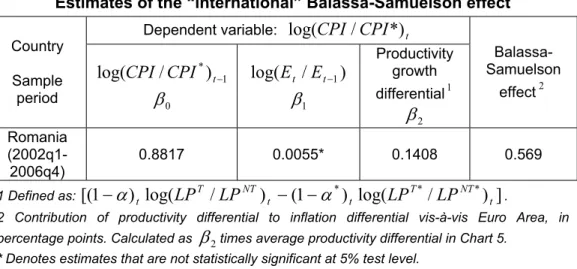
The results of the estimations, using ordinary least squares are shown in the next table. To allow for the possibility of a delayed pass-through of productivity effects on inflation differentials, productivity terms are lagged up to four quarters. The assumptions for the standard regression are not violated in any way.
Table 2
Estimates of the “international” Balassa-Samuelson effect
Dependent variable:
log(
CPI
/
CPI
*)
t Country Sample period 1 *)
/
log(
CPI
CPI
t0
E
)
/
log(
E
tE
t1 1E
Productivity growth differential1 2E
Balassa-Samuelson effect2 Romania (2002q1-2006q4) 0.8817 0.0055* 0.1408 0.5691 Defined as:
[(
1
D
)
tlog(
LP
T/
LP
NT)
t(
1
D
*)
tlog(
LP
T*/
LP
NT*)
t]
.2 Contribution of productivity differential to inflation differential vis-à-vis Euro Area, in percentage points. Calculated as
E
2times average productivity differential in Chart 5.* Denotes estimates that are not statistically significant at 5% test level.
As it can be seen in the table, the Balassa-Samuelson effect in Romania explains on average only 0.569 percentage points of the observed inflation differential -8.06 percentage points (2002Q1:2006Q4).
The estimates are lower that those obtained in previous studies because we considered the effect of the productivity differential on the inflation differential and not on domestic inflation. The conclusion is that, although productivity gains are superior in Romania versus the Euro Area, the Balassa-Samuelson effect does not explain much of the observed inflation differential and thus factors, other than productivity differences, are responsible for the observed differences in inflation rates.
As a consequence, the Balassa-Samuelson effect itself is not likely to endanger the Maastricht inflation criterion. Also, the observed differences in productivity growth are not likely to be maintained in the next years because the growth rate is expected to be lower in Romania.
R
eferences
Balassa, B., (1964), “The purchasing power parity doctrine: A Reappraisal”, Journal of Political Economy, 6: 584-596.
Bergin, P., R. Glick and A.M. Taylor (2006), “Productivity, tradability and the long-run price puzzle”, Journal of Monetary Economics, 53: 2041-2066.
Brooks, C. (2002), Introductory Econometrics for Finance, Cambridge University Press
Candelon,B., K. Raabe, T. van Veen and C. Kool, (2006), “Long-run real exchange rate determinants: Evidence from eight new EU member states, 1999-2003”,Journal of Comparative Economics, 35: 87-107.
Canzoneri, M.B., R.E. Cumby and B.Diba, (1999), “Relative labor productivity and the real exchange rate in the long run: Evidence for a panel of OECD countries”,Journal of International Economics, 47: 245-266.
Egert, B., I. Drine, K. Lommatzsch and C. Rault, (2003), “The Balassa–Samuelson effect in Central and Eastern Europe: Myth or reality?” Journal of Comparative Economics, 31: 552-572.
Egert, B., (2002), “Estimating the impact of the Balassa–Samuelson effect on inflation and the real exchange rate during the transition”, Economic Systems, 26: 1-16.
Faria, J.R. and M. Leon-Ledesma, (2002), “Testing the Balassa–Samuelson effect: Implications for growth and the PPP “, Journal of Macroeconomics, 25: 241-253
Klau, M. and D. Mihaljek, (2003), “The Balassa-Samuelson effect in Central Europe: A disaggregated analysis”, BIS Working Papers, 143
Lommatzsch, K.and S. Tober, (2005), “What is behind the real appreciation of the accession countries’ currencies? An investigation of the PPI-based real exchange rate”, Economic Systems, 28: 383-403.