PS-026
EXTRACTION OF FERULIC ACID FROM AGRO-INDUSTRIAL
WASTES AND EVALUATION OF BIOCONVERSION OF FERULIC
ACID TO VANILLIN BY
STREPTOMYCES SETONII
Salgado, José Manuel
1,2,*
; Max, Belen
1; Rodríguez, Raquel
1; Pérez, Noelia
1;
Domínguez, José Manuel
11Chemical Engineering Department, Faculty of Sciences, University of Vigo (Campus
Ourense), As Lagoas s/n, 32004 Ourense, Spain.
2IBB – Institute for Biotechnology and Bioengineering, Centre of Biological Engineering,
University of Minho, Campus de Gualtar, 4710–057 Braga, Portugal * Corresponding author. E-mail: [email protected]
Abstract
Several agro-industrial wastes (as chestnut and pistachio shells, grass, leaf fruit, vine leaf, and, red and white grape stems) were evaluated to ferulic acid extraction. The chemical analysis of these raw materials shows a high content of xylan in pistachio shells (33%), following the biorefinery concept, this fraction can be used in xylitol manufacture. The lignocellulosic materials were submitted to an alkaline extraction to obtain phenolic compounds, reaching a concentration of 312 mg ferulic acid/L in grass wastes. Other phenolic compounds were also extracted (gallic acid, p-coumaric acid, syringic acid etc.) depending of used raw material. Besides, the ferulic fermentation into vanillin was assayed. The higher concentration of vainillin (2692 mg/L) was achieved at 27 h (QP =
99.704 mg/L·h and YP/S = 0.50 mg/mg) using Streptomyces setonii.
Keywords: Ferulic acid, agro-industrial wastes, vanillin, Streptomyces setonii
INTRODUCTION
Similar to petroleum, lignocellulosic materials (LCMs) have a complex composition and, as such, their fractionation in hemicelluloses, celluloses and lignin allows obtaining a wide range of products (FitzPatrick et al., 2010).In biorefineries, added value products such as
ferulic acid (FA) extracted from LCMs represents an important component of the overall value chain and economics (Abokitse et al., 2010).
FA can be released by chemical and enzymatic hydrolysis from LCMs. In chemical treatments is common to use non-pressurised and pressurised alkaline hydrolysis, although FA can also be released by other pressurized solvents (ethanol, water and ammonia) (Buranov and Mazza, 2009), meanwhile enzymatic hydrolysis is carried out by feruloyl esterases (Topakas et al., 2007).
FA can also be metabolized in other value added products as 4-vinylguaiacol (VG) and vanillin (V) (Mathew et al., 2007). The commercial cost of VG is nearly 40 times higher than that of FA (Mathew et al., 2007). Nowadays, consumers have increased the demand of natural flavors, since they have natural and healthy attributes (Hua et al., 2007). Thus, interest of natural V production by biotechnological processes has grown.
V can be produced by Streptomyces setonii (Muheim and Lerch, 1999). In its metabolic pathway, V is an intermediate metabolite of the microbial degradation of FA (Muheim and Lerch, 1999). V is further oxidized to vanillic acid, which is either O-demethylated to protocatechuic acid or decarboxylated to guaiacol (Priefert et al., 2001)
The aim of this work was to study the extraction of ferulic acid from different agro-industrial waste and evaluation of media composition for bioconversion of synthetic FA by S. setonii.
METHODOLOGY
Raw materials
Seven LCMs with local agricultural and processing origin were considered in this work: chestnut and pistachio shells, grass, leaf fruit, vine leaf, and, red and white grape stems. All materials were dried, milled to a particle size less than 1 mm, homogenized in single lots to avoid compositional differences, distributed to smaller containers, and stored at low
Alkaline hydrolysis of pre-treated materials
The treatment was carried out according to Salgado et al. (2012).
Microorganism, medium composition and cultures conditions
Streptomyces setonii CECT 3276 was purchased to Spanish Type Culture Collection (Valencia, Spain) equivalent to Streptomyces setonii ATCC 39116 and maintained in cryovials at -40 ºC using 30% glycerol as cryoprotector. Inocula were prepared by dissolving the previous glycerol stock cryovials in 250 mL Erlenmeyer flasks containing 50 mL of the following basal medium: 10 g commercial glucose/L, 4 g yeast extract/L, 4 g Na2HPO4/L, 1 g KH2PO4/L, 0.2 g MgSO4•7H2O/L, 0.2 g NaCl/L and 0.05 g CaCl2•H2O/L,
and pH adjusted to 7.2 with a solution of NaOH 2M. The preculture was grown overnight before inoculation, 2 mL of grown medium were added to other Erlenmeyer flask with basal medium. After glucose was consumed 5 g/L of FA was added to medium. FA dissolution was sterilized by ultrafiltrationusing 0.22 µm membranes (Nalgene).Samples of 1 mL were recovered along of fermentation in sterile conditions. Samples were centrifuged and analyzed by HPLC. All assays were performed in duplicate.
Analytical determinations
The treatment was carried out according to Salgado et al. (2012).
RESULTS
Characterization of raw materials
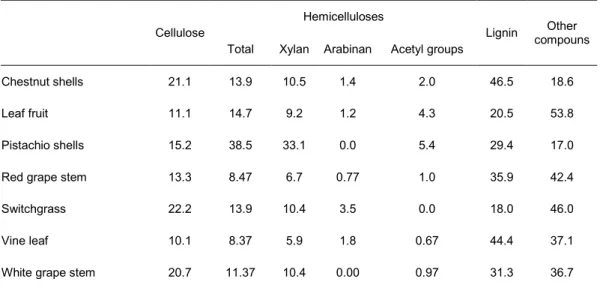
Seven raw materials (chestnut and pistachio shells, grass, leaf fruit, vine leaf, and, red and white grape stems) were characterized by quantitative acid hydrolysis (Salgado et al., 2012). Table 1 shows the obtained results.
Pistachio shells had a higher content in hemicelluloses, of which xylan showed a 33.1%. This fraction can be hydrolyzed to obtain liquors with high concentration of xylose and can
be fermented to xylitol by Debaryomyces hansenii (Salgado et al., 2012). Cellulose changes widely from only 10.1 % in vine leaf to 22.2 % in grass.
Cellulose Hemicelluloses Lignin compouns Other Total Xylan Arabinan Acetyl groups
Chestnut shells 21.1 13.9 10.5 1.4 2.0 46.5 18.6 Leaf fruit 11.1 14.7 9.2 1.2 4.3 20.5 53.8 Pistachio shells 15.2 38.5 33.1 0.0 5.4 29.4 17.0 Red grape stem 13.3 8.47 6.7 0.77 1.0 35.9 42.4 Switchgrass 22.2 13.9 10.4 3.5 0.0 18.0 46.0 Vine leaf 10.1 8.37 5.9 1.8 0.67 44.4 37.1 White grape stem 20.7 11.37 10.4 0.00 0.97 31.3 36.7 Table 1. Quantitative acid hydrolysis (in %) of agro-industrial waste (Salgado et al. 2012).
Ferulic acid extraction
Different phenolic compounds and concentrations were released depending on the material employed: gallic acid (628.0 mg/L in chestnut shells), p-coumaric acid (542.7 mg/L in grass), p-hydroxybenzoic acid (394.5 mg/L in leaf fruit), ferulic acid (312.0 mg/L in grass), vanillic acid (192.7 mg/L in vine leaf), syringic acid (116.2 mg/L in pistachio shells), and 3,4-dihydroxybenzaldehyde (66.8 mg/L in chestnut shells). Vanillin and vanillic alcohol were detected in negligible amounts (< 0.5 mg/L) with the exception of the small amounts (17.3 mg/L) quantified in white grape stem.
Evaluation of bioconversion of ferulic acid in vanillin
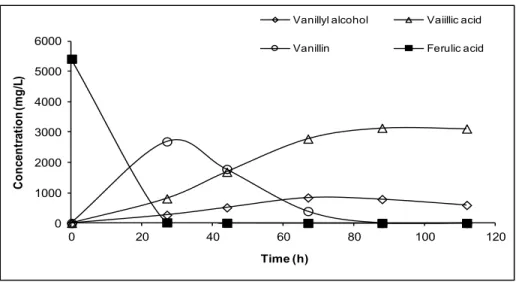
Previously to the use of FA obtained by hydrolysis of LCMs, synthetic FA was assayed to study the V production by S. setonii. Once the microorganism was grown in a medium basal with glucose, FA was added after glucose consumption. Fig. 1 shows the production of vanillin, vainillic acid and vanillyl alcohol after FA addition. FA was quickly degraded to
mg/L·h and 0.50 mg/mg). Higher fermentation times result in a degradation of V to produce 3139 mg/L vainillic acid after 88h.
Among the materials considered in this work, grass showed the highest concentration of ferulic acid (Table 2).
Pre-treated materials Ferulic acid (mg/L)
White grape stem 97.9
Red grape stem 92.2
Vine leaf 35.8
Leaf fruit 64.0
Grass 312.0
Pistachio shells 43.0
Chestnut shells 19.5
Table 2. Ferulic acid released from pre-treated materials (Salgado et al., 2012).
Fig. 1. Bioconversion of ferulic acid in vanillin by S. setonii
0 1000 2000 3000 4000 5000 6000 0 20 40 60 80 100 120 Co nc en tra tio n ( m g/ L) Time (h)
Vanillyl alcohol Vaiillic acid Vanillin Ferulic acid
CONCLUSIONS
Agro-industrial wastes can be a source of FA. The released of FA was integrated in fractionation stages of LCMs. From all these wastes, grass showed the highest concentration of FA. S. setonii can metabolize synthetic FA to vanillin in basal medium. The following works will focus on the bioconversion of FA present in hydrolyzates to V. Different treatments of FA purification from LCMs will be necessary to improve productivities and yields.
ACKNOWLEDGEMENTS
We are grateful for the financial support of this work to the Spanish Ministry of Science and Innovation (project CTQ2011-28967) which has partial financial support from the FEDER funds of the European Union.
REFERENCES
Abokitse, K., Wu, M., Bergeron, H., Grosse, S., & Lau, P. C. K. (2010). Thermostable feruloyl esterase for the bioproduction of ferulic acid from triticale bran.Applied Microbiology and Biotechnology, 87(1), 195-203.
Buranov, A. U. and Mazza, G. (2009).Extraction and purification of ferulic acid from flax shives, wheat and corn bran by alkaline hydrolysis and pressurised solvents.Food Chemistry, 115(4), 1542-1548.
Bustos, G., Cruz, J. M., Moldes, A. B., and Domínguez, J. M. (2004). Production of fermentable media from vine-trimming wastes and bioconversion into lactic acid by
Lactobacillus pentosus.Journal of the Science of Food and Agriculture,84 ,2105-2112.
FitzPatrick, M., Champagne, P., Cunningham, M. F., and Whitney, R. A. (2010). A biorefinery processing perspective: treatment of lignocellulosic materials for the production of value-added products. Bioresource technology, 101(23), 8915-22. Hua, D., Ma, C., Song, L., Lin, S., Zhang, Z., Deng, Z., and Xu, P. (2007). Enhanced
Mathew, S., Abraham, T. E., and Sudheesh, S. (2007). Rapid conversion of ferulic acid to 4-vinyl guaiacol and vanillin metabolites by Debaryomyces hansenii.Journal of Molecular Catalysis, 44, 48-52. doi:10.1016/j.molcatb.2006.09.001
Muheim, A., and Lerch, K. (1999).Towards a high-yield bioconversion of ferulic acid to vanillin.Applied Microbiology and Biotechnology, 51(4), 456-461.
Priefert, H., Rabenhorst, J., and Steinbüchel, A. (2001). Biotechnological production of vanillin.Applied Microbiology and Biotechnology, 56(3-4), 296-314.
Salgado, J. M., Max, B., Rodríguez-Solana, R., and Domínguez, J. M. (2012). Purification of ferulic acid solubilized from agroindustrial wastes and further conversion into 4-vinyl guaiacol by Streptomyces setonii using solid state fermentation. Industrial Crops and Products. doi:10.1016/j.indcrop.2012.02.014
Salgado, J. M., Rodríguez, N., Cortés, S.M., and Domínguez, J.M. (2012).Biotechnological production of xylitol from agro-industrial wastes.Food additives, Intech, Rijeka, Croatia.139-156.
Topakas, E., Vafiadi, C., & Christakopoulos, P. (2007).Microbial production, characterization and applications of feruloyl esterases. Process Biochemistry, 42(4), 497-509.