Exploring Automatic Speech
Recognition with TensorFlow
Degree’s Thesis
Audiovisual Systems Engineering
Author: Janna Escur i Gelabert
Advisors: Xavier Gir´o-i-Nieto, Marta Ruiz Costa-Juss`a
Universitat Polit`ecnica de Catalunya (UPC) 2017 - 2018
Abstract
Speech recognition is the task aiming to identify words in spoken language and convert them into text. This bachelor’s thesis focuses on using deep learning techniques to build an end-to-end Speech Recognition system. As a preliminary step, we overview the most relevant methods carried out over the last several years. Then, we study one of the latest proposals for this end-to-end approach that uses a sequence to sequence model with attention-based mechanisms. Next, we successfully reproduce the model and test it over the TIMIT database. We analyze the similarities and differences between the current implementation proposal and the original theoretical work. And finally, we experiment and contrast using different parameters (e.g. number of layer units, learning rates and batch sizes) and reduce the Phoneme Error Rate in almost 12% relative.
Resum
Speech Recognition (reconeixement de veu) ´es la tasca que pret´en indentificar paraules del llenguatge parlat i convertir-les a text. Aquest treball de fi de grau es centra en utilitzar t`ecniques de deep learning per construir un sistema d’Speech Recognition entrenant-lo end-to-end. Com a pas preliminar, fem un resum dels m`etodes m´es rellevants duts a terme els ´ultims anys. A continuaci´o, estudiem un dels treballs m´es recents en aquesta `area que proposa un model se-quence to sese-quence amb l’atenci´o entrenat end-to-end. Despr´es, reproduim satisfact`oriament el model i l’avaluem amb la base de dades TIMIT. Analitzem les semblances i difer`encies entre l’implementaci´o proposada i el treball te`oric original. I finalment, experimentem i contrastem el model utilitzant diferents par`ametres (e.g. nombre de neurones per capa, la taxa d’aprenentatge -learning rate- i elsbatch sizes) i reduim el Phoneme Error Rate gaireb´e un 12% relatiu.
Resumen
Speech Recognition (reconocimiento de voz) es la tarea que pretende indentificar palabras habladas y convertirlas a texto. Este trabajo de fin de grado se centra en utilizar t´ecnicas de
deep learning para construir un sistema de Speech Recognitionentren´andolo end-to-end. Como paso preliminar, hacemos un resumen de los m´etodos m´as relevantes llevados a cabo los ´ultimos a˜nos. A continuaci´on estudiamos uno de los trabajos m´as recientes en este ´area que propone un modelo sequence to sequence con atenci´on entrenado end-to-end. Despu´es, reproducimos satisfactoriamente el modelo y lo avaluamos con la base de datos TIMIT. Analizamos los parecidos y diferencias entre la implementaci´on propuesta y el trabajo te´orico original. Y finalmente, experimentamos y contrastamos el modelo utilizando diferentes par´ametros (e.g. numero de neuronas por capa, la tasa de aprendizaje -learning ratey losbatch sizes) y reducimos el Phoneme Error Rate cerca del 12% relativo.
Acknowledgements
First of all, I want to thank my tutor, Xavier Giro-i-Nieto, for making possible my collaboration in this project, and for all his help and efforts from the very beginning. I also want to thank Marta Ruiz for her patience when guiding me and teaching me, and most of all, for helping me every time I needed.
It has been a pleasure working with Daniel Moreno and Amanda Duarte. I really hope Speech2Signs keeps growing and we can continue helping each other.
I am very grateful to Jos´e Adri´an Fonollosa, for providing me the datasets and share to me his knowledge about speech tasks.
My partners in the X-theses group deserve also a mention here for their ideas and help in the development of this project.
A special thank to Fran Rold´an, for being so passionate about deep learning and helping me in all my doubts.
Finally, I would like to thank Vincent Renkens for his patience and for solving all my issues. Without him this project could not have been carried out.
Revision history and approval record
Revision Date Purpose
0 27/12/2017 Document creation
1 24/01/2018 Document revision
2 25/01/2018 Document approbation
DOCUMENT DISTRIBUTION LIST
Name e-mail
Janna Escur [email protected] Xavier Gir´o i Nieto [email protected]
Marta Ruiz Costa-Juss`a [email protected]
Written by: Reviewed and approved by: Reviewed and approved by: Date 24/01/2018 Date 25/01/2018 Date 25/01/2018 Name Janna Escur Name Xavier Gir´o i
Ni-eto Name Marta Ruiz
Position Project Author Position Project
Supervi-sor Position
Project Supervisor
Contents
1 Introduction 10 1.1 Motivation . . . 10 1.2 Speech to signs . . . 10 1.3 Statement of purpose . . . 11 1.4 Main Contribution . . . 111.5 Requirements and specifications . . . 11
1.6 Methods and procedures . . . 12
1.7 Work Plan . . . 12
1.7.1 Work Packages . . . 12
1.7.2 Gantt Diagram . . . 13
1.8 Incidents and Modifications . . . 13
1.9 Organization . . . 14
2 State of the art 15 2.1 Hidden Markov Model in Speech Recognition . . . 15
2.2 Deep Neural Network - Hidden Markov Model (DNN-HMM) . . . 16
2.3 End-to-end ASR . . . 17
2.3.1 Connectionist Temporal Classification . . . 17
2.3.2 Sequence to sequence learning with attention mechanism . . . 18
3 Methodology 19 3.1 Baseline . . . 19
3.2 LAS Implementation . . . 21
3.2.1 Differences with respect to the paper . . . 21
3.2.2 Kaldi toolkit . . . 22
3.2.4 Data preparation . . . 23
3.2.5 Training and testing . . . 24
3.2.6 Decoding . . . 24 4 Results 25 4.1 Computational requirements . . . 25 4.2 Dataset . . . 25 4.3 Evaluation metric . . . 27 4.4 Experiment analysis . . . 27 5 Budget 31 6 Conclusions 32
List of Figures
1.1 Speech2Signs blocks architecture . . . 10
1.2 Gantt Diagram of the Degree Thesis . . . 13
2.1 Components of a Speech Recognizer using HMM . . . 15
2.2 HMM applied to each phoneme. The output Y is the acoustic vector sequence . 16 2.3 DNN-HMM model structure . . . 17
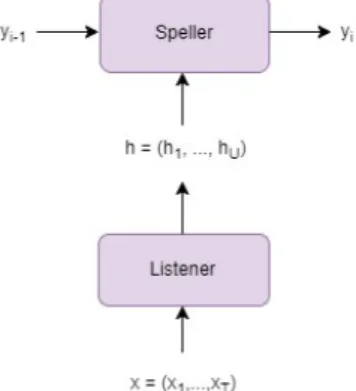
3.1 Listen, Attend and Spell model . . . 19
3.2 Listener architecture . . . 20
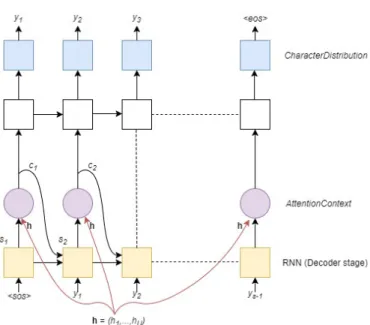
3.3 Speller architecture . . . 20
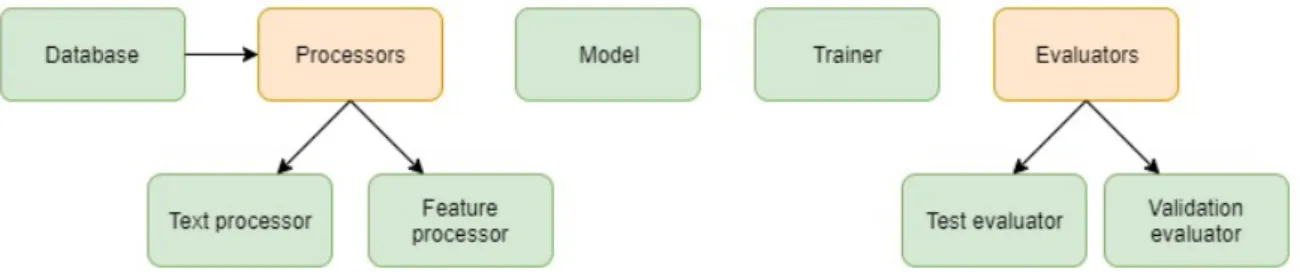
3.4 Relation between the configuration files . . . 23
4.1 Frequency of the phonemes appearance . . . 28
4.2 Training (left) and validation (right) losses of the model trained with Fisher trainer and Nabu’s parameters . . . 28
4.3 Training (left) and validation (right) losses of the model trained with Fisher trainer and LAS parameters . . . 29
4.4 Training (left) and validation (right) losses of the model trained with the standard trainer and Nabu’s parameters . . . 29
4.5 Training (left) and validation (right) losses of the model trained with standard trainer and LAS parameters . . . 30
List of Tables
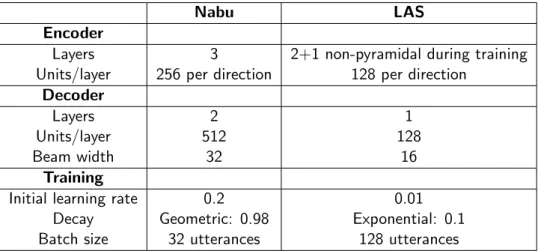
3.1 Differences between Nabu’s implementation and parameters specified in the paper 22
4.1 TIMIT corpus split in train and test sets depending on the dialect region . . . 26
4.2 Phoneme error rates of evaluated models . . . 30
4.3 Reported results on TIMIT Core Test Set . . . 30
Chapter 1
Introduction
1.1
Motivation
1.2
Speech to signs
The motivation of training an end-to-end system for Speech Recognition is the projectSpeech2Signs
at UPC, awarded with a Facebook Caffe2 grant, which aims to synthesize a sign language inter-preter from speech.
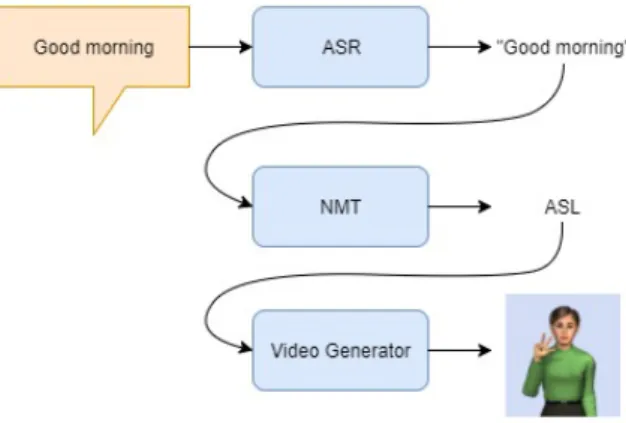
The final goal of this project is to build a translation system that generates a interpreter video to translate the speech signal input (extracted from a video) into American Sign Language. It will be an end-to-end neural network, but there is not any proper database to train it, so the first step of the project is to generate the data needed by combining existing intermediate systems. To obtain this, the system has been split in three different blocks:
Figure 1.1: Speech2Signs blocks architecture
1. An Automatic Speech Recognition (ASR) system that transcribes the audio (it can be extracted from a video) to text. This module is the contribution of this thesis.
2. A Neural Machine Translation (NMT) module translating from English to American Sign Language[30], developed in parallel by Daniel Moreno using a model based on attention[23]. 3. A Video Generator that creates the interpreter avatar[4], under development by PhD student
Amanda Duarte.
Every block input is the previous step output. Concatenating this systems it will be able to generate ad much data as needed to train the whole system end-to-end. Therefore, the ASR is a segment of a complete system prototype in the data generation purpose.
1.3
Statement of purpose
Speech recognition is the ability of a device or program to identify words in spoken language and convert them into text. The most frequent applications of speech recognition include speech-to-text processing, voice dialing and voice search. Even if some of these applications work properly for the consumer, there is still a room for improvement: sometimes it is hard to recognize the speech due to variations of pronunciation, it is not well performed for most languages beyond English, and it is necessary to keep fighting against background noise. All these factors can lead to inaccuracies and that is why it is still an interesting research area.
Over the last several years, the number of research projects related to Machine Learning has increased exponentially, both in the academic and industrial worlds. Such growth has been boosted by the success of deep learning models in tasks that were considered especially challeng-ing, such as computer vision or natural language processing. Solutions have been found to many tasks obtaining outstanding performances, leading to more complex tasks derived from these ones. Speech recognition is not an exception, even though in the beginning other models were used (Hidden Markov Models)[13]. Over the years, HMM have been combined with Deep Neural Networks and it led to improvements in various components of speech recognition. However, it was necessary to train different models separately (acoustic, pronunciation and language models). Recent work in this area attempts to rectify this disjoint training issue by designing models that are trained end-to-end: from speech directly to transcripts. In my work I will focus on sequence to sequence models with attention trained end-to-end[7].
1.4
Main Contribution
This degree’s thesis is developed in the broader context of the Speech2Signs, a project at UPC funded by Facebook, in which a module of Speech Recognition is required. The main contributions of this thesis is providing a speech recognition system trained end-to-end available for integration. This thesis has been written thinking that could be used for other students or developers in the future to participate in upcoming challenges1.
1.5
Requirements and specifications
The requirements of this project are the following:• Understand Listen, Attend and Spell (LAS) model [6], a deep-learning architecture that learns to transcribe speech utterances to characters. It was submitted on 2015 by William Chan, Navdeep Jaitly, Quoc V. Le and Oriol Vinyals.
• As it is very challenging to build from scratch a whole system for Speech Recognition, find the implementation that better achieves the system described on this paper.
• Be able to train the model so it could be used in the Speech2Signs project
1
• Have the first deep Speech Recognition model trained end-to-end at GPI and TALP groups of UPC.
The specifications are the following:
• Use Python as a programming language
• Develop the project using the Tensorflow framework for deep learning • Use Tensorboard to visualize the results
1.6
Methods and procedures
No deep learning model for speech recognition had been trained end-to-end by the students or research groups in the UPC before. In order to do that, it was necessary to find an implementa-tion, and we found Nabu[26], an Automatic Speech Recognizer (ASR) framework for end-to-end networks built on Tensorflow, implementing Listen, Attend and Spell paper.
1.7
Work Plan
This project has been developed as a joint effort between the GPI and the TALP research groups at Universitat Polit`ecnica de Catalunya, having a regular weekly meeting to discuss de-cisions to be made. This meeting has been complemented with a weekly seminar with other students developing their bachelor, master or Phd thesis at GPI to present our research and share our knowledge.
The work plan is described in the following work packages and Gantt diagram, as well as the modifications introduced since the first version.
1.7.1 Work Packages
• WP 1: Project management.
• WP 2: Introduction to ASR tasks and TensorFlow • WP 3: Critical Review of the project
• WP 4: Software development • WP 6: Dissemination
1.7.2 Gantt Diagram
Figure 1.2: Gantt Diagram of the Degree Thesis
1.8
Incidents and Modifications
The first incident I had to face that I was not expecting was that the selected implementation was under development yet, so there were some changes quite often, and it was not working completely well. Therefore, the original plans targeting the datasets used in the Speech2Signs
project had to change: most of the work has been understanding the whole code and fix the errors. Some of them were due to the new version of Tensorflow that was updated the 5th of October (when the environment was already created), so it was necessary to create another one. Another problem was that to start running the implementation of Listen, Attend and Spell(LAS), it was necessary to have the data prepared in the same format as Kaldi, before being able to train the system. This took a lot of time since Kaldi is a complex tool. This toolkit is explained in section 3.2.2
I have been in contact with the Nabu developer trying to share all the issues and fix them during all these months. Vincent Renkens is pursuing a PhD degree at KULeuven.2 At the same
time, working with the whole team of Speech2Signs project, we have been searching datasets from speech to sign language but it has been challenging. We finally end up deciding to split the whole project into modules and the train all the separated parts (speech recognition model is one of them).
Due to the mentioned difficulties in the previous section, running the model took more time than expected. That is why the phase of testing on other datasets has not been accomplished, and the task became understanding the whole code to be able to solve the issues. But it has been motivating and enriching to have been working in a project under development, getting deep into the code and understanding how it really works to be able to solve the errors.
1.9
Organization
The following chapters include a description of the background information related to speech recognition (Chapter 2), the methodology followed, including the baseline and the description of implementation used, as well as the toolkits needed (Chapter3), the results obtained (Chapter4), approximated cost of the project (Chapter5), and finally the conclusions and possible future development (Chapter6).
Chapter 2
State of the art
Automatic speech recognition (ASR), which identify words in spoken language and convert them into text, has many potential applications including command and control, dictation, tran-scription of recorded speech, searching audio documents and interactive spoken dialogues. This chapter presents an overview of the main different approaches to speech recognition.
2.1
Hidden Markov Model in Speech Recognition
Historically, most speech recognition systems have been based on a set of statistical models representing the various sounds of the language to be recognized. The hidden Markov model (HMM) is a good framework for constructing such models because speech has temporal structure and can be encoded as a sequence of spectral vectors inside the audio frequency range [13].
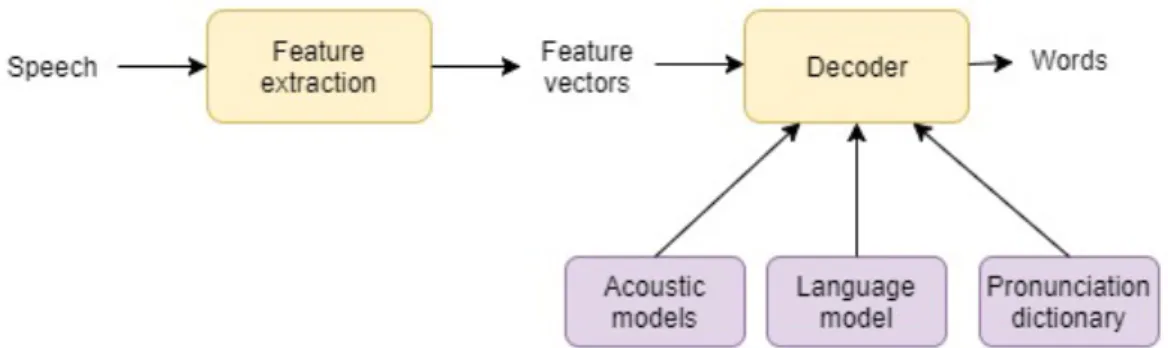
The principal components of a continuous speech recognizer when using the hidden Markov model are shown in Figure 2.1:
Figure 2.1: Components of a Speech Recognizer using HMM
The language model has the word sequences probabilities, while the acoustic model is gener-ated from HMM. Then, the acoustic model is synthesized by concatenating phonemes to make words as defined by a pronunciation dictionary.
The first part of this process is extracting the features of a fixed size acoustic vectors Y= y1,...,yT obtained by the input audio waveform from a microphone. Then the decoder attempts to find the sequence of words W = w1,...,wLwhich is most likely to have generated Y , i.e. the decoder tries to find
It is used the Bayes’ Rule since P(W/Y) is difficult to model directly, so the previous step it is transformed into the equivalent problem of finding:
w=argmax{P(Y|W)P(W)} (2.2)
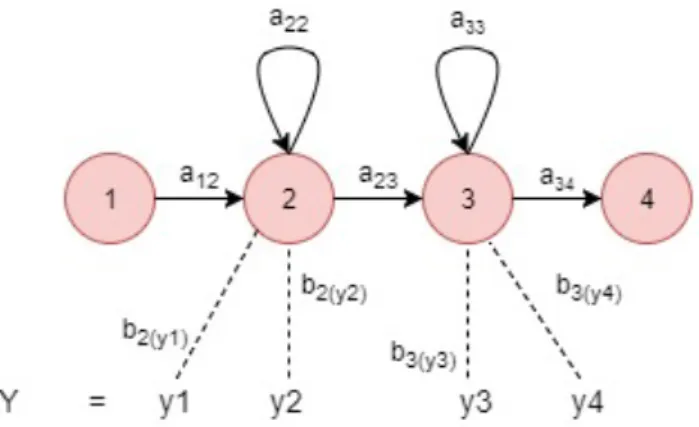
The acoustic model is used to determine the he likelihood p(Y/W) and the language model to determine the prior p(W). The basic unit of sound represented by the acoustic model is the phonemes. For example, the word “bat” is composed of three phonemes /b/ /ae/ /t/. About 40 such phonemes are required for English. Each base phoneme is represented by a continuous density HMM[11]:
Figure 2.2: HMM applied to each phoneme. The output Y is the acoustic vector sequence
where aijare the transition probability parameters and bj() the output observation distributions. At every time step HMM makes a transition from its current state to one of its connected states: it can be itself or the next one. The probability of making a particular transition from state si to state sj is given by the transition probability aij. On entering a state, a feature vector is generated using the distribution associated with the state being entered, bj(). This way, each phoneme will have a different output distribution. To obtain a hidden Markov model for a sequence of phonemes the individual trained hidden Markov models for the separate phonemes are concatenated.
Finally, to determine how well each state of each HMM fits a frame or a short window of frames of coefficients that represents the acoustic input, Gaussian mixture models (GMMs) are used[14]. A mixture model is a probabilistic model which assumes the underlying data to belong to a mixture distribution. In this case, it is used the Gaussian distribution.
2.2
Deep Neural Network - Hidden Markov Model (DNN-HMM)
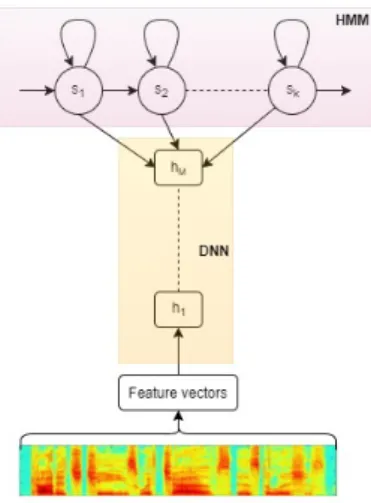
Instead of HMM models combined with the Gaussian mixture model, the architecture Deep Neural Network - Hidden Markov Model (DNN-HMM) showed better results and has been widely used in speech recognition[19].
DNN is a feed-forward artificial neural network that has more than one hidden layers. Each hidden unit uses a nonlinear function to map the feature input from the layer below to the current unit. In DNN-HMM models the output of the DNN are fed to the HMM.
Figure 2.3: DNN-HMM model structure
2.3
End-to-end ASR
The previous approaches (traditional phonetic-based like all HMM-based models) required separate components and training for the pronunciation, acoustic and language model. Acoustic models take acoustic features and predict a set of subword units (phonemes). Then the pronun-ciation model, which is a hand-designed lexicon, maps a sequence of phonemes produced by the acoustic model to words. Finally, the language model is in charge of assigning probabilities to word sequences.
Training independent components is complex and suboptimal compared to training all compo-nents jointly. That is why there has been a growing popularity in developing end-to-end systems over the last several years, which attempt to learn these separate components jointly as a sin-gle system[5]. This is valuable since it simplifies the training process and deployment process. Two main approaches for this are Connectionist Temporal Classification (CTC) and sequence to sequence (seq2seq) models with attention.
2.3.1 Connectionist Temporal Classification
This first method uses Recurrent Neural Networks (RNN). In a traditional neural network we assume that all inputs (and outputs) are independent of each other, but RNN make use of sequential information[18].
This kind of networks are used in Language Modelling, Machine Translation or Speech Recog-nition, for example. RNN are typically trained as frame-level classifiers in speech recognition. That means that a separate training target is required for every frame, which in turn requires the alignment between the audio and transcription sequences to be determined by the HMM.
How-ever, the alignments are irrelevant to most speech recognition tasks, where only the word-level transcriptions matter. Connectionist Temporal Classification (CTC) is a function that allows an RNN to be trained for sequence transcription tasks without requiring any prior alignment between the input and target sequences[15]. Using CTC, the output layer of the RNN contains a single unit for each of the transcription labels (characters, phonemes etc.), plus an extra unit referred to as the ‘blank’ which corresponds to a null emission.
For a given transcription sequence, there are as many possible alignments as there different ways of separating the labels with blanks. If using ’/’ to denote blanks, the alignments (/, a, /, b, c, /) and (a, /, b, /, /, c) both correspond to the same transcription (a, b, c). Also, when the same label appears on successive time-steps in an alignment, the repeats are removed: therefore (a, b, b, b, c, c) and (a, /, b, /, c, c) also correspond to (a, b, c). Intuitively the network decides whether to emit any label, or no label, at every timestep. Considering these decisions together define a distribution over alignments between the input and target sequences[16]. CTC then uses a forward-backward algorithm to sum over all possible alignments and determine the normalized probability of the target sequence given the input sequence.
CTC assumes that the label outputs are conditionally independent from each others. Jointly, the RNN-CTC model learns the pronunciation and acoustic model together, however it is inca-pable of learning the language model due to conditional independence assumptions similar to a HMM.
2.3.2 Sequence to sequence learning with attention mechanism
Attention Mechanisms in Neural Networks are based on the visual attention mechanism found in humans. Human visual attention models focus on a certain region of an image with “high resolution” while perceiving the surrounding image in “low resolution”, and then adjusting the focal point over time. This visual attention can be applied also to speech recognition models.
Unlike CTC-based models, attention-based models do not have conditional-independence as-sumptions and can learn all the components of a speech recognizer including the pronunciation, acoustic and language model directly
• Sequence to sequence learning
Attempts to address the problem of learning variable-length input and output sequences using an encoder RNN to map the sequential variable-length input into a fixed-length vector. A decoder RNN then uses this vector to produce the variable-length output sequence. • Attention mechanism
Sequence to sequence models can be improved by the use of an attention mechanism that provides the decoder RNN more information when it produces the output[8][9]. At each output step, the last hidden state of the decoder RNN is used to generate an attention vector over the input sequence of the encoder. The attention vector is used to propagate information from the encoder (which encodes the input sequence to an internal represen-tation) to the decoder (which generate the output sequence) at every time step, instead of just once, as with the original sequence to sequence model.
Chapter 3
Methodology
This chapter presents the methodology used to develop this project and the process followed to be able to get our final results.
3.1
Baseline
The TALP group of UPC had never trained before an end-to-end speech recognition system as it is quite new. We found it interesting to have a model trained end-to-end that could be used in the future, and the one proposed in ”Listen, Attend and Spell” (LAS) paper[6] was a popular approach in speech recognition community during the last years. This system combines a seq2seq model with an attention mechanism, but it had never been applied to speech recognition before. Very recently(January 2018), new approaches have been proposed, exploring a variety of structural and optimization improvements to the LAS model, which significantly improve performance[7].
Listen, Attend and Spell is a neural network that learns to transcribe an audio sequence signal to a word or phoneme sequence, depending on the dataset used. It is not a HMM based model, and it learns all the components of a speech recognizer jointly. It consists of an encoder (called listener) and a decoder (called speller), both recurrent neural Networks. While the listener is a pyramidal RNN that converts low level speech signals into higher level features, the speller converts theses high level features into output characters using the attention mechanism. The listener and the speller are trained together.
Ifx=(x1;...;xT)is the input sequence of filter bank spectra features, andy=(<sos>; y1;....; yS;<eos>)the output sequence of characters (whereyi are all the numbers and characters of the
alphabet), the Listen function transforms the original signal x into a high level representationh=
(h1;...; hU) withU<T, while the AttendAndSpell function consumeshand produces a probability
distribution over character sequences:
• Encoder (Listener)
The Recurrent Neural Network used in the listener it is a Bidirectional Long Short Term Memory (BLSTM)[27]. In order to reduce the length T of the input sequence x to the lengthU of h, it has a pyramid structure. It is quite common in speech because the signals can be hundreds to thousands of frames long. This helps to the next step (Attend and Spell) because otherwise it would take a lot of time extracting the relevant information from a large number of input time steps.
Figure 3.2: Listener architecture
The structure of the pyramid BLSTM reduces the time resolution by a factor of 2 in every layer. In the paper, 3 pyramid BLSTM layers are used, so the time resolution is reduces 23=8 times. Besides, it also reduces the computational complexity.
• Decoder (Speller)
Figure 3.3: Speller architecture
The Attend and Spell function produces a probability distribution over the next character conditioned on all the characters seen previously. Several parameters are involved. We have a decoder state, si, which is a function of the previous state si-1, the previous character
emitted yi-1 and the previous context vector generated by the attention mechanism, ci-1.
The decoder stage is a RNN with 2 layer LSTM.
si =RN N(si-1,yi-1,ci-1) (3.1)
The mentioned context vectorciencapsulates the information in the acoustic signal needed
to generate the next character, and it is a function ofsiandh. To create the context vector ci it is necessary to compute the scalar energy for each time step u using vectorhuandsi,
convert it into a probability distribution over time steps using softmax function and then linearly blend the listener features hu at different time steps.
ci=AttentionContext(si,h) (3.2)
A multilayer perceptron with softmax outputs over characters produces the probability distribution.
P(yi|x,y<i) =CharacterDistribution(si,ci) (3.3)
3.2
LAS Implementation
The implementation of LAS network was not provided by the authors, and it was challenging to find one, although we finally succeed. Nabu [26] is an Automatic Speech Recognizer frame-work for end-to-end netframe-works built on TensorFlow[1]. It was still under-development during the development of this thesis, so it was even more challenging. It works in different stages. First of all the data preparation is needed, then we can train the model and finally test it. At every step there are some configuration files specifying the parameters of the neural network.
3.2.1 Differences with respect to the paper
There are some differences between the model raised in the LAS paper explained in 3.1 and the implementation of Nabu. Some of them are related to the model and others to the parameters used to train it.
The original paper specifies that 3 layers of 256 nodes per direction are used in the encoder (Listener), but in the Nabu implementation there are 2 layers of 128 units in each layer. There is also another non-pyramidal layer added during training.The number of timesteps to concatenate in each pyramidal level is 2 in both cases.
The dropout it is not specifically defined in the paper, in the implementation it is 0.5. This technique randomly selects neurons that are ignored during training[29]. They are “dropped-out” randomly. This means that their contribution to the activation of downstream neurons is temporally removed on the forward pass and any weight updates are not applied to the neuron on the backward pass. It is also added a Gaussian input noise during training, and its standard deviation is set to 0.6.
In the case of the decoder (Speller), the number of layers proposed by the authors are two, with 512 nodes each one, and Nabu’s has one layer of 128 units. In both cases the weights are initialized with a uniform distribution U(-0.1, 0.1).
In the training parameters the biggest differences are in the initial learning rate and its decay. In LAS paper the initial learning rate it is defined as 0.2 with a geometric decay of 0,98, and in the implementation it is 0.01 with an exponential decay of 0.1. Also the batch size is quite different. A mini-batch is a subset of the training set that is used to evaluate the gradient of the loss function and update the weights[20]. In the paper DistBelief framework[10] has been used, with 32 replicas each with a minibatch of 32 utterances. The size of the minibatch in the implementation is 128.
Nabu LAS
Encoder
Layers 3 2+1 non-pyramidal during training Units/layer 256 per direction 128 per direction
Decoder
Layers 2 1
Units/layer 512 128
Beam width 32 16
Training
Initial learning rate 0.2 0.01
Decay Geometric: 0.98 Exponential: 0.1 Batch size 32 utterances 128 utterances
Table 3.1: Differences between Nabu’s implementation and parameters specified in the paper
3.2.2 Kaldi toolkit
Kaldi is a toolkit for speech recognition that has as input any database and outputs some files with an specific format containing all the dataset content and information[25]. The main motivation to use Kaldi is that it is easier to work with these generated files rather than with the downloaded corpus. In fact, many of the speech recognition systems implemented nowadays assume that the input data is the resulting after using Kaldi toolkit, although it is also necessary to have the corpus downloaded because some of the Kaldi files refer to the original audio files. Every file has to be understood in order to use it in any implementation.
The most important files are the following:
1. Text: utterance-by-utterance transcript of the corpus.
2. Segments: contains the start and end time for each utterance in an audio file 3. Wav.scp: contains the location for each of the audio files.
4. Utt2spk: contains the mapping of each utterance to its corresponding speaker 5. Spk2utt: contains the speaker to utterance mapping.
3.2.3 Configuration files
The configuration files are called recipes. It is necessary to have a recipe for every model and corpus to be trained.
Figure 3.4: Relation between the configuration files
• database.conf
Contains the paths to wav.scp and text files from Kaldi, the output, and the processors (feature and text) are set.
• Feature and text processors
The type of processor (audio or text) and some features are defined. In case of the text processor it is necessary to specify the alphabet of the corpus: all the possible input characters from the transcriptions.
• model.cfg
Here the structure of the RNNs is defined: The types of inputs (features) and outputs (text) are set and also the parameters of the encoder (listener) and decoder (speller), for example the number of layers and the units of each layer. For the decoder, we have to specify the number of outputs, that corresponds to the number of characters in the alphabet. It will change depending on the corpus used.
• trainer.cfg
We choose the training parameters: the loss function to be minimized, the number of epochs (number of passes over the entire database), the initial learning rate, etc.
• Test and validation evaluators
Features for the test and validation steps are set.
3.2.4 Data preparation
When all the network parameters are defined, the features computation and the target nor-malization for training and testing are done in the stage called data preparation. Features are extracted by pointing to the feature processor defined before and the audio features are extracted, while the target normalization points to the text processor and it is used to normalize targets to make them usable for training. Some examples of normalization steps are replacing unknown characters with a fixed label or making everything lower case. In this stage two directories for each division of the dataset (train, test, and validation) are created inside the output defined in the filedatabase.conf explained at 3.2.3: features andnormalized. These directories contain the necessary files for the next steps.
3.2.5 Training and testing
In the training step, the model is trained to minimize a loss function (defined in trainer.cfg). During the training, the model can be evaluated using the validation evaluation file to adjust the learning rate if necessary. Then, we can run the model with the test subset of data, and obtain the percentage of incorrect characters.
3.2.6 Decoding
In the decoding stage, the model is used to decode the test set and we can see the resulting best results written in the output. Although the error it is obtained in the test stage, it can be useful to have both ground truth transcriptions and the output ones if we want to use another metric.
Chapter 4
Results
This chapter presents the results obtained with the implementation presented in Chapter 3.
4.1
Computational requirements
Experiments have been run with the computational resources available at the Image Processing Group of the Universitat Politecnica de Catalunya. When dealing with deep learning projects, one of the main concerns is the available computation resources, as you are often working with large datasets. This is why GPI has a cluster of servers which is shared between all the research group and in which we ran our experiments. For each experiment, we must ask for the resources needed (number of GPU’s/CPU’s, reserve RAM) and the task is sent to a queue of processes. As soon as there is enough resources as you demanded, your process start running. The internal policy of GPI allows one GPU per BCs student. It was also needed to access to the VEU server in order to obtain the datasets.
4.2
Dataset
After realizing that the Nabu implementation was under development and a lot of test had to be done, we ended up choosing a small dataset, TIMIT. Before that, we tried other ones like AMI and Fisher also available from the VEU server.
The dataset used for training the system, the TIMIT corpus [21], consists in phonemically and lexically speech transcriptions of American English speakers of both genders and eight different dialects. It contains a total of 6300 sentences, 10 sentences spoken by each of 630 speakers in 16-bit, 16kHz waveform files for each utterance, and its phonetic and word transcriptions. This corpus has been chosen because it is quite smaller than the other datasets used in speech recognition (AMI, Fisher, etc.) and as the implementation was under-development yet it was good to be able to test the code without spending so many time on it. The alphabet of this corpus consists on 48 phonemes, including the silence.
The data is organized in the following way: inside every set (train, test, validation), the data is separated by the dialect regions mentioned. In the directory of every region, there are all the speakers speaking that dialect named as: speaker initials (3 characters) plus a number from 0 to 9 to differentiate speakers with identical initials.
Every speaker has 10 sentences spoken, and there are 4 files for each sentence:
• .phn: phonetic transcription file • .wav: speech waveform file
• .wrd: word transcription file
• .txt: Associated orthographic transcription of the words the person said.
Depending on the dialect region and the suggested training and testing set, the TIMIT corpus could be summarized as follows:
dr1 dr2 dr3 dr4 dr5 dr6 dr7 dr8 Total Train TIMIT 38 76 76 68 70 35 77 22 462
Test TIMIT 11 26 26 32 28 11 23 11 168
Total 49 102 102 100 98 46 100 33 630 Table 4.1: TIMIT corpus split in train and test sets depending on the dialect region
Where the dialect regions are:
• dr1: New England • dr2: Northern • dr3: North Midland • dr4: South Midland • dr5: Southern • dr6: New York City • dr7: Western
• dr8: Army Brat (moved around)
The data provided is already subdivided into portions of training and testing.
Some of the criteria for this division are using 20-30% of the corpus for testing and 70-80% for training, no speaker should appear in both the training and testing portions, all the dialect regions should be represented in both subsets, with at least 1 male and 1 female speaker from each dialect...
With these conditions, two test sets are proposed: the core test set, and the complete test set. For these experiments, the smaller one has been used. The resulting amount of data used is the following:
• Train: 462 speakers, 8 sentences per speaker. • Validation: 50 speakers, 8 sentences per speaker. • Test: 24 speakers, 8 sentences per speaker.
4.3
Evaluation metric
The evaluation of Speech recognition models, as well as machine translation ones, is usually done with WER metric: Word Error Rate. The main difficulty when measuring performance is that the recognized sequence can have a different length from the reference one. That is why it is not possible to evaluate the models only looking at the mistakes: it is also necessary to know the insertions or the deletions. It is defined like this:
W ER= Sw+Dw+Iw Nw (4.1) Where, • Sw: number of substitutions • Dw: number of deletions • Iw: number of insertions
• Nw: number of words in the reference sentence.
This metric is used working at the word level, but as TIMIT uses phonemes, the proper metric to be used is PER: Phoneme Error Rate. The way to compute it is quite similar, but using the total number N of phonemes and the minimal number of character insertions I, substitutions S and deletions D required to transform the reference text into the output.
Since the number of mistakes can be larger than the length of the reference text and lead to rates large than 100% (for example, a ground-truth sentence with 100 phonemes and an output which contains 120 wrong phonemes give a 120% error rate), sometimes the number of mistakes is divided by the sum (I + S + D + C ): the number of edit operations (I + S + D) and the number C of correct symbols, which is always larger than the numerator.
Another way to evaluate this kind of datasets is computing the accuracy. In this case we just need to substract 100-PER:
Accuracy= 100−P ER= Nw−S−D−I
Nw
x100% (4.2)
4.4
Experiment analysis
The model was only trained with the TIMIT corpus, but different setups have been tried. Apart from the differences between the Nabu’s parameters and the paper ones (Section 3.2.1, two different trainers (Section 3.2.3) have been tried: the standard one and the fisher one. The fisher trainer uses the Fisher Information Matrix, which essentially determines the asymptotic behavior of the estimator[12][22]
In all the experiments, the frequency of evaluating the validation set is every 500 steps, and the number of times the validation performance can be worse before terminating the training is five. If after a worse validation comes a better one, the the number of tries (5) is reset.
To have a baseline of the error, we decided to solve the task by predicting always the phoneme with most probability of appearance in the test set. In the figure below (3.4) we can see the number of times every phoneme appears. The most probable is the phoneme ”cl” which we can find it 611 times of a total of 7407 phonemes in the test set. This is a 8.2490% probability of appearance. If we always assign this phoneme, we would get a PER of 100-8.2490 = 91.7510%
Figure 4.1: Frequency of the phonemes appearance
Now we will revise the training and validation loss curves for the different experiments we made:
• Fisher trainer with Nabu’s parameters
Figure 4.2: Training (left) and validation (right) losses of the model trained with Fisher trainer and Nabu’s parameters
PER = 39,21%
As expected, both training and validation loss curves descend, until the validation loss value does not get smaller. With this configuration, the model stops training after 4.400 steps.
• Fisher trainer with LAS parameters
Figure 4.3: Training (left) and validation (right) losses of the model trained with Fisher trainer and LAS parameters
PER = 31.54%
In this case, the behavior is quite similar, but the validation loss does not get stuck until 5.000 steps.
These results are not the best because the fisher trainer was created thinking about transfer learning: the idea is to store the knowledge gained and apply it to a different but related problem. This method can lead to a problem called catastrophic forgetting, which means that the neural network forgets all that was learned previously. It is possible to solve this using Elastic Weight Consolidation, which constrains important parameters to stay close to their old values using the Fisher information matrix.
• Standard trainer with Nabu’s parameters
Figure 4.4: Training (left) and validation (right) losses of the model trained with the standard trainer and Nabu’s parameters
PER = 31,94%
When training with the standard trainer and Nabu’s parameters, we can observe that the PER is better than when training with the same parameters but the Fisher trainer. The result is quite similar to the previous experiment, were both trainer and parameters are changed. It took a little bit more to train the model, since we can see the validation loss converges after 5.500 steps.
• Standard trainer with LAS parameters
Figure 4.5: Training (left) and validation (right) losses of the model trained with standard trainer and LAS parameters
PER = 27.29%
This is our best result and it is obtained using the standard trainer and the parameters defined in the paper.
The behavior of both models trained with the standard trainer is quite similar. We can see that the main difference is that with LAS parameters the validation loss does not converge until 7.500 steps, while with Nabu’s parameters it stops at 5.000 steps.
Model DEV TEST
Fisher trainer and Nabu’s parameters 36.36% 39.21% Fisher trainer and LAS parameters 29.92% 31.54% Standard trainer and Nabu’s parameters 30.20% 31.94% Standard trainer and LAS parameters 25.12% 27.29%
Table 4.2: Phoneme error rates of evaluated models
As in the TIMIT corpus it is defined the train and test sets (Section 4.2) we can compare the results to other experiments that have been carried out with the Core Test Set (the one we used).
Model DEV TEST
Large margin GMM[28] -% 33%
CTC end to end training[17] 19.05% 21.97% DBLSTM hybrid training[17] 17.44% 19.34% CNN limited weight sharing[2] - 20.50% Bayesian triphone HMM[24] - 25.6% CNN 3hidden layer (no pre-training)[3] - 20.07% RNN seq2seq with attention end-to-end training(our work) 25.12% 27.29%
Chapter 5
Budget
This thesis has been developed without any aim to create any kind of product to be sold, so there will not be any analysis on this matters. As we have used the resources available at the Image Processing Group (GPI) at UPC there has been no real cost for the hardware needed. However, we can make an approximation about the cost we would have had if those resources were not provided by the research group.
The amount of hours of CPU and GPU that I have used along the last months when developing the thesis is:
• cpu: 202h • gres/gpu: 98h
For the gpu, taking the lower prize (0.5e/h), the amount spent would be 49e. But looking at cloud computing service of Amazon Web Services (AWS) and searching for the most similar gpu, the prize per hour goes up to 0.9e/h, so the expense is around 88e.
The other cost that may be considered is the wage of the engineers working on the project, as all the software used is open-source and don’t suppose any cost. I consider that my position was of junior engineer, while the two professors who were advising me had a wage/hour of a senior engineer. The salary costs, considering that the length of the project has been of 20 weeks, as depicted in the Gantt diagram in Figure 1.2, amounts to 6.000efor the junior engineer and 4.800etaking in count both senior engineer.
Amount Wage/hour Dedication Total Junior engineer 1 10,00 e/h 30 h/week 6,000 e Senior engineer 2 30,00 e/h 4 h/week 4,800 e
Computation 1 0.9 e/h 98h 88 e
Total 10.888 e Table 5.1: Budget of the project
Chapter 6
Conclusions
This project’s main goal has been to train an end-to-end speech recognition system so it can be used in theSpeech2Signs project or in any future work of the TALP research group at UPC. As shown in the current manuscript, we have successfully accomplished this main goal. To achieve such objective, we have reached a better understanding of the techniques used to process speech in the deep learning framework through the process of running the speech recognition system.
This has not been an easy journey and we are not saying that there is no space for improve-ments, but we had the chance to learn about one of the most trendy approaches in speech recognition from the very last years.
After facing with an under-development implementation, it took more time than expected to have the system working, so it let us few time to make the experiments (like trying other datasets). However, we finally have trained an end-to-end model with sequence to sequence learning improved with the attention mechanism, and tried it with different configurations in order to obtain the lowest Phoneme Error Rate.
The system we have been working on was proposed in Listen, Attend and Spell (LAS)[6]. LAS is trained end-to-end and has two main components. The first component, the listener, is a pyramidal acoustic RNN encoder that transforms the input sequence into a high level feature representation. The second component, the speller, is an RNN decoder that attends to this high level features and spells out one character at a time. The main difference in the implemented system is that we have trained it with a phoneme-based dataset (TIMIT) instead of using word-based datasets.
As a future work, we want to change the dataset to another one not containing phonemes but words, and then the system will be ready to be used as the first module of Speech2Signs. Also, we want to reproduce fresh new research (from 18th January 2018) that furhter extends the LAS architecture by using an improved attention mechanism (i.e. based on multi-heads) [7].
Bibliography
[1] Mart´ın Abadi, Ashish Agarwal, Paul Barham, Eugene Brevdo, Zhifeng Chen, Craig Citro, Greg S. Corrado, Andy Davis, Jeffrey Dean, Matthieu Devin, Sanjay Ghemawat, Ian Good-fellow, Andrew Harp, Geoffrey Irving, Michael Isard, Yangqing Jia, Rafal Jozefowicz, Lukasz Kaiser, Manjunath Kudlur, Josh Levenberg, Dan Man´e, Rajat Monga, Sherry Moore, Derek Murray, Chris Olah, Mike Schuster, Jonathon Shlens, Benoit Steiner, Ilya Sutskever, Kunal Talwar, Paul Tucker, Vincent Vanhoucke, Vijay Vasudevan, Fernanda Vi´egas, Oriol Vinyals, Pete Warden, Martin Wattenberg, Martin Wicke, Yuan Yu, and Xiaoqiang Zheng. Ten-sorFlow: Large-scale machine learning on heterogeneous systems, 2015. Software available from tensorflow.org.
[2] Ossama Abdel-Hamid, Li Deng, and Dong Yu. Exploring convolutional neural network structures and optimization techniques for speech recognition. InInterspeech, pages 3366– 3370, 2013.
[3] Ossama Abdel-Hamid, Abdel-rahman Mohamed, Hui Jiang, and Gerald Penn. Applying convolutional neural networks concepts to hybrid nn-hmm model for speech recognition. In
Acoustics, Speech and Signal Processing (ICASSP), 2012 IEEE International Conference on, pages 4277–4280. IEEE, 2012.
[4] Students at DePaul University. The american sign language avatar project. http://asl. cs.depaul.edu.
[5] Dzmitry Bahdanau, Jan Chorowski, Dmitriy Serdyuk, Philemon Brakel, and Yoshua Bengio. End-to-end attention-based large vocabulary speech recognition. InAcoustics, Speech and Signal Processing (ICASSP), 2016 IEEE International Conference on, pages 4945–4949. IEEE, 2016.
[6] William Chan, Navdeep Jaitly, Quoc V Le, and Oriol Vinyals. Listen, attend and spell. arXiv preprint arXiv:1508.01211, 2015.
[7] Chung-Cheng Chiu, Tara N Sainath, Yonghui Wu, Rohit Prabhavalkar, Patrick Nguyen, Zhifeng Chen, Anjuli Kannan, Ron J Weiss, Kanishka Rao, Katya Gonina, et al. State-of-the-art speech recognition with sequence-to-sequence models. arXiv preprint arXiv:1712.01769, 2017.
[8] Jan K Chorowski, Dzmitry Bahdanau, Dmitriy Serdyuk, Kyunghyun Cho, and Yoshua Ben-gio. Attention-based models for speech recognition. In Advances in Neural Information Processing Systems, pages 577–585, 2015.
[9] FA Chowdhury, Quan Wang, Ignacio Lopez Moreno, and Li Wan. Attention-based models for text-dependent speaker verification. arXiv preprint arXiv:1710.10470, 2017.
[10] Jeffrey Dean, Greg S. Corrado, Rajat Monga, Kai Chen, Matthieu Devin, Quoc V. Le, Mark Z. Mao, Marc’Aurelio Ranzato, Andrew Senior, Paul Tucker, Ke Yang, and Andrew Y. Ng. Large scale distributed deep networks. InNIPS, 2012.
[11] Sean R Eddy. Hidden markov models. Current opinion in structural biology, 6(3):361–365, 1996.
[12] Kenji Fukumizu. A regularity condition of the information matrix of a multilayer perceptron network. Neural networks, 9(5):871–879, 1996.
[13] Mark Gales and Steve Young. The application of hidden markov models in speech recogni-tion. Foundations and trends in signal processing, 1(3):195–304, 2008.
[14] J-L Gauvain and Chin-Hui Lee. Maximum a posteriori estimation for multivariate gaussian mixture observations of markov chains. IEEE transactions on speech and audio processing, 2(2):291–298, 1994.
[15] Alex Graves, Santiago Fern´andez, Faustino Gomez, and J¨urgen Schmidhuber. Connectionist temporal classification: labelling unsegmented sequence data with recurrent neural networks. In Proceedings of the 23rd international conference on Machine learning, pages 369–376. ACM, 2006.
[16] Alex Graves and Navdeep Jaitly. Towards end-to-end speech recognition with recurrent neural networks. InProceedings of the 31st International Conference on Machine Learning (ICML-14), pages 1764–1772, 2014.
[17] Alex Graves, Navdeep Jaitly, and Abdel-rahman Mohamed. Hybrid speech recognition with deep bidirectional lstm. InAutomatic Speech Recognition and Understanding (ASRU), 2013 IEEE Workshop on, pages 273–278. IEEE, 2013.
[18] Alex Graves, Abdel-rahman Mohamed, and Geoffrey Hinton. Speech recognition with deep recurrent neural networks. In Acoustics, speech and signal processing (icassp), 2013 ieee international conference on, pages 6645–6649. IEEE, 2013.
[19] Geoffrey Hinton, Li Deng, Dong Yu, George E Dahl, Abdel-rahman Mohamed, Navdeep Jaitly, Andrew Senior, Vincent Vanhoucke, Patrick Nguyen, Tara N Sainath, et al. Deep neural networks for acoustic modeling in speech recognition: The shared views of four research groups. IEEE Signal Processing Magazine, 29(6):82–97, 2012.
[20] Sergey Ioffe and Christian Szegedy. Batch normalization: Accelerating deep network training by reducing internal covariate shift. InInternational Conference on Machine Learning, pages 448–456, 2015.
[21] William M. Fisher Jonathan G. Fiscus David S. Pallett Nancy L. Dahlgren Victor Zue John S. Garofolo, Lori F. Lamel. Timit acoustic-phonetic continuous speech corpus. InLinguistic Data Consortium, 1993.
[22] Alexander Ly, Maarten Marsman, Josine Verhagen, Raoul Grasman, and Eric-Jan Wagen-makers. A tutorial on fisher information. arXiv preprint arXiv:1705.01064, 2017.
[23] Daniel Moreno Manzano. English to american sign language translator in the context of speech2signs project. 2018.
[24] Ji Ming and F Jack Smith. Improved phone recognition using bayesian triphone models. In
Acoustics, Speech and Signal Processing, 1998. Proceedings of the 1998 IEEE International Conference on, volume 1, pages 409–412. IEEE, 1998.
[25] Daniel Povey, Arnab Ghoshal, Gilles Boulianne, Lukas Burget, Ondrej Glembek, Nagendra Goel, Mirko Hannemann, Petr Motlicek, Yanmin Qian, Petr Schwarz, Jan Silovsky, Georg Stemmer, and Karel Vesely. The kaldi speech recognition toolkit. In IEEE 2011 Workshop on Automatic Speech Recognition and Understanding. IEEE Signal Processing Society, De-cember 2011. IEEE Catalog No.: CFP11SRW-USB.
[27] Ha¸sim Sak, Andrew Senior, and Fran¸coise Beaufays. Long short-term memory recurrent neu-ral network architectures for large scale acoustic modeling. InFifteenth Annual Conference of the International Speech Communication Association, 2014.
[28] Fei Sha and Lawrence K Saul. Large margin gaussian mixture modeling for phonetic classi-fication and recognition. In Acoustics, Speech and Signal Processing, 2006. ICASSP 2006 Proceedings. 2006 IEEE International Conference on, volume 1, pages I–I. IEEE, 2006. [29] Nitish Srivastava, Geoffrey E Hinton, Alex Krizhevsky, Ilya Sutskever, and Ruslan
Salakhut-dinov. Dropout: a simple way to prevent neural networks from overfitting. Journal of machine learning research, 15(1):1929–1958, 2014.