Abstract—E-learning aims to build knowledge and skills in order to enhance the quality of learning. Research has shown that the majority of the e-learning solutions lack in pedagogical background and present some serious deficiencies regarding teaching strategies and content delivery, time and pace management, interface design and preservation of learners’ focus. The aim of this review is to approach the design of e-learning solutions with a pedagogical perspective and to present some good practices of e-learning design grounded on the core principles of Learning Theories (LTs).
Keywords—design principles, e-learning, Learning Theories
I. INTRODUCTION
-LEARNING is the delivery, via WWW, of concise and dynamic educational content and instructional methods which aims to build knowledge and skills in order to enhance the quality of learning [1]. Research [2],[3] has shown that developing a successful Web-based learning environment is a challenging and complicated enterprise that involves principles from various disciplines like pedagogy, psychology, software and knowledge engineering, and ICT technologies [4].
Even though the great advances of technology and the introduction of the ICT in education may have improved learning activities [5], there is a false impression that e-learning is purely technology-enhanced [6]. E-e-learning is not only technology. Technology should be considered only as a mean to deliver educational content and not as the fundamental nature of e-learning. An e-learning environment, however sophisticated or technologically advanced it could be, it will not be proved efficient if it is not based on pedagogical basis.
As [2] states, “effective learning must produce profound understanding, not merely knowledge reproduction”. Nevertheless, since the origins of e-learning, research [7]-[9] has underlined major concerns about its quality and effectiveness. With the exception of the elimination of the time and space barriers, the online content provides, most of the times, no additional enhancement to the educational learning experience [1]. For such reason, in order to improve
A. Pange is with the Laboratory of New Technologies and Distance Learning, Department of Pre-School Education, School of Education, University of Ioannina, Panepistimioupoli, Ioannina, 45110 Greece (e-mail: [email protected]).
J. Pange is with the Laboratory of New Technologies and Distance Learning, Department of Pre-School Education, School of Education, University of Ioannina, Panepistimioupoli, Ioannina, 45110 Greece (e-mail: jpagge @cc.uoi.gr).
e-learning solutions, there is a need to enrich them with pedagogical principles and state an explicit theory [9].
The aim of this review is to approach the design of e-learning solutions with a pedagogical perspective and to present some good practices which are based on the core principles of four Learning Theories (LTs): Behaviourism, Cognitivism, Constructivism and Active Learning.
II. E-LEARNING SOLUTIONS TODAY
Nowadays, it is available a variety of e-learning solutions, commercial or free of charge, covering a vast range of subjects. Some are intended as a stand-alone solution and others as a supplement of traditional education. They propose an attractive package of services and tools but the majority presents some serious deficiencies regarding: a) teaching strategies and content delivery, b) time and pace management, c) interface design and d) preservation of learners’ focus.
As far as the teaching strategies and educational content are concerned, technology provides designers with the opportunity to create stylish environments where educational material is presented by text, graphs, audio, video and even simulations of real classroom settings using virtual reality. Yet, the fundamental problem for the quality and effectiveness of the educational procedure is the structure of the teaching and not the mean of delivery [10]. Any technology is pedagogically neutral [6]. The educational approach and the selected strategies to deliver content, to sustain learners during the studying program, to evaluate their progress and to underline their strengths and weakness are more important than an elaborated interface. Still, in most cases, one of the most important quality factors is neglected, thus the development of properly structured content for e-learning solutions that suits the biology of adult learners and covers different learning styles [11]. Developers focus on technologies and tools, often restricted due to their proprietary character [1],[6],[12], which reproduce existing textbooks in online environments. In e-learning scenery, technology took on a more important role than pedagogy [6].
Another core aspect of e-learning is personalization. In contrast to traditional learning, where there is a pre-established lesson plan, online learners should be given the chance to determine the learning agenda according to their personal needs. Currently, little importance is given to the learners’ different cognitive levels and preferences, whereas learning paths are still rigid and learning is passive [13]. Additionally, many of the courses are still being offered within a restricted time frame, without consideration of the learners preferred pace and capabilities.
Apostolia Pange and Jenny Pange
Is E-learning Based On Learning Theories? A
Literature Review
E
As technology evolves, interfaces of e-learning programs become more and more complicated. The majority of the existing e-learning solutions have interfaces that are often overloaded with information and elaborated graphics. In consequence learners concentrate on technology and not on the material offered. To avoid this, the design of such interfaces should be based on pedagogical grounds in order to provide a flexible and efficient learning environment.
In all learning programs, and especially in e-learning solutions, motivation is, probably, the most critical element. Learners should know in advance the educational goals of the e-learning program and the benefits obtained from the educational procedure. Even when carrying out the program, learners should be able to evaluate their progress and achievement of educational goals with the aid of tests, assignments and informative feedback from the tutor and the other learners in order to redefine a possible erroneous approach. John Keller summarized the existing theories on the psychological motivation of the learner and created the ARCS model [14],[15]. ARCS stands for Attention, Relevance, Confidence, and Satisfaction. More precisely [14],[15]:
• Attention: the most important concern in the ARCS model is to gain and maintain the learners’ interest.
• Relevance: the interest of the learner is not maintained unless s/he feels that the learning process is relevant.
• Confidence: confidence is mostly important in order to make the learner feel that the lesson s/he undertakes is worth the effort.
• Satisfaction: the learner should obtain satisfaction and a feeling of reward after the conclusion of the process.
III. LEARNING THEORIES
All educational systems should be designed to promote knowledge. For that reason, even before the design and implementation of any educational solution, designers should be aware of the LTs and the way learners learn.
Many LTs exist, but none is especially formulated in order to support e-learning environments. With the continuous research on this area, new LTs are emerging, but still the most common approach is the combination of more than one LT when designing a web-based learning environment and the relative learning material.
Some researchers and educators may disagree that new LTs should be formulated, as the existing theories are sufficient, well established and are currently used, after being adapted to the new demands, with great success in education. The main problem is that all theories have been formulated long before the proliferation of the Internet and its massive use in education. According [16], what is needed is not a new, stand alone theory, but a model that incorporates the principals of different LTs for the development of educational systems and content. As mentioned above, the development of an appropriate and effective educational material should be
grounded on the principles of pedagogy. For the selection of the most suitable strategies, the developer of the educational system should be familiar with the different learning styles. S/he should know how to motivate the learners, help reinforcing their character, facilitate the cognitive procedure, provide prompt and accurate feedback, identify and meet the specific needs of each learner and support her/him during the entire studying program. The above constitutes the prior aim in the distance education where tutor and learners do not coexist in the same physical environment.
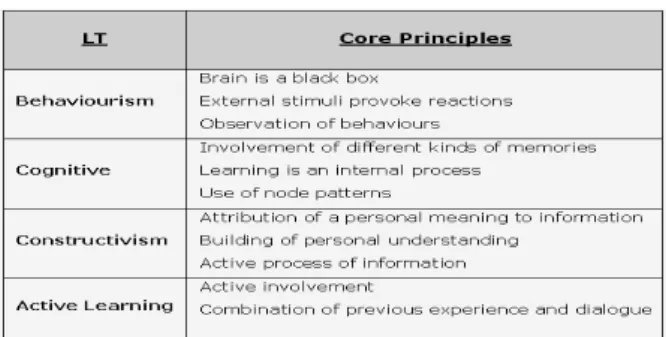
The first educational systems were based on the Behaviourist Learning Theory. The main supporters of Behaviourism LT, [17]-[19], postulate that learning is an observable change of the behaviour of the learner that originates from external conditions [19]. More precisely, the brain is considered a black box, thus it responds to stimuli and the reactions provoked can be estimated without taking into account any intellectual activity. Concluding, Behaviourism LT detects the behaviours that can be considered indicatives of learning and can be estimated [20].
Some educators argue that not all changes are observable and that learning is much more than a behavioural change. Based on such belief, there has been a cross from Behaviourism to the Cognitive Learning Theory. Cognitive psychology sustain that learning involves different kind of memories, motivation and thinking. Equally important in learning is considered the reflection. The sustainers of Cognitivism believe that learning is an internal process and also concur that the amount of information memorized and the pre-existing knowledge [21] are not affecting the ability and the quality of the mental processing [22],[23]. Moreover, Cognitivism states that information is stored in memory using a node pattern that creates a network, where nodes are connected to each other by means of relations [24].
Recently, e-learning developers adopted a Constructivist approach. In fact, most of the existing e-learning programs are based on a Constructivist LT [25]. The supporters of Constructivism state that learners interpret and encode the information and the circumambient in basis of their own personal perception [26],[27]. Thus, learners learn better when they are able to attribute a personal meaning to information. Reference [1] states that:
“individuals gradually build their own understanding of the world through experience, maturation, and interaction with the environment, to include other individuals. Thus, from the constructivist viewpoint, the learner is an active processor of information”.
Another interesting LT that can be applied in e-learning environments is Active Learning. According [28] Active Learning is any educational strategy that engages learners in the learning procedure [29]-[31]. In other words, Active Learning requires the active involvement of learners in the learning process [32] in order to achieve a better understanding of the educational content. This could be actualized with the use of learning activities that combine previous experience or dialogue. Reference [33] differentiated
two kinds of dialogue and two kinds of experience. The two main types of dialogue are “dialogue with self” (think reflectively) and “dialogue with others” and the two main types of experience are “observing” and “doing” [33].
Examining carefully the LTs analyzed above, it is obvious that they present similarities in the fundamental ideas and principles. Accordingly, the design of an online learning system could embrace the principles of all suggested theories. The principles of Behaviourism could be used to teach the facts, thus the «what», the principles of Cognitivism could be used to teach procedures and principles, thus the «how» and, the principles of Constructivism could be used to teach the causation and the more complex notions, thus the «why» [34]. Likewise, the whole educational procedure should be aligned with the principles of Active Learning in order to stimulate and maintain vivid learners’ attention, which in e-learning environments is very important as the learner has complete control of the learning process. Fig. 1 summarizes the relations that subsist among LTs.
Fig. 1 LTs Relationships
IV. DESIGN PRINCIPLES
It is argued that technology is pedagogically neutral [6]. Yet, e-learning technology, in order to be qualitative and efficient, ought to be pedagogically biases. The way technology is being used is more important than the technology itself [35], as the key problem in an e-learning environment is knowledge acquisition, thus the long-term retention of information and the ability to apply what is learned in everyday life.
Literature review [9],[35] revealed the need to reconsider e-learning design in pedagogical basis. One way to enhance educational procedure is to integrate and adjust LTs principles on the e-learning field. Table 1 summarizes the core principles of the LTs presented. In such aspect, some good practices are presented regarding teaching strategies and content delivery, time and pace management, interface design and preservation of learners’ focus.
Fig. 2 Summary of LTs principles
A. Educational Content and Assessment
Traditional textbooks are not always suitable in e-learning settings where tutor and learners are physically separated. As previously mentioned, the educational content should be accurate, concise, thorough and well designed so as to be suitable for quality and effective online learning. The structure of the material should go from simple to more complicated concepts, from known to unknown situations, from theory to practice.
Reference [36] asserts that an online educational program should include a variety of educational approaches in order to accommodate different learning styles. A learning style refers to the way learners comprehend, react and interact to the learning environment [37],[38]. There are different learning approaches that vary from theory to practice. According [39], learners who prefer the theoretical approach tend to memorize facts and figures and search for new information regarding a variety of subjects. On the other hand, learners who prefer the practical approach tend to apply new knowledge in real-life scenarios and learn from their experience. In view of that, an e-learning solution is efficient when learners with different learning styles are presented with the proper educational material and activities.
The simulation of ordinary situations relevant to the educational content should be present in the e-learning educational practice. The adoption of this strategy helps the learner to deeply understand the concepts giving a personal meaning to the knowledge provided. One way to do so, according [11], is to give learners the chance to carry out tasks and assignments that use real-life scenarios and connect the current experiences obtained to past ones and foresee the future implications.
Reference [40] affirms that information presented in different formats than the ordinary text is elaborated better as different parts of the brain are stimulated. Presenting educational content in various ways facilitates the elaboration and memorization of information. In particular, in the work of [4], apart from text, where present graphs, audio and video files, and other possible alternative presentation of the same information, as by presenting material in different modalities, the system covers different learners’ needs.
Finally, the delivery of educational content in small and semantically complete entities smoothes the progress of elaboration and memorization. Reference [41] suggested that
it is preferable to visualize on the screen from five to nine items. If the educational content consists of more than nine items, then those should be presented via conceptual maps. Conceptual maps consist of presenting a synopsis of the subject in a linear, hierarchical or netlike way [42],[43]. During the educational program, according [44], all items are presented and analysed in depth. At the end of the program, the conceptual map is accessible once more, including this time the relationships that incur between items. They also suggest that, in order to facilitate even more the elaboration of information, it is a good idea to ask learners to formulate their own conceptual map, either during the educational procedure or at the end of the program [44], whereas this activity can help learners to better apprehend the details of the educational material.
B. Time and Pace Management
The most important characteristics of e-learning are independence of time and personalization. Reference [45] asserts that information remains in memory less than a second and, if it is not elaborated and memorized in long-term memory, then it is lost. The elaboration of any new information lasts about 20 seconds and if not concluded, the information fails to be memorized. Put in another way, the amount of stored information depends on the quality of learner’s mental elaboration [45]. For such reason, [46] proposes an e-learning solution that utilizes strategies which provide learners with the necessary time to apprehend and elaborate information, such as journal keeping and prompting questions to reflect on.
In e-learning programs, learners should be able to appoint their personal pace as every learner has an individual learning style with different needs and capabilities. Additionally, the majority of learners who undertake an e-learning program have limited free time due to occupation and family life [47]. Reference [6] supports e-learning solutions that do not have restricted time frames, i.e. an academic semester, but permit learners to dedicate the time desired to elaborate the material and to conclude tasks.
C. Interface Design
The system should give learners the opportunity to use their senses to comprehend and elaborate the information provided, in order to memorize new data. According to [48], an efficient e-learning solution stimulates senses by using well-designed and well-placed graphics (colours, size and type of font, graphs, pictures), controlled delivery of educational content and by presenting the educational content in various formats (sound, animation, video, etc.), without overloading learner with stimuli. Avoiding non important stimuli lets the learner focus on the important data.
D. Learners’ Involvement and Focus Preservation
Learners should be motivated in order to undertake an
e-learning program. Even the most well designed application is doomed to fail its original purpose if the user is not motivated enough. Reference [6] designed an e-learning solution that keep learners active by leading then to apply, analyze, compose and evaluate new information. This is achieved through involving learners to real-life tasks, individual or group assessments, and conversation boards where tutor and learners could discuss, clarify misunderstandings and appose ideas.
V. CONCLUSION –FUTURE WORK
The proliferation of information over the Internet and the introduction of ICT in education altered the way people learn. As [10] states, online information is not actual knowledge, but how this information is treated makes it knowledge. Evaluation of e-learning programs has shown that they lack in fundamental educational principles. Hence, there is a need to reconsider e-learning in educational basis in order to enhance online education qualitatively.
In an attempt to overcome deficiencies regarding teaching strategies and content delivery, time and pace management, interface design and preservation of learners’ focus, some good practices of e-learning design were presented. Such solutions are partially grounded on the core principles of LTs. However, as argued earlier, e-learning research is still far from stating an explicit e-learning theory and designing an integrated solution with concrete learning outcomes that covers the online learners’ needs. The next step is to design and implement an e-learning solution that covers the proposed pedagogical principles and test it in a real educational scenario.
REFERENCES
[1] A. P. Rovai, “ A constructivist approach to online learning”, The Internet and Higher Education, vol. 7, no. 2, pp. 79-93, 2004.
[2] D. J. Jarc, “Assessing the Benefits of Interactivity and the Influence of Learning Styles on the Effectiveness of Algorithm Animation using Web-Based Data Structures Courseware”, PhD Dissertation, George WashingtonUniversity, May 1999.
[3] J. L. Ross and R. A. Schulz, “Using the World Wide Web to Accommodate Diverse Learning Styles”, College Teaching, vol. 47, no. 4, pp. 123-129, 1999.
[4] M. Aase and F. Kurfess, “Utilizing learning styles for interactive tutorials”, Proceedings of the 4th IEEE International Conference on Advanced Learning Technologies, pp. 828-830, Aug. 2004.
[5] H. Gardner, Intelligence Reframed: Multiple Intelligences for the 21st Century. New York: Basic Books, 1999.
[6] C.B. Teo and R.K.L. Gay, “A Knowledge-Driven Model to Personalize e-Learning” ACM Journal of Educational Resources in Computing, vol.
6, no. 1, pp. 1-15, Mar. 2006.
[7] M.D. Lytras and N. Pouloudi, “E-learning: Just a waste of time”, In
Proceedings of the Seventh Americas Conference on Information Systems, pp. 216 –222, Aug. 2001.
[8] P.R. Polsani, “Use and abuse of reusable learning objects”, Journal of Digital Information, vol. 3, no. 4, 2003.
[9] C. Dalsgaard, “Pedagogical quality in e-learning – Designing e-learning from a learning theoretical approach”, E-learning and education, vol. 1, no. 1, February 2005.
[10] A. P. Rovai, “Building sense of community at a distance”, International Review of Research in Open and Distance Learning, vol. 3, no. 1, pp. 1– 16, Apr. 2002.
[11] K. Cercone, “Characteristics of adult learners with implications for online learning design”, AACE Journal, vol. 16, no. 2, pp. 137-159, 2008.
[12] G. McCalla, “The ecological approach to the design of E-learning environments: Purpose-based capture and use of information about learners”, Journal of Interactive Media in Education, vol. 7, 2004. [13] S. Chee, “Distance education and e-learning in the digital age: Critical
considerations”, Intelligent Virtual World: Technologies and Applications in Distributed World Environments, pp. 289–308, 2004. [14] J. M. Keller, “Motivational design of instruction”, Instructional design
theories and instruction: An overview of their current status, pp. 383– 429, 1983.
[15] J. M. Keller and K. Suzuki, “Use of the ARCS motivation model in courseware design”, Instructional design for microcomputer courseware, pp. 401–434, 1988.
[16] G. Siemens, “Learning management systems: the wrong place to start learning”, Elearnspace, 2004. Retrieved from http://www.elearnspace.org/Articles/lms.htm [07 April 2010].
[17] E. L. Thorndike, Educational psychology: The psychology of learning. New York: Teachers College Press, 1913.
[18] I. P. Pavlov, Conditioned reflexes. London: Clarendon Press, 1927. [19] B. F. Skinner, About behaviorism. New York: Knopf, 1974.
[20] T. L. Good and J. E. Brophy, Educational psychology: A realistic approach (4th ed.).White Plains, NY: Longman, 1990.
[21] D. P. Ausubel, Educational psychology: A cognitive view. New York: Holt, Rinehart & Winston, 1974.
[22] F. I. M. Craik and R. S. Lockhart, “Levels of processing: A framework for memory research” Journal of Verbal Learning and Verbal Behavior, vol. 11, no. 6, pp. 671–684, Dec. 1972.
[23] F. I. M. Craik and E. Tulving, “Depth of processing and the retention of words in episodic memory”, Journal of Experimental Psychology: General, vol. 104, no. 3, pp. 268–294, Sep. 1975.
[24] N. Stoyanova and P. Kommers, “Concept mapping as a medium of shared cognition in computer-supported collaborative problem solving”,
Journal of Interactive Learning Research, vol. 13, pp. 111–133, 2002. [25] D. P. Schulz and S. E. Schultz, A History of Modern Psychology. San
Diego, CA: Book World Promotions, 2002.
[26] P. A. Cooper, “Paradigm shifts in designing instruction: From behaviorism to cognitivism to constructivism”, Educational Technology, vol. 33, no. 5, pp. 12–19, 1993.
[27] B. G. Wilson, “Reflections on constructivism and instructional design”,
Instructional developmentparadigms, pp. 63–80, 1997.
[28] C.C. Bonwell and J. A. Eison, Active Learning: Creating Excitement in the Classroom. Washington, DC: George Washington University, 1991. [29] C. Bonwell, “Building a supportive climate for active learning”, The
National Teaching and Learning Forum, vol. 6, no. 1, pp. 4-7, 1996. [30] L. G. Richards, “Promoting active learning with cases and instructional
modules”, Journal of Engineering Education, vol. 84, no. 4, pp. 375-381, Oct. 1995.
[31] L. Rubin and C. Hebert, “Model for active learning: Collaborative peer teaching”, College Teaching, vol. 46, no. 1, pp. 26-30, 1998.
[32] V. F. Hartman, “Teaching and learning style preferences: Transitions through technology”, VCCA Journal, vol. 9, no. 2, pp. 18-20, 1995. [33] Y. Shang, H. Shi and S. S. Chen, “An intelligent distributed environment
for active learning”, Journal of Educational Resources in Computing (JERIC), vol. 1, no. 2, 2001.
[34] M. Ally, “Foundations of educational theory for online learning”, Theory and practiceof online learning, pp. 3-31, 2004.
[35] M. Nichols, “A theory for eLearning”, Educational Technology & Society, vol. 6, no. 2, pp. 1-10, 2003.
[36] S.Cassidy, “Learning Styles: An overview of theories, models, and measures”, Educational Psychology, vol. 24, no. 4, pp. 419–444, 2004. [37] A. Chamillard and R. E. Swardl “Learning styles across the curriculum”
Proceedings of the 10th Annual SIGCSE Conference Innovation and Technology in Computer Science Education, pp. 241–245, 2005. [38] H. J. Cha, Y. S. Kim, S. H. Park, T. B. Yoon, Y. M. Jung, and J. H. Lee,
“Learning style diagnosis based on user interface behaviour for the customization of learning interfaces in an intelligent tutoring system”,
Proceedings of the 8th International Conferenceon Intelligent Tutoring Systems, Lecture Notes in Computer Science, vol. 4053, pp. 513–524, 2006.
[39] D. A. Kolb, Learning style inventory. Boston: McBerr, 1984.
[40] A. Paivio, Mental representations: A dual coding approach. Oxford: Oxford University Press, 1986.
[41] G. A. Miller, “The magical number seven, plus or minus two: Some limits on our capacity for processing information”, Psychological Review, vol. 101, no. 2, pp. 343-352, Apr. 1994.
[42] C. D. Holley, D. F. Dansereau, B. A. McDonald, J. C. Garland, and K. W. Collins, “Evaluation of a hierarchical mapping technique as an aid to prose processing”, Contemporary Educational Psychology, vol. 4, no. 3, pp. 227–237, July 1979.
[43] P. L. Smith and T. J. Ragan, Instructional design. New York: John Wiley & Sons, 1999.
[44] C. J. Bonk and T. H. Reynolds, “Learner-centered web instruction for higher-order thinking, teamwork, and apprenticeship”, Web-based instruction, pp. 167–178, 1997.
[45] J. W. Kalat, Introduction to psychology. Pacific Grove, CA: Wadsworth- Thompson Learning, 2007.
[46] C. Vrasidas, “Issues of Pedagogy and Design in e-learning Systems”,
ACM Symposium on Applied Computing, pp. 911-915, 2004.
[47] A.Pange, M.Dova andJ.Pange, “The use of ICTs in early childhood studies”, E-Proceedings of Internatioal Conference on Information Communication Technology, pp.319-323, 2006.
[48] W. Horton, E-learning by Design. San Francisco, CA: Pfeiffer, 2006.