
Design and Evaluation of
Low-Latency Communication
Middleware on High Performance
Computing Systems
Roberto Rey Exp ´
osito
Low-Latency Communication
Middleware on High Performance
Computing Systems
Roberto Rey Exp´
osito
Doctoral Thesis
July 2014
PhD Advisors:
Guillermo L´
opez Taboada
Juan Touri˜
no Dom´ınguez
Dpto. de Electr´onica y Sistemas
Universidade da Coru˜na
Dpto. de Electr´onica y Sistemas
Universidade da Coru˜na
CERTIFICAN
Que la memoria titulada “Design and Evaluation of Low-Latency Communication
Middleware on High Performance Computing Systems” ha sido realizada por D.
Roberto Rey Exp´osito bajo nuestra direcci´on en el Departamento de Electr´onica y
Sistemas de la Universidade da Coru˜na, y concluye la Tesis Doctoral que presenta
para optar al grado de Doctor en Ingenier´ıa Inform´atica con la Menci´on de Doctor
Internacional.
En A Coru˜na, a 29 de Julio de 2014
Fdo.: Guillermo L´opez Taboada
Director de la Tesis Doctoral
Fdo.: Juan Touri˜no Dom´ınguez
Director de la Tesis Doctoral
Fdo.: Roberto Rey Exp´osito
por tanto
A mis padres, familia y amigos
por soportarme
First of all, I would especially like to acknowledge my PhD advisors Guillermo and Juan for their valuable help and guidance during all these years. It has been an honor being their PhD student. Next, I will always be grateful to Alba, who has always been there for me, for her unconditional love and care. There are just no words to describe what her presence means to me. Of course, I cannot forget my parents, who have taught me about hard work, self-respect, persistence and how to be independent. I am also greatly indebted to Gore and Luci for their constant affection, as well as to all my loving family and closest friends, especially Gaby and Nando, for all the good times. Huge thanks also to all my past and present colleagues in the GAC group for their kindness, both the ones from the FIC and
those from the CITIC. I would like to mention Iv´an, Sabela, Andi´on, To˜no, Juan,
Jacobo, Mois´es, Jorge, Darriba, Andr´es, Dyer, ´Oscar, Dani, Santorum and Sasi. I would like to sincerely thank Dr. Heinz Kredel and his group for hosting me
during my three-month research visit to the Rechenzentrum Universit¨at Mannheim
(Germany). Moreover, I am grateful to the following institutions for providing access to the clusters and supercomputers that have been used as testbeds for this work: CESGA (Galicia Supercomputing Center), BSC (Barcelona Supercomputing Cen-ter), HLRS (High Performance Computing Center Stuttgart), the Vrije University Amsterdam and the Phylogenomics Group of the University of Vigo.
Finally, I want to acknowledge the following institutions and projects for funding this work: the Computer Architecture Group, the Department of Electronics and
Systems and the University of A Coru˜na for the human and material support, and
for funding my attendance at some conferences; the Galician Government (Xunta de Galicia) for the Consolidation Program of Competitive Research Groups (Computer
Architecture Group, refs. GRC2013/055 and 2010/6) and the Galician Network of High Performance Computing (ref. 2010/53); the Open European Network for High Performance Computing on Complex Environments (ComplexHPC, COST Action ref. IC0805) for providing financial support to attend the ComplexHPC Spring
School; the Barri´e Foundation for the project HPC4HPT; Amazon Web Services
(AWS) for providing access to the Amazon EC2 cloud through a research grant;
INDITEX S.A. and the University of A Coru˜na for a joint grant to make a research
visit to the Rechenzentrum Universit¨at Mannheim; the Ministry of Economy and
Competitiviness and the Ministry of Education, Culture and Sport of Spain for the project TIN2010-16735 and the FPU grant AP2010-4348.
(La vida, la libertad y la b´
usqueda de la felicidad)
O interese en Java para computaci´on paralela est´a motivado polas s´uas intere-santes caracter´ısticas, tales como o seu apoio multithread, portabilidade, facilidade de aprendizaxe, alta produtividade e o aumento significativo no seu rendemento
computacional. No entanto, as aplicaci´ons paralelas en Java carecen xeralmente de
mecanismos de comunicaci´on eficientes, os cales adoitan usar protocolos baseados
en sockets que son incapaces de obter o m´aximo proveito das redes de baixa
laten-cia, obstaculizando a adopci´on de Java na computaci´on de altas prestaci´ons (High Performance Computing, HPC). Esta Tese de Doutoramento presenta o dese˜no, im-plementaci´on e avaliaci´on de soluci´ons de comunicaci´on en Java que superan esta limitaci´on. En consecuencia, desenvolv´eronse m´ultiples dispositivos de comunicaci´on
a baixo nivel para paso de mensaxes en Java (Message-Passing in Java, MPJ) que
aproveitan ao m´aximo o hardware de rede subxacente mediante operaci´ons de
ac-ceso directo a memoria remota que proporcionan comunicaci´ons de baixa latencia.
Tam´en se incl´ue unha biblioteca de paso de mensaxes en Java totalmente funcional,
FastMPJ, na cal foron integrados os dispositivos de comunicaci´on. A avaliaci´on
ex-perimental amosou que as primitivas de comunicaci´on de FastMPJ son competitivas
en comparaci´on con bibliotecas nativas, aumentando significativamente a
escala-bilidade de aplicaci´ons MPJ. Por outra banda, esta Tese analiza o potencial da
computaci´on na nube (cloud computing) para HPC, onde o modelo de distribuci´on
de infraestrutura como servizo (Infrastructure as a Service, IaaS) xorde como unha
alternativa viable aos sistemas HPC tradicionais. A ampla avaliaci´on do
rendemen-to de recursos cloud espec´ıficos para HPC do proveedor l´ıder, Amazon EC2, puxo de manifesto o impacto significativo que a virtualizaci´on imp´on na rede, impedindo mover as aplicaci´ons intensivas en comunicaci´ons ´a nube. A clave at´opase no soporte
de virtualizaci´on apropiado, como o acceso directo ao hardware de rede, xunto coas
directrices para a optimizaci´on do rendemento suxeridas nesta Tese.
El inter´es en Java para computaci´on paralela est´a motivado por sus interesantes caracter´ısticas, tales como su soporte multithread, portabilidad, facilidad de apren-dizaje, alta productividad y el aumento significativo en su rendimiento computacio-nal. No obstante, las aplicaciones paralelas en Java carecen generalmente de
meca-nismos de comunicaci´on eficientes, los cuales utilizan a menudo protocolos basados
en sockets incapaces de obtener el m´aximo provecho de las redes de baja latencia,
obstaculizando la adopci´on de Java en computaci´on de altas prestaciones (High Per-formance Computing, HPC). Esta Tesis Doctoral presenta el dise˜no, implementaci´on y evaluaci´on de soluciones de comunicaci´on en Java que superan esta limitaci´on. En consecuencia, se desarrollaron m´ultiples dispositivos de comunicaci´on a bajo nivel
para paso de mensajes en Java (Message-Passing in Java, MPJ) que aprovechan al
m´aximo el hardware de red subyacente mediante operaciones de acceso directo a
me-moria remota que proporcionan comunicaciones de baja latencia. Tambi´en se incluye
una biblioteca de paso de mensajes en Java totalmente funcional, FastMPJ, en la cual se integraron los dispositivos de comunicaci´on. La evaluaci´on experimental ha
mostrado que las primitivas de comunicaci´on de FastMPJ son competitivas en
com-paraci´on con bibliotecas nativas, aumentando significativamente la escalabilidad de
aplicaciones MPJ. Por otro lado, esta Tesis analiza el potencial de la computaci´on en la nube (cloud computing) para HPC, donde el modelo de distribuci´on de
infraestruc-tura como servicio (Infrastructure as a Service, IaaS) emerge como una alternativa
viable a los sistemas HPC tradicionales. La evaluaci´on del rendimiento de recursos
cloud espec´ıficos para HPC del proveedor l´ıder, Amazon EC2, ha puesto de ma-nifiesto el impacto significativo que la virtualizaci´on impone en la red, impidiendo mover las aplicaciones intensivas en comunicaciones a la nube. La clave reside en un soporte de virtualizaci´on apropiado, como el acceso directo al hardware de red, junto con las directrices para la optimizaci´on del rendimiento sugeridas en esta Tesis.
The use of Java for parallel computing is becoming more promising owing to its appealing features, particularly its multithreading support, portability, easy-to-learn properties, high programming productivity and the noticeable improvement in its computational performance. However, parallel Java applications generally suffer from inefficient communication middleware, most of which use socket-based proto-cols that are unable to take full advantage of high-speed networks, hindering the adoption of Java in the High Performance Computing (HPC) area. This PhD The-sis presents the design, development and evaluation of scalable Java communication solutions that overcome these constraints. Hence, we have implemented several low-level message-passing devices that fully exploit the underlying network hardware while taking advantage of Remote Direct Memory Access (RDMA) operations to provide low-latency communications. Moreover, we have developed a production-quality Java message-passing middleware, FastMPJ, in which the devices have been integrated seamlessly, thus allowing the productive development of Message-Passing in Java (MPJ) applications. The performance evaluation has shown that FastMPJ communication primitives are competitive with native message-passing libraries, im-proving significantly the scalability of MPJ applications. Furthermore, this Thesis has analyzed the potential of cloud computing towards spreading the outreach of HPC, where Infrastructure as a Service (IaaS) offerings have emerged as a feasible alternative to traditional HPC systems. Several cloud resources from the leading IaaS provider, Amazon EC2, which specifically target HPC workloads, have been thoroughly assessed. The experimental results have shown the significant impact that virtualized environments still have on network performance, which hampers porting communication-intensive codes to the cloud. The key is the availability of the proper virtualization support, such as the direct access to the network hardware, along with the guidelines for performance optimization suggested in this Thesis.
The performance and scalability of inter-node communications are key aspects for running High Performance Computing (HPC) applications efficiently on parallel architectures. In fact, current HPC systems, from multi-core clusters to large super-computers, are aggregating a significant number of cores interconnected via a high-speed network such as InfiniBand, RoCE or high-high-speed Ethernet (10/40 Gigabit).
Furthermore, the advent of cloud computing [15, 72] has generated considerable
in-terest in the HPC community due to the high availability of computational resources at large scale. Thus, public Infrastructure as a Service (IaaS) providers (e.g., Ama-zon) are increasingly offering virtualized HPC resources allowing end users to set up virtual clusters to exploit supercomputing-level power. In this context, cloud com-puting platforms have become an interesting alternative to deploy an HPC system without any knowledge of the underlying infrastructure.
The continuously increasing number of cores available in the current multi- and many-core era underscores the need for scalable parallel solutions, where the effi-ciency of the underlying communication middleware is fundamental. In this context, it is key to fully harness the power of the likely abundant processing resources from HPC systems while taking advantage of the interesting features of high-speed net-works, such as Remote Direct Memory Access (RDMA) operations, with still easy-to-use programming models. The Message-Passing Interface (MPI) [61] remains as the de-facto standard in the area of parallel computing owing to its flexibility and portability, being able to achieve high performance in very different systems. Thus, MPI is still the most widely extended programming model for writing parallel ap-plications on HPC systems, traditionally using natively compiled languages (e.g., C/C++, Fortran).
Java is currently among the preferred programming languages in web-based and distributed computing environments, and it has become a valuable alternative for
parallel computing [73, 79]. The interest in Java for HPC is based on its appealing
characteristics that can be of special benefit for parallel programming such as built-in networkbuilt-ing and multithreadbuilt-ing support, object orientation, automatic memory management, portability, easy-to-learn properties and thus high programming pro-ductivity. Moreover, the significant improvement in its computational performance has narrowed the performance gap between Java and natively compiled languages, thanks to the use of efficient Just-in-Time (JIT) compilers. However, although this performance gap is usually small for sequential applications, it can be particularly large for parallel applications when depending on communications performance. The main reason is that current parallel Java applications generally suffer from ineffi-cient communication middleware that do not take full advantage of high-speed net-works [44]. This lack of efficient communication support in current Message-Passing in Java (MPJ) [18] implementations usually results in lower performance than MPI, which has hindered the use of Java in this area.
The present PhD Thesis, “Design and Evaluation of Low-Latency Communica-tion Middleware on High Performance Computing Systems”, has been structured to accomplish a twofold purpose. On the one hand, it focuses on providing a more efficient Java communication middleware for parallel computing that overcomes the performance constraints discussed above by fully exploiting the underlying network-ing hardware, enablnetwork-ing low-latency and high-bandwidth inter-node communications for parallel Java applications. This goal has been tackled specifically in the first part of the Thesis, particularly for clusters and supercomputers as they are currently the most widespread HPC deployments. On the other hand, the second part focuses on the use of public cloud infrastructures for HPC and scientific computing. Hence, the scalability of the Java communication middleware developed in the previous part has been analyzed on the most popular IaaS cloud provider: Amazon EC2 [2]. Additionally, a comprehensive feasibility study of using Amazon EC2 resources for HPC has been carried out. This extensive review ranges from the identification of the main causes of communication inefficiency on a cloud computing environment up to the proposal of some techniques for reducing their impact on the scalability of communication-intensive HPC codes, both for Java and natively compiled lan-guages. This study also considers other important aspects of Amazon EC2 to be
a viable alternative in the HPC area, such as providing high-performance file I/O through Solid State Drive (SSD) disks, the performance characterization of paral-lel/distributed file systems for data-intensive applications (e.g., Big Data workloads) or the use of coprocessors, such as Graphics Processing Units (GPU), as many-core accelerators [56].
Work Methodology
The Thesis methodology has followed a classical approach in research and en-gineering: analysis, design, implementation and evaluation. Thus, the work of this Thesis has started with the feasibility analysis of providing efficient Java communi-cations for HPC. For this task, a proof-of-concept low-level communication device was implemented and integrated in a production Java communication middleware. This communication device provides native support for an InfiniBand network, se-lected for being widely used in current HPC systems. The feedback obtained from this initial task was used to define and structure the subsequent developments, where one of the most relevant contributions was the implementation of FastMPJ, a production-quality Java message-passing middleware. The communication support of this modular middleware was built upon several low-level communication devices that take full advantage of high-speed networks. Therefore, the communication device for InfiniBand was integrated in FastMPJ, while additional low-level commu-nication devices were implemented to extend its high-speed network support. An important task was the evaluation of this middleware on representative clusters and supercomputers, as well as the analysis of the state of the art regarding the use of Java for HPC. Next, this Java communication middleware was evaluated on a public cloud computing infrastructure, Amazon EC2, using HPC-aimed resources, both in terms of performance and cost. As the popularity of public clouds has increased significantly in the last years, another task was to evaluate Amazon EC2 resources for running HPC applications. Amazon EC2 was selected as it is currently the most popular IaaS provider, offering several cloud resources that are intended to be well suited for HPC: cluster instances equipped with powerful multi-core CPUs, high-speed networks (10 Gigabit Ethernet), multi-GPU cluster instances and instances that provide SSD-based disks as local storage.
Structure of the Thesis
In accordance with the current regulations of the University of A Coru˜na, the
PhD dissertation has been structured as a compilation Thesis (i.e., based on merg-ing research articles). Particularly, this research work comprises nine JCR-indexed journal papers which have been organized into two different parts. The Thesis
be-gins with theIntroductionchapter, intended to give the reader a general overview of
all the research carried out in these papers. First, this chapter introduces the scope and main motivations of the Thesis in order to delimit its context and provides a clear description of the main objectives to be achieved. Next, it includes an overall discussion of the main research results of each part in order to provide consistency and coherence to the different works.
Hereafter, the Thesis is divided into two parts. In the first part (Design of
Low-Latency Java Communication Middleware on High-Speed Networks), we present the
design, implementation and evaluation of efficient Java communication middleware for parallel computing. The journal papers derived from the first part, each one presented as a separate chapter (Chapters 2-5), are the following:
R. R. Exp´osito, G. L. Taboada, J. Touri˜no, and R. Doallo. Design of scalable
Java message-passing communications over InfiniBand. Journal of
Supercom-puting, 61(1):141–165, 2012.
R. R. Exp´osito, S. Ramos, G. L. Taboada, J. Touri˜no, and R. Doallo. FastMPJ: a scalable and efficient Java message-passing library. Cluster Computing, 2014.
(in press, http://dx.doi.org/10.1007/s10586-014-0345-4).
R. R. Exp´osito, G. L. Taboada, S. Ramos, J. Touri˜no, and R. Doallo.
Low-latency Java communication devices on RDMA-enabled networks. 2014. (Sub-mitted for journal publication).
G. L. Taboada, S. Ramos, R. R. Exp´osito, J. Touri˜no, and R. Doallo. Java
in the high performance computing arena: research, practice and experience. Science of Computer Programming, 78(5):425–444, 2013.
The second part of the Thesis (Evaluation of Communication Middleware for
of a public cloud computing platform, Amazon EC2, for running HPC applications. The journal papers derived from the second part, each one also presented as a separate chapter (Chapters 6-10), are the following:
R. R. Exp´osito, G. L. Taboada, S. Ramos, J. Touri˜no, and R. Doallo.
Evalua-tion of messaging middleware for high-performance cloud computing. Personal
and Ubiquitous Computing, 17(8):1709–1719, 2013.
R. R. Exp´osito, G. L. Taboada, S. Ramos, J. Touri˜no, and R. Doallo.
Perfor-mance analysis of HPC applications in the cloud. Future Generation Computer
Systems, 29(1):218–229, 2013.
R. R. Exp´osito, G. L. Taboada, S. Ramos, J. Gonz´alez-Dom´ınguez, J. Touri˜no,
and R. Doallo. Analysis of I/O performance on an Amazon EC2 cluster
compute and high I/O platform. Journal of Grid Computing, 11(4):613–631,
2013.
R. R. Exp´osito, G. L. Taboada, S. Ramos, J. Touri˜no, and R. Doallo.
Perfor-mance evaluation of data-intensive computing applications on a public IaaS cloud. 2014. (Submitted for journal publication).
R. R. Exp´osito, G. L. Taboada, S. Ramos, J. Touri˜no, and R. Doallo.
General-purpose computation on GPUs for high performance cloud computing.
Con-currency and Computation: Practice and Experience, 25(12):1628–1642, 2013.
Finally, theConclusions and Future Work chapter summarizes the main
contri-butions of the Thesis and outlines the main research lines that can be derived from this work.
Funding and Technical Means
The necessary means to carry out this Thesis have been the following:
Working material, human and financial support primarily by the Computer
Fellowship funded by the Ministry of Education, Culture and Sport of Spain (FPU grant AP2010-4348).
Access to bibliographical material through the library of the University of A Coru˜na.
Additional funding through the following research projects:
• European funding: project “Open European Network for High
Perfor-mance Computing on Complex Environments” (ComplexHPC, COST Action ref. IC0805).
• State funding by the Ministry of Economy and Competitiviness of Spain
through the project “Architectures, Systems and Tools for High Perfor-mance Computing” (TIN2010-16735).
• Regional funding by the Galician Government (Xunta de Galicia) under
the Consolidation Program of Competitive Research Groups (Computer Architecture Group, refs. GRC2013/055 and 2010/6) and Galician Net-work of High Performance Computing (ref. 2010/53).
• Private funding: projects “High Performance Computing for High
Per-formance Trading (HPC4HPT)” funded by the Barri´e Foundation and
“F-MPJ-Cloud (Fast Message-Passing in Java on the Cloud)” funded by a research grant of Amazon Web Services (AWS) LLC.
Access to clusters, supercomputers and cloud computing platforms:
• Pluton cluster (Computer Architecture Group, University of A Coru˜na,
Spain). Initially, 16 nodes with 2 Intel Xeon quad-core Nehalem-EP
processors and up to 16 GB of memory, all nodes interconnected via InfiniBand DDR and 2 of them via 10 Gigabit Ethernet. Additionally, two nodes with one Intel Xeon quad-core Sandy Bridge-EP processor and 32 GB of memory, interconnected via InfiniBand FDR, RoCE and iWARP, and four nodes with one Intel Xeon hexa-core Westmere-EP processor, 12 GB of memory and 2 GPUs NVIDIA Tesla “Fermi” 2050 per node, interconnected via InfiniBand QDR. Later, 16 nodes have been added, each of them with 2 Intel Xeon octa-core Sandy Bridge-EP processors,
64 GB of memory and 2 GPUs NVIDIA Tesla “Kepler” K20m per node, interconnected via InfiniBand FDR.
• DAS-4cluster (Advanced School for Computing and Imaging, ASCI, Vrije University Amsterdam, the Netherlands). For the experiments of the Thesis, 64 nodes have been used, each of them with 2 Intel Xeon quad-core Westmere-EP processors and 24 GB of memory, interconnected via InfiniBand QDR. Furthermore, we have used one fat node with 4 AMD Opteron twelve-core Magny-Cours processors and 128 GB of memory.
• XB5 cluster (Phylogenomics Group, University of Vigo, Spain). One fat
node with 4 Intel Xeon ten-core Westmere-EX processors and 512 GB of memory has been used.
• Finis Terrae supercomputer (Galicia Supercomputing Center, CESGA,
Spain): 144 nodes with 8 Intel Itanium-2 dual-core Montvale processors and 128 GB of memory, interconnected via InfiniBand DDR. Addition-ally, we have used one Superdome system with 64 Intel Itanium-2 dual-core Montvale processors and 1 TB of memory.
• MareNostrum supercomputer (Barcelona Supercomputing Center, BSC,
Spain): 2560 nodes with 2 IBM PowerPC dual-core 970MP processors and 8 GB of memory, interconnected via Myrinet 2000.
• Hermit supercomputer (High Performance Computing Center Stuttgart,
HLRS, Germany): 3552 nodes each of them with 2 AMD Opteron 16-core Interlagos processors and up to 64 GB of memory, interconnected via the custom Cray Gemini interconnect with a 3D torus topology.
• Amazon EC2IaaS cloud platform (Amazon Web Services, AWS). Several
instance types have been used: (1) CC1, 2 Intel Xeon quad-core Nehalem-EP processors, 23 GB of memory and 2 local storage disks per instance; (2) CC2, 2 Intel Xeon octa-core Sandy Bridge-EP processors, 60.5 GB of memory and 4 local storage disks per instance; (3) CG1, 2 Intel Xeon quad-core Nehalem-EP processors, 22 GB of memory, 2 GPUs NVIDIA Tesla “Fermi” 2050 and 2 local storage disks per instance; (4) HI1, 2 Intel Xeon quad-core Westmere-EP processors, 60.5 GB of memory and 2 SSD-based local storage disks per instance; (5) CR1, 2 Intel Xeon octa-core Sandy Bridge-EP processors, 244 GB of memory and 2 SSD-based
local storage disks per instance; and (6) HS1, 1 Intel Xeon octa-core Sandy Bridge-EP processor, 117 GB of memory and 24 local storage disks per instance. All these instance types are interconnected via 10 Gigabit Ethernet.
A three-month research visit to the Rechenzentrum Universit¨at Mannheim,
Germany, which has allowed the access to theHermitsupercomputer installed
at the High Performance Computing Center Stuttgart (HLRS) for implement-ing the correspondimplement-ing FastMPJ commmunication device for the network sup-port of the Cray XE/XK/XC family of supercomputers. This research visit
was funded by INDITEX S.A. in collaboration with the University of A Coru˜na
through a competitive INDITEX-UDC grant obtained in 2013.
Main Contributions
The main contributions related to the first part of the Thesis are:
1. Design and implementation of the ibvdev low-level communication library,
which is a Java message-passing device implemented on top of the Verbs in-terface that provides scalable communications on InfiniBand systems [38]. 2. Design, implementation and evaluation of an efficient Java message-passing
library: FastMPJ. This middleware not only benefits from the integration of
ibvdev, but also from two new low-level communication devices: (1) mxdev,
implemented on top of MX/Open-MX for communication on Myrinet and
generic Ethernet hardware; and (2)psmdev, implemented on top of InfiniPath
PSM for the support of the InfiniPath family of InfiniBand adapters from Intel/QLogic [31].
3. Design, implementation and optimization of Java communication devices on RDMA-enabled networks. This work includes the design and implementation
of two new communication devices, ugnidev and mxmdev, which have been
integrated into FastMPJ. The former device is intended to provide efficient support for the RDMA networks used by Cray supercomputers. The latter
includes support for the recently released messaging library developed by
Mel-lanox for its RDMA adapters. Furthermore, an enhanced version of ibvdev,
which includes additional support for RDMA networks along with an opti-mized short-message communication protocol, has been provided [36].
4. An up-to-date review of Java for HPC, which includes an extensive perfor-mance evaluation that focuses on message passing due to its scalability and extended use in HPC. Thus, FastMPJ is evaluated comparatively with repre-sentative MPI and MPJ middleware. This review also analyzes the current state of Java for HPC both for shared and distributed memory programming, showing an important number of past and present projects which are the result of the sustained interest in the use of Java in this area [79].
The main contributions related to the second part of the Thesis are:
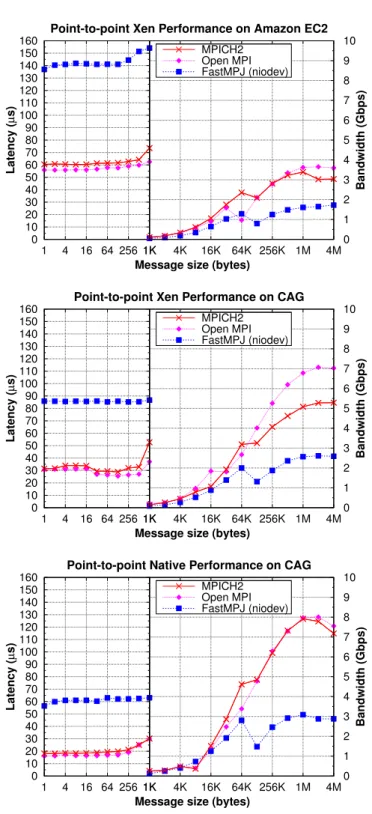
1. A detailed study of the impact of the virtualized network overhead on the scalability of HPC applications on the leading public IaaS cloud: Amazon EC2. This work compares the first generation of the HPC-aimed family of EC2 cluster instances, whose access to its high-speed network (i.e., 10 Gigabit Ethernet) is paravirtualized, with the performance of a similar private cloud testbed that supports the direct access to the same EC2 networking technology through the PCI passthrough technique and the same testbed running on a non-virtualized environment [33].
2. A thorough analysis of the main performance bottlenecks in HPC application scalability on Amazon EC2 along with the proposal and evaluation of some techniques to reduce the impact of the virtualized network overhead. This work gives more insight into the performance of running HPC applications on Amazon EC2, using an important number of cores (up to 512) and comparing the first and second HPC-aimed generations of cluster instances in terms of single instance performance, scalability and cost-efficiency, as well as taking into account hybrid programming models (e.g., MPI+OpenMP) [35].
3. A comprehensive evaluation of the I/O storage subsystem on Amazon EC2. This work evaluates both generations of cluster instances along with storage-optimized instances, which provide SSD-based disks, in order to determine
their suitability for I/O-intensive applications. The evaluation has been car-ried out at different layers, ranging from the cloud low-level storage devices (e.g., ephemeral disks) and I/O interfaces (e.g., MPI-IO, HDF5) up to the application level, including also an analysis in terms of cost. Furthermore, the Network File System (NFS) performance has been characterized, showing the impact of the main NFS configuration parameters on a virtualized cloud environment [32].
4. A performance analysis of running data-intensive computing applications on Amazon EC2. This work analyzes the full I/O software stack for data-intensive computing, both for HPC and Big Data workloads. More specifically, the performance and cost-efficiency of four instance types that provide 10 Giga-bit Ethernet has been characterized at multiple layers, using a representative suite of benchmarking tools (e.g., IOzone, IOR, Intel Hibench), parallel/dis-tributed file systems (OrangeFS, HDFS), disparallel/dis-tributed computing frameworks (Apache Hadoop), I/O-intensive parallel codes for HPC (e.g., FLASH-IO) and MapReduce-based workloads for Big Data processing (e.g., Sort, PageR-ank) [37].
5. A feasibility study of using heterogeneous architectures with many-core ac-celerators on Amazon EC2. Thus, the GPU family of EC2 cluster instances has been assessed using representative Compute Unified Device Architecture (CUDA) and Open Computing Language (OpenCL) synthetic kernels and benchmarks, and their results have been compared with a non-virtualized GPU environment in order to analyze the virtualization overhead for GPGPU. Fur-thermore, hybrid parallel codes (e.g., MPI+CUDA) have been also taken into account at the application level, using two real-world applications and the High Performance Linpack (HPL) benchmark [34].
1. Introduction 1
1.1. Scope and Motivation . . . 1
1.1.1. Java Communications for HPC . . . 3
1.1.2. HPC in the Cloud . . . 6
1.2. Objectives of the Thesis . . . 8
1.3. Research and Discussion . . . 9
1.3.1. Part I: Design of Low-Latency Java Communication Middle-ware on High-Speed Networks . . . 10 1.3.2. Part II: Evaluation of Communication Middleware for HPC
on a Public Cloud Infrastructure . . . 26
I
Design of Low-Latency Java Communication
Middle-ware on High-Speed Networks
47
2. Design of Scalable Java Communications over InfiniBand 49
3. FastMPJ: a Scalable Java Message-Passing Library 75
4. Java Communication Devices on RDMA-enabled Networks 97
5. Java in the HPC Arena: Research, Practice and Experience 125
II
Evaluation of Communication Middleware for HPC on
a Public Cloud Infrastructure
147
6. Evaluation of Messaging Middleware for Cloud Computing 149
7. Performance Analysis of HPC Applications in the Cloud 161
8. Analysis of I/O Performance on the Amazon EC2 Cloud 175
9. Performance Evaluation of Data-Intensive Applications on a Public
Cloud 195
10.General-Purpose Computation on GPUs for Cloud Computing 219
Conclusions and Future Work 235
References 239
1.1. Description of the EC2 cluster compute instances: CC1 and CC2 . . 30 1.2. Description of the EC2 storage-optimized instances: HI1 . . . 35
1.3. Description of the HS1 and CR1 instance types . . . 38
1.4. Hourly cost of the EC2-based HPC clusters . . . 40 1.5. Number of (M)ap/(R)educe tasks and hourly cost of the Hadoop
clusters . . . 41 1.6. Description of the EC2 cluster GPU instances: CG1 . . . 43 1.7. Characteristics of the CG1-based cluster . . . 44
1.1. Eager and rendezvous protocols inibvdev . . . 11
1.2. Eager protocol implementation in ibvdev . . . 12
1.3. Message-passing point-to-point performance on IB . . . 13 1.4. Performance and scalability of the NPB FT kernel on IB . . . 13
1.5. Overview of the FastMPJ layered design andxxdev devices . . . 16
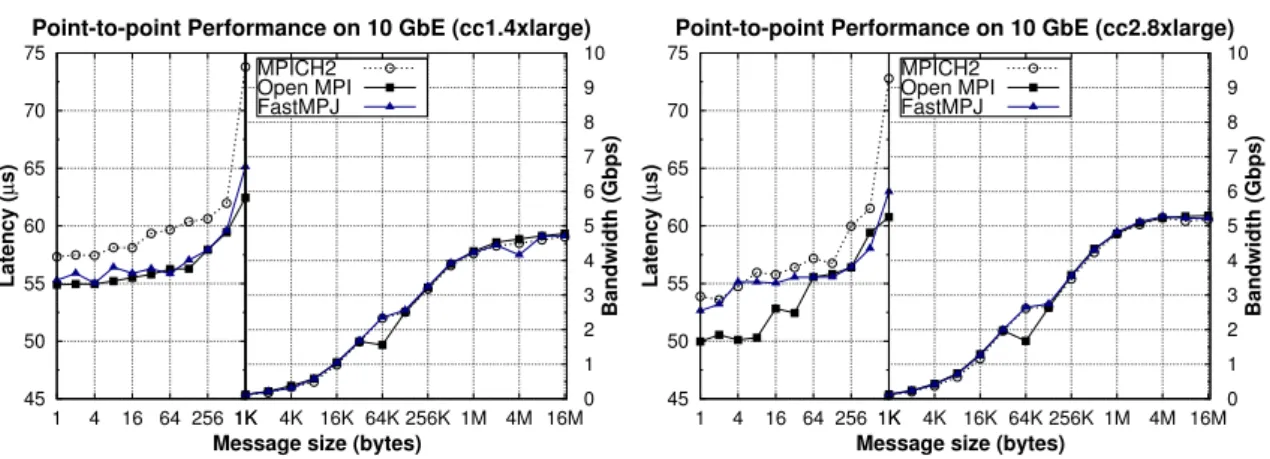
1.6. Point-to-point performance on IB, 10 Gigabit Ethernet (10 GbE) and Myrinet . . . 17 1.7. Broadcast performance on IB and Myrinet . . . 18 1.8. Performance of NPB CG and MG kernels on IB . . . 18 1.9. Overview of the FastMPJ communication devices . . . 19 1.10. First path of the eager protocol inugnidev. . . 20 1.11. Point-to-point performance on RoCE and Cray Gemini . . . 21 1.12. Scalability of the NPB FT kernel on IB and Cray Gemini . . . 22 1.13. Scalability of the FDTD parallel application on IB and Cray Gemini . 22 1.14. Runtime and scalability of the Gadget parallel application . . . 25 1.15. Message-passing point-to-point performance on 10 Gigabit Ethernet . 28
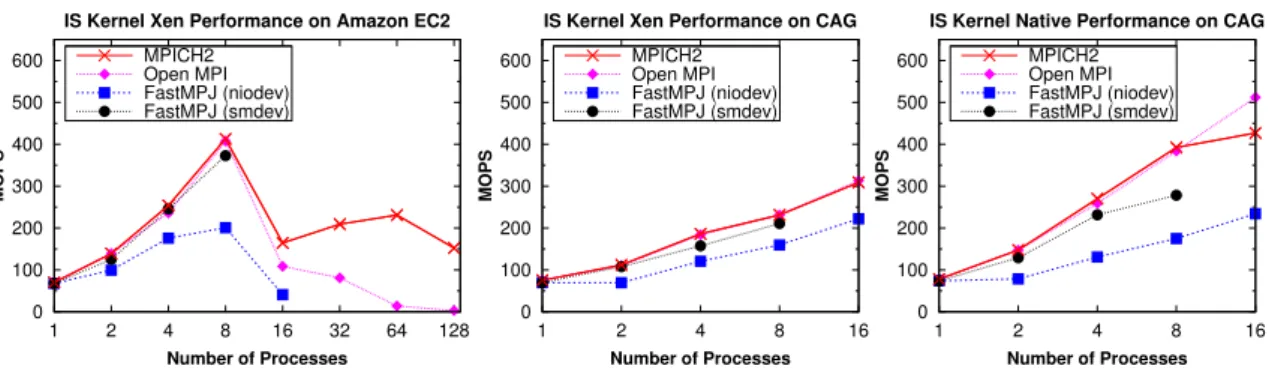
1.16. Performance of the NPB IS kernel on 10 Gigabit Ethernet . . . 29
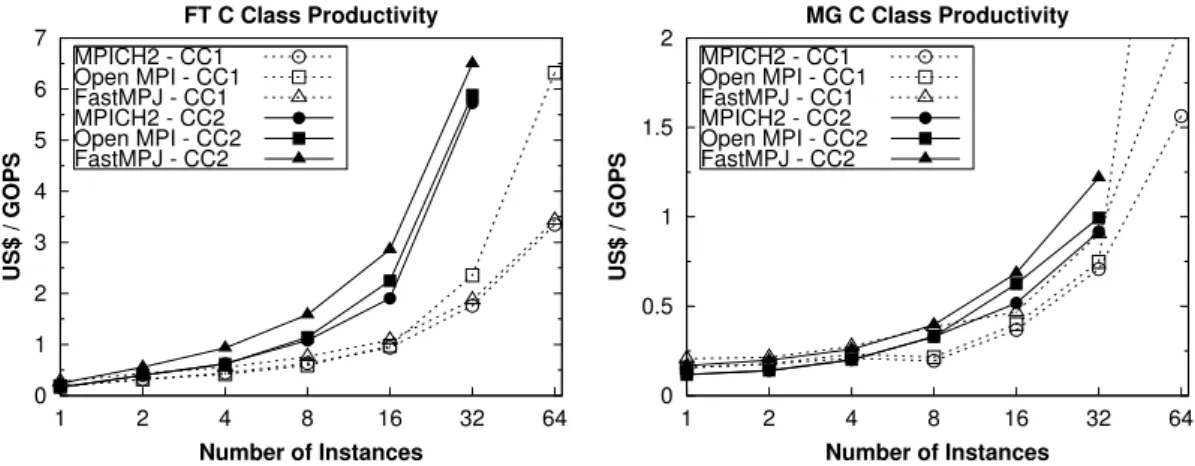
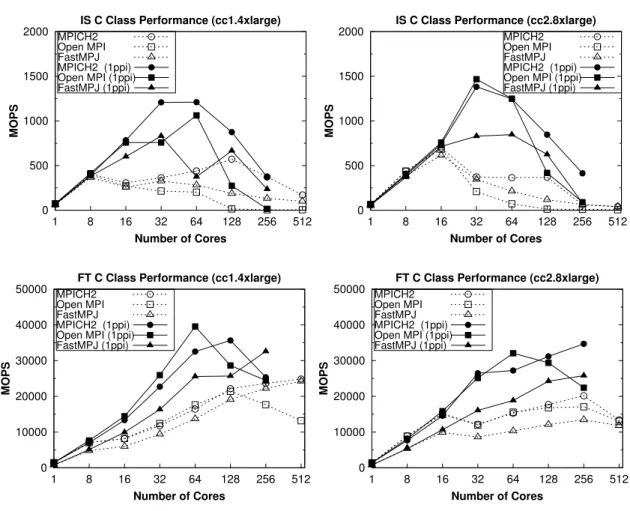
1.17. Point-to-point performance on Amazon EC2 cluster instances over 10 Gigabit Ethernet . . . 31 1.18. Performance of the NPB FT and MG kernels on Amazon EC2 . . . . 32 1.19. Productivity of NPB FT and MG kernels on Amazon EC2 (GOPS =
GigaOperations Per Second) . . . 32 1.20. Performance of NPB IS and FT kernels on Amazon EC2 (ppi =
pro-cesses per instance) . . . 33 1.21. Scalability of the NPB/NPB-MZ SP kernel on Amazon EC2 (tpp =
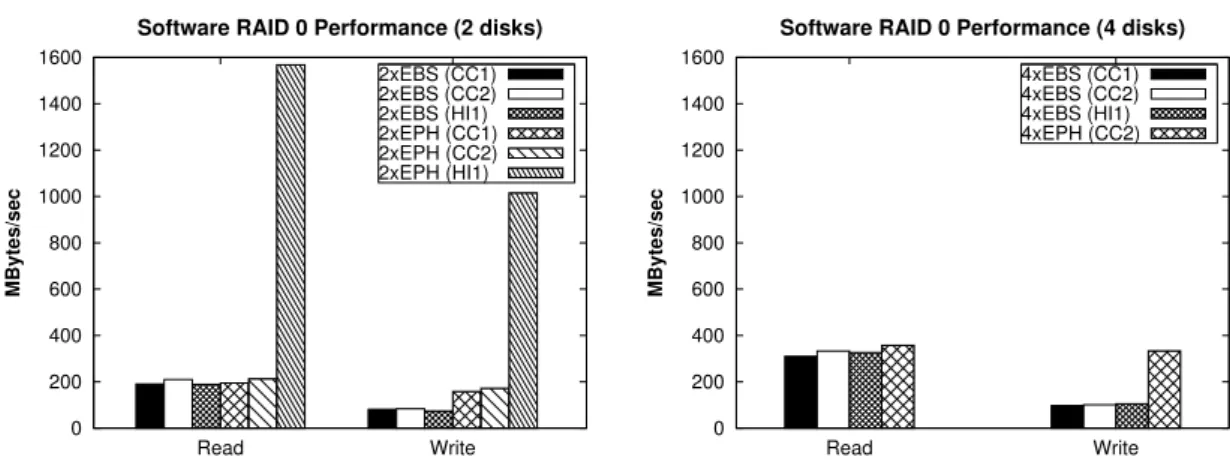
threads per process, ppi = processes per instance) . . . 33 1.22. Software RAID 0 performance on CC1, CC2 and HI1 instances . . . . 36
1.23. NFS write performance using CC2 and HI1 as server . . . 37
1.24. Performance of the NPB BT-IO kernel on Amazon EC2 . . . 37 1.25. Productivity of the NPB BT-IO kernel using on-demand, spot (S)
and reserved (R) EC2 instances . . . 37
1.26. I/O software stacks for data-intensive computing applications . . . . 39
1.27. OrangeFS results using 4 I/O servers and 128 cores . . . 40 1.28. HDFS results using 8 and 16 slave instances . . . 41 1.29. Hadoop Sort performance and execution cost . . . 42 1.30. Performance of low-level GPU benchmarks on Amazon EC2 and CAG 45 1.31. Performance of FFT and GEMM kernels on Amazon EC2 and CAG . 45 1.32. MC-GPU and NAMD results on CG1 instances . . . 46
Introduction
This introductory chapter is intended to give the reader a brief summary of the whole research carried out in this Thesis. The structure of this chapter is as follows: Section 1.1 introduces the scope and main motivations of the Thesis in order to delimit its context. A clear description of the main objectives that must be achieved is included in Section 1.2. Finally, Section 1.3 provides an overall discussion of the main research results in order to provide consistency and coherence to the different journal papers that compose this work.
1.1.
Scope and Motivation
High Performance Computing (HPC) has become increasingly important over the last decades as an essential tool for scientific and industry research. In fact, HPC is currently one of the leading edge disciplines in Information Technology (IT) with a wide range of demanding applications in economy, science, and engineer-ing. These applications usually involve the construction of mathematical models and numerical solution techniques that often require a huge number of computing resources to perform large scale experiments or to cut down the computational com-plexity into a reasonable time frame. These computational needs have been tipically addressed by supercomputers installed at national laboratories, big research groups or large companies. Despite the significance of HPC towards scientific research and
industrial growth, only the largest research projects are able to afford expensive su-percomputers. Moreover, the access to these systems is usually highly restricted and can only be obtained by an allocation through competitive research grant proposals. Hence, for small or medium-scale users with emerging, but limited, HPC demands, the conventional option has been to set up their own in-house HPC cluster.
In order to meet the computational power demands of HPC applications, cur-rent deployments are increasing significantly the number of cores installed, inter-connected via high-speed networks. This trend in hardware evolution increases the complexity of the system, which demands scalable communication middleware and programming languages with high productivity in parallel code development. For performance reasons, those languages compiled to the native code of each platform (e.g., C/C++, Fortran) have been traditionally the most widely used for writing parallel applications. However, the interest in Java for parallel programming has been rising during the last years thanks to the noticeable improvement in its com-putational performance and its inherent productivity features. Nevertheless, even though Java is usually the preferred programming language in web-based and dis-tributed computing environments, its presence in the HPC area is still reduced. The main reason that has hindered the adoption of Java is the lack of efficient Java com-munication middleware, most of which use socket-based protocols that are unable to take full advantage of high-speed networks.
Moreover, setting up a dedicated infrastructure for HPC is a complex endeavor that requires a long lead time, high capital expenditure, and large operational costs. These entry barriers have restricted HPC to a small number of significant users. A cheap, fast, and effective alternative could tremendously spread the outreach of HPC to new users. Recently, the emergence of cloud computing brings new possibilities for constructing and using HPC platforms. Public clouds (e.g., Amazon EC2 [2]) have emerged as a promising alternative to clusters and supercomputers, in which resources are no longer hosted by the researcher’s computational facilities, but leased from big data centers only when needed. This is especially interesting for users who cannot afford their own HPC infrastructure due to the limitations mentioned earlier. In fact, cloud computing can provide HPC users with infrastructures at cheaper price compared to dedicated infrastructures, since they benefit from economy of scale and also multiple users sharing resources, which results in improved utilization.
In this context, the present PhD Thesis is composed of two parts in order to
ac-complish a twofold purpose. On the one hand, the first part of the Thesis (Design of
Low-Latency Java Communication Middleware on High-Speed Networks) arises from
the main goal of improving Java communications performance on traditional HPC systems (i.e., clusters and supercomputers) in order to increase the adoption of this language for parallel computing. The availability of an efficient Java communication middleware would allow parallel programmers to benefit from its appealing features at a reasonable overhead, thus increasing their programming productivity. On the
other hand, the second part (Evaluation of Communication Middleware for HPC
on a Public Cloud Infrastructure) focuses on the feasibility of using a public cloud platform, Amazon EC2, for HPC and scientific computing. This study includes not only the evaluation of our Java communication middleware in the cloud, but also provides an extensive review that considers other important aspects of the Amazon cloud to be a viable alternative in the HPC area. The specific motivations of each part of the Thesis are discussed next.
1.1.1.
Java Communications for HPC
The growing computational power requirements of HPC applications have been traditionally addressed by using dedicated HPC infrastructures such as multi-core clusters or custom supercomputers, which are currently the most widely extended parallel architectures in the TOP500 list [89]. Most of these systems are increasingly aggregating a significant number of cores interconnected via high-speed networks. This current trend to increase the number of cores per processor underscores the im-portance of efficient and scalable communication middleware along with highly pro-ductive programming languages, in order to fully exploit the features of the abundant processing resources and the underlying networking hardware. Current networking technologies typically rely on scalable topologies and advanced network adapters that allow for low-latency and high-bandwidth communications, usually providing interesting features such as Remote Direct Memory Access (RDMA) operations that enable zero-copy and kernel-bypass facilities. Examples of popular high-speed networks widely extended in HPC environments are InfiniBand (IB) [47], Myrinet, high-speed Ethernet (10/40 Gigabit), RDMA over Converged Ethernet (RoCE) [46], Internet Wide Area RDMA Protocol (iWARP) [70] or the Gemini interconnect [1].
The performance of inter-node communications on top of high-speed networks can have a dramatic impact on the overall scalability of communication-intensive parallel applications. Hence, this scenario requires scalable parallel solutions, where communication efficiency is fundamental. This efficiency not only depends heavily on the use of high-speed networks [59], but also on the communication middle-ware [91]. Therefore, it is fundamental to fully harness the power of the likely abun-dant processing resources while taking full advantage of high-speed networks with still easy-to-use programming models. The Message-Passing Interface (MPI) [61] is the de-facto standard in the area of parallel computing owing to its flexibility and portability, being able to achieve high performance in very different systems. MPI has been the preferred choice for writing parallel applications on distributed memory systems for a long time, traditionally using natively compiled languages such as C/C++ or Fortran. With the advent of the many-core era, MPI remains as the most widely extended programming model for communication between nodes within parallel applications, but it is usually combined with other popular program-ming models, such as Compute Unified Device Architecture (CUDA) [64] or Open Computing Language (OpenCL) [77], in order to enable the use of the increasingly widespread coprocessors, such as Graphics Processing Units (GPUs), as many-core HPC accelerators [56].
Java is a highly portable and flexible programming language that enjoys a dom-inant position in a wide diversity of computing environments. In fact, Java has become the leading programming language both in academia and industry due to its appealing features that make it a highly productive language. Although some early works have identified its potential for scientific computing soon after its re-lease [27,40,88], Java was severely criticized for its poor computational performance in its beginnings [12]. However, the performance gap between Java and natively com-piled languages has been narrowing for the last years. The Java Virtual Machine (JVM) is currently equipped with efficient Just-in-Time (JIT) compilers that can ob-tain near-native performance from the platform-independent bytecode [78]. In fact, the JVM identifies sections of the code frequently executed and converts them to na-tive machine code instead of interpreting the bytecode. Therefore, Java is currently gaining popularity in other domains which usually make use of HPC infrastructures,
such as the area of parallel computing [73, 79] and Big Data analytics, where the
choices for the development of applications that follow the MapReduce program-ming model [25]. Additionally, Java provides some appealing properties that can be of special benefit for parallel programming, especially its built-in networking and multithreading support in the core of the language. These interesting features along with the continuous increase in the performance of the JVM and its other traditional advantages for general programming, such as object orientation, automatic memory management, type-safety, platform independence, portability, security, easy-to-learn properties and thus a higher productivity in code development, have turned Java into an interesting alternative for HPC.
Nevertheless, although the performance gap between Java and natively compiled languages is usually relatively small for sequential applications, it can be particu-larly large for parallel applications when depending on communications performance. The related literature points out the inefficiency of Java communications as the main cause for its usually low parallel performance. The main reason is that current par-allel Java applications generally suffer from inefficient communication middleware, most of them based on protocols with high communication overhead (e.g., sockets-based protocols) that are unable to take full advantage of high-speed networks [44]. This lack of efficient communication support in current Message-Passing in Java (MPJ) [18] implementations usually results in lower performance than native MPI libraries, which has been the main obstacle for the embracement of Java in HPC. Thus, the adoption of Java as an alternative language on these systems heavily de-pends on the availability of efficient communication middleware in order to benefit from its appealing features at a reasonable overhead.
Therefore, the main motivation of the first part of the Thesis is to improve the efficiency of Java communications for HPC, providing a communication middleware that takes full advantage of high-speed networks in order to increase the performance of parallel Java applications. This communication middleware would definitely con-tribute to increase the benefits of the adoption of Java for HPC, in order to achieve higher parallel programming productivity.
1.1.2.
HPC in the Cloud
Cloud computing [15,72], the current emerging trend in delivering IT services, is a relatively recent Internet-based computing model which is gaining significant ac-ceptance in many areas and IT organizations as an elastic, flexible, and variable-cost way to deploy their service platforms using outsourced resources. These resources can be rapidly provisioned and released with minimal management effort. Public cloud providers offer access to external users who are typically billed by consump-tion using the pay-as-you-go pricing model. More specifically, Infrastructure as a Service (IaaS) is a type of cloud service which dinamically provides, by means of virtualization technologies, on-demand and self-service access to elastic computa-tional resources (e.g., CPU, memory, networking and storage). Public IaaS cloud providers typically make huge investments in data centers, and then rent it out, al-lowing consumers to avoid heavy capital investments and obtain both cost-effective and energy-efficient solutions [71]. Thus, organizations are no longer forced to invest in additional computational resources, since they can just leverage the infrastruc-ture offered by the IaaS provider. Customers can derive significant economies of use by leveraging the pay-per-use model, instead of upgrading their infrastructure, dimensioned to handle peak requests.
Traditional HPC systems are typically managed and operated by individual orga-nizations in private. However, computing demand is fluctuating, resulting in periods where dedicated resources are either underutilized or overloaded. The advantages of the pay-as-you-go model, elasticity, flexibility, customization, security, migration and resource control offered by virtualization make cloud computing an attractive option for meeting the needs of HPC applications. IaaS cloud providers can be well-suited for handling the increasing processing requirements of resource-intensive applications due to the high availability of on-demand computational resources at large scale. In fact, in the last years the use of cloud infrastructures for HPC has gen-erated a strong interest in the scientific and research community as an emerging and
feasible alternative to traditional HPC systems [29,49,63,90,92]. The cloud-based
approach offers a lot of apparent benefits and interesting perspectives, promising cost savings and more flexibility. This model provides a powerful abstraction that easily allows end users to set up elastic virtual clusters to exploit supercomputing-level power without any knowledge of the underlying infrastructure. The provisioning of
these virtual clusters as on-demand pay-as-you-go resources avoids initial cost for physically owned hardware and allows great flexibility and scalability for customers and their applications. Moreover, cloud-based virtual clusters allow scientists to securely gain administrative privileges within the guest operating system and com-pletely customize their execution environment, thus providing the perfect setup for their experiments. Furthermore, public IaaS resources usually may on average be better utilized than private computing resources within laboratories or companies, which increases efficiency in terms of cost and energy consumption.
Despite the advantages of cloud for HPC, it still remains unclear whether and when clouds can become a feasible substitute or complement to clusters and super-computers. There is a mismatch between the requirements and goals of HPC and the characteristics and goals of current cloud environments. HPC is performance-oriented, whereas clouds are usually cost and resource-utilization oriented. Further-more, clouds have traditionally been designed to run business and web applications. The interest in the use of public clouds for HPC increases as their availability, computational power, price and performance improves. However, previous early
studies [26, 29, 30, 49, 63, 67, 90, 92] have evaluated public clouds and the main
conclusion was that clouds were not designed for running tightly-coupled HPC work-loads, such as MPI applications. The main reasons are processor sharing and the poor network performance, mainly caused by the use of commodity interconnection technologies (e.g., Gigabit Ethernet) and the virtualization network overhead, that limit severely the scalability of HPC applications in public clouds. To overcome these constraints, IaaS providers have started to offer some HPC-aimed cloud resources in the last years. These recent efforts towards HPC-optimized clouds point to a promising direction to overcome some of the fundamental performance bottlenecks. Amazon Web Services (AWS) is the leading commercial public cloud provider in terms of services and number of users, whose Elastic Compute Cloud (EC2) ser-vice [2] is nowadays among the most used and largest IaaS cloud platform. Amazon EC2 offers several cloud resources which specifically target HPC environments [3]. These resources are composed of several instance types or Virtual Machines (VM) which are intended to be well suited for HPC workloads and other demanding network-bound applications by offering dedicated physical node allocation (a sin-gle VM per node), powerful and up-to-date multi-core CPU and GPU resources,
improved network performance via high-speed Ethernet (10 Gbps) and enhanced storage performance providing high-performance Solid State Drive (SSD) disks. Us-ing these instance types customers can expedite their HPC workloads on elastic resources as needed, adding and removing compute resources to meet the size and time requirements for their specific workloads.
Therefore, the IaaS model in clouds can enable HPC to reach out to a wider scientific and industrial community. Whether and how this potential can be realized in practice is a research question that we aim to answer in the second part of this Thesis. Hence, the main motivation of this part is to examine the feasibility of using a public cloud infrastructure for HPC and scientific computing. The Amazon EC2 cloud has been selected as a representative public IaaS provider because it is currently the most popular one, offering several HPC-aimed resources which are suitable for this assessment study.
1.2.
Objectives of the Thesis
Taking into account the particular motivations for the Thesis that have been discussed above, the main objectives for each part of this work have been defined. Thus, among the specific goals of the first part of the Thesis are the design and implementation of middleware to improve Java communication efficiency on top of high-speed networks, and the evaluation of the current state of Java for HPC, particularly for cluster and supercomputer systems. To achieve this, the design and development of low-level communication middleware that increases Java per-formance on current HPC systems has been carried out. Hence, the Thesis presents the design, implementation and evaluation of several low-level Java communication devices optimized for the following high-speed networks: InfiniBand, RoCE, iWARP, Myrinet, high-speed Ethernet and Cray Gemini/Aries (Chapters 2 and 4). These communication devices provide a high-level message-passing API that follows the MPJ specification, based on the MPI standard widely used in HPC. Moreover, the Thesis presents an efficient Java message-passing library, FastMPJ (Chapter 3), in which all these communication devices haven been successfully integrated. Further-more, the Thesis provides an up-to-date review of Java for HPC (Chapter 5), which includes an extensive evaluation of the performance of current projects.
The main goals of the second part of the Thesis include the evaluation of the Java message-passing middleware, developed in the first part, on the Amazon EC2 IaaS platform using HPC-aimed cloud resources. This assessment has been conducted both in terms of performance (Chapters 6 and 7) and cost (Chapter 7), using both Java and natively compiled codes. Moreover, it is fundamental to measure not only the raw performance, but also the isolated impact of the virtualization overhead on the scalability of communication-intensive HPC applications (Chapter 6). In ad-dition, some techniques to reduce this overhead have been assessed, including the impact of the use of different process mappings and several levels of parallelism (Chapter 7). Next, in order to provide a thorough analysis of the state of the art regarding the use of the Amazon EC2 cloud for HPC, other additional aspects of this cloud to be a viable alternative in the HPC area have to be considered. Hence, further assessments of Amazon EC2 have been carried out: the evaluation of the I/O storage subsystem (Chapter 8), the performance characterization of parallel/dis-tributed file systems for data-intensive applications (Chapter 9), and the feasibility of using GPUs as many-core HPC accelerators (Chapter 10).
Finally, all these efforts have served to accomplish the twofold goal of this Thesis: improving Java communication efficiency for HPC applications on top of high-speed newtworks, and providing a feasibility study of the use of a public cloud computing infrastructure for HPC.
1.3.
Research and Discussion
This section presents an overview of the whole research carried out in the Thesis. Basically, we describe how the main goals defined in the previous section have been accomplished by the different journal articles that make up this work, providing an overall discussion of the main research results that have been achieved. The particular research concerning each of the two parts is discussed separately next.
1.3.1.
Part I: Design of Low-Latency Java Communication
Middleware on High-Speed Networks
The first part of the Thesis follows a bottom-up approach. First, it is targeted at the design and development of low-level Java communication devices on high-speed networks. These devices provide efficient point-to-point communication primitives conforming to a low-level message-passing API, which is not aware of higher level MPI abstractions (e.g., communicators). Next, an MPJ library (FastMPJ) is imple-mented on top of the previously developed communication middleware, taking ad-vantage of the more efficient high-speed network support. Additionally, an extensive evaluation of the FastMPJ performance has been provided, including an up-to-date review of Java for HPC. A brief summary of this research is next presented.
Design of Scalable Java Communications over InfiniBand (Chapter 2)
The first task of the Thesis has been the design and implementation ofibvdev[38], a low-level Java message-passing communication device over InfiniBand (IB). The efficient support of this high-speed network in Java is of great interest, as it is currently the most widely adopted RDMA networking technology in the TOP500 list [89]. Furthermore, the use of Java sockets on top of the IP over IB emulation protocol (IPoIB) [48] has shown quite poor performance in the related literature [44]. These facts have motivated this task as our first main goal, in order to explore the feasibility of implementing efficient Java communications over native IB in a produc-tion and already existing MPJ library. The MPJ Express (MPJE) middleware [9], which implements the mpiJava 1.2 API [17] (the most widely extended MPI-like Java bindings), was selected as it is the most active project in terms of adoption by the HPC community, presence on academia and production environments, and available documentation.
The ibvdev device transparently provides Java message-passing applications
with efficient communications over IB thanks to its direct support of the IB Verbs (IBV) API and the scalable implementation of a lightweight communication proto-col that is able to take advantage of RDMA operations. This device conforms with
new transport protocol. More specifically, this device implements an eager and a rendezvous communication protocol (see Figure 1.1) through the Java Native Inter-face (JNI). These protocols rely on the Reliable Connection (RC) transport service defined in the IBV specification, which provides reliability, delivery order and data
loss and error detection. On the one hand, the eager protocol of ibvdev, which is
used for short messages to achieve the lowest latency, is illustrated in Figure 1.2. It has been implemented using a copy in/out protocol, as the overhead of data copies is small for short messages. Moreover, the buffer registration and unregistration overhead is avoided by using a shared pool of pre-registered, fixed size buffers for communication. Hence, for sending an eager data message, the user data is copied to one of the available buffers from the pool (step 1 of the figure) and then sent out from this buffer to the send queue. At the receiving side, a number of buffers from the pool are pre-posted (step 2). After the message is received, the message payload is copied to the user destination buffer (step 3).
On the other hand, the rendezvous protocol, used for large messages, negotiates the buffer availability at the receiving side before the message is actually transferred. A zero-copy protocol has been implemented by using the RDMA Write operation. In this implementation (see right part of Figure 1.1), the application buffers are reg-istered on-the-fly and the buffer addresses are exchanged via control messages. The sending process first sends a control message to the receiver (RNDZ START). The receiver replies to the sender using another control message (RNDZ REPLY). This
Data
Registered Buffer User Buffer
Send Recv Send Recv
CPU
MEMORY MEMORY
Data CPU Data
Channel Adapter Channel Adapter Data InfiniBand Network
Source Process Destination Process
1 2 3 IB Port IB Port Queue Pair Queue Completion Completion Queue Queue Pair
Figure 1.2: Eager protocol implementation in ibvdev
reply message contains the information of the receive application buffer along with the required remote key to access that memory region. The sending process then sends the large message directly to the receive application buffer by using RDMA Write. Finally, the sending process issues another control message (RNDZ END) which indicates to the receiver that the message has been placed in the application buffer. Additionally, this protocol takes advantage of a cache of registered buffers that can reduce the buffer registration and unregistration overhead. The effective-ness of this cache depends heavily on the reuse rate of the buffers.
The experimental evaluation of the ibvdev device on a multi-core IB cluster
has shown significant point-to-point performance benefits (see Figure 1.3), obtain-ing up to 85% start-up latency reduction and twice the bandwidth compared to
previous Java sockets-based middleware using the IPoIB protocol (i.e., niodev).
Furthermore, the analysis of the impact of the use of ibvdev on representative
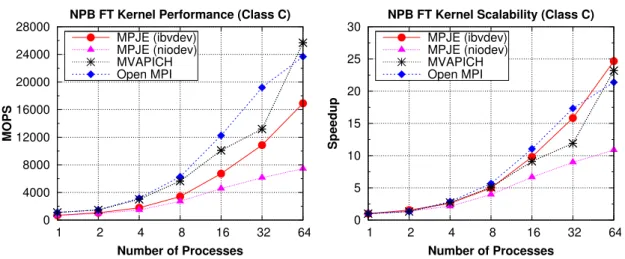
message-passing kernels and applications has shown significant performance gains, as shown in Figure 1.4, which presents the FT kernel of the NAS Parallel Benchmarks
(NPB) [6] as example. Therefore, the efficiency ofibvdev, which is even competitive
with native MPI libraries (Open MPI and MVAPICH) in terms of point-to-point performance, increases the scalability of communication-intensive parallel Java ap-plications, which helps to bridge the performance gap between MPJ and MPI.
Message size (bytes)
Point-to-point Performance on InfiniBand
0 10 20 30 40 50 60 70 80 1 4 16 64 256 1K Latency ( µ s) 1K 4K 16K 64K 256K 1M 4M 0 1 2 3 4 5 6 7 8 9 10 Bandwidth (Gbps) MPJE (ibvdev) MPJE (niodev) MVAPICH Open MPI
Figure 1.3: Message-passing point-to-point performance on IB
0 4000 8000 12000 16000 20000 24000 28000 1 2 4 8 16 32 64 MOPS Number of Processes NPB FT Kernel Performance (Class C)
MPJE (ibvdev) MPJE (niodev) MVAPICH Open MPI 0 5 10 15 20 25 30 1 2 4 8 16 32 64 Speedup Number of Processes NPB FT Kernel Scalability (Class C)
MPJE (ibvdev) MPJE (niodev) MVAPICH Open MPI
FastMPJ: a Scalable Java Message-Passing Library (Chapter 3)
The proof-of-concept implementation of the ibvdev device in the MPJ Express
library showed that it was feasible to obtain efficient Java communications over IB. However, the overall design of MPJ Express relies on a buffering layer [10] that
is only able to transfer the custom xdev buffer objects. In fact, this layer adds
a noticeable copying overhead that significantly limits performance and scalability of communications, as shown in previous works [84]. Furthermore, MPJ Express includes poorly scalable collective algorithms and its bootstrapping mechanism
typ-ically exhibits some issues in specific environments. As a consequence of these
constraints, the ibvdev device was reimplemented to conform with the xxdev API
and then adapted for its integration into the F-MPJ library [83] in order to improve its performance and scalability.
F-MPJ is our Java message-passing implementation of the mpiJava 1.2 API, presented as a proof of concept in [83]. The communication support of F-MPJ
is implemented on top of the xxdev device layer, which has been designed as a
simple and pluggable architecture of low-level communication devices. This layer supports the direct communication of any serializable Java object without data
buffering, whereas xdev, the API that xxdev is extending, does not support this
direct communication, as mentioned before. The avoidance of this intermediate data
buffering overhead is the main benefit of the xxdev device layer with respect to its
predecessor. The xxdev API (see Listing 1.1) is composed of basic operations such
as point-to-point communications, both blocking (send and recv) and nonblocking (isend and irecv). It also includes synchronous communications (ssend and issend) and methods to check incoming messages without actually receiving them (probe and iprobe). Additionally, F-MPJ includes a scalable collective library with more than 60 topology-aware algorithms, which are implemented on top of point-to-point communications [80].
Nevertheless, F-MPJ presents several important constraints as it was intended as a research-oriented and proof-of-concept implementation. In fact, it only implements a small subset of the communication-related API, which prevents its use in most real-world applications (e.g., it does not support inter- and intra-communicators, virtual topologies and group operations). Additionally, it includes a basic
bootstrap-public abstract c l a s s D e v i c e { public s t a t i c D e v i c e n e w I n s t a n c e ( S t r i n g d e v i c e ) ; abstract P r o c e s s I D [ ] i n i t ( S t r i n g [ ] a r g s ) ; abstract P r o c e s s I D i d ( ) ; abstract void f i n i s h ( ) ;
abstract void s e n d ( O b j e c t buf , PID d s t , i n t tag , i n t c o n t e x t ) ;
abstract S t a t u s r e c v ( O b j e c c t buf , PID s r c , i n t tag , i n t c o n t e x t ) ;
abstract R e q u e s t i s e n d ( O b j e c t buf , PID d s t , i n t tag , i n t c o n t e x t ) ;
abstract R e q u e s t i r e c v ( O b j e c t buf , PID s r c , i n t tag , i n t c o n t e x t , S t a t u s s t t s ) ;
abstract R e q u e s t i s s e n d ( O b j e c t buf , PID d s t , i n t tag , i n t c o n t e x t ) ;
abstract void s s e n d ( O b j e c t buf , PID s r c , i n t tag , i n t c o n t e x t ) ;
abstract S t a t u s i p r o b e ( PID s r c , i n t tag , i n t c o n t e x t ) ;
abstract S t a t u s p r o b e ( PID s r c , i n t tag , i n t c o n t e x t ) ;
}
Listing 1.1: API of the xxdev.Device class
ping mechanism based on system-dependent scripts, unable to provide portability on different platforms. Furthermore, it only includes one communication device implemented on top of Java IO sockets (iodev), which severely limits its overall scalability. Although the use of high-performance socket implementations, such as the Java Fast Sockets (JFS) project [82], can improve performance on shared mem-ory and high-speed networks, the use of the sockets API still represents an important source of overhead and lack of scalability in Java communications, especially in the presence of high-speed networks [44]. Therefore, in addition to the reimplementation
ofibvdev, our main goal has been to overcome the current limitations of F-MPJ in
order to provide a production-quality implementation of the full MPJ specification, which is now known as FastMPJ [31].
In addition to the integration of ibvdev in FastMPJ, two new communication
devices, mxdev and psmdev, have been included in order to improve its high-speed
network support. On the one hand,mxdev implements thexxdev API on top of the
Myrinet Express (MX) library [62], which runs natively on Myrinet networks. More recently, the MX API has also been supported in high-speed Ethernet networks (10/40 Gigabit Ethernet), both on Myricom specialized NICs and on any generic
Ethernet hardware through the Open-MX open-source project [42]. Hence, the
TCP/IP stack can be replaced bymxdevtransfers over Ethernet networks providing
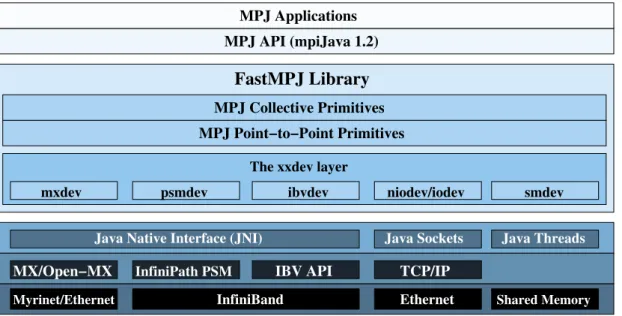
Ethernet Java Threads Java Sockets IBV API InfiniPath PSM InfiniBand Myrinet/Ethernet
Java Native Interface (JNI)
TCP/IP Shared Memory niodev/iodev smdev ibvdev mxdev MX/Open−MX psmdev MPJ Applications MPJ API (mpiJava 1.2) FastMPJ Library MPJ Collective Primitives MPJ Point−to−Point Primitives
The xxdev layer
Figure 1.5: Overview of the FastMPJ layered design and xxdev devices
provides native support for the InfiniPath family of Intel/QLogic IB adapters over the Performance Scaled Messaging (PSM) interface. PSM is a low-level user-space messaging library which implements an intra-node shared memory and an inter-node communication protocol, which are completely transparent to the application.
Although the Intel/QLogic IB adapters are also supported by the ibvdev device,
psmdev usually achieves significantly higher performance than ibvdev, as PSM has
been specifically designed by Intel/QLogic for its hardware. Furthermore, the imple-mentation of a new device based on Java NIO sockets (niodev), which includes more
scalable non-blocking communication support than iodev by providing
select()-like functionality, has also been included. Nevertheless, these socket-based devices are only provided for portability reasons, as they rely on the ubiquitous TCP/IP stack, which introduces high communication overhead and limited scalability for communication-intensive applications. Figure 1.5 presents a high-level overview of
the FastMPJ layered design and its xxdev communication devices.
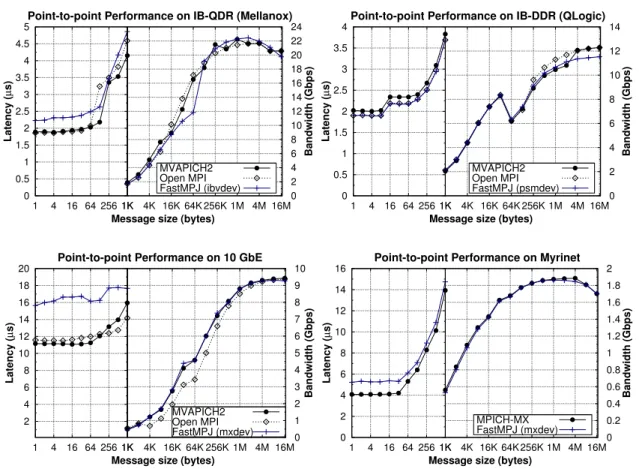
Furthermore, FastMPJ has been evaluated comparatively with native MPI li-braries on five representative testbeds: two IB multi-core clusters, one Myrinet supercomputer, and two shared memory systems using both Intel- and AMD-based processors. The comprehensive performance evaluation has revealed that FastMPJ communication primitives are quite competitive with their MPI counterparts, both
Message size (bytes)
Point-to-point Performance on IB-QDR (Mellanox)
0 0.5 1 1.5 2 2.5 3 3.5 4 4.5 5 1 4 16 64 256 1K Latency ( µ s) 1K 4K 16K 64K 256K 1M 4M 16M 0 2 4 6 8 10 12 14 16 18 20 22 24 Bandwidth (Gbps) MVAPICH2 Open MPI FastMPJ (ibvdev)
Message size (bytes)
Point-to-point Performance on IB-DDR (QLogic)
0 0.5 1 1.5 2 2.5 3 3.5 4 1 4 16 64 256 1K Latency ( µ s) 1K 4K 16K 64K 256K 1M 4M 16M 0 2 4 6 8 10 12 14 Bandwidth (Gbps) MVAPICH2 Open MPI FastMPJ (psmdev)
Message size (bytes) Point-to-point Performance on 10 GbE
2 4 6 8 10 12 14 16 18 20 1 4 16 64 256 1K Latency ( µ s) 1K 4K 16K 64K 256K 1M 4M 16M 0 1 2 3 4 5 6 7 8 9 10 Bandwidth (Gbps) MVAPICH2 Open MPI FastMPJ (mxdev)
Message size (bytes) Point-to-point Performance on Myrinet
0 2 4 6 8 10 12 14 16 1 4 16 64 256 1K Latency ( µ s) 1K 4K 16K 64K 256K 1M 4M 16M 0 0.2 0.4 0.6 0.8 1 1.2 1.4 1.6 1.8 2 Bandwidth (Gbps) MPICH-MX FastMPJ (mxdev)
Figure 1.6: Point-to-point performance on IB, 10 Gigabit Ethernet (10 GbE) and Myrinet
in terms of point-to-point and collective operations performance (see Figures 1.6 and 1.7). Hence, the use of the FastMPJ library in communication-intensive HPC codes allows Java to benefit from a more efficient communication support, taking advantage of the use of a high number of cores and improving significantly the performance and scalability of parallel Java applications (see results for the NPB CG and MG kernels in Figure 1.8). In fact, the development of this efficient Java communication middleware is definitely bridging the gap between Java and native languages in HPC applications.
Figure
Outline
Related documents