OpenBU http://open.bu.edu
Theses & Dissertations Boston University Theses & Dissertations
2016
Visual saliency computation for
image analysis
https://hdl.handle.net/2144/19587
GRADUATE SCHOOL OF ARTS AND SCIENCES
Dissertation
VISUAL SALIENCY COMPUTATION FOR IMAGE
ANALYSIS
by
JIANMING ZHANG
B.S., Tsinghua University, China, 2008
M.S., Tsinghua University, China, 2011
Submitted in partial fulfillment of the
requirements for the degree of
Doctor of Philosophy
2016
First Reader
Stan Sclaroff, PhD
Professor of Computer Science
Second Reader
Margrit Betke, PhD
Professor of Computer Science
Third Reader
Lorenzo Torresani, PhD
Associate Professor of Computer Science Dartmouth College
First and foremost I would like to thank my advisor Prof. Stan Sclaroff, who has given me tremendous support for the past five years. Stan is not only a nice advisor to his students, but also a helpful collaborator and a considerate friend that you will feel lucky to have. I cannot say enough about how much I have benefited from the excellent academic training and guidance he provides. I am especially grateful for the freedom and encouragement he gave me in my research. His joy and enthusiasm for his work will keep motivating me to pursue my career in research.
I also thank my thesis committee members, Prof. Margrit Betke, Prof. Lorenzo Torresani, Prof. Kate Saenko and Prof. Lorenzo Orecchia, for reading my thesis and providing helpful comments.
I thank my mentors, Dr. Zhe Lin, Dr. Xiaohui Shen, Dr. Brian Price, Dr. Radom´ır
Mˇech, Dr. Jonathan Brandt and Dr. Chen Fang, for their guidance and kindness
throughout my wonderful internships at Adobe. Special thanks to Dr. Zhe Lin for his inspiring ideas and helpful discussions in our collaborations.
I thank my fellow labmates, Dr. Shugao Ma, Sarah Bargal, Dr. Danna Gurari, Dr. Zheng Wu, Dr. Liliana Presti and Mehrnoosh Sameki, for closely collaborating with me. I also thank Dr. Ashwin Thangali, Qinxun Bai, Kun He, Ajjen Joshi, Wenxin Feng, Andrew Kurauchi, Fatih Cakir, Dr. Mikhail Breslav, Dr. Diane Theriault and Prof. Erik Learned-Miller for interesting discussions about research and study.
Last but not least, I must express deepest appreciation and greatest admiration to my lovely wife, Erru Yang, for her unlimited and selfless support for my pursuit of PhD and her achievements in both work and life. I also thank my parents for their generous help, and thank my children, Alice and Daniel, for all the happiness shared with me.
Foundation grants 0910908, 1029430, 1059218 and 0855065. Any opinions, findings, and conclusions or recommendations expressed in this material are those of the author and do not necessarily reflect the views of the National Science Foundation. We also gratefully acknowledge additional support through gifts from NVidia and Adobe, Inc.
ANALYSIS
JIANMING ZHANG
Boston University, Graduate School of Arts and Sciences, 2016
Major Professor: Stan Sclaroff, Professor of Computer Science
ABSTRACT
Visual saliency computation is about detecting and understanding salient regions and elements in a visual scene. Algorithms for visual saliency computation can give clues to where people will look in images, what objects are visually prominent in
a scene, etc. Such algorithms could be useful in a wide range of applications in
computer vision and graphics. In this thesis, we study the following visual saliency
computation problems. 1) Eye Fixation Prediction. Eye fixation prediction aims
to predict where people look in a visual scene. For this problem, we propose a Boolean Map Saliency (BMS) model which leverages the global surroundedness cue using a Boolean map representation. We draw a theoretic connection between BMS and the Minimum Barrier Distance (MBD) transform to provide insight into our algorithm. Experiment results show that BMS compares favorably with
state-of-the-art methods on seven benchmark datasets. 2) Salient Region Detection. Salient
region detection entails computing a saliency map that highlights the regions of dom-inant objects in a scene. We propose a salient region detection method based on the Minimum Barrier Distance (MBD) transform. We present a fast approximate MBD transform algorithm with an error bound analysis. Powered by this fast MBD trans-form algorithm, our method can run at about 80 FPS and achieve state-of-the-art
object detection targets at localizing each salient object instance in an image. We propose a method using a Convolutional Neural Network (CNN) model for proposal generation and a novel subset optimization formulation for bounding box filtering. In experiments, our subset optimization formulation consistently outperforms heuris-tic bounding box filtering baselines, such as Non-maximum Suppression, and our method substantially outperforms previous methods on three challenging datasets. 4)Salient Object Subitizing. We propose a new visual saliency computation task, called Salient Object Subitizing, which is to predict the existence and the number of salient objects in an image using holistic cues. To this end, we present an image dataset of about 14K everyday images which are annotated using an online crowd-sourcing marketplace. We show that an end-to-end trained CNN subitizing model can achieve promising performance without requiring any localization process. A method is proposed to further improve the training of the CNN subitizing model by
leveraging synthetic images. 5) Top-down Saliency Detection. Unlike the
afore-mentioned tasks, top-down saliency detection entails generatingtask-specific saliency
maps. We propose a weakly supervised top-down saliency detection approach by modeling the top-down attention of a CNN image classifier. We propose Excitation Backprop and the concept of contrastive attention to generate highly discriminative top-down saliency maps. Our top-down saliency detection method achieves superior performance in weakly supervised localization tasks on challenging datasets. The usefulness of our method is further validated in the text-to-region association task, where our method provides state-of-the-art performance using only weakly labeled web images for training.
1 Introduction 1
1.1 Problems of Visual Saliency Computation . . . 1
1.1.1 Eye Fixation Prediction . . . 2
1.1.2 Salient Region Detection . . . 4
1.1.3 Salient Object Detection . . . 5
1.1.4 Salient Object Subitizing . . . 7
1.1.5 Top-down Saliency Detection . . . 8
1.2 Contributions . . . 10
1.3 Roadmap of Thesis . . . 12
1.4 List of Related Papers . . . 15
2 Related Work 17 2.1 Eye Fixation Prediction . . . 17
2.2 Salient Region Detection . . . 18
2.3 Salient Object Detection . . . 19
2.4 Salient Object Subitizing . . . 20
2.5 Top-down Saliency Detection . . . 22
3 Saliency Detection: A Boolean Map Approach 25 3.1 Boolean Map based Saliency . . . 28
3.1.1 Boolean Map Generation . . . 29
3.2 BMS and the Minimum Barrier Distance . . . 34
3.2.1 Preliminaries . . . 35
3.2.2 BMS Approximates the MBD Transform . . . 36
3.3 Experiments . . . 43
3.3.1 Datasets . . . 43
3.3.2 Compared Models . . . 45
3.3.3 Evaluation Methods . . . 46
3.3.4 Results . . . 48
3.3.5 Speed Accuracy Tradeoff . . . 55
3.3.6 Component Analysis . . . 56
3.4 Summary . . . 57
4 Minimum Barrier Salient Region Detection 59 4.1 Fast Approximate MBD Transform . . . 61
4.1.1 Background: Distance Transform . . . 61
4.1.2 Fast MBD Transform by Raster Scan . . . 62
4.1.3 Approximation Error Analysis . . . 65
4.2 Minimum Barrier Salient Region Detection . . . 67
4.2.1 MBD Transform for Salient Region Detection . . . 68
4.2.2 Combination with Backgroundness Cue . . . 69
4.2.3 Post-processing . . . 71
4.3 Experiments . . . 72
4.3.1 Speed Performance . . . 73
4.3.2 Evaluation Using PR Curve . . . 73
4.3.3 Evaluation Using Weighted-Fβ . . . 75
4.4 Summary . . . 78
5 Unconstrained Salient Object Detection 80 5.1 A Salient Object Detection Framework . . . 82
5.1.1 MAP-based Proposal Subset Optimization . . . 84
5.1.2 Formulation Details . . . 85
5.1.3 Optimization . . . 88
5.1.4 Salient Object Proposal Generation by CNN . . . 89
5.2 Experiments . . . 92
5.2.1 Results . . . 96
5.2.2 Component Analysis . . . 99
5.3 Summary . . . 101
6 Salient Object Subitizing 102 6.1 The SOS Dataset . . . 105
6.1.1 Image Source . . . 105
6.1.2 Annotation Collection . . . 107
6.1.3 Annotation Consistency Analysis . . . 108
6.2 Salient Object Subitizing by Convolutional Neural Network . . . 112
6.2.1 Leveraging Synthetic Images for CNN Training . . . 112
6.3 Experiments . . . 115 6.3.1 Experimental Setting . . . 115 6.3.2 Results . . . 118 6.3.3 Analysis . . . 122 6.4 Applications . . . 129 x
6.4.2 Image Retrieval . . . 132
6.5 Summary . . . 138
7 Top-down Neural Attention by Excitation Backprop 139 7.1 Method . . . 141
7.1.1 Top-down Neural Attention based on Probabilistic WTA . . . 141
7.1.2 Excitation Backprop . . . 143
7.1.3 Contrastive Top-down Attention . . . 146
7.1.4 Implementation of Excitation Backprop . . . 148
7.2 Experiments . . . 151
7.2.1 The Pointing Game . . . 151
7.2.2 Localizing Dominant Objects . . . 158
7.2.3 Text-to-Region Association . . . 159
7.3 Summary . . . 164
8 Conclusions and Future Work 166 8.1 Main Contributions . . . 166
8.2 Strengths and Limitations . . . 169
8.2.1 The BMS Model . . . 169
8.2.2 The Minimum Barrier Salient Region Detection Method . . . 170
8.2.3 Unconstrained Salient Object Detection . . . 171
8.2.4 CNN-based Salient Object Subitizing . . . 172
8.2.5 Top-down Neural Attention by Excitation Backprop . . . 173
8.3 Interesting Directions for Future Research . . . 175
Appendices 178
A.1 Preliminaries . . . 178
A.1.1 Alexander’s Lemma . . . 178
A.1.2 Hyxel and Supercover . . . 182
A.2 Proof of Theorem 3.4 . . . 183
B Proof of Lemma 4.1 187 B.1 Distance Transform on Graph . . . 187
B.2 Proof Lemma 4.1 . . . 190
C Proof of the Submodularity of Function 5.11 196
Bibliography 199
Curriculum Vitae of Jianming Zhang 220
3.1 Descriptions of eye tracking datasets . . . 44
3.2 Compared models in eye fixation prediction . . . 45
3.3 Performance scores of compared eye fixation prediction methods . . . 49
5.1 AP scores of compared methods . . . 97
5.2 AP scores in identifying background images on MSO . . . 97
5.3 AP scores of variants of our method . . . 100
6.1 Distribution of images in the SOS dataset . . . 107
6.2 Human subitizing accuracy in matching category labels from AMT workers . . . 110
6.3 Average Precision of compared methods. . . 118
6.4 Mean average precision scores for different CNN architectures . . . . 123
6.5 The effect of using the synthetic images . . . 124
6.6 Cross-category generalisation test . . . 128
6.7 Salient object detection performance on the MSO dataset . . . 131
6.8 Recognition accuracy in predicting the presence of salient objects on the thumbnail image dataset . . . 132
7.1 Mean accuracy in the Pointing Game . . . 154
7.2 Analysis of contrastive attention on VOC07 difficult set using GoogleNet158 7.3 Bounding box localization error on ImagNet Val. using GoogleNet . . 159
7.5 Per group recall@5 on the Flickr30k Entities dataset . . . 162
1.1 Examples of eye fixation prediction and salient region detection . . . 2
1.2 Examples of unconstrained salient object detection . . . 5
1.3 Sample images of the SOS dataset . . . 8
1.4 Example top-down saliency maps by Excitation Backprop . . . 10
3.1 Examples of BMS vs rarity based methods . . . 26
3.2 Pipeline of BMS . . . 28
3.3 Pipeline of the attention map computation . . . 32
3.4 The MBD transform vs other distance transform on a synthetic test image . . . 42
3.5 The MBD transform and BMS vs geodesic distance transform on a real test image . . . 43
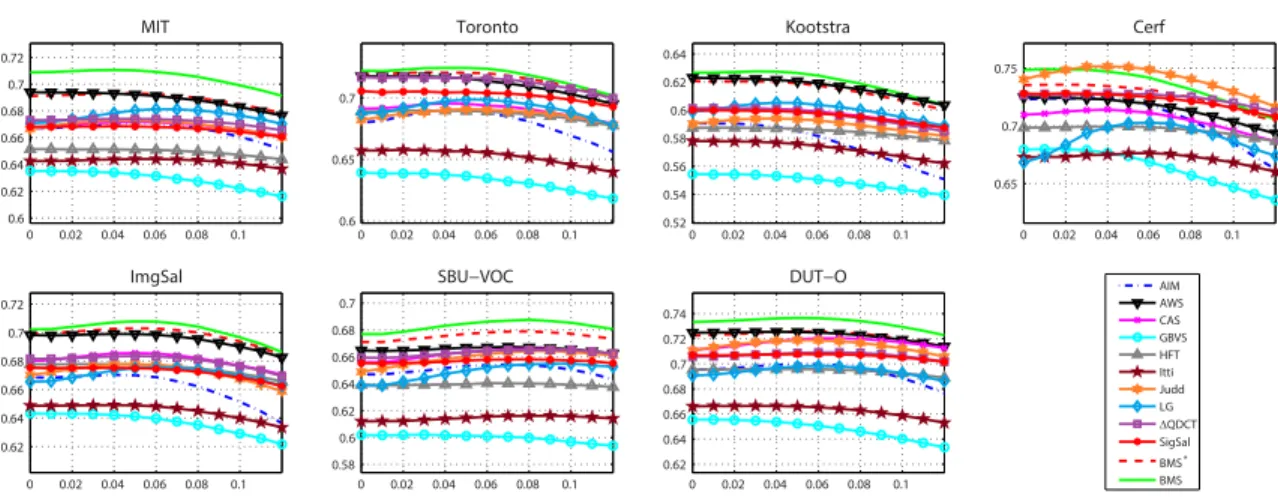
3.6 Plots of sAUC scores against the level of blur in postprocessing . . . 50
3.7 The influence of distance-to-center re-weighting on the NSS scores . . 52
3.8 Sample images and saliency maps of compared models . . . 53
3.9 Sample images . . . 53
3.10 Speed performance comparison . . . 54
3.11 Speed and performance of BMS under different configurations . . . . 55
3.12 Influence of color space whitening . . . 56
3.13 Influence of activation map splitting . . . 57
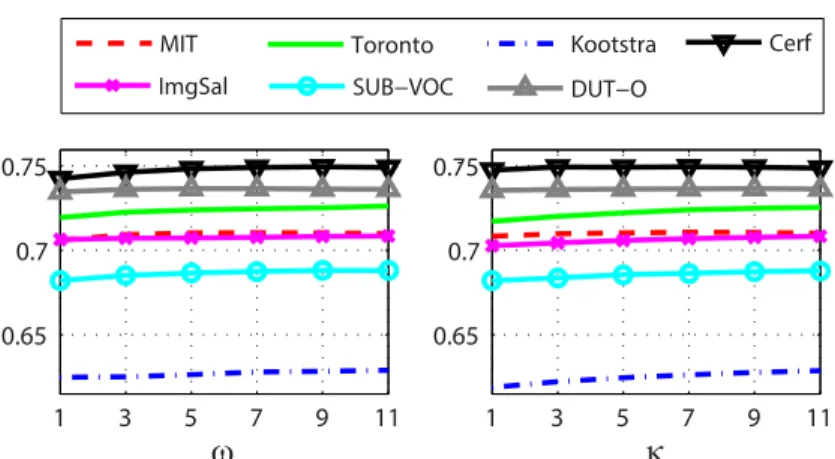
3.14 Parameter analysis of BMS . . . 58
region detection . . . 60
4.2 Illustration of the raster scan pass and the inverse raster scan pass . . 64
4.3 Mean absolute distance approximation error against the number of iterations for FastMBD . . . 67
4.4 An example of the MBD transform vs geodesic distnace transform . . 69
4.5 Speed performance of compared salient region detection methods . . . 73
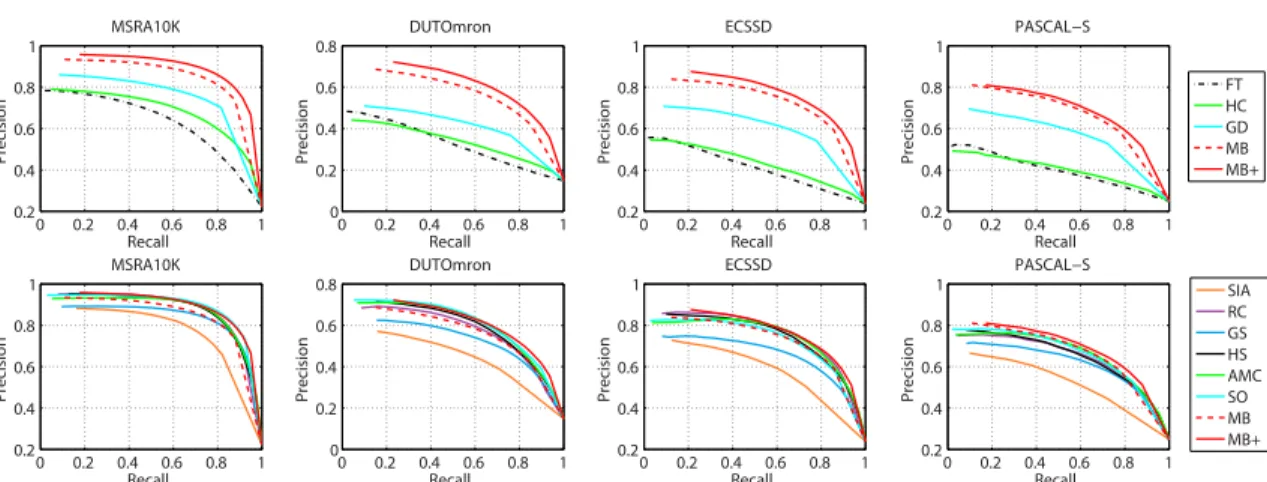
4.6 Precision-recall curves of the compared salient region detection methods 74 4.7 Weighted-Fβ scores of compared salient region detection methods. . . 76
4.8 Weighted-Fβ scores when the effect of post-processing is controlled . . 77
4.9 Sample saliency maps of the compared salient region detection methods. 78 4.10 Some failure cases of our salient region detection method . . . 79
5.1 Illustration of the greedy algorithm for the subset optimization . . . . 89
5.2 Precision-Recall curves of compared methods . . . 96
5.3 Sample detection results of our salient object detection method . . . 96
5.4 Object proposal generation performance on VOC07 . . . 98
6.1 Examples of the subtilizing phenomenon . . . 103
6.2 Example labeled images for AMT workers . . . 106
6.3 Sample images with divergent labels . . . 108
6.4 Averaged confusion matrix of our offline human subitizing test . . . . 109
6.5 Sample images that are consistently labeled differently in the offline test from AMT worker’s labels . . . 111
6.6 Sample synthetic images . . . 114
6.7 Subitizing vs.counting . . . 119
6.9 Example images of overlapping objects and multiple object categories 121
6.10 Feature visualization of the learned CNN model . . . 125
6.11 Precision-Recall curve of USOD and the performance of USOD+SOS and USOD+GT . . . 130
6.12 nDCG scores for compared methods . . . 136
6.13 Sample results of the SOS-based method for number-object image retrieval . . . 136
7.1 Deterministic WTAvs. our probabilistic WTA . . . 141
7.2 Example Marginal Winning Probability (MWP) maps . . . 145
7.3 Illustration of the contrastive attention formulation . . . 146
7.4 Marginal Winning Probability vs.contrastive MWP . . . 147
7.5 Mean accuracy per category on VOC07 using GoogleNet . . . 154
7.6 Mean accuracy per category on COCO using GoogleNet . . . 155
7.7 Example attention maps using GoogleNet . . . 156
7.8 Effects of layer selection on VOC07 difficult set . . . 157
7.9 Example word attention maps obtained by c-MWP . . . 163
7.10 Examples of localizing gender attributes . . . 164
A.1 Illustration of Lemma A.1 and Theorem A.2 . . . 179
A.2 An example to show the effects of the two modification steps in the proof of Theorem A.2 . . . 180
∆QDCT . . . Multi-scale Quaternion Discrete Cosine Transform Model
AIM . . . Attention Based on Information Maximization Model
AMC . . . Absorbing Markov Chain Model
AMT . . . Amazon Mechanic Turk
AP . . . Average Precision
AUC . . . Area Under the Curve
AWS . . . Adaptive Whitening Saliency Model
BMS . . . Boolean Map Saliency
CAM . . . Class Activation Map
CAS . . . Context Aware Saliency Model
CBIR . . . Content Based Image Retrieval
CCA . . . Canonical-Correlation Analysis
CIE . . . International Commission on Illumination
c-MWP . . . Contrastive Marginal Winning Probability
CNN . . . Convolutional Neural Network
COCO . . . Common Objects in Context Dataset
CPU . . . Central Processing Unit
Deconv . . . Deconvolution Based Method
DTC . . . Distance-to-Center
EB . . . Edge Boxes Model
ECSSD . . . Extended Complex Scene Saliency Dataset
FPR . . . False Positive Rate
FPS . . . Frame per Second
FT . . . Frequency Tuned Model
GBVS . . . Graph Based Visual Saliency Model
GD . . . Geodesic Distance
GPU . . . Graphic Processing Unit
Grad . . . Gradient Based Method
GS . . . Geodesic Saliency Model
GT . . . Ground Truth
HC . . . Histogram Contrast Model
HFT . . . Hypercomplex Fourier Transform Model
HIT . . . Human Intelligence Task
HOG . . . Histogram of Gradients
HS . . . Hierarchical Saliency Model
IBC . . . Image Boundary Contrast
ILSVRC . . . ImageNet Large Scale Visual Recognition Competition
ImgSal . . . the Image Saliency Dataset
I/O . . . Input/Output
IO . . . Inter-Observer
IOU . . . Intersection over Union
IFV . . . Improved Fisher Vector
KNN . . . K-nearest-neighbor
LG . . . Local and Global Patch Rarity Model
LOO . . . Leave-One-Out
LRP . . . Layer-wise Relevance Propagation
mAP . . . mean Average Precision
MAP . . . Maximum a Posteriori
MB . . . Minimum Barrier Saliency Model
MBox . . . Multi-Box Model
MBD . . . Minimum Barrier Distance
MCG . . . Multiscale Combinatorial Grouping Model
MIL . . . Multiple Instance Learning
MIT . . . Massachusetts Institute of Technology
MMR . . . Maximum Marginal Relevance
MSO . . . Multi Salient Object Dataset
MSRA . . . Microsoft Research Asia
MWP . . . Marginal Winning Probability
nDCG . . . Normalized Discounted Cumulative Gain
NMS . . . Non-maximum Suppression
NP . . . Noun Phrase
NSS . . . Normalized Scanpath Saliency
NUS . . . National University of Singapore
PASCAL . . . Pattern Analysis, Statistical Modelling
and Computational Learning
PCA . . . Principle Component Analysis
PR . . . Precision Recall
ReLU . . . Rectified Linear Unit
RNN . . . Recurrent Neural Network
ROC . . . Receiver Operating Characteristic
RS . . . Region Sampling
sAUC . . . Shuffled Area Under the Curve
SBU . . . Stony Brook University
SC . . . Saliency by Composition Model
SGD . . . Stochastic Gradient Descend
SIA . . . Soft Image Abstraction Model
SIFT . . . Scale Invariant Feature Transform
SigSal . . . Image Signature Saliency Model
SO . . . Saliency Optimization Model
SOS . . . Salient Object Subitizing
SS . . . Selective Search Model
STD . . . Standard Deviation
SUN . . . Scene Understanding Dataset
SVM . . . Support Vector Machine
TF-IDF . . . Term Frequency-Inverse Document Frequency
THUS . . . Tsinghua University Saliency Dataset
TPR . . . True Positive Rate
USOD . . . Unconstrained Salient Object Detection Model
VGG . . . Visual Geometry Group
VOC . . . Visual Object Classes
WTA . . . Winner-Take-All
Introduction
Visual saliency computation is about detecting and understanding pertinent regions and elements in a visual scene. Given limited computational resources, the human visual system relies on saliency computation to quickly grasp important information from the excessive input from the visual world [216]. Modeling visual saliency com-putation can help computer vision systems to filter out irrelevant information and thus make them fast and smart. For example, saliency detection methods have been proposed to predict where people look [99], delineate between foreground regions and the background [1], and localize dominant objects in images [126]. These techniques
have been used in many computer vision applications, e.g. image segmentation [81],
object recognition [172], visual tracking [132], gaze estimation [193], action recogni-tion [139], and so on.
1.1
Problems of Visual Saliency Computation
In this thesis, we study a series of problems of visual saliency computation that range from low-level saliency detection to high-level salient object detection and scene understanding. In the following, we will describe these problems, discuss existing challenges and introduce our approaches to these problems.
(a)
(b)
(c)
(d)
(e)
Figure 1.1: (a) A sample image from the DUT-Omron dataset [221]. (b) The ground truth for eye fixation prediction. Each white spot on the map is an eye fixation position of some participant in the free-viewing experiment. (c) The saliency map by an state-of-the-art method for eye fixation prediction [74]. (d) The ground truth for salient region detection. (e) The saliency map by an state-of-the-art method for salient object detection [96].
1.1.1 Eye Fixation Prediction
Eye fixation prediction aims to compute a saliency map that topographically rep-resents humans’ attentional priority when they freely view a given image. Predict-ing human eye fixation is useful in applications related to human-computer
inter-action and graphics, e.g. gaze estimation [193], eye tracker calibration [192],
non-photorealistic rendering [56], stereoscopic disparity manipulations [104], image
re-targeting [167], photo quality assessment [146], etc. Other computer vision tasks
such as action recognition, tracking and object detection can also benefit from this task by analyzing relevant regions indicated by human eye fixation [132, 139, 172]. To evaluate the success of an eye fixation prediction method, free-viewing eye fix-ation data are collected using eye trackers to assess the accuracy of saliency maps (see Fig. 1.1 (a) and (b)).
A majority of existing eye fixation prediction models are based on the contrast
image properties have limited ability to model some global perceptual phenomena [109] known to be relevant to the deployment of visual attention. One such global perception mechanism is figure-ground segregation. Several factors are likely to
in-fluence figure-ground segregation,e.g. size, surroundedness, convexity and symmetry
[149]. In the first part of this thesis, we explore the utility of the surroundedness cue for eye fixation detection. The essence of surroundedness is the enclosure topological relationship between different visual components. This kind of topological relation-ship is invariant under homeomorphisms; thus it is a quite fundamental property of a scene, regardless of the scale or the shape of the visual content.
To demonstrate the strength of the surroundedness cue for eye fixation detec-tion, we propose a simple, training-free and computationally efficient Boolean Map Saliency model (BMS). In our formulation, an image is characterized by a set of randomly sampled Boolean maps. For each Boolean map, an attention map is effi-ciently computed using binary image processing techniques to activate regions with closed outer contours. Then, attention maps are averaged into a mean attention map, which is further post-processed to suit the purpose of eye fixation prediction. Despite its simplicity, BMS consistently achieves state-of-the-art performance across all the testing datasets. Regarding the efficiency, BMS can be configured to run at about 100 FPS with only a little drop in performance, which makes it quite suitable for many time-critical applications.
To provide insight into why and how BMS can capture the surroundedness cue
via Boolean maps, we draw a connection between BMS and the Minimum Barrier
Distance (MBD) [190]. We prove that BMS is able to approximate the MBD of each pixel to the image border. Thus, BMS shares the desirable properties of MBD discovered in [190, 48], thereby guaranteeing that the surroundedness cue is properly
captured by BMS in a robust way.
1.1.2 Salient Region Detection
The goal of salient region detection is to compute a saliency map that highlights the overall region of dominant objects in a scene. This task is different from eye fixation prediction in that it requires the saliency map to uniformly highlight the regions of dominant objects with precise object boundary details. Without any prior infor-mation about object categories, salient region detection methods can automatically generate saliency maps to extract dominant objects, and thus this task is useful for automatic image segmentation [40] and photo editing applications [38, 88, 45]. In experiments, human-annotated foreground masks are used to evaluate saliency maps (see Fig. 1.1 (d) and (e)).
Due to the emerging applications on mobile devices and large scale datasets, a desirable salient region detection method should not only output high quality saliency maps, but should also be highly computationally efficient. In the second part of this thesis, we address both the quality and speed challenges for salient region detection. The Image Boundary Connectivity Cue, which assumes that background regions are usually connected to the image borders, is shown to be effective for salient region detection [241, 213, 230, 221]. To leverage this cue, previous methods, geodesic-distance-based [213, 241] or diffusion-based [96, 221], rely on a region abstraction step to extract superpixels. The superpixel representation helps remove irrelevant images details, and/or makes these models computationally feasible. However, this region abstraction step also becomes a speed bottleneck for this type of methods.
To boost the speed, we propose a method to exploit the image boundary connec-tivity cue without region abstraction. Inspired by the connection between our BMS
Input
Output
Figure 1.2: Example results of our salient object detection method. Our salient object detection method aims to generate a highly reduced set of detection windows (shown in the bottom row) that localize each salient object in an image. Note that for the input image in the right column, where no dominant object exists, our method does not output any detection window.
eye fixation prediction method and theMinimum Barrier Distance (MBD) [190, 48]
(see Sec. 1.1.1), we use the MBD [190, 48] to measure a pixel’s connectivity to the image boundary. Compared with the widely used geodesic distance, the MBD is much more robust to pixel value fluctuation. Since the exact algorithm for the MBD transform is not very efficient, we present FastMBD, a fast raster-scanning algorithm for the MBD transform, which provides a good approximation of the MBD transform in milliseconds, being two orders of magnitude faster than the exact algorithm [48]. The proposed salient region detection method runs at about 80 FPS using a single thread, and achieves comparable or better performance than the leading methods on four benchmark datasets. Compared with methods with similar speed, our method gives significantly better performance.
1.1.3 Salient Object Detection
Detecting generic salient objects in unconstrained images, which may contain mul-tiple salient objects or no salient object, is a challenging problem (see examples in
Fig. 1.2). Solving this problem entails generating a compact set of detection win-dows that matches the number and the locations of salient objects. Detecting each salient object (or reporting that no salient object is present) can be very helpful in the weakly supervised or unsupervised learning scenario [39, 102, 240], where object appearance models are to be learned with no instance level annotation.
Many previous methods [1, 42, 180, 127, 97, 18] only solve the task of salient region detection, i.e. generating a dense foreground mask (saliency map). These methods do not individuate each object. In contrast, we present a salient object detection system that directly outputs a compact set of detections windows for an unconstrained
image. Our system leverages the high expressiveness of a Convolutional Neural
Network (CNN) model to generate a set of scored salient object proposals for an image. Inspired by the attention-based mechanisms of [115, 10, 141], we propose an Adaptive Region Sampling method to make our CNN model “look closer” at
promising images regions, which substantially increases the detection rate. The
obtained proposals are then filtered to produce a compact detection set.
A key difference between salient object detection and object class detection is that saliency greatly depends on the surrounding context. Therefore, the salient object proposal scores estimated on local image regions can be inconsistent with the ones estimated on the global scale. This intrinsic property of saliency detection makes our proposal filtering process very challenging. Using the common greedy Non-maximum Suppression (NMS) method often leads to suboptimal results for our proposals. To attack this problem, we propose a subset optimization formulation
based on the Maximum a Posteriori (MAP) principle, which jointly optimizes the
number and the locations of detection windows. The effectiveness of our optimization formulation is validated on three benchmark datasets, where our formulation attains
about 15% relative improvement in Average Precision (AP) over the NMS approach. Moreover, our method also attains about 15-35% relative improvement in AP over previous methods on these datasets.
1.1.4 Salient Object Subitizing
In the fourth part of this thesis, we propose a new problem of visual saliency compu-tation, called Salient Object Subitizing (SOS), which is to predict the existence and the number of salient objects in an image using holistic cues. This task is inspired by humans’ subitizing ability to quickly and accurately tell the number of items within the subitizing range (1-4) [103]. Because the appearance and size of salient objects can vary dramatically from category to category, and from image to image, the SOS problem poses very different challenges than traditional object counting problems [144, 4].
Knowing the existence and the number of salient objects without the expensive detection process can enable a machine vision system to select different processing pipelines at an early stage, making the vision system more intelligent and reducing computational cost. Furthermore, differentiating between scenes with zero, a single and multiple salient objects can also facilitate applications like image retrieval, iconic image detection [17], image thumbnailing [46], robot vision [174], egocentric video
summarization [117], snap point prediction [218], etc.
To study the SOS problem, we present a salient object subitizing image dataset of about 14K everyday images. The number of salient objects in each image was annotated by Amazon Mechanical Turk (AMT) workers. The resulting annotations from the AMT workers were analyzed in a more controlled offline setting; this analysis showed a high inter-subject consistency in subitizing salient objects in the collected
0 1 2 3 4+
Figure 1.3: Sample images of the proposed SOS dataset. We collected about 14K everyday images, and use Amazon Mechanical Turk (AMT) to annotate the number of salient object of each image. The consolidated annotation is shown on the top of each image group. These images cover a wide range of content and object categories.
images. Sample images of the SOS dataset are shown in Fig. 1.3.
We formulate the SOS problem as an image classification task, and aim to de-velop a method to quickly and accurately predict the existence and the number of generic salient objects in everyday images. We propose to use an end-to-end trained Convolutional Neural Network (CNN) model for our task, and show that an imple-mentation of our method achieves very promising performance. In particular, the CNN-based subitizing model can approach human performance in identifying im-ages with no salient object and with a single salient object. To further improve the training of the CNN SOS model, we propose a method to leverage synthetic images. Moreover, we demonstrate the application of our CNN-based SOS method in salient object detection and image retrieval.
1.1.5 Top-down Saliency Detection
In many applications such as object localization, detection and segmentation, top-down task-driven saliency can be more useful than bottom-up saliency. Many pre-vious top-down saliency models [222, 73, 101] require manually annotated object category masks for the training images, which are expensive to collect. Moreover, the model training and the data annotation are difficult to scale up with the number
of object categories. In the fifth part of this thesis, we propose a weakly-supervised approach to top-down saliency detection by modeling the top-down attention of a CNN image classifier.
Inspired by the Selective Tuning model [204], we formulate the top-down atten-tion of a CNN classifier as a probabilistic Winner-Take-All (WTA) process. The probabilistic WTA formulation is realized by a novel backpropagation scheme, called
Excitation Backprop, which integrates both top-down and bottom-up information and computes the winning probability of each neuron in an efficient layer-wise man-ner. Interpretable attention maps can be generated by Excitation Backprop at each intermediate convolutional layer, thus avoiding the need to perform a complete back-ward sweep. Based on the probabilistic WTA formulation, we further introduce the concept of contrastive top-down attention, which captures the differential effect be-tween a pair of contrastive top-down signals. The contrastive top-down attention can significantly improve the discriminativeness of attention maps for cluttered scenes.
Our top-down attention model for CNN classifiers provides substantially better performance in weakly supervised localization tasks than previous techniques for CNN visualization and saliency computations [181, 226, 27, 238, 11]. We further explore the scalability of our top-down attention model for localizing a large number of visual concepts. For this purpose, we train a CNN tag classifier on 6M web
images collected from a commercial stock image website1. These images come with
user tags, which cover a wide range of concepts, including objects, scenes, body
parts, attributes, activities, and abstract concepts (e.g. holiday). The CNN tag
classifier is trained to predict ∼18K tags only using the multi-label classification
objective function. However, by leveraging the top-down attention model, our image 1
Input chair glass boy woman man couple father
Figure 1.4: A CNN classifier’s top-down attention maps generated by our Excitation
Backprop can localize common object categories, e.g. chair and glass, as well
as fine-grained categories like boy, man and woman in this example image, which
is resized to 224×244 for our method. The classifier in this example is trained to
predict∼18K tags using only weakly labeled web images. Visualizing the classifier’s
top-down attention can also help interpret what has been learned by the classifier.
For couple, we can tell that our classifier uses the two adults in the image as the
evidence, while for father, it mostly concentrates on the child. This indicates that
the classifier’s understanding of father may strongly relate to the presence of a
child.
tag classifier can be used to localize a variety of visual concepts. Moreover, our method can also help to understand what has been learned by our tag classifier. Some examples are shown in Fig. 1.4.
The performance of our method is also evaluated on the challenging Flickr30k Entities dataset [158]. Without using a language model or any localization supervi-sion, our top-down attention based approach achieves competitive phrase-to-region performance against a state-of-the-art fully-supervised method [158].
1.2
Contributions
In this thesis, we propose novel solutions, theoretic algorithmic analyses and new problems for visual saliency computation. Our contributions are summarized as follows.
• We propose a novel eye fixation prediction model, Boolean Map Saliency (BMS),
representa-tion. BMS is advantageous in terms of both speed and accuracy compared with state-of-the-art methods. We provide insight into BMS by showing the connection between BMS and the Minimum Barrier Distance.
• We propose a salient region detection algorithm based on an approximate MBD
transform algorithm, FastMBD, which is 100X faster than the exact algorithm. Our salient region detention method achieves state-of-the-art performance at a substantially reduced computational cost. Moreover, we present a theoretic error bound analysis for the FastMBD algorithm.
• We present a salient object detection method that outputs high quality
detec-tion windows for unconstrained images. A novel MAP-based subset optimiza-tion formulaoptimiza-tion is proposed for filtering bounding box proposals. We achieve significant improvement over the state-of-the-art methods on three challenging benchmark datasets.
• We formulate the Salient Object Subitizing (SOS) problem, which aims to
predict the number of salient objects in an image without resorting to any object localization process. A large-scale image dataset is collected for studying the SOS problem and benchmarking SOS models. We present a CNN-based method for SOS, and propose to use synthetic images to improve the learned CNN model. Moreover, we demonstrate applications of the SOS method in salient object detection and image retrieval.
• We propose a top-down attention model for CNN classifiers based on a
proba-bilistic Winner-Take-All process using a novel Excitation Backprop scheme. A contrastive top-down attention formulation is also proposed for enhancing the discriminativeness of attention maps. Moreover, we conduct a large scale
em-pirical exploration of weakly supervised text-to-region association by leveraging our top-down neural attention model.
1.3
Roadmap of Thesis
The rest of the thesis is organized as follows:
Chapter 2: Related Work
This chapter reviews related works for eye fixation prediction, salient region de-tection, salient object dede-tection, salient object subitizing and top-down saliency detection.
Chapter 3: Saliency Detection: A Boolean Map Approach
This chapter describes our Boolean Map based Saliency (BMS) detection method for eye fixation prediction. We first present an overview of the formulation of BMS. Given an image, the BMS model first represents the image by a set of Boolean maps, and then detects surrounded regions on the Boolean maps to compute activation maps. After normalization, the activation maps are aver-aged to generate the final saliency map. After each part of the formulation is described in detail, we provide a theoretic connection between BMS and the Minimum Barrier Distance (MBD) transform. We show that BMS captures the MBD of each pixel to the image boundary region. Finally, we conduct experiments to evaluate and analyse our BMS model. We show that BMS achieves state-of-the-art performance on seven eye tracking datasets. Further-more, BMS can run at about 100 FPS with only a slight drop in performance.
This chapter presents our minimum barrier salient region detection method. We start with some preliminaries of the MBD transform, and then propose fastMBD, a fast iterative approximate MBD transform algorithm. Furthermore,
we show a theoretic error bound analysis and prove that fastMBD approaches
the exact algorithm in an asymptotic sense. We also empirically verify that
fastMBDcan achieve satisfying approximation accuracy in a couple of iterations
in practice. Based on fastMBD, we propose a salient region detection method
that combines the image boundary connectivity cue and the backgroundness cue. Finally, we evaluate the speed and accuracy of our salient region detection method. Our method compares favorably with state-of-the-art methods, while being at least one order of magnitude faster.
Chapter 5: Unconstrained Salient Object Detection
This chapter describes our unconstrained salient object detection method. We first propose the MAP-based framework for bounding box filtering. Then, we delve into details of each component in our formulation. Our bounding box formulation aims to cluster bounding boxes and select a representative bound-ing box as output from each cluster. Our formulation jointly considers the confidence scores and the spatial relationships of bounding boxes, and it favors a reduced detection window set. We propose to solve our objective function using a greedy algorithm. After that, we describe our CNN-based salient object proposal generation model. We propose an adaptive region sampling scheme to enhance the proposal generation performance. Our experiment results val-idate the benefits of our MAP-based bounding box filtering formulation on three salient object detection datasets. Our full system also significantly out-performs previous methods. Extensive component analysis is provided at the
end of the chapter.
Chapter 6: Salient Object Subitizing
This chapter describes a new problem, Salient Object Subitizing (SOS), the collection of a large-scale SOS image dataset, and our proposed CNN-based subitizing method. We first provide details about the data collection and an-notation for the SOS dataset. We collected about 14K images, which were annotated by Mechanical Turk workers. Then, we conduct a controlled offline experiment to validate human annotation consistency for our collected images. After that, we present the CNN subtizing model and a method to leverage synthetic images for model training. In experiments, we compare our CNN subitizing model with several baselines and our model gives significant better performance. More analyses are provided to validate the usage of the synthetic images and the generalizability of our model. In particular, we visualize the learned CNN features and quantitatively evaluate how well our model general-izes to unseen categories. Finally, we demonstrate two applications of our CNN subitizing model in salient object detection and image retrieval. We show that our CNN subitizing model can improve the performance of our unconstrained salient object detection method, and can be used for image search with object number constraints.
Chapter 7: Top-down Neural Attention by Excitation Backprop
This section presents our top-down neural attention model for modern CNNs using Excitation Backprop. Inspired by the Selective Tuning attention model, we propose a probabilistic Winner-Take-All (WTA) formulation for localizing task-relevant network neurons. We also discuss the connection between our
formulation and the absorbing Markov Chain process. Our formulation can be efficiently implemented via our novel Excitation Backprop scheme. Then, we introduce the idea of contrastive attention to enhance the discriminativeness of the generated attention maps. Implementation details of Excitation Backprop for common CNN layers are described. In the experiments, we devise a pointing game to compare different methods in weakly supervised localization. We show our method attains significantly better performance. Our method also provides competitive performance on another weakly supervised localization setting. Finally, we demonstrate the scalability of our method by training a CNN image tag classifier for about 18K tags using web images. By leveraging our top-down neural attention model, we achieve promising results on a challenging phrase localization dataset without using a language model or any bounding box annotation.
Chapter 8: Conclusions and Future Work
This chapter summarizes our contributions and discusses the strengths and lim-itations of each proposed method. Some future directions and open problems are presented in the end.
1.4
List of Related Papers
Material for this thesis is based on the following papers:
1. Jianming Zhang, Shugao Ma, Mehrnoosh Sameki, Stan Sclaroff, Margrit
Betke, Zhe Lin, Xiaohui Shen, Brian Price and Radom´ır M˘ech. “Salient Object
Subitizing.” Submitted to International Journal of Computer Vision (IJCV),
2. Jianming Zhang, Zhe Lin, Jonathan Brandt, Xiaohui Shen, Stan Sclaroff.
“Top-down Neural Attention by Excitation Backprop.” In Proc. of the
Euro-pean Conference on Computer Vision (ECCV), oral, 2016.
3. Jianming Zhang, Stan Sclaroff, Zhe Lin, Xiaohui Shen, Brian Price and
Radom´ır Mˇech. “Unconstrained Salient Object Detection via Proposal
Sub-set Optimization.” In Proc. of the IEEE Conference on Computer Vision and
Pattern Recognition (CVPR), spotlight, 2016.
4. Jianming Zhang and Stan Sclaroff. “Exploiting Surroundedness for Saliency
Detection: A Boolean Map Approach.” IEEE Transaction Pattern Analysis
and Machine Intelligence (TPAMI), 2016.
5. Jianming Zhang, Stan Sclaroff, Zhe Lin, Xiaohui Shen, Brian Price and
Radom´ır M˘ech. “Minimum Barrier Salient Object Detection at 80 FPS.” In
Proc. of the IEEE International Conference on Computer Vision(ICCV), oral, 2015.
6. Jianming Zhang, Shugao Ma, Mehrnoosh Sameki, Stan Sclaroff, Margrit
Betke, Zhe Lin, Xiaohui Shen, Brian Price and Radom´ır M˘ech. “Salient Object
Subitizing.” InProc. of the IEEE Conference on Computer Vision and Pattern
Recognition(CVPR), 2015.
7. Jianming Zhang and Stan Sclaroff. “Saliency Detection: A Boolean Map
Approach.” InProc. of the IEEE International Conference on Computer Vision
Related Work
In this chapter, we review related areas for each of our visual saliency computation problems.
2.1
Eye Fixation Prediction
There have been many eye fixation models based on a variety of principles and assumptions. We review some typical approaches to this problem.
Rarity/contrast based models. A majority of the previous eye fixation mod-els use center-surround contrast or image statistics to identify salient patches that are complex (local complexity/contrast) or rare in their appearance (rarity/improbability). Center-surround contrast is used by [91, 178, 199, 64] for eye fixation prediction. The contrast and rarity of an image region are also widely exploited for eye fixation prediction via information theoretic models [25, 235], Bayesian probabilistic models [90], graphical models [83], color co-occurrence histogram [128] and feature vector differences [74, 63, 35].
Spectral analysis models. Another family of eye fixation prediction models is based on spectral domain analysis [87, 86, 175, 120]. In [120] it is argued that some previous spectral analysis based methods are equivalent to a local gradient operator plus Gaussian blurring, and thus cannot detect large salient regions very well. To
overcome this limitation, a method based on spectral scale-space analysis is proposed by [120].
Learning based models. Some models employ machine learning to learn eye
fixation patterns. Kienzel et al. [106] learn a kernel support vector machine (SVM)
based on eye tracking data. Juddet al. [99] train an SVM using a combination of low,
middle and high level features. In [209, 114], Convolutional Neural Network models are leveraged for eye fixation prediction. A linear weighting function is learned by [82] to combine different types of eye fixation models.
Unlike the previous approaches, our proposed BMS formulation does not rely on center-surround filtering, statistical analysis of features, spectral transforms, off-line learning, or multi-scale processing. Instead, it makes use of simple image processing operations to leverage the topological structural cue, which is scale-invariant and known to have a strong influence on visual attention [216, 37].
2.2
Salient Region Detection
While eye fixation prediction methods often generate highly sparse saliency maps, salient region detection aims at uniformly highlighting the salient object regions with well defined boundaries. We review several typical approached to this problem.
Rarity/contrast based models. Similar to eye fixation prediction methods, many salient region detection methods are based on the rarity/contrast cue [42, 137, 220, 153, 43]. To uniformly highlight the object regions, these methods also
leverage other priors, e.g. region uniformity, spatial compactness and centeredness.
Because these methods are effective at detecting object regions with distinct color or appearance from the background, but cannot well detect low contrast foreground regions.
Boundary prior based models. The image boundary prior has been used for salient region detection, assuming that most image boundary regions are background. Salient regions can be inferred by their dissimilarity in appearance [121, 96, 127], or their connectivity [241, 213, 230] with respect to the image boundary regions. These methods often jointly consider the geometric property and the appearance contrast, and thus can better handle foreground regions with complex appearance when the boundary assumptions hold.
Learning based models. Some recent methods [97, 123, 127, 236] have
at-tained superior performance by using machine learning techniques. These
data-driven methods are able to handle challenging scenarios where learning-free methods fail. However, they require off-line training with fully annotated images, which can be expensive to get. Many of these methods use complex region-level features based on object proposal generation and Convolutional Neural Networks. Therefore, these methods are often much slower than the training-free methods.
2.3
Salient Object Detection
Few attempts have been made in detecting each individual salient object in uncon-strained images. Therefore, we review several most relevant areas.
Salient region detection. Salient region detection aims at generating a dense foreground mask (saliency map) that separates salient objects from the background of an image [1, 42, 180, 220, 97]. Some methods can detect regions of multiple salient objects [133, 123]. However, these methods do not separate each object.
Salient object localization. Given a saliency map, some methods find the best detection window based on heuristics [126, 207, 194, 130]. Various segmentation techniques are also used to generate binary foreground masks to facilitate object
localization [126, 136, 78, 129]. A learning-based regression approach is proposed in [212] to predict a bounding box for an image. Most of these methods critically rely on the assumption that there is only one salient object in an image. In [126, 129], it is demonstrated that segmentation-based methods can localize multiple objects in some cases by tweaking certain parts in their formulation, but they lack a principled way to handle general scenarios.
Predicting the existence of salient objects. Existing salient object/region detection methods tend to produce undesirable results on images that contain no dominant salient object [212, 18]. In [212, 174], a binary classifier is trained to detect the existence of salient objects before object localization. In [229], a salient object subitizing model is proposed to suppress the detections on background images that contain no salient object. While all these methods use a separately trained background image detector, we provide a unified solution to the problems of Existence and Localization through our subset optimization formulation.
Object proposal generation. Object proposal methods [2, 32, 242, 206, 6, 44] usually generate hundreds or thousands of proposal windows in order to yield a high recall rate. While they can lead to substantial speed-ups over sliding window ap-proaches for object detection, these proposal methods are not optimized for localizing salient objects. Some methods [184, 72] generate a ranked list of proposals for salient objects in an image, and can yield accurate localization using only the top few pro-posals. However, these methods do not aim to produce a compact set of detection windows that exactly match the ground-truth objects.
2.4
Salient Object Subitizing
Salient object detection. Ideally, if a salient object detection method can well localize each salient object, then the number of objects can be simply inferred by counting the detection windows. However, many existing salient object detection methods assume the existence of salient objects, and they are mainly tested and optimized for images that contain a single dominant object, as observed in [123, 21]. Therefore, salient object detection methods often generate undesirable results on background images, and are prone to fail on images with multiple objects and complex background. Recently, [234] proposed a salient object detection method for unconstrained images. Although this method can handle complex images to some extent, we will show that the counting-by-detection approach is less effective than our subitizing method in predicting the number of salient objects.
Detecting the existence of salient objects. Only a few works address the problem of detecting the existence of salient objects in an image. [212] use a global feature based on several saliency maps to determine the existence of salient objects in thumbnail images. Their method assumes that an image either contains a single salient object or none. [174] use saliency histogram features to detect the existence of interesting objects for robot vision. It is worth noting that the testing images handled by the methods of [212] and [174] are substantially simplified compared to ours, and these methods cannot predict the number of salient objects.
Automated object counting. There is a large body of literature about auto-mated object counting based on density estimation [119, 8], object detection/segmentation [191, 144, 4] and regression [30, 31]. While automated object counting methods are often designed for crowded scenes with many objects to count, the SOS problem aims to discriminate between images with 0, 1, 2, 3 and 4+ dominant objects.
people and cells), and assumes that the target objects have similar appearances and sizes in the testing scenario. On the contrary, the SOS problem addresses category-independent inference of the number of salient objects. The appearance and size of salient objects can vary dramatically from category to category, and from image to image, which poses a very different challenge than the traditional object counting problem.
Modeling visual numerosity. Some researchers exploit deep neural network models to analyze the emergence of visual numerosity in human and animals [189, 243]. In these works, abstract binary patterns are used as training data, and the re-searchers study how the deep neural network model captures the number sense during either unsupervised or supervised learning. Our work looks at a more application-oriented problem, and targets at inferring the number of salient objects in natural images.
2.5
Top-down Saliency Detection
We propose a top-down saliency detection method by modeling a CNN classifier’s top-down attention. Unlike traditional top-down saliency detection method based on hand-crafted features and fully supervised training [222, 101], our approach is weakly supervised by leveraging modern CNN classifiers and is related to biologically inspired computational attention theories. We review the following closely related areas.
Top-down attention models for human visual system. There is a rich literature about modeling the top-down influences on selective attention in the human visual system (see [13] for a review). It is hypothesized that top-down factors like knowledge, expectations and behavioral goals can affect the feature and location
expectancy in visual processing [215, 202, 108, 61], and bias the competition among the neurons [161, 204, 61, 60, 16]. Our attention model is related to the Selective Tuning model of [204], which proposes a biologically inspired attention model using a top-down WTA inference process.
Grounding CNN’s predictions. Various methods have been proposed to lo-calize regions that may be relevant to a CNN’s prediction [181, 226, 27, 238, 237, 11]. In [181, 226, 187], error backpropagation based methods are used for visualizing rel-evant regions for a predicted class or the activation of a hidden neuron. Recently, a layer-wise relevance backpropagation method is proposed by [11] to provide a
pixel-level explanation of CNNs’ classification decisions. Caoet al.[27] propose a feedback
CNN architecture for capturing the top-down attention mechanism that can success-fully identify task relevant regions. In [237], it is shown that replacing success-fully-connected layers with an average pooling layer can help generate coarse class activation maps that highlight task relevant regions. Unlike these previous methods, our top-down attention model is based on the WTA principle, and has an interpretable probabilis-tic formulation. Our method is also conceptually simpler than [27, 237] as we do not require modifying a network’s architecture or additional training. The ultimate goal of our method goes beyond visualization and explanation of a classifier’s decision [226, 187, 11], as we aim to maneuver CNNs’ top-down attention to generate highly discriminative attention maps for the benefits of localization.
Attention mechanisms for recurrent neural networks. Attention mecha-nisms have been employed in recurrent neural network models for applications like image classification [142], machine translation [12] and image caption generation [219]. Attention mechanisms can make the network models selectively attend to relevant parts of the input for a task. In [219], a recurrent attention mechanism
is used to highlight the important regions for generating words for image caption-ing. Unlike our problem, this work targets at modeling the attention mechanism for inference, and it requires specific model design and model training to learn the attention model. Moreover, this method can only passively generate attention maps to explain the predicted words, and it lacks a way to explicitly control the generation of top-down attention maps for designated words.
Weakly supervised localization by CNN. Training CNNs to localize objects or visual concepts by weak supervision has been studied by [147, 151, 150, 157, 69]. In [147, 69, 157], a CNN model is transformed into a fully convolutional net to perform efficient sliding window inference, and then Multiple Instance Learning (MIL) is integrated in the training process through various pooling methods over the confidence score map. Due to the large receptive field and stride of the output layer, the resultant score maps only provide very coarse location information. To
overcome this issue, a variety of strategies, e.g. image re-scaling and shifting, have
been proposed to increase the granularity of the score maps [147, 157, 156]. Image and object priors are also leveraged to improve the object localization accuracy in [151, 150, 157].
Compared with weakly supervised localization, the problem setting of our task is essentially different. We assume a pre-trained deep CNN model is given, which may not use any dedicated training process or model architecture for the purpose of localization. Our focus, instead, is to model the top-down attention mechanism of generic CNN models to produce interpretable and useful task-relevant attention maps.
Saliency Detection: A Boolean Map
Approach
In this chapter, we propose a saliency detection model for eye fixation prediction. A majority of existent saliency models of this type are heavily based on the contrast
and the rarity properties of local image patches, e.g. [91, 25, 19]. However, these
local image properties have limited ability to model some global perceptual phenom-ena [109] known to be relevant to the deployment of visual attention. One such global perception mechanism is figure-ground segregation. As Gestalt psychological studies suggest, figures are more likely to be attended to than background elements [166, 140] and the figure-ground assignment can occur without focal attention [107]. Neuroscience findings also show that certain responses in monkey and human brains involved in shape perception are critically dependent on figure-ground assignment [15, 111], indicating that this process may start early in the visual system.
Several factors are likely to influence figure-ground segregation, e.g. size,
sur-roundedness, convexity and symmetry [149]. In this work, we explore the utility of the surroundedness cue for saliency detection. The essence of surroundedness is the enclosure topological relationship between different visual components. This kind of topological relationship is invariant under homeomorphisms; thus it is a quite funda-mental property of a scene, regardless of the scale or the shape of the visual content.
Figure 3.1: (a) Image from the MIT dataset [99] (left) and its eye tracking data (right). (b) Saliency maps estimated by (from left to right) AIM [25], LG [19] and our method. AIM and LG measure an image patch’s saliency based on its rarity. Our method, based on global structural information, is less responsive to the elements in the background.
It is also worth noting that the topological status of a scene has long been identified as one of the probable attributes that guide the deployment of visual attention [216]. To demonstrate the strength of the surroundedness cue for saliency detection, we propose a simple, training-free and computationally efficient Boolean Map based Saliency model (BMS). In our formulation, an image is characterized by a set of randomly sampled Boolean maps. For each Boolean map, an attention map is ef-ficiently computed by binary image processing techniques to activate regions with closed outer contours. Then attention maps are averaged into a mean attention map, which is further post-processed to suit the purpose of eye fixation prediction.
Fig. 3.1 shows an example that the surroundedness cue for figure-ground segre-gation can help in saliency detection. A test image along with eye tracking data is displayed in Fig. 3.1 (a). The bird in the image is naturally perceived as the fore-ground and the rest as the backfore-ground, which is in agreement with the enclosure relationship between the bird and the sky. The eye fixations are concentrated on
the bird, corresponding well to this figure-ground assignment. However, without the awareness of this global structure, rarity based models [25, 19] falsely assign high saliency values to the boundary area between the trees and the sky, due to the rarity of high contrast regions in natural images. In contrast, by leveraging the surround-edness cue for figure-ground segregation, our model is less responsive to the edges and cluttered areas in the background (Fig. 3.1 (b)).
To provide insight into why and how BMS can capture the surroundedness cue
via Boolean maps, we draw a connection between BMS and the Minimum Barrier
Distance (MBD) [190]. We prove that BMS is able to approximates the MBD of each pixel to the image border. Thus, BMS shares the desirable properties of MBD discovered in [190, 48], which guarantees that the surroundedness cue is properly captured by BMS in a robust way.
BMS is extensively evaluated on seven eye tracking datasets, comparing with 10 state-of-the-art saliency models under two evaluation metrics. Detailed speed perfor-mance and component analyses are also provided. In our experiments, most of the competing models critically rely on off-line training or multi-scale processing, while BMS uses neither of them. Despite its simplicity, BMS consistently achieves state-of-the-art performance across all the testing datasets. Regarding the efficiency, BMS can be configured to run at about 100 FPS with only a little drop in performance, which makes it quite suitable for many time-critical applications.
The contribution of this work is summarized as follows:
• To the best of our knowledge, we show, for the first time, the usefulness of the
surroundedness cue for eye fixation prediction.
• We propose a simple saliency model, BMS, which is advantageous in terms of
Boolean Maps Attention Maps
Mean Attention Map
Σ Input Image
Activation Maps
Figure 3.2: The Pipeline of BMS. An image is first represented by a set of randomly generated Boolean maps. For each Boolean map, a binary activation map is produced by suppressing unsurrounded regions. Then a real-valued attention map is obtained by normalizing the activation map. At last, attention maps are linearly combined.
• We provide insight into BMS by revealing and proving the connection between
BMS and the Minimum Barrier Distance.
3.1
Boolean Map based Saliency
We start with a general description of our basic formulation. We borrow theBoolean
Map concept that was put forward in the Boolean Map Theory of visual attention
[89], where an observer’s momentary conscious awareness of a scene can be repre-sented by a Boolean Map. We assume that Boolean maps in BMS are generated
by sampling from a distribution function F(B|I) conditioned on the input image
I, and the influence of a Boolean map B on visual attention can be represented by
anAttention Map A(B), which highlights regions on B that attract visual attention.
Then the saliency is modeled by the mean attention map ¯Aover randomly generated
Boolean maps:
¯
A=
Z
A(B)dF(B|I), (3.1)
where ¯A can be further post-processed to suit the purpose of eye fixation prediction.
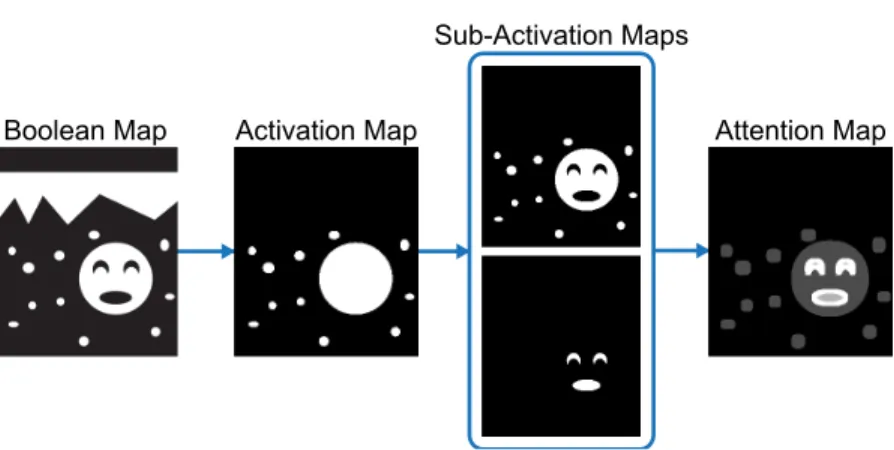
In our formulation, computing the attention mapA(B) for a Boolean map requires
a Boolean Activation Map M(B) is produced by removing unsurrounded regions on the Boolean map; in the normalization step, the attention map is computed by normalizing the activation map to emphasize those rare activated regions. The pipeline of the computation of the mean attention map is illustrated in Fig. 3.2.
3.1.1 Boolean Map Generation
BMS samples a set of Boolean maps by randomly thresholding the input image’s feature maps, according to the prior distributions over the feature channels and the threshold:
Bi =THRESH(φ(I), θ), (3.2)
φ∼Fφ, θ∼F φ θ.
The function THRESH(., θ) assigns 1 to a pixel if its value on the input map is greater
than θ, and 0 otherwise. φ(I) denotes a feature map of I, whose values, without
loss of generality, are assumed to range between 0 to 1. Fφ denotes the prior
distri-bution function for feature channel sampling, and Fθφ denotes the prior distribution
function for the threshold sampling on the feature channel φ. Feature channels can
consist of multiple features like color, intensity, depth, motion, etc. In this work, we
demonstrate the proposed formulation in an implementation using only color chan-nels of images. Note that although feature maps generated by various image filters are widely used in previous rarity/contrast based saliency models [8], [9], [30], our preliminary study shows that this feature maps of this type are not suitable for mea-suring surroundedness in our formulation, because they tend to lose the topological structure of the scene by only sparsely highlighting certain local patterns (e.g. edges and corners).
According to [62, Theorem 2.1], we have the following fact.
Proposition 3.1. LetFθ be a continuous cumulative distribution function of variable θ, and U be a random variable with uniform distribution over [0,1]. Then
P(θ≤x) = P(U ≤Fθ(x)), ∀x∈R.
It means that we can get equivalent sampling of Boolean maps from a feature
map φ(I) by first re-mapping the values of φ(I) using Fθφ, and then sampling a
threshold from a uniform distribution over [0,1]. Thus, without loss of generality, we
can always assume that the threshold θ is drawn from a uniform distribution over
[0,1]. As a result, the distribution of generated Boolean maps is now only dependent
on the specific parametrization of the feature space and the prior distribution for the feature channel selection.
If we want to further simplify the sampling process by assuming equal
impor-tance of different color channels, i.e. Fφ is uniform, then the color space should have
independent channels and the distance metric on different channels should be com-parable. Following this intuition, we propose a color whitening step to rectify a color
space before sampling the Boolean maps. Let xi = (x1i, x2i, x3i)T be the 3-D color
vector of a pixel indexed byi. Given an image, we first compute the color mean and
the color covariance matrix as follows.
x= 1 n X i xi, (3.3) Q= 1 n X i xixTi −xxT, (3.4)
by
yi = (Q+λI) −1
2 ·x
i, (3.5)
where yi is the color vector in the whitened space. I is the identity matrix and λ
serves as regularization parameter to avoid degeneracy. Note that this whitening process is not limited to color space, and it can help de-correlate and normalize
feature channels of multiple features such as color, depth, motion,etc. Feature space
whitening has been used for saliency detection in [163, 74], but for a different purpose. In [163, 74], a pixel’s saliency is directly measured by its distance to the sample mean in the whitened space.
In summary, to generate Boolean maps for an image, we first do color space whitening according to Eqns. 3.3, 3.4 and 3.5. Then we simply enumerate the color
channels and sample the threshold θ at a fixed step size δ within the range of that
channel. Note that in the limit, a fixed-step sampling is equivalent to the uniform sampling.
3.1.2 Attention Map Computation
Given a Boolean mapB, BMS computes the attention map A(B) by first activating
the surrounded regions on B, and then normalizing the resultant activation map
M(B) to further emphasize rare regions. We now describe these two steps in detail.
3.1.2.1 Activation
On a Boolean Map B, the pixels are separated into two complementary sets: the
white set C+ := {i : B(i) = 1} and the black set C− := {i : B(i) = 0}, where i
denotes the pixel index andB(i) denotes the Boolean value of pixelionB. Intuitively,
Boolean Map Activation Map
Sub-Activation Maps
Attention Map
Figure 3.3: The pipeline of the attention map computation. See the text for details. lies in a hole of the black (white) set. Formally, the surroundedness can be defined based on a pixel’s connectivity to the image border pixels.
Definition 3.1. On a Boolean MapB, a pixeliissurrounded if there exists no path
inC+ orC− that joins iand any image border pixel.
Here, a path is a sequence of pixels in which any pair of consecutive pixels are adjacent. On a 2D image, we consider 4-adjacency or 8-adjacency. It follows that a
pixel is surrounded iff it is not in