Adaptive Educational Hypermedia Systems based on
Learning Styles: The Case of Adaptation Rules
https://doi.org/10.3991/ijet.v12i05.6967
Xanthippi Tsortanidou
University of Thessaly, Volos, Greece [email protected]
Charalampos Karagiannidis
University of Thessaly, Volos, Greece [email protected]
Adamantios Koumpis
Universität Passau, Passau, Germany [email protected]
Abstract—This paper investigates the pedagogical basis of Adaptive Educa-tional Hypermedia Systems (AEHS) that incorporate Learning Styles in order to accommodate user's learning style preferences and needs. Therefore, AES adapt the learning content, its presentation and navigation to the user's learning style preferences. We collect thirty three (33) Adaptive and Intelligent Web-based Educational Systems (AIWBES) that incorporate learning styles and discuss twenty of them, namely the AEHS, as the remaining are Intelligent Tutorng Systems. The main achievement of this work is the investigation of AEHS' ped-agogical basis in terms of adaptation rules. We conclude that these systems fol-low similar patterns in their adaptation logic.
Keywords—adaptive educational hypermedia systems, learning styles, peda-gogical basis
1
Introduction
The Internet and World Wide Web (WWW) offer new possibilities for innovative instruction, as the development of hypermedia educational systems facilitates learning and utilizes learning as an active process, in which users can explore alternative learn-ing paths. The utilization of web is more beneficial when it follows a student-oriented approach in order to reinforce the learning experience [1]. Many researchers conclude that learning environments should take into consideration the individual differences among users/learners. The fundamental idea of personalization, namely individualized instruction, is that education should not be restricted by time, place or any other ob-stacle and should be adapted to constantly changing demands of users', namely their capabilities, preferences, knowledge, skills, etc. [2]. Within this context, the user
modelling is vital to process of personalization, as the system assembles the most appropriate personalized course for each individual. Therefore, AEHS cater to needs of each individual user, adapts to learning goals/tasks, level of knowledge, back-ground, experience, traits, context of work, prerequisite knowledge and interests [3]. Several terms for characterizing the AES that incorporate learning styles are used, such as LSAES (Learning Style based Adaptive Educational System) [4], [5], LS -AE (Learning Style-Adaptive Enviornments) [6], LS-BAEHSS (Learning Styles-Based Adaptive Educational Hypermedia Systems) [7], etc. In our study we adopt a more general chracterization, as AEHS that incorporate learning styles. There are only a few studies that provide overview of such systems, which main source of adaptation are learning styles, such as [8], [9], [10], [11], [7], [12], [6], [13], etc. In our study we categorize the undermentioned systems by learning style models and adaptation rules. Regarding adaptation rules, Popescu et al. [4] propose a model, ULSM (Unified Learning Style Model), a characteristic-based modeling approach for characterizing the students from their learning preferences. Also, Vandewaetere et al. [12], present an overview of pathways of adaptation in computer-based adaptive learning environ-ments. Consequently, the aforementioned reasons rendering the investigaton of peda-gogical basis a daunting task.
The present work investigates AES which incorporate learning styles in order to adapt the learning content, its presentation and navigation to the user's learning style preferences. As the adaptation to the learning style has been considered an important factor towards personalized instruction and adaptation rules are required for adapta-tion, we consider that is purposeful to examine the adaptation rules of these systems.
2
Methodology
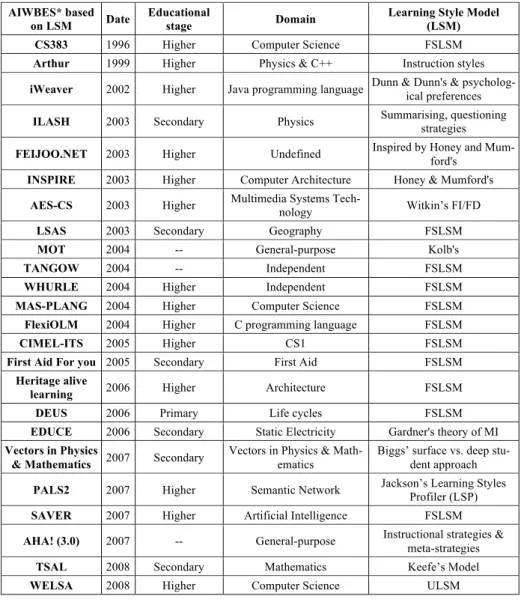
We collect thirty three (33) Adaptive and Intelligent Web-based Educational Sys-tems (AIWBES) that incorporate learning styles and discuss twenty of them, namely the AEHS, as shown by Table 1, as the remaining are Intelligent Tutorng Systems. We attempt to gather all the existing AIWBES and we analyze them in accordance with authors' description, because many of them are not available on-line. Based on methodology of literature review, we search for relevant works in library databases, greek and foreign, through google scholar and emails to various researchers. Based on the provided educational material, we conclude which adaptation rules are followed by these AEHS. The research questions are: What is the pedagogical basis of AEHS? What are the adaptation rules that following these systems in order to adapt the educa-tional material to user's learning style preferences? In particular, the search was per-formed using keywords, such as adaptive educational stystems, intelligent systems, personalization and adaptative systems, learning styles, learning styles and adaptive systems, pedagogical basis at adaptive systems, adaptation rules, adaptation rules and
adaptive systems, categorization of adaptive systems, etc. We searced at journals,
such as Computers & Education, Review of Educational research, Educational Tech-nology & Society, Journal of Business Education, User Modeling and User-Adapted Interaction, International Journal of Artificial Intelligence in Education, Instructional
science, Applied Artificial Intelligence, etc., at conference proceedings, such as Learning Technologies Conference, Conference on Hypertext and Hypermedia, Con-ference on Intelligent Tutoring Systems, WWW ConCon-ference, International ConCon-ference on E-Learning and Games, IEEE International Conference, Conference on Computers in Education, etc.
3
Brief description of AEHS based on Learning Styles
We gather thirty three (33) Adaptive and Intelligent Web-based Educational Sys-tems (AIWBES) from 1996 to 2014, as we can see at Table 1, and discuss twenty of them. Specifically, we analyze the AEHS and refer some basic features of them, as we can see at Table 2. AIWBESystems in order to be adaptive, they build a model of goals, preferences and knowledge of each individual user and according to it, the
system is adapted to the user's needs [3]. According to [14] ''AEH systems build a
model of the individual user/learner, and apply it for adaptation tothat user. In this sense, they can be considered as a sub-domain of ITS'' (pp.31). The AEHS are the following:
''CS383, Computer Systems'' is a hypermedia courseware and an adaptive
hy-permedia interface weredeveloped in order to personalize the presentation of course
material to user's learning style, based on the Felder and Silverman Learning Style Model. It introduces briefly university students to various areas of Computer Science [15].
''Arthur'' is a Web-based instruction system that provides adaptive instruction to
implement themany-to-one relationship in order to teach Physics and CCC
program-ming language. There are three instructors, each of which has on his own section, audio, visual, tactile or textual and different instruction style is used each time [16].
''iWeaver'' is a Web-based Adaptive Learning Environment that provides an in-troductory course on computer programming in accord with user's learning styles. The system accommodates the learning styles and implements different forms of instruc-tion, based on Dunn and Dunn's Learning Style Model [6].
''ILASH'' is an Educational Hypermedia System that incorporates the
summaris-ing and questionsummaris-ing strategies into hypermedia. The system includes different
adap-tive techniques embedded in the text and link structure to support the use of strategies. The system contains courseware and aims at GCSE-level students, including an adap-tive session about “The behaviour of waves” and a non-adapadap-tive session about “The
Solar System” in the field of Physics [17].
''FEIJOO.NET'' is an Adaptive System Hypermedia which adapts content and its presentation to the user's learning style, namely Theorists and Activist. The system aims at university students [18].
''INSPIRE'' (INtelligent System for Personalized Instruction in a Remote
Envi-ronment) is an Adaptive Educational Hypermedia System that personalizes the
presentation of educational material in accordance with users' learning style, based on the Honey and Mumford's Learning Style Model. Also, suggests a navigation route based on their level of knowledge, aiming to teach Computer Architecture [19].
''AES-CS'' (Adaptive Educational System based on Cognitive Styles) is an
Adap-tive EducationalSystem based on user's cognitive style and aims to teach ''Multimedia
Systems Technology'' at university students. The system adopts the Witkin's Cogni-tive Style Model [20].
''LSAS'' is a Hypermedia Educational System that incorporates the sequencing of pages and structure, employing two different presentation style of user interface tem-plates in order to caters learner's preferences. The system aims to teach Geography and incorporates the global and sequential learning style according to Felder-Silverman Learning Style Model [17].
''MOT'' is a tool which allows the incorporation of different learning styles into
adaptive educationalhypermedia applications, based on Kolb's Learning Style Model
[10].
''TANGOW'' (Task-based Adaptive learNer Guidance On the Web) adapts the course structure and sequencing to the student’s profile based on Felder-Silverman learning style model [21].
''WHURLE'' (Web-based Hierarchical Universal Reactive Learning
Environ-ment) is an AdaptiveWeb-based Educational System (AWBES) that adapts content to
visual-verbal preferences [22].
''MASPLANG'' (MultiAgent System PLAtforma de Nueva Generation) is e-learning system that provides personalized contents, navigation tools and navigation strategies dependant on the user's learning style and cognitive state, based on Felder
and Silverman Learning Style Model [23].
''DEUS'' (Digital Environment Utilising Styles) is an Adaptive Educational
Hy-permedia System that incorporates the sequential and global learning style of Felder
and Silverman's Learning Style Model. The system aims at primary school students and its domain is Life Cycles [24].
''AHA! System: Version 3.0'' (Adaptive Hypermedia Architecture) is a
general-purpose adaptivehypermedia system and implement learning styles [25].
''WELSA'' (Web-based Educational system with Learning Style Adaptation) is an
Intelligent and Adaptive Web-based Educational System that aims at adapting the
courses to the student's learning style preferences, teaching a course module in the area of Artificial Intelligence [26].
''PALS2'' is an Adaptive Web-based Educational System that provides learners with personalized learning content based on their learning styles. This system aims at university students and teaches Semantic Network course, based on Jackson’s Learn-ing Styles Profiler [27].
''AEHS-LS'' (Adaptive E-Learning Hypermedia System based on Learning Style) is an Adaptive E-Learning Hypermedia System that adapts content presentation to student learning styles in order to present the appropriate content, format and media type. The system aims to teach Java programming language and adopts the VARK Learning Style Model [28].
''MATHEMA'' is a Web-based Adaptive Educational Hypermedia System that aims at teaching senior High School students or novices of Higher Education about Physics and especially electromagnetism [11].
''AMDPC'' (Adaptation with Multi-Dimensional Personalization Criteria) is an
Adaptive Learning System, based on Witkin's Cognitive Style Model and
Felder-Silverman's Learning Style Model. The provision of personalized content and presen-tation layout based on learning styles, while personalized user interfaces and naviga-tion strategies based on cognitive styles. This system regards Computer Networks [29].
''LS-AEHS'' (Learning Style based on Adaptive E-learning Hypermedia System) is a system which integrates learning styles into adaptive e-learning hypermedia. This system addresses university students in order to teach Chemistry, by adapting content presentation to students' learning styles [30].
Table 1. Adaptive and Intelligent Web-based Educational Systems (AIWBES) AIWBES* based
on LSM Date Educational stage Domain Learning Style Model (LSM)
CS383 1996 Higher Computer Science FSLSM
Arthur 1999 Higher Physics & C++ Instruction styles
iWeaver 2002 Higher Java programming language Dunn & Dunn's & psycholog-ical preferences
ILASH 2003 Secondary Physics Summarising, questioning strategies
FEIJOO.NET 2003 Higher Undefined Inspired by Honey and Mum-ford's
INSPIRE 2003 Higher Computer Architecture Honey & Mumford's
AES-CS 2003 Higher Multimedia Systems Tech-nology Witkin’s FI/FD
LSAS 2003 Secondary Geography FSLSM
MOT 2004 -- General-purpose Kolb's
TANGOW 2004 -- Independent FSLSM
WHURLE 2004 Higher Independent FSLSM
MAS-PLANG 2004 Higher Computer Science FSLSM
FlexiOLM 2004 Higher C programming language FSLSM
CIMEL-ITS 2005 Higher CS1 FSLSM
First Aid For you 2005 Secondary First Aid FSLSM
Heritage alive
learning 2006 Higher Architecture FSLSM
DEUS 2006 Primary Life cycles FSLSM
EDUCE 2006 Secondary Static Electricity Gardner's theory of MI
Vectors in Physics
& Mathematics 2007 Secondary Vectors in Physics & Math-ematics Biggs’ surface vs. deep stu-dent approach PALS2 2007 Higher Semantic Network Jackson’s Learning Styles Profiler (LSP)
SAVER 2007 Higher Artificial Intelligence FSLSM
AHA! (3.0) 2007 -- General-purpose Instructional strategies & meta-strategies
TSAL 2008 Secondary Mathematics Keefe’s Model
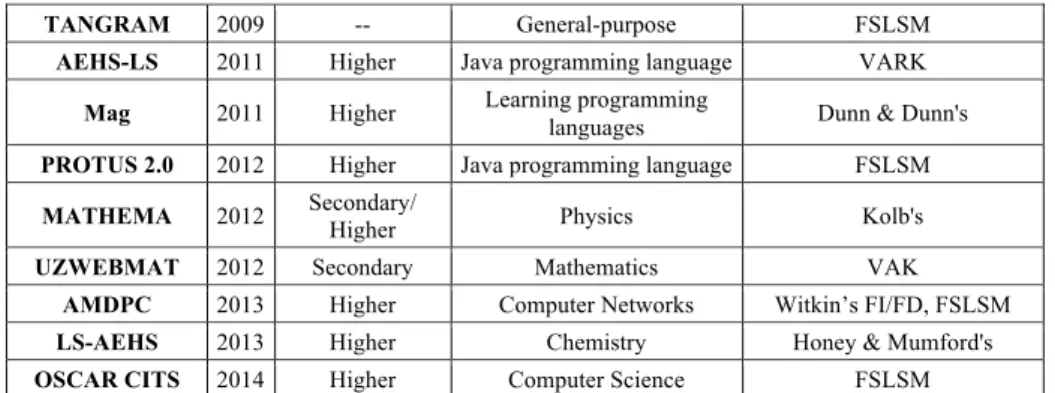
TANGRAM 2009 -- General-purpose FSLSM
AEHS-LS 2011 Higher Java programming language VARK
Mag 2011 Higher Learning programming languages Dunn & Dunn's
PROTUS 2.0 2012 Higher Java programming language FSLSM
MATHEMA 2012 Secondary/ Higher Physics Kolb's
UZWEBMAT 2012 Secondary Mathematics VAK
AMDPC 2013 Higher Computer Networks Witkin’s FI/FD, FSLSM
LS-AEHS 2013 Higher Chemistry Honey & Mumford's
OSCAR CITS 2014 Higher Computer Science FSLSM
*Adaptive and Intelligent Web-based Educational Systems (AIWBES) [3] Table 2. Basic features of AEHS
AEHS Student Mod-elling
Ap-proach Learning Style Model
To what is
adapted What is adapted Research
CS383 Index of Learn-ing Styles
Questionnaire FSLSM Learning style Content presenta-tion Empirical Arthur performance in Learner’s
the tests Instruction styles Performance
Instructional style [visual-interactive, auditory-text, auditory-lecture, text] Empirical
iWeaver Building Excel-lence Survey
Dunn & Dunn Model & four psychological learner preferences [Impulsive,Reflective& Global,Analytical] Learning style, experience rat-ings, navigational choices Content, content navigation, (rec-ommendation of) media experience (choice/no choice) Empirical
ILASH ---- Summarising & ques-tioning strategies Knowledge state/ progress
Layout presenta-tion, Navigation
sup-port
Empirical
FEIJOO.NET CHAEA Test of Inspired by the Honey & Mumford's model
[Theorists&Activists] Learning style
Content, content
presentation Unknown
INSPIRE Learning Style Questionnaire Honey & Mumford’s Model
Knowledge, learning style, learning goal, last
login, favourite pages, time spent
Lesson contents,
navigational route Empirical
AES-CS Group Embed-ded Figures
Test Witkin’s FI/FD
Cognitive style, level of knowledge Presentation, navigation, in-structional strate-gies Empirical
LSAS Index of Learn-ing Styles Questionnaire
FSLSM
[Global&sequential] Learning styles Presentation, navigation Empirical MOT Monitoring the learner's Kolb's Learning Style Model Learning style Instructional strategies Unknown
behavior [Diverger&converger]
TANGOW Learning Styles Inventory of [Sensing/intuitive & FSLSM sequential/global]
background, age, language, previ-ous use of hyper-media, learning
styles, student actions & teaching strategy
Content, sequence & structure,
guid-ance Empirical
WHURLE Learning Styles Inventory of [Visual&verbal] FSLSM Learning prefer-ences Mode of presenta-tion Empirical
MAS-PLANG Learning Styles Inventory of FSLSM knowledge level, learning style Content, content presenation Unknown DEUS Learning Styles Inventory of [Global&sequential] FSLSM Learning style structuring of information Empirical PALS2 Jackson’s Learning Styles Profiler ques-tionnaire Jackson’s Learning Styles Profiler learning style, background knowledge Pedagogical strategies, presentation, content Empirical AHA! (3.0) Instructional metastrategies to infer the learner's pref-erences
defined by the author Learning styles & preferences Instructional strategies Empirical
WELSA
Analysis of the learners’ inter-actions with the
system
ULSM Learning
prefer-ences Navigation, educa-tional resources Empirical
AEHS-LS Filling the VARK ques-tionnaire or selecting the learning style based on in-formation
VARK knowledge level, learning style
presentation of content (content,
format & media type)
Empirical
MATHEMA Kolb's Learning Style Inventory Kolb's Learning Style Model
learning goal, knowledge level
for each main concept/ learning goal, Web experi-ence, learning style, preference for visual and/or verbal feedback & preference for the kind of navigation
Presentation, navigation, se-quence of content,
group formation, peer help,
feed-back
Empirical
AMDPC
Group Embed-ded Figures Test & Index of
Learning Style questionnaire
FD/FI cognitive style &
FSLSM Learning style, cognitive style presentation, content Empirical LS-AEHS Learning Style Questionnaire Honey & Mumford's Model Learning style Presentation, navigation Empirical
4
Classification of AEHS in learning style families
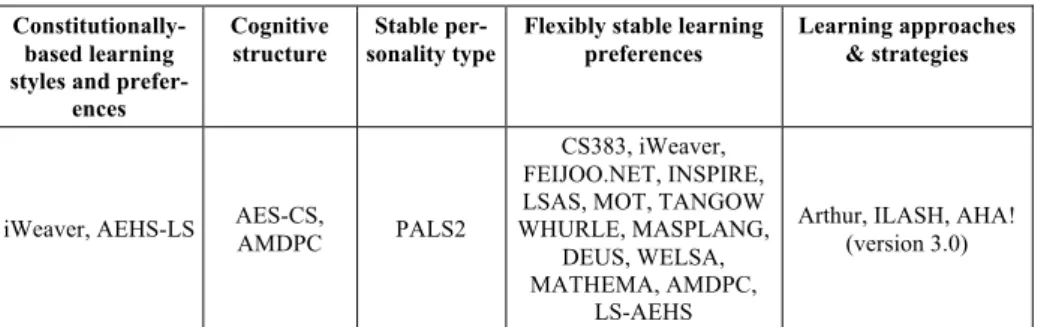
Among the several definitions that are used to describe the term ''learning syles'', the most frequenlty used and generally accepted is Keefe's [31] who defined them as “characteristic cognitive, affective and psychological behaviours that serve as rela-tively stable indicators of how learners perceive, interact with and respond to the learning environment” [p. 4]. Learning styles sometimes used interchangeably with cognitive styles, which can be defined as a person's approach in perceiving, remem-bering, processing [32] and organizing information [33], [34]. In current study, we categorize the AEHS in accord with [35] learning styles families, as we can see at Table 3. Coffield et al. [35] sort learning styles models into five families, drawing on the classification of learning styles by Curry [36]. Learning style models that are influenced by genetics and refer to fixed, inherited traits and about the interaction of personality and cognition are placed at the left-hand end of the continuum. Moving
along it, learning styles models are based on ''the idea of dynamic interplay between
self and experience'' [35] [pp. 20]. Personal and environmental factors, effects of curriculum design, culture, teaching and assessment tasks on how students opt or reject particular learning strategies are placed at the right-hand end of the continuum [35].
Table 3. Families of learning styles
Constitutionally-based learning styles and
prefer-ences
Cognitive
structure sonality type Stable per- Flexibly stable learning preferences Learning approaches & strategies
iWeaver, AEHS-LS AES-CS, AMDPC PALS2
CS383, iWeaver, FEIJOO.NET, INSPIRE, LSAS, MOT, TANGOW WHURLE, MASPLANG,
DEUS, WELSA, MATHEMA, AMDPC,
LS-AEHS
Arthur, ILASH, AHA! (version 3.0)
As we can see from the Table 3, the most AEHS utilize models that come from the fourth family that accommodate learning styles as flexibly stable learning preferences. From the authors' point of view, Felder and Silverman's Learning Style Model is con-sidered an appropriate measure for developing hypermedia courseware that should take into account personal factors [37]; has been recognized by many researchers as one of the most appropriate model for the development of adaptive learning environ-ments [29]; the global-sequential dimension can be easily translated to hypertext and hypermedia structures and provide a logical scructure of information and/or naviga-tional support [24]; its questionnaire gives the possibility of liking automatically sults to learning environment [21]; had already been used successfully by many re-searchers, shows a good level of validity and reliability and uses multiple representa-tions that could easily be rendered by different media [22]. Papadimitriou et al. [11] opt Kolb's model, as it can match the appropriate didactic strategies with user's
learn-ing style, its concrete-abstract dimension is used for group formation and is suitable for the domain of Physics, namely for supporting didactic approaches for conceptual change. Papanikolaou et al. [19] choose Honey and Mumford's model in order for presentation of the educational material on each of the performance levels and Drissi & Amirat [30] adopt the same model because is appropriate for presentation of pages and links at a hypermedia course. As far as the first family and Dunn and Dunn's Learning Style Model is concerned, its high index of reliability and validity, the breadth of six areas of learning preferences that covers [6] and the different presenta-tion modes that serves, make it preferable [38]. According to [28], the VARK Learn-ing Style Model is considered as the simplest model with the greatest influence.
As far as the second family is concerned, FI/FD cognitive styles are siginficant fac-tor for hypermedia-based courseware's design and instruction [20]. Regarding the fifth family of learning styles, instructional strategies that suit to preferred learning styles with an option to switch it to a non-preferred version are adopted [17] and as stated in [16], instructional strategies can lessen the limitation of the tutor’s ability to adapt to the learner’s learning style.
From our point of view, an explanation of why the fourth family of learning styles, namely the flexibly stable learning preferences, is the most commonly-used is be-cause the most AEHS are aimed at university students whose learning preferences are more fixed than younger ones. Also, the domains are complicated and require specific instructional design with appropriate strategies. In addition to this, it is obvious that the Felder and Silverman's model is generally accepted as the most comprehensive, handy and with construable results, thus many researchers implement it as safe op-tion. Consequently, we deduce that the nature of subjects, the age and the technical features of instruments make a model and/or learning style family more or less
''fa-mous''.
5
Pedagogical basis of AEHS: the case of Adaptation Rules
Various techniques are used in order to represent student models, such as rules, fuzzy logic, Bayesian networks and case-based reasoning [39]. An adaptation model
is specified by adaptation rules which are ''the adaptive methods and techniques used
for content selection, navigation or presentation'', according to [26] [pp. 21]. The
development of adaptation rules is a daunting task andaccording to Popescu (2009) is
''a delicate and tedious task'', as requires interpretation of the literature in order to specify the instructional guidelines [8].
We report the rule-based systems and we present them according to Learning Style families. We do not refer the adaptation rules for the following systems AHA! 3.0, MOT, TANGOW, WHURLE, because are general-purpose AEH systems and the rules are defined by authors; at DEUS, FEIJOO.NET and PALS2 are not referred sufficient information in order to extract the adaptation rules and Arthur based on the Case-based Reasoning. As far as the format of adaptation rules, we follow the pro-posed in [5] for systems that adaptation rules have not specific format, while we maintain the format of systems that report them, for example the LS-AEHS system.
As criteria to compare and present the adaptation rules, we employ the Learning Style Models and the corresponding learning preferences (learning style families).
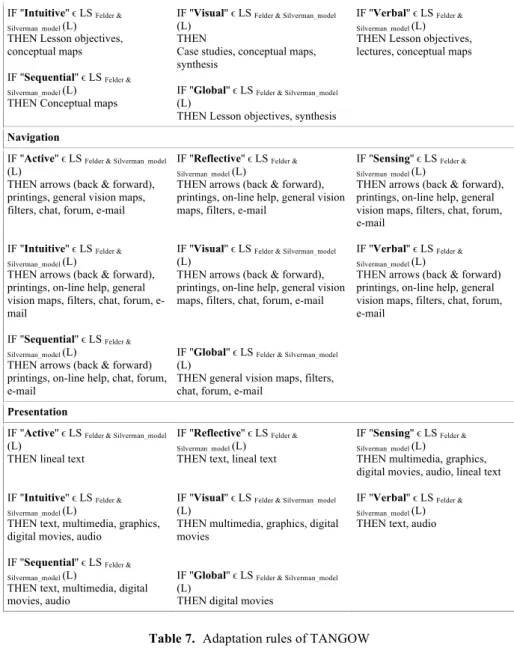
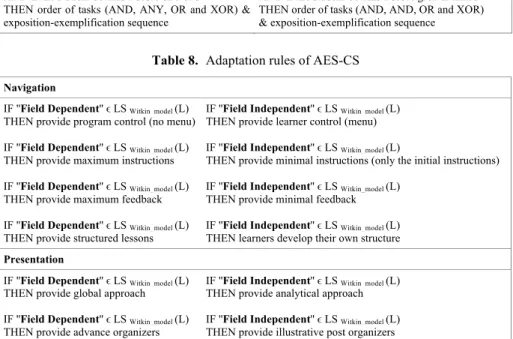
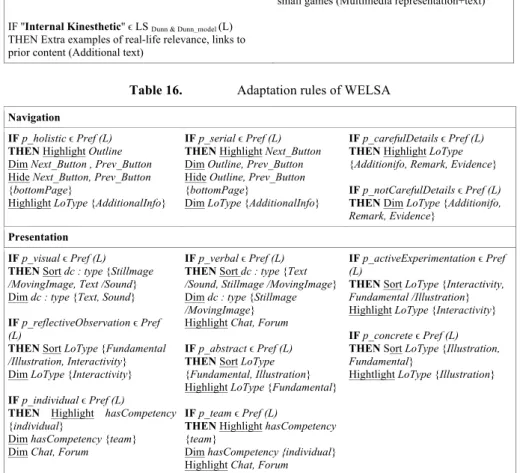
We can deduce that AEC-CS and AMDPC, as described in Tables 8 and 4 that em-ploy the Witkin's Learning Style Model in order to adapt the user interface to users' learning preferences, follow similar adaptation logic. In other words, the systems provide Field Dependent user with more information, more guidance and more com-plicated user interface, while Field Independent with less and more scructured infor-mation, no guidance and simplier user interface. Regarding the CS383 and MASPLANG, as we can see at Tables 5 and 6, we observe that they have many simi-larities in terms of content selection and presentation. Specifically, they provide users with similar lesson structure and multimedia presentation, for instance, textual slides for verbals, pictorial format for visuals, overview for globals, etc. Regarding the LS-AEHS and INSPIRE, as depicted in Tables 12 and 13, they have similarities to con-tent's order and presentation order. For example, the two systems provide Activists with exploratory items, then present examples and theory and finally, practice. Con-cerning the system WELSA, the learning style model that applies is inspired by Herrmann’s Whole Brain Model, Felder-Silverman Learning Style Model and Kolb's Learning Style Model. In terms of learning style preferences, there are similarities to content and presentation among CS383, AMDPC, MASPLANG and WELSA, as illustrated in Tables 5, 4, 6 and 16. Specifically, visual, verbal, active and reflective users are common and systems follow similar instructional guidelines in order to meet their needs. In terms of learning style families, we can claim that iWeaver and
AEHS-LS, as depicted in Tables 15 and 11 respectively, AES-CS and AMDPC, Tables 8 and
4 respectively, and finally, CS383, iWeaver, MASPLANG, WELSA and AMDPC, as shown by Tables 5, 15, 6, 16 and 4 share common learning style preferences, such as visual, verbal, active, reflective, sequential/serial, global/holistic, etc. and therefore, adopt similar instructional guidelines. For example, systems provide globals with overviews, verbals with audio files, sequentials with hierarchical structure of content, etc.
Consequently, we can infer that the adaptation rules are categorized primarily, on the basis of Learning Style Models, secondarily, on learning preferences and ulitmate-ly, on adaptive hypermedia technologies without significant differences among them. This means that, systems that are based on the same model follow the same patterns, in terms of instructional guidelines and technologies (Adaptive navigation support and Adaptive presentation) that support the adaptation process.
Table 4. Adaptation Rules of AMDPC Content selection
IF ''Active'' ! LS FelderSilverman_model (L)
THEN present Text: fundamental, Figure: fundamental & Example: fundamental & supplementary
IF ''Sensing'' ! LS FelderSilverman_model (L)
THEN present Text: fundamental, Figure: fundamental & supplementary & Example: fundamental & supplementary
IF ''Reflective'' ! LS FelderSilverman_model (L) THEN present Text: fundamental, Figure: fundamental & Example: fundamental IF ''Intuitive'' ! LS FelderSilverman_model (L) THEN present Text: fundamental &
supplementary, Figure: fundamental & Example: fundamental & supplementary
IF ''Visual'' ! LS FelderSilverman_model (L)
THEN present Text: fundamental, Figure: fundamental & supplementary & Example: fundamental & supplementary IF ''Sequential'' ! LS FelderSilverman_model (L)
THEN present Text: fundamental & supplementary, Figure: fundamental, Example: fundamental & Scope: a concept or learning step
IF 'Text'' ! LS FelderSilverman_model (L) THEN present Text: fundamental &
supplementary, Figure: fundamental & Example: fundamental
IF ''Global'' ! LS FelderSilverman_model (L)
THEN present Text: fundamental with an abstract, Figure: fundamental & supplementary, Example: fundamental & supplementary & Scope: a chapter Presentation
IF ''Field Dependent'' ! LS Witkin_model (L)
THEN present simpler interface, less information, only frequently used functions and links to the information, related to the current learning content
IF ''Field Independent'' ! LS Witkin_model (L) THEN present more complex interface, more information, links to show the full functions of the system and the schema of the entire learning content
Table 5. Adaptation rules of CS383 Content selection
IF ''Active'' ! LS Felder & Silverman_model (L) THEN Knowledge nucleus, DOOM Scenario IF ''Sensing'' ! LS Felder & Silverman_model (L) THEN Case studies, conceptual maps, DOOM Scenario
IF ''Visual'' ! LS Felder & Silverman_model (L) THEN virtual computer
IF ''Sequential'' ! LS Felder & Silverman_model (L) THEN Conceptual maps
IF ''Reflective'' ! LS Felder & Silverman_model (L)
THEN Lesson objectives, case studies, lectures, conceptual maps
IF ''Intuitive'' ! LS Felder & Silverman_model (L)
THEN Lesson objectives detail the main concepts of the course IF ''Verbal'' ! LS Felder & Silverman_model (L)
THEN Lesson objectives provide a textual overview (words, oral or written), virtual computer
IF ''Global'' ! LS Felder & Silverman_model (L)
THEN Lesson objectives with lesson overview before the details, jumping between different lessons, DOOM Scenario Presentation
IF ''Active'' ! LS Felder & Silverman_model (L) THEN group discussions
IF ''Sensing'' ! LS Felder & Silverman_model (L) THEN hypertext, factual information, not concepts, slideshows & written papers IF ''Visual'' ! LS Felder & Silverman_model (L) THEN full multimedia version of the slideshow, video segments, digital movies, graphics & written papers
IF ''Sequential'' ! LS Felder & Silverman_model (L) THEN sequential structure of the slideshows, hierarchical structure of the hypertext, digital movies
IF ''Intuitive'' ! LS Felder & Silverman_model (L) THEN slideshows, digital movies IF ''Verbal'' ! LS Felder & Silverman_model (L)
THEN textual slides, course hypertext, sound files, written papers & slideshows
IF ''Global'' ! LS Felder & Silverman_model (L) THEN digital movies, slideshows & written papers
Table 6. Adaptation rules of MASPLANG Content selection
IF ''Active'' ! LS Felder & Silverman_model (L)
THEN Knowledge nucleus
IF ''Reflective'' ! LS Felder & Silverman_model (L)
THEN Lesson objectives, case studies, lectures, conceptual maps
IF ''Sensing'' ! LS Felder & Silverman_model (L)
THEN Case studies, conceptual maps
IF ''Intuitive'' ! LS Felder & Silverman_model (L) THEN Lesson objectives, conceptual maps IF ''Sequential'' ! LS Felder & Silverman_model (L)
THEN Conceptual maps
IF ''Visual'' ! LS Felder & Silverman_model (L)
THEN
Case studies, conceptual maps, synthesis
IF ''Global'' ! LS Felder & Silverman_model (L)
THEN Lesson objectives, synthesis
IF ''Verbal'' ! LS Felder & Silverman_model (L) THEN Lesson objectives, lectures, conceptual maps
Navigation
IF ''Active'' ! LS Felder & Silverman_model (L)
THEN arrows (back & forward), printings, general vision maps, filters, chat, forum, e-mail IF ''Intuitive'' ! LS Felder & Silverman_model (L)
THEN arrows (back & forward), printings, on-line help, general vision maps, filters, chat, forum, e-mail
IF ''Sequential'' ! LS Felder & Silverman_model (L)
THEN arrows (back & forward) printings, on-line help, chat, forum, e-mail
IF ''Reflective'' ! LS Felder & Silverman_model (L)
THEN arrows (back & forward), printings, on-line help, general vision maps, filters, e-mail
IF ''Visual'' ! LS Felder & Silverman_model (L)
THEN arrows (back & forward), printings, on-line help, general vision maps, filters, chat, forum, e-mail
IF ''Global'' ! LS Felder & Silverman_model (L)
THEN general vision maps, filters, chat, forum, e-mail
IF ''Sensing'' ! LS Felder & Silverman_model (L)
THEN arrows (back & forward), printings, on-line help, general vision maps, filters, chat, forum, e-mail
IF ''Verbal'' ! LS Felder & Silverman_model (L)
THEN arrows (back & forward) printings, on-line help, general vision maps, filters, chat, forum, e-mail
Presentation
IF ''Active'' ! LS Felder & Silverman_model (L)
THEN lineal text IF ''Intuitive'' ! LS Felder & Silverman_model (L)
THEN text, multimedia, graphics, digital movies, audio
IF ''Sequential'' ! LS Felder & Silverman_model (L)
THEN text, multimedia, digital movies, audio
IF ''Reflective'' ! LS Felder & Silverman_model (L) THEN text, lineal text
IF ''Visual'' ! LS Felder & Silverman_model (L)
THEN multimedia, graphics, digital movies
IF ''Global'' ! LS Felder & Silverman_model (L)
THEN digital movies
IF ''Sensing'' ! LS Felder & Silverman_model (L)
THEN multimedia, graphics, digital movies, audio, lineal text IF ''Verbal'' ! LS Felder & Silverman_model (L) THEN text, audio
Table 7. Adaptation rules of TANGOW Presentation
IF ''Global-Sensing'' ! LS FelderSilverman_model (L) AND If the student obtains a score of 1 or 3 THEN order of tasks (AND, ANY, OR and XOR) & exposition-exemplification sequence
IF ''Global-Intuitive'' ! LS FelderSilverman_model (L) AND If the student obtains a score of 1 or 3 THEN order of tasks (AND, ANY, OR and XOR) & exposition-exemplification sequence
IF ''Global-Sensing'' ! LS FelderSilverman_model (L) AND If the student obtains a score greater than 5 THEN order of tasks (ANY, ANY, OR and XOR) & exemplification-exposition sequence
IF ''Global-Intuitive'' ! LS FelderSilverman_model (L) AND If the student obtains a score greater than 5 THEN order of tasks (ANY, ANY, OR and XOR) & exposition-exemplification sequence
IF ''Sequential-Sensing'' ! LS FelderSilverman_model (L) AND If the student obtains a score of 1 or 3 THEN order of tasks (AND, ANY, OR and XOR) & exposition-exemplification sequence
IF ''Sequential-Intuitive'' ! LS FelderSilverman_model (L) AND If the student obtains a score of 1 or 3 THEN order of tasks (AND, ANY, OR and XOR) & exposition-exemplification sequence
IF ''Sequential-Sensing'' ! LS FelderSilverman_model (L) AND If the student obtains a score greater than 5 THEN order of tasks (AND, AND, OR and XOR) & exemplification-exposition sequence
IF ''Sequential-Intuitive'' ! LS FelderSilverman_model (L) AND If the student obtains a score greater than 5 THEN order of tasks (AND, AND, OR and XOR) & exposition-exemplification sequence
Table 8. Adaptation rules of AES-CS Navigation
IF ''Field Dependent'' ! LS Witkin_model (L) THEN provide program control (no menu) IF ''Field Dependent'' ! LS Witkin_model (L) THEN provide maximum instructions IF ''Field Dependent'' ! LS Witkin_model (L) THEN provide maximum feedback IF ''Field Dependent'' ! LS Witkin_model (L) THEN provide structured lessons
IF ''Field Independent'' ! LS Witkin_model (L) THEN provide learner control (menu) IF ''Field Independent'' ! LS Witkin_model (L)
THEN provide minimal instructions (only the initial instructions) IF ''Field Independent'' ! LS Witkin_model (L)
THEN provide minimal feedback IF ''Field Independent'' ! LS Witkin_model (L) THEN learners develop their own structure Presentation
IF ''Field Dependent'' ! LS Witkin_model (L) THEN provide global approach IF ''Field Dependent'' ! LS Witkin_model (L) THEN provide advance organizers
IF ''Field Independent'' ! LS Witkin_model (L) THEN provide analytical approach IF ''Field Independent'' ! LS Witkin_model (L) THEN provide illustrative post organizers Table 9. Adaptation rules of ILASH Navigation
If score after each lesson is correct
THEN The ''Summarising strategy'' is preferred by the student, keep on using S_type pages [a top-down approach where the material is presented with key-points summarised at the end of each page & provides contextual clues to help students with getting the gist of information (by using headings, diving text in small chunks etc)]
ELSE The ''Summarising strategy'' is NOT preferred, a ''Questioning strategy'' needed ENDIF
If score after each lesson is correct
THEN The ''Questioning strategy'' is preferred by the student, keep on using Q_type pages [have a question asked after each paragraph (which contains an explanation of a concept)]
ELSE The ''Questioning strategy'' is NOT preferred, a ''Summarizing strategy'' needed ENDIF
Table 10. Adaptation rules of LSAS Navigation
IF ''Sequential'' ! LS FelderSilverman_model (L) THEN present ''Sequential page layout'' (small chunks of information, text-only pages with ‘forward’ & ‘back’ buttons)
IF ''Global'' ! LS FelderSilverman_model (L)
THEN present ''Global page layout'' (elements, such as a table of contents, summary, diagrams, overview of information, etc.)
Table 11. Adaptation rules of AEHS-LS Presentation
IF ''Visual preference'' ! LS VARK_model (L) THEN include the depiction of information in maps, diagrams, flow charts & all the symbolic arrows IF ''Read/write preference'' ! LS VARK_model (L) THEN display information as text
IF ''Auditory preference'' ! LS VARK_model (L) THEN present information that is "heard or spoken" IF ''Kinesthetic preference'' ! LS VARK_model (L) THEN provide opportunities for use of experience & practice
Table 12. Adaptation rules of AEHS-LS Navigation
If LS “H & M” (learner) = “activist’’ Then Appear in the top of page exploratory learning objects followed by links to illustrative learning objects, theoretical learning objects and interactive learning objects
If LS “H & M” (learner) = “reflector’’ Then Appear in the top of page illustrative learning objects followed by links to theoretical learning objects, interactive learning objects and exploratory learning objects
If LS “H & M” (learner) = “theorist’’ Then Appear in the top of page theoretical learning objects followed by links to interactive learning objects, exploratory learning objects and learning objects
If LS “H & M” (learner) = “pragmatist’’ Then Appear in the top of page interactive learning objects followed by links to exploratory learning objects, illustrative learning objects and theoretical learning objects
Presentation
If LS “H & M” (learner)=“activist” Then apply exploratory mode Else if LS “H & M” (learner)=“reflector” Then apply reflective mode Else if LS “H & M” (learner)=“theorist’’ Then apply abstract mode Else if LS “H & M” (learner)=“pragmatist’’ Then apply verification mode
Table 13. Adaptation rules of INSPIRE Content selection
IF the knowledge level of the learner has been evaluated as {Inadequate} on outcome concepts THEN these outcome concepts & their entire set of prerequisite concepts is recommended to the learner IF the knowledge level of the learner has been evaluated as {Mediocre} or {Advanced} on outcome concepts & {Proficient} on several of their prerequisite concepts
THEN these outcome concepts & the rest of their prerequisites are recommended to the learner
IF the knowledge level of the learner has been evaluated as {Inadequate} on outcome concepts
THEN educational material of the Remember level of performance for these outcome concepts & material for their prerequisite concepts that are included in the lesson contents, is proposed to the learner
IF the knowledge level of the learner has been evaluated as {Mediocre} on outcome concepts
THEN educational material of the Use level of performance for these outcome concepts & material for their prerequisite concepts that are included in the lesson contents, is proposed to the learner
IF the knowledge level of the learner has been evaluated as {Advanced} on outcome concepts
THEN educational material of the Find level of performance for these outcome concepts & material for their prerequisite concepts that are included in the lesson contents, is proposed to the learner
Navigation
If learner’s knowledge level has been evaluated as {Inadequate} with regards to a specific outcome concept THEN next to its title in the Navigation Area an empty measuring cup appears
THEN next to its title in the Navigation Area a half empty measuring cup appears
If learner’s knowledge level has been evaluated as {Advanced} with regards to a specific outcome concept THEN next to its title in the Navigation Area an almost full measuring cup appears
Presentation
IF ''Activist'' ! LS H & M_model (L)
THEN present activity, example, theory & practice IF ''Theoretical'' ! LS H & M_model (L)
THEN present theory, example, exercise & activity
IF ''Reflector'' ! LS H & M_model (L)
THEN present example, theory, practice & activity IF ''Pragmatist'' ! LS H & M_model (L)
THEN present exercise, example, theory & activity Table 14. Adaptation rules of MATHEMA
Navigation
IF the learner is not ready to study because the necessary prerequisite main concepts were not met THEN Links to the main concepts are colored red
IF the learner is ready to study
THEN Links to the main concepts with low degree of difficulty are colored light green
IF the learner is ready to study
THEN Links to the main concepts with high degree of difficulty are colored dark green
IF the learner has already studied but he/she has successfully assessed in the assessment tests THEN Links to the main concepts are colored orange
IF the learner has already studied and has succeeded in the assessment tests
THEN Links to the main concepts are colored yellow IF the learner is ready to study
THEN Links to the main concepts with medium degree of difficulty are colored green IF the learner is ready to study
THEN Links to the main concepts with medium degree of difficulty are colored green
Presenation
IF ''Diverger'' ! LS KOLB_model (L)
THEN present questions using analogies and/or video simulations, theory and examples, exercise solving & problem solving activity
IF ''Converger'' ! LS KOLB_model (L)
THEN present exercise solving, problem solving activity, questions using analogies and/or video simulations & theory and examples
IF ''Assimilator'' ! LS KOLB_model (L)
THEN present theory and examples, exercise solving, problem solving activity & questions using analogies and/or video simulations
IF ''Accommodator'' ! LS KOLB_model (L)
THEN present problem solving activity, questions using analogies and/or video simulations, theory and examples & exercise solving
Table 15. Adaptation rules of iWeaver Navigation
IF ''Impulsive'' ! LS Dunn & Dunn_model (L)
THEN Try-it button (allows immediate trial) (Additional tool)
IF ''Global'' ! LS Dunn & Dunn_model (L)
THEN Advance organisers (full-tree view) or mind maps (Additional multimedia representation)
IF ''Reflective'' ! LS Dunn & Dunn_model (L) THEN Context-aware note-taking tool, questions that encourage reflection (Additional tool) IF ''Analytical'' ! LS Dunn & Dunn_model (L) THEN Sequential lists of key points and components [Text (default)]
Presentation
IF ''Auditory'' ! LS Dunn & Dunn_model (L)
THEN PowerPoint-style presentations with synchronous audio, no text (Multimedia representation)
IF ''Visual (Pictures)'' ! LS Dunn & Dunn_model (L) THEN Diagrams, illustrations, graphs, flowcharts, animations+audio (Multimedia representation text or audio)
IF ''Visual (Text)'' ! LS Dunn & Dunn_model (L) THEN reading, context-aware note-taking tool (Text+additional tool)
IF ''Internal Kinesthetic'' ! LS Dunn & Dunn_model (L) THEN Extra examples of real-life relevance, links to prior content (Additional text)
IF ''Tactile Kinesthetic'' ! LS Dunn & Dunn_model (L) THEN Interactive multimedia elements (interactivelets): puzzles, drag & drop, fill-ins, small games (Multimedia representation+text)
Table 16. Adaptation rules of WELSA Navigation
IF p_holistic ! Pref (L)
THEN Highlight Outline Dim Next_Button , Prev_Button
Hide Next_Button, Prev_Button
{bottomPage}
Highlight LoType {AdditionalInfo}
IF p_serial ! Pref (L)
THEN Highlight Next_Button
Dim Outline, Prev_Button
Hide Outline, Prev_Button
{bottomPage}
Dim LoType {AdditionalInfo}
IF p_carefulDetails ! Pref (L)
THEN Highlight LoType
{Additionifo, Remark, Evidence} IF p_notCarefulDetails ! Pref (L)
THEN Dim LoType {Additionifo, Remark, Evidence}
Presentation IF p_visual ! Pref (L)
THEN Sort dc : type {Stillmage /MovingImage, Text /Sound} Dim dc : type {Text, Sound} IF p_reflectiveObservation ! Pref (L)
THEN Sort LoType {Fundamental /Illustration, Interactivity} Dim LoType {Interactivity} IF p_individual ! Pref (L)
THEN Highlight hasCompetency
{individual}
Dim hasCompetency {team} Dim Chat, Forum
IF p_verbal ! Pref (L)
THEN Sort dc : type {Text /Sound, Stillmage /MovingImage} Dim dc : type {Stillmage /MovingImage} Highlight Chat, Forum
IF p_abstract ! Pref (L)
THEN Sort LoType
{Fundamental, Illustration} Highlight LoType {Fundamental} IF p_team ! Pref (L)
THEN Highlight hasCompetency
{team}
Dim hasCompetency {individual} Highlight Chat, Forum
IF p_activeExperimentation ! Pref (L)
THEN Sort LoType {Interactivity, Fundamental /Illustration} Highlight LoType {Interactivity} IF p_concrete ! Pref (L)
THEN Sort LoType {Illustration, Fundamental}
Hightlight LoType {Illustration}
6
Conclusion and Future Work
In order to accommodate users' learning style preferences and needs, AEHSystems utilize learning styles models as a way of modelling user's preferences, aiming at provision of personalized content or/and navigation advice. We can assume that user modelling has changed, as the employed learning style preferences allow more flexi-ble and personal adaptation to each user. Within this context, the development of metacognitive ability can be achieved and self-regulated learning can be cultivated, as the students can obtain awareness of their learning needs and preferences. The contri-bution of this work is that there are not similar works, at least from 2003, that investi-gate the pedagogical basis of AEHS and thus, could trigger similar undertakings. With regard to teaching, the work's contribution can be located on the utilization of Learning Style Models in educational process. Educators can improve the students'
performance with or without learning disabilities through instruction's individualiza-tion to students' needs. Future works could study the pedagogical basis at a more broaden scope, including AEHS that do not utilize Learning Style Models.
7
References
[1]Lin, B., & Hsieh, C. T. ''Web-based teaching and learner control: A research review''. Computers & Education, 37(3), 377-386, 2001 https://doi.org/10.1016/S0360-1315(01)00060-4
[2]Neo, M., Neo, T. K., & Yap, W. L. ''Students' perceptions of interactive multimedia medi-ated web-based learning: A Malaysian perspective''. In Proceedings of ASCILITE 2008 Conference, Melbourne, 2008
[3]Brusilovsky, P. & Peylo, C. ''Adaptive and intelligent Web-based educational systems''. In-ternational Journal of Artificial Intelligence in Education, 13 (2-4), 159-172, 2003 [4]Popescu, Elvira, Philippe Trigano, and Costin Badica. "Towards a Unified Learning Style
Model in Adaptive Educational Systems." Seventh IEEE International Conference on Ad-vanced Learning Technologies (ICALT 2007), 2007. https://doi.org/10.1109/ICALT. 2007.263
[5]Popescu, E., Badica, C., & Trigano, P. ''Rules for learner modeling and adaptation provi-sioning in an educational hypermedia system''. In Symbolic and Numeric Algorithms for Scientific Computing, 2007. SYNASC. International Symposium on (pp. 492-499). IEEE, 2007 https://doi.org/10.1109/synasc.2007.72
[6]Wolf, C. ''iWeaver: towards' learning style'-based e-learning in computer science educa-tion''. In Proceedings of the fifth Australasian conference on Computing education-Volume 20 (pp. 273-279). Australian Computer Society, Inc, 2003
[7]Al-Azawei, Ahmed, and Atta Badii. "State of The Art of Learning Styles-Based Adaptive Educational Hypermedia Systems (Ls-Baehss)." International Journal of Computer Science and Information Technology 6, no. 3 (2014): 01-19. https://doi.org/10.5121/ijcsit. 2014.6301
[8]Popescu, Elvira. "Diagnosing Students' Learning Style in an Educational Hypermedia Sys-tem." Cognitive and Emotional Processes in Web-Based Education: 187-208. https://doi.org/10.4018/978-1-60566-392-0.ch011
[9]Mulwa, C., Lawless, S., Sharp, M., Arnedillo-Sanchez, I., & Wade, V. ''Adaptive educa-tional hypermedia systems in technology enhanced learning: a literature review''. In Pro-ceedings of the 2010 ACM conference on Information technology education (pp. 73-84), 2010 https://doi.org/10.1145/1867651.1867672
[10]Stash, Natalia Victorovna, Alexandra Ioana Cristea, and Paul M. De Bra. "Authoring of learning styles in adaptive hypermedia." Alternate track papers & posters of the 13th inter-national conference on World Wide Web - WWW Alt. '04, 2004. https://doi.org/10.1145/1010432.1010452
[11]Papadimitriou, A., Grigoriadou, M., & Gyftodimos, G. ''MATHEMA: A Learner-controlled Adaptive Educational Hypermedia System''. Journal of Information Technology and Application in Education, 1(2), 47-73, 2012
[12]Vandewaetere, Mieke, Piet Desmet, and Geraldine Clarebout. "The contribution of learner characteristics in the development of computer-based adaptive learning environments." Computers in Human Behavior 27, no. 1 (2011): 118-30. https://doi.org/10.1016/ j.chb.2010.07.038
[13]Özyurt, Özcan, Hacer Özyurt, and Adnan Baki. "Design and development of an innovative individualized adaptive and intelligent e-learning system for teaching–learning of
probabil-ity unit: Details of UZWEBMAT." Expert Systems with Applications 40, no. 8 (2013): 2914-940. https://doi.org/10.1016/j.eswa.2012.12.008
[14]Sampson, D., & Karagiannidis, C. ''Personalised learning: Educational, technological and standardisation perspective''. Interactive educational multimedia, (4), 24-39, 2010
[15]Carver, C. A., Howard, R. A., & Lavelle, E., ''Enhancing student learning by incorporating learning styles into adaptive hypermedia.'' In Proceedings of Ed-Media, Vol. 96, (pp. 118-123), 1996
[16]J. E.Gilbert and Han, C. Y. ''Adapting instruction in search of ‘a significant difference’''. Journal of Network and Computer applications, 22(3), 149-160, 1999 https://doi.org/10.1006/jnca.1999.0088
[17]"Incorporating learning styles in hypermedia environment: Empirical evaluation." Incorpo-rating learning styles in hypermedia environment: empirical evaluation. Accessed March 30, 2017. http://wwwis.win.tue.nl/ah2003/proceedings/www-4/
[18]Ruiz, M. D. P. P., Barriales, S. O., Pérez, J. R. P., & Rodríguez, M. G. ''Feijoo. net: an ap-proach to personalized E-learning using learning styles''. In International Conference on Web Engineering (pp. 112-115). Springer Berlin Heidelberg, 2003
[19]Papanikolaou, K. A., Grigoriadou, M., Kornilakis, H., & Magoulas, G. D. ''Personalizing the Interaction in a Web-based Educational Hypermedia System: the case of INSPIRE''. User modeling and user-adapted interaction, 13(3), 213-267, 2003 https://doi.org/10.1023/A:1024746731130
[20]Triantafillou, Evangelos, Andreas Pomportsis, and Stavros Demetriadis. "The design and the formative evaluation of an adaptive educational system based on cognitive styles." Computers & Education 41, no. 1 (2003): 87-103. https://doi.org/10.1016/S0360-1315(03)00031-9
[21]Paredes, P., and P. Rodriguez. "A Mixed Approach to Modelling Learning Styles in Adap-tive Educational Hypermedia." Advanced Technology for Learning 1, no. 4 (2004). https://doi.org/10.2316/Journal.208.2004.4.208-0823
[22]Brown, Elizabeth, Tim Brailsford, Tony Fisher, Adam Moore, and Helen Ashman. "Reap-praising cognitive styles in adaptive web applications." Proceedings of the 15th interna-tional conference on World Wide Web - WWW '06, 2006. https://doi.org/10.1145/ 1135777.1135827
[23]Peña, C. I., Marzo, J. L., & de la Rosa, J. L. ''Curriculum sequencing for an e-learning sys-tem based on learning styles''. In Information Technology Based Higher Education and Training, 2004. ITHET 2004. Proceedings of the FIfth International Conference on (pp. 167-172). IEEE
[24]Brown, Elizabeth, Tony Fisher, and Tim Brailsford. "Real users, real results." Proceedings of the 18th conference on Hypertext and hypermedia - HT '07, 2007. https://doi.org/10.1145/1286240.1286261
[25]Stash, Natalia. "Incorporating cognitive/learning styles in a general-purpose adaptive hy-permedia system." ACM SIGWEB Newsletter 2007, no. Winter (2007). https://doi.org/10.1145/1324960.1324963
[26]E. Popescu, ''Dynamic adaptive hypermedia systems for e-learning''. Ph.D. dissertation, Université de Technologie de Compiègne, 2008
[27]Siadaty, Melody, and Fattaneh Taghiyareh. "PALS2: Pedagogically Adaptive Learning System based on Learning Styles." Seventh IEEE International Conference on Advanced Learning Technologies (ICALT 2007), 2007. https://doi.org/10.1109/ICALT.2007.198 [28]Mustafa, Y. E. A., & Sharif, S. M. ''An approach to adaptive e -learning hypermedia
sys-tem based on learning styles (AEHS-LS): Implementation and evaluation''. International Journal of Library and Information Science, 3(1), 15-28, 2011
[29]Yang, T. C., Hwang, G. J., & Yang, S. J. H. ''Development of an adaptive learning system with multiple perspectives based on students' learning styles and cognitive styles''. Journal of Educational Technology & Society, 16(4), 185-200, 2013
[30]Drissi, Samia, and Abdelkrim Amirat. "An adaptive e-learning hypermedia system: Design and evaluation." 2013 3rd International Symposium ISKO-Maghreb, 2013. https://doi.org/10.1109/ISKO-Maghreb.2013.6728106
[31]Keefe, J.W. ''Learning style: an overview''. In J.W. Keefe, editor, Student learning styles: diagnosing and prescribing programs. NASSP, 1979
[32]Witkin, H. A., & Goodenough, D. R. ''Cognitive styles: essence and origins. Field depend-ence and field independdepend-ence''. Psychological issues, (51), 1-141, 1980
[33]Ausubel, David Paul. Educational psychology ; a cognitive view. New York: Holt., 1968 [34]Riding, R., & Rayner, S. ''Cognitive styles and learning strategies: Understanding style
dif-ferences in learning and behavior''. Routledge, 2013
[35]Coffield, F., Moseley, D., Hall, E., & Ecclestone, K. ''Learning styles and pedagogy in post-16 learning: A systematic and critical review'', 2004
[36]Curry, L. ''An Organization of Learning Styles Theory and Constructs'', 1983
[37]Carver, C.a., R.a. Howard, and W.d. Lane. "Enhancing student learning through hyperme-dia courseware and incorporation of student learning styles." IEEE Transactions on Educa-tion 42, no. 1 (1999): 33-38. https://doi.org/10.1109/13.746332
[38]Klasnja-Milicevic, Aleksandra, Boban Vesin, Mirjana Ivanovic, and Zoran Budimac. "In-tegration of recommendations and adaptive hypermedia into java tutoring system." Com-puter Science and Information Systems 8, no. 1 (2011): 211-24. https://doi.org/10.2298/CSIS090608021K
[39]García, P., Amandi, A., Schiaffino, S., & Campo, M. ''Evaluating Bayesian networks’ pre-cision for detecting students’ learning styles''. Computers & Education, 49(3), 794-808, 2007 https://doi.org/10.1016/j.compedu.2005.11.017
8
Authors
Xanthippi Tsortanidou holds a Master of Education on "Contemporary Learning Environments and Curriculum Development" and a Bachelor of Primary Education from the University of Thessaly, Greece. Her research interests are in the area of adaptive educational environments and in particular the exploration of pedagogical basis and the use of learning styles.
Charalampos Karagiannidis is Professor for ICT Applications in Learning & Special Education at the Department of Special Education, University of Thessaly, Greece. His research interests are in the area of intelligent user interfaces and their use to improve access for people with disabilities. He had been one of the first to conduct research in what would be nowadays regarded as Big Data for human-computer inter-action, with use of mixed research methods that make use of applied mathematics to improve decision making for improving quality of access to information.
Adamantios Koumpis is scientific collaborator at the Universität Passau, Lehrstuhl für Informatik mit Schwerpunkt Digital Libraries and Web Information Systems. Till June 2014 Adamantios was Research Fellow at the Digital Enterprise Research Institute of the National University of Ireland, Galway. Before this, Ada-mantios headed the Research Programmes Division of ALTEC Software S.A., which he founded in 1996.