Abstract We examined attention shifting in baboons and humans during the learning of visual categories. Within a conditional matching-to-sample task, participants of the two species sequentially learned two two-feature cate-gories which shared a common feature. Results showed that humans encoded both features of the initially learned category, but predominantly only the distinctive feature of the subsequently learned category. Although baboons ini-tially encoded both features of the first category, they ul-timately retained only the distinctive features of each cat-egory. Empirical data from the two species were analyzed with the 1996 ADIT connectionist model of Kruschke. ADIT fits the baboon data when the attentional shift rate is zero, and the human data when the attentional shift rate is not zero. These empirical and modeling results suggest species differences in learned attention to visual features.
Key words Attention · Categorization · Primate · Baboon · Human
Introduction
This study investigates attention during learning from a comparative perspective. The term “attention” has been used to refer to many different attentional processes. Some research has emphasized spatially selective atten-tion. Witte et al. (1996), for instance, investigated whether the location of a pre-cue stimulus relative to a target af-fected response times of rhesus monkeys in a target detec-tion paradigm. Other studies have inferred dimensionally selective attentional mechanisms from discriminative
per-formance in tasks involving complex stimuli. An example of these studies comes from research on conceptual dis-crimination by monkeys (e.g., D’Amato and van Sant 1988) and pigeons (e.g., Cerella 1979), which suggests that discrimination performance relies on an attentive analysis of stimulus features such as color, rather than on configurations of features. We consider here a different but related aspect of attention, namely, the ability of at-tention to rapidly shift away from one stimulus dimension to another, contingent upon prior associative learning.
The idea that attention to dimensions can shift during learning has a long history in the animal learning litera-ture (see, for example, the historical summary provided in Chapter 1 of Sutherland and Mackintosh 1971). Rescorla and Wagner (1972), in their classic model of associative learning, suggested that different cues can have different associabilities, or attention strengths. Sutherland and Mack-intosh (1971) and MackMack-intosh (1975) presented formal models of how attention to cues can change during learning. In these models, the attention allocated to a cue determines the cue’s associability, such that a cue to which more at-tention is paid is more easily associated with other stimuli.
Many phenomena in human and animal learning have been explained by the idea that attention to cues can be changed by learning. One such phenomenon occurs when the cue-to-outcome correspondence shifts at some point during the course of training. Under conditions where the shifted correspondence has the same relevant, diagnostic, or valid cues as the initial correspondence, learning the shifted correspondence is relatively fast. Under other con-ditions, where the relevant cues for the shifted correspon-dence differ from those for the initial corresponcorrespon-dence, learning the shifted correspondence is relatively slow (e.g., Kruschke 1996b). This difference can be explained by assuming that the subject learns to attend to the rele-vant cue(s) in the initial phase of training, and this learned attention perseverates into the shifted phase of training. When the same cue(s) continue to be relevant, this atten-tional perseveration is advantageous. When different cues are relevant in the shifted phase, the attentional persever-ation is detrimental.
Joël Fagot · John K. Kruschke · Delphine Dépy · Jacques Vauclair
Associative learning in baboons (Papio papio)
and humans (Homo sapiens): species differences
in learned attention to visual features
Received: 30 May 1998 / Accepted after revision: 13 September 1998 O R I G I N A L A RT I C L E
J. Fagot (Y) · D. Dépy · J. Vauclair CNRS, CRNC, 31 chemin Joseph-Aiguier, F-13402 Marseille, Cedex 20, France e-mail: [email protected]
J. K. Kruschke
The ADIT model (Kruschke 1996 a), which we use in this article to address attentional learning in humans and baboons, is closely related to the model of Mackintosh (1975) (Kruschke 1997). Mackintosh (1969) presented re-search comparing attentional learning across different non-human species. Our present research is the first to di-rectly compare attentional learning abilities of humans and monkeys, using an experimental paradigm that dra-matically highlights attentional abilities in humans.
Attentional shifts during learning by humans
In a recent experiment, Kruschke (1996 a, experiment 2) presented people with a medical diagnosis task in which a learner had to diagnose a hypothetical patient as having one of several possible fictitious diseases. The basic design involved distinguishing a disease shown early in training (referred to as “E”) from a disease shown later in training (“L”). Each disease had two symptoms. One of the two symptoms was shared by diseases E and L. It is labeled “I” for “imperfect predictor”. The other symptom was a perfect predictor of the disease. It is labeled “PE” (for “perfect predictor” of E) for disease E, and PL for disease L.
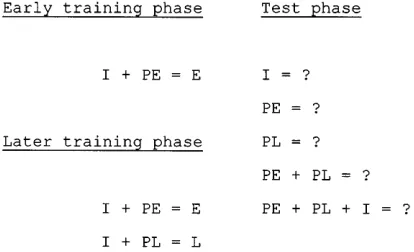
Figure 1 shows the abstract design of this experiment (Kruschke 1996a). In an early training phase, subjects were asked to learn only disease E. In a later training phase, diseases E and L were intermixed across trials with equal frequencies. After this two-phase training, partici-pants were asked to diagnose patients who had novel combinations of the possible symptoms, such as the symptom I alone, or symptoms PE+PL presented simulta-neously.
How should a rational learner respond to these novel symptom combinations? Consider symptom I presented alone. During the entire course of training, it appeared twice with disease E for each time it appeared with dis-ease L. Therefore a rational response would be to choose disease E. Consider now the symptom combination
PE+PL. During the entire course of training, symptom PE appeared with disease E twice for each time that symptom PL appeared with disease L. A rational response to PE+PL would therefore favor E again.
Results showed that when tested with symptom I alone, people diagnosed it as the early disease E. By con-trast, when presented with the conflicting PE+PL symp-toms, people chose the later disease L. According to Kruschke (1996 a), these results can be explained as fol-lows. Because disease E is learned first, its two symptoms (I and PE) are each associated with the early disease. When subsequently learning disease L, the shared symp-tom I is already associated with E, which conflicts with the correct response, L. To avoid this conflict, people shift their attention away from I to PL, thereby encoding dis-ease L predominantly by its distinctive symptom PL, and not by its shared symptom I. Consequently, when pre-sented with symptom I alone during the test phase, people tend to respond with disease E. When tested with combi-nation PE+PL, people diagnose it as the later disease, be-cause PL is the strongly encoded perfect predictor of dis-ease L, but PE is only half of the two symptoms needed to predict disease E.
This explanation suggests that people’s response to symptom combination PE+PL is not irrational, but is in-stead a side effect of a highly adaptive mechanism for se-lective attention during learning. When learning the later disease, people dramatically reduce interference with their previously learned associations by selectively attending to the distinctive symptom PL, and by selectively ignoring the conflicting symptom I. This shift of attention protects and preserves previously acquired knowledge, and the shift simultaneously enhances rapid acquisition of new as-sociations.
The principle of rapidly shifting attention in learning was formalized by Kruschke (1996 a) in a connectionist model, called ADIT (attention to distinctive input). ADIT accurately fit data from several experiments, providing additional evidence that the theory of rapid attention shifts has merit.
Goal of this research
It is important to study learned attention for two reasons. First, learned attention arguably accounts for many phe-nomena in animal and human learning. Second, rapid shifts of attention are a computationally efficient means of reducing interference between previously learned associa-tions and novel associaassocia-tions. Given the importance of learned attention, the rationale of the current study was to test baboons with an analogue, in the visual domain, of the disease diagnosis task, in order to assess the ability of these animals to shift attention while sparing previous cat-egory knowledge. Experimental results will suggest that baboons do not shift attention comparably to humans. In a second part of this paper, data from each species will be fit with the ADIT model. This model formalizes the no-tion of rapidly shifting attenno-tion, and makes detailed
Fig. 1 Abstract design of the experiment from Kruschke (1996,
quantitative predictions. In line with empirical data, the model fits will also suggest that baboons do not shift at-tention as humans do.
Experiment: evidence for species differences in attention shifts
Monkeys were tested with a conditional matching-to-sam-ple task in which the visual forms to be categorized were presented on a monitor screen. The experimental proce-dure involved two training phases followed by a testing phase. During the training phases, monkeys sequentially learned two categories of two-feature visual objects, one after the other. In the testing phase, they were presented with various combinations of the features of the initially and subsequently learned categories. For comparative purposes, and as our visual task had never been presented before to humans, people were also tested in the same conditions as baboons.
Method
Participants
Two 6-year-old wild-born baboons (Papio papio), re-ferred to as B04 and B06, were selected from a social group of 12 animals in the animal facilities at the C.N.R.S., Marseille, France. The two baboons were cho-sen as subjects in this experiment because they were al-ready trained in various visual discrimination tasks in-volving the setup and the procedure employed in the pre-sent research (e.g., Fagot and Deruelle 1997; Vauclair et al. 1993). Animals were not deprived of food, but ob-tained their daily food ration at the end of the day, after completion of daily training and testing. Nine 22- to 26-year-old psychology students also participated for mone-tary payment. The human participants were not informed of the purpose of the experiment.
Apparatus
The apparatus comprised a 14-inch (35-cm) color monitor on which visual stimuli were displayed, and an analogue joystick controlling a cursor on the monitor screen. When baboons were tested, the set-up comprised an experimen-tal cage (68 ×50 ×72cm) facing the joystick and the mon-itor. This cage was fitted with a view port, two hand ports for joystick manipulation, and a food dispenser for deliv-ering 190-mg banana-flavored pellets. The testing appara-tus for humans was identical to that of the baboons, ex-cept that the monitor and the joystick were placed on a table. For both humans and baboons, the viewing distance was 50 cm.
Stimuli
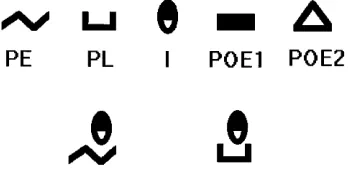
Stimuli were composed of either one or two of the geo-metric features shown in the top part of Fig. 2. Each of these elementary features was composed of 510 yellow pixels displayed on a black background. For stimuli com-posed of more than one feature, such as those depicted in the bottom part of Fig. 2, the location of the features rela-tive to each other was varied across trials, with the con-straint that they did not overlap and they occupied a max-imum of 3° of visual angle. For instance, in training phase 1, the oval form could be displayed either above or below the zigzag line.
Experimental design
Figure 3 illustrates the abstract structure of the categories in the two training phases. Consider first the structure of the categories in training phase 2. Subjects had to learn that stimuli composed of features I+PE required response E, and stimuli composed of features I+PL required re-sponse L. The feature I is an imperfect predictor of the two outcomes, whereas feature PE is a perfect predictor of outcome E, and feature PL is a perfect predictor of out-come L. Outout-come E is denoted as such because it is also part of early training, in phase 1, whereas outcome L oc-curs only in later training, in phase 2. This much of the de-sign is identical to the dede-sign of experiment 2 of Kruschke (1996 a) (summarized in Fig. 1).
Fig. 2 Upper row Elementary features employed to construct the
stimulus set, and corresponding labels used in specifying the ab-stract design. Lower row Example of two-feature stimulus used during training phase 1 (left) or training phase 2 (right)
Fig. 3 Experimental design
Our account of the effect seen in humans relies on the assumption that in phase 1 subjects learn about both fea-tures, I and PE, of category E. Previous research (Fagot and Deruelle 1997) suggests that baboons will select local features of a compound stimulus, when this selection sup-ports a viable solution. To prevent this from happening in this experiment, another category, labeled OE, was in-cluded in phase 1, which had instances consisting of fea-tures I+POE1, or of PE+POE2. With this structure, only the conjunction of features I+PE accurately predicted out-come E in the early training phase.
General procedure
The method of testing was based on the conditional matching-to-sample paradigm. At the beginning of each trial, a cursor appeared in the center of the monitor, along with a 0.5 ×0.5 cm “start” stimulus, 1.5 cm above or be-low the cursor. Participants then had to manipulate the joystick so as to place the cursor on the “start” stimulus to initiate the trial. Once accomplished, a sample stimulus appeared on either the left or the right side of the screen, along with two response squares of different colors, 4 cm above and below the cursor. Subjects then had to move the cursor to the color square designating the category to which the sample belonged. For instance, in phase 2 of the training, participants had to select the green response square when the sample belonged to E, or the white re-sponse square when the sample belonged to L. The loca-tion of response colors, either above or below the center, was random on each trial. For monkeys, correct responses were reinforced with food, and incorrect responses re-sulted in a time delay of 5 s before the next trial began. For humans, the outcome of each trial was indicated by the French words “vrai” or “faux” (correct or wrong) ap-pearing for 250 ms on the screen.
The first training phase was designed to teach the par-ticipants categories E and OE (see Fig. 3). On each trial, a training stimulus was shown on the monitor, along with a blue and a green response square. To respond correctly, subjects were required to select the green square if it be-longed to E, and the blue square if the sample bebe-longed to OE. Because E stimuli shared one feature with all the OE stimuli, an accurate discrimination required participants to take into account the identity of both elemental features of the sample. In phase 1, training blocks contained 48 trials for humans and 96 trials for baboons. Baboons received one to three blocks of training per day, but humans re-ceived all training and testing blocks is immediate succes-sion. Within each block, the OE stimuli were presented in 50% of the trials (25% for each type of OE stimulus, see Fig. 3), and the E stimuli were displayed in the remaining 50% of the trials. The order of stimulus presentation was randomly selected prior to each block, with the constraint that no more than three consecutive trials were from the same category.
Prior to training phase 1, human subjects were told how to initiate the trials and to manipulate the joystick.
They were never told, however, what the matching rule was, but were asked to discover it by themselves. Training phase 1 continued until the participants attained at least 80% correct responses for all three feature combinations.
The second training phase involved a discrimination between E and L categories (Fig. 3). All the procedural details of phase 2 were identical to those of training phase 1. The two categories were presented with equal frequen-cies. Moreover, participants had to select a green response square when the sample belonged to E, or a white re-sponse square when the sample was from L. The instruc-tion given to human participants emphasized only the need to discover the matching rule.
The testing phase consisted of series of trials in which the sample form could be either an instance from phase 2 of training or any of the test stimuli shown in Fig. 4. Test stimuli were either features I, PE or PL presented alone, or the feature combinations PE and PL, or PE and PL and I. The response squares in the test phase were always green and white, corresponding to the E and L categories from phase 2. As there was no correct response for the five test stimuli, test trials with these stimuli never gave rise to feedback for humans. However, because an ab-sence of feedback might have been considered as a nega-tive reinforcement by baboons (since they had previously been rewarded in every correct trial), test trials involving the transfer stimuli were, for baboons, randomly rein-forced at a 50% rate.
Each monkey received 20 test blocks of 106 trials. Each block comprised 48 E trials, 48 L trials, and 20 transfer trials involving the five test stimuli (see Fig. 4). People received only five sessions of 88 trials each, in or-der to keep a sustained level of motivation. Their sessions consisted of 24 E and 24 L trials intermixed with 40 test trials (eight trials per test stimulus). Moreover, prior to the test, human participants were instructed that they would receive trials, similar to those of phase 2, intermixed with some trials of a novel type, for which no feedback was given. For the novel trials, they were asked to give their best educated guess.
Results
Training
One baboon (B04) needed 9696 trials (101 blocks) to reach the training criterion in training phase 1. The other subject (B06) needed 9408 trials (98 blocks). Humans were much faster and needed 219 trials on average (SD =
Fig. 4 Stimuli used during testing, with corresponding abstract
148) to reach the training criterion in phase 1. For training phase 2, criterion was reached in 864 and 1152 trials (9 and 12 blocks) for subjects B04 and B06, respectively. Humans all reached the training criterion in phase 2 within the first block of 96 trials.
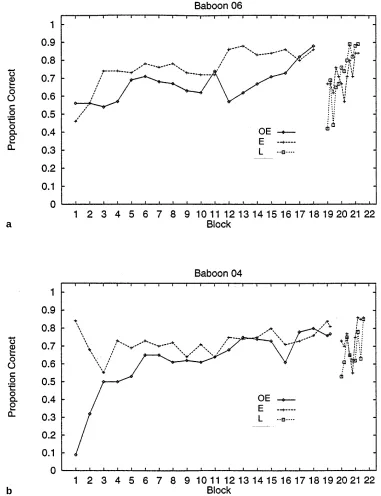
Individual learning curves for training phases 1 and 2 are reported in Fig. 5 a for B06 and in Fig. 5 b for B04. In phase 1, B06 learned category E before category OE. This relative difficulty of OE might be accounted for by its com-plexity, in that it comprises two types of stimuli (Fig. 2).
In the initial 50 trials of phase 2, baboon B06 did not perform significantly above chance for category L,
χ2
(1, n = 50) = 1.28, P > 0.10, but performance on E
re-mained above chance, χ2
(1, n = 50)= 6.48, P < 0.02. Hence,
this baboon did remember category E during the initial training sessions of phase 2. Results for B04 were very similar to those of B06, except that during the early ses-sions of phase 1 B04 showed a bias for response E, which resulted in a high proportion correct on E but a low pro-portion correct on OE. Like B06, however, B04 showed a significant tendency to respond correctly during the initial E trials of phase 2, χ2
(1, n = 50) = 11.52, P < 0.001, and
showed no significant bias for the initial 50 L trials of phase 2, χ2
(1, n = 50)= 0.08, P > 0.10. Fig. 5 Proportion of correct
trials for a B06 and b B04, and for each stimulus category used in training. Training trials were blocked by 500 trials in training phase 1 and 50 trials in training phase 2. Thus, the Block on the abscissa of these graphs is different from the training and testing blocks definied in the main text
a
Testing
Table 1 reports the response proportions for individual ba-boons in the test phase, along with response proportions at the group level for humans. The two monkeys behaved in a very similar way during testing. First, both B04 and B06 showed a significant response preference for E when pre-sented with PE, and for L when prepre-sented with PL. Because PE and PL corresponded to the perfect predictor of E and L, respectively, this finding shows that monkeys have encoded associations between the distinctive fea-tures and the corresponding categories they predict. Second, for both B04 and B06, there was no significant response bias for the imperfect predictor I. Finally, these two baboons exhibited random choices when presented with either PE+PL or I+PE+PL.
Not unlike baboons, human participants selected E and L when presented with PE and PL, respectively (see Table 1). They also showed no significant response bias for I+PL+PE, which comprised the imperfect and both per-fect predictors of each category. However, humans be-haved very differently from baboons when presented with feature I or with feature combination PE+PL. Indeed, for feature I there was a significant preference for response E instead of the random choice exhibited by baboons. For feature combination PE+PL, people showed a significant preference for response L instead of the ambivalence shown by the baboons.
The pattern of responses shown by human subjects in this experiment is consistent with the results of the exper-iment of Kruschke (1996a), despite the changes in stimuli and apparatus. Thus, the results observed by Kruschke (1996 a) cannot be due to the use of symptoms and eases, with their implied direction of causality from dis-eases to symptoms, nor can the original results be due to
the use of explicitly verbal material for stimuli and re-sponses.
Discussion
This research investigated attention to visual features in animals and humans. For that purpose, baboons were tested with an analogue, in the visual domain, of the ficti-tious medical diagnosis task presented to humans by Kruschke (1996 a, experiment 2). Human participants were also tested under the same conditions as baboons. Our discussion will focus on attentional mechanisms in-volved in phased learning.
Humans and baboons both showed retention of cate-gory E while learning catecate-gory L in phase 2. Humans and baboons also both showed a preference for response E when tested with feature PE, and they both showed a pref-erence for response L when tested with feature PL. Humans and baboons also both showed no differential preference for either response when presented with fea-ture combination I+PE+PL.
The two species differed quite dramatically, however, in their responses to test stimuli I and I+PL. Whereas the baboons showed no preference for either response option, humans strongly preferred response E for stimulus I, and response L for stimulus I+PL.
Results for the humans are consistent with those of Kruschke (1996 a). As described in the Introduction, these results can be explained by assuming that learners associ-ated both features I and PE with the early learned category E, but shifted attention to the distinctive feature PL of the later learned category L. Why did baboons behave differ-ently from humans in this experiment?
It might be argued that, in baboons only, associations related to the imperfect predictor acquired in phase 1 were forgotten in phase 2, due to a limited memory capacity. This hypothesis is unlikely for at least two reasons. First, as reported in Fig. 5, both baboons presented a significant propensity for correctly responding E during the initial 50 E trials of phase 2. Second, in phase 2, E trials which had already been presented in phase 1 were intermixed with 50% of L trials. Thus, the experimental design favored the retention of associations linked to E during acquisition of category L.
Another possible hypothesis is that people may have encoded E by the conjunction of its two elemental fea-tures, I and PE, whereas baboons may have encoded E merely as anything that does not contain the distinctive features of OE, namely POE1 and POE2. According to this hypothesis, the baboons responded OE if the sample contained either a POE1 or POE2, and responded E if the sample contained neither of these two features. This hy-pothesis predicts that, during the initial presentations of L in training phase 2, these I+PL stimuli should have been responded to as E, because they contained neither POE1 nor POE2. However, when the initial 50 presentations of L are considered, the two baboons responded E in 52% (B04) and 42% (B06) of the trials, which indicates
ran-Table 1 Percentage of E responses for stimuli in the test phase,
for baboons, humans, and best-fitting ADIT (attention to distinc-tive input) models; No shift best fit of ADIT when attention shift-ing is set to zero, but an additional parameter allowshift-ing different learning rates for present and absent categories is used; Shift best fit of ADIT with attention shifting, * significant (P ≤ 0.05) re-sponse biases inferred from a two-tailed chi-square test, + signifi-cant (P≤0.05) response bias at the group level inferred from a two-tailed t-test comparing the mean number of E responses for the group to random 50-50 choice, ns no significant response bias). No statistical analyses were conducted on baboons' mean data, be-cause of the limited number of subjects; results for each individual (B04, B06) are given separately
Stimulus Baboons Humans
B04 B06 Mean No shift Mean Shift
I+PE 83.6* 88.9* 86.2 85.3 99.5+ 99.7
I+PL 19.6* 11.3* 15.5 15.3 1.3+ 1.2
PE 82.5* 92.5* 87.5 86.9 99.2+ 99.3
PL 20.0* 10.5* 15.3 13.8 0.0+ 0.2
dom choices (chi-square test, all Ps > 0.1) rather than a preference for E. This latter result shows that, at least at the end of phase 1, the two baboons relied on the encod-ing of both features of E to respond correctly.
In brief, the results demonstrate that baboons encoded the two elementary features of E at the end of training phase 1 and, moreover, remembered category E in the ini-tial training sessions of phase 2. Whereas the two elemen-tary features of E were encoded during phase 1 and early in phase 2, only the distinctive feature of this category was coded at the end of phase 2, as demonstrated by the transfer tests. This phenomenon is probably not to be ex-plained by limitations in memory, but rather by acquired changes in the association strength between the imperfect predictor I and response E. We propose that, during phase 2, the previously learned association between the imperfect predictor I and category E progressively di-minished, due to the frequent co-occurrence of feature I with outcome L. Unlike humans, the baboons did not shift attention away from feature I when it appeared with outcome L. To compensate for this loss of association between I and E, the association strength between the perfect predictor PE and category E grew to be approxi-mately equal to the association strength between the per-fect predictor PL and the category L, leading to random choices when the two perfect predictors conflicted in test item PE+PL. In other words, rather than shift attention to protect associations learned in early training and to pre-vent interference with new learning, the baboons “over-wrote” the earlier learned associations with new associa-tions.
Modeling: additional evidence
for species differences in attention shifts
The experimental results showed a dramatic difference between the generalization behavior of baboons and hu-mans. In this section, we demonstrate that the ADIT model, which incorporates attention shifts, can fit the hu-man data, and can also fit the baboon data when its atten-tional shift rate is set to zero. The modeling thereby sup-ports the claim that a critical difference between the ba-boons and the humans is rapid attention shifting.
The Rescorla-Wagner (RW) model (Rescorla and Wagner 1972) is the best known model of associative learning in animals (cf. Miller et al. 1995; Siegel and Allan 1996), and it has also been successfully applied to some aspects of human category learning (e.g., Gluck and Bower 1988). The RW model associates cues with re-sponses (or with unconditioned stimuli) such that the amount of associative change is proportional to the dis-crepancy between the correct response and the predicted outcome. In this way, the changes in associative weights are error-driven. In the basic RW model, any cue that is present in the stimulus will have its associative weights changed whenever there is an erroneous prediction. There
is no mechanism of shifting attention whereby the differ-ent cues can participate more or less in accounting for the error. For example, if a cue is present in two different tri-als with different outcomes, then the cue must be attended to in both trials, and associative learning must accommo-date the conflicting outcomes. In the particular experi-mental design used here (see Fig. 1), this property of the RW model implies that the cue, I, shared by stimuli I+PE and I+PL, will eventually be associated about equally with the two response categories, rather than unequally as demanded by the human data.
The configural connectionist model of Pearce (1994) also does not incorporate selective attention and also can-not accommodate the human data. In the Pearce model, there are configural nodes that mediate the mapping from input cues to output responses. Importantly, these config-ural nodes are recruited so that they exactly copy all the cues presented on a given trial, with no differential selec-tive emphasis of individual cues within a configuration. The Pearce model does have a form of attentional capac-ity constraint expressed as activation normalization, but the model does not have any selective attention shifting. The Pearce configural model cannot, therefore, exhibit the preferences shown by humans for stimuli I and PE+PL, but it does predict the pattern of results shown by ba-boons.
Kruschke (1996 a) reviewed several other models of human categorization that have attempted to account for the type of phenomenon addressed here. These models in-cluded the component cue model of Gluck and Bower (1988), the attentional connectionist model of Shanks (1992), the context model of Medin and Schaffer (1978), the generalized context model of Nosofsky (1986), the ALCOVE model of Kruschke (1992), and the rational model of Anderson (1991). All of these models failed be-cause they do not implement stimulus-specific attention shifts.
will show that ADIT can fit both the baboon behavior and the human behavior, and the fit to baboon behavior is best when attention shifting is set to zero.
Formal description of ADIT
ADIT can be construed as a connectionist network in which each input node represents a cue and each output node represents a categorical response. To model this ex-periment, the network has five input nodes, corresponding to the five cues, and three output nodes, corresponding to the three response categories. When the ith cue is present, input node i has activation ai= 1, otherwise it has
activa-tion zero. When the kth category is the correct response, the kth output node receives a “teacher” value of tk = 1,
otherwise it has teacher value zero1
Each input node is gated by an individual attention strength, which simply amplifies or attenuates the input node activation via multiplication. When a stimulus is presented, all activated nodes are initially attended to equally. There is a capacity constraint on the total atten-tion, so that as more cues are presented, less attention can be allocated to each one. If the stimulus has N cues, then the initial attention given to each cue is α= 1/N(1/η), where
η> 0 and is a freely estimated parameter that expresses the attentional capacity. This causes the normed total at-tention, (Σiαiη)1/η, to be equal to 1. If ηis small, then
in-creasing the number of cues reduces the attention per cue. If ηis large, then increasing the number of cues has rela-tively little effect on the attention per cue.
Between input node i and output node k is a connection with associative weight wki. The associative weights are
initialized at zero, but gradually learn according to the delta-rule described later. When a stimulus is presented, the input nodes are activated, attention is allocated to the activated nodes, and then activation spreads to the output nodes via the weighted connections, with output activa-tion given by:
ak= Σiwkiαiai
The output node activations are converted to choice prob-abilities so that the probability of response K is given by:
p(K) = exp(φaK)/Σkexp(φak)
where φis a freely estimated constant that determines the “decisiveness” of the network. A large φcauses the most activated output node to garner a large choice probability at the expense of other partially activated response nodes. A small φcauses even slightly activated responses to be
chosen with probability nearly as large as highly activated responses.2
After the network makes its initial prediction, the teacher values are delivered to the output nodes, just as feedback is delivered to experimental subjects. The atten-tion strengths are then redistributed to reduce the error, E, across the output nodes, which is measured as:
E = 0.5Σk(tk– ak)2
The primary goal of learning is error reduction, and the first reaction to the error is a rapid shift of attention away from cues that cause error and toward cues that reduce er-ror. In ADIT, this shift of attention is accomplished by gradient descent on the error with respect to the attention strengths, which yields the following equation for shifting attention:
∆αi= σΣk(tk– ak)wkiai
where σis a freely estimated constant of proportionality, called the attention shift rate. If the shift causes an atten-tion strength to take on a negative value, then the value is set to zero because negative values might not have a clear psychological interpretation. After the attention strengths are shifted, they are renormalized by dividing each by:
(Σiαiη)1/η
This renormalization respects the capacity constraint on attention.
With the model now having determined which cues to attend to, the cue activations are propagated again to the output nodes and a new error is computed. The associa-tion weights are then adjusted to reduce this remaining er-ror, with the change in weights given by:
∆wki= λ(tk– ak)αiai
where λis a freely estimated constant of proportionality, called the weight learning rate. This learning rule is for-mally equivalent to the learning rule in the original RW model, except that Rescorla and Wagner proposed that the learning rate for reinforced trials could be greater than the learning rate for non-reinforced trials. In the present for-malism, this means that the learning rate takes on one value, λ, for output nodes with tk= 1, and a different value β ≤ λ, for output nodes with tk= 0.
In summary, when stimulus cues are presented to ADIT, they are initially all attended to equally, and acti-vation propagates from the cues, weighted by attention, to the category nodes. Corrective feedback is then supplied, and attention rapidly shifts away from cues that cause er-ror and toward cues that reduce erer-ror. This shifting of at-tention constitutes reduction of interference between prior knowledge and new learning, because attention is shifted 1The “shift” and “no-shift” versions of ADIT implemented here
actually used “humble” teachers, for which an activation more ex-treme than the zero or one teacher value does not generate an error (see Kruschke 1996 a). Humble teachers turn out to have little in-fluence on the model fits; in fact, they improve the fits of the two versions of ADIT slightly but not significantly
away from exactly those cues that cause interference with prior knowledge. Any remaining error is used to drive changes in the associative weights. The no-shift version of this model, which is equivalent to the RW model, is simply the special case in which the attention shift rate is fixed at zero, and the associative weight learning rate for absent categories is allowed to differ from the associative weight learning rate for present categories.
The “shift” version of ADIT has four freely estimated parameters: the learning rate for the association weights, the decisiveness constant for mapping output activations to response probabilities, the attentional capacity con-stant, and the attention shift rate. The no-shift version of ADIT also has four freely estimated parameters: the atten-tion shift rate is fixed at zero but the associative learning rate for absent categories is free.
Measure of fit
The model was fit to the empirical response frequencies for each test-phase stimulus. The fit of the predictions to the data was measured using a log-likelihood statistic, G2
= 2Σifiln(fi/mi) where fi is the empirical response
fre-quency in cell i, miis the predicted response frequency in
cell i, and the sum is over all cells in the response fre-quency table (Wickens 1989).
Parameter value search method
Best-fitting parameter values were found using simulated annealing (e.g., Goffe et al. 1994). Simulated annealing randomly checks many thousands of parameter value combinations, and gradually increases the density of search in regions of parameter space with the best fit. We can be fairly confident that the resulting best fits are very nearly the global optimum in the searched range of pa-rameter values. As an additional check, gradient-descent search was also performed from a number of different starting values.
Fit results
Best fit of ADIT to the baboon data
The two baboons’ mean response frequencies in the test phase (see Table 1) were fit. For each of the seven stimuli in the test phase, there were two possible responses, E or L, thereby yielding 14 response frequencies to be fit. As the total number of responses for a given stimulus was fixed by the experimental design, the data included seven independent frequencies.
The model was trained on 2388 blocks of four trials (9552 trials) in phase 1, and 252 blocks of four trials in phase 2 (1008 trials), which represents the approximate mean training time of the two baboons. Phase 3 contained 20 blocks of 106 trials (2120 trials), with each block
hav-ing 24 occurrences of stimulus I+PE reinforced with re-sponse E, 24 occurrences of stimulus I+PE reinforced with response L, 24 occurrences of stimulus I+PL rein-forced with response E, 24 occurrences of stimulus I+PL reinforced with response L, one occurrence of each of the five test stimuli reinforced with response E, and one oc-currence of each of the five test stimuli reinforced with re-sponse L. The results of two random training sequences were averaged to obtain the model predictions.
It turned out that an excellent fit to the baboon data could be obtained without use of a separate learning rate for absent categories (that is, β= λ). Moreover, the atten-tional capacity constraint was also unneeded (η= 100.0, the maximum permitted value). The best fit was obtained with φ= 1.22 and λ= 0.637, which yielded G2(df = 5) =
0.88, an excellent fit. The predictions of the “no-shift” version of ADIT are shown in Table 1. The model shows indifferent responses to stimuli I and PE+PL, just as ex-hibited by the baboons (but not by the humans).
Best fits to the human data
The nine humans’ mean response frequencies in the test phase (see Table 1) were fit. Just as with the baboon data, for each of the seven stimuli in the test phase there were two possible responses, E or L, thereby yielding 14 re-sponse frequencies to be modeled. As the total number of responses for a given stimulus was fixed by the experi-mental design, the data included only seven independent frequencies. The two version of ADIT (“shift” and “no-shift”) each have four estimated parameters, leaving three degrees of freedom. The models were trained for 55 blocks of four trials (220 trials) in phase 1, and 24 blocks of four trials (96 trials) in phase 2, representing the ap-proximate mean training time of the human participants.
The best fit of the “no-shift” version of the model to the mean human data is quite poor, with best-fitting pa-rameter values of φ= 6.44, λ= 0.0913, and η= 0.875, and
β= 0.594, which yielded G2(df = 3) = 225.4. Thus the
no-shift version of the model can be rejected with extremely high confidence. The model predicts indifferent responses to stimuli I and PE+PL, contrary to the human data.
The fit of the “shift” version of ADIT to the human data is excellent. The best fit, with φ= 6.65, λ= 0.0337,
σ = 0.213 and η = 6.69, yielded G2(df = 3) = 2.78.
Predictions are shown in Table 1, where it can be seen that responses for stimuli I and PE+PL, in particular, are very close to the empirical values.
Model fit summary
The baboon data can be accurately fit without any atten-tion shifts. The human data, on the other hand, can be ac-curately fit by ADIT only with attention shifts. When at-tention shifting is constrained to be zero, the model can-not reproduce the response preferences shown by humans, even when it is provided with separate learning rates for present and absent categories. Insofar as the attention shifting mechanism in ADIT is critical to account for the human data, we have additional evidence that comparable attention shifting is indeed occurring in human learning.
General discussion
The current study compared category learning in humans and baboons using a task derived from the work of Kruschke (1996 a). Consistent with Kruschke (1996 a), re-sults from humans demonstrated that when two categories that share a feature are learned successively, the shared feature is associated with the earlier-learned category, and the distinctive feature of the later-learned category is strongly associated with the later category. In the terms of Kruschke (1996 a), this result suggests that, when learning new associations, humans shifted their attention away from the stimulus features already associated with a re-sponse, and focused their attention on uncommitted dis-tinctive features. This conclusion is confirmed by our mod-eling, showing that ADIT with attentional shifting fits hu-man data well. ADIT with zero attention shifting failed to account for the human data, but fit the baboon data.
One obvious advantage of attentional shifting in the context of our experiment is to protect previously learned associations and to facilitate new learning. Humans are remarkably proficient among animals in their ability to rapidly learn arbitrary new associations without cata-strophically interfering with previously learned associa-tions. It is proposed, therefore, that attentional shifting mechanisms are an important component of this ability.
Regarding the baboons, two main conclusions can be drawn from their results. First, baboons changed their as-sociations during the learning process. Second, baboons selectively processed stimulus features, rather than exclu-sively the stimuli as wholes. The first conclusion, regard-ing changregard-ing associations, derives from the inspection of transfer trials involving the imperfect predictor “I”. Results showed that this elementary feature was not dif-ferentially associated with either E or L during the test phase, while it was more strongly associated with E than with L early in training phase 2. The second conclusion, regarding the selective processing of stimulus features, derives from the test phase in which the elementary stim-ulus features were presented individually or in novel com-binations. If these novel combinations were processed as compound wholes, then responses should have been at chance level for the five transfer stimuli. Contrasting with this expectation, responses to the test items PE and PL
differed from random choices, suggesting that these test stimuli were associated to either E or L, although they were never presented as such during the training phases. Note also that the test items PE and PL were as strongly associated with their respective categories as the typical stimuli of E and L (see Table 1), ruling out the possibility that performance in the test phase reflected an effect of stimulus generalization alone. Altogether, the results im-ply that baboons processed the compound stimuli used in this experiment as sets of elementary features, rather than as compounds.
Baboons’ focusing on stimulus features might depend on the experimental procedure and nature of stimulus con-figuration, and it is likely that the use of other types of stimuli, such as continuous bi-dimensional forms instead of discontinuous pairs of forms, might have favored the processing of the two stimulus dimensions. It should be noted, however, that the processing of stimulus feature, as opposed to compounds, has previously been observed in baboons for both stimulus discrimination (e.g., Fagot and Deruelle 1997; Deruelle and Fagot, in press) and catego-rization tasks (e.g., Dépy et al. 1997). For instance, Fagot and Deruelle (1997) presented the same baboons as in the current study with large (i.e., global) forms made of smaller forms (e.g., a large square made of small squares). After presentation of these compound stimuli as samples, the subject had to match the samples with comparison forms by considering either the local or global stimulus level. Results demonstrated a strong advantage (i.e., shorter response times) for processing the local aspects of the stimulus compared to global processing.
In other animal species, such as birds, rodents and fish, Mackintosh (1969) argued that results from probability learning and from serial reversal shift learning could be accounted for if subjects learned to selectively attend to relevant cues, and if this selective attention was learned to different degrees by different species. Mackintosh (1969) argued that “The simplest explanation ... of the behavioural differences between rat, bird and fish, is to suggest that the three classes of animal differ in the extent to which they can learn to attend to a given cue ...” (pp. 148–149). Our experiment and modeling demonstrate that baboons and humans also differ in their ability to rapidly shift at-tention among cues, suggesting that differences in selec-tive attention may account for a broad range of species differences in learning and behavior.
Acknowledgements John Kruschke’s research was supported in
References
Anderson JR (1991) The adaptive nature of human categorization. Psychol Rev 98 : 409–429
Cerella J (1979) Visual classes and natural categories in the pi-geon. J Exp Psychol Hum Percept Perform 5 : 68–77
D’Amato MR, Sant P van (1988) The person concept in monkeys (Cebus apella). J Exp Psychol Anim Behav Proc 14 : 43–55 Dépy D, Fagot J, Vauclair J(1997) Categorisation of
three-dimen-sional stimuli by humans and baboons: search for a prototype effect. Behav Proc 39 : 299–306
Deruelle C, Fagot J (in press) Visual search for global/local stimu-lus features in humans and baboons. Psychonom Bull Rev Fagot J, Deruelle C (1997) Processing of global and local visual
information and hemispheric specialization in humans (Homo sapiens) and baboons (Papio papio). J Exp Psychol Hum Percept Perform 23 : 429–442
Gluck MA, Bower GH (1988) From conditioning to category learning: an adaptive network model. J Exp Psychol Gen 117 : 227–247
Goffe WL, Ferrier GD, Rogers J (1994) Global optimization of statistical functions with simulated annealing. J Econometrics 60 : 65–99
Kruschke JK (1992) ALCOVE: an exemplar-based connectionist model of category learning. Psychol Rev 99 : 22–44
Kruschke JK (1996a) Base rates in category learning. J Exp Psychol Learning Mem Cogn 22 : 3–26
Kruschke JK (1996b) Dimensional relevance shifts in category learning. Connection Sci 8 : 201–223
Kruschke JK (1997) Attention in learning: relating Mackintosh’s (1975) theory to connectionist models and human categoriza-tion. Talk presented at the Eighth Australasian Mathematical Psychology Conference, Perth, Australia, 29 November 1997
Mackintosh NJ (1969) Comparative studies of reversal and proba-bility learning: rats, birds and fish. In: Gilbert RM, Sutherland NS (eds) Animal discrimination learning. Academic Press, New York, pp 137–162
Mackintosh NJ (1975) A theory of attention: variations in the as-sociability of stimuli with reinforcement. Psychol Rev 82 : 276–298
Medin DL, Schaffer MM (1978) Context theory of classification learning. Psychol Rev 85 : 207–238
Miller RR, Barnet RC, Grahame NJ (1995) Assessment of the Rescorla-Wagner model. Psychonom Bull 117 : 363–389 Nosofsky RM (1986) Attention, similarity and the
identification-categorization relationship. J Exp Psychol General 115 : 39–57 Pearce JM (1994) Similarity and discrimination: a selective review
and a connectionist model. Psychol Rev 101 : 587–607 Rescorla RA, Wagner AR (1972) A theory of Pavlovian
condi-tioning: variations in the effectiveness of reinforcement and non-reinforcement. In: Black AH, Prokosy WF (eds) Classical conditioning II. Current research and theory. Appleton-Century-Crofts, New York, pp 64–99
Shanks DR (1992) Connectionist accounts of the inverse base-rate effect in categorization. Connection Sci 4 : 3–8
Siegel S, Allan LG (1996) The widespread influence of the Rescorla-Wagner model. Psychonom Bull Rev 3 : 314–321 Sutherland NS, Mackintosh NJ (1971) Mechanisms of animal
dis-crimination learning. Academic Press, New York
Vauclair J, Fagot J, Hopkins WD (1993) Rotation of mental im-ages in baboons when the visual input is directed to the left cerebral hemisphere. Psychol Sci 4 : 99–103
Wickens TD (1989) Multiway contingency tables analysis for the social sciences. Erlbaum, Hillsdale