IJSRR, 7(3) July – Sep., 2018 Page 514
Review article
Available online www.ijsrr.org
ISSN: 2279–0543
International Journal of Scientific Research and Reviews
Neural Network Based Tuberculosis Disease Classification
M. Muthuvijayalakshmi
1*, E. Kumar
2and C. PonnuRaja
3 1,3Department of Statistics, National Institute for Research in Tuberculosis, (ICMR), Chennai-31
2Department of Statistics, Presidency College, Chennai-5
ABSTRACT
Symptoms based Tuberculosis disease diagnosis is one of the challenging tasks in the
medical field. So many techniques are availabe for classification of data such as Artificial Neural
Network, Support vector machine and Genetic Algorithm. The objective of this paper is to construct
a Multiplayer Feed Forward Neural Network model for the diagnosis of Tuberculosis. The trained
network serves as a knowledge base of the system. The construction of the system is presented in
this paper. This model correctly classifies 92.3%.
KEYWORDS: Artificial Neural Network, Tuberculosis, Multiplayer Feed Forward Neural Netwrk.
*Corresponding author
M. Muthuvijayalakshmi
Department of Statistics
National Institute for Research in Tuberculosis,
IJSRR, 7(3) July – Sep., 2018 Page 515
INTRODUCTION
Tuberculosis is an infectious disease caused by bacteria whose scientific name is
Mycobacterium tuberculosis. It was first isolated in 1882 by a German physician named Robert
Koch who received the Nobel Prize for this discovery. TB most commonly affects the lungs but also
can involve almost any organ of the body. According to WHO estimates1,2. India has the world’s largest tuberculosis epidemic. India accounts for one-fifth of the global TB incident cases. Each
year nearly 2 million people in India develop TB, of which around 0.87 million are infectious cases.
It is estimated that annually around 330,000 Indians die due to TB. In India, the prevalence is 3.1
million at best and 4.3 million at high. In China, the figures are 1.4 million and 1.6 million
respectively. Tuberculosis is not a hereditary disease. It is an infectious disease. Any person can get
afflicted with TB. Whenever, a patient having active tuberculosis coughs or sneezes in an open
manner, bacteria causing TB come out in the aerosol. This aerosol can infect any person who
happens to inhale it. Characteristic symptoms of TB are persistent cough of more than three weeks
duration, cough with expectoration of sputum, fever, weight loss or loss of appetite etc. If any of
these symptoms persist beyond three weeks, the person concerned should visit the nearest DOTS TB
Center or Health Center and get his sputum examined.
NEURAL NETWORK
The aim of Neural Network is to mimic the human ability to adapt to changing circumstances
and the current environment. This depends heavily on being able to learn from events that have
happened in the past and to be able to apply this to future situations. Every neuron operates
independently, processing the input received, adjusting weights, propagating its computed output
thus a neuron is a natural level of parallelization for neural networks. Every neuron is treated as a
parallel processor. If the network consists of many hidden layers, the processing time can be
reduced at each layer in the network and thus the overall training time of the network can be reduced
drastically. Hence the parallel concept in this to speed up the training process of the net to perform
the classification task.
ARTIFICAL NEURAL NETWORKS
Artificial neural network consists of many nodes processing units analogous to neuron in the
brain. Each node has a node function associated with it which along with a set of local parameter
determines the output of the nodes, given an input modifying the local parameters alter the node
function. Artificial neural network is an information processing system. In this information
IJSRR, 7(3) July – Sep., 2018 Page 516
by means of connection links. The links possess an associated weight, which is multiplied along with
the incoming signal for any typical neural net. The output signal is obtained by applying activations
to the net input.
The neural net can generally be single layer or a multilayer net. Thus artificial neural network
represents the major extension to computation. They perform the operations similar to that of the
human brain. Hence it is reasonable to except a rapid increase in our understanding of artificial
neural network leading to improved neural network paradigms and a host of application
opportunities.
A simple artificial neural net with two input neurons ( ) and one output neuron(y).The
interconnected weights are given by and .In a single layer net there is a single layer of
weighted interconnections.
y
Neural Networks for classification
Neural Network consists of composition of single nonlinear processing units that are
organised in a densely interconnected graph. A set of parameters, called weights are assigned to
each of edges of the graph3. These parameters are adapted through local interactions of processing units in the network. By repeatedly adjusting these parameters the neural network is able to
construct a representation of the given data set. The adaption process is known as Training. Neural
Network is able to solve highly complex problems due to non linear processing capabilities of
neurons. The inherent modularity of the Neural Network structure makes it adaptable to a wide
IJSRR, 7(3) July – Sep., 2018 Page 517
FEED FORWARD NETWORKS
There is network where in for every input vector laid on the network an output vector is
calculated and this can be read from the output neurons. There is no feedback. Hence only a forward
flow of information is present. Network having this structure are called as feed forward network. The
important types of feed forward network is the Back propagation network.
BACK PROPAGATION NETWORK (BPN)
Back propagation is a systematic method for training multilayer artificial neural network. It is
a multilayer forward network using extend gradient descent based delta learning rule, commonly
known as back propagation rule. Back propagation provides a computationally efficient method for
changing the weights in a feed forward network with differentiable activation function units to learn
a training set of input –output examples. The aim of this network is to train the net to achieve a
balance between the ability to respond correctly to the input patterns that are used for training and
the ability to provide good responses to the input that are similar.
The total squared error of the output computed by net is minimized by a gradient descent
method known as back propagation or generalized delta rule. Back propagation learning consists of
two passes through the different layers to the network: a forward pass and backward pass. In forward
pass input vector is applied to the sensory nodes of the network and its effect propagates through the
network layer by layer. A set of outputs is produced as the actual response of the network. During the
forward pass the synaptic weights of the network are all fixed. During the backward pass the
synaptic weights are all adjusted in accordance with an error correction rule. The actual response of
the network is subtracted from a target response to produce an error signal. This error signal is then
back propagated through the network, against the direction of synaptic conditions4.
NEURAL NETWORKS IN MEDICAL FIELD
Keeping in view of the significant characteristics of NN and its advantages for the
implementation of the classification problem, Neural Network technique is considered for the
classing of data related to medical field in this study. Owing to their wide range of applicability and
their ability to learn complex and nonlinear relationships including noisy or less precise information
Neural Networks are very well suited to solve problems in biomedical engineering. By their nature,
Neural Networks are capable of high-speed parallel signal processing in real time. They have an
advantage over conventional technologies because they can solve problems that are too complex
problems that do not have an algorithmic solution or for which an algorithmic solution is too
complex. Neural Networks are trained by examples instead of rules and are automated. This is one
IJSRR, 7(3) July – Sep., 2018 Page 518
medical diagnosis they are not affected by factors such as human fatigue, emotional status and
habituation. They are capable of rapid identification, analyses of conditions, and diagnosis in real
time. With the spread of Neural Networks in almost all fields of science and engineering, it has
found extensive application in biomedical engineering field also. The applications of neural
networks in biomedical computing are numerous. Various applications of ANN techniques in
medical expert system, cardiology, neurology, rheumatology, mammography and pulmonology were
studied 7, 8. In this study, medical data related to Tuberculosis is considered for classification purpose to identify the disease.
As the neural networks are inherently parallel in nature, this technique is considered in this
study to implement parallelism for calculating the output at each node in different node in different
layers of the network. The basic unit of modularity in a network is neuron.
METHODS AND MATERIAL
Every neuron operates independently, processing the input receive, adjusting weights, and
propagating its computed output thus a neuron is a natural level of parallelization for neural
networks. Every neuron is treated as a parallel processor. For example a layer other than the input
layer consists of ‘m’ neurons and assume that processing time‘t units’ to calculate the output at each
neuron is similar. If the parallel concept is not adopted in neural network ‘mt units’ of time is
needed to calculate the output. The needed time can be reduced by ‘m’ times, if parallel concept is
implemented at neuron level. If the network consists of many hidden layers, the processing time can
be reduced at each layer in the network and thus the overall training time of the network can be
reduced drastically. Hence, we adopted the above said parallel concept in this thesis to speed up the
training process of the net to perform the classification task.
DATA COLLECTION
For the purpose of the study and analysis the data was taken from the records of National
Institute for Research in Tuberculosis. Totally we collected 220 cases with six variables. The
attributes are cough, fever, Hameoptisis, chestpain, weightloss, and Breathe restlessness. In this
paper used MATLAB software for disease classification. The incidence of Tuberculosis is
considered as the output feature while all the other six features are taken as input features. The value
attached on the title of each column represents the maximum point that a patient can score on such
symptoms. As a patient is examined for any of the symptoms a score that represents the medical
practitioner in respect of the system is recorded for the patient. Based on all the recorded values, the
IJSRR, 7(3) July – Sep., 2018 Page 519
TRAINING THE NEURAL NETWORK
The training mode begins with arbitrary values of the weights they might be random number
and proceeds iteratively. Each iteration of the complete training set is called an epoch. In each epoch
the network adjusts the weights in the direction that reduces the error. As the iterative process of
incremental adjustment continues, the weights gradually converge to the locally optimal set of
values. Many epochs are usually required before training is completed. The Neural Network is
trained with different sample sizes of the database to achieve a high degree of accuracy by using feed
forward Neural Network Model and Back propagation learning Algorithm using Levenberg
Marquardt Back propagation Learning Algorithm.
RESULTS AND DISCUSSION
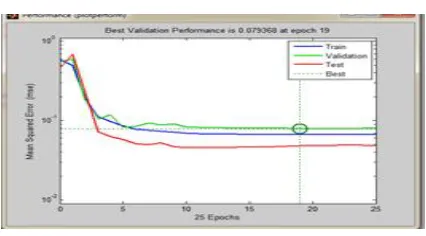
Figure .1 Performance Plot
Training: 70%
Validation: 15%
Testing: 15%
Best validation performance is 0.079368 at epoch 19
Table 1: Comparison of the training, validation, testing results
% of Training
%of Validation
% of Testing
Number of
hidden layer Result
55 25 20 10 85.5%
75 15 10 05 87.7%
65 25 10 10 89.5%
60 25 15 10 90.0%
70 15 15 08 89.1%
70 15 15 05 92.3%
70 15 15 20 90.9%
85 25 20 15 90.5%
IJSRR, 7(3) July – Sep., 2018 Page 520
As the comparison of each trial the maximum value can be obtained by training as 70%, validation
15%, and testing 15%.
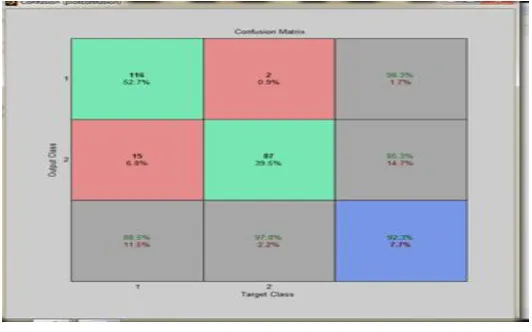
Figure. 2 Plot Confusion Matrix
No of True positives( ) 116
No of True Negatives( ) 87
No of False Positives( ) 15
No of False negatives( ) 2
Correct classification Rate = ( + )/ ( + + + )*100
Error rate= ( + )/ ( + + + )*100
Sensitivity= ( )/ ( + )*100
Specificity= ( )/ ( + )* 100
Rates %
Correct classification Rate 92.3%
Error Rate 7.7%
True Positive Rate(Sensitivity) 98.3%
IJSRR, 7(3) July – Sep., 2018 Page 521
CONCLUSION
In this study, a Neural Network Model for classification of medical data set and is used to develop predictive model for classification. The Model is developed with feed forward network
using Back propagation algorithm with variable learning rate to train the network. In this study, the
data is transferred into the knowledge that the symptoms are the significant ones in diagnosis
Tuberculosis. The presented results revealed that the multilayer Neural Network Model gives the
classification accuracy is 92.3%.
REFERENCES
1. Kochi, A., The Global tuberculosis situation and the new control strategy of the World Health
Organization. Tubercle 1991; 72: 1-6.
2. World Health Organization-TB, A Global Emergency-Geneva: WHO, 1994.
3. Rojas, R. Neural Networks: a systematic introduction Springer-Verlag, 1996.
4. SimonHaykin. Neural Networks-A Comprehensive Foundation. Pearson Education 2001.
5. Anil Jain, K., Mao, Jianchang and Mohiuddin, K.M.. Artificial Neural Networks: A Tutorial
IEEE Computers ,1996.
6. Cybenko, George. Neural Networks in Computational Science and Engineering. IEEE
Computational Science and Engineering, 1996; 36-42.
7. Kandaswamy, A. Application of Artificial Neural Networks in Bio Medical Engineering.
The Institute of Electronics and Telecommunication Engineers, Proceedings of the Zonal
Seminar a Neural Networks 1997.
8. Kusiak, A., Kernstine, K.H., J.A., McLaughlin, K.A. and Tseng, T.L.. Data mining: Medical
and Engineering Case Studies, Proceedings of the Industrial Engineering Research 2000
Conference, Cleveland, Ohio.
9. P.J. Braspenning, F. Thuijsman, and A.J.M.M. Weijters, Eds. Artificial Neura Networks.
Springer-Verlag, Berlin, ISBN 3-540-59488-4.
10. A. Armoni, “Use of neural networks in medical diagnosis”, MD Computing 1998; 5(2),
100-104.
11. M.L. Astin and P. Wilding, “Application of neural network to the interpretation of laboratory
data in cancer diagnosis”, Clin. Chem. 1992;1: 34-38.
12. M.L. Astion, M.H. Wener, R.G. Thomas, G.G. Hunder and D.A. Bloch, “Over training
in neural network that interpret clinical data” , Clin. Chem 1993; 38: 1998-2004.
13. F. Atieza, N.M. Alzamora, J.A.D. Velasco, S. Dreiseitl and L. Othno-Machado, “Risk
IJSRR, 7(3) July – Sep., 2018 Page 522
14. L. Atlas, R. Cole and J. Connor, “Performance comparisons between back propagation
networks and classification trees on three real-world applications”, Advances in Neural
Information process Systems 1990; 2:622-629.
15. Ahmed Hashmi, Chinmoy Das, Neural Network and Its Application.
16. S.N.Sivanandam, S.Sumathi, S.N.Deepa, Introduction to Neural Network Using MATLAB