ISSN: 2231-5381
http://www.ijettjournal.org
Page 662
Character Recognition Using Neural Network
Ankit Sharma
#1,Dipti R Chaudhary
#2#Instrumentation & Control department#1, #Instrumentation & Control department#2,
#1Nirma University
, #2Nirma University #1Ahemedabad, India
, #2Ahemedabad, India
Abstract- In the present paper, we are use the neural network to recognize the character. In this paper it is developed 0ff-line strategies for the isolated handwritten English character (A TO Z) and (0 to 9) .This method improves the character recognition method. Preprocessing of the Character is used binarization, thresolding and segmentation method .The proposed method is based on the use of feed forward back propagation method to classify the characters. The ANN is trained using the Back Propagation algorithm. In the proposed system, English nue-merical letter is represented by binary numbers that are used as input then they are fed to an ANN. Neural network followed by the Back Propagation Algorithm which compromises Training.
Index Terms—Neural network, back propagation method Segmentation, image processing toolbox ,matlab .
I.INTRODUCTION
Handwriting recognition is undoubtedly one of the most challenging areas of pattern recognition. It is extremely useful in a wide range of real world practical problems, including documentation analysis, mailing address interpretation, bank check processing, signature verification, document verification and many others [1].Several pattern recognition approaches have been applied to both on-line and off-on-line handwriting recognition, including statistical methods, structural and syntactic methods, and neural networks. Some reading systems identify strokes; others try to identify Characters, groups of characters, or entire words .
Neural networks are composed of simple elements operating in parallel. These elements are inspired by biological nervous systems. As in nature, the network Function is determined largely by the connections between elements. We can train a neural network to perform a particular function by adjusting the values Of the connections (weights) between elements. Commonly neural networks are adjusted, or trained, so that a particular input leads to a specific target output. Such a situation is shown below. There, the Network is adjusted, based on a comparison of the output and the target, until the network output matches the target. Typically many such input/target
pairs are used, in this supervised learning, to train a network.
Computerized document processing has been growing rapidly since the 1980’s because of the exponentially increasing amount of daily received documents and the more powerful and affordable computer systems. Intuitively, the conversion of textual blocks into ASCII codes represents one of the most important tasks in document processing [5]. Our strategy of reclassifying characters is to incorporate typographical structure analysis which categorizes characters in the first step, and therefore it reduces the scope of character Recognition.
Automatic Postal sorting, automatic bank cheque processing are application of Character recognition. In the work on character recognition has been reviewed. Optical Character Recognition (OCR) is used to recognize printed and handwritten characters. There are numerous approaches that address the problem and they vary in the features extracted from the graphical representation of the
Characters.
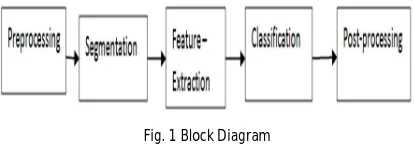
Fig. 1 Block Diagram
II.HISTORY
ISSN: 2231-5381
http://www.ijettjournal.org
Page 663
letters or characters. Goldberg continued to develop OCR technology for data entry. Later, he proposed photographing data records and then, using photocells, matching the photos against a template containing the desired identification pattern. Paul W. Handel also obtained a US patent on such template-matching OCR technology in USA in 1933.
In 1949 RCA engineers worked on the first primitive computer-type OCR to help blind people for the US Veterans Administration It converted the typewritten reports into punched cards for input into the computer in the magazine’s subscription department, for help in processing the shipment of 15-20 million books a year. In about 1965, Reader's Digest and RCA collaborated to build an OCR Document reader designed in 1965.
Image Preprocessing:
The first phase in our character recognition process is converting the image to Binary image by thresholding the given character image. Two intensity values are available in binary image. These values are Black and White. We are use zero for Black and one for white. Thus the color of the character is White and the background is black.
Preprocessing techniques are needed on color, grey-level or binary document images containing text and/or graphics. In character recognition systems most of the applications use grey or binary images since processing color images is computationally high [5].Such images may also contain non-uniform background and/or water marks making it difficult to therefore; the desired result from preprocessing is a binary image containing text only. Thus, to achieve this, several steps are needed, first, some image enhancement techniques to remove noise or correct the contrast in the image, second, thresholding to remove the background containing any scenes, watermarks and/or noise, third, page segmentation to separate graphics from text, fourth, character segmentation to separate characters from each other and, finally, morphological processing to enhance the characters in cases where thresholding and/or other preprocessing techniques eroded parts of the characters or added pixels to them. The above techniques present few of those which may be used in character recognition systems and in some applications; few or some of these techniques or others may be used at different stages of the OCR system.
Pre-processing
Pre-processing covers all those functions of feature extraction to produce a original image. the feature extraction components of the character recognition used directly.
The steps in pre-processing involves
Size normalization: Bicubic interpolation is used for standard sized image.
Binarization: it is process of converting a gray scale image into binary image by thresholding
Smoothing: the erosion and dilation smooth the Boundaries of objects.
Edge detection: morphological gradient operators are used in edge detection because they enhance intensity of edges of characters.
Segmentation:, the characters are always written in "print fashion", not connected,horizontal histogram profile (for line segmentation), vertical histogram profile (for word segmentation) and connected component analysis are able to handle the character segmentation problem.
III.SEGMENTATION
After scanning the document, the document image is subjected to pre-processing for background noise elimination, and binarization to generate the bit map image of the text. The pre-processed image is divided into lines, words and characters. Explanation is given to the below.
Line Segmentation Word Segmentation Character Recognition
Line segmentation-To separate the text lines, line segmentation is used.
Word segmentation- Word segmentation is provide the space between words.
Character Recognition-It is providing the Spacing between the characters. so it is called segmentation
.
IV.FEED FORWARD NETWORK
ISSN: 2231-5381
http://www.ijettjournal.org
Page 664
V.MODULE OF CHARACTER RECOGNITION SYSTEM
IMAGE PRE-PROCESSING
The next stage is image pre-processing module. Image pre-processing relates to the preparation of an image for later analysis and use. Images captured by a camera or a similar technique are not necessarily in a form that can be used by image analysis routines. Some may need improvement to reduce noise; other may need to simplified, enhanced, altered, segmented, filtered, etc[4]. The first step in the pre-processing block is to transform the color image into a gray scale image and this result to noisy gray scale image. In the next step, filtering is used in order to cancel the presented noise. Then, edge detection algorithm is applied for obtaining edge of the noiseless gray scale image. Image pre-processing module is consist of following
operations-(i) Gray scale image (ii) Noise removal (iii)Edge detection (iv)Feature Extraction
GRAY SCALE IMAGE
In this proposed system hand image is captured through digital camera so the original image is colored image. For digital image processing it is necessary first colored hand image convert in to grayscale image.Each pixel has single sample which has intensity information. Now color image is converted in to gray scale image with noise because there is some noise present in the input colored image due to dust and atmospheric conditions. This noise removal is therefore essential for the system.
NOISE REMOVAL
The next step in image pre-processing is noise removal. It is necessary to remove the noise from the
image because it may produce difference between the actual palm and captured image. This causes the variation in data base feature and measured feature and also affected the accuracy of the system. edge detection is difficult in noisy image. Noise and the edges contain high- frequency content.
Basically the noise produced in the image is due to device using for capturing image, atmosphere condition or surrounding. There are many methods to remove the noise in Matlab. In this proposed system the noise is removed by wiener2 filter. So before extracting features from the image, it is very important to remove the noise from the image. noisy images are used by operator larger in scope. So less accurate localization of the detected edges are available
color edges, gray level edges, texture edges etc. Not all edges are detected by all edge detection operators. Each operation has its specific specialty in edges and better the edge detection, usually; more complex and costly is the operation.
FEATURE EXTRACTION
The next module of character recognition is feature extraction. It is the special form of Reduction. When input algorithm is very large at that time it is reduce the data [9].If the features extracted are carefully chosen it is expected that the features set will extract the relevant information from the input data in order to perform the desired task using this reduced representation instead of the full size input.
VI.RESULTS
ISSN: 2231-5381
http://www.ijettjournal.org
Page 665
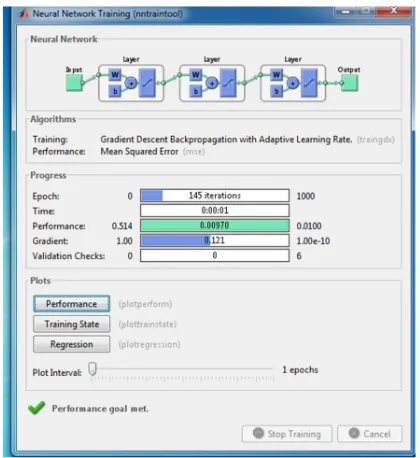
Fig 1 Neural network training
Fig.2 Training Performance
Fig 3 Input colored image
ISSN: 2231-5381
http://www.ijettjournal.org
Page 666
Fig 5 feature extractionFig. 6 feature extraction
Fig. 7 Final output
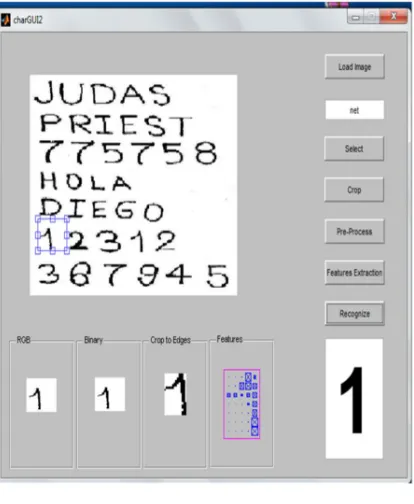
Below GUI show the Recognition of the 1.
ISSN: 2231-5381
http://www.ijettjournal.org
Page 667
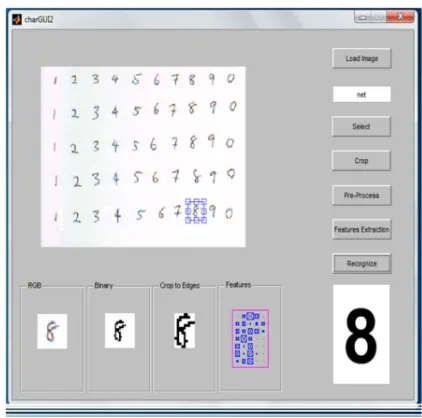
Fig .9 Recognition of 5Fig .10 Recognition of 8
VII.COCLUSION
The paper gives a useful method for the recognition of handwritten characters to a great extent. The proposed method has been applied on different unknown characters. Neural network based method gives the accuracy 85 %. Developed for Proposed algorithms cannot be applied to recognize a cursive handwriting Recognition..
VIII.REFERENCES
[1]. Hand printed Symbol Recognition System, Ptrttern Recognition, Vol. 21 No.2, pp. 91 - 118, I988
[2]. Rosenfeld,A. and Kak, A.C., Digital Image Processing, Academic Press Inc., 2nd. Ed., 1993 Simon,
[3]. C-L. Liu and K. Marukawa, “Normalization Ensemble for Handwritten Character Recognition”, The Ninth International
Workshop on Frontiers in Handwriting Recognition (IWFHR 9),
Tokyo, Japan, pp. 69-74, 2004.
[4] I. D. Jackel et.al., A neural network approach to handprint character recognition, IEEE Trans. PAMI, 1991.
[5] Richard Buse, Zhi-Qiang Liu and Jim Bezdek, Word Recognition using Fuzzy Logic, IEEE Trans. on Fuzzy Systems, Vol 10, No 1,
Feb 2002.