Texture
Representation
Through
Overlapped
Multi-Oriented
Tri-Scale
Local
Binary
Pattern
FAWAD 1,(StudentMember,IEEE),MUHAMMADJAMILKHAN1,(Member,IEEE),
MUHAMMADALIRIAZ1,(Member,IEEE),HUMAYUNSHAHID1,(Member,IEEE),
MANSOORSHAUKATKHAN2,YASARAMIN 1,(SeniorMember,IEEE),
JONATHANLOO 3,(Member,IEEE),ANDHANNUTENHUNEN4,5,(Member,IEEE)
1ACTSENA Research Group, Telecommunication Engineering Department, University of Engineering and Technology Taxila, Taxila 47050, Pakistan 2Mathematics Department, COMSATS University Islamabad, Islamabad 45550, Pakistan
3School of Computing and Engineering, University of West London, London W5 5RF, U.K.
4Department of Electronic Systems, Royal Institute of Technology (KTH), SE 16440 Stockholm, Sweden 5Department of Information Technology, TUCS, University of Turku, 20520 Turku, Finland
Correspondingauthor:Fawad([email protected])
ABSTRACT This paper ideates a novel texture descriptor that retains its classification accuracy under varying conditions of image orientation, scale, and illumination. The proposed Overlapped Multi-oriented Tri-scale Local Binary Pattern (OMTLBP) texture descriptor also remains insensitive to additive white Gaussian noise. The wavelet decomposition stage of the OMTLBP provides robustness to photometric variations, while the two subsequent stages – overlapped multi-oriented fusion and multi-scale fusion – provide resilience against geometric transformations within an image. Isolated encoding of constituent pixels along each scale in the joint histogram enables the proposed descriptor to capture both micro and macro structures within the texture. Performance of the OMTLBP is evaluated by classifying a variety of textured images belonging to Outex, KTH-TIPS, Brodatz, CUReT, and UIUC datasets. The experimental results validate the superiority of the proposed method in terms of classification accuracy when compared with the state-of-the-art texture descriptors for noisy images.
INDEX TERMS Classification, geometric transformations, photometric variations, texture representation, wavelet decomposition.
I. INTRODUCTION
Human visual perception system banks heavily on struc-tural componentswithinan imagefor patternclassification and objectrecognition.Natural images, ingeneral, consist of highly complected structures, modeling which remains a long-standing challenge. Accurate texture modeling and classification is crucial for a variety of modern-day appli-cations, including medical imaging [1] and retrieval [2]. Agriculturalproducesuchasherbs[3],fruits[4],leaves[5], rocks [6], mud [7], and wood [8], as well as industrial products including marble [9], and fabric [10] possess uniquetexturalcharacteristicsthatprovidebasisfor catego-rization into respective classes. Event detection [11], [12]
biometric authentication [13], multimedia retrieval [14], landmark identification [15], and similar applications rely largely upon robust texture representation for attaining desir-able system performance.
The first category draws heavily from research in deep learn-ing, where several models based upon Convolutional Neural Networks (CNNs) have been developed. Though such models allow for the extraction of texture features with relatively high accuracy, the massive amount of training data required makes the entire process both computationally expensive and time consuming. The second category relies upon hand-crafted techniques aimed at feature extraction, which largely remain independent of training data and function without much of a computational overhead [21]. In this category, extraction of discriminative features from the structural composition is crucial, and governs the degree of robustness offered by the resulting descriptor.
In hand-crafted feature extraction methods, several algo-rithms have been proposed during the last decade [22]. Among them, local binary pattern (LBP) [23] is the most widely used technique. LBP encodes the pixels of each seg-ment by thresholding the same against intensity measure corresponding to the pixel in the center. LBP has captured the attention of researchers due to its computational efficiency, robustness to illumination as well as changes in orientation. However, LBP descriptor is sensitive to grayscale intensity inversion that might take place [24], [25]. Robustness to inverse gray-scale intensities is achieved in the complete local binary pattern (CLBP) [26] by incorporating magnitude and center components in the LBP description. CLBP still remains sensitive to illumination changes, necessitating the image be normalized as a pre-step in order to remove the effects of global intensity changes. Moreover, other vari-ants of LBP such as dominant LBP (DLBP) [38], complete local binary count (CLBC) [52], complete dual-cross pattern (CDCP) [47], local directional ZigZag pattern (LDZP) [48], and local morphological pattern (LMP) [56] have also been developed for various applications. These methods, however, are sensitive to noise in the texture, and the feature values of such descriptors vary in a non-uniform manner in response to changes in scale. The DLBP offers better accuracy by utilizing only the most frequently occurring binary pattern of LBP. On the downside, the descriptor neglects discriminant macro-structures present in the texture. It is worth noting that both CDCP and LDZP can only extract the isotropic micro-structures, which cannot represent the textual characteris-tics effectively. Median robust extended local binary pattern (MRELBP) has been developed [29] to capture the micro-and macro-structures of the image. Though this approach offers lowered computational complexity and feature dimen-sionality, it still requires non-local median pixel sampling. Complete joint-scale local binary pattern (CJLBP) [27] is developed to include neighbors at multiple scales around the center pixel in CLBP. The CJLBP consider multiples scale of the texture, which improves the classification accuracy for scale variations in the input image at the cost of computational complexity.
Noise, which affects the micro-geometric structures, can also degrade the classification accuracy. Hence, noise tolerant texture representation has sparked interest in the research Classifier(NNC)[17],SupportVectorMachine(SVM)[18],
andNearestSubspaceClassifier(NSC)[19]arewidelyused forfeatureclassification.NSCisadefiniteimprovementover NNC because the former does away with the problem of overfittingwhichthelatterremainsvulnerableto.Classifier regularizationisachievedinNSCbytakingintoaccountthe associated variance constraint parameter. Upon choosinga considerably low value of variance constraint,NSC effec-tivelytransformsintoNNCintermsofclassification perfor-mance.Owingtoitsadvantages andsuperiorperformance, the proposed texture descriptor makes useof NSC for the purposeoffeatureclassification[20].
Anincreasingnumberofpresent-dayapplicationsrequire attaining a higher texture classification accuracy. This, inturn,requiresastableandrobusttexturerepresentationthat isinsensitivetogeometricandphotometricvariationsofthe image.Traditionally,thesaidhasbeenachievedbydesigning texture descriptorsthat are largely independent of changes taking place in the rotation, scale, and illumination. Such descriptors,however,strugglewithattainingahighvalueof classificationaccuracywhenthetextureunderinvestigation containsalargeamountofnoise.
This work ideates a newapproach towards texture rep-resentation offering highly sought-after features including deterrenceagainstadditivewhiteGaussiannoise,immunity against orientation changes, robustness to scale variation and insensitivity towardsillumination changes. Deterrence against additive white Gaussian noise has been achieved by decomposing the input image into corresponding sub-bandsusingwavelettransform.Immunityagainstorientation changesisdevelopedbyincludingoverlappedmulti-oriented pixelfusionprocess.Robustnesstoscalevariationissecured byincorporatingmulti-scalefusioninthedescriptor. Insensi-tivitytowardsilluminationisattainedusingnormalizationof relevantfeatures.
Theproposeddescriptorholdsimmenseappealfor deploy-mentinvariousnovelapplications.Forinstance,autonomous person re-identification in distributed surveillance systems can potentially be improved using the proposed texture descriptor.Bycombatingilluminationchangesand environ-mental noise, the descriptor is likely to enhance the clas-sification accuracy in intelligent surveillance applications. Similarly,foremergingapplicationsinaerialimaging, robust-ness offeredby the proposed descriptor canpotentially be leveraged for disaster evaluation and evacuee localization whilemaintainingreasonableclassificationaccuracy.
The remaining discussion is organized as follows. SectionIIprovidescoverageofrelatedworkreportedinthe literature.SectionIIIdetailstheformulationoftheproposed texture descriptor.In section IV, we describe the obtained results and their comparison with state-of-the-art texture models.TheconclusionisdrawninsectionVofthispaper.
II. RELATEDWORK
community. Local ternary pattern (LTP) [40] is developed for noisy texture representation. The feature vector associated with LTP is not vulnerable to gray-scale inversion. At the same time, LTP functions by decomposing a texture locally into positive and negative binary patterns. This constituent step has been criticized as an inefficient approach towards texture decomposition [41]. A peculiar diamond sampling structure-based local adaptive binary pattern (DLABP) is presented in [30]. This method has obtained efficiency and simplicity in noisy texture representation by introducing diamond-shaped sampling, adaptive quantization, and gray level averaging across a radial direction. The method per-forms well for noisy texture of the Outex database. However its performance degrades when test on several other texture databases.
Noise resistant local binary pattern (NRLBP) [50] can per-form texture classification in the presence of noise with high accuracy. However, the noise tolerance capability of NRLBP remains unsatisfactory in many applications [29]. In addition, the memory requirements of NRLBP increases exponentially with the number of sample points [51]. In [28], binary rotation invariant and noise tolerant (BRINT) descriptor has been developed which, as the name suggests, combats changes in rotation as well as noise within the texture. Speaking of limitations, BRINT undergoes a rapid increase in feature dimensionality due to its multi-scale approach and is also sensitive to illumination-related changes.
Varma and Zisserman Maximum Response (VZ-MR8), [42], and Varma and Zisserman Patch (VZ-Patch) [43] describe both micro- and macro-textures by employing dense response of multiple spatial filters. VZ-MR8 and VZ-Patch descriptors provide poor results in comparison to LMP with high computational complexity. LBPV [37] utilizes local con-trast information to describe the texture in the input image. Moreover, it also includes global rotation-invariant texture matching to improve the classification accuracy. The main drawback is high dimensionality associated with the resulting feature vector.
This work presents a novel texture descriptor, offering highly-desirable features of insensitivity to variation in the factors enlisted below, even in the presence of additive white Gaussian noise:
• Illumination
• Scale
• Orientation
The underlying algorithmic details for the proposed texture descriptor are presented section-wise.
III. PROPOSED TEXTURE DESCRIPTOR
The focus of the proposed approach is to formulate a tex-ture descriptor robust to variation in illumination, scale, and rotation. CJLBP is taken as a starting point, wherein multi-scale fusion is performed to create a combined 3×3 patch of the pixels. The above is carried out by applying an aver-aging operation around all defined radii corresponding to
a segment. Sign and magnitude components are calculated by subjecting the multi-scale fused patch to the local dif-ference sign magnitude transform (LDSMT). The operators CJLBP_S, CJLBP_M, and CJLBP_C representing the his-togram of the center, magnitude and sign components of the image, are computed. Thereafter, the operators are combined in different ways to create multiple variants of the parent technique. CJLBP_MC is the result of combining CJLBP_M and CJLBP_C. Likewise, CJLBP_S_MC, CJLBP_SM, and CJLBP_SMC have been demonstrated to yield good classifi-cation accuracy [27].
The proposed framework is divided into three stages. The first stage of the proposed method provides deterrence against additive white Gaussian noise, and immunity against the orientation changes. The second stage makes the descrip-tor robust to scale variations. The third stage normalizes the extracted features along each radius. In the third stage, the descriptor becomes insensitive to illumination changes. The detail description of each stage is available in the follow-ing subsections.
A. STAGE 1
In the proposed technique, the image under investigation is first decomposed into its sub-bands using two-dimensional discrete wavelet transform (2D-DWT). The approximation coefficients are obtained through dmey (Discrete approxima-tion of Meyer) waveform of the wavelet at single level decom-position. Values of the feature vector are extracted from the approximated version of an image. An individualized seg-ment of the low frequency sub-band (LL) is calculated using Eq. (1) given as:
Yr,c=LL(r+u,c+v) (1)
whereYr,c shown in Fig. 1 (a) represents the segment of the approximated image corresponding to center pixel. The row (r) and column (c) define the location of the segment in the approximated image. The pixels of the segmentYr,c are shown with the help of symbolJθs. The subscriptθ is the orientation angle, while the superscriptsrepresents the radius. Since it is not possible to extract a segmentYr,cnear the periphery of the image,randcare therefore constrained to vary over a certain range defined by the interval [1+Rmax xn-Rmax] and [1+Rmax yn-Rmax], respectively.xn,yn repre-sent the last row and column position of the approximated image, while Rmax is the maximum radius of the segment
Yr,c. Variablesuandvin Eq. (1) define the coordinates of the segment in the approximated image. Note that bothuand vspan over a range of [−Rmax+Rmax]. Dimensions ofYr,c in pixels equal (2Rmax +1)×(2Rmax +1) segment of the approximation.
The overlapped multi-oriented pixel fusion process, shown in Fig.1(b), creates a topological structure of 8 samples for all 3 scales shown in Fig.1 (c). Overlapped multi-oriented pixel fusion process is performed over the pixels laying at radius 2 and 3 are shown in Eq. (2) and (3). Sample pointsP3k, P2k, andP1k in Eq. (2), (3), and (4) represent the topological
FIGURE 1. Framework of our proposed texture representation approach.
structure of 8 samples with radius 3, 2, and 1 respectively.
P3k =
P6
i=0(J03◦+15◦(i)+45◦(k−2))
7
8
k=1
(2)
P2k =
P4
i=0(J02◦+22.5◦(i)+45◦(k−2))
5
8
k=1
(3)
P1k =
J01◦+45◦(k−1)
8
k=1
(4)
B. STAGE 2
using Eq. (5).
eyr,c= Pn
i=(n−1) Pik
2
8
k=1
(5)
wherePikrepresents thekthpixel intensity at radiusRiof the topological structure in Fig.1(c).eyr,cdenotes the multi-scale fused patch with topological structure (8, 3), (8, 2) and (8, 1) of the Fig.1(e), (f), and (g) respectively.
C. STAGE 3
In the third stage feature vectors are extracted from each topological structure shown in Fig. 1 (e), (f), and (g). The local difference sign-magnitude transform (LDSMT) is used to calculate the sign and magnitude component from theeyr,c.
dr,c =
ey
k
r,c−Cr,c
P
k=1
(6)
dr,c =
skr,c×mkr,c
P
k=1 and
(
skr,c=sign(drk,c) mkr,c= |drk,c| (7)
wheredr,cdenotes the set of local difference,ey
k
r,crepresents thekthsample point of the multi-scale fused patch, andCr,c represents the intensity value of the center pixel correspond-ing to segmentYr,c.skr,c represents thekth sign component having a value equal to 1 whendrk,cis greater than or equal to 0, and−1 whendrk,cis less than 0. The magnitude compo-nentmr,cstores the absolute values of the local differencedr,c The rotation invariant operator OMTLBP_SriuP,R2 is obtained using the sign componentsr,cof the local differencedr,c. Its encoding is formulated as LBPriuP,R2[23]. The rotation invariant operator OMTLBP_MriuP,R2shown in Eq. (8) is obtained using the magnitude component of the local differencedr,c.
OMTLBP_MPriu,R2 =
(
ψ(mkr,c, µm), ifU_MP,R≤2
P+1, otherwise (8)
U_MP,R = |ψ(mPr,c−1, µm)−ψ(m0r,c, µm)|
+ P−1
X
k=1
|ψ(mkr,c, µm)−ψ(mkr,−c1, µm)|
(9)
whereψ(x,y) is 1 forxgreater than or equal toyandψ(x)= 0 forx<y. Themkr,cis thekthmagnitude component andµm is the mean value of the magnitude component of the segment at location (r,c) of the input image. In addition to the sign and magnitude pattern, the center pixel’s grey level OMTLBP_C is also considered. This is formulated as
OMTLBP_CP,R=ψ(Cr,c, µI) (10)
where µI represents the mean value of the whole input image. The joint combination of operators OMTLBP_SriuP,R2, OMTLBP_MriuP,R2, and OMTLBP_CP,R is represented by OMTLBP_SMCriuP,R2.
The train and test feature vectors are obtained using the operator OMTLBP_SMCriuP,R2. Chi-square distance is used as
Algorithm 1Extract OMTLBP_SMC Feature Vector
Input : Input imageI of size M×N
Output : Feature Vector: OMTLBP_SMC
Initialization: The parameters asRmax =3,
r=Rmax+1, andc=Rmax+1 1 Apply 2D-DWT onI;
2 Extract the Approximation (LL);
3 forr≤(M−Rmax)do
4 forc≤(N−Rmax)do
5 Extract the segmentYr,cusing Eq. (1);
6 ComputeP3 k,P
2 k, andP
1
k described through Eq. (2), (3), and (4);
7 Compute
eyr,cthrough Eq. (5) for the set of {1,
2} and {2, 3};
8 foreach topological structuredo
9 Compute LDSMT by Eq. (6) and (7) ;
10 Compute signS, magnitudeM, and centerC component;
11 end
12 increment c;
13 end
14 increment r;
15 end
16 Compute OMTLBP_S, OMTLBP_M, and OMTLBP_C from the componentS,M, andC;
17 Concatenate all operators to get OMTLBP_SMC;
a dissimilarity measure, and the classification accuracy is obtained using Eq. (11).
Accuracy= TP+TN
TP+FP+TN+FN (11)
where TP stands for true positive, TN signifies true negative, FN corresponds to false negative, and FP denotes false pos-itive samples of the test dataset. It is worth-noting that the classification accuracy of a descriptor reflects its ability to categorize textured images into respective classes, and is a key metric to evaluate the performance.
IV. EXPERIMENTAL RESULTS AND ANALYSIS
TABLE 1. Texture databases overall summary.
FIGURE 2. Texture samples from outex database [31].
A. OUTEX
LDZP, CDCP, CJLBP_SMC, BRINT_CS_CM respectively. Inclusion of noise affects the micro-structures, leading to reduced inter class variations in the texture. The proposed texture descriptor is also evaluated on noisy textured images. Table2describes the comparative results in term of classifica-tion accuracy (%). The table shows that the proposed descrip-tor with NSC classifier outperforms the other techniques. Upon addition of Gaussian noise (AWGN) with signal-to-noise ratio (SNR) 100 dB, 30 dB, 15 dB, and 5 dB, classi-fication accuracy of 99.96%, 99.84%, 99.80%, and 99.75% has been demonstrated using the proposed method. The initial wavelet decomposition stage renders the proposed OMTLBP descriptor robust against noise. Wavelet decomposition of the input image via demy waveform breaks the image into approximation and detail coefficients. The coefficients of the approximation provide distinctive features, which maximize the inter-class variation of the feature set.
B. BRODATZ
Brodatz dataset [32] consists of total 2048 sample images of 32 homogeneous texture classes. The dataset samples have variations in their scale and orientation. Each sample of the dataset is divided into 25 non-overlapping segments of size 128×128 pixels. The patches are further down-sampled into 64×64 pixels. Each texture class contains a total of 64 sample images. The dataset image of each class is labeled with four different properties namely, that are normal, rotated, scaled, and scaled with rotation. The dataset is summarized in Table 1. Few randomly selected color samples of the database have been presented in Fig.3. The difference in scale and orientation may create variations in the micro-texture of the image. The images of the dataset consist of grass, wood, water, gain, bricks, sand, and many other naturally-occurring texture-rich objects.
The classification presented in Table 3 depicts that the proposed OMTLBP descriptor, when applied to images in the Brodatz database outperforms most of the other techniques. The proposed descriptor with classification accuracy 99.17% results in a percentage improvement of 0.01%, 4.37%, 4.55%, and 4.57% when compared with DLBP, CLBP_SMC, Outex database consists of 24 different homogeneous
tex-ture classes depicted inFig. 2. The illumination and rota-tion invariance of OMTLBP is examined by employing threetestsuites,TC10,TC12 000,andTC12001 fromthe Outex database. For all testsuites, the classifier is trained using 20 reference images withan orientation angle of 0◦ and illumination condition ‘inca’, which makes a total of 480samples.The differencebetweenthesethreetestsuites is in their test data. In Outex TC10, 3840 samples with rotation angles 5◦, 10◦, 15◦, 30◦, 45◦, 60◦, 75◦, and 90◦ with illuminationcondition ‘inca’,are used for testing the classifier.InOutexTC12000andOutexTC12001,the clas-sifieristestedwithall4320imagesfromfluorescentand sun-lightlighting,respectively.Thedatasethasbeensummarized inTable1.
TABLE 2. Performance analysis (%) on TC10 (Outex) and TC12 (Outex) [31].
FIGURE 3. Texture samples from Brodatz album [32].
VZ-MR8, and LBPHF_S, respectively. The classification accuracy of the proposed descriptor stands at 99.17%, which is slightly lower than BRINT_CS_CM. On the other hand, BRINT_CS_CM comprehensively falls short when applied on a number of significant databases when compared with the proposed texture descriptor. This wider adaptability of the proposed texture descriptor validates its efficacy as a leading choice in the new-age of texture classification applications.
C. CUReT
The CUReT database [33] has a total of 61 texture classes. Each class contains 92 sample images. The database is designed by including a large intra-class variation in the samples, making it the main reason why this particular dataset
TABLE 3.Comparison of classification accuracy (%) on KTH-TIPS [35], Brodatz [32], CUReT [33] and UIUC [34].
FIGURE 4. Texture samples from CUReT [33].
into 200×200 local regions, and each segment is converted into grayscale. The dataset is summarized in Table 1. Few randomly selected samples of the dataset have been presented in Fig.4.
The classification accuracy of the proposed descriptor on CUReT dataset is 98.58%, which is 0.03%, 0.47%, 0.55%, and 0.58% higher than SSLBP, LMP, VZ-Patch, and COALBP descriptor respectively. The classification accuracy presented in Table3highlights the superiority of the proposed texture descriptor over recently reported techniques.
FIGURE 5. Random samples from KTH-TIPS [35] database.
D. KTH-TIPS
E. UIUC DATABASE
The UIUC database [34] consists of 25 different texture classes collected from various materials. Each class of the dataset includes 40 images with resolution 640×480. A few random samples from the dataset are in Fig.6. The images of each class have variations in scale and viewpoint. Moreover, the images have non-rigid deformation and illumi-nation changes. Half of the random samples from each class is selected for training, while the remaining half images are used as test data.
FIGURE 6. Random samples from UIUC [35] database.
The results presented in Table3proposed OMTLBP_SMC provides 0.03%, 0.84%, 2.73%, and 4.27% higher classifi-cation accuracy for VZ-Patch, SSLBP, CJLBP_SMC, and VZ-MR8 respectively.
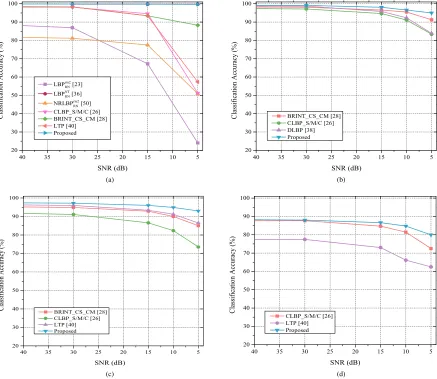
The results achieved from the experimental setup reveal that the classification accuracy of the operator OMTLBP_SMCriuP,R2is high for the set of radius R = 1, 2, and 3 with the sampling point value of 8. The comparison of classification accuracy obtained with various combinations of radius and sample points using the same databases is shown in Table2and3. The results reported in Fig.7(a)-(d), show the proposed descriptor is much better than recently reported descriptors applied on the Outex, Brodatz, CUReT, and UIUC dataset in the presence of additive Gaussian noise. The noise with zero mean and standard derivation
σ = (40, 30, 15, 5) dB is included in the texture before the validation process of Fig.7. The dimension of the proposed descriptor in comparison to the recently reported approaches is presented in Fig. 8. The dimensionality of the proposed descriptor stands at 600 variables, which is lower than that offered by most recently developed descriptors.
Table2and3show the classification performance of dif-ferent texture techniques with various scales R and sampling points P. The proposed OMTLBP_SMCriuP,R2 with wavelet type ’dmey’ provides more robustness to additive white Gaussian noise as compared to other recently developed approaches. OMTLBP_SMCriuP,R2 with sample point 8 and radius set 1, 2, and 3, provides the average classification accuracy of 99.92%, 98.58%, 99.17%, 98.58%, and 97.86% with Outex [31], KTH-TIPS [35], Brodatz [32], CUReT [33], Ten textureclassesof theCUReT database [33]havebeen
FIGURE 7. Noisy texture classification on various publicly available databases. (a) Outex dataset [31]. (b) Brodatz dataset [32]. (c) CUReT dataset [33]. (d) UIUC database [34].
FIGURE 8. Comparison of various texture descriptor’s dimensionality.
and UIUC [34] respectively that is better than all other com-binations of radius for the same descriptor.
V. CONCLUSION
A novel texture descriptor, Overlapped Multi-oriented Triscale Local Binary Pattern (OMTLBP), is proposed in this work. The proposed descriptor is insensitive to a wide range of variations in image scale, illumination, and ori-entation. OMTLBP descriptor is also resilient to additive
white Gaussian noise with SNR of up to 5 dB. This has been attained by decomposing the texture under inves-tigation into its corresponding sub-bands. The OMTLBP contains the Overlapped Multi-oriented fusion that trans-forms each input segment of the image into eight sam-ple points. The process imparts rotation invariant features to the proposed descriptor. Multi-scale fusion is also per-formed to merge the pixels along the radius in three different combinations. Doing so secures the sought-after property of scale invariance for the formulated descriptor. Moreover, the process of feature normalization has also been applied to achieve illumination invariance while designing the proposed texture descriptor.
accuracy is reported by 0.01% when compared with DLBP. On taking the CURET dataset into account, an improve-ment in classification accuracy has been reported by 0.03% in comparison with SSLBP. Upon analyzing texture images from KTH-TIPS, increase in average classification accuracy of 0.1% to that of LMP has been demonstrated. Finally, tex-ture images from UIUC database have also been scrutinized wherein a performance improvement in terms of average classification accuracy is increased by 0.03% of VZ-Patch descriptor.
The descriptor holds potential for deployment across a broad array of applications related to texture classifica-tion including personnel re-identificaclassifica-tion in distributed video surveillance systems, search and localization tasks in aerial surveillance, and so on.
REFERENCES
[1] P. M. Pradhan, C. H. Cheng, and J. R. Mitchell, ‘‘A region of interest based approach for texture analysis of medical images in space–frequency domain,’’ Biomed. Signal Process. Control, vol. 51, pp. 222–234, May 2019.
[2] F. Alaei, A. Alaei, U. Pal, and M. Blumenstein, ‘‘A comparative study of different texture features for document image retrieval,’’Expert Syst. Appl., vol. 121, pp. 97–114, May 2019.
[3] R. Branca, S. Triantaphillidou, and P. Burns, ‘‘Texture MTF from images of natural scenes,’’Electron. Imag., vol. 2017, no. 12, pp. 113–120, 2017. [4] A. Bonneauet al., ‘‘Impact of fruit texture on the release and perception of aroma compounds duringin vivoconsumption using fresh and processed mango fruits,’’Food Chem., vol. 239, pp. 806–815, Jan. 2018.
[5] A. Riaz, S. Farhan, M. A. Fahiem, and H. Tauseef, ‘‘An ensemble classifier based leaf recognition approach for plant species classification using leaf texture, morphology and shape,’’Nucleus, vol. 55, no. 1, pp. 1–7, 2018. [6] D. A. Jerram, K. J. Dobson, D. J. Morgan, and M. J. Pankhurst,
‘‘The petrogenesis of magmatic systems: Using igneous textures to under-stand magmatic processes,’’ inVolcanic and Igneous Plumbing Systems. Elsevier, 2018, ch. 8, pp. 191–229. doi: 10.1016/B978-0-12-809749-6.00008-X.
[7] W. Wu, Q. Yang, J. Lv, A. Li, and H. Liu, ‘‘Investigation of remote sensing imageries for identifying soil texture classes using classifi-cation methods,’’IEEE Trans. Geosci. Remote Sens., vol. 57, no. 3, pp. 1653–1663, Mar. 2018.
[8] R. Ren, T. Hung, and K. C. Tan, ‘‘A generic deep-learning-based approach for automated surface inspection,’’IEEE Trans. Cybern., vol. 48, no. 3, pp. 929–940, Mar. 2018.
[9] A. Seul and K. Okarma, ‘‘Classification of textures for autonomous clean-ing robots based on the GLCM and statistical local texture features,’’ in Proc. Comput. Sci. On-Line Conf.Cham, Switzerland: Springer, 2018, pp. 405–414.
[10] Q. Huangpeng, H. Zhang, X. Zeng, and W. Huang, ‘‘Automatic visual defect detection using texture prior and low-rank representation,’’IEEE Access, vol. 6, pp. 37965–37976, 2018.
[11] X. Chang, Z. Ma, Y. Yang, Z. Zeng, and A. G. Hauptmann, ‘‘Bi-level semantic representation analysis for multimedia event detection,’’IEEE Trans. Cybern., vol. 47, no. 5, pp. 1180–1197, May 2017.
[12] X. Chang, Y.-L. Yu, Y. Yang, and E. P. Xing, ‘‘Semantic pooling for complex event analysis in untrimmed videos,’’IEEE Trans. Pattern Anal. Mach. Intell., vol. 39, no. 8, pp. 1617–1632, Aug. 2017.
[13] Z. Li, F. Nie, X. Chang, and Y. Yang, ‘‘Beyond trace ratio: Weighted harmonic mean of trace ratios for multiclass discriminant analysis,’’IEEE Trans. Knowl. Data Eng., vol. 29, no. 10, pp. 2100–2110, Oct. 2017. [14] L. Xie, L. Zhu, and G. Chen, ‘‘Unsupervised multi-graph cross-modal
hashing for large-scale multimedia retrieval,’’Multimedia Tools Appl., vol. 75, no. 15, pp. 9185–9204, 2016.
[15] L. Zhu, J. Shen, X. Liu, L. Xie, and L. Nie, ‘‘Learning compact visual representation with canonical views for robust mobile landmark search,’’ inProc. Int. Joint Conf. Artif. Intell., 2016, pp. 3959–3965.
[16] U. R. Acharyaet al., ‘‘A novel algorithm for breast lesion detection using textons and local configuration pattern features with ultrasound imagery,’’ IEEE Access, vol. 7, pp. 22829–22842, 2019.
[17] B. Caputo, E. Hayman, M. Fritz, and J.-O. Eklundh, ‘‘Classifying materials in the real world,’’ Image Vis. Comput., vol. 28, no. 1, pp. 150–163, 2010.
[18] J. Xu, C. Xu, B. Zou, Y. Y. Tang, J. Peng, and X. You, ‘‘New incremental learning algorithm with support vector machines,’’IEEE Trans. Syst., Man, Cybern. Syst., to be published.
[19] J. Wright, A. Y. Yang, A. Ganesh, S. S. Sastry, and Y. Ma, ‘‘Robust face recognition via sparse representation,’’IEEE Trans. Pattern Anal. Mach. Intell., vol. 31, no. 2, pp. 210–227, Feb. 2009.
[20] C. J. Veenman and M. J. T. Reinders, ‘‘The nearest subclass classi-fier: A compromise between the nearest mean and nearest neighbor classifier,’’ IEEE Trans. Pattern Anal. Mach. Intell., vol. 27, no. 9, pp. 1417–1429, Sep. 2005.
[21] P. Simon and V. Uma, ‘‘Review of texture descriptors for texture clas-sification,’’ inData Engineering and Intelligent Computing. Singapore: Springer, 2018, pp. 159–176.
[22] A. Humeau-Heurtier, ‘‘Texture feature extraction methods: A survey,’’ IEEE Access, vol. 7, pp. 8975–9000, 2019.
[23] T. Ojala, M. Pietikäinen, and T. Mäenpää, ‘‘Multiresolution gray-scale and rotation invariant texture classification with local binary patterns,’’IEEE Trans. Pattern Anal. Mach. Intell., vol. 7, pp. 971–987, Jul. 2002. [24] T. Song, L. Xin, C. Gao, G. Zhang, and T. Zhang, ‘‘Grayscale-inversion
and rotation invariant texture description using sorted local gradient pattern,’’ IEEE Signal Process. Lett., vol. 25, no. 5, pp. 625–629, May 2018.
[25] M. Hu, Y. Zheng, C. Yang, X. Wang, L. He, and F. Ren, ‘‘Facial expression recognition using fusion features based on center-symmetric local octonary pattern,’’IEEE Access, vol. 7, pp. 29882–29890, 2019.
[26] Z. Guo and D. Zhang, ‘‘A completed modeling of local binary pattern operator for texture classification,’’IEEE Trans. Image Process., vol. 19, no. 6, pp. 1657–1663, Jan. 2010.
[27] X. Wu and J. Sun, ‘‘Joint-scale LBP: A new feature descriptor for texture classification,’’ Vis. Comput., vol. 33, no. 3, pp. 317–329, 2017.
[28] L. Liu, Y. Long, P. W. Fieguth, S. Lao, and G. Zhao, ‘‘BRINT: Binary rotation invariant and noise tolerant texture classification,’’IEEE Trans. Image Process., vol. 23, no. 7, pp. 3071–3084, Jul. 2014.
[29] L. Liu, S. Lao, P. W. Fieguth, Y. Guo, X. Wang, and M. Pietikäinen, ‘‘Median robust extended local binary pattern for texture classification,’’IEEE Trans. Image Process., vol. 25, no. 3, pp. 1368–1381, Mar. 2016.
[30] Z. Pan, X. Wu, Z. Li, and Z. Zhou, ‘‘Local adaptive binary patterns using diamond sampling structure for texture classification,’’IEEE Signal Process. Lett., vol. 24, no. 6, pp. 828–832, Jun. 2017.
[31] T. Ojala, T. Maenpaa, M. Pietikainen, J. Viertola, J. Kyllonen, and S. Huovinen, ‘‘Outex-new framework for empirical evaluation of texture analysis algorithms,’’ inProc. 16th Int. Conf. Pattern Recognit., vol. 1, Aug. 2002, pp. 701–706.
[32] P. Brodatz,Textures: A Photographic Album for Artists and Designers. New York, NY, USA: Dover, 1966.
[33] K. J. Dana, B. van Ginneken, S. K. Nayar, and J. J. Koenderink, ‘‘Reflectance and texture of real-world surfaces,’’ACM Trans. Graph., vol. 18, no. 1, pp. 1–34, Jan. 1999.
[34] S. Lazebnik, C. Schmid, and J. Ponce, ‘‘A sparse texture representation using local affine regions,’’ IEEE Trans. Pattern Anal. Mach. Intell., vol. 27, no. 8, pp. 1265–1278, Aug. 2005.
[35] E. Hayman, B. Caputo, M. Fritz, and J.-O. Eklundh, ‘‘On the significance of real-world conditions for material classification,’’ inProc. Eur. Conf. Comput. Vis., 2004, pp. 253–266.
[36] A. Fathi and A. R. Naghsh-Nilchi, ‘‘Noise tolerant local binary pattern operator for efficient texture analysis,’’Pattern Recognit. Lett., vol. 33, no. 9, pp. 1093–1100, Jul. 2012.
[37] Z. Guo, L. Zhang, and D. Zhang, ‘‘Rotation invariant texture classification using LBP variance (LBPV) with global matching,’’Pattern Recognit., vol. 43, no. 3, pp. 706–719, 2010.
[38] S. Liao, M. W. K. Law, and A. C. S. Chung, ‘‘Dominant local binary patterns for texture classification,’’IEEE Trans. Image Process., vol. 18, no. 5, pp. 1107–1118, May 2009.
[40] X. Tan and B. Triggs, ‘‘Enhanced local texture feature sets for face recog-nition under difficult lighting conditions,’’ inProc. Int. Workshop Anal. Modeling Faces Gestures, 2007, pp. 168–182.
[41] T. Song, H. Li, F. Meng, Q. Wu, and J. Cai, ‘‘LETRIST: Locally encoded transform feature histogram for rotation-invariant texture classification,’’ IEEE Trans. Circuits Syst. Video Technol., vol. 28, no. 7, pp. 1565–1579, Jul. 2018.
[42] M. Varma and A. Zisserman, ‘‘A statistical approach to texture classifica-tion from single images,’’Int. J. Comput. Vis., vol. 62, nos. 1–2, pp. 61–81, 2005.
[43] M. Varma and A. Zisserman, ‘‘A statistical approach to material classifi-cation using image patch exemplars,’’IEEE Trans. Pattern Anal. Mach. Intell., vol. 31, no. 11, pp. 2032–2047, Nov. 2009.
[44] K. Wang, C.-E. Bichot, C. Zhu, and B. Li, ‘‘Pixel to patch sampling structure and local neighboring intensity relationship patterns for texture classification,’’IEEE Signal Process. Lett., vol. 20, no. 9, pp. 853–856, Sep. 2013.
[45] Z. Guo, Q. Li, J. You, D. Zhang, and W. Liu, ‘‘Local directional derivative pattern for rotation invariant texture classification,’’Neural Comput. Appl., vol. 21, no. 8, pp. 1893–1904, 2012.
[46] R. Mehta and K. Egiazarian, ‘‘Dominant rotated local binary pat-terns (DRLBP) for texture classification,’’Pattern Recognit. Lett., vol. 71, pp. 16–22, Feb. 2016.
[47] S. K. Roy, B. Chanda, B. B. Chaudhuri, D. K. Ghosh, and S. R. Dubey, ‘‘A complete dual-cross pattern for unconstrained texture classification,’’ in Proc. 4th IAPR Asian Conf. Pattern Recognit., Nanjing, China, Nov. 2017, pp. 741–746.
[48] S. K. Roy, B. Chanda, B. B. Chaudhuri, S. Banerjee, D. K. Ghosh, and S. R. Dubey, ‘‘Local directional ZigZag pattern: A rotation invariant descriptor for texture classification,’’Pattern Recognit. Lett., vol. 108, pp. 23–30, Jun. 2018.
[49] S. K. Roy, S. R. Dubey, and B. B. Chaudhuri, ‘‘Local ZigZag max histograms of pooling pattern for texture classification,’’Electron. Lett., vol. 55, no. 7, pp. 382–384, 2019.
[50] J. Ren, X. Jiang, and J. Yuan, ‘‘Noise-resistant local binary pattern with an embedded error-correction mechanism,’’IEEE Trans. Image Process, vol. 22, no. 10, pp. 4049–4060, Oct. 2013.
[51] L. Liu, P. Fieguth, Y. Guo, X. Wang, and M. Pietikäinen, ‘‘Local binary features for texture classification: Taxonomy and experimental study,’’ Pattern Recognit., vol. 62, pp. 135–160, Feb. 2017.
[52] Y. Zhao, D.-S. Huang, and W. Jia, ‘‘Completed local binary count for rotation invariant texture classification,’’IEEE Trans. Image Process., vol. 21, no. 10, pp. 4492–4497, Oct. 2012.
[53] Z. Guo, X. Wang, J. Zhou, and J. You, ‘‘Robust texture image representa-tion by scale selective local binary patterns,’’IEEE Trans. Image Process., vol. 25, no. 2, pp. 687–699, Feb. 2015.
[54] T. Ahonen, J. Matas, C. He, and M. Pietikäinen, ‘‘Rotation invariant image description with local binary pattern histogram Fourier features,’’ inImage Analysis. Berlin, Germany: Springer, 2009, pp. 61–70.
[55] R. Nosaka, Y. Ohkawa, and K. Fukui, ‘‘Feature extraction based on co-occurrence of adjacent local binary patterns,’’ inProc. Pacific-Rim Symp. Image Video Technol., 2011, pp. 82–91.
[56] S. K. Roy, B. Chanda, B. B. Chaudhuri, D. K. Ghosh, and S. R. Dubey, ‘‘Local morphological pattern: A scale space shape descriptor for texture classification,’’Digit. Signal Process., vol. 82, pp. 152–165, Nov. 2018.
FAWAD received the B.S. degree in telecommu-nication from the National University of Modern Languages, Pakistan, in 2011, and the M.S. degree from the Military College of Signals, National University of Science and Technology, Pakistan, in 2016, which was followed by his Graduate Assistant job with the Ghulam Ishaq Khan Institute of Engineering Sciences and Technology. He is currently pursuing the Ph.D. degree in telecommu-nication engineering with the University of Engi-neering and Technology Taxila, Pakistan. In 2012, he joined Zong China mobile company as a Transmission Engineer. His research interests include computer vision, pattern recognition, and image processing.
MUHAMMAD JAMIL KHANreceived the B.Sc. degree in computer engineering, the M.Sc. degree in telecommunication engineering, and the Ph.D. degree in computer engineering from the Uni-versity of Engineering and Technology Taxila, Pakistan, in 2005, 2009, and 2016, respectively, where he is currently an Assistant Professor and the Director of the Embedded Systems and Dig-ital Signal Processing Laboratory. He is also the Founder of the Virtual Reality Simulation Laboratory, University of Engineering and Technology Taxila. He has authored or coauthored numerous technical articles in well-known inter-national journals and conferences. His current research interests include multimedia content analysis, RF identification, and machine learning.
MUHAMMAD ALI RIAZreceived the M.S. and B.S. degrees in electrical engineering from Iowa State University, USA, in 2010 and 2009, respec-tively. Afterward, he joined the Department of Electrical and Computer Engineering, Iowa State University, USA, as a Research Assistant. He is currently serving as an Assistant Professor with ACTSENA Research Group, University of Engi-neering and Technology Taxila. He is working towards the design and implementation of chipless RFID tags based on electromagnetic signature and their signal processing applications. He also serves as the Director of the Electronics and Measure-ments Laboratory, University of Engineering and Technology Taxila. His research work has been featured in a number of ISI-indexed journals.
HUMAYUN SHAHIDreceived the B.S. degree in communication systems engineering from the Institute of Space Technology, Islamabad, in 2008, the M.S. degree in signal processing from Nanyang Technological University, Singapore, in 2011. He joined the Space and Upper Atmo-sphere Research Commission (SUPARCO), where he involved in radiation-hardened space grade components for telemetry subsystems. He joined the Department of Telecommunication Engineer-ing, University of Engineering and Technology Taxila, where he is currently an Assistant Professor. He is with the ACTSENA Research Group working towards design and signal processing-related aspects of electromagnetic transduction-based sensor-incorporated chipless RFID tags. He is also the Director with the Departmental Antenna and RF Laboratory. His research work has been featured in a number of ISI-indexed journals and international conferences.
YASAR AMINreceived the B.Sc. degree in elec-trical engineering with specialization in telecom-munication and the M.B.A. degree in innovation and growth from the Turku School of Economics, University of Turku, Finland, and the M.Sc. degree in electrical engineering with specialization in system on chip design, and the Ph.D. degree in electronic and computer systems from the Royal Institute of Technology (KTH), Sweden, with the research focuses on printable green RFID antennas for embedded sensors. He is currently an Associate Professor and the Chair-man of the Telecommunication Engineering Department, University of Engi-neering and Technology Taxila, Pakistan. He also serves as the Director of the Embedded Systems Research and Development Centre. He is the Founder of the Agile Creative Technologies for Smart Electromagnetic Novel Applica-tions (ACTSENA) Research Group. He has authored or coauthored more than 100 international technical papers in conferences and journals. His research interests include the design and application of multiple antenna systems for next generation mobile communication systems, millimeter-wave and terahertz antenna array, implantable & wearable electronics, and inkjet printing technology in microwave applications. He is a member of more than 12 international professional societies and the fellow of PAE.
JONATHAN LOO received the M.Sc. degree in electronics and the Ph.D. degree in electronics and communications from the University of Hert-fordshire, U.K., in 1998 and 2003, respectively. He leads a research team of 8 Ph.D. students in the area of communication and networking. He is currently a Professor and the Chair in computing and communication engineering with the School of Computing and Engineering, University of West London, U.K. His research interests include
network architecture, communication protocols, network security, embed-ded systems, video coding and transmission, wireless communications, digital signal processing, and optical networks. He has successfully grad-uated 13 Ph.D. students as a Principle Supervisor and contributed over 175 publications in the aforementioned specialist areas.

![FIGURE 2. Texture samples from outex database [31].](https://thumb-us.123doks.com/thumbv2/123dok_us/982487.1597859/6.576.38.276.245.402/figure-texture-samples-from-outex-database.webp)
![TABLE 3. Comparison of classification accuracy (%) on KTH-TIPS [35],Brodatz [32], CUReT [33] and UIUC [34].](https://thumb-us.123doks.com/thumbv2/123dok_us/982487.1597859/7.576.296.537.429.657/table-comparison-classification-accuracy-tips-brodatz-curet-uiuc.webp)
![FIGURE 6. Random samples from UIUC [35] database.](https://thumb-us.123doks.com/thumbv2/123dok_us/982487.1597859/8.576.300.536.193.336/figure-random-samples-from-uiuc-database.webp)