© 2018 IJRAR February 2018, Volume 5, Issue 1 www.ijrar.org (E-ISSN 2348-1269, P- ISSN 2349-5138)
Mechanical Scheduling in a Piston manufacturing
industry using Value Stream Mapping
Umesh Gupta
1, Mohit Kumar Agrawal
2, Kailash Rai
31
Associate Professor, Vaish College of Engineering, Rohtak, India
2Associate Professor, Vaish College of Engineering, Rohtak, India
3
Asstt. Professor, Global Engineering College, Jabalpur, India
Abstract - Basically, India has become a target market for many industries and companies of any kind because of its rapidly growing economic environment and high potentiality of customers. In this case, companies implementing lean manufacturing are better placed in achieving higher competitive edge in the market. In this paper studied lean manufacturing, The Principles of Lean Manufacturing and The Benefits of Lean. It also provides different research papers which are surveyed. Implementation of value stream mapping (VSM) is done in a manufacturing line of a piston. Values for cycle time, change over time and WIP are used for calculation. Respective map for future state has been developed and a comparison is showed among the current and future state maps.
Keywords: WIP, piston manufacturing, cycle time, change over time, VSM
I. INTRODUCTION
The global market has dramatically changed during the past years. Thus, items with low quality, long lead time, and restricted assortment are never again satisfactory among clients. Customers‟ requests are expanding by time and conventional production frameworks can't meet this new degree of interest. Henceforth, applying new production strategies so as to deliver top notch item, in brief time, with low value gets basic for endurance in current focused worldwide market.
Lean production is one of the methodologies which has been utilized by numerous organizations around the globe to accomplish these upper hands. Be that as it may, lean production was created by enormous organizations and dependent on their attributes. Huge organizations are by all account not the only significant undertakings and Small and Medium estimated Enterprises (SMEs) have an enormous offer on the planet economy: for instance 55.5% of all the additional incentive in Europe originates from SMEs (European Commission, 2005). Along these lines, it is critical to discover; regardless of whether SMEs can likewise appreciate the focal points brought about by applying lean production. Since lean production isn't custom fitted for SMEs and their qualities, these organizations may confront a few troubles with usage of it in their associations.
A.
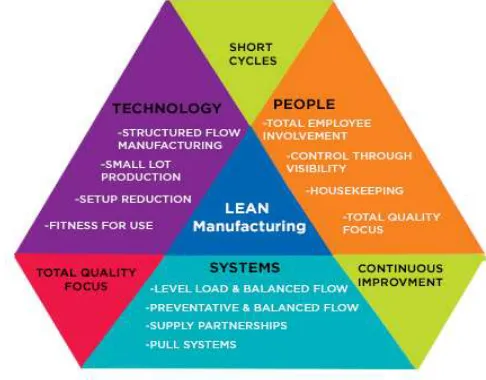
Lean ManufacturingLean Manufacturing is a methodical way to deal with recognizing and wiping out waste through nonstop improvement. Lean is tied in with accomplishing more with less: Less time, stock, space, individuals, and cash. Lean is about speed and hitting the nail on the head the first run through. Lean production
is focused on the end of waste in each territory of production including client relations, item structure, provider systems and processing plant the board. Its will probably fuse less human exertion, less stock, less time to create items, and less space to turn out to be profoundly receptive to client request while delivering top quality items in the most proficient and affordable way conceivable. Lean is a mentality, or perspective, with a guarantee to accomplish a thoroughly squander free activity that is centeredaround our client's prosperity.
Lean production is a coordinated socio-specialized framework whose principle objective is to make stream and dispose of waste by simultaneously decreasing or limiting provider, client, and interior inconstancy.
Figure 1.1: Lean Manufacturing Concept
B. Value Stream Mapping
Fig.1.3 Value Stream mapping procedure
II. LITERATURE REVIEW
(Verma and Sharma, 2017) referenced contextual investigation, work has been done on distinguishing the waste related regions as an investigation of lean manufacturing. It has been discovered that the explanation behind non-esteem added exercises are because of wrong taking care of material, long separation, deformity and ill-advised stock. After writing study in the field of lean instruments we inferred that the VSM is a compelling apparatus for disposing of these squanders and concentrate likewise proposed the approaches to decrease non esteem included occasions in a manufacturing procedure.
Enormous decreases in time utilization can be
accomplished by diminishing the holding up time of a vocation during production process. Most significant point is that in this improvement procedure, no new machines were bought nor were administrators expected to work quicker or harder; just methodology and formats were changed to enable the item to stream all the more easily through the manufacturing procedure. Also, this movement diminished the manufacturing lead time understudy expanded the efficiency of a small scale industry.
(Yadav et al., 2018)indicated that "absence of management duty and leadership", "absence of correspondence" and "absence of assets" are the most basic obstructions thus these ought to be considered as the establishment of any lean execution venture in SMEs. The examination likewise proposed that essential information on lean just as its advantages ought to be known to the workers at a beginning period for their dynamic contribution. Moreover, absence of assets was seen as an overwhelming variable in SMEs.
The management may search for elective wellsprings of cash to support the lean activities.
(Thanki and Thakkar, 2018)discoveries of this exploration obviously propose that the Government backing and top management responsibility and adequate portion of assets are critical for a fruitful organization of lean-green activities. The repercussion for small-and medium-scale industry is that they can harvest considerable improvement in their operational and business execution through lean-green usage in the event that they exploit government plans and mindfulness programs, explicitly propelled for SMEs. As a last comment, regardless of the high effect of SMEs
on the economy of creating nation, operational
effectiveness and ecological supportability is as yet a territory which requires a lot of research to investigate its actual potential in mechanical setting. Profitability misfortunes go unnoticed in Indian small-and medium-sized businesses; and thus such examinations would help specialists in tending to lean-green usage challenges all the more effectively.
eco-© 2018 IJRAR February 2018, Volume 5, Issue 1 www.ijrar.org (E-ISSN 2348-1269, P- ISSN 2349-5138) plan and natural supportability highlights. Further this
investigation gives a concise outline on different points of view of LSS relating to manufacturing segments got from the writing. It additionally helps the specialists in picking up information about the ecological bits of knowledge during LSS execution and gives activities to actualizing the proposed system to convey com-bined operational and natural upgrades.
(Meena et al., 2018)solved the problem of rejection due to internal distance and concentric diameter as shown in Tables 9 and 10, which are improved through the successful implementation of DMPEAIC. The estimated savings per annum with the assembly of the engine is 39, 28,000 in Indian rupees. The developed DMPEAIC framework helped the organisation to reduce hunting in the fulcrum lever of the distribution pump. The result of this case study has helped establish the objective to go forward with another DMPEAIC implementation in the other products within the organization.
(Aboelmaged, 2018)The model is exactly approved by methods for the PLS-SEM strategy utilizing information from 238 proprietors and chiefs from a wide range of Egyptian SMEs. This examination shows that
envi-ronmental pressures, management backing and
representatives' commitment predicts SMP in Egyptian SMEs. As opposed to existing writing, this examination sets up that innovation foundation, innovation fitness, and ecological guidelines don't fundamentally impact SMP. Strangely, the connection among SMP and focused capacities of Egyptian SMEs is emphatically critical which bolsters the commitment of SMP to upgrade firms' aggressive execution. From an administrative point of view, the present research offers approach producers and directors a casing of reference to help SMP in the setting ofSMEs not exclusively to disparage chiefs' and workers' ecological duty towards different weights from clients, providers and open media yet in addition to empower their commitment in creating feasible projects. Along these lines, expanding
supervisors' mindfulness, information and specific
preparing concerning maintainability issues in SMEs will be critical. Moreover, Egyptian ecological specialists need to set up an institutional system and hierarchical limit that mirror SMEs' varieties and criticism to authorize the execution of natural guidelines. So that, getting to, observing and revealing genuine natural information by the chiefs of SMEs will never again be a troublesome procedure that is dispersed among various specialists. Incredible possibilities are likewise anticipated from
supportable manufacturing innovation when the
administration considers SMEs limit working by
coordinating innovation speculations with real
supportability needs while observing the SMEs job in making feasible incentive at a vital level.
(Sahoo and Yadav, 2018)suggests that implementing lean in small and medium manufacturing firms is by no means an easy task, as it is heavily burdened by several internal and external organizational barriers. In addition to the identification of the major barriers to implementation of lean manufacturing in Indian SMEs, the paper also
investigated the effect of lean manufacturing
implementation on Indian SMEs performance. The result
provides insights into the extent of lean manufacturing implementation in SMEs in the Indian context and provides further evidence that lean practices are significant in enhancing OP. The results show that all the three lean constructs are significantly related to OP. Both PI and WM constructs show a high level of significance, whereas FM has shown a moderate level of significance with OP. One possible reason could be that “PI” and “WM” lean implementation in SMEs require less capital investment, and are focused upon hardcore maintenance and quality
improvement techniques that optimize equipment
effectiveness, eliminate breakdown and integrate the capabilities of the workforce for continuous improvement of production parameters to attain excellence. There is no doubt about the similar relevance of FM practices which have a moderate level of association with OP parameters. The reason could be the lack of strategy for integration of information technology and traditional manufacturing processes such as MRP (Material Requirement Planning), MRP II (Manufacturing Resource Planning) and ERP (Enterprise Resource Planning), which are extensively used by large-scale manufacturers. Nevertheless, the adoption of these systems could lead to a high production cost, as a result of heavy investment in the IT infrastructure, internal training and after-sale service, which is unaffordable to most SMEs. Lean manufacturing implementation requires time, money, energy and full company commitment. The use of rigorous 5S and preventative maintenance appears to be a widespread practice among Indian SMEs. Due to limited resources, it is not possible to apply all lean tools and techniques at one time.
(Contreras González et al., 2017)Worth stream mapping can be a significant device for item advancement process improvement. Avionic business experience shows that both a decent arrangement of significant worth stream mapping apparatuses and a lean setting connect with process improvement achievement. No single best practice However, lean wording was found. Reassessed to apply to PD, joined with a few correlative worth stream mapping techniques, give a compelling arrangement of devices for PD esteem stream mapping.
(T RAMADAS, 2017)described the realization of the critical barriers implementing lean manufacturing with in small and medium scale enterprise environment. This paper also makes two broad conceptual contributions, first it explores the identification of the barriers and second it provides a model to identification of the key employee barrier that will be helpful for further studies in the area of
lean manufacturing. The implementation of lean
(Marodin et al., 2017)presented empirical evidence about how the implementation of LP practices is associated with improvements in operational performance of Brazilian automotive supply chain companies. We validated our questionnaire and performed multivariate regression analysis with data from 64 Brazilian firms. The results suggested that our preliminary assumption was correct, because the relationship between LP practices and performance in Brazilian companies seems to be different from other countries. In particular, the companies in the Brazilian automotive supply chain have experienced reduction in Lead time due to the implementation of TPM practices, and reduction of Inventory because of the use of JIT practices.
(Samantoroy, 2017)decides the basic variables for effective usage of Lean idea in Indian SMEs. For this,
different SME businesses have contemplated for
information assortment, where a few ideas of Lean have just been executed and the issues looked by them during usage, additionally the SMEs the individuals who are intrigued to apply Lean, the Procedure for that is depicted in this Paper. Lean manufacturing otherwise called Toyota Production Systems was first presented by Toyota which is a Value added substance Process by dispensing with all losses by Proper Process Management. Presently days, practically all areas ventures Particularly SMEs are attempting actualize Lean in their Organization. This Paper attempts to take care of some normal Problems looked by them during the execution arrange.
(Prakash, 2016)Levels of SS deployment are increasing, especially in large organizations in the US, UK and the Netherlands, and in some SMEs in developing countries such as India; the number of available SS publications is increasing accordingly. The application of SS methodology in the manufacturing sector has demonstrated the significant benefits that can be gained, along with motivation factors. Equally importantly, the limitation and impeding factors which need to be overcome are also stated. There are many gaps in the available literature that need to be covered in future research, and although a great deal of work has been undertaken on individual Six Sigma themes. In the past there has been little written on Six Sigma as a coherent strategy for business improvement and this is one of the more immediate gaps that needs to be bridged.
III. METHODOLOGY
A. Steps of methodology
Selecting the suitable industry for implementing the lean manufacturing procedure.
Study the different procedures of machining and
manufacturing adopted in the industry.
Calculate the machining time and other time based
operations which can contribute in the improvement of production process of current study.
Apply value stream mapping on the current scenario to
calculate the complete procedure time and to suggest future state changes.
Applying Kanban to have the record of each and every
ongoing and required activity.
Finally Comparing both the states that is present and future state with incorporated benefits
The worth stream is dissected and mapped so as to diminish the loss in forms, empower stream, and move the procedure towards the perfect of quick reaction to client pull. In the item improvement setting, this implies quick reaction to client requirements for both new items and alterations and adjustments of existing ones.
A worth stream is an assortment of all activities esteem included just as non-esteem added that are required to bring an item or a gathering of items that utilization similar assets through the primary streams, from crude material to the arms of clients. Worth stream maps are an extremely basic method when you're actualizing a lean framework.
The examination talks about the usage of Value Stream Mapping.
Step -1 Calculate Takt time: Takt time is the maximum amount of time required to complete operation as per customers’ satisfaction.
Step-2 Understand Customer Demand: Customer demand is monthly or daily demand of customer as per need.
Step -3Mapping the Process flow: This step involves various processes which are in sequence to complete product development and calculation of cycle time, changeover time, and uptime for each.
Step -4 Maps the material flow: The flow of material form row to finish good is given by supplier to customer.
Step -5Map flow: The data stream is likewise joined to give request data which is a basic parameter for deciding the procedure in the production framework. Different information with respect to process duration (C/T), change after some time (C/O), uptime, require significant investment and so forth.
Step-6 Calculate complete item process duration: After both material and data have been mapped. A timetable is shown at the base of the guide demonstrating the handling time for every activity and the exchange delay between tasks. The course of events is utilized to distinguish the worth including step, just as waste. Where, S/T is arrangement time, C/T is process duration, and C/O is change after some time. The production of the cylinders is finished by executing the Kanban (pull framework) from the machining stage till the gathering stage. Further after this procedure there is additionally the need to check for bottleneck process in the total framework.
Takt Time is the rate of a completed product needs to be finished in order to meet customer demand. Available time = Working time - Regular ‘non-direct’ time
© 2018 IJRAR February 2018, Volume 5, Issue 1 www.ijrar.org (E-ISSN 2348-1269, P- ISSN 2349-5138)
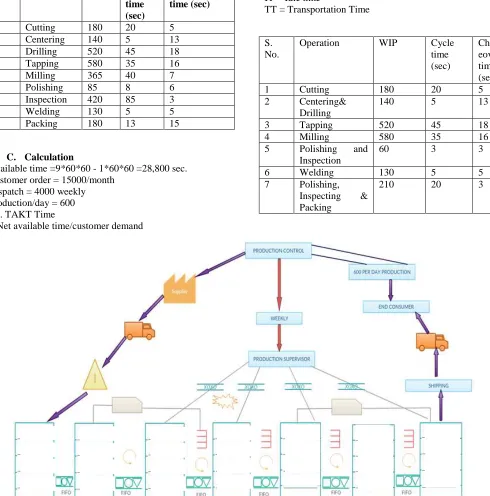
B. VSM Data for current state
S.No. Operation WIP Cycle
time (sec)
Changeover time (sec)
1 Cutting 180 20 5
2 Centering 140 5 13
3 Drilling 520 45 18
4 Tapping 580 35 16
5 Milling 365 40 7
6 Polishing 85 8 6
7 Inspection 420 85 3
8 Welding 130 5 5
9 Packing 180 13 15
C. Calculation
Available time =9*60*60 - 1*60*60 =28,800 sec. Customer order = 15000/month
Dispatch = 4000 weekly Production/day = 600 (1). TAKT Time
= Net available time/customer demand
=28800/15000/26(per shift) =50seconds
(2). No. of work station required = line cycle time/TAKT Time =398/50 =7.96≈ 8
(3). Lead time = LCT+Σ IT +TT = 398+3600/600 + 7*24*60*60/4000 = 555sec.
Where, LCT= Total Line cycle Time IT = Idle time
TT = Transportation Time
S. No.
Operation WIP Cycle
time (sec)
Chang eover time (sec)
1 Cutting 180 20 5
2 Centering&
Drilling
140 5 13
3 Tapping 520 45 18
4 Milling 580 35 16
5 Polishing and
Inspection
60 3 3
6 Welding 130 5 5
7 Polishing,
Inspecting & Packing
210 20 3
Figure 3.9:
Future state Map
IV. RESULT
In the first cutting operation work in process is 200, Cycle time 18 sec. and changeover time 18 sec. In the second, Centering& Drilling operation; work in process is 550, Cycle time 48 sec and changeover time 20 sec. In the third, tapping operation; work in process is 600, Cycle time 48 sec and changeover time 18 sec. In the fourth,
Table 4.1
Future state of VSM data
S.No. Operation WIP Cycle time
(sec)
Changeov
er time
(sec)
1 Cutting 180 20 5
2 Centering& Drilling 140 5 13
3 Tapping 520 45 18
4 Milling 580 35 16
5 Polishing and Inspection 60 3 3
6 Welding 130 5 5
7 Polishing, Inspecting &
Packing
210 20 3
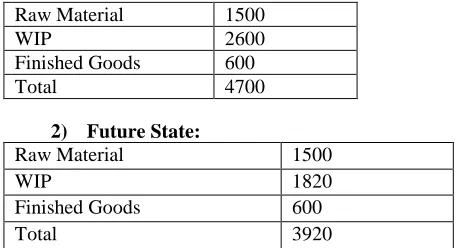
D. Results for Inventory
1) Current state:
Total quantity of raw materials = 1500, & Finished goods = number of units/day = 600
Raw Material 1500
WIP 2600
Finished Goods 600
Total 4700
2) Future State:
Raw Material 1500
WIP 1820
Finished Goods 600
Total 3920
Based on the manufacturing comparison of production process in current state and future state. By the following proposed implementation path of the improvements, the performance of the production process can be improved. This research work has been done for improving the overall productivity of a small scale industry by implementing the lean methodology.
Table 4.2 Comparison table
Ʃ(WIP) Ʃ(CT)
sec
Ʃ(CO) sec
Number of Operations Current
state
2600 256 88 9
Future state
1820 133 63 7
In comparison analysis based on manufacturing process in current state and future state are discussed in this section. The comparison table clearly shows that the overall summation of WIP of the current state is reduced from 2725 to 2175. Further, the number of operations in current state is 9 where as in future state is 7. The operations of centering and drilling are combined in to a single operation in the future state. Similarly, the operations polishing & inspections are combined as single operation. Also the last operation in future state is combination of polishing inspection and packing.
V. CONCLUSION
The primary focal point of lean manufacturing is to dispose of waste, improving in half of the assets as large scale manufacturing requires, giving more excellent lesser expense. It inferred that the VSM is a successful device for dispensing with these squanders and concentrate likewise recommended the approaches to diminish non esteem included
occasions in a manufacturing procedure.
Enormous decreases in time utilization can be accomplished by lessening the holding up time of an occupation during production process. There are some central matters in deduces in this exploration are beneath:
By the accompanying proposed usage way of the upgrades, the presentation of the production procedure can be improved.
From the inventory table it very well may be unmistakably observed that the proposed VSM model decreased the general time of the manufacturing unit as the estimations of the inventory diminished from 4700 to 3920.
The summation esteems for Cycle time decreased from 256 sec to 88 sec later on state.
The summation esteems for Change after some
time from 133 sec to 63 sec later on state.
Combining the procedures likewise helped in
decreasing the manufacturing cost and recyclable waste material.
© 2018 IJRAR February 2018, Volume 5, Issue 1 www.ijrar.org (E-ISSN 2348-1269, P- ISSN 2349-5138)
VI. REFERENCES
[1] N. Verma and V. Sharma, “Sustainable competitive
advantage by implementing lean manufacturing "a Case study for Indian SME,” Mater. Today Proc., vol. 4, no. 8, pp. 9210–9217, 2017.
[2] V. Yadav, R. Jain, M. L. Mittal, A. Panwar, and M.
K. Sharma, “An appraisal on barriers to implement lean in SMEs,” J. Manuf. Technol. Manag., p. JMTM-12-2017-0262, 2018.
[3] S. J. Thanki and J. Thakkar, “Interdependence
analysis of lean-green implementation challenges:
A case of Indian SMEs,” J. Manuf. Technol.
Manag., vol. 29, no. 2, pp. 295–328, 2018.
[4] R. Ben Ruben, S. Vinodh, and P. Asokan, “Lean
Six Sigma with environmental focus: review and framework,” Int. J. Adv. Manuf. Technol., vol. 94, no. 9–12, pp. 4023–4037, 2018.
[5] M. L. Meena, R. Jain, P. Kumar, S. Gupta, and G.
S. Dangayach, “Process improvement in an Indian automotive part manufacturing company: a case study,” Int. J. Product. Qual. Manag., vol. 23, no. 4, p. 524, 2018.
[6] M. Aboelmaged, “The drivers of sustainable
manufacturing practices in Egyptian SMEs and their impact on competitive capabilities: A PLS-SEM model,” J. Clean. Prod., vol. 175, pp. 207– 221, 2018.
[7] S. Sahoo and S. Yadav, “Lean implementation in
small- and medium-sized enterprises: An empirical
study of Indian manufacturing firms,”
Benchmarking, vol. 25, no. 4, pp. 1121–1147, 2018. [8] B. Contreras González et al., “Hipertensión arterial
no controlable en el primer trimestre de la
gestación. Hiperparatiroidismo primario, a
propósito de un caso,” Clin. Invest. Ginecol. Obstet., pp. 8–13, 2017.
[9] F. Authors, “Article information : Identification and
Modeling of Employee Barriers-Implementing Lean Manufacturing in Small and Medium Scale Enterprises Abstract,” 2017.
[10] G. A. Marodin, A. G. Frank, G. L. Tortorella, and D. C. Fetterman, “Lean production and operational performance in the Brazilian automotive supply chain,” Total Qual. Manag. Bus. Excell., no. October, pp. 1–16, 2017.
[11] P. Samantoroy, “Implementation of Lean and
Challenges in Sme ’ S,” vol. 4, no. 2, pp. 35–43, 2017.
[12] R. Prakash, “Six Sigma Implementation in Small