Predator exclusion experiments in an intertidal mud flat
K. REISE
2. Zoologisches [nstitut der Universitlit G6ttingen; Gbttingen, Federal Republic of Germany
ABSTRACT: The intensity of predation pressure exerted on the macrofauna in muddy sedi- ments was investigated in K~Snigshafen (island of Sylt, eastern North Sea). Tests in aquaria revealed shrimp Crangon crangon, juveniles of the shore crab Carcinus maenas, and gobiid fish Pomatoschistus microps as the most important local predators. Their high abundance from July to September led to the hypothesis, that predation pressure on the infauna will be most intense during that period. Cages were set up to protect the infauna against these pre- dators. No protective effect was a&ieved with cages constructed of 20-ram mesh nylon net; however, cages with screen wire and gauze of 5-ram mesh and smaller resulted in a consider- able increase of the infauna. In cages of l-ram mesh gauze, set up from March to June, the macrofauna reached an abundance of four times the control density. In the period from July to October, the factor of increase was as high as 23. Species density was 28 400 cm -2, as compared with only 7 in the control. Species which colonized the mud flat during spring and early summer established dense settlements inside the cages, but failed to do so in uncaged mud-flat areas. It is concluded that predation by young crabs, shrimp and gobies determines to a large extent the structure and dynamics in the local intertidal macrofanna.
I N T R O D U C T I O N
Research on biological interactions as determinant of species abundance patterns has become a thriving branch in marine ecology. Predation, an essential component of biological interactions, has been evaluated under field conditions by three basic experimental procedures: (a) removal of predators, (b) introduction of predators, and (c) transplantation of p r e y organisms into areas of v a r y i n g p r e d a t o r abundance.
In the present study, predators are separated from their p r e y b y using exclosures. This technique has turned out to be very successful in demonstrating the role of p r e d a - tion in the rocky intertidal zone (Connell, 1970; D a y t o n , 1971; Paine, 1974). For in- t e m d a l sofL-sediment environments, however, no predator-exclusion experiments have been reported. These field experiments should be regarded as disturbances of inter- relationships among co-occurring organisms (Goodman, 1975); nevertheless, the re- suiting initial changes in abundance and species number of potential p r e y provide a rough estimate of the eliminated p r e d a t i o n pressure.
from small plots for intervals of three months. The resulting changes in macrofaunal composition were recorded.
M A T E R I A L S A N D M E T H O D S
Close to the low-water mark, mussel beds covered with Fucus species occur in discrete patches, allowing the accumulation of so~, fine silt and clay on the flats between the banks. These sediments are exposed for only 2 h during low tide and remain water-saturated. By virtue of their sheltered position the mud flats are not subject to disturbance by gales.
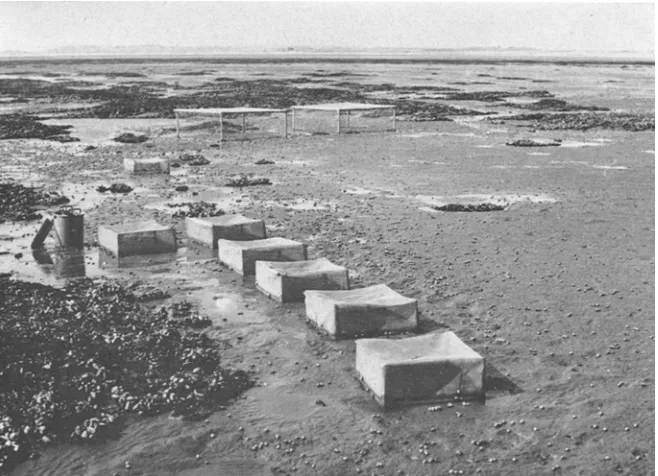
Fig. 1: Mud flat in K/Snigshafen (Island Sylt) with predator exclosures
by grazing preferably on the gauze. Eight samples were taken from each cage to estimate the abundance and species composition of the macrofauna. Four were pro- cessed as described above, the others were "puddled" through a l-ram sieve on site, in order to obtain further counts on the larger animals. In the comparison of abun- dances, the test o n homogeneity developed by Kolmogoroff & Smirnoff was applied (Sachs, 1969).
RESULTS
Three species are particularly abundant among the infauna of the mud flat: the oligochaete Peloscolex benedeni (D'Udekem) and the capitellid Heterornastus filifor- mis (Clap.), both being subsurface deposit feeders, and the spionid Pygospio elegans
Clap., which lives in a tube and feeds on the sediment-water interface. The total abundance is highest in summer, followed by a minimum in autumn. The same applies
June 74 August 74 October 74 %[ 396 521 150
60] '~
404\
April 75 June 75 August 75 705
~1 I I I I I
828 1216
October 75 477 %
-60
.40
~ .20
i , i i i
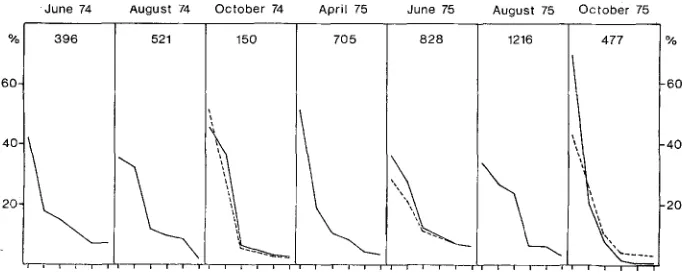
Fig. 2: Dominance-curves for the macrofauna of an intertidal mud flat from sampling periods between June 1974 and October 1975. Only the 6 most abundant species at each period are represented. The percentage of the total macrofauna is given on the ordinate, the species sequence cn the abcissa. The total numbers of individuals 400 cm -2 are listed in the top.
Domlnance-curves for caged areas a~er a period of 3 months are added as broken lines
to the number of species. The m a x i m u m in early summer is caused to a large extent by settling juveniles. This species-rich assemblage of juveniles decreases rapidly with the approach of autumn and is replaced by a monotone Peloscolex-Heteromastus
association. This phenomenon is demonstrated by simple dominance-curves in Figure 2. The scattered mussel beds give shelter to numerous shore crabs Carcinus maenas
In July, I found up to two juveniles 10 cm -2. As judged from the combined presence of all three predators mentioned above, the expected period of most intense predation will be from July to September.
To test this hypothesis, predators were excluded with l-ram mesh cages, which were placed on the mud flat from June 13 to October 9, 1974 (117 days), March 31 to June 20, 1975 (81 days), and July 1 to October 11, 1975 (103 days).
Table 1
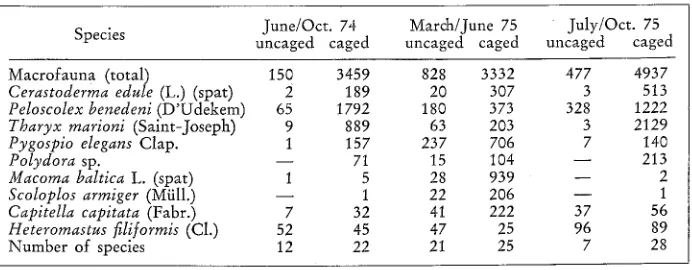
Abundances and species number of macrofauna within 400 cm 2 of caged and uncaged areas in an intertidal mud flat a~er intervals of three months
June/Oct. 74 March/June 75 July/Oct. 75 Species uncaged caged uncaged caged uncaged caged
Macrofauna (total) 150 3459 828 3332 477 4937
Cerastoderma edule (L.) (spat) 2 189 20 307 3 513 Peloscolex benedeni (D'Udekem) 65 1792 180 373 328 1222 Tharyx marioni (Saint-Joseph) 9 889 63 203 3 2129
Pygospio elegans Clap. 1 157 237 706 7 140
Polydora sp. - - 71 15 104 - - 213
Macoma baltica L. (spat) 1 5 28 939 - - 2
Scoloplos armiger (Miill.) - - 1 22 206 - - 1
Capitella capitata (Fabr.) 7 32 41 222 37 56
Heteromastus filiformis (CI.) 52 45 47 25 96 89
Number of species 12 22 21 25 7 28
Striking differences in the macrofauna between the caged and uncaged areas resulted al~ each interval (Table 1). In October 1974 and 75, the total abundance was higher within the exclosures by factors of 23.1 and 10.4, respectively. In June 1975, the factor was only 4.0. During the summer, when the overall abundance in the mud flat is high, the fauna is little altered by the cages. Whereas in autumn, when the unprotected fauna is reduced considerably, the difference in abundance is enor- mous. The annelids Peloscolex benedeni, Tharyx marioni, Pygospio elegans, Polydora sp., and many other species, as well as spat of the cockle Cerastoderma edule, confirm this general result. In addition, P. benedeni and T. rnarioni show only a slight increase in the summer cage, but increase tremendously in the autumn cages. In the case of T. rnarioni there is an increase of 710 times the normal density!
A few species do not show these tendencies. There is no change from summer to autumn, but the populations increase sharply from spring to summer. Macoma baltica and Scoloplos armiger reproduce only in the spring, thus they can not invade the autumn cages. N o explanation can be given for the varying responses of Capitella capitata to the presence of cages. The only species which showed no increase within the exclosures is the deep dwelling Heteromastus filiformis. Apparently this capitellid remains unaffected by such predators as crabs, shrimp and small fish.
the uncaged species density. The species rich assemblage during early summer is caused by settling juveniles of species, the adults of which do not occur in the mud flat area. These juveniles established dense settlements when protected by cages. Among them are the polychaetes Scoloplos armiger, Arenicola marina (L.), Lanice conchilega (Pal-
40C
200
Fig. 3: Test on predation: sediment samples obtained from a mud-flat area were placed in aquaria. For periods of 3 days, test-species were allowed to prey on the infauna. The quantity
of surviving macrofauna (indiv. 200 cm -~) is shown
period of most intense predation
Fig. 4: Presence of Carcinus maenas, Crangon crangon and Pomatoschistus microps in the mud-flat area of KSnigshafen (Island Sylt) in 1975. Light shade: shrimp and gobiid fish,
las),
Spio filicornis
(M~ill.) and others. Spat from bivalves matured in the cages, where- as the adults do not occur in the intertidal zone, but are restricted to the sublittoral. Examples of this areSpisula subtruncata
Da Costa,Mactra corallina
Montagu,Vene-
rupis pullastra
Montagu andAbra alba
(Wood).Despite these apparent changes in abundance and species number, diversity indices (i.e. Shannon index) based on numbers of individuals and species failed to show any significant increase. This is also demonstrated by the broken lines in Figure 2. H o w - ever, although diversity and diversity-trends indicate no particular difference between the fauna under predation-free conditions and that of the untouched mud flat, the composition of the assemblage did change considerably. For example, when the six most abundant species in each interval are ranked according to their relative individual numbers, positions are altered almost entirely (Table 2). These changes are partially due to the fact that young bivalves, which play no role in the unprotected mud flat, join the higher ranks. In addition, species feeding on the sediment-water interface increase in the cages relative to the deeper dwelling species.
6000.
4 0 0 0
200C
control 20 5 2 1 0,5ram
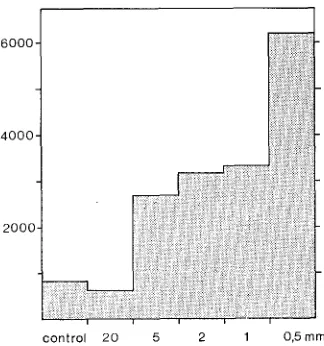
Fig. 5: Total macrofauna abundance (indiv. 400 cm -~) within the uncaged area and in thos~ caged with 20, 5, 2, 1 and 0.5 mm mesh net, screen wire and gauze respectively, al%r about
three months (April to July 1975)
e q
r
~ d
~3
- o
o
9
#
I~
~
~ i
~ 1 ~ ' ~ , ~ . ~
N ~
~ o ~ r
. ~ ~
D I S C U S S I O N
The protective effects of the exclosures are very remarkable, and the resulting densities of up to 12 individuals cm -2 are unparalleled for the macrofauna in so~ sediment environments. Whereas the increase in abundance and species number is cer- tainly due to a lack of predation within the cages, it is likely that the relative propor- tions of the species to one another are influenced by competition. Because almost all species increased in individual numbers, when protected by an exclosure, competition was probably not very important in the initial phase of faunal change. Predatory species of the infauna became more abundant within the cages as well. However, they apparently had no distinct effect on the overall change in abundance of the remaining infauna. Both, the co-occurrence of relatively large numbers of young crabs, shrimp and gobies, and the sharp decline of infaunal species abundance from July to Septem- ber - at which time the highest relative increase within the exclosures was observed - indicate that the overall abundance pattern of the mud flat community can be attrib- uted to the influence of predators. Even the species composition is altered under preda- tion-free conditions. Nevertheless, diversity indices and dominance-curves show no apparent differences between protected and unprotected infauna. Either this is an inherent feature of possible community structures in this mud flat or, in this context, these measurements are simply useless.
These short-term exclusion experiments showed that predation pressure deter- mines, to a large extent, the structure and dynamics of the macrofaunal assemblage in this intertidal mud flat. This is in contrast to hitherto expressed views (D6rjes, 1970; Eltringham, 1971; Woodin, 1974), assuming predation to be of minor impor- tance or considering shore birds to be the most important predators on intertidal flats. Sanders' (1968) hypothesis that intertidal communities are physically controlled is too general in its scope and a more restricted form, stressing biological interactions, ought to be formulated. In general, these results are well in line with the concept of community interactions on marine rocky intertidal shores as proposed by Connell (1972). It is concluded that the structure and dynamics in this intertidal macrofauna community are,.to a large extent, determined by predation pressure.
Acknowledgements. I would like to thank Professor P. Ax for helpful advice and sup- port of this study. The Biologische Anstalt I-telgoland provided laboratory space. I am in- depted to the staff of the Litoralstation List/Sylt for valuable technical assistance.
L I T E R A T U R E CITED
Connell, J. H., 1970. A predator-prey-system in the marine intertidal region. I. Balanus glandula and several predatory species of Thais. Ecol. Monogr. 40, 49-78.
- - 1972. Community interactions on marine rocky intertidal shores. Ann. Rev. Ecol. Syst. 3, 169-192.
D~Srjes, J., 1970. Das Watt als Lebensraum. In: Das Watt~ Ed. by I-I. R. Reineck. Senckenberg, Frankfurt, 71-105.
Eltringham, S. K., 1971. Life in mud and sand. Crane, Russak & Comp., New York, 218 pp. Goodman, D., 1975. The theory of diversity-stability relationships in ecology. Q. Rev. Biol.
50, 237-266.
Paine, R. T., 1974. Intertidal community structure. Oecologia 15, 93-120. Sachs, L., 1969. Statistische Auswertungsmethoden. Springer, Berlin, 677 pp.
Sanders, H. L., 1968. Marine benthic diversity: a comparative study. Am. Nat. 102, 243-282. Woodin, S. A., 1974. Polychaete abundance patterns in a marine so~-sediment environment:
the importance of biological interactions. Ecol. Monogr. 44, 171-187. Author's address : K. Reise
Biologische Anstalt Helgoland (Litoralstation) Hafenstraf~e 3
D-2282 List/Sylt