145 |
P a g e
A FRAME WORK FOR DYNAMIC ROUTE FOR
INFORMATION UNITY AND DETAIN
DIFFERENTIATED SERVICES IN WIRELESS
SENSOR NETWORKS
D.Suson
1, K.Praveen Kumar Rao
2, B.Arathi
31
pursuingM.Tech (CSE)
2
working as anAssociate Professor
3
working as anAssistant Professor.Department of CSE fromKamala Institute of Technology &
Science, Huzurabad, Karimnagar, Telangana, Affiliated to JNTUH, (India)
ABSTRACT
With the colossal progression in the field of inserted PC and sensor innovation, Wireless Sensor
Networks (WSNs) have had wonderful effect in this day and age. These WSNs comprise of a few a
huge number of sensor hubs sent randomly, are equipped for detecting, inciting, and conveying the
gathered data. Since remote sensor systems are compelled by expense,versatility, topology change
and power utilization, new advancements are being considered to defeat these and numerous other
issues. Applications running on the same Wireless Sensor Network (WSN) stage as a rule have
distinctive Quality of Service (QoS) necessities. Two essential necessities are low postpone and high
information trustworthiness. Be that as it may, much of the time, these two prerequisites can't be
fulfilled at the same time. In this paper, in light of the idea of potential in material science, I propose
IDDR, a multi-way dynamic directing calculation, to determine this contention. By developing a
virtual half breed potential field, IDDR isolates parcels of uses with various QoS prerequisites as
indicated by the weight relegated to every bundle, and courses them towards the sink through various
ways to move forward the information constancy for trustworthiness delicate applications and in
addition lessen the end-to- end delay for postponement touchy ones. Utilizing the Lyapunovfloat
strategy, I demonstrate that IDDR is steady. Recreation results exhibit that IDDR gives information
respectability and deferral separated administrations.
Keywords: Wireless Sensor Networks, Potential Field, Dynamic Routing, Data Integrity, Delay
146 |
P a g e
I. INTRODUCTION
Wireless Sensor Networks (WSNs) have increased around the world consideration as of late, especially with the
expansion in Micro-Electro-Mechanical Systems (MEMS) innovation which has encouraged the improvement
of savvy sensors. These sensors are little, with constrained preparing and processing assets and they are modest
contrasted with customary sensors. These sensor hubs can sense, measure, what's more, assemble data from the
earth and, in view of some nearby choice procedure, they can transmit the detected information to the client.
Shrewd sensor hubs are low power gadgets furnished with one or more sensors, a processor, memory, power
supply, radio, and an actuator. WSNS, which are utilized to sense the physical world, will play an essential part
in the cutting edge systems. Because of the assorted qualities and multifaceted nature of utilizations running
over WSNs, the QoS ensure in such systems increases expanding consideration in the exploration group. As a
part of a data foundation, WSNs ought to be ready to bolster different applications over the same stage.
Distinctive applications may have diverse QoSnecessities. For example, in a flame observing application, the
occasion of a flame caution ought to be accounted for to the sink as before long as would be prudent. Then
again, a few applications require the vast majority of their bundles to effectively touch base at the sink
independent of when they arrive. For instance, in natural surroundings observing applications, the entry of
parcels is permitted to have a deferral, yet the sink ought to get the vast majority of the parcels.
WSNs have two essential QoS necessities: low postpone and high information honesty, prompting what are
called delay sensitive applications and high-respectability applications, separately. By and large, in a system
with light load, both prerequisites can be promptly fulfilled. Be that as it may, an intensely stacked system will
endure clog, which builds the end- to-end delay. This work plans to all the while enhance the devotion for
high-honesty applications and diminishing the end- to-end delay for deferral touchy ones, notwithstanding when the
system is congested. I get the idea of potential field from the control of material science and configuration a
novel potentialbased steering calculation, which is called honesty and postponement separated directing
(IDDR). IDDR can give the taking after two capacities:
[1] Improve devotion for high-uprightness applications. The fundamental thought is to discover however much
support space as could reasonably be expected from the unmoving and/or under-stacked ways to store the
extreme parcels that may be dropped on the most limited way. Accordingly, the principal assignment is to locate
these unmoving and/or underloaded ways, then the second undertaking is to reserve the parcels effectively for
consequent transmission. IDDR develops a potential field as per the depth1 and line length data to locate the
under-used ways. The parcels with high uprightness prerequisite will be sent to the following jump with littler
line length. A system called Implicit Hop- by-Hop Rate Control is intended to make bundle reserving more
productive.
Decrease end- to-end delay for postponement touchy applications. Every application is allotted a weight, which
speaks to the level of affectability to the postponement. Through building nearby dynamic potential fields with
147 |
P a g e
weight to pick shorter ways. In expansion, IDDR likewise utilizes the need line to facilitate diminish the lining
deferral of postponement touchy bundles.
IDDR characteristically keeps away from the contention between high respectability what's more, low postpone:
the high-respectability parcels are reserved on the under stacked ways along which bundles will endure huge
end- to-end delay as a result of more bounces, and the deferral touchy bundles make a trip along shorter ways to
approach the sink at the earliest opportunity. Utilizing the Lay float hypothesis, I demonstrate that IDDR is
steady. Moreover, the aftereffects of anarrangement of recreations led on the TOSSIM stage show the
productivity and achievability of the IDDR plan
II. RELATED WORK
Most QoS provisioning conventions proposed for customary advertisement hoc systems have extensive
overhead brought on by end- to-end way disclosure and asset reservation. Subsequently, they are most certainly
not reasonable for asset obliged WSNs. A few instruments have been intended to give QoS benefits particularly
to WSNs. Here I for the most part concentrate on the measurements of postponement and unwavering quality.
Giving Real-Time Service RAP misuses the thought of speed and proposes a speed monotonic planning strategy
to minimize the proportion of missed due dates [7]. Be that as it may, the worldwide data of system topology is
required. Certain Earliest Deadline First (EDF) for the most part uses a medium access control convention to
give continuous administration [8]. The verifiable prioritization is utilized rather than depending on control
bundles as most different conventions do. SPEED keeps up a craved conveyance speed over the system through
a novel mix of criticism control also, non-deterministic QoS-mindful geographic sending [9]. In [10], a
two-bounce neighbor data based inclination directing system is proposed to improve ongoing execution. The
directing choice is made taking into account the number of bounces from a source to the sink and the two-jump
data.
2.1 Providing Reliability Service
Versatile Forwarding Scheme (AFS) utilizes the bundle need to decide the sending conduct to control the
dependability [11]. ReInforM utilizes the idea of element parcel states to control the quantity of ways required
for the sought dependability [12]. Notwithstanding, both of AFS and ReInforM require to know the worldwide
system topology. LIEMRO [13] uses a dynamic way support system to screen the nature of the dynamic ways
amid system operation and directs the infused activity rate of the ways as indicated by the most recent saw ways
quality. Nonetheless, it doesn't consider the impacts of cushion limit what's more, administration rate of the
dynamic hubs to gauge and alter the movement rate of the dynamic ways.
2.2 Providing Real-Time and Reliability Services
MMSPEED expands SPEED for administration separation and probabilistic QoS ensure [6]. It utilizes the same
system as SPEED to fulfill the deferral necessities for various sorts of movement, and utilizations excess ways
to guarantee unwavering quality. The MAC layer function is adjusted to give organized access and dependable
148 |
P a g e
source hubs still ceaselessly transmit parcels to the sink along multi paths without taking a few different
instruments, for example, reserving bundles for quite a while. This falls apart unwavering quality as well as
retards the delay-delicate parcels. Vitality Effective and QoS - based Multipath Routing Protocol (EQSR) [14]
progresses dependability through utilizing a lightweight XOR-based Forward Blunder Correction (FEC)
component, which presents information excess in the information transmission process. Moreover, in request to
meet the postponement necessities of different applications, EQSR utilizes a lining model to oversee ongoing
and non-genuine time activity. DARA [15] considers dependability, delay also, remaining vitality.
III. MOTIVATION
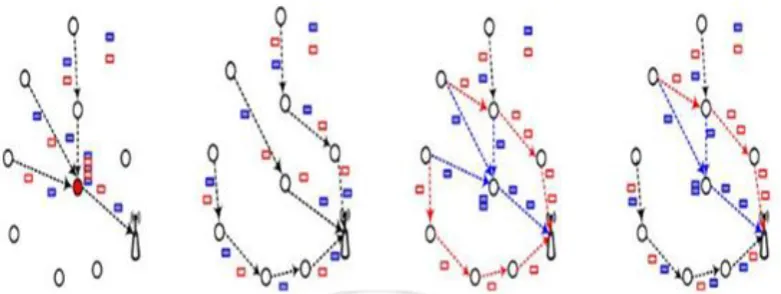
Fig. 1 outlines a little part of a WSN. Assume hub 1 is a hotspot and there are both high uprightness parcels
(empty rectangles) and postponement delicate parcels (strong rectangles) from source hubs A, B and C. A
usually utilized directing calculation will pick the ideal way for every one of the parcels. For instance, the
standard briefest way tree (SPT) directing will forward every one of them to hub 1 as appeared in Fig. 1a. This
will bring about clog and along these lines lead to numerous high integrity parcels misfortune and huge end-
to-end delay for deferral touchy parcels. A multipath directing calculation as appeared in Fig. 1b can use more
ways to stay away from hotspots. Be that as it may, the low deferral and high throughput are barely met all the
while.
The reasons are:
Delay-touchy parcels possess the restricted transfer speed and cushions, exacerbating drops of
high-trustworthiness ones.
High-honesty parcels hinder the most limited ways, convincing the postponement delicate parcels to travel
more bounces before achieving the sink, which expands the deferral.
High-uprightness parcels involve the cradles, which likewise expands the lining deferral of postponement
touchy parcels.
To beat the above disadvantages, I mean to plan a component which permits the deferral touchy bundles to
move along the most limited way and the parcels with loyalty necessities to reroute to keep away from
conceivable dropping on the hotspots. Thusly, the information trustworthiness and postponement separated
administrations can be given in the same system. Propelled by this understanding, I propose the IDDR plan, a
potential-based multi-way dynamic steering calculation.
As appeared in Fig. 1c, the high-respectability parcels don't pick hub 1 because of its extensive line length.
Some other unmoving what's more, or under stacked ways, for example, way 2->3->Sink 4->5->6->6sink, are
utilized to store and course these parcels productively in order to shield them from being dropped in the hotspot.
Then again, IDDR gives delay-delicate bundles need to proceed in the most limited way to accomplish low
postpone. Moreover, if the movement on the most brief way is overwhelming, IDDR can likewise choose
different ways for the postponement touchy parcels, for example, way: A ->4 -> 5 -> 6 -> Sink appeared in Fig.
1d, the connection from hub 1 to the sink is so occupied that hub An or B will sidestep hub 1 and send bundles
149 |
P a g e
IDDR recognizes distinctive sorts of parcels utilizing the weight values embedded into the header of bundles,
and after that performs distinctive activities on them. Its foundation is to build appropriate potential fields to
make right directing choices for various sorts of bundles. Next the potential- based IDDR calculation will be
portrayed in point of interest. draw in broad consideration due to its gigantic administration overhead. It is
entirely costly to manufacture a select virtual field for every destination in customary systems where various
destinations may be dispersed self-assertively. On the opposite, the potential-based steering calculation is much
reasonable for the numerous to-one movement design in WSNs.
Fig 1: (A) Action of SPT. (B) Action Of Multipath Router. (C) Action Of IDDR. (D) IDDR With
Hotspot
IV. EXISTING SYSTEM
Most QoS provisioning conventions proposed for conventional specially appointed systems have substantial
overhead brought about by end- to-end way revelation and asset reservation. In this manner, they are not
reasonable for asset compelled WSNs. A few components have been intended to give QoSbenefits particularly
to WSNs. 2) Adaptive Forwarding Scheme(AFS) utilizes the parcel need to decide the sending conduct to
control the unwavering quality. 3) LIEMRO uses a dynamic way support component to screen the nature of the
dynamic ways amid system operation and manages the infused activity rate of the ways as indicated by the most
recent saw ways quality.
4.1 Disadvantages of Existing System
1. It doesn't consider the impacts of cradle limit and administration rate of the dynamic hubs to appraise and
change the movement rate of the dynamic ways.
2. This will bring about blockage and in this way prompt some high trustworthiness bundles misfortune and
vast end- to-end delay for delay delicate bundles.
3. Delay-delicate bundles involve the constrained data transmission furthermore, cushions, declining drops of
high-respectability ones.
4. High-respectability bundles obstruct the briefest ways, convincing the deferral touchy bundles to travel
150 |
P a g e
5. High-honesty bundles involve the cradles, which likewise expands the lining postponement of deferral
delicate bundles.
4.2 Proposed System
This work intends to all the while enhance the devotion for high-uprightness applications and reduction the end-
to-end delay for postponement touchy ones, notwithstanding when the system is congested. I obtain the idea of
potential field from the order of material science and configuration a novel potential based steering calculation,
which is called uprightness and postponement separated steering (IDDR). IDDR can give the taking after two
capacities: Enhance devotion for high-trustworthiness applications. The essential thought is to discover however
much cushion space as could reasonably be expected from the unmoving furthermore, or under-stacked ways to
store the over the top bundles that may be dropped on the most brief way. Hence, the to start with undertaking is
to locate these unmoving and/or underloaded ways, then the second errand is to store the parcels proficiently for
resulting transmission.
IDDR develops a potential field as indicated by the depth1 and line length data to discover the under-used ways.
The parcels with high respectability prerequisite will be sent to the following jump with littler line length. An
instrument called Implicit Hop- by - Hop Rate Control is intended to make parcel storing more productive.
Diminish end- to-end delay for deferral delicate applications. Every application is appointed a weight, which
speaks to the level of affectability to the deferral. Through building neighborhood dynamic potential fields with
various slants as indicated by the weight values conveyed by parcels, IDDR permits the parcels with bigger
weight to pick shorter ways. In expansion, IDDR likewise utilizes the need line to encourage diminish the lining
deferral of postponement touchy parcels.
4.3 Advantages of Proposed System
1. IDDR naturally maintains a strategic distance from the contention between high honesty and low defer: the
high-respectability parcels are reserved on the under stacked ways along which parcels will endure an
extensive end- to-end delay as a result of something beyond jumps, and the postponement touchy parcels go
along shorter ways to approach the sink as quickly as time permits.
2. Utilizing the Lyapunov float hypothesis, I demonstrate that IDDR is stable.
3. Besides, the aftereffects of a progression of recreations directed on the TOSSIM stage show the
productivity and plausibility of the IDDR plan.
V. IMPLEMENTATION
5.1 Administration Provider
In this module, the administration supplier will skim the information document, introduce the switch hubs and
after that send to the specific beneficiaries. Administration supplier will send their information document to
switch what's more, switch will choose littlest separation way and send to specific getr.
151 |
P a g e
The Router deals with a various systems to give information capacity administration. In system n-number of
hubs are available (n1, n2, n3, n4, n5...). In a switch administration supplier can see hub subtle elements and
assaulted hubs. Administration supplier will send their information record to switch and switch will choose
littlest separation way and send to specific collector. On the off chance that any assailant is found in a hub then
switch will interface with another hub also, send to specific client.
5.3 Ids Manager
In this module, the IDS Controller comprises of two stages. In the event that Uprightness or Malicious Data is
happens in switch then IDS controller is enacted. In a first stage DNS parcels, Net stream, Traffic channel and
Fine-grained IDS customer recognition are present. Point is that distinguishing all hosts inside the observed
system that take part in IDS interchanges. I break down crude activity gathered at the edge of the observed
system what's more, apply a pre-sifting venture to dispose of system streams that are unrealistic to be produced
by IDS applications. I then examine the remaining activity and concentrate various factual elements to
distinguish streams created by IDS customers. In the second stage, Coarse-grained IDS Integrity or Vindictive
Data discovery, Fine-grained IDS customer identification furthermore, Integrity or Malicious Data are available;
our framework investigates the movement created by the IDS customers and characterizes them into either true
blue IDS customers or IDS Respectability or Malicious Data.
5.4 Collector (End User)
In this module, the collector can get the information record from the switch. Administration supplier will send
information record to switch and switch will send to specific collector. The collectors get the record by without
changing the File Contents. Clients may get specific information records inside the system as it were.
5.5 Assailant
Assailant is one who is infusing noxious information to the comparing hub furthermore aggressor will change
the data transmission of the specific hub. The aggressor can infuse fake data transmission to the specific hub. In
the wake of assaulting the hubs, data transmission will have changed in a switch.
VI. CONCLUSION
In this paper, an element multipath steering calculation IDDR is proposed in view of the idea of potential in
material science to fulfill the two diverse QoS necessities, high information constancy what's more, low end-
to-end delay, over the same WSN at the same time. The IDDR calculation is demonstrated stable utilizing the
Lyapunov float hypothesis. In addition, the test results on a little proving ground and the reenactment results on
TOSSIM show that IDDR can altogether enhance the throughput of the high-honesty applications and
diminishing the end- to-end postponement of deferral delicate applications through diffusing diverse parcels
from various applications spatially and transiently. IDDR can likewise give great adaptability in light of the fact
that lone nearby data is required, which rearranges the execution. Likewise, IDDR has worthy correspondence
152 |
P a g e
REFERENCES
1. P. Levis, N. Lee, M. Welsh, and D. Culler, “TOSSIM: Accurate and scalable simulation of entire TinyOS applications,”
in Proc. 1st Int. Conf. Embedded Networked Sensor Syst., 2003, pp. 126–137.
2. T. Chen, J. Tsai, and M. Gerla, “QoS routing performance in multi-hop multimedia wireless networks,” in Proc. IEEE
Int. Conf. Universal Personal Commun., 1997, pp. 55 –561.
3. R. Sivakumar, P. Sinha, and V. Bharghavan, “CEDAR: Core extraction distributed ad hoc routing algorithm,” IEEE J.
Selected Areas Commun., vol. 17, no. 8, pp. 1454–1465, Aug. 1999.
4. S. Chen and K. Nahrstedt, “Distributed quality-of-service routing in ad hoc networks,” IEEE J. Selected Areas
Commun., vol. 17, no. 8, pp. 1488–1505, Aug. 1999.
5. B. Hughes and V. Cahill, “Achieving real-time guarantees in mobile ad hoc wireless networks,” in Proc. IEEE
Real-Time Syst. Symp., 2003.
6. E. Felemban, C.-G. Lee, a nd E. Ekici, “MMSPEED: Multipath multi-speed protocol for QoS guarantee of reliability
and timeliness in wireless sensor networks,” IEEE Trans. Mobile Comput., vol. 5, no. 6, pp. 738 –754, Jun. 2003.
7. C. Lu, B. Blum, T. Abdelzaher, J. Stankovic, and T. He, “ RAP: A real-time communication architecture for large-
scale wireless sensor networks,” in Proc. IEEE 8th Real-Time Embedded Technol. Appl. Symp., 2002, pp. 55–66.
8. M. Caccamo, L. Zhang, L. Sha, and G. Buttazzo, “An implicit prioritized access protocol for wireless sensor networks,”
in Proc. IEEE Real -Time Syst. Symp., 2002, pp. 39 – 48.
9. T. He, J. Stankovic, C. Lu, and T. Abdelzaher, “SPEED: A stateless protocol for real-time communication in sensor
networks,” in Proc. IEEE 23rd Int. Conf. Distrib. Comput. Syst., 2003, pp. 46–55.
10. P. T. A. Quang and D.- S. Kim, “Enhancing real-time delivery of gradient routing for industrial wireless sensor
networks,” IEEE Trans. Ind. Inform., vol. 8, no. 1, pp. 61–68, Feb. 2012.
11. S. Bhatnagar, B. Deb, and B. Nath, “Service differentiation in sensor networks,” in Proc. Int. Symp. Wireless Pers.
Multimedia Commun., 2001.
12. B. Deb, S. Bhatnagar, and B. Nath, “ReInForM: Reliable information forwarding using multiple paths in sensor
networks,” in Proc. IEEE Intl Conf. Local Comput. Netw., 2003, pp. 406–415.
13. J. Ben-Othman and B. Yahya, “Energy efficient and QoS based routing protocol for wireless sensor networks,” J.
Parallel Distrib. Comput., vol. 70, no. 8, pp. 849–857, 2010.
14. M. Razzaque, M. M. Alam, M. MAMUN-OR-RASHID, and C. S. Hong, “Multi-constrained QoS geographic routing
for heterogeneous traffic in sensor networks, ieice transactions on communications,” IEICE Trans. Commun., vol. 91B,
no. 8, pp. 2589–2601, 2008.
15. D. Djenouri and I. Balasingham, “Traffic-differentiation-based modular qos localized routing for wireless sensor
networks,” IEEE Trans. Mobile Comput., vol. 10, no. 6, pp. 797–809, Jun. 2010.
Author Details
D.Susonpursuing M.Tech (CSE) from Kamala Institute Of Technology & Science, Huzurabad, Karimnagar, Telangana,
Affiliated to JNTUH, India
K.Praveen Kumar Raoworking as anAssociate Professor Department of CSE from Kamala Institute Of Technology & Science,
Huzurabad, Karimnagar, Telangana, Affiliated to JNTUH, India.
B.Arathiworking as anAssistant Professor Department of CSE from Kamala Institute Of Technology & Science, Huzurabad,