539 |
P a g e
DESIGN AND ANALYSIS OF RECTANGULAR
MICROSTRIP PATCH ANTENNA USING
METAMATERIAL
Shashilata Rawat
1, L. N. Gahalod
21
Department of Electronics & Communication Engineering, J.N.C.T, Bhopal (India)
2Department of Electronics & Communication Engineering, J.N.C.T, Bhopal (India)
ABSTRACT
This paper shows the results obtained from simulation and fabrication process of inspired metamaterial Structure with RMPA 2GHz with rectangular cut shaped structure at 3.2mm layer. To this date, the technology in Left-Handed Metamaterial is best suited for finding beneficial result for our purpose. The metamaterial is the starting point of the analysis and is usually composed of periodic structure of metal and dielectric. We have designed the structure using simulation tools and fabricate them to see how the performance is changing by using inspired metamaterial Structure with respect to fabricated RMPA alone. Simulation results showed that the RMPA return loss is reduced by -26.36 dB and the bandwidth is improved by 5% by incorporating the proposed metamaterial structure. RMPA with Rectangular Cut Shaped Structure at 3.2mm plane is simulated on IE3D Simulation platform, fabricated, and measured on Spectrum Analyzer in the microwave laboratory, Simulation and Measurement results are compiled here.
Keywords:
Bandwidth, Dielectric Substrate, Left-Handed Metamaterials (LHM), Return Loss,
RMPA
I. INTRODUCTION
The greatest potential of metamaterials is the possibility to create a structure with a negative refractive index,
since this property is not found in any non-synthetic material. Almost all materials encountered in optics, such as
glass or water, have positive values for both permittivity ε and permeability µ. However, many metals (such as
silver and gold) have negative ε at visible wavelengths. A material having either (but not both) ε or µ negative is
opaque to electromagnetic radiation. Although the optical properties of a transparent material are fully specified
by the parameters εr and µr, refractive index n is often used in practice, which can be determined from
. All known non-metamaterial transparent materials possess positive εr and µr. By convention the
positive square root is used for n. Metamaterials are artificial materials engineered to have properties that may not be found in nature. They are assemblies of multiple individual elements fashioned from conventional
microscopic materials such as metals or plastics, but the materials are usually arranged in periodic patterns.
Metamaterials gain their properties not from their composition, but from their exactingly-designed structures.
Their precise shape, geometry, size, orientation and arrangement can affect the waves of light or sound in an
Volume No.02, Special Issue No. 01, September 2014 ISSN (online): 2348 – 7550
540 |
P a g e
metamaterials achieve desired effects by incorporating structural elements of sub-wavelength sizes, i.e. featuresthat are actually smaller than the wavelength of the waves they affect. These Metamaterials are typically realized
artificially as composite structures that are composed of periodic metallic patterns printed on dielectric
substrates. Metamaterials have been extensively studied in the recent years, in the framework of microwave
applications. Several works have been aimed towards the improvement of the performances of antennas in the
microwave range of frequencies. It is noted in that some principal properties of waves propagating in materials
with negative permittivity and negative permeability are considered and high directivity can be obtained from
conventional antenna using metamaterials.
II. LEFT-HANDED META-MATERIALS
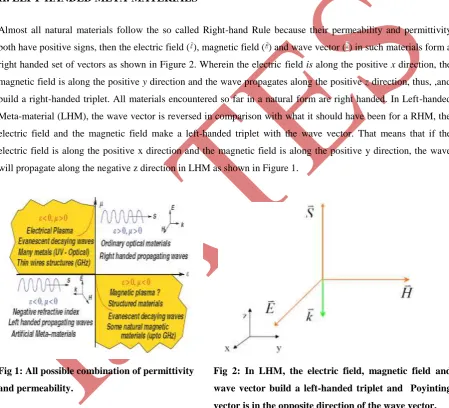
Almost all natural materials follow the so called Right-hand Rule because their permeability and permittivity
both have positive signs, then the electric field ( ), magnetic field ( ) and wave vector ( ) in such materials form a
right handed set of vectors as shown in Figure 2. Wherein the electric field is along the positive x direction, the magnetic field is along the positive y direction and the wave propagates along the positive z direction, thus, ,and build a right-handed triplet. All materials encountered so far in a natural form are right handed. In Left-handed
Meta-material (LHM), the wave vector is reversed in comparison with what it should have been for a RHM, the
electric field and the magnetic field make a left-handed triplet with the wave vector. That means that if the
electric field is along the positive x direction and the magnetic field is along the positive y direction, the wave
will propagate along the negative z direction in LHM as shown in Figure 1.
Fig 1: All possible combination of permittivity Fig 2: In LHM, the electric field, magnetic field and
and permeability. wave vector build a left-handed triplet and Poyinting
vector is in the opposite direction of the wave vector.
Now, examine the direction of the energy flow in LHM, which is characterized by the Poynting Vector as
follows,
………. (1) the Poynting vector power density can be written as[1]:
541 |
P a g e
..………... (2)
In RHM
(
and
),
the Poynting vector is in the same direction as shown in Figure 2, wherein both theandthe are along the positive z direction. For Left-handed Metamaterial
(
and)
, the wave vectoris along the negative z direction as shown in Figure 1. According to equation (2), the Poynting power density has
the opposite direction of for
(
and)
thus is in the opposite direction of and along the positive zdirection as shown in Figure 2. Consequently, the energy flow and the phase velocity in LHM are in opposite
directions.
III. UNIQUE PROPERTIES OF LEFT-HANDED METAMATERIALS
Negative Refractive Index: For conventional material with > 0 and > 0, the refractive index is
given , so that the conventional material possesses a positive refractive index. Yet, Left-handed
Meta-material has both negative permittivity and negative permeability , the
refractive index n has negative value [2] [3]. Inverse Snell's law: An incident light that enters left-handed
meta-materials from a right-handed medium will undergo refraction, but opposite to that usually observed for two right
handed media.
The Snell's law is described as
………. (3)
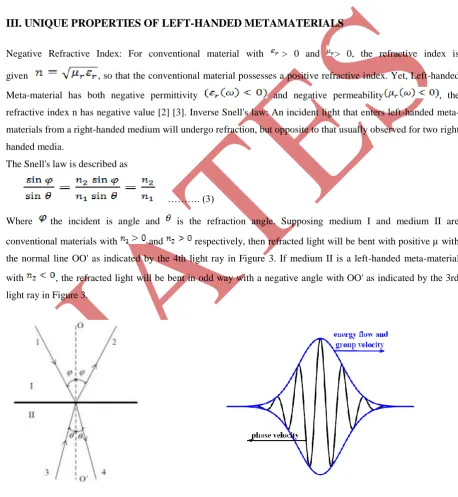
Where the incident is angle and is the refraction angle. Supposing medium I and medium II are
conventional materials with and respectively, then refracted light will be bent with positive µ with
the normal line OO' as indicated by the 4th light ray in Figure 3. If medium II is a left-handed meta-material
with , the refracted light will be bent in odd way with a negative angle with OO' as indicated by the 3rd
light ray in Figure 3.
Fig 3: Passage of a light ray through the Fig 4: The energy flow and group velocity propagate boundary between medium I with positive forward in LHMs but the phase velocity is
Volume No.02, Special Issue No. 01, September 2014 ISSN (online): 2348 – 7550
542 |
P a g e
The phase velocity expression shows that the phase velocity is related to the index of refraction; here c denotes the speed of light in a vacuum. For LHM has negative refractive index, the phase velocity has negative value. In
LHM, the phase velocity is in the opposite direction of the energy flow in the sense that the energy flow leaves
the source in waves with a phase velocity pointing backward as shown in Figure 4. Veselago [4] also predicted
that the Doppler and Cerenkov effects will be reversed in LHM. An approaching source will appear to radiate at
a lower frequency and charged particles moving faster than the speed of light in the medium will radiate in a
backward cone, not a forward cone. These two exotic properties are not employed here, however details about
them can be found in.
III. EXPERIMENTAL WORK
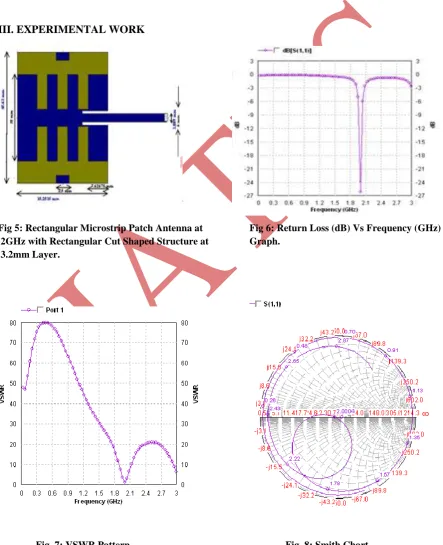
Fig 5: Rectangular Microstrip Patch Antenna at Fig 6: Return Loss (dB) Vs Frequency (GHz) 2GHz with Rectangular Cut Shaped Structure at Graph.
3.2mm Layer.
543 |
P a g e
Fig. 9: Comparative Graph between Simulated and Measured Results
The Design of RMPA for 2GHz has been done. First of all necessary parameters are calculated by the formula
for given frequencies and after that by using IE3D Software the Simulation is done by the calculated parameters.
The Structure is designed on the dielectric substrate (glass epoxy) of dielectric constant 4.4 with thickness
1.6mm having loss tangent 0.02. The patch is designed simply as ordinary patch antenna on a substrate with
ground as one plane and patch at 1.6mm as other plane while another substrate is designed to form inspired
RCSS, with RCSS at one plane 3.2mm keeping other side completely etched. Then both substrates tied together
using nut-bolt assembly to form composite structure i.e. RMPA with Inspired RCSS Metamaterial Structure at
3.2mm Layer shown in Figure 5.
VI. RESULTS AND DISCUSSIONS
The Simulated and Measured Results of RMPA with Rectangular Cut Shaped Structure at 3.2mm Layer are
shown in figure 9 at 2GHz frequency. Simulated RMPA alone exhibits the Simulated and Measured Return Loss
is -20.11dB and 18.90dB while when it is designed with Rectangular Cut Shaped Structure at 3.2mm Layer it
shows Simulated and Measured Return Loss is –26.36dB and -26.30dB which shows significant reduction of
Return Loss using above structure, and Improve 5% Bandwidth. To fabricate the patch, screen printing is done
on the substrate layer by the designing on the AutoCAD, coated with copper layer and the ground plane is well
covered by tape in order to protect from etching. Etching of the printing plate is done by dilute solution of FeCl3
till the required substrate is obtained. To get better response care is taken to obtain sharp corners. The plate is
taken out and wipe. Drilling and soldering is done in order to connect to the connector. The fabricated antenna
can be then taken for the further testing for continuity and measurement by Spectrum Analyzer. The Simulated
and Measured Results are little bit different because of huge reflection, fabrication time error.
REFERENCES
[1] P. Kolinko and D. R. Smith, “Numerical study of electromagnetic waves interacting with negative
Volume No.02, Special Issue No. 01, September 2014 ISSN (online): 2348 – 7550
544 |
P a g e
[2] H.A. Majid, M.K.A. Rahim and T. Marsi, Microstrip Antenna gain enhancement using left-handedmetamaterial structure, progress in Electromagnetic Research M. Vol.8, 235-247, 2009
[3] D.R.Smith, S.Schultz, P.Markos, and C.M.Soukoulis, “Determination of effective permittivity and
permeability of metamaterials from reflection and transmission coefficients," Physical Review B, vol. 65,
195104, 2002.
[4] Veselago, V. G., "The electrodynamics of substances with simultaneously negative values of epsilon and
mu," Soviet Physics Uspekhi., Vol. 10, No. 4, 509-514, 1968.
Biographical Notes
Ms. Shashilata Rawat has done M.Tech from B.U.I.T Bhopal, worked as a Guest faculty in Electronics and
Communication Department, N.S.I.T New Delhi and working as an Assistant Professor in Electronics and
Communication Department, J.N.C.T, Bhopal, India.
Mr. L. N. Gahalod is working as an Associate Professor in Electronics and Communication Department,
J.N.C.T Bhopal, India and presently pursuing Ph. D. from AISECT University, Bhopal, India.