Authentication of Colored Document Images
using Secret-Sharing Method with Repair
Capability
Miss. Manjiri T Jagnade Prof. Vijay Bagdi
M Tech Student Associate Professor
Department of Computer Science and Engineering Department of Computer Science and Engineering Abha Gaikwad Patil College of Engineering
R T M Nagpur University, Nagpur
Abha Gaikwad Patil College of Engineering R T M Nagpur University, Nagpur.
Abstract
New authentication method for colored document images using secret sharing technique with repair capability through the use of the PNG image is introduced. The input image is assumed to be any color document image as it is used for preserving confidential and sensitive information. Generate the several shares of input image using the secret sharing Scheme. The alpha channel is combined with another cover image over input image to form a PNG image shares. Here, alpha plane is used for embedding purpose. After getting embedded image, in the process of image authentication, if receiver gets all the sufficient parts which are shared with all participants then that image will be authentic image. And if, receiver collect improper shares then that image will be found unauthentic. Data repair is applied to each tampered block, if particular block of image is marked as tampered then taking parts from all the three images, and then comparing them to get the best part which matches the most and repair it. But by using cover image and alpha channel plane, original image remain untouched. So, need to repair only stego image. Good simulation results prove the effectiveness of the proposed method for real applications.
Keywords: color document image, image authentication, Portable Network Graphics (PNG), repair image, secret sharing ________________________________________________________________________________________________________
I. INTRODUCTION
In today’ Digital World, The rapid development and worldwide deployment of wired and wireless networking technologies resulted in ever increasing popularity of the transmission of data over the Internet. Due to this, information security has become a very important issue. As Digital document image is a form of preserving important information and because of fast development of multimedia and internet applications, hence the digital document image become more and more popular, so it is easy to modify and copy the content of it and claim ownership. Therefore preserving important document images security and integrity such as important certificates, signed documents, scanned checks, etc. becomes very necessary. It is also expect that, if content of a document image is verified to have been illegally modified, the destroyed part can be repaired. Many methods have received considerable attention for protecting the security of digitized data, such as cryptography, data hiding and secret sharing techniques. Cryptography and data hiding techniques have a common weakness, that is, the security problem of data storage. On the contrary, secret sharing method is efficient and securer one that can enhance the security of digitized data, Basically Digital document image. In aimed technique, As RGB and RGBA images require more space for storage than do grayscale so will convert it in to grayscale image in embedding process with alpha channel associated with it.
The main purpose of this technique is that image data protection and image-based authentication techniques provide effective solutions for controlling however non-public information and picture are created offered simply to elect individuals. Ontology to the planning of systems utilized to manage images that contain confidential information like medical records, money transactions, and electronic vote systems, the approaches conferred during this paper helpful to counter ancient encryption techniques, that don't scale well and are less advantageous once applied on to image files.
II. LITERATURE REVIEW
the watermark is adaptively embedded into blocks to deal with the uneven embed ability condition in the host image. Here, several disadvantages such as Distortion in stego image, No tampering block localization capability, No data repaired capability. Min Wu and Bede Liu [12], propose a new method for binary images to embed data, “flippable” pixels criterion is used to impose specific block based relationship in order to embed a vital amount of data without causing notable changes for data hiding. Shuffling of pixels from region to region is applied before embedding to equalize the uneven embedding capacity. The data embedding method can be used to detect unauthorized use of a digitized signature, and annotate or authenticate binary documents. Image hidden data can be extracted, after high quality printing and scanning with the help of a few registration marks without using original image. In the method proposed by Kim and Afif [11], a set of pseudo-random pixels in a binary or halftone image are chosen and cleared. Then authentication codes are computed and inserted into the selected random pixels. The process of converting a grayscale image to corresponding binary image called Half toning. The image after half toning process is called halftone image which can be either a scattered dot(have better visual quality) or clustered dot. In Tzeng and Tsai’s method [16], for image authentication, randomly generated authentication codes are embedded into image blocks, and to reduce image distortion, code holder is used resulting from data embedding. Lee et al.[5],proposed a Hamming-code-based data embedding method that flips one pixel in each binary image block for embedding a watermark, yielding low false negative rates and small distortions.Lee et al.[6],enhanced the method later by using an edge line similarity measure to select flippable pixels for the purpose of reducing the distortion. Che- Wei Lee and Wen-Hsiang Tsai [4] proposed a method for the authentication of document images with an additional self-repair capability for fixing tampered image data using PNG image for grayscale images.
III. PROPOSED RESEARCH METHODOLOGY
Many Conventional methods have received considerable attention for protecting the security of digitized data, such as cryptography, data hiding techniques. Cryptography and data hiding techniques have a common weakness, that is, the security problem of data storage. To provide a well-developed intellectual property rights protection scheme, an innovative approach has been proposed. The aimed method, whatever modification has been made in image, preserves image authentication. Authentication method based on the secret sharing technique with a color document image will be converted to binary-type grayscale document with alpha channel associated with it. The secret sharing of image is based on the (k, n)-threshold secret sharing method proposed by Shamir. By using the Shamir secret sharing scheme, distributing a secret in to a group of participants, each of participants is allocated a share of the secret. When sufficient and different types of shares are combined together then only secret reconstructed; individual shares are of no use on their own. Collecting all the shares of participants to generate the secret might be impractical, and therefore we sometimes use the threshold scheme where any k of the parts is sufficient to reconstruct the original secret, by using reverse Shamir scheme, and then data repairing is applied by comparing all the parts from all the images. Here, the alpha channel with cover image is used which is act like a carrier. Due to this, no damage will occur to the original image in the process of authentication. So, first we add the alpha channel to the original color image. Now the image containing the four channels i.e. ARGB. In that ‘A’ stands for alpha. Alpha channel is used for embedding process.
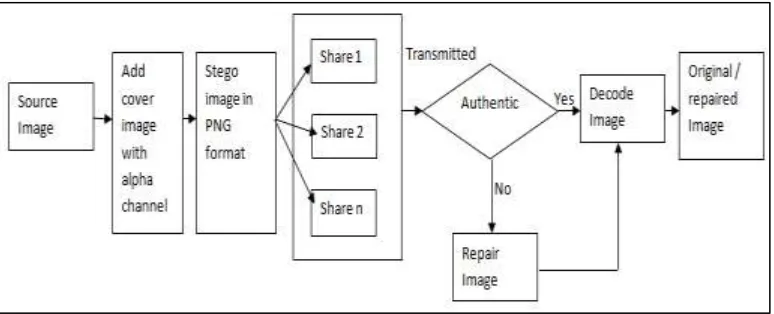
Fig. 1: Framework of proposed document image authentication method
In the proposed system, a PNG image is created from binary type color document image, the image containing the alpha channel plane. First take input image as a color image with another cover image. During embedding process it converted in to grayscale image, for better visual quality. Conventional authentication method causes the destruction in secret image to overcome this problem we proposed secret sharing authentication method for color document images as well as provide the data repairing capacity.
Review of the Shamir Method for Secret Sharing and Secret Recovery Method:
algorithm is applied at receiver end to combine specified shares to retrieve the original images. Number of share created will be same the number of share distributed.
Secret Sharing:
Threshold Secret sharing algorithm is introduced .In secret sharing algorithm, secret data d with n participant and threshold k which is passed as an input, Where k<= n. And getting n shares as output for the n participant. So for that we required the prime number p which is greater than d and k-1 coefficient i.e. c1, c2... ck-1 and n real values i.e. x1, x2...xn. So shares are generated using the following formula.
Algorithm 1: Secret Generation
1) Step1: Choose prime number p randomly, which is greater than d
2) Step2: Choose integer value c1, c2, c3,…, ck-1; which is in the range of 0 to p-1 3) Step3: Choose n different real values i.e. x1, x2, x3,…,xn
4) Step4: Calculate partial shares using formula F (xi) = (d+c1xi+c2xi2 +…+ck-1 xik-1) mod p (a)
5) Step5: [xi, F(xi)] which is taken as a shares for i=1,2,3,…,n. Secret Recovery:
Secret recovery algorithm which is used for recover the secret at the time of authentication and data repairing. So input to the secret recover algorithm is k shares which is collected from the secret sharing algorithm with prime number p and threshold k. And output as secret data d which is present in the shares and coefficient. So for extracting d from shares, use the following formula.
Algorithm 2: Secret Recovery
1) Step1: Take input as k shares i.e. [x1, F(x1)], [x2, F(x2)], [x3, F(x3)]…, [xk, F(xk)] 2) Step2: Calculate the value of d using the formula
d = (-1) k-1 [F(x1) * x2x3…xk / (x1-x2) (x1-x3)… (x1 - xk)+ F (x2) * x1x3…xk / (x2-x1) (x2-x3)… (x2 - xk)+…+ F (xk) * x1x2…xk-1 / (xk-x1) (xk-x2)…... (xk - xk-1)] modp (b)
3) Step3: Find the coefficient c1 to ck-1 from equation (a) of algorithm 1
IV. AUTHENTICATION AND REPAIRING OF IMAGE
In the proposed method, input image as a color image with another any cover color image which is embedded in to original image. Using cover image with extra alpha channel plane, promoting the security protection and data repair capabilities. In contrast, conventional image authentication methods often sacrifice part of image contents, such as least significant bits (LSBs) or flappable pixels, to accommodate data used for authentication. In the proposed method yields a stego-image in the PNG format, which, in normal cases, will not be further compressed, reducing the possibility of erroneous authentication caused by imposing undesired compression operations on the stego-image.
Fig. 2: Illustration of creation of a PNG image from a color image and an additional alpha channel plane.
Proposed system mainly divides into two phases: Encoding phase
Decoding phase
Encoding Phase:
Fig. 3: Illustration of creating a stego image from a color image and an alpha channel.
1) Step 1: Formation of shares of input image-After selecting input color image, proposed method split image in n number of parts which is requiring for high security by using Shamir algorithm. These shares can be distributed with different participants. 2) Step 2: Pick another cover image-Before creating PNG image, for provide more security and formation of embedded image,
get another cover image which is first converted in to grayscale for embedding, using rgb2gray function from image processing tools.
3) Step 3: Image Normalization- For save these shares as PNG, resize the cover image to match with input image. Then find minimum value to remove any negative values, after that add absolute value to get cover image. Now find the max value of cover image, then divide cover image with max value of image to get normalized image. This normalized image used as alpha channel plane and alpha channel need values between 0 and 1. In this way shares saves as PNG image.
4) Step 4: Embedding- This step is for embedding the generated shares of all the three images to form a stego image, by using alpha channel plane. After formation of embedded image, sender can distribute the shares with different users using different media like emails, hard drive, and soft drive etc. also sender can pass the information of shares to receiver for share collection.
Decoding Phase:
In this phase receiver side receive stego image and check stego image authentication, including both verification and self-repairing of the original image content. It is reverse procedure of embedding phase.
Fig. 4: Authentication process for color document image in PNG format
Authentication and Verification of Images:
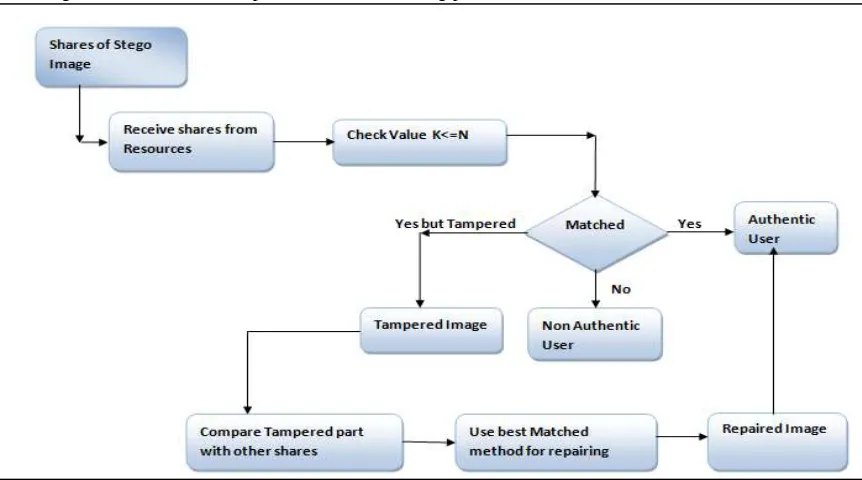
using reverse Shamir scheme and can decode the original image. If receiver get all the sufficient ’ K’ parts from ‘n’ parts which are shared with ‘n’ participants then that image will be authentic image. And if, receiver collect improper shares then that image will be found unauthentic.
Repairing of the initial original image part:
It is often seen that any image can be easily tampered by using various techniques and is very difficult to identify and recovery of such tampered image without loss. In proposed method, we have used double security mechanism to avoid tampering of image. If any user tries to damage image then firstly alpha channel get damage and rest of two images remain untouched. If anyone removes alpha channel and tries to damage cover image then also original image remain untouched as only alpha and cover image gets damaged. Apart from this, if someone tries to damage shares which were shared with different users, damage image can be identified by applying reverse secret sharing method. If particular block of image is marked as tampered then taking parts from all the 3 images, and then comparing them to get the best part which matches the most.
V. EXPERIMENTAL PROCESSAND RESULTS
Share Generate Process and Formation of Embedded Image
Original image and generated shares of image are shown below in following figures. Here, for test 1 original secret image as color document certificate having size”638 * 891”and the image shares are create as ‘n=6’ with’ k=5’.For test 2, original image with size “1125*696” and the image shares create as ‘n=9’ with ‘k=6 by using above secret sharing algorithm.
Fig. 4(a): Fig. 5(a): Fig. 4(b): Fig. 5(b):
Also the formation of embedded image by combining shares of above secret image with another cover image and alpha channel plane are as follows. Sender can distribute the shares with different participant using different media like emails, hard drive, soft drive etc.
Fig. 4(c): Fig. 5(c): Fig. 4(d): Fig. 5(d):
Share Reconstruction Process and Authentication Results:
After generating the shares we run the file having reconstruction algorithm. In proposed method there are two conditions to check the authenticity of images for recovery of image at receiver end,
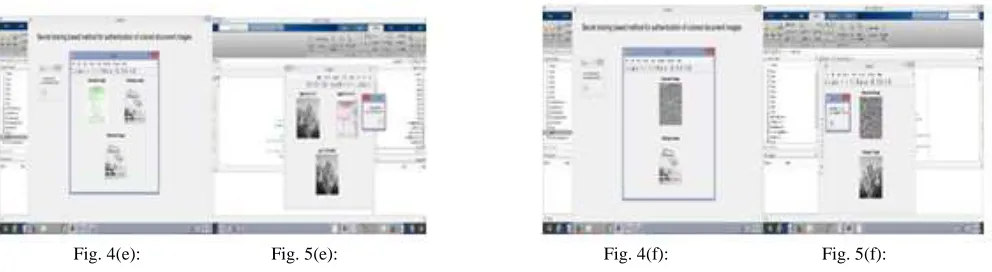
Authorized User: - If receiver can collect proper determined number of shares then only he/she may get secret image. Here in test 1 receiver get k=5 shares as input and reconstructed the secret image with destego image. And for test 2 receiver get k=6 proper shares so recreate original image. Here, in both examples, get authorized users.
Fig. 4(e): Fig. 5(e): Fig. 4(f): Fig. 5(f):
Repairing of Tampered Image Part
If any user/attacker tries to damage shares of image which was shared with different people, then damage image can be repaired as shown in below figure. For test 1damaged one share using paint with GIMP software. And get repaired destego image .For test 2 damage 2 shares then also get repaired image with no data loss. Dictation of damaged part also shown.
Fig. 4(g): Fig. 5(g): Fig. 4(h): Fig. 5(h):
Fig. 4: Test 1 & Fig 5 Test 2 :- 4(a) , 5(a) - Original (Secret) Image ; 4(b),5(b)-Generation of secret image shares;4(c),5(c) - Creation of shares with extra cover image and alpha channel plane;4(d),5(d) - Formation of Embedded image;4(e),5(e) -
Decoded secret image with authorizeduser;4(f),5(f) - Decoded image with non-authorized user;4(g),5(g) - Tampered shares;4(h),5(h) - Original image and Destego Image with tampering detection and repairing image
As in proposed method, to save secret image, we are adding cover image with alpha plane for more protection so that attacker can only damaged the cover image shares. Hence receiver get damaged destego image but with repaired image and original image as it is as shown in above fig4 (h) and 5(h).
Table - 1
Statistics of Experimental Result of Documents Type Images
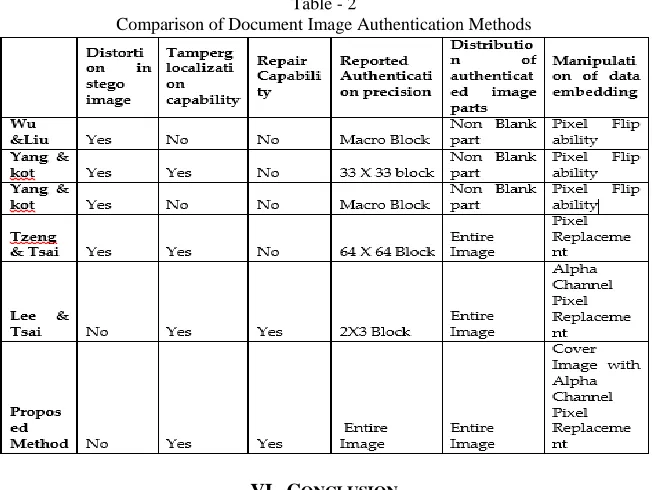
Comparative Result Analysis with Others Works:
Table - 2
Comparison of Document Image Authentication Methods
VI. CONCLUSION
Proposed method focused on a very important authentication and security problem basically the document images whose security must be protected. As information security has become a very important issue due to digitized data can be duplicated and tampered easily. Provide authentication using secret sharing technique is one of the robust solutions to avoid of unauthorized copying or tampering digital document image to ensure the integrity of document image and verify the identity of the owner.
In the present work, an effective authentication method for document type color images with self data repair capabilities based on the secret sharing method has been proposed. The shares are created by using Shamir secretsharing based method, is transformed into the process for generating the embedded (stego) image. The alpha channel plane is used to create the stego image in a form of the PNG format. The maximum alpha channel value is used in that proposed system is 255. So the share embedding into an image and forms the stego image. In the image authentication process, if it seen that the data is tampered then self-repairing is done in the content of the tampered block by reverse Shamir scheme. This method enhance the security by embedding the data in the alpha channel plane and encrypting the PNG image and provide the double folded security to document color image. Future studies may be directed to choices of other block sizes and related parameters (prime number, coefficients for secret sharing, number of authentication signal bits, etc.) to improve data repair effects.
REFERENCES
[1] Manjiri Jagnade and Vijay Bagdi,”A Secret sharing based method for athenticarion of colored document images with a self data repair capability,” in International Journal Of Recent Advances in Engineering & Technology (IJRAET), ISSN (Online): 2347 -2812.2016.
[2] Vijay Bagdi and S.L Sahu,” A Review on Secure SMS Transmission and authentication at User end,” IJRITCC,vol 3 ,issue 2, feb.2015.
[3] Paweł Korus and JarosławBiałas, and Andrzej Dziech,“Towards Practical Self-Embedding for JPEG-Compressed Digital Images,” IEEE Trans. On multimedia,vol. 17, no. 2,Feb 2015.
[4] Che-Wei Lee, Wen-Hsiang Tsai ,”A Secret-Sharing-Based Method for Authentication of Grayscale Document Images via the Use of the PNG Image With a Data Repair Capability”, IEEE TRANSACTIONS ON IMAGE PROCESSING, VOL. 21, NO. 1, JANUARY 2012.
[5] Y. Lee, H. Kim, and Y. Park, “A new data hiding scheme for binary image authentication with small image distortion,” Information Sci., vol. 179, no. 22, pp. 3866–3884, Nov. 2009.
[6] Y. Lee, J. Hur, H. Kim, Y. Park and H. Yoon, “A new binary image authentication scheme with smalldistortion and low false negative rates,”IEICE Trans. on Communications, vol. E90-B, no. 11, Nov. 2007.
[7] H. Yang and A. C. Kot, “Pattern-based data hiding for binary images authentication by connectivity-preserving,”IEEE Tran on Multimedia, vol. 9, no. 3, pp. 475–486, April 2007.
[8] H. Yang and A. C. Kot, “Binary image authentication with tampering localization by embeddingcryptographic signature and block identifier,” IEEE Signal Processing Letters, vol. 13, no. 12, pp. 741–744, Dec. 2006.
[9] Z. M. Lu, D. G. Xu and S. H. Sun, “Multipurpose image watermarking algorithm based on multistage vector quantization” IEEE Trans. on Image Proc., vol. 14, pp. 822–831, June 2005.
[10] Z.M. Lu, D. G. Xu,and S. H. Sun, “Multipurpose image watermarking algorithm based onmultistage vector quantization,” IEEE Trans. Image Process., vol. 14, no. 6, pp. 822–831, Jun2005.
[11] H. Y. Kim and A. Afif, “Secure authentication watermarking for halftone and binary images,” Int’l Journal of Imaging Systems and Technology, vol. 14, no. 4, pp. 147–152, 2004.
[12] M. Wu and B. Liu, “Data hiding in binary images for authentication and annotation,” IEEE Trans.on Multimedia, vol. 6, no. 4, pp. 528–538, Aug. 2004. [13] C. C. Lin and W. H. Tsai, “Secret image sharing with stegnography and authentication,” Journal of Systems & Software, vol. 73, pp. 405–414, 2004. [14] M. U. Celik, G. Sharma, E. Saber and A. M. Tekalp, “Hierarchical watermarking for secure image authentication with localization,” IEEE Trans.on Image