ISSN (e): 2250-3021, ISSN (p): 2278-8719
Vol. 09, Issue 1 (January. 2019), ||V (I) || PP 20-26
Optimal Power Flow Solution Using Crow Search Algorithm
1
Sreekakulam Naresh,
2Prof. M. Damodar Reddy and
3Y V Krishna Reddy
1Sri Venkateswara University, Dept. Of EEE, Tirupati, India 2, 3 Sri Venkateswara University, Dept. Of EEE, Tirupati, India
Corresponding Author: Sreekakulam Naresh
Abstract:
-
This paper describes Crow Search Algorithm (CSA), inspired by the intelligent behaviour of crows to solve Optimal Power Flow (OPF) problem. CSA is a population-based method; works on behaviour of crows how to retrieve their reserve food in secrete places when the food is needed. OPF is the most familiar problem in power system optimization. The OPF problem formulation includes various constraints like generator, active power; reactive power limits and also valve point loading. The proposed method developed on the IEEE 14-bus, 30-bus and 26-bus power systems for optimize the cost of generation, emission and active power loss in single objective optimization space. The optimal results are compared to those informed in the literature. The results prove that the CSA has faster convergence and lesser cost as compared with other OPF solution methods.Keywords: -
Crow Search Algorithm, Optimal Power Flow, Emission, Active power loss, Valve-point loading. --- --- Date of Submission: 18-12-2018 Date of acceptance: 03-01-2019 ------I.
INTRODUCTION
The Optimal Power Flow (OPF) problem was initially introduced in 1960’s (Carpentier 1962). With the help of OPF to find the optimal settings of power system network that optimizes the system objective functions such as total generation cost, system power loss, emission of generating units while satisfying its power flow equations, and operating limits of equipment. Many conventional methods used for solving OPF problem but these methods have limitation for local optima and facing difficulty regarding inequality constraint. To overcome these difficulties some heuristics approaches has been proposed. Evolutionary Programming (EP) [3], Genetic Algorithm (GA) [4, 5], Artificial Bee Colony (ABC) [6], and Particle Swarm Optimization (PSO) [7, 8] and some hybrid methods are MSG-HS [16], SFLA-SA [17] used to obtain solution of OPF problem.
The coding and operators of those algorithms have been modified to apply in various engineering problems [11]. Modified PSO (MPSO) [12] has been obtained by changing the set-on boundary strategies and velocity reflection, and in case of Modified DE (MDE) [13] random uniform distribution used. By including DE and PSO operators obtaining Moth Swarm Algorithm (MSA) [14] these are find the solutions for OPF problem. The final objective of this paper is to optimize the objective functions are cost of generation, transmission losses and emission by approaching the Newton Raphson based Crow Search Algorithm (CSA) [18] is applied to IEEE 14,-bus, 30-bus, and 26-bus test systems. The proposed method optimal solutions are compared with recently methods results which are mention in literature. As a result, CSA Provides better results than those in the literature.
II.
OPTIMAL
POWER
FLOW
In this paper, the objective functions of OPF problem is minimization of generation cost, minimization of losses and minimization of emission to the generator units meeting inequality and equality constraints. The general form of OPF problem as follows:
Minimize:f (x, u) (1)
Subject to:g(x, u)0 (2)
h(x, u)0 (3) Where f(x,u):objective function, g(x,u): equality constraint, h(x,u): inequality constraint.
2.1 State Variables
In order to obtain the state of the power system, set of state variables are represented in Eqn. (4).
T
L1 LNG G1 G1 GNG L1 LNG
L G1 G L
V : Load bus voltage, P : slack bus active power, Q : generator active powers,S : transmission line loading
2.2 Control Variables
In order to control the power flow, the set of parameters are represented as decision vector represented in Eqn. (5).
T
G1 GNG G 2 GNG 1 NT
u [V ...V , P ...P , T ...T ] (5)
G G
V : generator voltages, P : generator real power outputs except slack bus T : transformers tap settings
2.3. Constraints
To minimize the objective function the OPF problem need to satisfy both equality and inequality constraints. The equality constraint treated as power balance constraints. The inequality constraints considered as operating limits of power system components.
2.3.1. Equality constraints
The equality constraints for the OPF problem are, balances of the active and reactive power represented in Eqn. (6) and Eqn. (7).
1
[ ( ) ( )] 0
Nb Gi Di i j ij ij ij ij j
P P V V G cos
B sin
(6)1
[ ( ) ( )] 0
Nb Gi Di i j ij ij ij ij
j
Q Q V V G cos
B sin
(7)2.3.2 Inequality Constraints:
The Inequality constraints for OPF problem are considered to restrict the conditions of operation for getting a better optimal condition:
Generator limits:
min max
i i i
V V V (8)
min max
Gi Gi Gi
P
P
P
Where i = 1, 2... Ng. (9)Voltages at loading buses:
min max
j j j
V V V Where j = 1, 2… npq; (10)
In order to obtain the optimal solution while satisfying the above constraints performing load flow with help of Newton Raphson method and optimal power flow can obtained by CSA optimization technique.
III.
CROW
SEARCH
ALGORITHM
Crow Search Algorithm (CSA) is a population-based technique, which works on behaviour of crows how to retrieve their stored excess food in hiding places when the food is needed.
Implementation of CSA for optimization
Step 1: Initialize of parameters
The optimization problem, decision variables and constraints are defined. Then, the parameters of CSA are maximum iterations, flock size (n), flight length (fl) and awareness probability (ap) initialized.
Step 2: Initialize position and memory of crows
l
0; u
1;% Lower and upper bounds
x i, j
l
l u *rand;% Position of the crows in the space
(11)Step 3: Evaluate fitness (objective) function
Find the fitness value for the new position of each crow. Step 4: Update to new position
xnew i, j
l
l u *rand
(13)Step 5: Update memory
i,iter 1 i,iter 1 i,iter 1 i,iter
m
x
f (x
) is better than f (m
)
(14)i,iter 1 i,iter
m
m
otherwise
Step 6: Check termination criterion
ffit t
min fit _ mem ;% Best found value until maximum iteration
min fit _ mem ;
(15)
IV.
SIMULATION
RESULTS
The IEEE 14-bus [8], 26-bus and IEEE-30 [14] systems are used to test the effectiveness of the proposed method for solving OPF problem. Various case studies are examined, which are précised in Table 1. All simulation results are obtained by MATLAB programs in MATLAB.
Table 1: Various case studies investigated in this paper.
Test case Objective function Test system
case 1 Convex fuel cost IEEE 14-BUS, 26-BUS, IEEE 30-BUS case 2 Non-convex fuel cost IEEE 14-BUS, IEEE 30-BUS case 3 Power loss IEEE 14-BUS, 26-BUS, IEEE 30-BUS case 4 Piecewise quadratic fuel cost IEEE 30-BUS case 5 Emission IEEE 30-BUS
4.1 CASE 1: Convex fuel cost
Minimization of cost for the convex fuel cost function to the test systems consider as case 1. In order to minimize the fuel cost consider as quadratic fuel cost function as objective function as follows:
2
k Gk k Gk k Gk k
F (P )a P b P c (16)
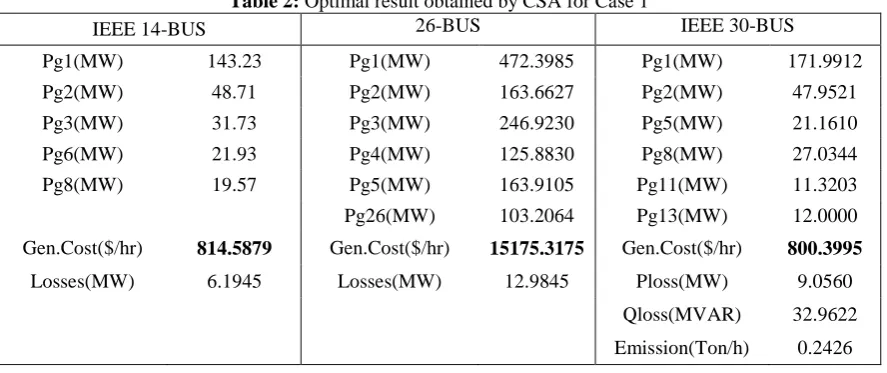
The CSA algorithm examined on IEEE 14-BUS [8], 26-BUS [5] and IEEE 30-BUS [14] test systems has active power demand 259MW, 1263 MW and 283.4 MW respectively. The simulation results obtained by proposed method are presented in Table 2 for three test systems.
Table 2: Optimal result obtained by CSA for Case 1
For IEEE-14 bus test system proposed method provide optimal cost 814.5879 ($/h) and transmission losses are 6.1945 MW. Similarly for 26-bus test system CSA provide optimal cost 15175.3175 ($/h) less as compare with GA [5], GA-FUZZY [5] and GSA [5] methods optimal costs as 15434.67 ($/h), 15431.69 ($/h) and 15467.45 ($/h) respectively. The optimal cost for IEEE-30 system is 800.3995 ($/h) for load demand of 283.4 MW. The proposed method provide less cost as compared with FPA [14], MPSO [14] and MSA [14] methods. The comparative results for test systems are presented in Table 3.
IEEE 14-BUS 26-BUS IEEE 30-BUS
Pg1(MW) 143.23 Pg1(MW) 472.3985 Pg1(MW) 171.9912 Pg2(MW) 48.71 Pg2(MW) 163.6627 Pg2(MW) 47.9521 Pg3(MW) 31.73 Pg3(MW) 246.9230 Pg5(MW) 21.1610 Pg6(MW) 21.93 Pg4(MW) 125.8830 Pg8(MW) 27.0344 Pg8(MW) 19.57 Pg5(MW) 163.9105 Pg11(MW) 11.3203 Pg26(MW) 103.2064 Pg13(MW) 12.0000 Gen.Cost($/hr) 814.5879 Gen.Cost($/hr) 15175.3175 Gen.Cost($/hr) 800.3995
Table 3: Comparative results for Case 1 test systems
4.2 CASE 2: Non-convex fuel cost
In order to make the OPF problem as complex including the valve-point effect in generator fuel cost function. The fuel cost functions with inclusion of valve-point effect as follows:
NG
2 min
C G k Gk k Gk k ck ck Gk Gk
k 1
F F (P ) (a P b P c ) e sin(f (P P )) ($ / h)
(17)For the above problem the proposed method examined on IEEE-14 bus [8] and IEEE-30 bus [14] test system has load of demand 259 MW and 283.4 MW. The simulation results of fitness function, active powers of generating units and power losses of the test systems are presented in Table 4.
Table 4: Optimal result obtained by CSA for Case 2
From the Table 4 observe that, due to the valve-point effect operating cost increases for both the test systems. The simulation results of the proposed method are comparing with recently published methods and presented in Table 5. It can be conclude that CSA method provide optimal as compare with other methods.
Table 5: Comparative results for Case 2 test systems
4.3 CASE 3: Minimization of Power loss
The objective function for the case 3 is minimization of power loss for non-convex function represented in Eqn. (21).
nl nl
2 2
ij i j i j i j
i 1 j i
f G V V 2V V cos( ) (MW)
(18)The proposed method examined on IEEE 14-BUS [8], 26-BUS [5] and IEEE 30-BUS [14] test systems power loss minimization as objective function. The simulation results obtained by proposed method are
26-BUS IEEE 30-BUS
Method Fuel Cost ($/h) Method Fuel Cost ($/h)
GA [5] 15434.67 FPA [14] 802.7983
GA-FUZZY [5] 15431.69 MPSO [14] 800.5164
GSA [5] 15467.45 MSA [14] 800.5099
CSA 15175.3175 CSA 800.3995
IEEE 14-BUS IEEE 30-BUS
Pg1(MW) 144.40 Pg1(MW) 134.9079
Pg2(MW) 48.18 Pg2(MW) 79.9999
Pg3(MW) 31.46 Pg5(MW) 25.1494
Pg6(MW) 21.76 Pg8(MW) 10.0000
Pg8(MW) 19.44 Pg11(MW) 21.6337
Pg13(MW) 19.3919
Gen.Cost($/hr) 814.59928 Gen.Cost($/hr) 922.1680
Losses(MW) 6.2530 Ploss(MW) 7.6830
Qloss(MVAR) 38.2009 Emission(Ton/h) 0.1910
IEEE 14-BUS IEEE 30-BUS
Method Fuel Cost ($/h) Method Fuel Cost ($/h)
GA [8] 926.55 FPA [14] 931.7458
PSO [8] 833.57 MPSO [14] 952.3039
MSA [14] 930.7441
presented in Table 6, it can be conclude that the operating cost increases when power loss minimization considered as objective function.
Table 6: Optimal result obtained by CSA for Case 3
4.4 CASE 4: Piecewise quadratic fuel cost
The objective function for the case 4 is minimization of piecewise fuel cost for convex function as follows:
min
Gk Gk Gk1
Gk1 Gk Gk 2 C Gk
max Gk (n 1) Gk Gk 2
P P P
k1 Gk k1 Gk k1
2
P P P
k2 Gk k2 Gk k2
F F (P )
2 P P P
kn Gk kn Gk kn
a P b P c
a P b P c
.
..a P b P c
(19)
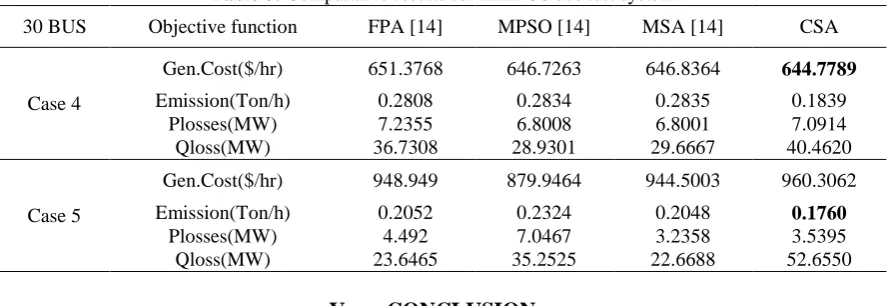
The objective function examined on IEEE 30-bus [14] test system, simulation results presented in Table 7 and comparison results are presented in Table 8. From the results conclude that CSA method provide better results as compare with remaining methods.
Table 7: Optimal results provided by CSA method for Case 4 and Case 5 IEEE 30-Bus
Case 4 Case 5
Pg1(MW) 139.9999 55.8821
Pg2(MW) 54.9999 77.0059
Pg5(MW) 23.6403 49.9800
Pg8(MW) 34.9999 34.7040
Pg11(MW) 17.5955 29.9722
Pg13(MW) 19.2555 39.3950
Gen.Cost($/hr) 644.7789 960.3062
Emission(Ton/h) 0.1839 0.1760
Ploss(MW) 7.0914 3.5395
Qloss(MW) 40.4620 52.6550
4.5 CASE 5: Minimization of Emission
The objective function for the case 5 is minimization of emission for non-convex function represented in Eqn. (20).
NG 2
G k Gk k Gk k ck Gk k
k 1
F E(P ) ( P P ) exp(P ) (ton / h)
(20)The objective function examined on IEEE 30-bus [14] test system, simulation results presented in Table 7 and comparison results are presented in Table 8. From the results conclude that CSA method provide better results as compare with remaining methods.
IEEE 14-BUS 26-BUS IEEE 30-BUS
Pg1(MW) 72.654 Pg1(MW) 313.951 Pg1(MW) 54.1445
Pg2(MW) 77.574 Pg2(MW) 197.607 Pg2(MW) 77.7851
Pg3(MW) 48.786 Pg3(MW) 297.559 Pg5(MW) 49.9918
Pg6(MW) 33.975 Pg4(MW) 149.578 Pg8(MW) 34.9999
Pg8(MW) 29.361 Pg5(MW) 198.075 Pg11(MW) 29.9920 Pg26(MW) 119.221 Pg13(MW) 39.9999 Gen.Cost($/hr) 1143.4055 Gen.Cost($/hr) 15266.2208 Gen.Cost($/hr) 965.8423
Table 8: Comparative results for IEEE-30 bus test system
30 BUS Objective function FPA [14] MPSO [14] MSA [14] CSA
Case 4
Gen.Cost($/hr) 651.3768 646.7263 646.8364 644.7789 Emission(Ton/h) 0.2808 0.2834 0.2835 0.1839
Plosses(MW) 7.2355 6.8008 6.8001 7.0914 Qloss(MW) 36.7308 28.9301 29.6667 40.4620
Case 5
Gen.Cost($/hr) 948.949 879.9464 944.5003 960.3062 Emission(Ton/h) 0.2052 0.2324 0.2048 0.1760
Plosses(MW) 4.492 7.0467 3.2358 3.5395
Qloss(MW) 23.6465 35.2525 22.6688 52.6550
V.
CONCLUSION
This paper has presented a Crow Search Algorithm (CSA) and applied to solve OPF problem for different objective functions in IEEE 14- bus, 26-bus and IEEE-30 bus test power systems. The Crow Search algorithm has shown effective results in terms of convergence, consistency in different runs and lesser generation cost as compared to other techniques. These advantages are obtained by the intelligent behaviour of crows during food hunting process. In order to demonstrate the potential of this method, tested on IEEE 30 bus system for non-convex cost function, piecewise cost function also. The obtained optimal results are compared with EP based OPF with greater satisfaction.
REFERENCES
[1]. Harprit kaur and Y.S Brar, “Optimal Power Flow Using Power World Simulator” 2010 IEEE Electrical Power & Energy Conference
[2]. Xiaojiao Tong and Mugang Lin, “Semismooth Newton-Type Algorithms for Solving Optimal Power Flow Problems” 2005 IEEE/PES Transmission and Distribution Conference & Exhibition: Asia and Pacific Dalian, China
[3]. L L Lai and J T M a, “Power Flow Control In Facts Using Evolutionary Programming”, 0-7803-2759-4/95/$4.00 01995 IEEE
[4]. R.Narmatha Banu and D.Devaraj, “Optimal Power Flow for Steady state security enhancement using Genetic Algorithm with FACTS devices”, 2008 IEEE Region 10 Colloquium and the Third ICIIS, Kharagpur, INDIA December 8-10
[5]. Ashish Saini, Devendra K. Chaturvedi, “Optimal Power Flow Solution: a GA-Fuzzy System Approach”, International Journal of Emerging Electric Power Systems, Volume 5, Issue 2, 2006.
[6]. Fahad S. Abu-Mouti and Mohamed E. El-Hawary, “Overview of Artificial Bee Colony (ABC) Algorithm and Its Applications”, 978-1-4673-0750-5/12/$31.00 ©2012 IEEE
[7]. Hamzeh Hajian-Hoseinabadi, Seyed Hamid Hosseini and Mehdi Hajian, “Optimal Power Flow Solution by a Modified Particle Swarm Optimization Algorithm”.
[8]. Belgin Emre TURKAY and Rengin Idil CABADAG, “Optimal Power Flow Solution Using Particle Swarm
Optimization Algorithm”, EuroCon 2013 • 1-4 July 2013 • Zagreb, Croatia
[9]. Rengin Idil CABADAG, Belgin Emre TURKAY, “Heuristic Methods To Solve Optimal Power Flow Problem”, R. I. CABADAG and B. E. TURKAY / IU-JEEE Vol. 13(2), (2013), 1653-1659 [10]. Leonard L.Grigsby “Power system stability and control”, 3 rd edition, CRC press, Taylor and francis
group.
[11]. Ilhem Bouss, Julien Lepagnot and Patrick Siarry, “A survey on optimization metaheuristics”, Information Sciences (2013), doi: Doi.org/10.1016/j.ins.2013.02.041
[12]. Amin Karami a,n, Manel Guerrero-Zapata “A fuzzy anomaly detection system based on hybrid PSO-Kmeans
algorithm in content-centric networks”, Neurocomputing
[13]. Leandro dos Santos Coelho, Viviana Cocco Mariani “Solution of Jiles–Atherton vector hysteresis
parameters estimation
by modified Differential Evolution approaches”, Expert Systems with Applications 39 (2012) 2021– 2025.
[15]. Tahir Nadeem Malik, Azzam ul Asar, “A new hybrid approach for the solution of nonconvex economic dispatch problem with valve-point effects”, Electric Power Systems Research 80 (2010) 1128–1136 [16]. Celal Yasar, Serdar Özyön, “A new hybrid approach for nonconvex economic dispatch problem with
valve-point effect” Energy 36 (2011) 5838e5845.
[17]. Taher Niknam, Mohammad Rasoul Narimani, “A new hybrid algorithm for optimal power flow considering prohibited zones and valve point effect”, Energy Conversion and Management 58 (2012) 197–206.
[18]. Alireza Askarzadeh “A novel metaheuristic method for solving constrained engineering optimization problems: Crow search algorithm”, Computers and Structures 169 (2016) 1–12.