Available online throug
ISSN 2229 – 5046
VARIATION OF FLOW RATE IN CASE OF MHD FLOW
OVER A MOVING INFINITE VERTICAL POROUS PLATE
IN THE PRESENCE OF THERMAL RADIATION AND UNIFORM HEAT FLUX
1
K. JHANSI RANI*,
2CH. V. RAMANA MURTHY
1
Research Scholar, Rayalaseema University, Kurnool, India.
2
Vasavi Institute of Engineering and Technology, Nandamuru – 521369, India.
(Received On: 08-02-17; Revised & Accepted On: 10-03-17)
ABSTRACT
T
he case of variation of flow rate with respect to various flow entities in situation of MHD flow over a moving infinite vertical porous plate in the presence of thermal radiation has been examined in detail in this paper. It is observed that, as the pore size decreases the flow rate is found to be decreasing. In each of these illustrations, it is seen that the applied transverse magnetic field influences the flow rate significantly. Further, as the magnetic intensity increases the flow rate is found to be inversely proportional. Also, increase in the intensity of the magnetic field contributes to the decrease in flow rate. For a constant pore size of the bounding surface and the frequency of excitation, increase in the magnetic intensity amounts to the decrease in the flow rate. Also, a back flow is observed in certain cases and is illustrated graphically. Further, decrease in Grashoff number (Gr) contributes to the increase in the flow rate.Keywords: MHD flow, Heat and Mass transfer, Heat flux, impulsively started vertical plate, Radiation.
NOMENCLATURE
P
C
: Specific heat at constant pressureg
: Acceleration due to gravityr
G
: Thermal Grashoff numberκ
: Thermal conductivity of the fluidr
P
: Prandtl numberp
: Pressurer
q
: Radiative heat flux in the y-directionk
: Thermal diffusivityK
: PorosityM
: Magnetic fieldN
: Radiation parametert
: TimeT
: Temperature of the fluid near the plateW
T
: Temperature of the plate∞
T
: Temperature of the fluid far away from the plateu
: Velocity of the fluid in the x-direction0
u
: Velocity of the fluid plateU
: Dimensionless velocityy
: Coordinate axis normal to the platey
′
: Dimensionless coordinate axis normal to the plate*
k
: Mean absorption coefficientα
: Thermal diffusivityµ
: Coefficient of viscosityν
: Kinematic viscosityρ
: Densityσ
: Stefan-Boltzmann constantτ
: Dimensionless skin-frictionθ
: Dimensionless temperatureINTRODUCTION
Generally in industrial situations like nuclear power plants, gas turbines and propulsion devises for air craft, missiles and space vehicles are some situations where in radiative convective heat transfer occurs more often. The applications wide in general and are found mostly in cooling chambers, fossil fuel combustion, energy processes, astrophysical flows, solar power technology and space vehicle re-entry. Mostly, radiative heat transfer is found to have an important role in manufacturing sectors for the design of highly precision equipment.
Stokes1 examined the problem of viscous incompressible fluid past an impulsively started infinite horizontal moving plate in its own plane. Thereafter Brinkman2 analyzed the viscous force imparted by flowing fluid. Subsequently, Stewartson3 examined the problem of viscous flow past and impulsively started semi infinite horizontal plate for an analytical solution. The case of two dimensional steady state flow of an incompressible fluid with rigid parallel porous walls was investigated by Berman4. Thereafter, Mori5 examined the flow between two vertical plates which are electrically non - conducting while the wall temperature varies linearly in the direction of the flow. Later, the flow in renal tubules was analyzed by Macy6. Subsequently, Hall7 studied similar problems using finite differences method while Chang8 et al analyzed the effects of radioactive heat transfer on free convection regimes in specialized applications that occur in geophysics and geothermal reservoirs. Later, Mahajan9 et al examined the influence of viscous heat dissipating effect in natural convective flows. It was established that the heat transfer rates are reduced by an increase in the dissipation parameter. Subsequently, Soundalgekar and Thaker10 examined thermal radiation effects of an optically thin gray gas bounded by a stationary vertical plate. Later, Das11et al examined higher order numerical approximation for mass transfer effects on the study flow past an accelerated vertical porous plate. Using Rossland’s approximation Hossain12et al studied the radiation effects on a mixed convective flow along a vertical plate with a uniform surface temperature. Raptis and Perdikis13 studied the effect of thermal radiation and convective flow past a moving infinite vertical plate. The effects of thermal radiation on the flow past a semi infinite vertical isothermal plate with uniform heat flux was studied exhaustively by Chandrakala and Antony Raj14. Recently, Jhansi Rani and Ramana Murthy15 examined the MHD flow over a moving infinite vertical porous plate in the presence of thermal radiation and studied in detail the factors influencing the velocity and skin friction.
In all above papers the nature of velocity with reference to all critical parameters that appears in the field equations were just analysed. The most important factor i.e flow rate has been totally ignored and was not addressed by any of the investigators. Also, not much of prime importance was given to the bounding surface and factors influencing the flow rate. The flow rate is found to have an important application in several situations where efficient transfer of heat and mass transfer take place. Hence, such an important concept cannot be ignored while studying the situation of thermal radiation. Therefore, in this paper the influence of various critical parameters which appear in the field equations and there effects on the flow rate is examined. Such an analysis provides the knowledge of the transfer of fluid from one reaction chamber to another chamber and the amount of fluid that adheres to the walls of the container.
MATHEMATICAL FORMULATION
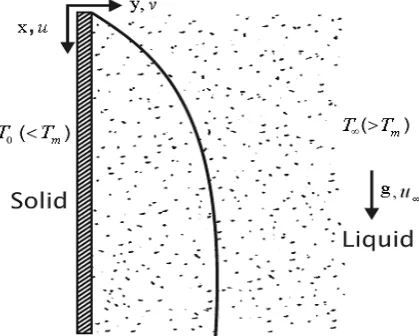
The geometry of the bounding surface and fluid motion is as given below. As usual the x- axis is taken along the plate in the vertical direction and y – axis is taken normal to the plate. The fluid is assumed to be incompressible, laminar, viscous radiating fluid past an impulsively started infinite vertical plate
Figure – 1: Schematic representation of the problem
When
t
≤
0
the plate and fluid are maintained at same temperature and in stationary condition. Whent
>0 the plate is given an impulsive motion in the vertical direction and in opposite to the gravitational field with constant velocity u0.During such a time the plate is heated through which the fluid temperature also rises at uniform rate. The fluid is considered to be absorbing, emitting radiation. Using Boussinesq’s approximation we have
(
)
22y
u
T
T
g
t
u
∂
∂
+
−
=
′
∂
∂
∞ν
β
(1)y
q
y
T
k
t
T
C
r p∂
∂
−
∂
∂
=
′
∂
∂
2 2ρ
(2)In view of Rossland approximation
q
r is given by:y
T
k
q
r∂
∂
−
=
* 43
4
σ
(3)
While, the initial and boundary conditions are:
0 :
0,
When t
′ ≤
u
=
T
=
T
∞ for ally
′
0
0 :
,
T
q
and if t
u
u
y
k
∂
′ >
=
= −
∂
aty
′
=
0
(4)0,
Also u
=
T
→
T
∞ asy
′
→
∞
Assuming that the temperature differences within the flow are negligible than T4 can be expressed as a linear function of the temperature. By neglecting higher order terms T4 in Taylor’s series about
T
∞can be expressed as
T
4≅
4
T
∞3T
−
3
T
∞4 (5)By using equations (4) and (5), equation (2) reduces to
2 2 * 3 2 2
3
16
y
T
k
T
y
T
k
t
T
C
p∂
∂
+
∂
∂
=
′
∂
∂
σ
∞ρ
(6)So as to make the Governing equations, initial and boundary conditions we introduce the following non – dimensional terms as 3 * 3 0
4
,
Pr
,
)
(
∞=
=
∞
−
=
T
k
N
k
C
u
T
T
g
Gr
w pσ
κ
µ
βν
(7) 2 0 0 0,
,
,
,
wt u
y u
T
T
u
U
t
y
u
ν
ν
θ
T
T
∞
∞
′
′
−
=
=
=
=
By considering the magnetic intensity as
M
and the permeability of the boundary asK
Eqs. (1) to (6), can be re defined as:u
K
M
y
U
Gr
t
U
)
1
(
2 2+
+
∂
∂
+
=
∂
∂
θ
(8) 2 2Pr)
3
(
Pr
3
y
N
t
N
∂
∂
+
=
∂
∂
θ
θ
(9)
The initial and boundary conditions in non-dimensionless form are
,
0
,
0
=
=
θ
u
For ally
,
t
≤
0
1
,
1
:
0
=
−
∂
∂
=
>
y
u
t
θ
aty
=
0
(10),
0
,
0
→
=
θ
u
Asy
→
∞
METHODOLOGY FOR SOLUTION
Assuming the solutions for Eqn (8) and Eqn (9) as:
t i
e
y
u
t
x
u
(
,
)
=
0(
)
ω (11)t i
e
y
t
y
θ
ωθ
(
,
)
=
0(
)
(12)The modified initial and boundary conditions will be as follows:
0
0
=
u
,θ
0=
0
, for ally
,
t
≤
0
t i t i
e
dy
d
e
u
t
>
=
−ωθ
0=
−ω0
,
:
0
aty
=
0
(13)0
,
0
00
=
θ
→
u
asy
→
∞
Using Eqns (11), (12) and (13) in Eqns (8) and (9)
)
exp(
))
exp(
)
(exp(
1
)
,
(
m
2y
m
1y
m
2y
R
Gr
t
y
u
=
−
−
−
+
−
(14)
Flow rate
=
∫
h
dy
t
y
u
Q
0)
,
(
(15)From equation (15)
1 2 2
1 2 2
exp( ) 1 1 exp( ) 1 exp( )
1
m h m h m h
Gr Q
R m m m
− − − − − − = + + Where
))
1
(
(
),
1
(
,
Pr
3
Pr
3
2 1 1 1 2 1K
M
i
m
m
R
K
M
i
m
N
i
N
m
−
−
−
=
−
−
=
+
=
ω
ω
ω
RESULTS AND DISCUSSIONS
2. Figure 4 and Figure 5 shows the influence of applied magnetic field with respect to the porosity and the Prandtl number (Pr). In general it is observed that, as the porosity decreases the flow rate is also found to be decreasing. But such a decrease is observed to be very minimal. In each of these illustrations, the applied transverse magnetic field influences the flow rate quite significantly. Increase in the intensity of the magnetic field decreases the flow rate. For a constant porosity and applied magnetic intensity change in the Prandtl number (Pr) does not influence the flow rate. In all these situations increase in Prandtl number (Pr) contributes to the constant flow rate.
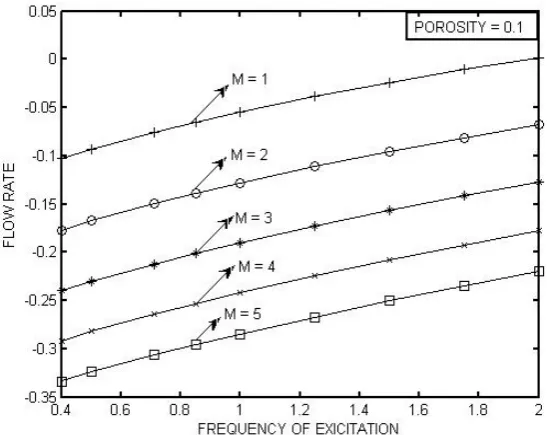
3. When the pore size of the fluid bed is held constant, the effect of the magnetic field with respect to the frequency of excitation has been shown in Figure 6 and Figure 7. In general, it is seen that as the pore size decreases the flow rate is found to be decreasing. It is seen that the magnetic intensity influences the flow rate quite significantly. Also, it is seen that the back flow is observed in the cases exhibited. In a situation where the porosity decreases significantly the flow rate is found to be positive. However, increase in the magnetic intensity does not qualitatively alter in nature of profiles for the flow rate.
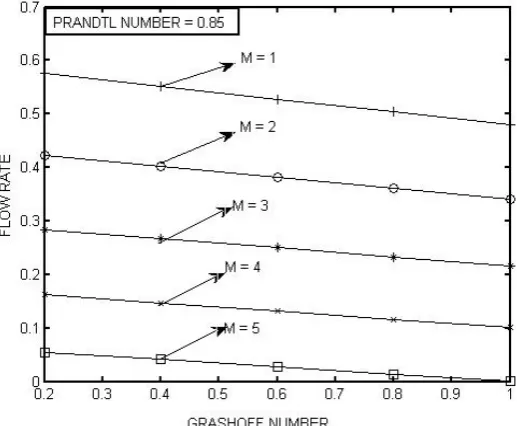
4. The effect of Grashoff number (Gr) with respect to the Prandtl number (Pr) on the flow rate has been illustrated in Figure 8 and Figure 9. It is observed that as the Grashoff number (Gr) decreases the flow rate is observed to be increasing. However, a situation of slight back flow is noticed when the Grashoff number (Gr) is 1.0. The magnetic field suppresses the flow rate significantly. Increase in the Prandtl number (Pr) marginally increases the flow rate.
5. The effect of the Prandtl number (Pr) and the magnetic intensity with respect to the Grashoff number (Gr) has been illustrated in Figure 10. It is noticed that as the magnetic intensity increases the flow rate is inversely proporsional. Further, increase in the Grashoff number (Gr) contributes to the decrease in the flow rate and such a change in the flow rate is observed to be almost negligible.
Figure 2: Influence of Magnetic Field (M) on flow rate
Figure 4: Influence of magnetic field (M) on flow rate
Figure 5: Effect of both magnetic field (M) and prandtl number (Pr) on flow rate
Figure – 7: Combined effect of frequency of excitation and magnetic field on flow rate
Figure – 8: Influence of Grashoff number (Gr) on flow rate
Figure – 10: Effect of Prandtl number (Pr) on flow rate
REFERENCES
1. Stokes. G. G. On the effects of Internal Friction of Fluids on the Motion of Pendulums, Camb.Phil. Trans IX, 2, Pp. 8 - 106. (1851).
2. Brinkman H.C, A calculation of viscous force extended by flowing fluid in a dense swarm of particles.
Appl.sci.Res, A(1) Pp 27-34.(1947).
3. Stewartson. K., On the impulsive Motion of a Flat plate in a Viscous Fluid. Quarterly Jnl. of Mechanics and Applied Mathematics, IV, 2, Pp.182 – 198, (1951).
4. Berman. A. S.Laminer flow in a channel with porous walls.Jnl. Appl.Phys, 24, Pp 1232-1235, (1953).
5. Mori Y, on combined free and forced convective laminar MHD flow and heat transfer in channels with transverse magnetic field, international developments in heat transfer, ASME paper no.124,Pp 1031-1037(1961).
6. Macey R.I., Pressure flow patterns in a cylinder with reabsorbing walls, Bull Math. Bio phys, 25(1), (1963).
7. Hall. M. G .The Boundary Layer over an impulsively Started Flat plate, Proc. Roy. Soc. A. 310, 1502, Pp.401 – 414, (1969).
8. Chang. I. C. Yang. K. T.,Lloyd. J. R., Radiation Natural Convection Interactions in Two Dimensional Complex Enclosures, ASME. Jnl. Heat Transfer, 105, 1, Pp. 89 – 95, (1983).
9. Mahajan. R. L., Gebhart. B. B., Viscous Dissipation Effects in Buoyancy-Induced Flows., Int. Jnl. of Heat Mass Transfer, 32, 7, Pp. 1380 – 1382, (1989).
10. Soundalgekar V. M. and Thaker H.S.: Radiation effects on free convection flow past a semi infinite vertical plate .modeling measurement and control, vol.B51, Pp 31-40, (1993).
11. Das. U. N., Deka. R. K., Soundalgekar. V. M., Effects of Mass Transfer on Flow Past an Impulsively Started Infinite Vertical Plate with Constant Heat Flux and Chemical Reaction, Forschang im Ingenieurwesen, 60, 10, Pp. 284 – 287, (1994).
12. Hossain M. A. and Takhar, Radiation effect on mixed convection along a vertical plate with uniform surface temperature, Heat and Mass Transfer, 31, Pp. 243 – 248, (1996).
13. Raptis. A and Perdikis.C, Radiation and free convection flow past a moving plate, Int. J.App.Mech.Engg, 4, 817-821 (1999).
14. Chandrakala. P and Antony Raj.S, Radiation effects on MHD flow past an implusively started vertical plate with uniform heat flux, Indian Journal of Mathematics, 50(3), 519-532 (2008).
15. Jhansi rani. K and Ramana Murthy. Ch MHD flow over a moving infinite vertical porous plate with uniform heat flux in the presence of thermal radiation, Int.J.Advances in Theoretical and Applied Mathematics,
Vol.6,No.1,51-63 (2011).
Source of support: Nil, Conflict of interest: None Declared.