JPRHC Volume 2 Issue 4
325-329
JPRHC
Research Article
IN VITRO CHARACTERZATIOAN AND EVALUATION OF TRANSDERMAL DRUG DELIVERY SYSTEM FOR METOPROLOL TARTARATE
DR.B.ANILREDDY
For author affiliations, see end of text
This paper is available online at www.jprhc.in
ABSTRACT
Transdermal delivery system bypass the hepatic first pass metabolism and avoid drug degradation due to gastrointestinal pH, enzymes etc., minimize plasma level fluctuations and extend the drug activity besides improving patient compliance. Transdermal films of metoprolol tartarate were prepared using polymers such as ethyl cellulose, poly vinyl alcohol, eudragit RL100, eudragit L100. Di-n-butylphlthalate was used as plasticizer. The study was undertaken to report the film forming properties of polymers used and in vitro drug release from the prepared monolithic matrices. Effect of drug loading on the drug release rate was also studied. The transdermal films were prepared using solvent casting method. These films were evaluated for Thickness, Percent moisture loss, Percent moisture absorption, Drug content, Weight variation and
folding endurance. In-vitro drug release kinetics was studied using Franz-diffusion cell. Drug release followed zero order kinetics. Drug loading at different concentrations found to have less effect on the film forming properties of the constituent polymers. Results have shown enhanced flux per unit time across rat skin. In conclusion combination of ethyl cellulose, poly vinyl alcohol, eudragit RL100, eudragit L100 and Di-n-butylphlthalate can potentially be optimized to develop an effective transdermal drug delivery system for metoprolol tartarate.
Key words: Metoprolol Tartarate, Transdermal Delivery system, Eudragit RL 100, Eudragit L 100.
INTRODUCTION
In recent years, considerable attention has been focused on the development of new drug delivery systems. Transdermal drug delivery system has been in existence for a long time. In past, the most commonly applied systems were topically applied creams and ointments for dermatological disorders. Drugs administered in the form of tablets, capsules, injectables and ointment etc., usually produce wide ranging fluctuation in drug concentrations in the blood stream and tissues and factors such as repetitive dosing and unpredictable absorption send lead to the concept of controlled drug delivery system or therapeutic system.
Transdermal systems provide drug systemically at a predictable rate and maintain the rate for extended periods of time thus eliminating numerous problems associated with oral products such as unpredictable or reduced bioavailability, enhanced first
pass hepatic metabolism, relatively short residence time, dose dumping and dosing inflexibility
Metoprolol tartrate is a beta blocker used in the treatment of hypertension, undergoes hepatic first pass metabolism reductions in low bioavailability 40-50% given by oral route and the low dose (100 -200mg) daily. Hence it is suitable for formulation as a transdermal patch.The present study was undertaken to formulate the matrix type transdermal patches of metoprolol tartarate. The polymers used for the preparation of monolithic matrix were Ethyl Cellulose (EC), Poly Vinyl Alcohol (PVA), Eudragit RL100, Eudragit L100 and Di-n-butylphlthalate used as plasticizer. The investigations intend to report the film forming properties of the selected polymers and also to study in-vitro drug release from the prepared transdermal
patches across the freshly excised rat skin.
MATERIALS AND METHODS
Metoprolol tartarate was obtained as the gift sample from the Madras Pharmaceuticals Ltd, Chennai. Ethyl Cellulose,
JPRHC Volume 2 Issue 4
325-329
vendors. Apart from these all other chemicals used were analytical grade reagents.
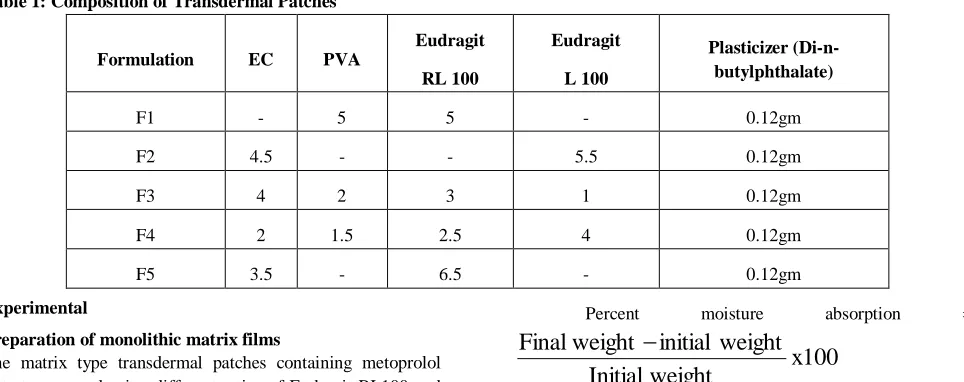
Table 1: Composition of Transdermal Patches
Formulation EC PVA
Eudragit
RL 100
Eudragit
L 100
Plasticizer (Di-n- butylphthalate)
F1 - 5 5 - 0.12gm
F2 4.5 - - 5.5 0.12gm
F3 4 2 3 1 0.12gm
F4 2 1.5 2.5 4 0.12gm
F5 3.5 - 6.5 - 0.12gm
Experimental
Preparation of monolithic matrix films
The matrix type transdermal patches containing metoprolol tartrate prepared using different ratios of Eudragit RL100 and Eduragit L100. The polymers in different ratios were increased to a total weight of 400 mg and dissolved in phosphate buffer pH 7.4. Metoprolol tartrate (50 mg) was added slowly to the polymer solution and mixed thoroughly to obtain a uniform solution. Di-n-butyl-phthalate was used as a plasticizer. The polymeric solution of the drug was poured onto the mercury surface (25cm2) and dried at room temperature in dust free environment. After 24 hours the film were cut into a pieces of 5cm2 area and a backing membrane of aluminum foil was glued on. The transdermal films were stored in desiccator until further use.
Evaluation of the films
The evaluation of the films was performed for the Thickness, Percent moisture loss, Percent moisture absorption, Drug content, Folding endurance, Weight variation
Thickness
Thickness of the films was measured at six different points using a screw gauge and average thickness of three films was found out.
Percent moisture absorption
The percent moisture absorption test was carried out to check the physical stability and integrity of the films at high humid conditions. In the present study the moisture absorption capacities of the films were determined in the following manner.
The films were placed is desiccator containing saturated solution of aluminum chloride, keeping the humidity inside the desiccator at 79.5% RH. After 3 days the films were taken and weighed the percentage moisture absorption of three films was found.
Percent moisture absorption =
100
x
weight
Initial
weight
initial
weight
Final
Percent Moisture Loss
This test was also carried to check the integrity of films at dry condition. Three films of 5 square centimeter area was cut and weighed accurately and kept in a desiccator containing fused anhydrous calcium chloride.
After 72 hours the films were removed and weighed. Average percentage moisture loss of three films was found out.
Percent moisture loss = Initial weight-Final weight X 100 Initial weight
Drug Content
A film of 5 square centimeter area was cut and dissolved in phosphate buffer. After adding suitable reagent and dilution, optical density was found out at 223nm. Average drug content of three transdermal films were determined.
Folding Endurance
It was determined by repeatedly folding a small strip of films at the same place till it broke. The number of times, the films could be folded at the same place without breaking gave the value of folding endurance.
Weight Variation
Each film was weighed individually and average weight of three films was found.
In-Vitro Dissolution Studies
JPRHC Volume 2 Issue 4
325-329
Ex-Vivo Permeation Studies
Male rats weighting 105 – 120 gm free from any visible sign of disease were selected. Having a depilatory preparation hair removed from the skin of full thickness was excised from the rat. This was mounted on the donor compartment. The Transdermal patch was placed over it.
The permeation study was carried out in the similar manner as that with artificial membrane
RESULTS AND DISCUSSION
In the present study efforts were to prepare transdermal patches of Metoprolol tartrate by using different polymers in different ratios such as Eudragit RL100, Eudragit L100, PVA and EC using different combinations of the above mentioned polymers and the plasticizer used dibutyphthalate.
The prepared formulations were subjected to various physiochemical characteristics such as percent moisture absorption, percent moisture loss, drug content, thickness, folding endurance and weight variation. The release characteristics of formulation were studied in-vitro dissolution studies Ex-vivo studies by using of rat skin.
The formulation F1 has shown the highest percent moisture absorption and percent moisture loss than other formulation. This might be because of the high water permeability of. It also observed that formulation F3 has shown least percent moisture absorption and percent moisture loss which might be due to the low permeability of Eudragit RL 100 to water.
The thickness of the films varied from 16 to 21mm. The minimum standard deviation values assumed that the process used for preparing the drug delivery system is capable of giving reproducible result. This fact is further conformed by drug content and weight uniformity studied. In order to evaluate the flexibility the film were subjected to folding endurance studied. The values in the range that prepared films were observed batches having capability to withstand the mechanical pressure along with good flexibility.
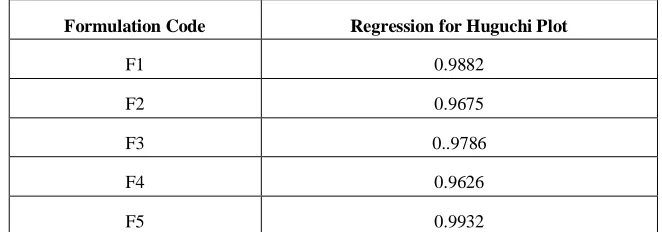
The formulations F1, F2, F3, F4and F5 have shown the drug release for 24 hours to the extent of 99%, 99.04%, 78.08%, 81.84% and 91.04% respectively. The Higuchi’s plot has shown the regression value of five formulations in Table 2
which indicates that the release of drug from the patch was governed by a diffusion mechanism.
Table 2: Regression Values of Formulations
Formulation Code Regression for Huguchi Plot
F1 0.9882
F2 0.9675
F3 0..9786
F4 0.9626
F5 0.9932
Comparision of invitro drug release profile of F1,F2, F3, F4, F5
0 10 20 30 40 50 60 70 80 90 100
1 2 3 4 5 6 7 8 9 10 11 12 13 14 15 16 17 18 19 20 21 22 23 24 25
Time (hrs)
C
um
ul
at
ive
% of
d
ru
g r
el
eas
e
JPRHC Volume 2 Issue 4
325-329
Table 3: INVITRO DRUG RELEASE DATA
Time (hours)
Cumulative % of Drug release
(F1)
Cumulative % of Drug release
(F2)
Cumulative % of Drug release (F3)
Cumulative % of Drug release
(F4)
Cumulative % of Drug release
(F5)
1. 67.2 53.52 29.52 23.36 50.4
2. 68.24 54.08 30.08 25.5 51.04
3. 68.8 55.35 30.72 27.04 52.24
4. 70.4 56.0 32.0 29.52 53.52
5. 72.8 57.2 33.84 33.2 54.72
6. 75.0 58.4 36.24 35.04 56.0
7. 80.0 60.24 38.08 36.24 57.2
8. 81.2 67.2 40.0 40.0 59.04
9. 81.8 68.88 42.4 42.4 60.88
10. 83.6 70.08 45.52 44.88 65.2
11. 84.8 72.0 48.56 46.72 67.04
12. 85.5 72.0 49.84 48.86 70.72
13 86.0 72.8 52.24 51.68 72.0
14 89.2 76.24 53.52 53.52 72.8
15. 91.0 78.08 54.72 54.72 75.2
16. 91.6 84.0 57.2 57.2 78.08
17. 92.2 85.52 59.68 59.68 79.3
18. 93.5 88.56 62.72 60.88 82.4
19. 95.3 91.68 65.84 65.54 84.24
20 95.3 92.88 67.04 68.88 85.52
21 96 94.72 70.08 72.0 86.08
22 96.5 99.04 72.0 74.4 87.36
23. 97.2 99.04 75.04 77.52 88.56
JPRHC Volume 2 Issue 4
325-329
CONCLUSION
Formulation F3 containing was found to best among all batches because of its consistent release rate for 24 hour and extent of drug release was 78.08%.
Ex-vivo permeating studied confirmed that in-vitro drug release data corrected with the ex-vivo data observed in rat skin.
The formulation F3 has achieved the object to extended release reduced frequency of administration, avoids the first pass effect and thus may improve the patient compliance.
As the extension of work pharmacokinetic studies, in-vivo
studies on higher animals and controlled clinical studies on human being can be carried out in future.
ACKNOWLEDGEMENT:
I am thankful to my management of Maheshwara College of Pharmacy for their consistent support and kind cooperation for my work.
REFERENCES
1. Aquill Mohamed.,(2004) “Matrix Type transdermal
drug delivery system of metoprolol tartrate: Skin
toxicity and invitro characterization”, Ethiopian
Pharmaceutical Journal: 12, P 53 – 60.
2. V.V. Ranade.,(2005)“The Journal of clinical
Pharmacology Drug Delivery System 6 transdermal
drug delivery”, Ranade: 32 (5) P 401.
3. Gupta S.P. Jain S.K., (2005)“Effective and
controlled transdermal delivery Metoprolal
tartrate”, 67(3), JIPS P 346 – 350.
4. Kusumdevi, Saisivam, S Maria GR, Deepti PU., (2003) “Design and evaluation of matrix diffusion
controlled transdermal patches of verapamil
hydrochloride”, Drug delivery Ind. Pharma 29(5),
Page No. 495- 503.
5. Gupta R. Mukhrejee B.,( 2003) “Development and
invitro evaluation of ditiach hydrochloride
transdermal patches based on providone ethyl
cellulose materials” Vol (1), Drug Dev. Ind.
Pharma, 1-7.
6. Gupta S.P. Jain S.K.,( 2004) “Development of Matrix, Membrane transdermal drug delivery system
for atenolol” 11(5), P. 281-6.
7. F.K. Earthlink.net / frankoeps / transdermal htm
“transdermal drug delivery”, F.K. 12/14/01 – 1-2.
8. S.Sridevi and D.R. Krishna.,( 1991) “Transdermal
drug delivery systems” Eastern Pharmacist.
9. Clarks, “Metoprolal”, Vol. 2 3rd ed., Analysis of Drugs and Poison Page No. 1275 – 76.
10. USP – 26., (2003) “Metoprolol Tartrate and
Hydrochlorothiazide Tablets” NF 21, USP – 26
Official Monograph P – 1224 – 25.
11. Tortora “Human Anatomy of Physiology”, X edition, Page 141 – 143.
12. Raymond, C. Rowe, Paul J. Sheskey “Handbook of
Pharmaceutical Exipeients” IV Edition, P (203-4)
(297 – 299), (237 – 241) P: (462–467).
13. K.D. Tripathi, “Metroprolal” Ed. IX, Medical Pharmacology P, 129.
14. Goodman and Guilman “Metoprolol” 10th edition, P – 1982.
15. Srinivas Mutalik, Nayerhabhiath Udupa.,( 2006)
“Pharmacological evaluation of Membrane,
Moderated transdermal system”, 33(1-2), Chin Exp.
Pharmacol, Physiology, Page 17 – 26.
AUTHORS AFFILIATION AND ADDRESS FOR CORRESPONDENSE:
Dr.B.Anilreddy, M.Pharm, Ph.D