fast intra coding in high eciency video coding
Y.-C. Lin
and J.-C. Lai
Department of Computer Science and Information Engineering, National Formosa University, Yunlin, 63201, Taiwan. Received 22 May 2014; received in revised form 9 May 2015; accepted 12 October 2015
KEYWORDS High eciency video coding;
Fast coding-unit algorithm; Fast encoding algorithm;
Quadtree partition.
Abstract. HEVC is a new video coding standard, which has been developed by the JCT-VC (Joint Collaborative Team on Video Coding) for applications with ultra high denition video coding. In HEVC, there are three types of encoding block: the Coding Unit (CU), the Predict Unit (PU) and the Transform Unit (TU). If every block of video pixels goes through the complete mode decision process, a large amount of encoding time is required, limiting its applicability in real-time applications. This paper proposes a fast algorithm that can reduce signicantly the computation time of intra coding for each Coding Unit (CU) block. In the proposed algorithm, depth information of the Coding Block Tree (CBT) from the previously encoded frame is used to help determine the current CU split depth, which can skip many unnecessary mode computations for some cases of block decomposition. Experimental results by HM10.1 show that the proposed method can provide about 20% time-saving and maintain a negligible degradation of coding eciency.
© 2015 Sharif University of Technology. All rights reserved.
1. Introduction
The High Eciency Video Coding (HEVC) proposal was established by two international organizations, namely ITU-T VCEG and ISO/IEC MPEG, devel-oped in April 2010. The rst formal edition of the HEVC was released in January 2013, becoming the newest generation video coding standard [1], with a major goal towards high denition video content compression. Dierent from H.264/AVC, the HEVC adopts a quad-tree based coding structure, which is a recursive block-splitting for seeking optimal coding eciency. In HEVC, there are three types of block: CU, PU and TU, respectively. Among them, CU is the basic coding unit, whose block size varies from the 64 64 Largest Coding Unit (LCU) to 8 8, *. Corresponding author. Tel.: +886-5-6315576;
Fax: +886-56330456
E-mail address: [email protected] (Y.-C. Lin)
which can then be formed into PU and TU. PU is the prediction unit for deciding the prediction modes, whose sizes vary from 64 64 to 4 4 for prediction modes ranging from intra coding to various inter-frame coding modes [2-3]. TU represents the transform unit that is used to dene the transform shapes and quantization parameters for the prediction residue by the PUs in a CU, whose block size can range from 32 32 to 4 4. If the encoder needs to calculate all the combinations of PUs and TUs for each incoming CU to get the best coding eciency, it makes the encoder more computationally complex. Thus, it limits commercial applications for the HEVC encoder. Therefore, computational optimization of the encoder is also a necessary topic in the design of practical HEVC encoders. Recently, many fast algorithms have been proposed for the HEVC encoder. Refs. [4-9] proposed fast algorithms to reduce the number of CU quadtree partitions, which can skip computation for some unnecessary predictions for an incoming CU.
Refs. [6,7,10-12] mention many approaches to reduce the computation complexity of angular intra prediction modes. Their methods focus on nding the best prediction mode to determine which mode is the most probable mode. Methods in [13-15] propose fast inter-frame prediction mode decision algorithms to terminate the search procedure early and skip unnecessary pre-diction modes.
The aforementioned methods can also be classi-ed as reference-neighbor and non-reference-neighbor methods. The reference-neighbor methods make use of adjacent block coding information for exploiting the high correlation in continuity videos. The continuity video does not have drastic scene-changes or fast object-moving phenomena. Therefore, it has a better prediction and time-saving for static objects or slow-moving videos. On the other hand, the non-reference-neighbor methods use the variation of frame content complexity to predict the partition of the current block and mode prediction. This kind of method relies on a set of decision thresholds each of which plays an important role in the proposed fast method. Due to referring to no other encoded blocks, they are not aected by the encoded neighboring blocks, and, thus, have the advantages of the independent encoding model. Hence, the coding eciency would not be aected signicantly by drastic scene-change and fast object-moving eects.
In this paper, the proposed method belongs to the class of reference-neighbor methods. It is an extension of the previous work [16] in exploiting the information from the partition of the co-located CBT in the previous frame to make a good estimate of the possible range of partition depth-level on the current CBT block. Correlation of the temporally co-located quadtree of partition CUs or CBTs is formulated and analyzed thoroughly with a large set of benchmark videos. In addition, a detailed description of the proposed fast HEVC intra coding algorithm is given with an explicit procedural pseudo code. Based on our experimental observations, there is a higher correlation of partition-tree depth between those co-located blocks in most benchmark videos. It is anticipated with high condence that a simple and eective fast intra coding process would be developed when making use of this kind of correlation.
This paper is organized as follows: Section 2 explains some key features of the HEVC encoder and illustrates the procedure of the CBT coding process for HEVC intra coding. Section 3 explains how the depth correlation is measured and justies the feasibility of using correlation information. Section 4 details the operational ow of the proposed method. Section 5 demonstrates the feasibility of computation by experiments. Concluding remarks are given in Section 6.
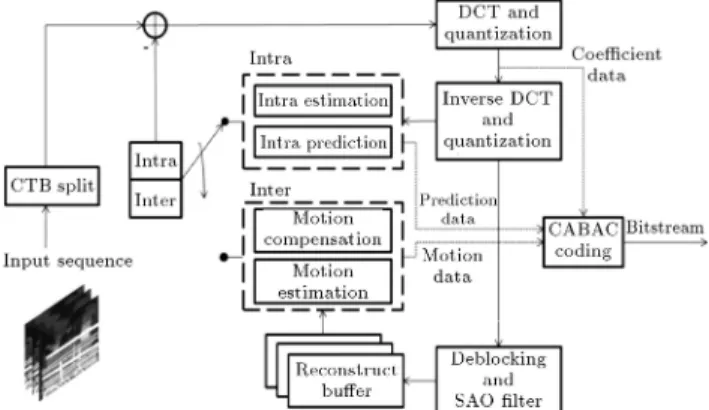
Figure 1. Block diagram of HEVC encoder.
2. HEVC coding process and fast algorithms This section rst describes the HEVC encoder process, including the introduction of HEVC intra coding, the procedure of Rate Distortion Optimization (RDO), and the quadtree partition of CUs. Then, two classes of fast HECV encoding algorithms are reviewed briey. 2.1. HEVC encoder
Figure 1 shows the coding process of a HEVC video encoder. Firstly, the incoming frame should be divided into CBTs as the basic coding elements. In general, each CBT is processed for considering both intra and inter prediction coding. Then, the prediction residues are generated for the subsequent coding modules, in-cluding transformation, quantization and entropy cod-ing. The family of Discrete Cosine Transforms (DCT) is used for the prediction residues, which outputs the quantized transform coecients for the following CABAC entropy coding. In the reconstruction loop of the encoder, the inverse DCT, inverse quantization, and post-processing lters are employed to generate the corresponding reconstructed frame to the original incoming one. The purpose of designing the HEVC encoder is to obtain the comparable reconstruction quality of the previous standard, H.264/AVC, while only a half bit-rate is required by the HEVC standard. 2.1.1. Coding units
In HEVC encoding, the role of CTB is similar to the macroblock in H.264, that is, a basic coding block. Each CTB should be further split into a Coding Unit (CU), a Prediction Unit (PU) and a Transform Unit (TU).
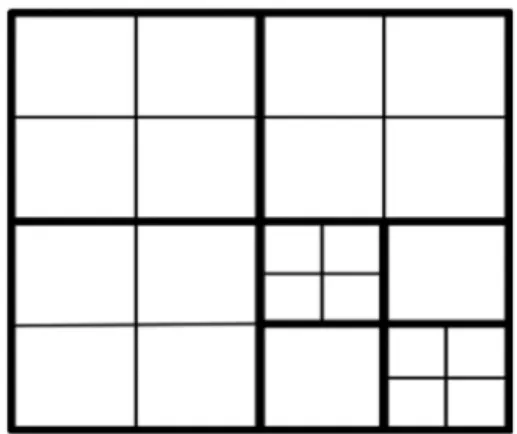
A coding unit is a coding block with a square partition in each CTB, which is partitioned from 64 64 to 8 8 by a recursive process. Each block size corresponds to a depth level of 0 to 3. An example of a CU partition is shown in Figure 2. The depth level of 0 is an initial CU partition in CTB whose block size is 64 64. Then, it should be divided into four equal-sized CU blocks of 3232 pixels by a recursive process, and each 32 32-block is further divided into 16
16-Figure 2. Quadtree structure of partitioning an incoming LCU.
block, and so on, until the maximum depth level of 3 is reached. The CU block is applied to intra and inter coding as basic elements for the subsequent Prediction Unit (PU) and Transform Unit (TU) partition. 2.1.2. Prediction units
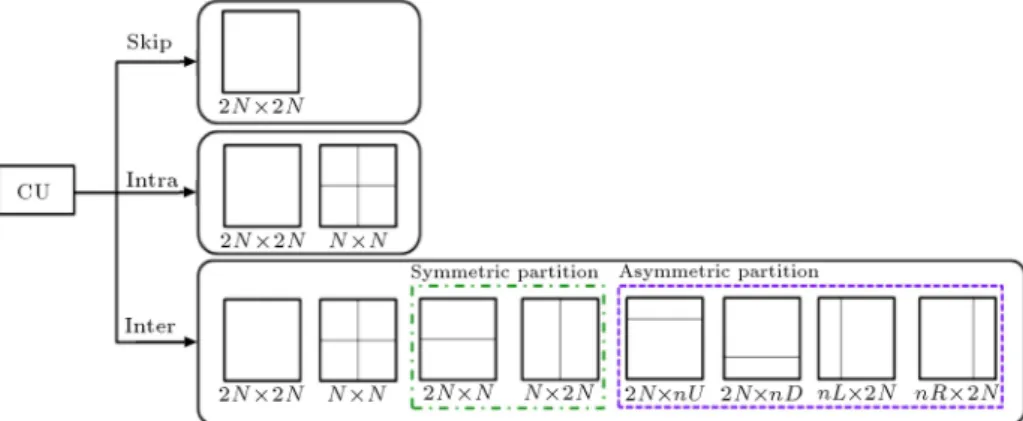
A Prediction Unit (PU) is the basic unit of block prediction where one or more PU partition blocks are composed of a single CU. Each PU adopts the block prediction from neighboring reconstructed pixels by the intra or inter prediction modes, and the possible block sizes are between 6464 and 44. Intra prediction uses only square PU blocks, which means that the partition is of a 2N 2N- or N N-type. Note that the PU-N PU-N block is only used for the intra coding of the CU 8 8 block. In inter prediction, in addition to the squared block types, the symmetric and asymmetric partition blocks of type 2N N, N 2N, 2N nU, 2N nD, nL 2N and nR 2N are also included. Figure 3 depicts the types of PU block for SKIP, intra, and inter coding modes.
2.1.3. Transform units
A Transform Unit (TU) is used in the transform and quantization process, which are performed on the residual of the PU block prediction. In the HEVC standard, the TU blocks are only partitioned to square blocks, with sizes ranging from 32 32 to 4 4 partitions, e.g. 32 32, 16 16, 8 8 or 4 4. In
general, to reduce the complexity of the encoder, the maximum partition depth of TU is only three depth levels. For example, if the CU is of size 32 32, the TU partition of the CU only involves three depth levels, e.g. 32 32, 16 16 and 8 8 partition blocks of TU. 2.2. HEVC intra coding
For each incoming LCU, its intra coding process involves a series of operations, including a quadtree structure decomposition, intra-frame prediction, and residual quadtree transform and quantization. In the quadtree decomposition, the incoming LCU is recursively partitioned from the size of 64 64 pixels into the size of 4 4 pixels. Each node in the partition quadtree, which corresponds to a sub-block of the LCU under consideration, is treated as a PU, and a predicted block is generated for it using a set of available prediction directions. There are 35 prediction modes dened in the HEVC standard. Figure 4(a) depicts the directions of these prediction modes. To get better coding eciency, the rate-distortion cost of encoding any node in the quad-tree structure is calculated by Eqs. (1) and (2), and the prediction direction with the minimum cost, J, is selected as the best intra-prediction mode for generating the predicted block. In Eqs. (1) and (2), D represents the prediction residual signal of the current block; is called the Lagrange multiplier whose value depends on the values of QP used in the encoder; and R is the number of bits
Figure 4. Illustration of CBT coding structure for HEVC intra coding: (a) 35 prediction modes for intra prediction; and (b) recursive partition process for each CBT.
used to represent the current CU block.
J = D + R; (1)
= 0:85 2(QP 12)=3: (2)
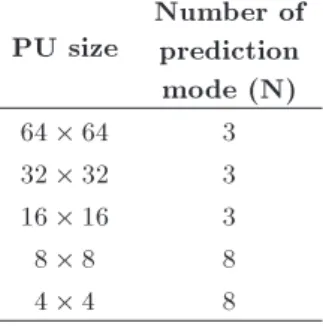
However, to reduce the computation load of choosing the optimal rate-distortion prediction mode, a light-weight cost criterion is derived to determine a subset of the prediction modes. This is called the Rough Mode Decision (RMD) set, and the actual Rate-Distortion Optimized (RDO) intra-prediction mode is decided from the RMD set. The size of the RMD set varies with the size of the block. Table 1 lists the valid sizes of the RMD set dened in the HEVC specications.
The generation of the quadtree structure for the LCU (also called CTB) involves recursive decomposi-tion, starting from the tree root (corresponding to the incoming LCU) down to the minimum allowed block size, which is the 4 4 block in HEVC intra coding.
Table 1. Number of prediction mode for PU block. PU size
Number of prediction mode (N)
64 64 3
32 32 3
16 16 3
8 8 8
4 4 8
Figure 4(b) illustrates an example of decomposing a 64 64 block from a video frame as a quadtree block structure until the fourth level of partition depth. HEVC denes a binary syntax element, SplitFlag, to indicate if the current block is partitioned or not. 2.3. Quadtree partition process
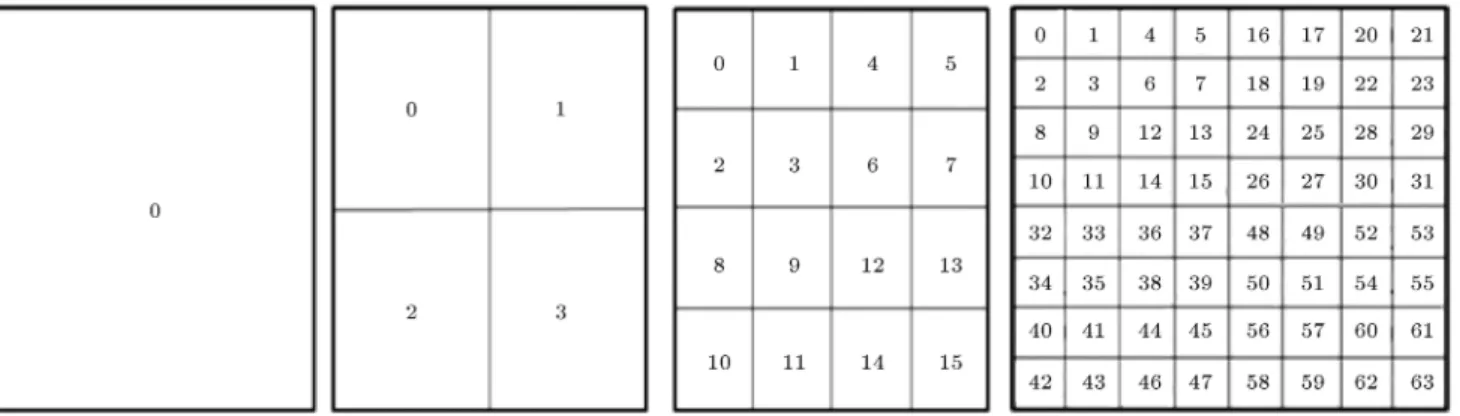
As can be seen in Figure 2, in the HEVC intra coding mode, the input LCU should be partitioned into a quadtree structure with variable-sized CU blocks, while each CU in the quadtree is encoded with the RDO process during the quadtree partition. Each node in the quadtree shown in Figure 2 corresponds to one image block in the incoming LCU. Figure 5 illustrates the numbering scheme for the partitioned blocks with the pair (i; j) of integers associated with the jth node at the ith depth level of the quadtree structure shown in Figure 2. For example, image block (1, 3), which is located at the bottom-right quadrant of LCU, stands for the 4th node at the 1st depth level of the quadtree shown in Figure 2.
The HEVC quadtree partition process for each LCU consists of two operations:
Splitting operation: Suppose the size of a LCU is set to 64 64 pixels. An incoming 64 64 Coding Block (CB) is rst dealt with by intra-prediction coding, and the RDcost and the related prediction information for this CB are recorded as the root node of the quadtree structure. Afterwards, the incoming CB is partitioned into four 32 32-CBs, each of which is treated as a child node of the root node and
Figure 5. Block numbering scheme on the image blocks at dierent depth levels of partition.
further undergoes the same intra-prediction process to store the corresponding prediction information and RDcost. Then, each of the nodes for the 32 32-CBs also spawns its own four child nodes for the corresponding 16 16-CBs using the same intra-prediction and RDO process. This tree-growing process is repeated until the lowest 4 4-CB is reached. At last, a complete quadtree structure is available with information for all possible variable block-size predictions and RDO data.
Pruning operation: To get the best partition tree, starting from the 88-CB nodes, each node is checked to see if pruning their four child nodes enables a better RDcost. If the sum of RDcosts for all four child nodes is smaller than that of their parent node, the child nodes are kept by setting its SplitFlag to 1, and the new RDcost of the parent node is set to the sum of the children RDcosts; otherwise, the four child nodes are removed and the parent node becomes a leaf node by setting its SplitFlag to 0. This process is applied to each non-leaf node in the complete quadtree and is executed in a bottom-to-up manner. Having once examined the root node, the complete quadtree would be pruned to become a RDO intra-coding quadtree structure.
Referring to the quadtree structure in Figure 2, the encoder needs to deal with 85 CUs, 341 PUs, and 3 or 8 TUs for each CU to nish the intra coding of each LCU, and thus requires a huge amount of arithmetic computation. In the subsequent sections, a fast HEVC intra coding process is developed with the exploitation of temporal correlation of the quadtree structure between successive video frames.
2.4. HEVC fast encoding methods
In most of the current fast HEVC encoding methods, the speeding up strategies can be mainly divided into block-based and mode-based decision categories. The block-based method is used to reduce the block partitions. Lee et al. [4] proposed to skip the partition of the current CU in terms of block content complexity
from those previously encoded blocks. Therefore, partition of the current block is determined from the previously encoded frames. This method could achieve time-saving and maintain good coding eciency. In order to achieve an accurate prediction of splitting, it tries to remove the furthest depth level in a CBT. Hence, this method has a limited capability of time-saving. Cho and Kim [5] employed machine learning to decide whether CU splitting was terminated or not. It should create actively the best time-saving and video compression. But this method takes further time to train the prediction model. Lee et al. [4] and Cho and Kim [5] aimed at the determination of current block partitioning based on previously encoded frames. If the frame contains a scene-change or fast object movement, an inaccurate prediction for the current frame might probably occur. Shen et al. [6] presented references to neighboring blocks to predict the possible current split of a block. They proposed a classication algorithm to decide whether CU needs to be computed for rate-distortion cost or not. Cheng et al. [7] introduced a reference to the neighboring RDcost method to early terminate the CU partition, which is able to provide a simple partition process for CUs at the slowly varying region in the frame. The methods in [6,7] are not limited by previously encoded frames. Hence, they could have better prediction for change scene and fast moving sequences. However, it requires information from the neighboring reference blocks to predict the partition structure.
In addition to the CU block-partition decision methods, there are also some PU block decision meth-ods proposed in the literature. Cheng et al. [8] used a bilinear interpolation for approximating the intensities of the PU block in order to predict the block complexity of intensity and determine the type of PU block division. Yoo and Suh [9] proposed a fast method on intra- and inter-frame coding structures that use the RDcost to derive some early termination thresholds. With the thresholds, if current RDcost is lower than the thresholds, then, the encoder can avoid further calculations on the block partition and coding process.
The mode-based methods concern the derivation of decision rules to improve the speed of calculating the prediction modes from PU blocks. They could be divided into two types of decision rules for the intra and inter mode decisions, respectively. In the intra mode decision method, the goal is primarily towards the improvement of performing the 35 prediction modes for the full RDcost. Shen et al. [6] and Cheng et al. [7] proposed to use the neighboring coding information for complexity reduction of intra prediction for the current PU block. Cheng et al. [7] employed the parent PU prediction mode to speed up calculations for the best PU prediction mode of the current PU block. Shen et al. [6] improved the performance of the method developed in [7] by adding a Rough Mode Decision (RMD) rule and the Most Probability Mode (MPM) to enhance the accuracy of PU prediction. Jiang et al. [10] and Silva et al. [11] utilized the gradient variation to nd a more accurate prediction mode. Diering from methods proposed in [6,7,10,11], which endeavor to reduce the number of available prediction modes for Rate-Distortion Optimization (RDO), Motra et al. [12] introduced the reduced RMD prediction mode to replace the full mode prediction for RMD. For inter coding rules, Yang et al. [13] employed the SKIP mode from the inter 2N 2N PU to skip Advanced Motion Vector Prediction (AMVP) in the inter prediction coding process. For speeding up motion estimation, Pumachand et al. [14] proposed a new search method to improve the accuracy for inter coding, and added detec-tion thresholds to early terminate the search procedure. Similar to [14], Pan et al. [15] proposed an improved TZSearch algorithm to reduce the motion estimation execution time for predicting the current PU block. 3. Correlation analysis of CBT partition 3.1. CBT partition depth
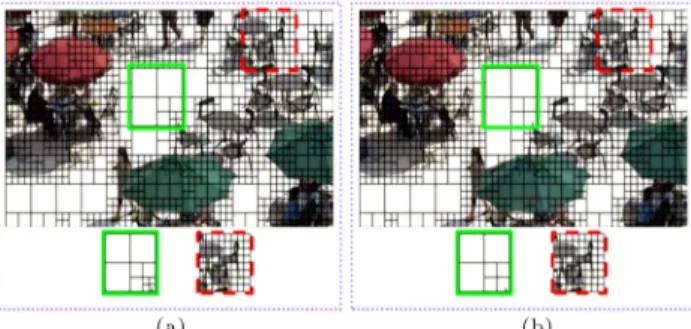
The structure of the quadtree with the best RDO coding for the input LCU block depends highly on the content complexity of the LCU block and its spatial neighboring pixels in a frame. Further, the content complexity of one frame is also very similar to its immediately neighboring frames in a video sequence. Therefore, it is intuitive to infer that the quadtree structure for a LCU block in a frame should be very similar or even identical to the co-located ones in the temporally neighboring frames. In this section, the correlation of quadtree partition-depth between consecutive frames is analyzed for its usefulness in improving the speed of decomposing a LCU block. Fig-ure 6 demonstrates an example for this correlation of quad-tree partition-leveling between the current frame (Figure 6(b)) and its previous frame (Figure 6(a)). The quadtree partition, as indicated by a red-dotted square in Figure 6(b), is found to be exactly identical to its
Figure 6. Examples of CBT correlation between video frames: (a) Previously encoded frame; and (b) currently encoded frame.
counterpart co-located in the previous frame indicated in Figure 6(a). In addition, there is another case that shows a similar quadtree partition structure to those indicated by the green-solid square in Figure 6. 3.2. Correlation of CBT depth between frames Once one frame has been coded by the intra-coding process, the coded frame can be viewed as a union of the non-overlapped, variable-sized CBs that corre-spond to the nodes in the quadtree structures generated by the intra-coding process. Since the size of each CB is specied in the power of two, say 26 j 26 j,
j = 0; 1; 2 or 3, each CB can be segmented into a set of non-overlapped 4 4-blocks. Each 4 4-block in a CB of size 26 j 26 j can be given a depth value,
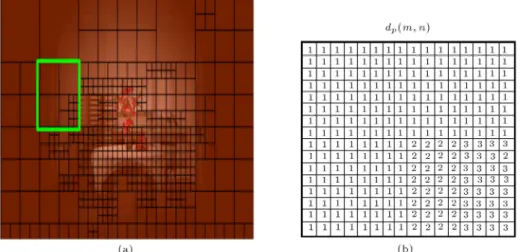
j, to carry the quadtree depth information about this 4 4-block. When combining this depth information of 4 4-blocks from a coded frame, a two-dimensional array, d(m; n) = j, is obtained for the 4 4-blocks in a coded frame. Figure 7(a) illustrates the sample quadtree partition results for a frame of size 416 240 pixels, and highlights a quadtree partition with a green box at position (41, 17) (in units of 4 4-block) in the frame. Figure 7(b) shows the value of d(m; n) for the highlighted quad-tree partition in Figure 7(a).
Suppose dc(m; n) and dp(m; n) denote the
quadtree depth information arrays for the current coded frame and its immediately previous frame, re-spectively. The frame dierence of quadtree depths can be calculated by Eq. (3):
D(m; n) = jdc(m; n) dp(m; n)j : (3)
In Eq. (3), (m; n) denotes the 44-block coordinate in a frame. To measure the similarity of depth information between consecutive frames, the ratio of frame depth dierence is dened in Eq. (4), which computes the similarity information based on the frame dierence, d(m; n), being less than one level:
FDR = PM
4 1
m=0 P
N 4 1
n=0 f(m; n)
M N 16 100%; (4)
Figure 7. Representation of the partition depth of each CU.
f(m; n) = (
1 if d(m; n) 1 0 otherwise
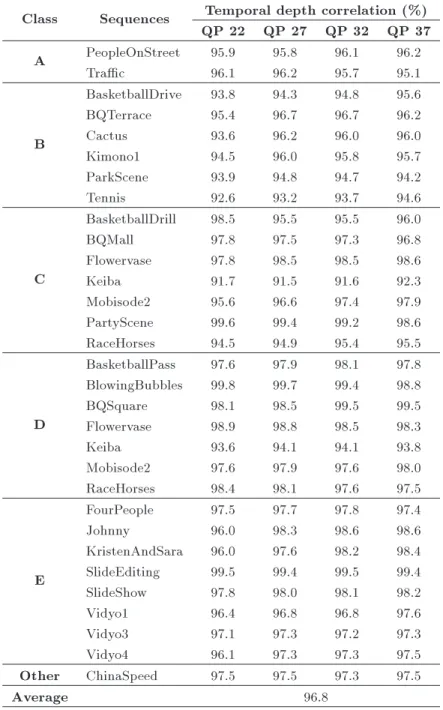
In Eq. (4), FDR denotes the ratio of frame depth dif-ference for a single frame in a video sequence. Table 2 illustrates the average values of quadtree correlation computed for a large set of test sequences. Each value shown in the table is computed using Eq. (4) and averaged over all the frames in the sequence encoded by HM using QP values ranging from 22 to 37. The video sequences that were used include those test sequences specied in the HEVC call for proposal document [17], with dierent classes for the test constraints. The resolution of frames for videos in Classes A, B, C, and D decrease from `2560 1600', `1920 1080', `832 480', and `416 240', respectively. Videos in Class E are recorded from videoconference applications, having a resolution of `1280 720' for each of them. The `ChinaSpeed' sequence is a non-camera video, which is captured from a computer game scene, with display resolution of `1024768'. Based on the computed results, it can be found that for most videos, the quadtree partition depth is very similar to the temporal neighboring frames, with over 96% area in the coded frame having a deviation of quadtree depth within one level. In the next section, a fast quadtree partition algorithm based on this observation will be designed.
4. Proposed method
4.1. The concept of how to speed up the quad-tree partition process
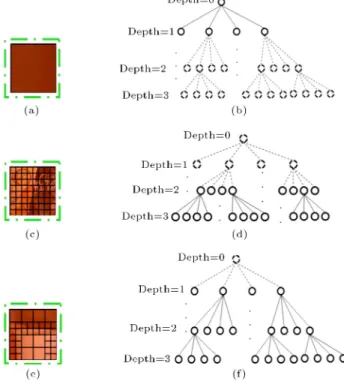
In the proposed method, simplication of quadtree partition is achieved by exploiting the quadtree depth information from the temporally co-located CBT in the same sequence to make a rough partition range for the current LCU. For example, Figure 8(a) shows the quadtree partition of the co-located CBT quadtree with depth 0. With the observation in Table 2, the possible depth range of the corresponding quadtree
Figure 8. Examples partition of CTB by referring the partition depth of co-located CTB.
of LCU in the next frame is highly likely to be increased by one, as the partition tree with solid lines shows in Figure 8(b). Therefore, it can skip the RDO computations for the CU at levels 2 and 3 (e.g. Figure 8(b), dotted line). Figure 8(c) shows another sample partition for the co-located CBT with highly complicated content, such that the maximum partition depth grows up to 3. The possible range of partition depth for the current LCU can only be set to between 2 and 3, in this case (see Figure 8(d), solid line). Figure 8(e) illustrates a case that does not give much reduction of computation to the proposed method, where the partition tree spans from depth 1 to depth 3 (see Figure 8(f), solid line), since the proposed method can only skip the computation of depth 0 partitioning.
Table 2. Quadtree depth correlation between temporally neighboring coded video frames. Class Sequences Temporal depth correlation (%)
QP 22 QP 27 QP 32 QP 37 A PeopleOnStreet 95.9 95.8 96.1 96.2
Trac 96.1 96.2 95.7 95.1
B
BasketballDrive 93.8 94.3 94.8 95.6
BQTerrace 95.4 96.7 96.7 96.2
Cactus 93.6 96.2 96.0 96.0
Kimono1 94.5 96.0 95.8 95.7
ParkScene 93.9 94.8 94.7 94.2
Tennis 92.6 93.2 93.7 94.6
C
BasketballDrill 98.5 95.5 95.5 96.0
BQMall 97.8 97.5 97.3 96.8
Flowervase 97.8 98.5 98.5 98.6
Keiba 91.7 91.5 91.6 92.3
Mobisode2 95.6 96.6 97.4 97.9
PartyScene 99.6 99.4 99.2 98.6
RaceHorses 94.5 94.9 95.4 95.5
D
BasketballPass 97.6 97.9 98.1 97.8 BlowingBubbles 99.8 99.7 99.4 98.8
BQSquare 98.1 98.5 99.5 99.5
Flowervase 98.9 98.8 98.5 98.3
Keiba 93.6 94.1 94.1 93.8
Mobisode2 97.6 97.9 97.6 98.0
RaceHorses 98.4 98.1 97.6 97.5
E
FourPeople 97.5 97.7 97.8 97.4
Johnny 96.0 98.3 98.6 98.6
KristenAndSara 96.0 97.6 98.2 98.4 SlideEditing 99.5 99.4 99.5 99.4
SlideShow 97.8 98.0 98.1 98.2
Vidyo1 96.4 96.8 96.8 97.6
Vidyo3 97.1 97.3 97.2 97.3
Vidyo4 96.1 97.3 97.3 97.5
Other ChinaSpeed 97.5 97.5 97.3 97.5
Average 96.8
4.2. Estimation of quadtree depth
In the proposed method, the rst frame of each se-quence is coded with the HM10.1 encoder. The purpose is to generate accurate reference information for the succeeding frames in the sequence that is designated to be coded by the proposed method. When encoding the succeeding frames, the proposed fast algorithm rst extracts the depth partition information, dp(m; n),
of the co-located CBT, each of which records the depth value of a 4 4-block at location (m; n) in the co-located CBT. Figure 9(b) shows an example of dp(m; n), storing the depth values of the co-located
CBT partition, highlighted with a green line box in Figure 9(a).
Among the values of dp(m; n), the maximum
depth (MaxDepth) and minimum depth (MinDepth) are rst obtained. Then, the depth range for the current LCU, the upper (Dmax) and lower (Dmin) limits, are
determined by Eq. (5). The rationale of Eq. (5) reects the facts observed in Section 3, that is, the possible depth range of the current LCU is most probably equal to the range expanded by the +1/-1 depth from the range of the co-located LCU:
Dmax= Min(MaxDepth + 1; 3);
Dmin= Max(0; MinDepth 1): (5)
Figure 9. Example of co-located CBT depth array: (a) Previously encoded frame; and (b) co-located CBT depth dp(m; n).
up the quadtree partition of CUs in intra coding, a fast quadtree partition function is described in the following subsection. It can be used by invoking the function call, Fast Quadtree Partition(0; Dmin; Dmax; 0), with
ar-guments, including starting level 0, minimum depth value Dmin, maximum depth value Dmax, and block
number 0.
4.3. Quadtree partition procedure of the proposed algorithm
In general, the CU partition and coding is executed recursively by splitting a lot of sub-CU blocks. We propose a method that utilizes a depth correlation property to decrease encoding time complexity. Fig-ure 10 shows the ow chart of the proposed method when encoding the current CBT.
The proposed method is divided into two parts: First, it generates the estimated depth range for a partitioning current CBT block, based on information from the co-located CBT block. In the second part, the quadtree partition process is carried out with maximum and minimum levels of partition depth. Unlike the HEVC CB partition process, the proposed algorithm limits the number of CU block to be processed for intra prediction of intra coding.
The splitting process of each block is recursively done from top to bottom and left to right; the pruning process is run from bottom to top and left to right during quadtree computation. During the splitting process, the RDcost for the jth CU at depth level i of the quadtree partition is evaluated by the intra coding function of the HM encoder, and is stored in Cost(i; j) for later access by the pruning operation. If the level of the current block partition is smaller than Dmin, computation for the intra coding is skipped and
the values of RDcost for these nodes are assigned with innity. When the partition depth is located between the minimum depth level, Dmin, and maximum depth
Figure 10. The pseudo code description of the proposed fast quad-tree partition algorithm.
level, Dmax, the algorithm adopts the original HEVC
process to make the cost values until the splitting process reaches depth level Dmax.
In the pruning process, RDcost Cost(i; j) is up-dated with the smaller one of the current CU's RDcost or the sum of RDcosts of its four children nodes. If all the children blocks of a parent block have been evaluated with their RD costs, the pruning process is invoked to update the value of Cost(i; j) for the parent block. If the sum of the children RDcosts is smaller than that of the parent block, the SplitFlag of the
Figure 11. Co-located CBT from previously frame.
parent block is set to 1, and the parent block cost is set to the sum of the children RDcosts; otherwise, the SplitFlag is set to 0 and there is no update to the parent block RDcost. Afterwards, the algorithm keeps running recursively and checks whether the current process node is the root or not; if yes, the algorithm stops the encoding process on the incoming LCU, and gets the SplitFlag(i; j) array for indicating the best partition of incoming LCU.
4.4. Example of the proposed quadtree partition
This proposed method can be used to skip unnecessary block decomposition computation. For example, when considering the co-located CBT from the previous frame, as shown in Figure 11, the proposed algorithm can nd out that Dmin and Dmax are 3 and 2 by
Eq. (5), respectively. Since, in the HEVC standard, the CU block maximum depth is 3, the depth range of partitioning the current CBT during the RDO process is from 1 to 3. Therefore, the algorithm can skip the computation for depth-0 partition and the associated RDO computation to reduce computation complexity in this situation. In this case, RDO process starts from level 1 of the quadtree partition to undertake RDO computation on each 32 32 CU. Then, each 32 32 CU is handled as a root node and further split into four 16 16-CUs. Then, the algorithm repeats partition and RDO computation until 8 8 CUs are reached. In order to nd the best CBT partition, each node is examined to undertake the pruning process based on their four sub-CU RDcosts. If the sum of the RDcosts from the four sub-CUs is smaller than the parent node, then the sub-CUs are kept intact and the sum of the sub-CU RDcosts is used to update the parent node. Otherwise, the sub-CUs are removed from the partition tree and the SplitFlag of the parent block is set to 0. When repeating this process for each encoded node until the 32 32 CU partition nodes, the algorithm can terminate the pruning process to generate the best partition of CBT.
5. Experiment results
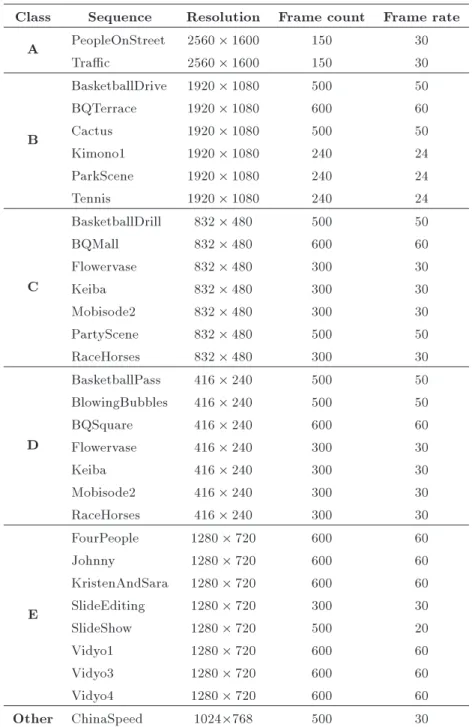
To verify the eectiveness of the proposed algorithm, experiments are conducted on several test sequences, which are classied into ve classes: Classes A to E, according to their own characteristics, are as those illustrated in Table 3. The experimental platform was implemented based on HM10.1 [18] reference software and executed on a computer with Microsoft Windows 7 Professional Service Pack 1 64-bit O/S, Intel(R) Core(TM) i7-4930K 3.4 GHz CPU and 5 GB RAM.
The program that executed the experiments is developed by modifying the HM encoder software to integrate the proposed fast CU partition algorithm. The rst frame in each test video is encoded by the ex-perimental program using the original HM intra coding conguration. The purpose of this special treatment for the rst frames is to generate good temporally initial reference information for the succeeding frames in the same sequence, while each of the succeeding frames is encoded by the proposed fast partition algorithm. The measurement of time-saving by the proposed fast encoding algorithm is dened in Eq. (6):
Time-saving(%) =TOT TF
O 100%; (6)
where TO stands for the execution time by the HM
original encoder, and TO is the execution time by the
fast encoding algorithm. The degradation of coding eciency by the modied HEVC encoder is measured using the BD-Rate and BD-PSNR [19], with respect to the corresponding coding performance of the original HEVC HM 10.1.
Table 4 lists the results of experiments performed on the dierent sequences with Quantization Parame-ters (QP) 22, 27, 32 and 37 in an intra only and low complexity case. As indicated in Table 4, the time-saving ability of the proposed method is about 20.34%, on average, at the expense of a 0.17% increase of output BD-Rate. When compared to the method proposed by Lee in [4], the proposed algorithm has an increase of average time-saving of 2.39%, under the compromise of increased BD-Rate of about 0.12% compared with Lee's method. When looking at the individual sequence, almost all the considered sequences have better and comparable time-saving abilities than those of Lee's method, except for few cases on the `ParkScene' (1920 1080), and `PartyScene' (832 480) sequences. The reason for slightly less time-saving of the sequences is the drastic change of content that these sequences have, such that a less accurate prediction is able to be undertaken from the previous co-located partition. Usually, these co-located partitions contribute a lot more partition information and cause many smaller partitions in the current quadtree partition by the proposed algorithm. Quadtree partition with many
ParkScene 1920 1080 240 24
Tennis 1920 1080 240 24
C
BasketballDrill 832 480 500 50
BQMall 832 480 600 60
Flowervase 832 480 300 30
Keiba 832 480 300 30
Mobisode2 832 480 300 30
PartyScene 832 480 500 50
RaceHorses 832 480 300 30
D
BasketballPass 416 240 500 50
BlowingBubbles 416 240 500 50
BQSquare 416 240 600 60
Flowervase 416 240 300 30
Keiba 416 240 300 30
Mobisode2 416 240 300 30
RaceHorses 416 240 300 30
E
FourPeople 1280 720 600 60
Johnny 1280 720 600 60
KristenAndSara 1280 720 600 60
SlideEditing 1280 720 300 30
SlideShow 1280 720 500 20
Vidyo1 1280 720 600 60
Vidyo3 1280 720 600 60
Vidyo4 1280 720 600 60
Other ChinaSpeed 1024768 500 30
smaller blocks would normally generate a higher output bitrate for the LCU. However, compared to Lee's method, the proposed algorithm can oer an additional 2.39% time-saving, on average. The reason for this is that the proposed algorithm can provide up to two levels of depth reduction, rather than the single level reduction in Lee's method.
Figures 12 and 13 demonstrate two examples of quadtree partition illustrating the dierence of time-saving abilities between the proposed algorithm and Lee's method. For the case shown in Figure 12, when the depth of the previously co-located partition is level 0, which is in a smooth region, the maximum depth
Figure 12. Smooth region time-savings between the proposed method and Lee's method: (a) Co-located CTB partition; (b) the proposed method encoding depth level; and (c) Lee's depth level.
Table 4. Experiment results.
Class Sequence BD-Rate (%) BD-PSNR (dB) Time-Saving (%)
The proposed
method [4]
The proposed
method [4]
The proposed
method [4]
A PeopleOnStreet 0.02 0.0 0.0 0.0 11.2 13.3
Trac 0.06 0.01 0.0 0.0 11.1 12.6
B
BasketballDrive 0.18 0.04 0.0 0.0 20.4 17.0
BQTerrace 0.02 0.0 0.0 0.0 14.0 15.6
Cactus 0.07 0.01 0.0 0.0 18.5 16.5
Kimono1 0.16 0.05 0.0 0.0 35.1 32.2
ParkScene 0.06 0.02 0.0 0.0 11.9 15.0
Tennis 0.65 0.21 -0.01 0.0 38.5 31.3
C
BasketballDrill 0.04 0.01 0.0 0.0 10.2 11.0
BQMall 0.05 0.01 0.0 0.0 12.5 12.2
Flowervase 0.03 0.01 0.0 0.0 20.9 17.0
Keiba 0.84 0.22 -0.04 -0.01 23.7 18.5
Mobisode2 0.37 0.07 -0.01 0.0 36.1 27.6
PartyScene 0.0 0.0 0.0 0.0 20.0 25.5
RaceHorses 0.06 0.02 0.0 0.0 18.5 19.9
D
BasketballPass 0.05 0.02 0.0 0.0 15.4 11.1
BlowingBubbles 0.0 0.0 0.0 0.0 17.7 9.4
BQSquare 0.0 0.0 0.0 0.0 14.1 9.2
Flowervase 0.01 0.0 0.0 0.0 14.6 14.7
Keiba 0.31 0.07 -0.02 0.0 17.9 12.2
Mobisode2 0.22 0.03 -0.01 0.0 22.8 15.3
RaceHorses 0.02 0.01 0.0 0.0 16.2 8.9
E
FourPeople 0.02 0.0 0.0 0.0 13.7 13.9
Johnny 0.06 0.03 0.0 0.0 30.6 27.5
KristenAndSara 0.06 0.01 0.0 0.0 25.8 25.1
SlideEditing 0.07 0.03 -0.01 0.0 17.5 14.7
SlideShow 1.49 0.43 -0.14 -0.04 41.6 35.7
Vidyo1 0.09 0.0 0.0 0.0 17.2 16.7
Vidyo3 0.25 0.12 -0.01 0.0 21.7 21.4
Vidyo4 0.08 0.02 0.0 0.0 18.4 18.0
Other ChinaSpeed 0.05 0.02 0.0 0.0 22.8 17.5
Average 0.17 0.05 -0.01 0.0 20.34 17.95
Figure 13. Time-savings of rich texture region between the proposed method and Lee's method: (a) The co-located CTB partition; (b) the proposed method encoding depth level; and (c) Depth level generated by [4].
of the quadtree structure by the proposed algorithm is level 1, whereas the quadtree partition by Lee's method requires up to level 2. There is one more level of partition and computation for Lee's method. As for the example of Figure 13, where the co-located quadtree structure has partitioned blocks with uniform size, the proposed algorithm only computes the intra coding process for the CUs at depth levels 2 and 3, while Lee's method requires computing CUs at levels 1, 2 and 3. Lee's method needs one more level of partition to complete the encoding process of LCU.
With these experiment results, although the output BD-Rate by the proposed method is rela-tively higher than Lee's method with an insignicant
less temporal correlation. Figure 14 shows an example of the `SlideShow' video exhibiting signicant scene-changing eects from the 4th to the 5th frame. Thus, it causes the lower correlation to make the poor partition for the 5th frame, as shown in Figure 14(b).
The advantage of the proposed method lies in the accurate prediction of quadtree partition and, thus, obtains a lot of time-saving for blocks in smooth regions without disrupting motion objects. Figure 15 illustrates an example of smooth region partition. Figure 15(a) shows the previously best splitting of co-located CBT with depth 0 (64 64) partition. Figure 15(c) shows the partition result by the proposed method that only calculates the parti-tion from depth 0 to 1, to get the exact identical partition to that obtained by HEVC HM 10.1 as that shown in Figure 15(b). The proposed algorithm saves the computations for the partitions at depths 2 and 3.
Figure 16 demonstrates one example that reveals the possible disadvantage of the proposed method. In this example, the image content of the current CBT (Figure 16(c)) has a signicant dierence with the previous co-located CBT. Therefore, when the best
Figure 14. Example of scene changing eect in `SlideShow' sequence.
Figure 15. (a) CBT in previously encoded frame. (b) The best split of current CBT by HM10.1 method. (c) The best split of CBT in the proposed method.
The best split of CBT by the proposed method.
partition of the co-located CBT is only at depth 0, which has smooth content, and partitioned as a single 64 64-block (as that shown in Figure 16(a)), the current CBT is partitioned up to depth 2 by the HEVC HM10.1 (see Figure 16(b)), because the content of the CBT is more complicated than that of the co-located CBT. In this case, due to the prediction from the co-located CBT, the proposed algorithm only partitions the current CBT into a single 64 64-block, causing an erroneous prediction of partition depth.
Conclusions
The highly complex computation requirement for the HEVC encoder is the concern of this paper. The temporal correlation of the HEVC quadtree structure between successive frames in a single video sequence is analyzed in this study to seek advantageous infor-mation of depth range prior to the actual quadtree partition, in order to reduce the amount of computation incurred in the HEVC encoder. This paper proposes a simple fast algorithm that exploits the co-located quadtree structure in the preceding frame to estimate the possible range of quadtree depth for the current LCU in a frame to improve the speed of HEVC intra coding.
Based on experiments, the primary results of this research can be summarized as follows:
a) The temporal correlation of the quadtree structure existing in a video sequence is really able to help speed up the HEVC encoder, being able to oer over 20% of time-saving, with negligible loss in coding eciency;
b) The speedup factor using the proposed algorithm becomes more prominent when dealing with videos that are partitioned into blocks with uniform size, i.e. a narrower range of quadtree depth;
c) The computation overhead used to estimate the possible range of quadtree partition depth is very simple, merely requiring the location of maximum and minimum depth values from the co-located LCU in the temporally-previous frame.
References
1. Sullivan, G.J., Ohm, J., Han, W.J. and Wiegand T. \Overview of the high eciency video coding (HEVC) standard", IEEE Trans. Circuits and Systems for Video Technology, 22(12), pp. 1649-1668 (2012).
2. Lainema, J., Bossen, F., Han, W.J., Min, J.H. and Ugur, K. \Intra coding of the HEVC standard", IEEE Trans. Circuits and Systems for Video Technology, 22(12), pp. 1792-1801 (2012).
3. Piao, Y., Min, J.H. and Chen, J. \Encoder improve-ment of unied intra prediction", JCT-VC Docuimprove-ment JCTVC-C207, 3rd meeting Guangzhou, China (2010)
4. Lee, H.S., Kim, K.Y., Kim, T.R. and Park, G.H. \Fast encoding algorithm based on depth of coding-unit for high eciency video coding", Optical Engineering, 51(6), pp. 1-11 ( 2012).
5. Cho, S. and Kim, M. \Fast CU splitting and prun-ing for suboptimal CU partitionprun-ing in HEVC intra coding", IEEE Trans. Circuits and Systems for Video Technology, 23(9), pp. 1555-1564 (2013).
6. Shen, L., Zhang, Z. and An, P. \Fast CU size decision and mode decision algorithm for HEVC intra coding", IEEE Trans. Consumer Electronics, 59(1), pp. 207-213 (2013).
7. Cheng, Y., Teng, G., Shi, X. and Li, H. \A fast intra prediction algorithm for HEVC", 9th Interna-tional Forum on Digital TV and Wireless Multimedia Communication, Shanhai, China, pp. 292-298 (2012).
8. Qiu, J., Liang, F. and Luo, Y. \A fast coding unit selection algorithm for HEVC", IEEE Int. Conf. Mul-timedia and Expo Workshops, San Jose, California, USA, pp. 1-5 (2013).
9. Yoo, H. and Suh, J.W. \Fast coding unit decision algorithm based on inter and intra prediction unit termination for HEVC", IEEE Int. Conf. Consumer Electronics, Las Vegas, NV, USA, pp. 300-301 (2013).
10. Jiang, W., Hanjie, M. and Chen, Y. \Gradient based fast mode decision algorithm for intra prediction in HEVC", IEEE Int. Conf. Consumer Electronics, Las Vegas, NV, USA, pp. 1836-1840 (2012).
11. da Silva, T.L., Agostimi, L.V. and da Sliva Cruz, L.A. \Fast HEVC intra prediction mode decision based on EDGE direction information", 20th European Signal Processing Conference, Bucharest, Romania, pp. 1214-1218 (2012).
12. Motra, A.S., Gupta, A., Shukla, M., Bansal, P. and Bansal, V. \Fast intra mode decision for HEVC video encoder", IEEE Int. Conf. Software, Telecommunica-tions and Computer Networks, Split, Croatia, pp. 1-5 (2012).
13. Yang, S., Lee, H., Shim, H.J. and Jeon, B. \Fast inter mode decision process for HEVC encoder", IEEE IVMSP Workshop, Seoul Korea, pp. 1-4 (2013).
14. Purnachand, N., Alves, L.N. and Navarro, A. \Fast motion estimation algorithm for HEVC", IEEE. Int. Conf. Consumer Electronics - Berlin, Berlin, Germany, pp. 34-37 (2012).
15. Pan, Z., Zhang, Y., Kwong, S., Wang X. and Xu, L. \Early termination for TZSearch in HEVC motion estimation", IEEE Int. Conf. Acoustics, Speech and Signal Processing, Vancouver, Canada, pp. 1389-1393 (2013).
16. Lin, Y.C. and Lai, J.C. \A fast depth-correlation algorithm for intra coding in HEVC", National Sym-posium on Telecommunications, Tainan, Taiwan, pp. 1-5 (2013).
17. ITU-T Q6/16 and ISO/IEC JTC1/SC29/WG11 \Joint call for proposals on video compression technology", ITU-T SG16/Q6/VCEG-AM91, 39th VCEG, Kyoto (2010).
18. HM10.1 Reference Software [Online]. Available: https: //hevc.hhi.fraunhofer.de/trac/hevc/browser/tags/ HM-10.1
19. Bjontegaard, G. \Calculation of average PSNR dier-ences between RD curves", ITU-T Document VCEG-M33, Thirteenth Meeting: Austin, Texas, USA (2001). Biographies
Yih-Chuan Lin received a BS degree in Applied Mathematics from the Chinese Culture University, Taipei, Taiwan, in 1990, and MS and PhD degrees in Electrical Engineering from the National Cheng Kung University, Tainan, Taiwan, in 1992 and 1997, respectively. He is currently a Professor of Computer Science and Information Engineering at the National Formosa University Yunlin, Taiwan. His research interests include computer networks, wireless sensor networks, Internet technology and applications, im-age/video coding and processing. He is a member of IEEE.
Jain-Cheng Lai received a BS degree in Computer Information and Network Engineering from Lunghwa University, Taoyuan, Taiwan, in 2012, and an MS de-gree in Computer Science and Information Engineering from the National Formosa University, Yunlin, Taiwan, in 2014. He is currently fullling his compulsory military service in Taiwan. His research interests include image processing and video coding.