How Informed is the Decision about Breast Reconstruction after
Mastectomy? A Prospective, Cross-sectional Study
Clara Nan-hi Lee, MD, MPP,
Department of Surgery, School of Medicine; Department of Health Policy and Management, School of Public Health; Lineberger Comprehensive Cancer Center; University of North Carolina Chapel Hill
Peter Anthony Ubel, MD,
Department of Marketing, Fuqua School of Business; Duke University
Allison M Deal, MS,
Lineberger Comprehensive Cancer Center Biostatistics Core Facility; University of North Carolina Chapel Hill
Lillian Burdick Blizard, BA,
Lineberger Comprehensive Cancer Center; University of North Carolina Chapel Hill
Karen R Sepucha, PhD,
Department of Medicine, Massachusetts General Hospital; Department of Medicine, Harvard Medical School
David W. Ollila, MD, and
Department of Surgery, School of Medicine; Lineberger Comprehensive Cancer Center; University of North Carolina Chapel Hill
Michael Patrick Pignone
Department of Medicine, School of Medicine; Lineberger Comprehensive Cancer Center; University of North Carolina Chapel Hill
Abstract
Objective—to assess how informed patients are about breast reconstruction, and how involved they are in decision making.
Summary Background Data—Breast reconstruction is an important treatment option for patients undergoing mastectomy. Wide variations in who gets reconstruction, however, have led to concerns about decision making.
Methods—We conducted a prospective cross-sectional study of patients planning mastectomy at a single site, over 20 months. Before surgery, patients completed a survey with validated scales to assess knowledge about breast reconstruction and involvement in decision making. Factors associated with knowledge were examined in a multivariable linear regression model.
HHS Public Access
Author manuscript
Ann Surg
. Author manuscript; available in PMC 2017 March 02. Published in final edited form as:Ann Surg. 2016 December ; 264(6): 1103–1109. doi:10.1097/SLA.0000000000001561.
A
uthor Man
uscr
ipt
A
uthor Man
uscr
ipt
A
uthor Man
uscr
ipt
A
uthor Man
uscr
Results—145 patients enrolled (77% enrollment rate), and 126 remained eligible. The overall knowledge score was 58.5% (out of 100%). Knowledge about risk of complications was especially low at 14.3%. Knowledge did not differ by treatment (reconstruction or not). On multivariable analysis, non-white race was independently associated with lower knowledge. Most patients (92.1%) reported some discussion with a provider about reconstruction, and most (90.4%) reported being asked their preference. More patients reported discussing the advantages of reconstruction (57.9%) than the disadvantages (27.8%).
Conclusions—Women undergoing mastectomy in this sample were highly involved in decision making but had major deficits in knowledge about the procedure. Knowledge about the risk of complications was particularly low. Providers appeared to have discussed the advantages of reconstruction more than its disadvantages.
INTRODUCTION
Breast reconstruction is an important treatment option for women undergoing mastectomy. Most women who have a mastectomy are candidates for breast reconstruction, and insurance coverage of the procedure is mandated by federal and state laws. Most women who have a
mastectomy, however, do not undergo reconstruction,1–3 and rates of reconstruction vary
substantially by race/ethnicity, age, income, and geographic location.1, 3–7 The rate of
reconstruction in white women is about 40%, whereas in African American women, it is
about 34%, and in low-acculturated Latina women, about 14%.7
Variations in rates of breast reconstruction have led to concerns about the quality of decision making for the procedure. One concern is that many patients may not be receiving enough information to guide their decisions. In retrospective studies, approximately 20% of women who had mastectomy reported no discussion about breast reconstruction with their
provider.1, 6, 8 Minority women are less likely to report a discussion about breast
reconstruction,1, 4, 6 and they have lower knowledge about reconstruction.8 Concern also
exists because many women are unsatisfied with their choice to receive or not receive reconstruction. As many as 47% of women undergoing reconstruction have reported regret
over the decision.9 In addition, satisfaction with decisions about reconstruction is lower
among minority women.7
Currently, it is difficult to determine whether these concerns about decision making quality are justified. Prior studies of breast reconstruction decisions have primarily been
retrospective, measuring knowledge and involvement in decision making months or even
years after treatment.1, 6, 7 Thus, how informed patients are about reconstruction at the time
of decision making remains unclear. To better understand how patients make this decision, we conducted a prospective study assessing how informed patients are about breast reconstruction, and how involved they are in the decision making process, prior to mastectomy. We were specifically interested in knowledge about the advantages and disadvantages of reconstruction and its alternatives.
A
uthor Man
uscr
ipt
A
uthor Man
uscr
ipt
A
uthor Man
uscr
ipt
A
uthor Man
uscr
METHODS
Study design
We conducted a prospective cohort study of patients planning to have mastectomy at a single site, over a 20-month period. Here we report on results from the baseline assessment. The site of the study was the Breast Clinic of the North Carolina Cancer Hospital, which is part of a National Cancer Institute-designated Comprehensive Cancer and treats approximately 500 Stage 0-III breast patients annually. The study was approved by the University of North
Carolina Chapel Hill Institutional Review Board and registered with clinicaltrials.gov.
Study population
Adult women (21 years or older) planning to have mastectomy were enrolled prior to surgery from June 2012 to February 2014. Women undergoing mastectomy for treatment of early stage (I-III) invasive ductal or lobular breast cancer, treatment of ductal carcinoma in situ (DCIS), or prophylaxis (eg, patients with BRCA mutation) were included. We excluded patients with stage IV disease and other histologic types (eg, sarcoma, desmoid, or
metaplastic tumors), since their clinical courses and prognoses differ substantially from that of Stages 0-III lobular or ductal carcinoma. We also excluded patients with a psychiatric illness who could not make their own decisions. We excluded patients who could not read or speak English because we did not have survey measures in other languages or resources for interpretation.
Clinical flow
At the study site, patients with incident breast cancer or DCIS are discussed at the multidisciplinary conference in the morning and then seen by a surgical oncologist in multidisciplinary breast clinic the same day or in the surgeon’s individual clinic on another day. Patients who are considering post-mastectomy reconstruction see a plastic surgeon, usually within about 1 week.
Enrollment
The research assistant initially identified eligible patients by screening clinic schedules. She then confirmed eligibility at the multidisciplinary breast conference or through discussion with the surgical oncologist. Most eligible patients were approached in clinic, immediately after the surgical oncology visit, although some patients were approached by mail.
Permission to approach the patient was confirmed with the surgical oncologist. For patients who were undecided about surgery (mastectomy versus partial mastectomy) at the end of the surgical oncology visit, the research assistant tracked them until a surgery decision was made, and then approached those having mastectomy about enrollment. We attempted to approach every eligible patient during the study period.
After patients provided informed consent, they were given a paper questionnaire, to be completed in clinic or at home prior to surgery. Among patients who saw a plastic surgeon after the surgical oncology visit, some completed the survey before the plastic surgery visit, and some completed it after that visit. Patients noted the date of survey completion, and we recorded dates of clinic visits. Patients who did not return the survey by 2 weeks after
A
uthor Man
uscr
ipt
A
uthor Man
uscr
ipt
A
uthor Man
uscr
ipt
A
uthor Man
uscr
enrollment were reminded with a phone call. Those who did not return the survey by 4 weeks, and who had not yet had surgery, were mailed a reminder packet with the survey. Patients who completed the survey after surgery were considered ineligible and removed from the study. Participants were mailed a $50 gift card.
Measures
The survey contained questions about demographics, knowledge about breast reconstruction, and involvement in decision making. It also included questions about preferences related to breast reconstruction, quality of life, and emotional well-being, about which we are not reporting here. Demographic, medical, and treatment data were abstracted from the medical record.
Demographics—These questions asked about education, marital status, race, ethnicity, employment status, and income.
Decision Quality Instrument—The Breast Reconstruction Decision Quality
Instrument© (DQI) was used to measure knowledge about reconstruction and involvement in decision making. The DQI was designed to evaluate condition-specific (rather than generic) knowledge, so it asks questions about specific aspects of the breast reconstruction process and its outcomes. Each of these aspects had been deemed by breast cancer survivors
and providers a “key fact” about reconstruction, in the instrument development process.10
Further details of the DQI development and validation process have been described
before.10–12 The DQI covers three broad domains.
1. Knowledge about specifics of breast reconstruction: Nine multiple-choice items
on the evidence about satisfaction with and without reconstruction, recovery time, number of surgeries, types of reconstruction, complication risk, radiation effects, breast cancer surveillance after reconstruction, and risk of recurrence after reconstruction.
2. Involvement in decision making. Four multiple choice items on whether or not
the provider discussed the option of reconstruction, how much the advantages of reconstruction were discussed, how much the disadvantages of reconstruction were discussed, and whether or not the provider ask the patient her treatment preference. Additional items asked whether or not the provider discussed use of a prosthesis as an option, how much the provider addressed the patients’ concerns about how she would look after mastectomy, and how much the patient felt involved in decision making.
3. Goals and concerns. Seven items assess goals and concerns related to
reconstruction. These items will be reported separately, along with other data on preferences.
Statistical analysis
We calculated descriptive summary statistics, including means and standard deviations for continuous variables, and frequencies and standard deviations for categorical variables. Demographic characteristics of patients having mastectomy only were compared to those of
A
uthor Man
uscr
ipt
A
uthor Man
uscr
ipt
A
uthor Man
uscr
ipt
A
uthor Man
uscr
patients having mastectomy with reconstruction, using t-tests for continuous variables and Fisher’s exact tests for categorical variables.
Knowledge—We created knowledge scores for each patient who completed at least 50% of the knowledge questions, by dividing the number of correct responses by 9, with missing responses counted as incorrect. For individual items, responses were compared between treatment groups (reconstruction or not) using Fisher’s exact tests. Factors associated with knowledge (socio-demographic and clinical characteristics, provider, and involvement in decision making) were examined using linear regression models. We compared overall knowledge among participants who completed the survey after seeing a plastic surgeon to overall knowledge among others (those who completed the survey before seeing a plastic surgeon or who did not see a plastic surgeon) using t-tests.
Involvement in decision making—An involvement score was computed by assigning 1 possible point for each of the four primary involvement questions (a “yes” response to whether or not reconstruction was described as an option, a response of “a lot/some” to discussion of advantages, a response of “a lot/some” to discussion of disadvantages, a “yes” response to whether the provider asked for the patient’s treatment preference). Descriptive statistics were computed for the additional involvement questions and compared using Fisher’s exact tests.
RESULTS
Patient characteristics
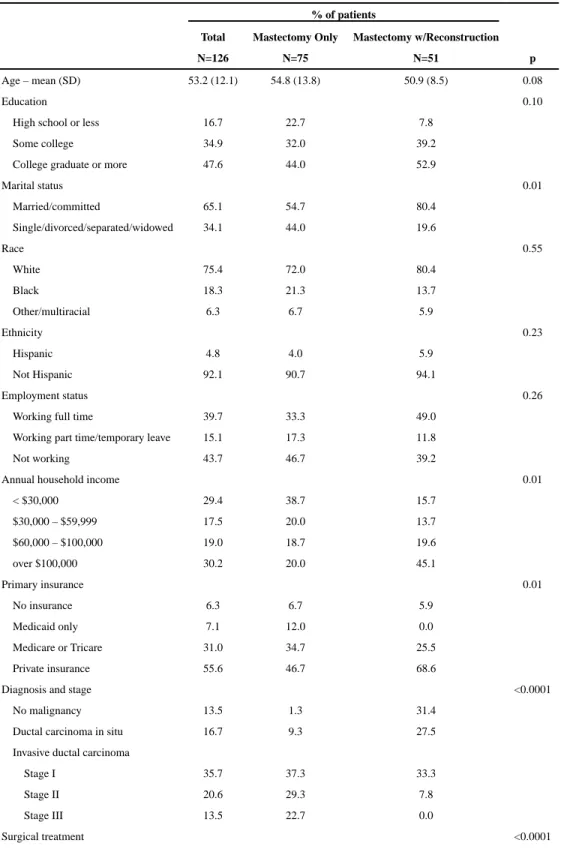
During the study period July 2012 to February 2014, 214 patients were eligible. Of those 214 eligible patients, we approached 182 and missed 32 (5 at the surgeon’s request, 27 who left clinic before we could approach). Of the 182 we approached, 145 enrolled (80% enrollment rate), and 131 completed the survey (72% participation rate) (Figure 1). Five participants became ineligible for various reasons (e.g., had surgery elsewhere, completed the survey after surgery), leaving a final study population of 126 patients (Table 1). The mean age was 53.2 years (SD 12.1), and 24.6% of participants were non-white. About half of the participants were college graduates, most were partnered, nearly half were not working, and half were privately insured. Most had stage 0-II disease, and one third received adjuvant radiation therapy. The immediate reconstruction rate was 40%, consistent with
national norms.1, 3, 7 The 37 eligible patients who declined enrollment were similar to
participants in mean age (53.1 years) and insured status (91.9%), but more of them were non-white (45.9%, p=0.01), and fewer of them had reconstruction (22%, p=0.05). Survey completion date was available for 116 participants. The median time between the first surgical oncology visit and survey completion was 15 days (81 days for patients who completed the survey after neoadjuvant chemotherapy). Forty of the 116 participants saw a plastic surgeon, and 31 out of 40 (78%) completed the survey after seeing the plastic surgeon.
A
uthor Man
uscr
ipt
A
uthor Man
uscr
ipt
A
uthor Man
uscr
ipt
A
uthor Man
uscr
Knowledge
All but five patients (4%) completed at least half of the knowledge questions and had a knowledge score computed. The mean knowledge score was 58.5% (SD 16.2) (Table 2), and 70.2% of participants had a knowledge score of at least 50%. Knowledge was especially low for the question on risk of complications, with only 14.3% of participants answering correctly that the risk of a major complication in the first two years was 16–40%. Nearly all those who answered incorrectly underestimated the risk. Knowledge was also low for the two questions on satisfaction, with only 40.0% of participants answering correctly that women who have reconstruction and women who have mastectomy only are equally satisfied. Knowledge was higher about recovery, number of procedures, recovery after flaps versus implants, and future cancer risk. Overall knowledge and knowledge of specific questions did not differ by whether or not participants had reconstruction. Overall knowledge among participants who completed the survey after a seeing a plastic surgeon (mean 62.0) was higher than overall knowledge among participants who completed the survey before seeing a plastic surgeon (mean 56.8, p = 0.12), but the difference was not statistically significant.
On bivariable analysis, non-white race, less education, lower income, and single relationship status were associated with lower knowledge about breast reconstruction (Table 3). On multivariable analysis, only non-white race was independently associated with lower knowledge (Table 3).
Involvement in decision making
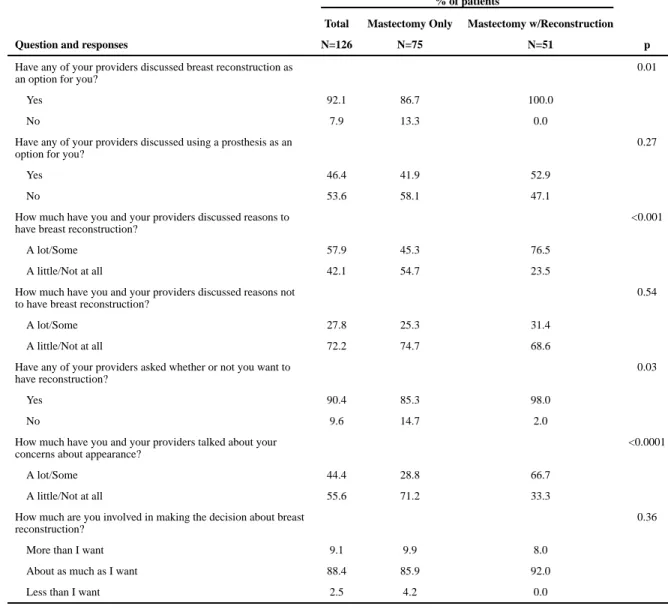
Most patients (92.1%) reported some discussion with a provider about breast reconstruction (Table 4), and most (90.4%) reported that they were asked for their preference about reconstruction. Although many patients reported discussing the advantages of reconstruction some or a lot (57.9%), far fewer reported discussing the disadvantages some or a lot
(27.8%). This difference was even larger for patients who had reconstruction (76.5% advantages versus 31.4% disadvantages).
More of the patients who discussed the disadvantages of reconstruction “a lot” were able to correctly answer the question about complication risk (28.6%), compared to the rest of the study population (13.4%), but this difference was not statistically significant (p=0.26). Non-white patients were less likely to report any discussion of disadvantages (20.7%), compared to white patients (63.2, p<0.0001).
DISCUSSION
In this population of patients undergoing mastectomy for treatment or prevention of breast cancer, decisions about breast reconstruction were only moderately well-informed. Patients answered nearly half of the knowledge questions incorrectly, and knowledge about the risk of complications was particularly low. Minority women, less educated women, and lower-income women had lower knowledge.
Our findings of limited knowledge about breast reconstruction are consistent with prior research on patient knowledge about reconstruction and other breast cancer treatments. In
A
uthor Man
uscr
ipt
A
uthor Man
uscr
ipt
A
uthor Man
uscr
ipt
A
uthor Man
uscr
our prior retrospective study, which also used the Decision Quality Instrument, overall
knowledge about reconstruction 2.5 years after mastectomy was 37.9%.13 Knowledge about
breast cancer surgery (mastectomy versus breast conserving surgery) has also been limited in prior studies, with patients correctly answering about half of questions about the pros and
cons of surgery.14–16 Patients also have incomplete knowledge about systemic therapy, with
frequent overestimation of the survival benefit of chemotherapy.17, 18 Our participants were
more educated than the average population of women undergoing mastectomy for breast cancer, and could all read or speak English. Given the demographics of our study
population, we expect that knowledge about reconstruction in the breast cancer population at large may be even lower than what we found here.
Knowledge about the risk of complications was particularly low at 15%. In our prior
retrospective study, knowledge about complication risk was even lower, at 3%.13 The DQI
question on complication risk was developed using the best available evidence about
long-term complications of reconstruction.13, 19 That evidence has found complication rates in the
range of 20–33%.20–22 Although other studies have reported complication rates in the 5–
15% range, they have been limited to short-term (usually 30-day) complications21, 23, 24 or
have not reported follow-up duration.25 Low knowledge about reconstruction complications
is consistent with prior literature on communication about risk. Patients tend to know less
about the disadvantages than the advantages of treatments,26 and providers’ estimations or
communications of risk can be biased by optimism.27, 28 Some providers have limited
numeracy, which affects how well they communicate to patients about risk.29, 30
Our assessment of knowledge had some limitations. Patients answered knowledge questions about two weeks after the surgical oncology visit, so they may have forgotten some
information that the surgeon had discussed. The measured levels of knowledge, however, do reflect what patients knew around the time that they were undergoing surgery, which we believe is when their knowledge about the procedure is most important. Some patients who saw a plastic surgeon completed the survey before the plastic surgery visit, so they may eventually have had higher knowledge about reconstruction than what the survey measured. We did in fact find that patients who completed the survey after the plastic surgery visit had somewhat higher knowledge than those who completed it before the visit or who never saw a plastic surgeon, but the difference was not statistically significant. Just how much knowledge about reconstruction patients ought to have, if they are not considering reconstruction, is not entirely clear. Surgical oncologists may choose not to discuss the disadvantages of
reconstruction with patients who are not interested in the procedure, and this is reasonable. Interestingly, patients in this sample who were having reconstruction were no more knowledgeable about complications than patients not having reconstruction.
Patients in this sample were more involved in the decision making process than has been reported before. Most patients (92.1%) reported that their provider discussed the option of reconstruction and that their provider asked for their preference about reconstruction (90.4%). In retrospective, multi-site, and population-based studies of breast cancer survivors, a smaller percentage (74–81%) of patients recalled a discussion about reconstruction with
their provider.6, 8, 13, 31 One possible explanation for our finding of higher involvement is
that we asked patients about their decision approximately 2 weeks after the surgical
A
uthor Man
uscr
ipt
A
uthor Man
uscr
ipt
A
uthor Man
uscr
ipt
A
uthor Man
uscr
oncology visit and prior to surgery, whereas most other studies have asked about
involvement months or years later. Thus, patients in our study may have had better recall of their involvement in the consultation than in other studies. Our study was limited by its setting of a single academic institution, and by a population that was more educated and wealthier than the average. Thus findings about involvement may not be generalizable to the breast cancer patient population at large. We expect that involvement in this study may have been higher than the average.
Lower knowledge was associated with non-white race, less education, lower income, and single relationship status, on bivariable analysis. In addition, non-white race was
independently associated with lower knowledge. We are uncertain why this was the case. We attempted to examine potential confounders of the relationship between race and knowledge, such as education, insurance, income, and involvement. Our sample size was somewhat limited, however, and we did not measure some potentially important variables, such as literacy or numeracy. Our sample was also limited to women who could read or speak English, so we cannot comment on the knowledge or decisional involvement of breast cancer patients who do not communicate in English. Such women would be important to future studies, since low-acculturated Latina women and minority women in general are less
likely to have breast reconstruction.7 Finally, we did not directly observe patient involvement
in the decision. In the future, audio recordings of the patient-provider conversation could provide some insight.
How much knowledge a patient must have in order to make an informed choice is not entirely clear. We based our approach to evaluating decisions on a theoretical framework of decision quality which requires that patients understand the advantages and disadvantages of
the options and make a choice consistent with their values.32–35 Our measure of knowledge
was based on that framework36 and included questions about facts that patients and
providers had deemed critical to the decision about reconstruction.19 One conservative
definition of being informed would require correct responses to 50% of knowledge
questions.37 By this definition, 70% of our sample was minimally informed. Different
opinions exist about what constitutes a minimal acceptable level of knowledge, however, and further research on this issue would be useful.
Conclusion
Women undergoing mastectomy in this sample were highly involved in the decision about breast reconstruction, but they had major deficits in knowledge about the procedure. Knowledge about the risk of complications was particularly low. Providers appeared to have discussed the advantages of reconstruction more than its disadvantages.
Acknowledgments
The authors acknowledge Ruth Huh for her assistance with statistical analyses and the patients and surgeons who participated in this study.
Funding:
National Institutes of Health 1K07CA154850-01A1 Cancer Prevention, Control, Behavioral, and Population Sciences Career Development Award (National Cancer Institute); Lineberger Comprehensive Cancer Center
A
uthor Man
uscr
ipt
A
uthor Man
uscr
ipt
A
uthor Man
uscr
ipt
A
uthor Man
uscr
Population Sciences Cancer Research Award; North Carolina Translational and Clinical Sciences Institute Pilot Award
References
1. Morrow M, Li Y, Alderman AK, et al. Access to Breast Reconstruction After Mastectomy and Patient Perspectives on Reconstruction Decision Making. JAMA Surg. 2014
2. Albornoz CR, Bach PB, Mehrara BJ, et al. A paradigm shift in U.S. Breast reconstruction: increasing implant rates. Plast Reconstr Surg. 2013; 131(1):15–23. [PubMed: 23271515] 3. Christian CK, Niland J, Edge SB, et al. A multi-institutional analysis of the socioeconomic
determinants of breast reconstruction: a study of the National Comprehensive Cancer Network. Ann Surg. 2006; 243(2):241–9. [PubMed: 16432358]
4. Tseng JF, Kronowitz SJ, Sun CC, et al. The effect of ethnicity on immediate reconstruction rates after mastectomy for breast cancer. Cancer. 2004; 101(7):1514–23. [PubMed: 15378473] 5. Joslyn SA. Patterns of care for immediate and early delayed breast reconstruction following
mastectomy. Plast Reconstr Surg. 2005; 115(5):1289–96. [PubMed: 15809588]
6. Chen JY, Malin J, Ganz PA, et al. Variation in physician-patient discussion of breast reconstruction. J Gen Intern Med. 2009; 24(1):99–104. [PubMed: 19023629]
7. Alderman AK, Hawley ST, Janz NK, et al. Racial and ethnic disparities in the use of
postmastectomy breast reconstruction: results from a population- based study. J Clin Oncol. 2009; 27(32):5325–30. [PubMed: 19805680]
8. Morrow M, Mujahid M, Lantz PM, et al. Correlates of breast reconstruction: results from a population-based study. Cancer. 2005; 104(11):2340–6. [PubMed: 16216000]
9. Sheehan J, Sherman KA, Lam T, et al. Association of information satisfaction, psychological distress and monitoring coping style with post-decision regret following breast reconstruction. Psychooncology. 2007; 16(4):342–51. [PubMed: 16874745]
10. Lee CN, Dominik R, Levin CA, et al. Development of instruments to measure the quality of breast cancer treatment decisions. Health Expect. 2010; 13(3):258–72. [PubMed: 20550591]
11. Sepucha KR, Belkora JK, Chang Y, et al. Measuring decision quality: psychometric evaluation of a new instrument for breast cancer surgery. BMC Med Inform Decis Mak. 2012; 12:51. [PubMed: 22681763]
12. Lee CN, Wetschler MH, Chang Y, et al. Measuring decision quality: psychometric evaluation of a new instrument for breast cancer chemotherapy. BMC Med Inform Decis Mak. 2014; 14(1):73. [PubMed: 25142035]
13. Lee CN, Belkora J, Chang Y, et al. Are patients making high-quality decisions about breast reconstruction after mastectomy? [outcomes article]. Plast Reconstr Surg. 2011; 127(1):18–26. [PubMed: 21200195]
14. Hawley ST, Griggs JJ, Hamilton AS, et al. Decision involvement and receipt of mastectomy among racially and ethnically diverse breast cancer patients. J Natl Cancer Inst. 2009; 101(19):1337–47. [PubMed: 19720966]
15. Hawley ST, Fagerlin A, Janz NK, et al. Racial/ethnic disparities in knowledge about risks and benefits of breast cancer treatment: does it matter where you go? Health Serv Res. 2008; 43(4): 1366–87. [PubMed: 18384361]
16. Lee CN, Chang Y, Adimorah N, et al. Decision making about surgery for early-stage breast cancer. J Am Coll Surg. 2012; 214(1):1–10. [PubMed: 22056355]
17. Lee CN, Wetschler MH, Chang Y, et al. Measuring decision quality: psychometric evaluation of a new instrument for breast cancer chemotherapy. BMC Med Inform Decis Mak. 2014; 14:73. [PubMed: 25142035]
18. Mandelblatt JS, Sheppard VB, Hurria A, et al. Breast cancer adjuvant chemotherapy decisions in older women: the role of patient preference and interactions with physicians. J Clin Oncol. 2010; 28(19):3146–53. [PubMed: 20516438]
19. Lee CN, D R, Levin CA, Barry MJ, Cosenza C, O’Connor AM, Mulley AG, Sepucha K. Development of instruments to measure the quality of breast cancer treatment decisions. Health Expectations. 2010:29.
A
uthor Man
uscr
ipt
A
uthor Man
uscr
ipt
A
uthor Man
uscr
ipt
A
uthor Man
uscr
20. Alderman AK, Wilkins EG, Kim HM, et al. Complications in postmastectomy breast reconstruction: two-year results of the Michigan Breast Reconstruction Outcome Study. Plast Reconstr Surg. 2002; 109(7):2265–74. [PubMed: 12045548]
21. Cordeiro PG, Albornoz CR, McCormick B, et al. The impact of postmastectomy radiotherapy on two-stage implant breast reconstruction: an analysis of long-term surgical outcomes, aesthetic results, and satisfaction over 13 years. Plast Reconstr Surg. 2014; 134(4):588–95. [PubMed: 25357021]
22. Momoh AO, Ahmed R, Kelley BP, et al. A systematic review of complications of implant-based breast reconstruction with prereconstruction and postreconstruction radiotherapy. Ann Surg Oncol. 2014; 21(1):118–24. [PubMed: 24081801]
23. Fischer JP, Wes AM, Tuggle CT, et al. Risk analysis and stratification of surgical morbidity after immediate breast reconstruction. J Am Coll Surg. 2013; 217(5):780–7. [PubMed: 24074811] 24. Chen CL, Shore AD, Johns R, et al. The impact of obesity on breast surgery complications. Plast
Reconstr Surg. 2011; 128(5):395e–402e. [PubMed: 21788831]
25. Nguyen KT, Hanwright PJ, Smetona JT, et al. Body mass index as a continuous predictor of outcomes after expander-implant breast reconstruction. Ann Plast Surg. 2014; 73(1):19–24. [PubMed: 24918734]
26. Graves KD, Peshkin BN, Halbert CH, et al. Predictors and outcomes of contralateral prophylactic mastectomy among breast cancer survivors. Breast Cancer Res Treat. 2007; 104(3):321–9. [PubMed: 17066320]
27. Christakis NA, Iwashyna TJ. Attitude and self-reported practice regarding prognostication in a national sample of internists. Arch Intern Med. 1998; 158(21):2389–95. [PubMed: 9827791] 28. Dale W, Hemmerich J, Ghini EA, et al. Can induced anxiety from a negative earlier experience
influence vascular surgeons’ statistical decision-making? A randomized field experiment with an abdominal aortic aneurysm analog. J Am Coll Surg. 2006; 203(5):642–52. [PubMed: 17084325] 29. Garcia-Retamero R, Wicki B, Cokely ET, et al. Factors predicting surgeons’ preferred and actual roles in interactions with their patients. Health Psychol. 2014; 33(8):920–8. [PubMed: 24512324] 30. Johnson TV, Abbasi A, Schoenberg ED, et al. Numeracy among trainees: are we preparing
physicians for evidence-based medicine? J Surg Educ. 2014; 71(2):211–5. [PubMed: 24602712] 31. Chen JY, Diamant AL, Thind A, et al. Determinants of breast cancer knowledge among newly
diagnosed, low-income, medically underserved women with breast cancer. Cancer. 2008; 112(5): 1153–61. [PubMed: 18189306]
32. Sepucha K, Mulley AG Jr. A perspective on the patient’s role in treatment decisions. Med Care Res Rev. 2009; 66(1 Suppl):53S–74S. [PubMed: 19001081]
33. Sepucha K, Ozanne E, Silvia K, et al. An approach to measuring the quality of breast cancer decisions. Patient education and counseling. 2007; 65(2):261–9. Epub 2006 Oct 4. [PubMed: 17023138]
34. Elwyn G, O’Connor A, Stacey D, et al. Developing a quality criteria framework for patient decision aids: online international Delphi consensus process. BMJ. 2006; 333(7565):417. [PubMed: 16908462]
35. Mulley A, Sepucha K. Making Good Decisions about Breast Cancer Chemoprevention. Ann Intern Med. 2002; 137(1):52–4. [PubMed: 12093247]
36. Sepucha KR, Fowler FJ Jr, Mulley AG Jr. Policy support for patient-centered care: the need for measurable improvements in decision quality. Health affairs (Project Hope). 2004 Suppl Web Exclusive:VAR54-62.
37. Hersch J, Barratt A, Jansen J, et al. Use of a decision aid including information on overdetection to support informed choice about breast cancer screening: a randomised controlled trial. Lancet. 2015
A
uthor Man
uscr
ipt
A
uthor Man
uscr
ipt
A
uthor Man
uscr
ipt
A
uthor Man
uscr
Figure 1.
Study flow diagram
A
uthor Man
uscr
ipt
A
uthor Man
uscr
ipt
A
uthor Man
uscr
ipt
A
uthor Man
uscr
A
uthor Man
uscr
ipt
A
uthor Man
uscr
ipt
A
uthor Man
uscr
ipt
A
uthor Man
uscr
ipt
Table 1
Demographic and treatment characteristics of study sample.
% of patients
Total Mastectomy Only Mastectomy w/Reconstruction
N=126 N=75 N=51 p
Age – mean (SD) 53.2 (12.1) 54.8 (13.8) 50.9 (8.5) 0.08
Education 0.10
High school or less 16.7 22.7 7.8
Some college 34.9 32.0 39.2
College graduate or more 47.6 44.0 52.9
Marital status 0.01
Married/committed 65.1 54.7 80.4
Single/divorced/separated/widowed 34.1 44.0 19.6
Race 0.55
White 75.4 72.0 80.4
Black 18.3 21.3 13.7
Other/multiracial 6.3 6.7 5.9
Ethnicity 0.23
Hispanic 4.8 4.0 5.9
Not Hispanic 92.1 90.7 94.1
Employment status 0.26
Working full time 39.7 33.3 49.0
Working part time/temporary leave 15.1 17.3 11.8
Not working 43.7 46.7 39.2
Annual household income 0.01
< $30,000 29.4 38.7 15.7
$30,000 – $59,999 17.5 20.0 13.7
$60,000 – $100,000 19.0 18.7 19.6
over $100,000 30.2 20.0 45.1
Primary insurance 0.01
No insurance 6.3 6.7 5.9
Medicaid only 7.1 12.0 0.0
Medicare or Tricare 31.0 34.7 25.5
Private insurance 55.6 46.7 68.6
Diagnosis and stage <0.0001
No malignancy 13.5 1.3 31.4
Ductal carcinoma in situ 16.7 9.3 27.5
Invasive ductal carcinoma
Stage I 35.7 37.3 33.3
Stage II 20.6 29.3 7.8
Stage III 13.5 22.7 0.0
A
uthor Man
uscr
ipt
A
uthor Man
uscr
ipt
A
uthor Man
uscr
ipt
A
uthor Man
uscr
ipt
% of patients
Total Mastectomy Only Mastectomy w/Reconstruction
N=126 N=75 N=51 p
Unilateral mastectomy 55.6 72.0 31.4
Bilateral mastectomy 44.4 28.0 68.6
Adjuvant radiation <0.0001
Yes 31.7 49.3 5.9
No 68.3 50.7 94.1
Adjuvant chemotherapy 0.01
Yes 25.4 33.3 13.7
A
uthor Man
uscr
ipt
A
uthor Man
uscr
ipt
A
uthor Man
uscr
ipt
A
uthor Man
uscr
ipt
Table 2
Knowledge of specific topics about breast reconstruction after mastectomy, by treatment
% of patients
Question and responses* (correct response in bold italics)
Total Mastectomy Only Mastectomy w/Reconstruction
n=126 n=75 n=51 p**
Which women are more satisfied after mastectomy? 0.46
Women who have reconstruction 55.6 50.7 62.7
Women who do not have reconstruction 1.6 2.7 0.0
They are equally satisfied 38.1 41.3 33.3
Which has a longer recovery time? 0.21
Mastectomy without reconstruction 8.7 10.7 5.9
Mastectomy with reconstruction 76.2 72.0 82.4
They have the same recovery time 11.9 12.0 11.8
Which is more likely to require more than one surgery or procedure?
0.03
Mastectomy without reconstruction 15.1 21.3 5.9
Mastectomy with reconstruction 77.8 70.7 88.2
They require the same number 3.2 4.0 2.0
After which reconstruction are women more satisfied with the look and feel?
0.57
Implants 26.2 28.0 23.5
Flap procedures 34.1 32.0 37.3
Both are about the same 33.3 30.7 37.3
Which surgery is easier on the body, heals faster? 0.34
Implants are easier 65.1 61.3 70.6
Flaps are easier 8.7 9.3 7.8
Implants and flaps are equally easy 19.8 20.0 19.6
Out of 100 women who have reconstruction, how many will have a major complication, within 2 years?
0.12
Fewer than 5 36.5 34.7 39.2
5–15 43.7 38.7 51.0
16–40 14.3 18.7 7.8
More than 40 0.8 1.3 0.0
How does radiation affect the number of complications? 0.18
Radiation increases the # of complications 67.5 62.7 74.5
Radiation decreases the # of complications 7.9 9.3 5.9
Radiation does not affect the # of complications 20.6 21.3 19.6
How does reconstruction affect future screening? 0.46
Makes it harder to find cancer 24.6 25.3 23.5
Makes it easier to find cancer 5.6 6.7 3.9
Has little or no effect on finding cancer 61.9 58.7 66.7
How does reconstruction affect chance of cancer coming back? 0.67
A
uthor Man
uscr
ipt
A
uthor Man
uscr
ipt
A
uthor Man
uscr
ipt
A
uthor Man
uscr
ipt
% of patients
Question and responses* (correct response in bold italics)
Total Mastectomy Only Mastectomy w/Reconstruction
n=126 n=75 n=51 p**
Decreases the chance of cancer coming back 15.1 8.0 25.5
Has little or no effect on cancer coming back 75.4 77.3 72.5
Overall knowledge (out of 100) – mean (SD) 58.5 (16.2) 57.9 (16.6) 59.3 (15.8) 0.66
*
Some wording has been shortened to fit this table
**
A
uthor Man
uscr
ipt
A
uthor Man
uscr
ipt
A
uthor Man
uscr
ipt
A
uthor Man
uscr
ipt
Table 3
Bivariable and multivariable (linear regression) analyses of factors associated with knowledge (significant factors in bold)
Bivariable Multivariable Characteristic Mean knowledge score (% correct) p Regression coefficient p
Age 0.83 −0.13 0.97
< 50 years 58.1
>=50 years* 58.8
Race <0.0001 11.97 0.00
White 62.0
Non−white* 46.8
Education 0.06 −2.22 0.60
High school or less 52.1
College or more* 59.6
Annual income 0.01 −4.67 0.22
< $60,000 54.2
>= $60,000* 62.0
Marital Status 0.14 −2.01 0.59
Partnered 60.0
Single/divorced/widowed* 55.3
Diagnosis
No malignancy 59.5 0.89 −2.51 0.62
DCIS 56.1 0.48 −3.11 0.44
Invasive breast cancer* 58.9
Surgical cancer treatment 0.18 −2.99 0.37
Unilateral mastectomy 56.7
Bilateral mastectomy* 60.7
Insurance 0.44 −2.33 0.70
No 54.2
Yes* 58.8
Involvement score (0–4) 0.99 −0.38 0.90
<3 points 58.8
>=3 points 58.8
*
A
uthor Man
uscr
ipt
A
uthor Man
uscr
ipt
A
uthor Man
uscr
ipt
A
uthor Man
uscr
ipt
Table 4
Involvement in decision making
% of patients
Total Mastectomy Only Mastectomy w/Reconstruction
Question and responses N=126 N=75 N=51 p
Have any of your providers discussed breast reconstruction as an option for you?
0.01
Yes 92.1 86.7 100.0
No 7.9 13.3 0.0
Have any of your providers discussed using a prosthesis as an option for you?
0.27
Yes 46.4 41.9 52.9
No 53.6 58.1 47.1
How much have you and your providers discussed reasons to have breast reconstruction?
<0.001
A lot/Some 57.9 45.3 76.5
A little/Not at all 42.1 54.7 23.5
How much have you and your providers discussed reasons not to have breast reconstruction?
0.54
A lot/Some 27.8 25.3 31.4
A little/Not at all 72.2 74.7 68.6
Have any of your providers asked whether or not you want to have reconstruction?
0.03
Yes 90.4 85.3 98.0
No 9.6 14.7 2.0
How much have you and your providers talked about your concerns about appearance?
<0.0001
A lot/Some 44.4 28.8 66.7
A little/Not at all 55.6 71.2 33.3
How much are you involved in making the decision about breast reconstruction?
0.36
More than I want 9.1 9.9 8.0
About as much as I want 88.4 85.9 92.0
Less than I want 2.5 4.2 0.0
*
Some questions have been reworded to fit this table.
**